
Life, 1911-06-29 · page 12 of 45
Life — June 29, 1911 — page 12: what you’re looking at
What you’re looking at
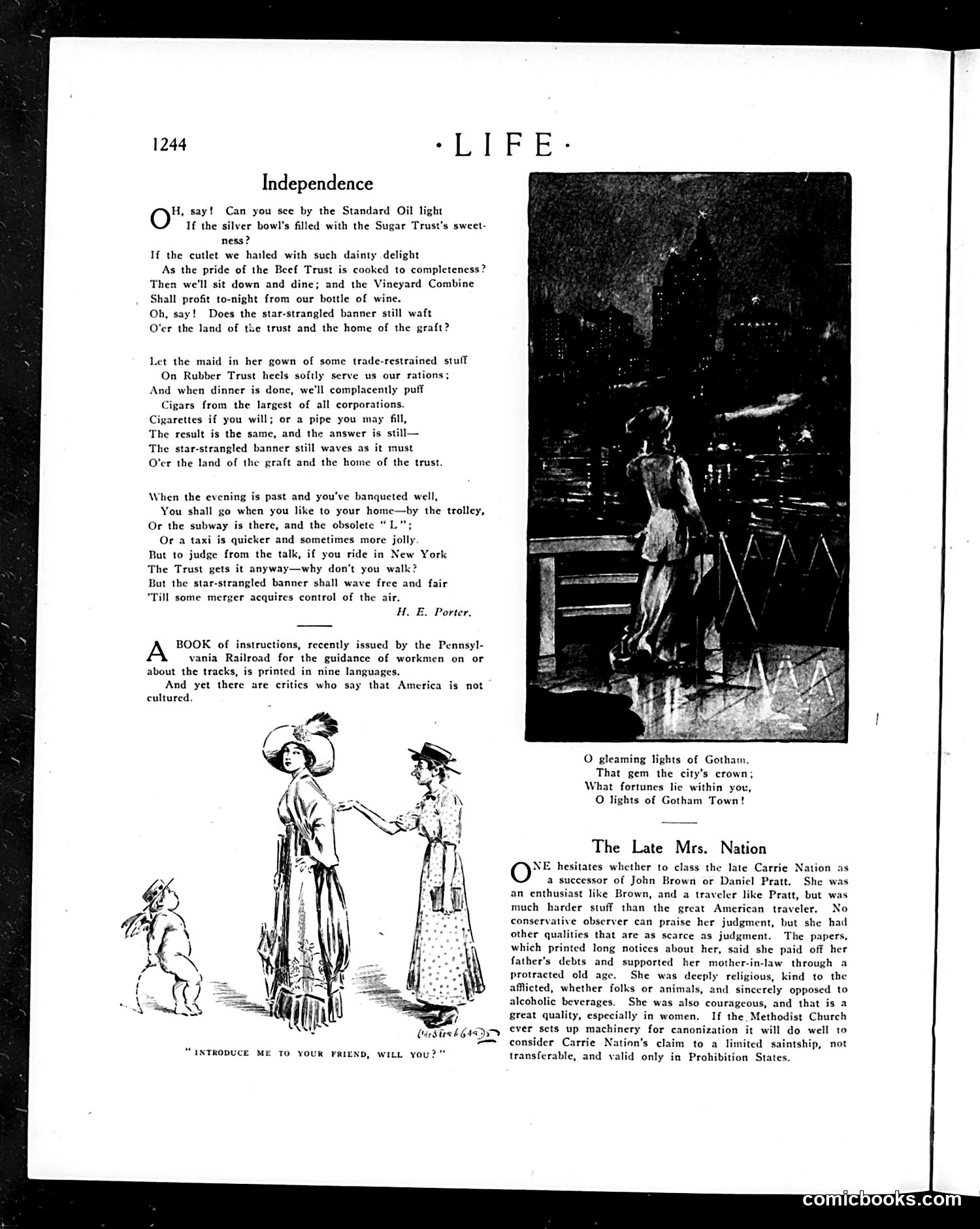
This page contains satirical poetry and commentary critiquing American corporate monopolies and wealth inequality circa the early 1900s. **"Independence" poem** (attributed to H.E. Porter): Sarcastically celebrates living under corporate "Trusts"—monopolistic businesses controlling sugar, beef, and railroads. The speaker ironically claims independence while remaining entirely dependent on these corporations for food, transportation, and even leisure (cigars, wine). The repeated refrain about the "star-strangled banner" mocks patriotic language made hollow by corporate domination. **Lower section**: Criticizes America as culturally uncultured while praising a Pennsylvania Railroad instruction manual printed in nine languages—implying America serves immigrant laborers better than native citizens. The illustration shows two women greeting, captioned "Introduce me to your friend, will you?" — likely social commentary, though the specific reference is unclear.
📄 Transcribed text from this page (OCR, searchable)
Machine-transcribed from the original scan — historical spelling and the odd misread are preserved.
Independence H, say! Can you see by the Standard Oil light If the silver bowl’s filled with the Sugar Trust's sweet- ness? If the cutlet we hailed with such dainty delight As the pride of the Beef Trust is cooked to completeness? Then we'll sit down and dine; and the Vineyard Combine Shall profit to-night from our bottle of wine. Oh, say! Does the star-strangled banner still waft O'er the land of the trust and the home of the graft? Let the maid in her gown of some trade-restrained stulf On Rubber Trust heels softly serve us our rations; And when dinner is done, we'll complacently puff Cigars from the largest of all corporations. Cigarettes if you will; or a pipe you may fill, The result is the same, and the answer is still— The star-strangled banner still waves as it must O'cr the land of the graft and the home of the trust. When the evening is past and you've banqueted well, You shall go when you like to your home—by the trolley, Or the subway is there, and the obsolete “ L" Or a taxi is quicker and sometimes more jolly But to judge from the talk, if you ride in New York The Trust gets it anyway—why don’t you walk? But the star-strangled banner shall wave free and fair "Till some merger acquires control of the air. H. E. Porter. BOOK of instructions, recently issued by the Pennsyl- vania Railroad for the guidance of workmen on or about the tracks, is printed in nine languages. And yet there are critics who say that America is not cultured. O gleaming lights of Gotham, That gem the cit What fortunes lie within you, O lights of Gotham Town! The Late Mrs. Nation NE hesitates whether to class the late Carrie Nation as a successor of John Brown or Danicl Pratt. She was an enthusiast like Brown, and a traveler like Pratt, but was much harder stuff than the great American traveler. No conservative observer can praise her judgment, but she had other qualities that are as scarce as judgment. The papers, which printed long notices about her, said she paid off her father’s debts and supported her mother-in-law through a protracted old age. She was deeply religious, kind to the afflicted, whether folks or animals, and sincerely opposed to alcoholic beverages. She was also courageous, and that is a great quality, especially in women. If the, Methodist Church ever scts up machinery for canonization it will do well to consider Carrie Nation’s claim to a limited saintship, not “INTRODUCE ME TO YOUR FRIEND, Witt you?” transferable, and valid only in Prohibition States Stee kG AE cm