
Life, 1911-06-29 · page 38 of 45
Life — June 29, 1911 — page 38: what you’re looking at
What you’re looking at
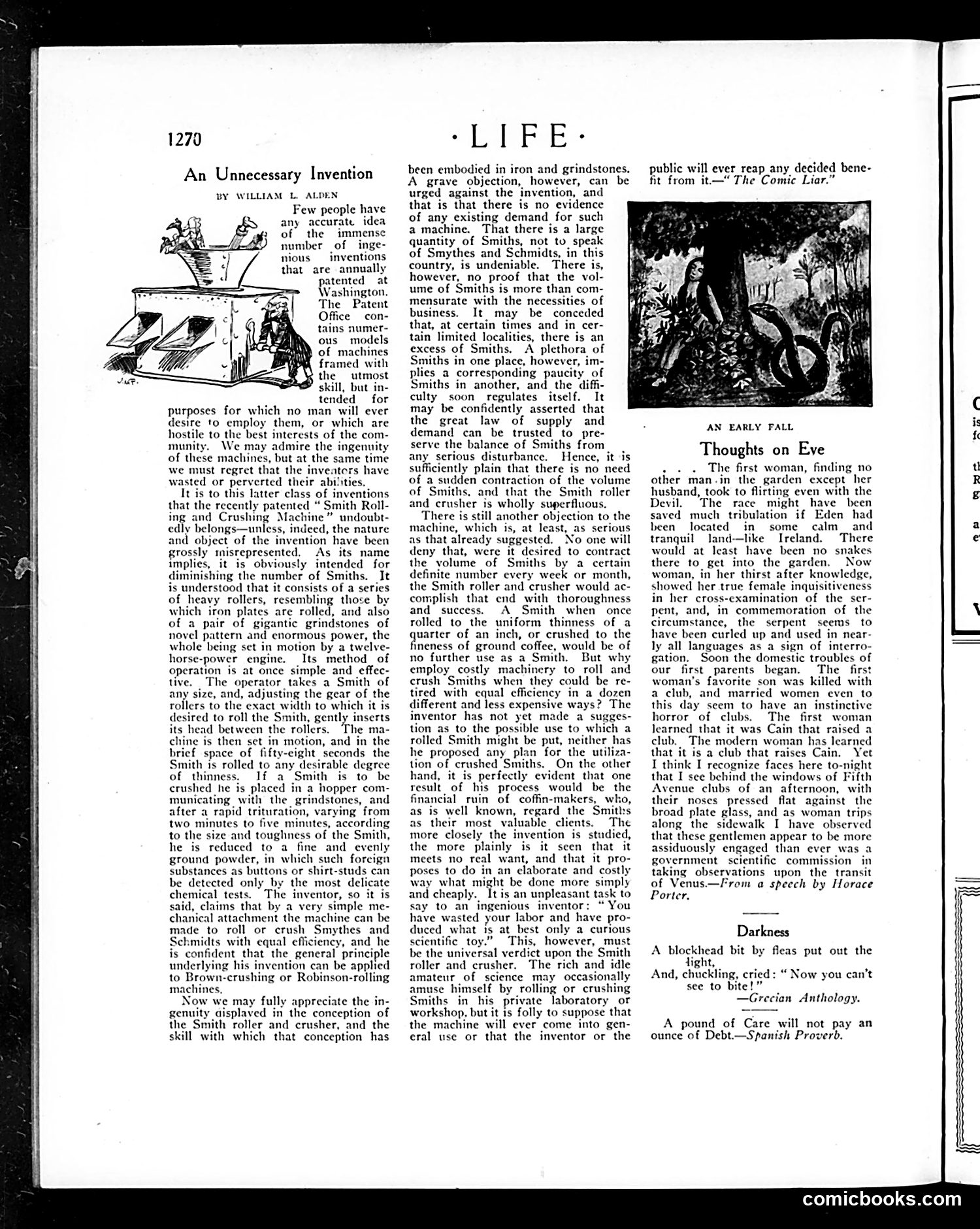
This is a humorous satire by William L. Alden mocking both frivolous patent applications and surname-based prejudice. The elaborate illustration depicts an absurd contraption—a "Smith Rolling and Crushing Machine"—designed to literally flatten or grind up people with the surname Smith (and similar names like Smythe, Schmidt). The joke operates on multiple levels: it ridicules the Patent Office for approving impractical inventions, while simultaneously lampooning ethnic or class-based discrimination disguised as economic concern. The author argues (tongue-in-cheek) that there's no actual "demand" to eliminate Smiths, and that natural market forces regulate their population adequately. The satire targets contemporary attitudes about immigration and foreign surnames, suggesting that prejudice against certain ethnic groups—identifiable by names—was being justified through pseudo-rational arguments about labor surplus. By presenting Smith-elimination as absurd, Alden implicitly critiques the discrimination underlying such reasoning. The piece exemplifies *Life* magazine's satirical style: exaggerated mechanical drawings paired with deadpan logical arguments to expose social prejudices.
📄 Transcribed text from this page (OCR, searchable)
Machine-transcribed from the original scan — historical spelling and the odd misread are preserved.
1270 An U nnecessary Invention BY WILLIAM L. ALDEN Few people have any accurate idea of the immense number of _inge- nious —_ inventions that are annually patented at Washington. The Patent Office con- tains numer- ous models of machines framed with the utmost skill, but in- tended for purposes for which no man will ever desire to employ them, or which are hostile to the best interests of the com- munity. We may admire the ingenuity of these machines, but at the same time we must regret that the inveaters have wasted or perverted their abiltie: It is to this latter class of inventions that the recently patented “ Smith Roll- ing and Crushing Machine” undoubt- edly belongs—untless, indeed, the nature and object of the invention have been grossly misrepresented. As its name implies, it is obviously intended for diminishing the number of Smiths. It understood that it consists of a series of heavy rollers, resembling those by which iron plates are rolled, and also of a pair of gigantic grindstones of novel pattern and enormous power, the whole being set in motion by a twelve- horse-power engine. Its method. of operation is at once simple and effec- tive. The operator takes a Smith of any size, and, adjusting the gear of the rollers to the exact width to which it is desired to roll the Smith, gently inserts its head between the rollers, The ma- chine is then set_in motion, and in the brief space of fifty-eight ‘seconds the Smith is rolled to any desirable degree of thinnes: If a Smith is to be crushed he is placed in a hopper com- municating with the grindstones, and after a rapid trituration, varying from two minutes to five minutes, according to the size and toughness of the Smith, he is reduced to a fine and evenly ground powder, in which such foreign substances as buttons or shirt-studs can be detected only by the most delicate chemical tests. The inventor, so it is said, claims that by a very simple me- chanical attachment the machine can be made to roll or crush Smythes and Schmidts with equal efficiency, and he is confident that the general principle underlying his invention can be applied to Brown-crushing or Robinson-rolling machines. Now we may fully appreciate the in- genuity aisplaved in the conception of the Smith roller and crusher, and the skill with which that conception has EAB been embodied in iron and grindstones. A grave objection, however, can be urged against the invention, and that is that there is no evidence of any existing demand for such a machine. That there is a large quantity of Smiths, not to speak of Smythes and Schmidts, in this country, is undeniable. There is, however, no proof that the vol- ume of Smiths is more than com- mensurate with the necessities of business. It may be conceded that, at certain times and in cer- tain limited localities, there is an excess of Smiths, A plethora of Smiths in one place, however, im- plies a corresponding city of Smiths another, and the diffi- culty soon regulates itself. It may be confidently asserted that the great law of supply and demand can be trusted to pre- serve the balance of Smiths from any serious disturbance. Hence, it is sufficiently plain that there is no need of a sudden contraction of the volume of Smiths, and that the Smith roller and crusher is wholly superfluous. There is still another objection to the machine, which is, at least, as serious as that already suggested. No one will deny that, were it desired to contract the volume of Smiths by a certain definite number every week or month, the Smith roller and crusher would ac- complish that end with thoroughness and success. A Smith when once rolled to the uniform thinness of quarter of an inch, or crushed to the fineness of ground coffee, would be of no further use as a Smith. But why employ costly machinery to roll and crush Smiths when they could be re- tired with equal efficiency in a dozen different and less expensive ways? The inventor has not yet made a sugges- tion as to the possible use to which a rolled Smith might be put, neither has he proposed any plan for the utiliza- tion of crushed Smiths. On the other hand, it is perfectly evident that one result of his process would be the financial ruin of coffin-makers, who, as is well known, regard the Smiths as their most valuable, clients, The more closely the invention is studied, the more plainly is it seen that it meets no real want, and that it pro- poses to do in an elaborate and costly way what might be done more simply and cheaply. It is an unpleasant task to say to an ingenious inventor: “ You have wasted your labor and have pro- duced what is at best only a curious scientific toy. however, must be the universal verdict upon the Smith roller and crusher, The rich and idle amateur of science may occasionally amuse himself by rolling or crushing Smiths in his private laboratory or workshop, but it 1s folly to suppose that the machine will ever come into gen- eral use or that the inventor or the public will ever reap any decided bene- fit from it—“ The Comic Liar.” AN EARLY FALL Thoughts on Eve + + « The first woman, finding no other man.in the garden except her husband, took to flirting even with the Devil. ‘The race might have been saved much tribulation if Eden had been located in some calm_ and tranquil Jand—like Ireland. There would at least have been no snakes there to get into the garden. Now woman, in her thirst after knowledge, showed her true female inquisitiveness in her cross-examination of the ser- pent, and, in commemoration of the circumstance, the serpent seems to have been curled up and used in near- ly all languages as a sign of interro- gation. Soon the domestic troubles of our first parents began. The first woman's favorite son was killed with a club, and married women even to this day seem to have an instinctive horror of clubs. The first woman learned that it was Cain that raised a club. The modern woman has learned that it is a club that raises Cain. Yet I think I recognize faces here to-night that I see behind the windows of Fifth enue clubs of an afternoon, with their noses pressed flat against the broad plate glass, and as woman trips along the sidewalk I have observed that these gentlemen appear to be more assiduously engaged than ever wa government scientific commission in taking observations upon the transit of Venus.—From a speech by Horace Porter, Darkness A blockhead bit by fleas put out the dight, And, chuckling, cried: “ Now you can’t see to bite!” —Grecian Anthology. A pound of Care will not pay an ounce of Debt—Spanish Proverb. comicbooks.com