
Life, 1911-06-29 · page 8 of 45
Life — June 29, 1911 — page 8: what you’re looking at
What you’re looking at
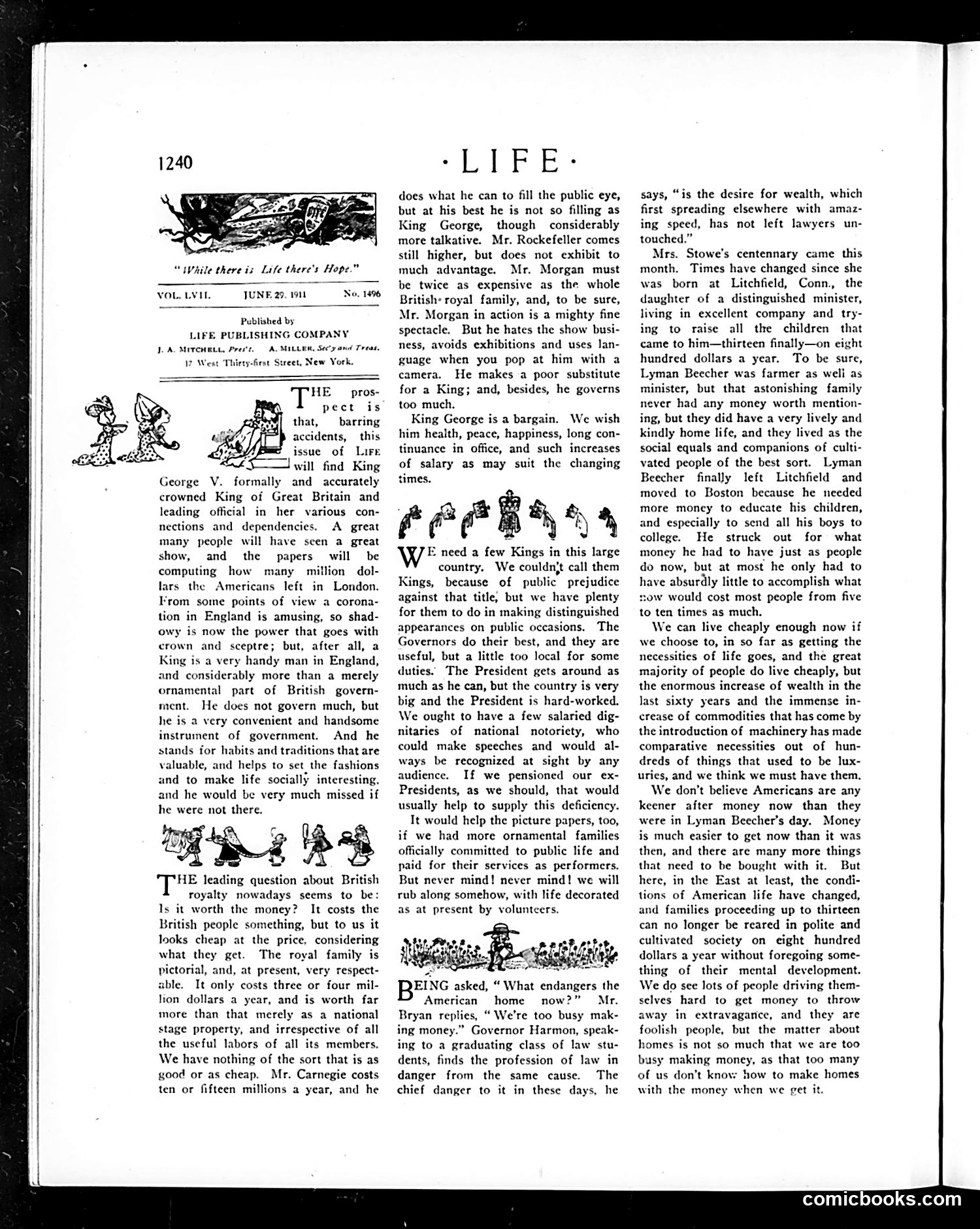
This *Life* magazine page (June 27, 1911) contains editorial commentary critiquing British royalty and American attitudes toward wealth and social status. The text discusses **King George V**, noting he costs the British public "three or four million dollars a year" yet provides minimal practical benefit—merely a "stage property." The author argues Americans shouldn't romanticize monarchy when the same wealth could improve lives directly. The piece also contrasts this with references to **wealthy Americans** (likely **Carnegie** and **Rockefeller**, mentioned by name), questioning whether their vast fortunes serve society better than royal pageantry. The satirical point: both British royalty and American industrial magnates consume enormous resources while contributing little tangible value—a critique of hereditary privilege and concentrated wealth.
📄 Transcribed text from this page (OCR, searchable)
Machine-transcribed from the original scan — historical spelling and the odd misread are preserved.
“While there iz Life there's Hope.” VOL. LIL. JUNE 29, 1911 Published by LIFE PUBLISHING COMPANY AO MILLER, Step and Treas, No. 1496 JA. MUTOH ELL, Pres 17 West Thirty-first Street, New York. THe pros- pect is that, barring accidents, this issue of Lire DLS will find King George V. formally and accurately crowned King of Great Britain and leading official in her various con- nections and dependencies. A great many people will have scen a great show, and the papers will be many million dol- Americans left in London. From some points of view a corona- tion in England is amusing, so shad- owy is now the power that goes with crown and sceptre; but, after all, a King is a very handy man in England, and considerably more than a merely ornamental part of British govern- ment. He does not govern much, but he is a very convenient and handsome instrument of government. And he stands for habits and traditions that are valuable, and helps to set the fashions and to make life socially interesting, and he would be very much missed if he were not there. ‘et AS ii Fast leading question about British royalty nowadays seems to be: 1s it worth the mone: It costs the British people something, but to us it looks cheap at the price, considering what they get. The royal family is torial, and, at present, very respect- able. It only costs three or four mil- lion dollars a year, and is worth far more than that merely as a national stage property, and irrespective of all the useful labors of all its members. We have nothing of the sort that is as good or as cheap. Mr. Carnegie costs ten or fifteen millions a year, and he computing how lars the *LIPE: does what he can to fill the public eye, but at his best he is not so filling as King George, though considerably more talkative. Mr. Rockefeller comes still higher, but does not exhibit to much advantage. Mr. Morgan must be twice as expensive as the whole Britishe royal family, and, to be sure, Mr. Morgan in action is a mighty fine spectacle. But he hates the show busi ness, avoids exhibitions and uses lan- guage when you pop at him with a camera. He makes a poor substitute for a King; and, besides, he governs too much, King George is a bargain. We wish him health, peace, happiness, long con- tinuance in office, and such increases of salary as may suit the changing times. PPABAS4 W* need a few Kings in this large country. We couldn't call them Kings, because of public prejudice against that title, but we have plenty for them to do in making distinguished appearances on public occasions. The Governors do their best, and they are useful, but a little too local for some duties. The President gets around as much as he can, but the country is very big and the President is hard-worked. We ought to have a few salaried dig- nitaries of national notoriety, who could make speeches and would al- ways be recognized at sight by any audience. If we pensioned our ex- Presidents, as we should, that would usually help to supply this deficiency. It would help the picture papers, too, if we had more ornamental families officially committed to public life and paid for their services as performers. But never mind! never mind! we will rub along somehow, with life decorated as at present by volunteers. EING asked, “ What endangers the American home now?” Mr. Bryan replies, “We're too busy mak- ing money.” Governor Harmon, speak- ing to a graduating class of law stu- dents, finds the profession of law in danger from the same cause. The chief danger to it in these days, he says, “is the desire for wealth, which first spreading elsewhere with amaz- ing speed, has not left lawyers un- touched.” Mrs. Stowe’s centennary came this month. Times have changed since she was born at Litchfield, Conn., the daughter of a distinguished minister, living in excellent company and try- ing to raise all the children that came to him—thirteen finally—on eight hundred dollars a year. To be sure, Lyman Beecher was farmer as weli as minister, but that astonishing family never had any money worth mention- ing, but they did have a very lively and kindly home life, and they lived as the social equals and companions of culti- vated people of the best sort. Lyman Beecher finally left Litchfield and moved to Boston because he needed more moncy to educate his children, and especially to send all his boys to college. He struck out for what money he had to have just as people do now, but at most he only had to have absurdly little to accomplish what now would cost most people from five to ten times as much. We can live cheaply enough now if we choose to, in so far as getting the necessities of life goes, and the great majority of people do live cheaply, but the enormous increase of wealth in the last sixty years and the immense in- crease of commodities that has come by the introduction of machinery has made comparative necessities out of hun- dreds of things that used to be lux- uries, and we think we must have them, We don’t believe Americans are any keener after money now than they were in Lyman Beecher’s day. Money is much easier to get now than it was then, and there are many more things that need to be bought with it. But here, in the East at least, the condi- tions of American life have changed, and families proceeding up to thirteen can no longer be reared in polite and cultivated society on eight hundred dollars a year without foregoing some- thing of their mental development. We do see lots of people driving them- selves hard to get money to throw away in extravagance, and they are foolish people, but the matter about homes is not so much that we are too busy making money, as that too many of us don’t know how to make homes with the money when we get it. comicbooks.com