
Life, 1911-06-29 · page 20 of 45
Life — June 29, 1911 — page 20: what you’re looking at
What you’re looking at
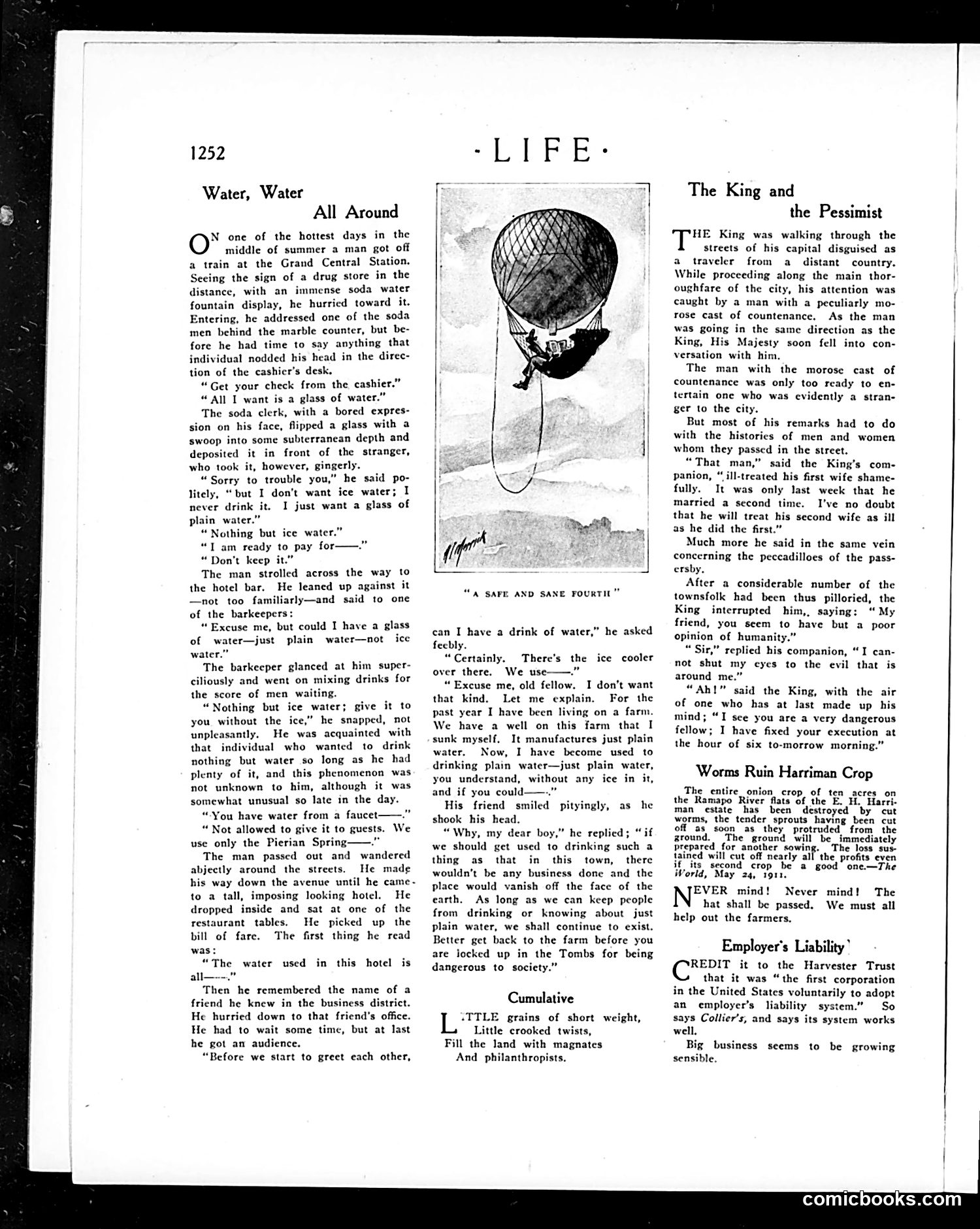
This cartoon satirizes early 1900s American commercialism and the marketing of unnecessary luxuries. A traveler seeking plain water encounters absurd resistance across New York City—a soda fountain clerk, a hotel barkeeper, and finally a businessman friend all insist only on serving ice water or proprietary "spring water." The joke mocks how businesses had convinced the public that plain tap water was beneath them, and how commerce had colonized even basic human needs. The traveler's farm background (representing simpler values) contrasts with the city's manufactured desires. The final threat about being "locked up in the Tombs for being dangerous to society" sardonically suggests that rejecting commercial products threatens the entire urban economic system. The smaller poem "Cumulative" at bottom satirizes how minor dishonest practices ("short weight," "crooked twists") accumulate to create wealthy industrialists and philanthropists—questioning the moral foundations of the era's robber barons.
📄 Transcribed text from this page (OCR, searchable)
Machine-transcribed from the original scan — historical spelling and the odd misread are preserved.
1252 All Around Water, Water one of the hottest days in the N O middle of summer a man got off a train at the Grand Central Station. Seeing the sign of a drug store in the distance, with an immense soda water fountain display, he hurricd toward it. Entering, he addressed one of the soda men behind the marble counter, but be- fore he had time to say anything that individual nodded his head in the direc- tion of the cashicr’s desk. “Get your check from the cashier.” “ All I want is a glass of water.” The soda clerk, with a bored expres- sion on his face, flipped a glass with a swoop into some subterranean depth and deposited it in front of the stranger, who took it, however, gingerly. “Sorry to trouble you,” he said po- litely, “but I don't want ice water; I never drink it. I just want a glass of plain water.” “Nothing but ice water.” “Tam ready to pay for—. “Don't keep it.” The man strolled across the way to the hotel bar. He leaned up against it —not too familiarly—and said to one of the barkeepers: “Excuse me, but could I have a glass of water—just plain water—not ice water.” The barkeeper glanced at him super- ciliously and went on mixing drinks for the score of men waiting. “Nothing but ice water; give it to you without the ice,” he snapped, not unpleasantly. He was acquainted with that individual who wanted to drink nothing but water so long as he had plenty of it, and this phenomenon was not unknown to him, although it was somewhat unusual so late in the day. “You have water from a faucet - Not allowed to give it to guests. We use only the Pierian Spring: The man passed out and wandered abjectly around the streets. He madg his way down the avenue until he came- to a tall, imposing looking hotel. He dropped inside and sat at one of the restaurant tables. He picked up the bill of fare. The first thing he read was: “The water used in all— Then he remembered the name of a friend he knew in the business district. He hurried down to that friend's office. He had to wait some time, but at last he got an audience. “Before we start to greet each other, this hotel is “A SAPE AND SANE FOURTIC” can I have a drink of water,” he asked fecbly. “Certainly. There's the ice cooler over there. We use—.” “Excuse me, old fellow. I don’t want that kind. Let me explain. For the past year I have been living on a farm. We have a well on this farm that I sunk myself, It manufactures just plain water, Now, I have become used to drinking plain water—just plain water, you understand, without any ice in it, and if you could——..” His friend smiled pityingly, as he shook his head. “Why, my dear boy,” he replied; “if we should get used to drinking such a thing as that in this town, there wouldn’t be any business done and the place would vanish off the face of the earth. As long as we can keep pcople from drinking or knowing about just plain water, we shall continue to exist. Better get back to the farm before you are jocked up in the Tombs for being dangerous to society.” Cumulative TTLE grains of short weight, Little crooked twists, Fill the land with magnates And philanthropists. The King and the Pessimist HE King was walking through the streets of his capital disguised as a traveler from a distant country. While proceeding along the main thor- oughfare of the city, his attention was caught by a man h a peculiarly mo- rose cast of countenance, As the man was going in the same direction as the King, His Majesty soon fell into con- versation with him, The man with the morose cast of countenance was only too ready to en- tertain one who was evidently a stran- ger to the city. But most of his remarks had to do with the histories of men and women whom they passed in the street. “That man,” said the King’s com- panion, “ ill-treated his first wife shame- fully. It was only last week that he married a second time. I’ve no doubt that he will treat his second wife as ill as he did the first. Much more he said in the same vein concerning the peccadilloes of the pass- ersby, After a considerable number of the townsfolk had been thus pilloried, the King interrupted him,, saying: “ My friend, you seem to have but a poor opinion of humanity.” “ Sir,” replied his companion, “I can- not shut my cyes to the evil that is around me.” “Ab!” said the King, with the air of one who has at last made up his mind; “I see you are a very dangerous fellow; I have fixed your execution at the hour of six to-morrow morning.” Worms Ruin Harriman Crop The entire onion crop of ten acres on the Ramapo River flats of the E. H. Harri- man estate has been destroyed by cut worms, the tender sprouts having been cut off as soon as they protruded. from the ground. The ground will be immediately Prepared for another sowing. The loss sus- tained will cut off nearly all the profits even if, its second crop be a good’ one—The World, May 24, 1911. EVER mind! Never mind! The hat shall be passed. We must all help out the farmers, Employer's Liability’ REDIT it to the Harvester Trust that it was “the first corporation in the United States voluntarily to adopt an employer’s liability system.” So says Collier's, and says its system works well. Big business seems sensible. to be growing comicbooks.com