
A complete issue · 44 pages · 1911
Life — June 22, 1911
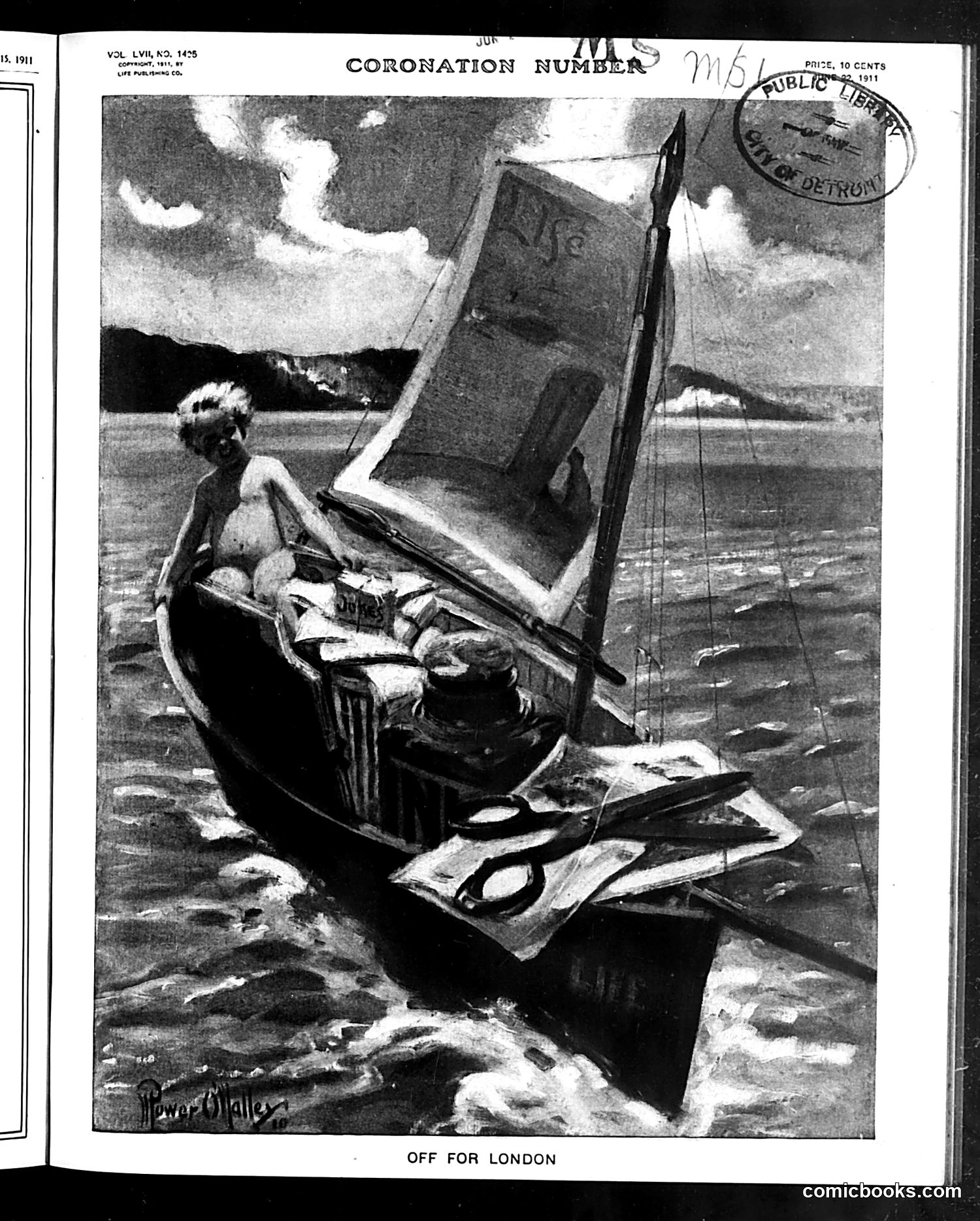
This illustration depicts a figure in a small boat laden with luggage and supplies, apparently departing for London. The caption "Off for London" combined with the magazine's identification as a "Coronation Number" suggests this relates to King George V's coronation in 1911. The satirical point appears to be commentary on the mass migration of Americans traveling to London for the coronation festivities—a major international event. The overloaded boat humorously represents the elaborate preparations and excessive baggage Americans brought for this journey, mocking either American tourism habits or the spectacle-seeking behavior surrounding the royal event. The figure's bulky appearance emphasizes the comic exaggeration typical of Life magazine's satirical style.
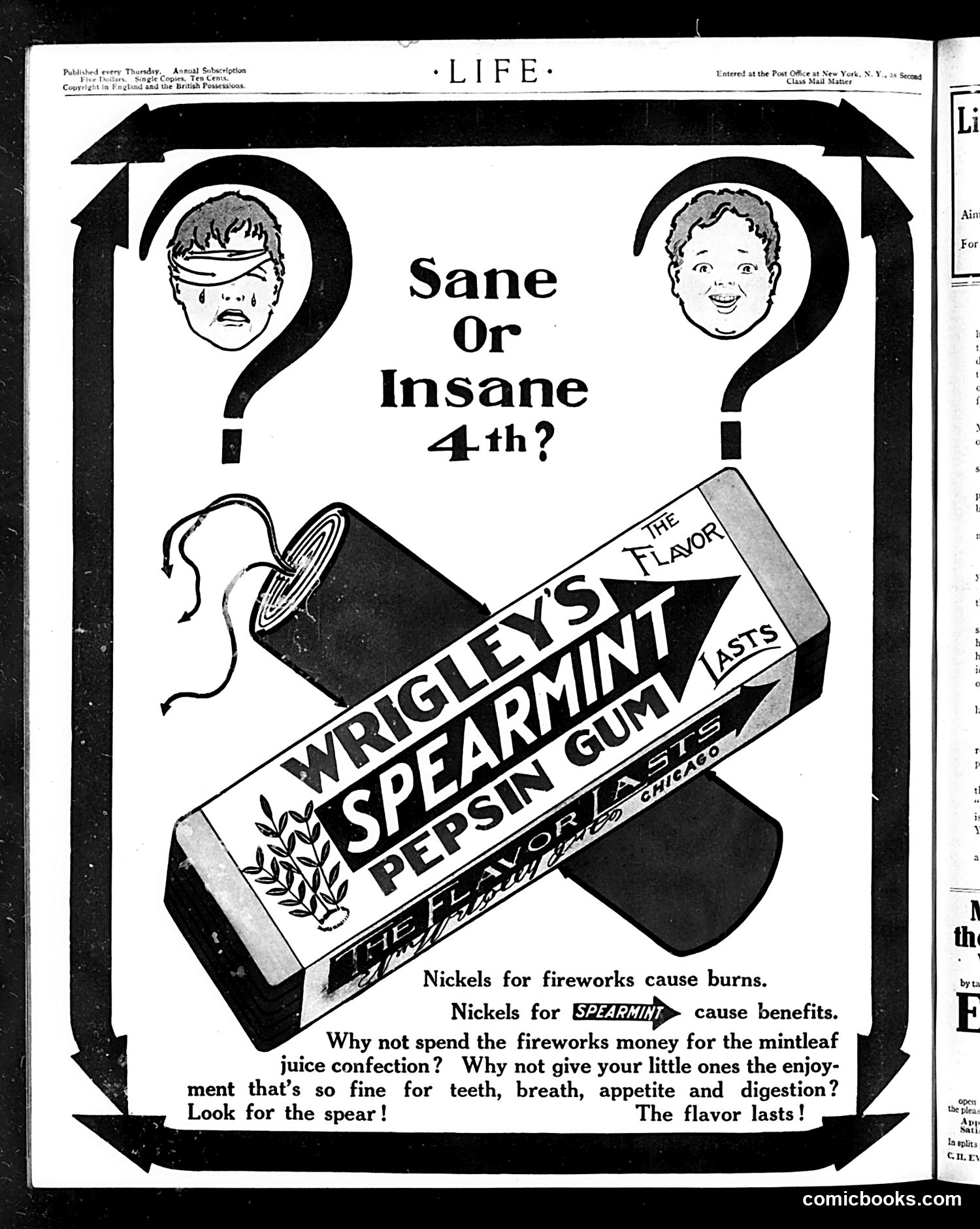
This is a **Wrigley's Spearmint gum advertisement** disguised as satirical editorial content in Life magazine. The headline "Sane or Insane 4th?" presents two contrasting faces—one angry/distressed, one cheerful—referencing Fourth of July celebrations. The accompanying text criticizes spending money on fireworks, which "cause burns," while promoting gum as an alternative gift for children. The satire is the advertisement's framing: it pretends to be social commentary criticizing fireworks safety while actually being product placement. The claim that gum provides "benefits" for "teeth, breath, appetite and digestion" was typical early 20th-century advertising hyperbole. This reflects the era when gum manufacturers aggressively marketed their products with health claims now considered dubious or false.
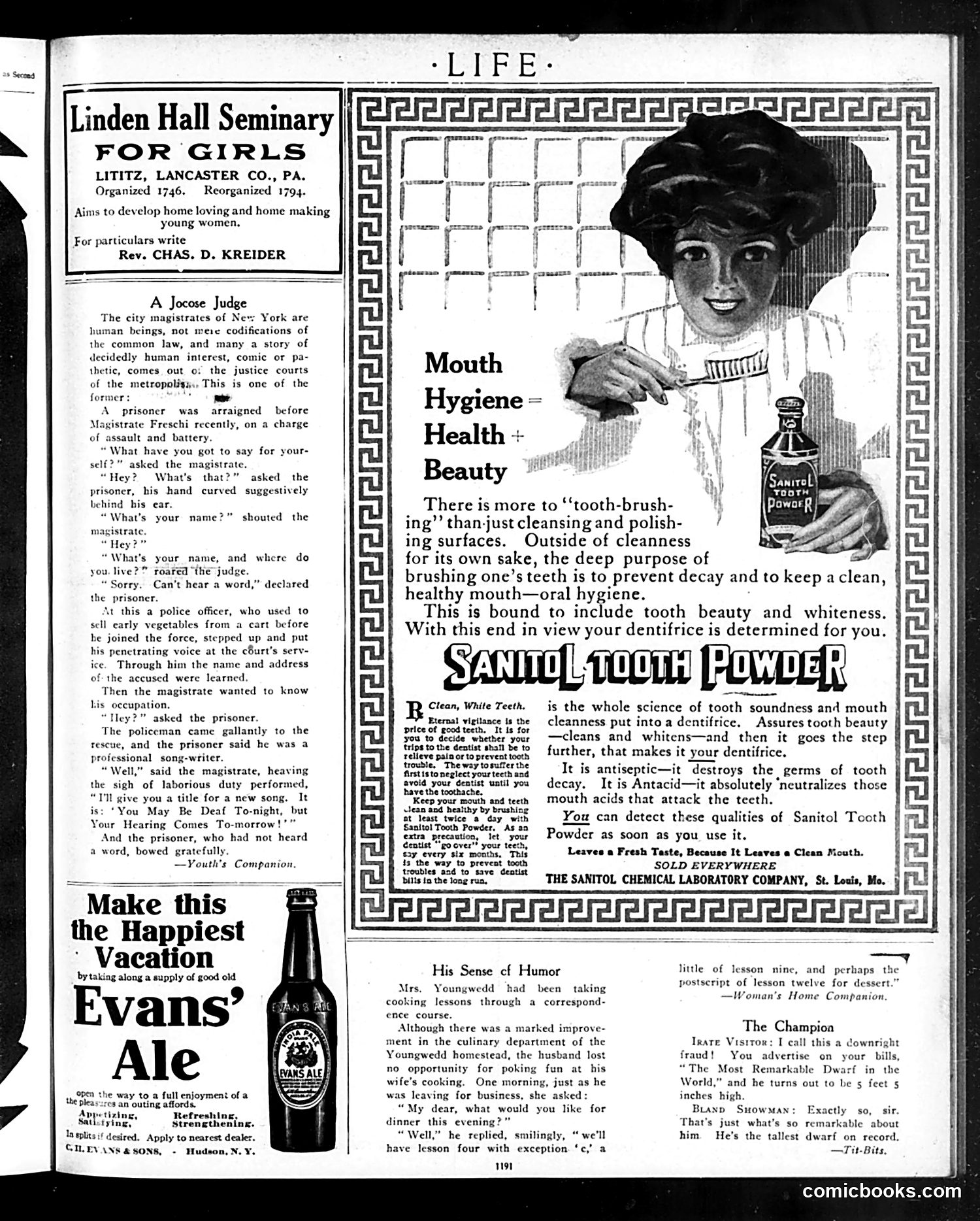
This page is primarily **advertising and advice content** rather than political satire. The main features are: 1. **Linden Hall Seminary advertisement** (top left): a girls' school emphasizing domestic skills 2. **Sanitol Tooth Powder ad** (center): the dominant feature, promoting oral hygiene with a woman demonstrating the product 3. **Evans' Ale advertisement** (bottom left): a beer brand 4. **"His Sense of Humor"** (bottom right): a brief humorous anecdote about a wife asking her husband what he wants for dinner The Sanitol ad reflects early 20th-century advertising's emphasis on cleanliness and "scientific" dental care. The humor piece is domestic comedy—typical light fare. There is **no political cartoon or satire** on this page; it represents standard commercial magazine content of the era.
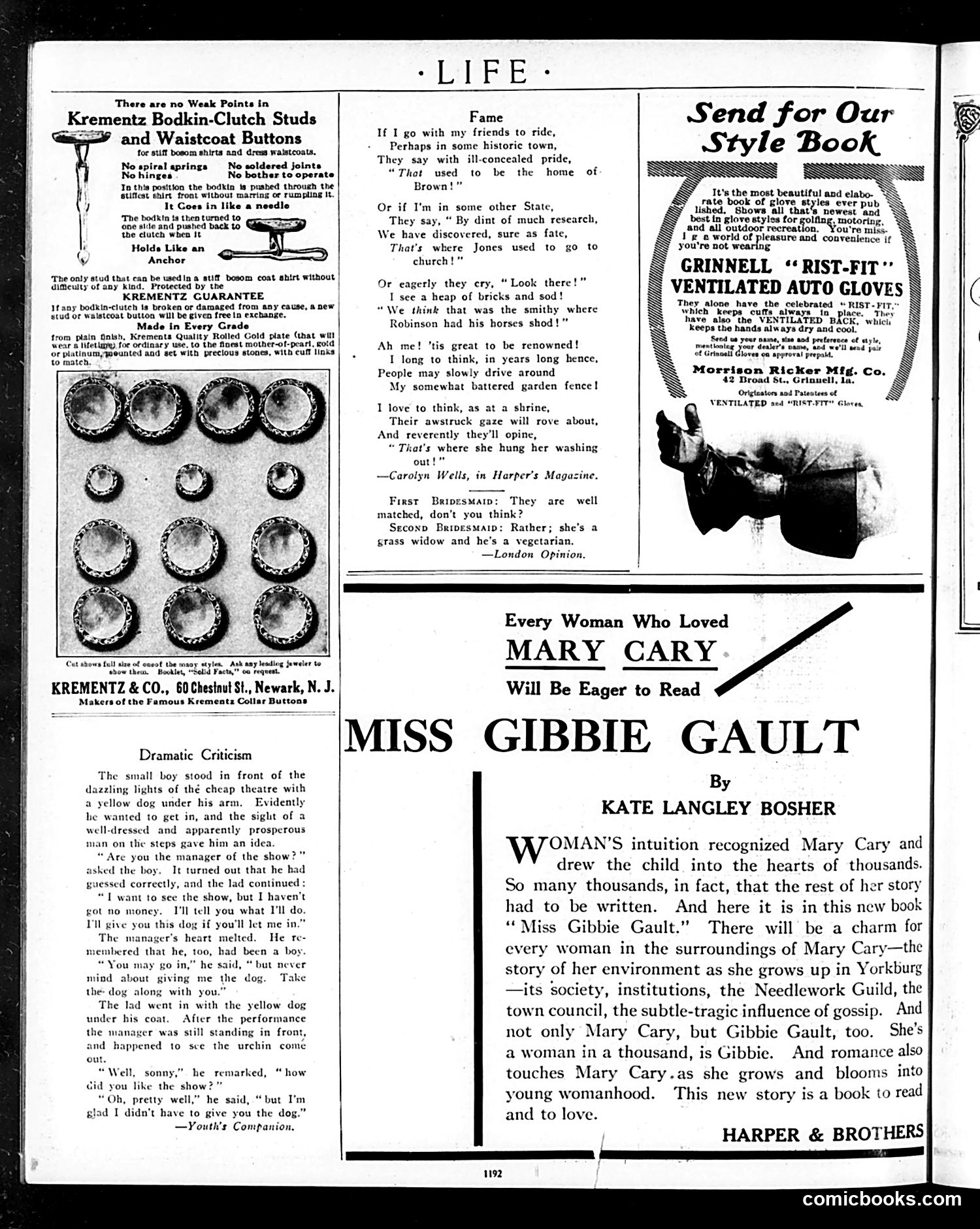
This page is primarily **advertising and literary promotion** rather than political satire. The main content advertises Krementz clothing fasteners (buttons and studs) on the left, and promotes two books on the right: a style guide for "Grinnel Fit-Fit" ventilated auto gloves, and a novel called *Miss Gibbie Gault* by Kate Langley Bosher. The center contains a brief poem about fame and locating historically significant places, followed by a humorous anecdote titled "Dramatic Criticism" about a poor boy attempting to sneak into a theater with a dog. There are no political cartoons or identifiable caricatures. The "satire" is limited to gentle social humor—the boy's encounter with the theater manager and his creative negotiation. This appears to be a standard magazine page mixing advertisements with light entertainment content.
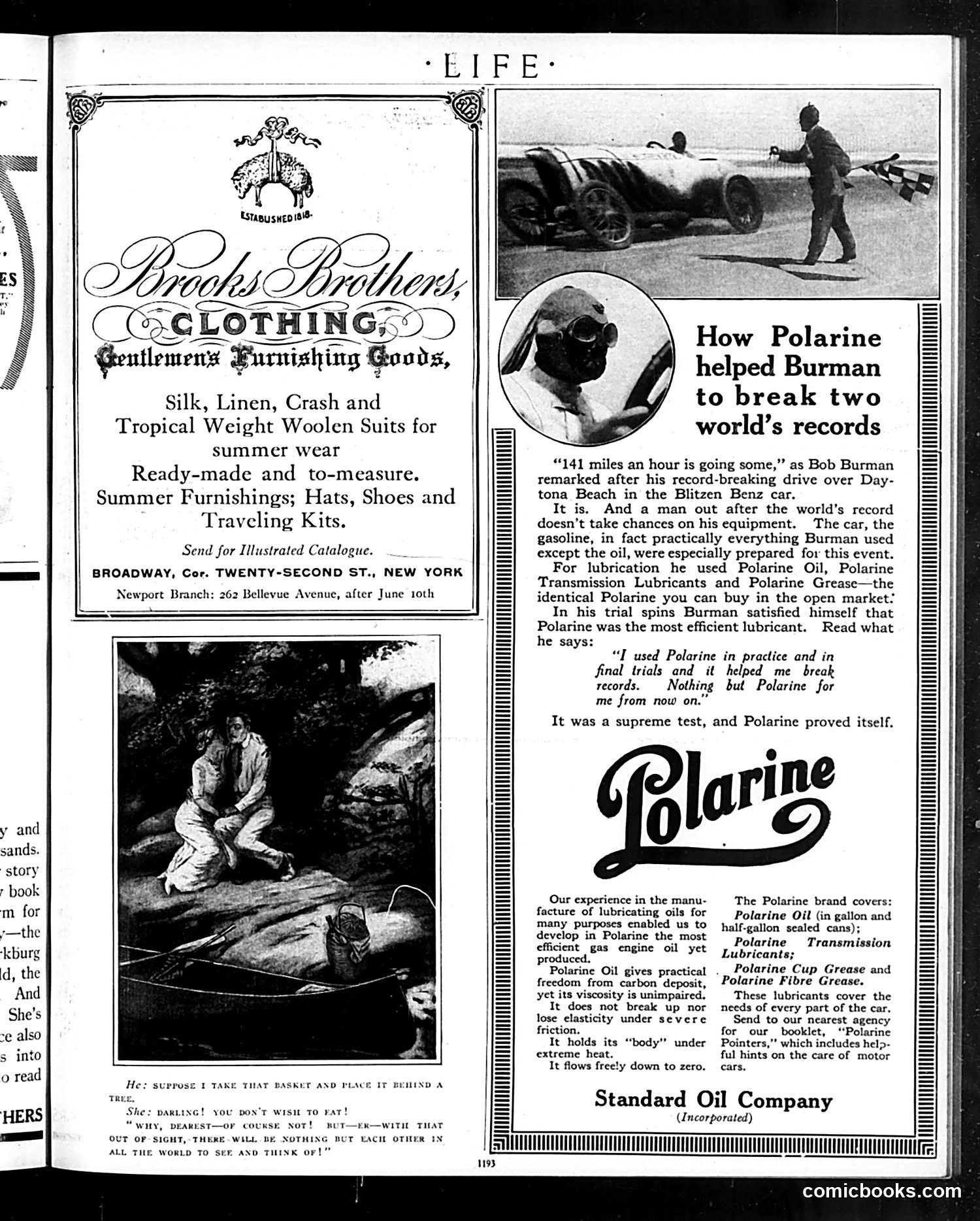
This page is primarily **advertising**, not satirical content. The left side features a Brooks Brothers clothing advertisement for gentlemen's suits. Below that is an illustration captioned with dialogue about placing a basket behind a tree—this appears to be a humorous domestic scene rather than political satire. The right side advertises **Polarine motor oil** through Standard Oil Company, featuring photographs of Bob Burman and his race car. The ad claims Polarine lubricants helped Burman break world speed records (141 mph mentioned). Burman himself provides a testimonial endorsing the product. The page represents typical early-20th-century *Life* magazine content: a mix of consumer advertisements and light humor, not political or social commentary requiring historical context to understand.
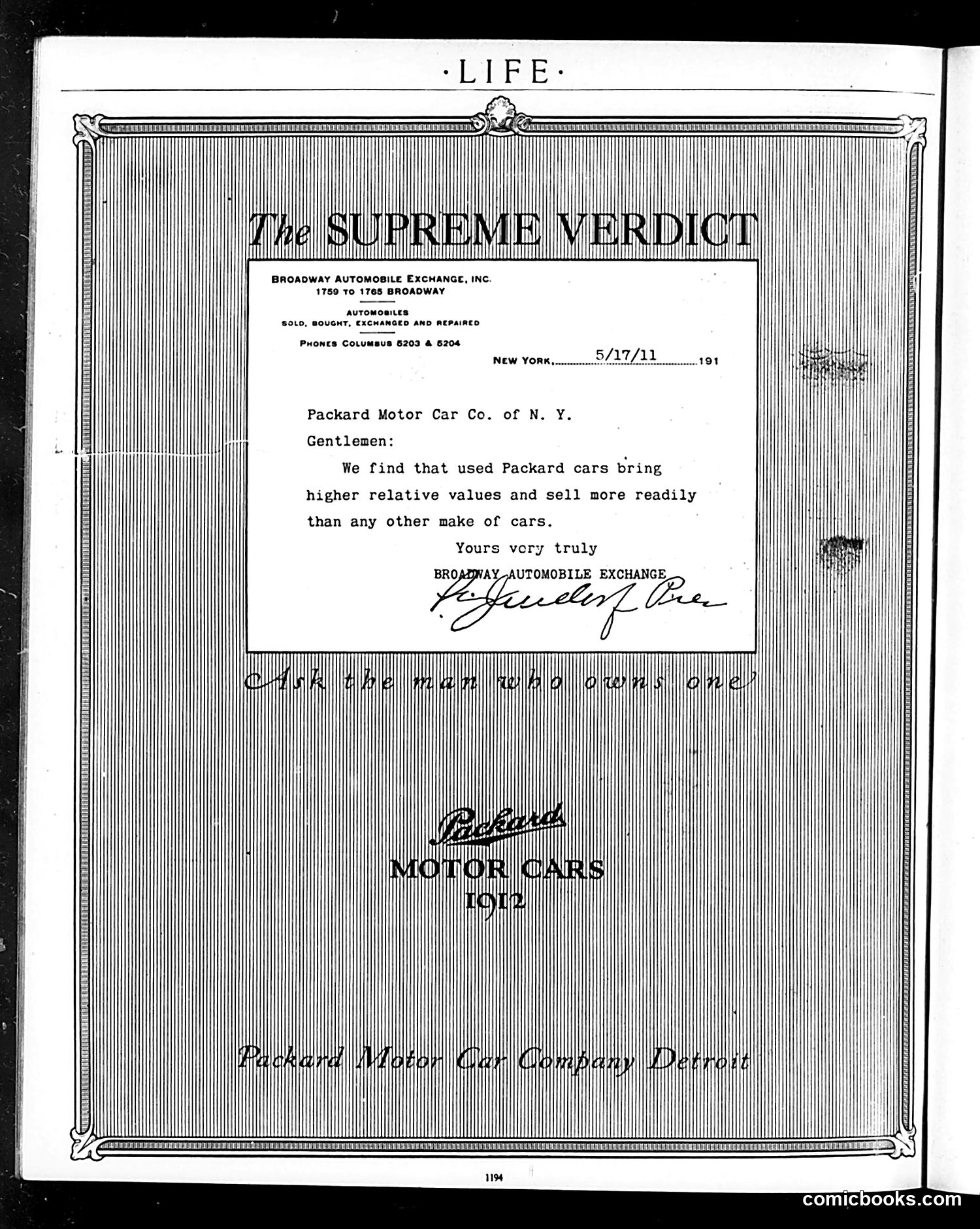
This page is primarily **advertising**, not satire or editorial content. It features a testimonial letter from Broadway Automobile Exchange (located at 1769-1703 Broadway, New York, dated 5/17/11) addressed to Packard Motor Car Company in Detroit. The letter states: "We find that used Packard cars bring higher relative values and sell more readily than any other make of cars." Below this is an advertisement for Packard Motor Cars from 1912. **The "Supreme Verdict" headline** frames the endorsement as authoritative judgment—using the language of legal verdicts to suggest that even used-car dealers prefer Packard vehicles, implying superior quality and resale value. This is a straightforward commercial advertisement using testimonial marketing, not political or social satire.
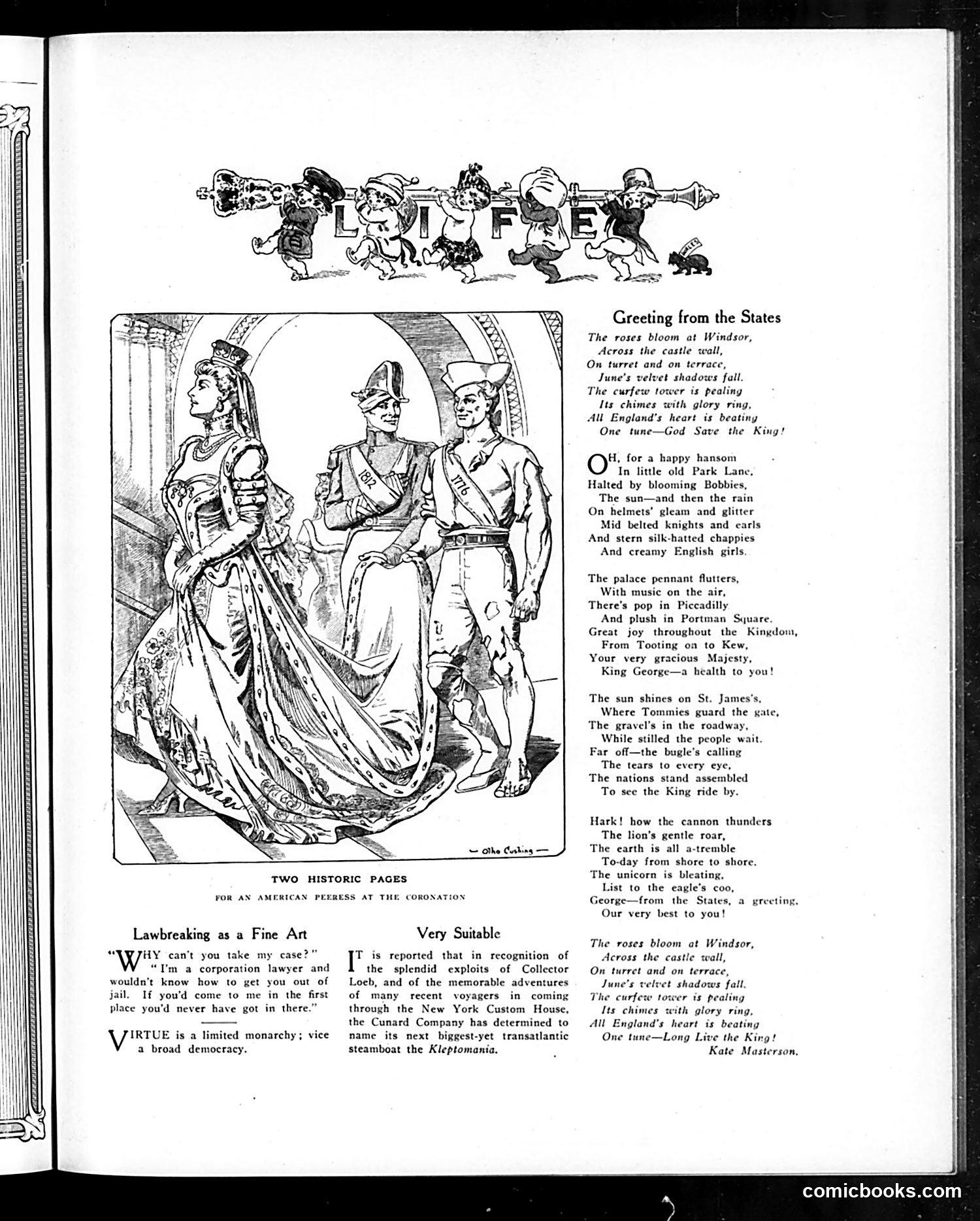
This Life magazine page commemorates a British royal coronation, likely King George V's (referenced in the poem "Greeting from the States"). The large illustration shows three figures in elaborate medieval/ceremonial dress labeled "TWO HISTORIC PAGES FOR AN AMERICAN PEERAGE AT THE CORONATION." The satirical poem mocks Americans' obsession with British royalty and pageantry—describing crowds, jingoism, and martial display. The humor targets American fascination with aristocratic ceremony despite the nation's democratic founding. Below, "Lawbreaking as a Fine Art" appears to be a separate brief satirical piece about legal troubles, while "Very Suitable" comments on a transatlantic steamship naming, likely mocking American deference to British cultural prestige. The overall tone satirizes American Anglophilia and class consciousness.
This page from *Life* magazine contains editorial commentary on President William Howard Taft's physical fitness and work habits. The text praises Taft for maintaining good health through moderate exercise—walking, golfing, and simple diet—while managing a demanding schedule. The piece suggests Taft is "the only Republican nowadays" with a genuine chance at re-election, contrasting him favorably with rival Theodore Roosevelt. The small illustrated vignettes appear to depict polo and athletic activities, supporting the article's theme about physical vigor in leadership. The commentary reflects contemporary anxieties about presidential fitness and the emerging 1912 election contest between the sitting president Taft and his predecessor Roosevelt.
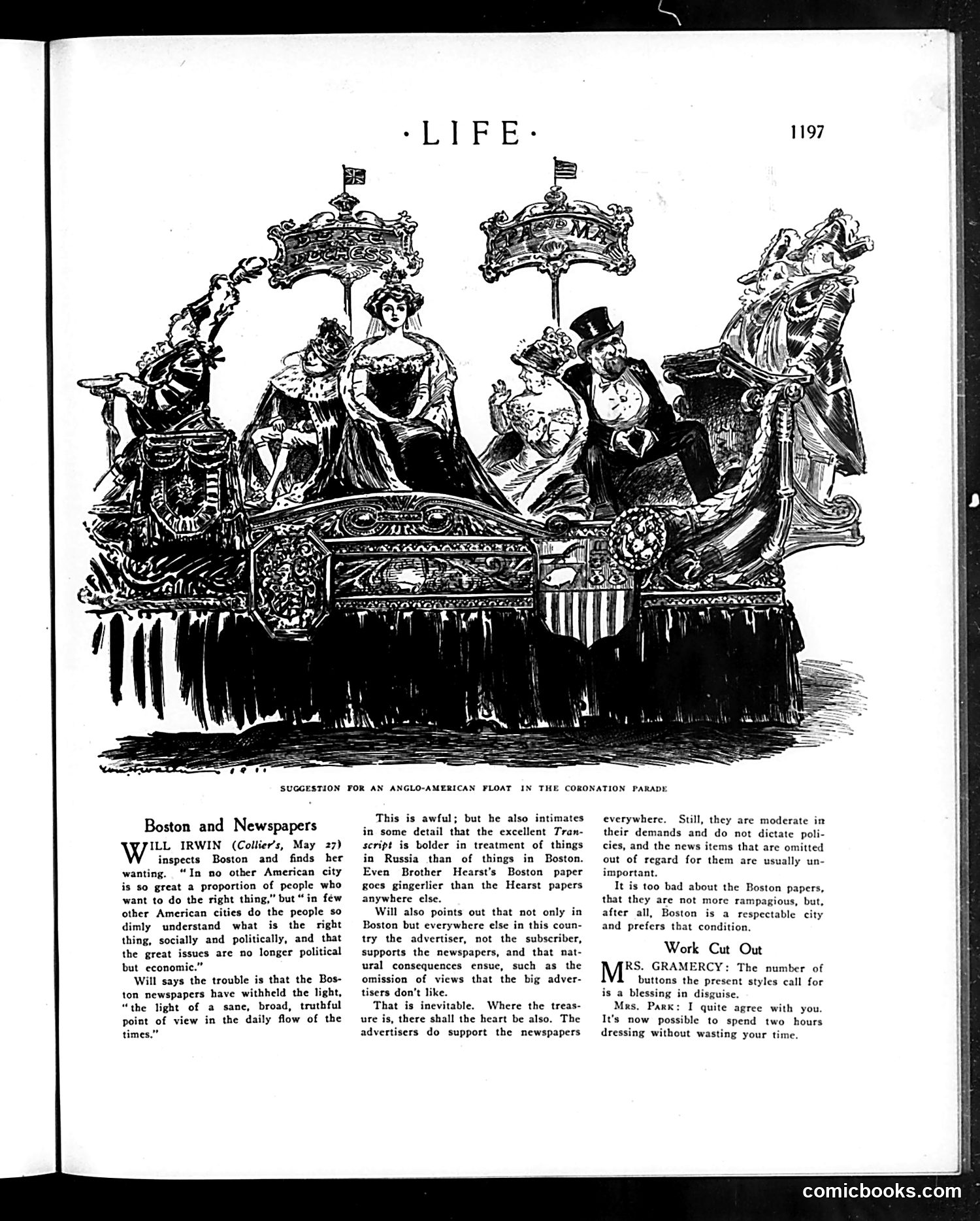
The main illustration is titled "SUGGESTION FOR AN ANGLO-AMERICAN FLOAT IN THE CORONATION PARADE." It depicts an ornate royal float carrying elaborately dressed figures under two crowns, representing Britain and America in harmonious unity—likely a commentary on Anglo-American relations during the early 20th century. Below, the text discusses Boston newspapers, with Will Irwin (Collier's, May 27) criticizing Boston papers for lacking the breadth and truthfulness of other American newspapers. He argues Boston advertisers, not readers, control editorial content, making papers parochial rather than politically independent. The adjacent short piece "Work Cut Out" by Mrs. Gramercy mocks the impracticality of fashionable dress styles requiring excessive preparation time.
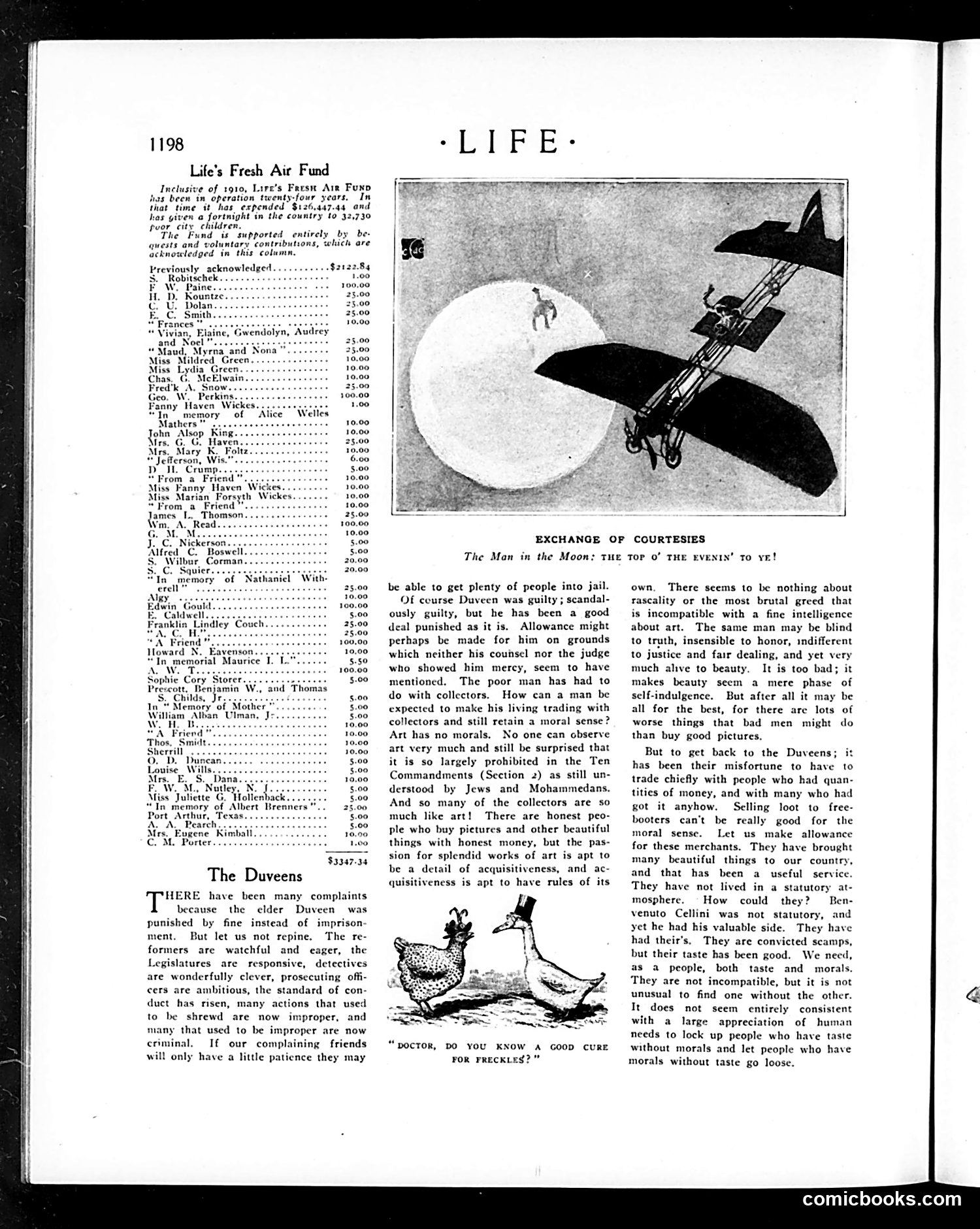
This page critiques **the Duveen art-dealing family**, prominent 20th-century art merchants accused of unethical practices. The text accuses them of: - **Manipulating collectors** through imposing their taste rather than letting buyers choose freely - **Moral compromise**: selling valuable artworks while claiming artistic integrity - **Hypocrisy**: prohibiting art under moral grounds (referencing religious prohibitions) while profiting from art sales The accompanying cartoon shows a doctor and chicken in conversation about curing "freckles"—a visual metaphor for the Duveens' practice of "fixing" or repackaging artworks for profit, removing original character to suit wealthy buyers. The satire argues that art merchants, despite wealth and sophistication, lack genuine morality and good taste without honest dealing.
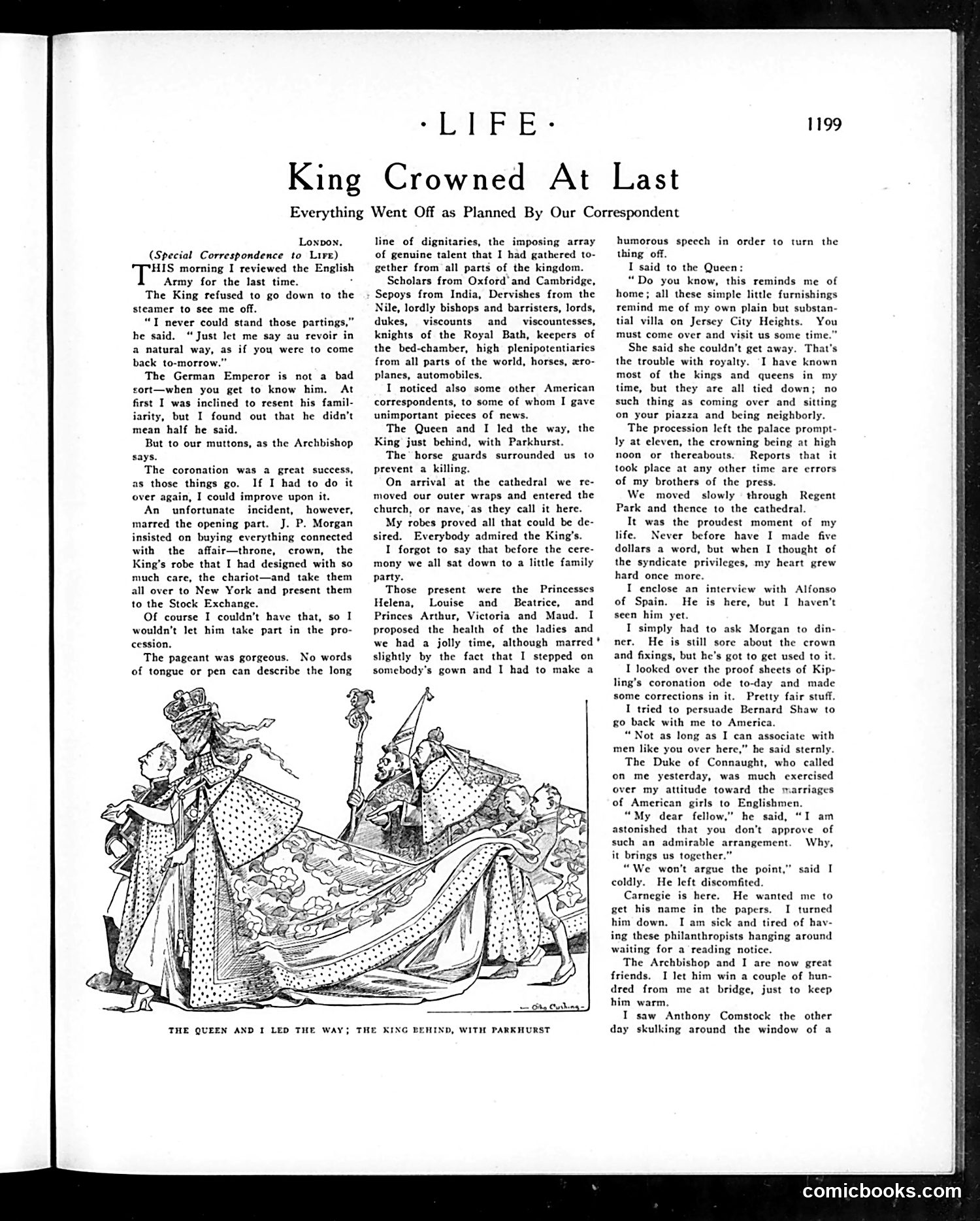
This is a satirical account of an English coronation ceremony, presented as a correspondent's report to *Life* magazine. The illustration depicts the royal procession with the Queen leading and the King following behind with Parkhurst (likely a reference to an English notable or politician of the era). The satire centers on the correspondent's observations about the ceremony's pageantry and the various attendees—princesses, bishops, lords, and dignitaries. The humor appears to derive from the correspondent's bemused, detailed descriptions of the elaborate proceedings and his asides about associated personalities and controversies. Without the specific coronation date visible, the exact historical context is unclear, but this represents *Life*'s characteristic mockery of ceremonial pomp and aristocratic pretension.
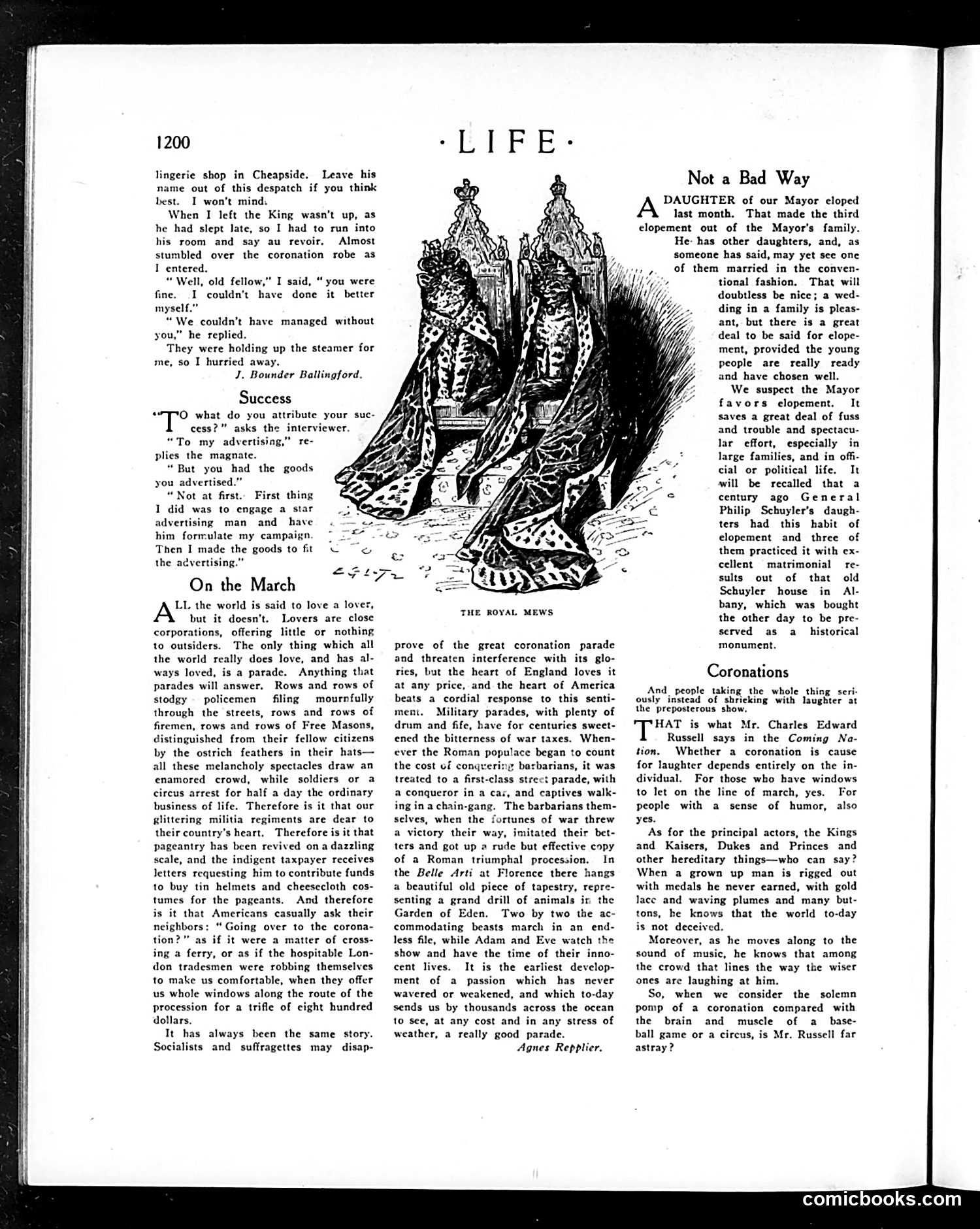
The central illustration shows ornate royal coronation robes and regalia. The accompanying text discusses coronations generally and references a specific historical example: General Philip Schuyler's daughters from Albany, who practiced elopement as a matrimonial strategy a century prior. The articles "On the March" and "Coronations" appear to use coronation pageantry as metaphors for social spectacle and human behavior. The "On the March" piece suggests that parades and ceremonial processions, while entertaining, represent humanity's enduring love of theatrical display—comparing public spectacle to circus entertainment. The overall tone is satirical, treating grand ceremonial occasions with gentle mockery while commenting on society's perennial fascination with pomp and pageantry.
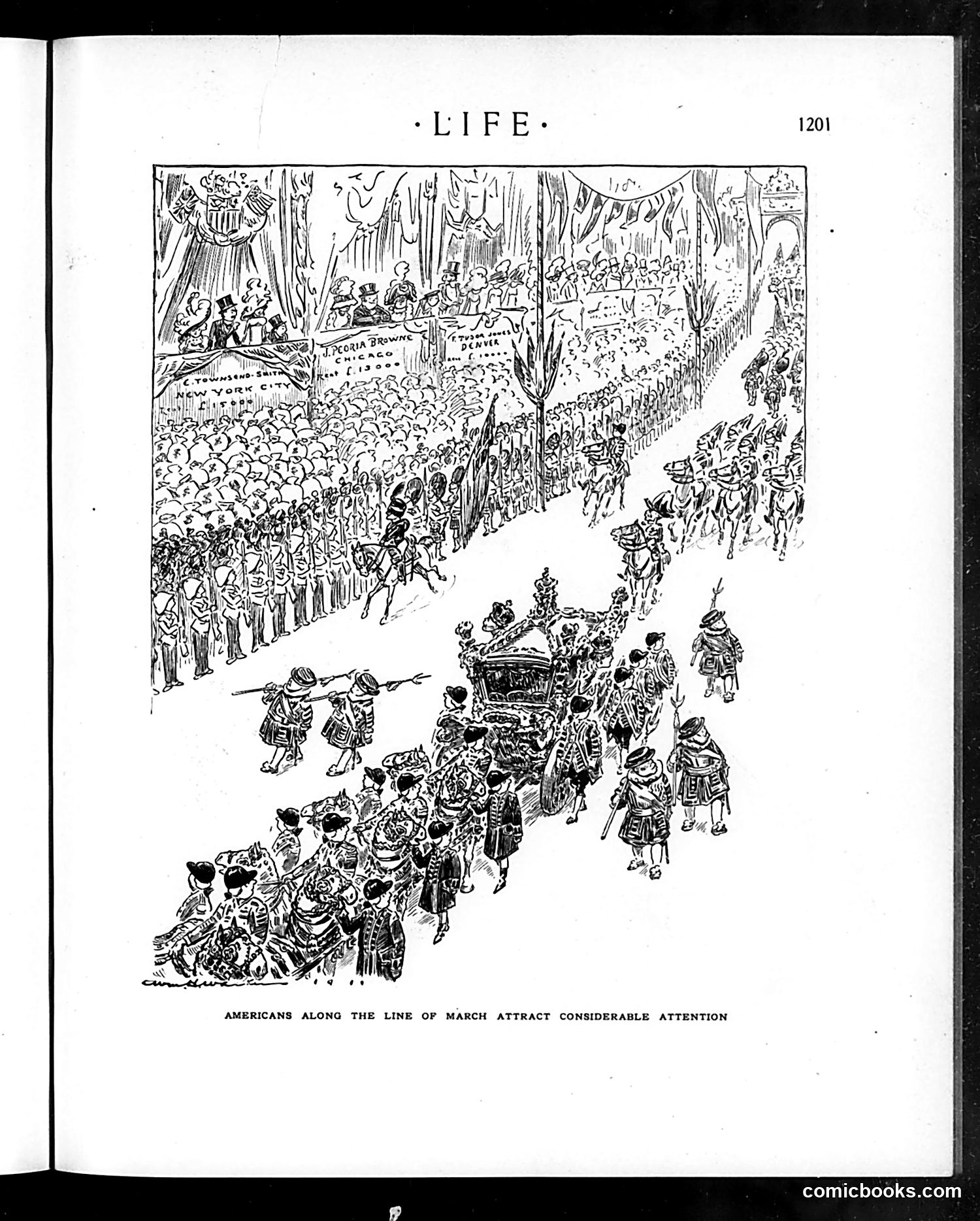
This Life magazine page depicts a royal or state procession, likely British based on the ornate ceremonial guards and carriages visible. Large crowds line the streets watching the parade pass, with viewing stands erected above. The caption reads: "AMERICANS ALONG THE LINE OF MARCH ATTRACT CONSIDERABLE ATTENTION" The satire appears to mock American tourists or dignitaries who draw more curiosity from onlookers than the actual official procession itself. The joke suggests that Americans—whether by their appearance, behavior, or sheer novelty—upstage the formal ceremony meant to be the center of attention. This reflects early 20th-century American attitudes about being perceived as loud, conspicuous outsiders abroad, unable to blend into Old World formality and decorum.
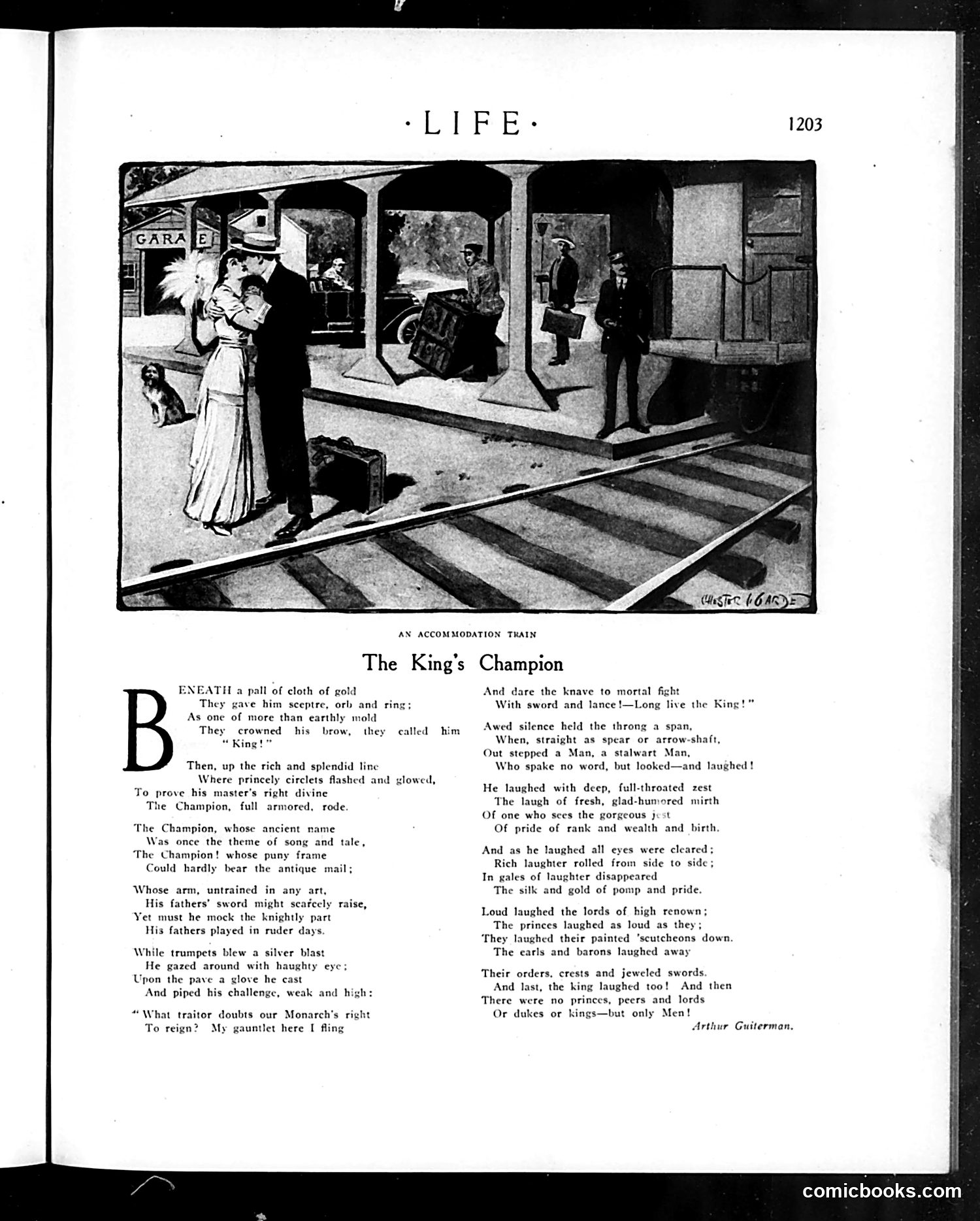
This illustration and poem by Arthur Guiterman satirize hereditary aristocracy and class hierarchy. The cartoon shows a train station scene where social classes intermix, accompanying a narrative poem about a weakling "Champion" of the king—a man of noble birth but no actual martial skill, forced to defend the monarchy's "divine right" to rule. The satire's point: when a commoner laughs at this pretense, everyone—lords, princes, even the king—joins in, realizing the absurdity of rank based on birth rather than merit. The poem's conclusion—"There were no princes, peers and lords / Or dukes or kings—but only Men!"—mocks the notion that nobility conveys inherent superiority. This reflects early 20th-century *Life* magazine's progressive critique of entrenched privilege and aristocratic pretension, suggesting that shared humanity supersedes artificial social distinctions.
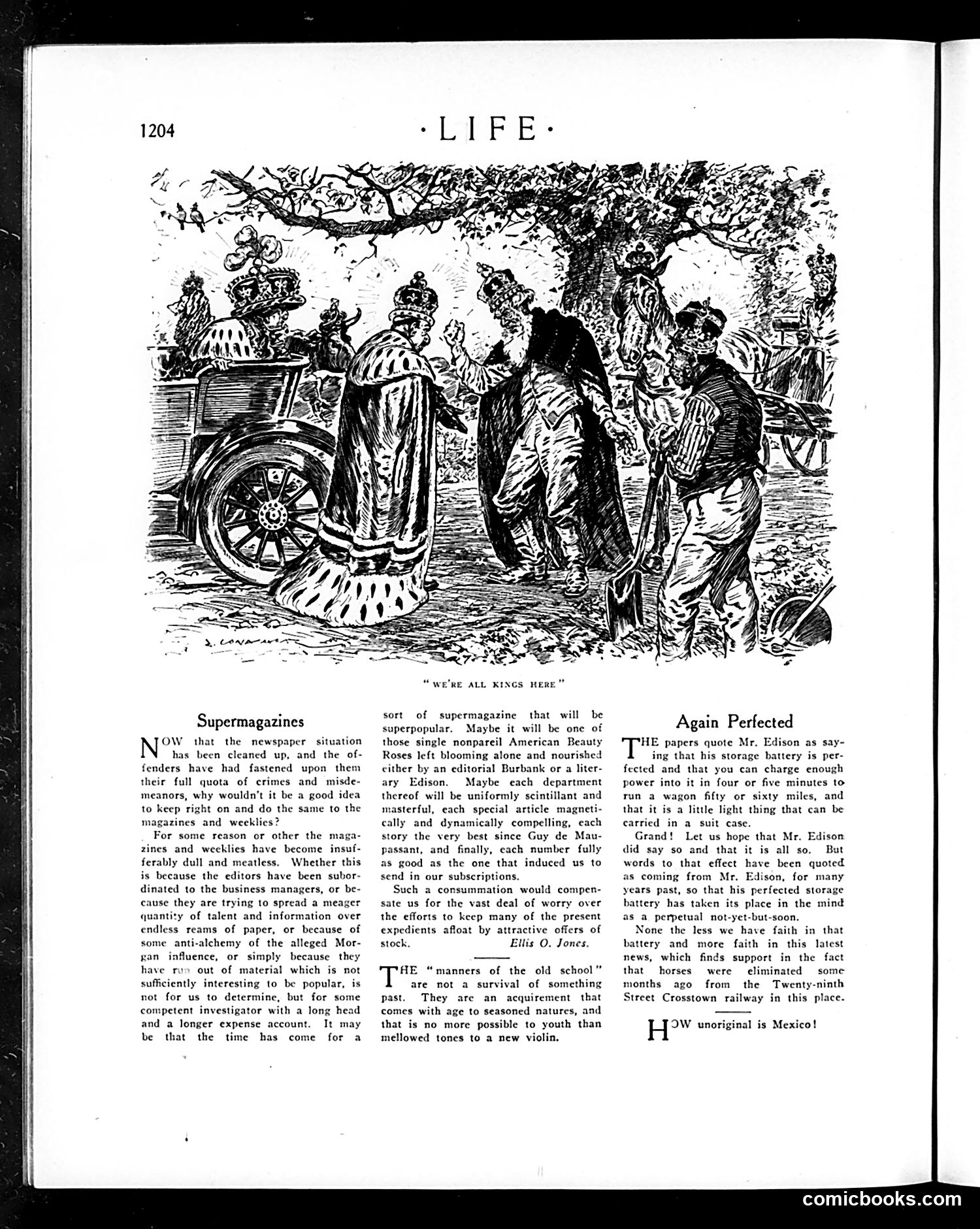
The page contains three opinion pieces from *Life* magazine's editorial section, not political cartoons. **"Supermagazines"**: The author criticizes American magazines and weeklies for becoming dull and insubstantial, possibly due to business managers prioritizing profit over editorial quality or editorial talent being stretched too thin. He sarcastically proposes creating one "superpopular" magazine with consistently excellent content—a utopian fantasy. The caption "We're All Kings Here" (showing well-dressed figures by a carriage) likely mocks the pretentious editorial self-regard he's satirizing. **"Old School Manners"**: A brief philosophical note distinguishing genuine refinement (acquired through age and experience) from youth's inability to achieve it naturally. **"Again Perfected"**: The author skeptically notes Edison's repeated claims about perfecting his storage battery over many years. He expresses hope while acknowledging Edison's "perpetual not-yet-but-soon" status—essentially calling Edison's promises habitually unfulfilled hype, though recent trolley electrification offers slight encouragement.
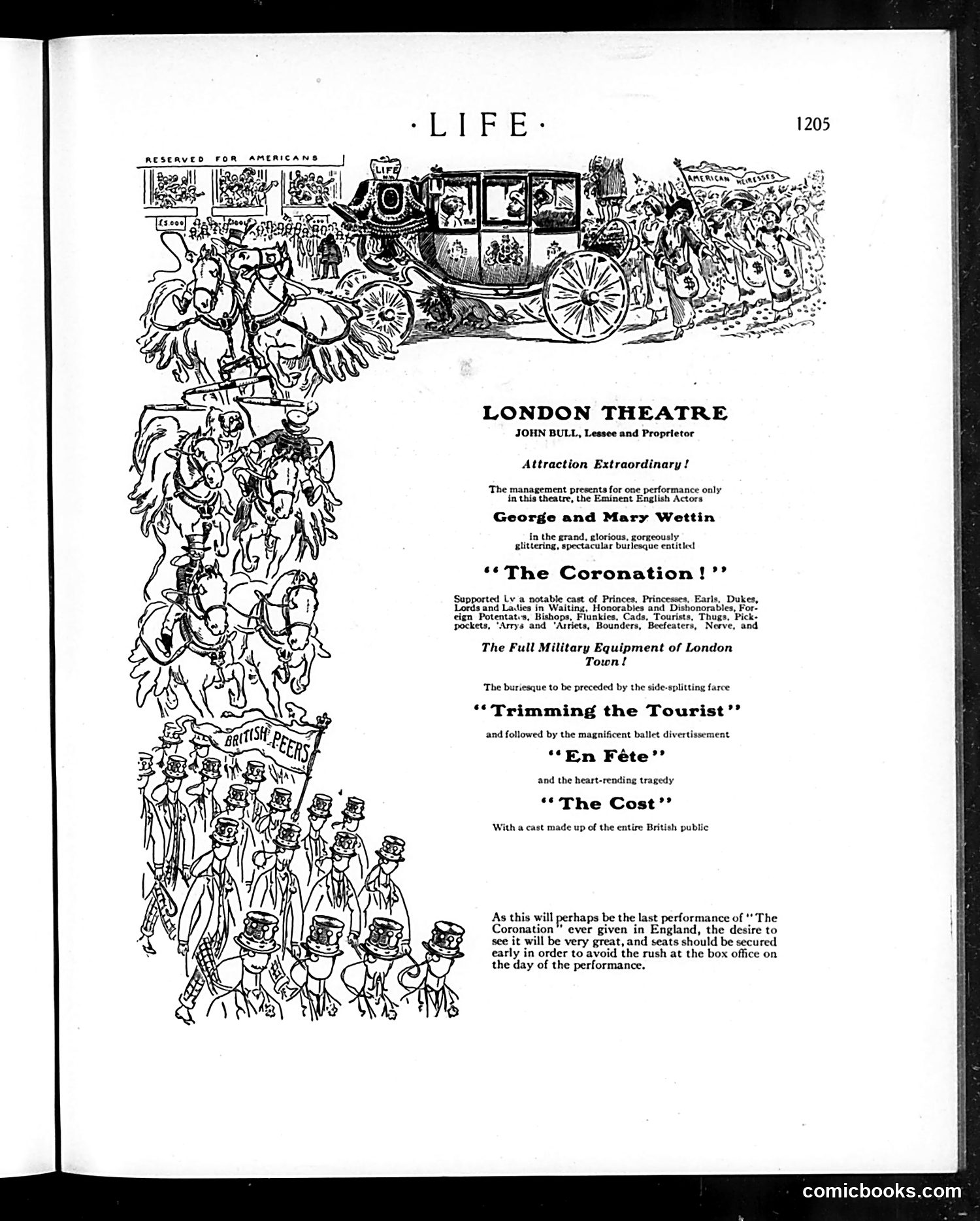
This page satirizes Britain's coronation ceremony as theatrical spectacle. "George and Mary Wettin" refers to King George V and Queen Mary (the Wettin was their German royal house name). The cartoon presents the coronation as a burlesque performance at a theater called "London Theatre" run by "John Bull" (personification of Britain itself). The satire mocks the elaborate pageantry by listing the "cast" as a mix of nobility and common people ("Pickpockets, 'Arrys and 'Arriets, Bounders"), suggesting the event encompasses all British social classes. The accompanying farce "Trimming the Tourist" and tragedy "The Cost" indicate the satirist views the coronation as both comedic spectacle and economically burdensome. The final note that this may be "the last performance" likely expresses concerns about Britain's stability or the monarchy's future—possibly referencing pre-WWI anxieties or the German royal connections.
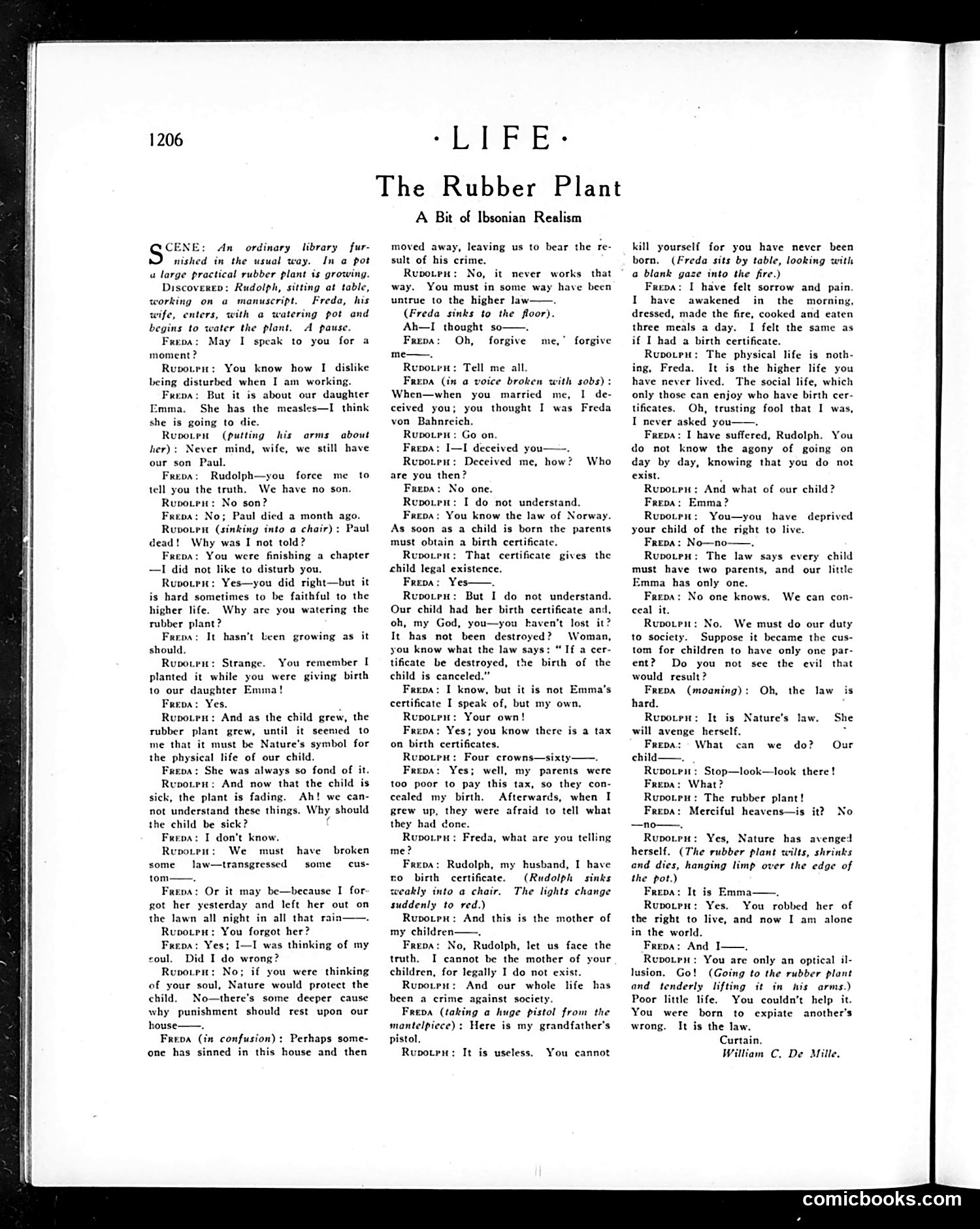
This page presents a one-act play mocking Henrik Ibsen's style of realistic drama—particularly his exploration of social hypocrisy and moral transgression. The satire targets the overwrought symbolism and melodramatic revelations common in Ibsen's work. The plot: Rudolph, a self-absorbed intellectual, discovers his wife Freda has committed a terrible transgression—her parents never obtained her birth certificate due to poverty and tax evasion. She therefore has no legal existence. The rubber plant serves as heavy-handed symbolism: it thrives as the child Emma grows, then wilts as she sickens, suggesting supernatural moral cause-and-effect. The joke lies in the escalating absurdity: Rudolph neglects his dying daughter to finish writing, forgets his dead son's death wasn't mentioned, but the *real* crisis is bureaucratic paperwork—his wife's missing birth certificate. The stage direction turning lights "suddenly to red" parodies Ibsen's dramatic moments. By William C. De Mille, this satirizes how Ibsenian realism reduces human tragedy to legal technicalities and symbolic objects, making serious drama seem ridiculous.
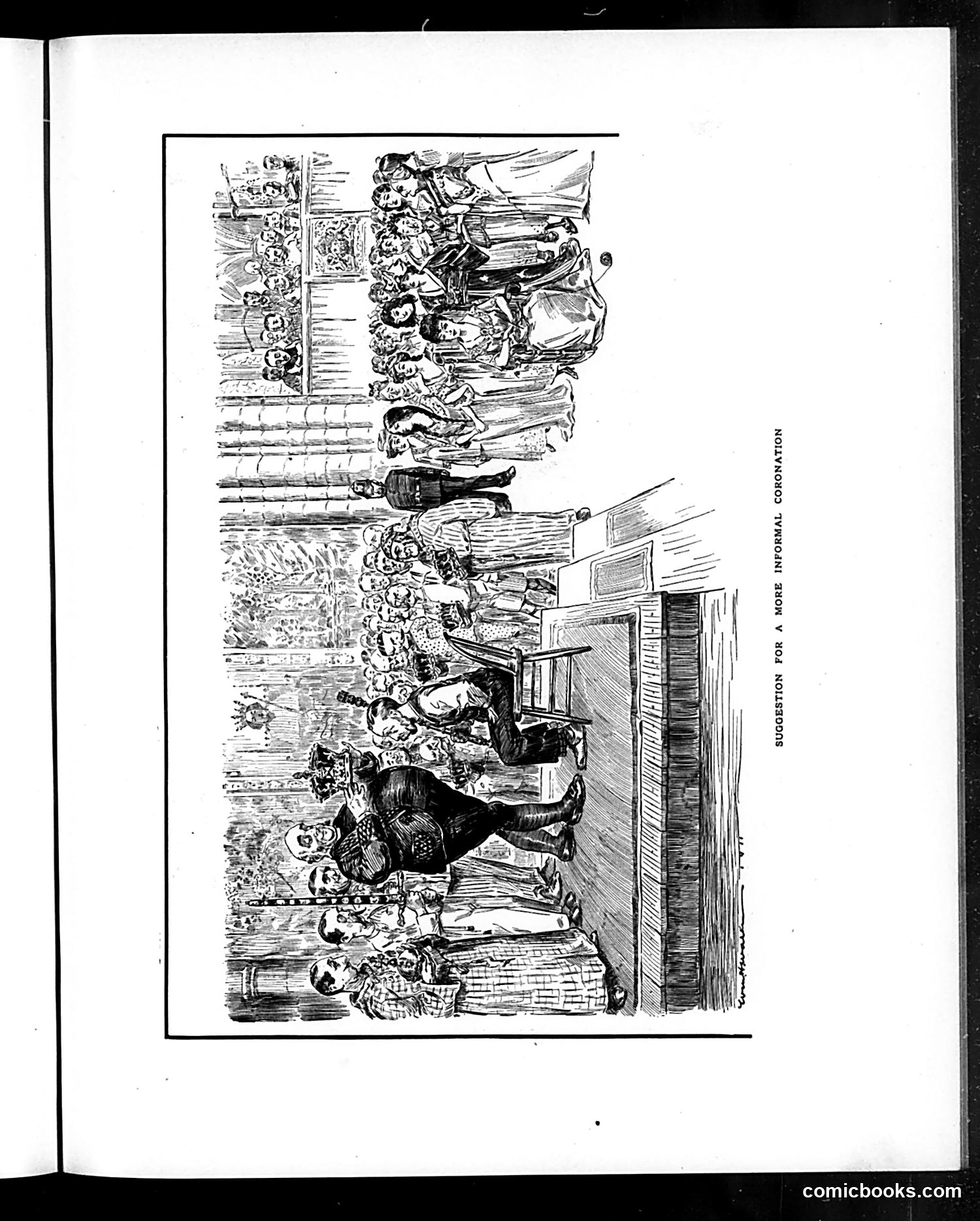
The OCR text is largely corrupted and unreadable. The image itself appears to be a detailed satirical engraving, rotated 90 degrees, depicting a crowded indoor scene with numerous figures in period dress (appears to be 19th century). There's text on the right margin reading "SUGGESTION FOR A LORDS INFORMAL CORONATION," which suggests this is political satire concerning British aristocracy or a coronation ceremony. However, without clearer text or visible labels identifying specific figures, I cannot reliably identify which political/social figures are caricatured or explain the specific satirical point. The elaborate composition and the reference to "Lords" suggests commentary on British parliamentary or royal affairs, but asserting more would exceed what the corrupted page clearly supports.
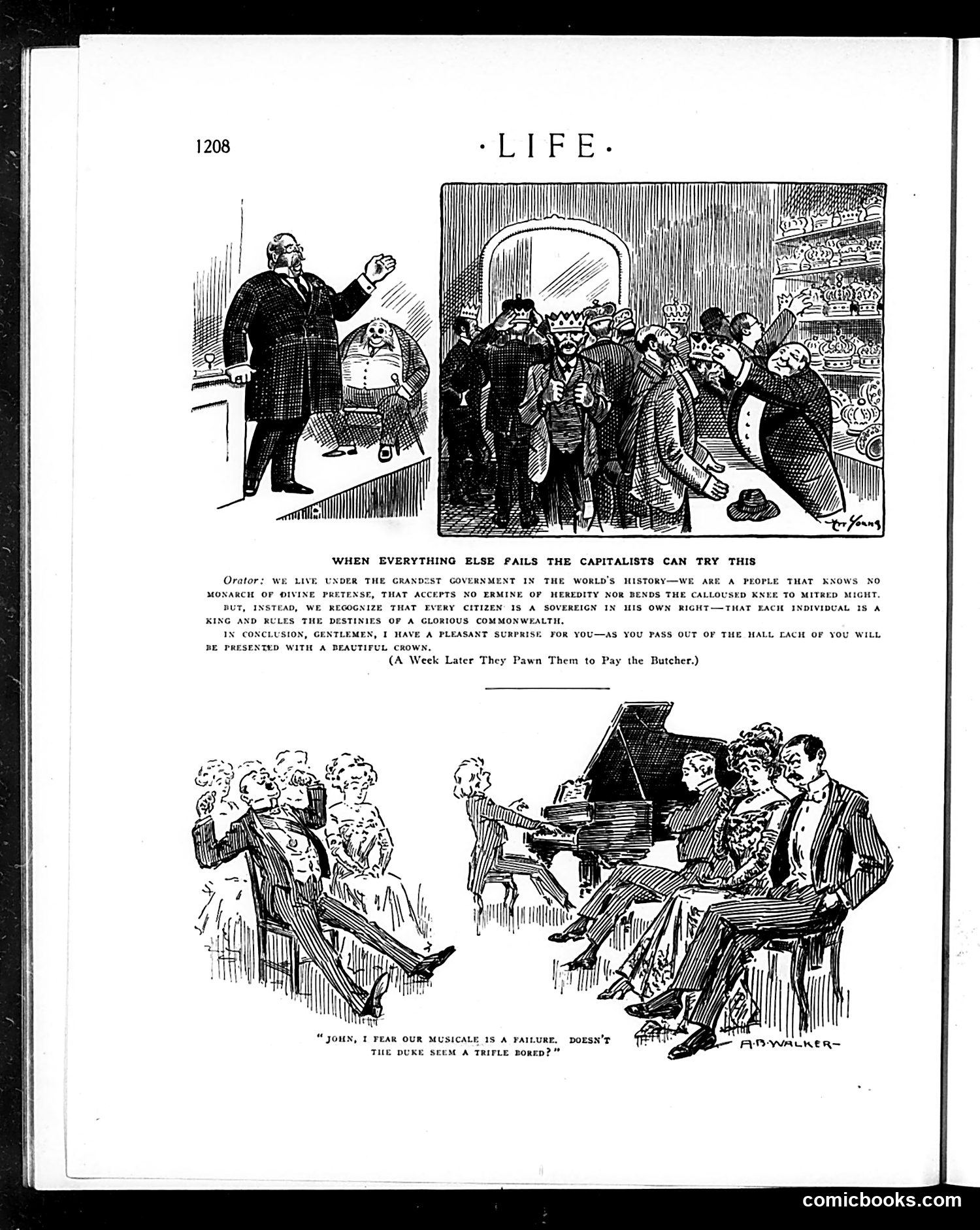
This Life magazine cartoon mocks wealthy capitalists using patriotic rhetoric to distract working people from economic hardship. An orator delivers grand speeches about democratic equality and individual sovereignty, then distributes symbolic "crowns" to the audience—metaphorically offering dignity instead of wages. The cruel punchline reveals the reality: within a week, people must pawn these worthless crowns to pay butchers for food, suggesting the working class remains impoverished despite flowery democratic ideals. The lower cartoon satirizes the upper class's indifference—the wealthy attend musical performances and worry about entertaining a bored duke, completely disconnected from workers' genuine struggles for survival. The satire targets how capitalists use patriotic propaganda to maintain class inequality while the poor face material deprivation.
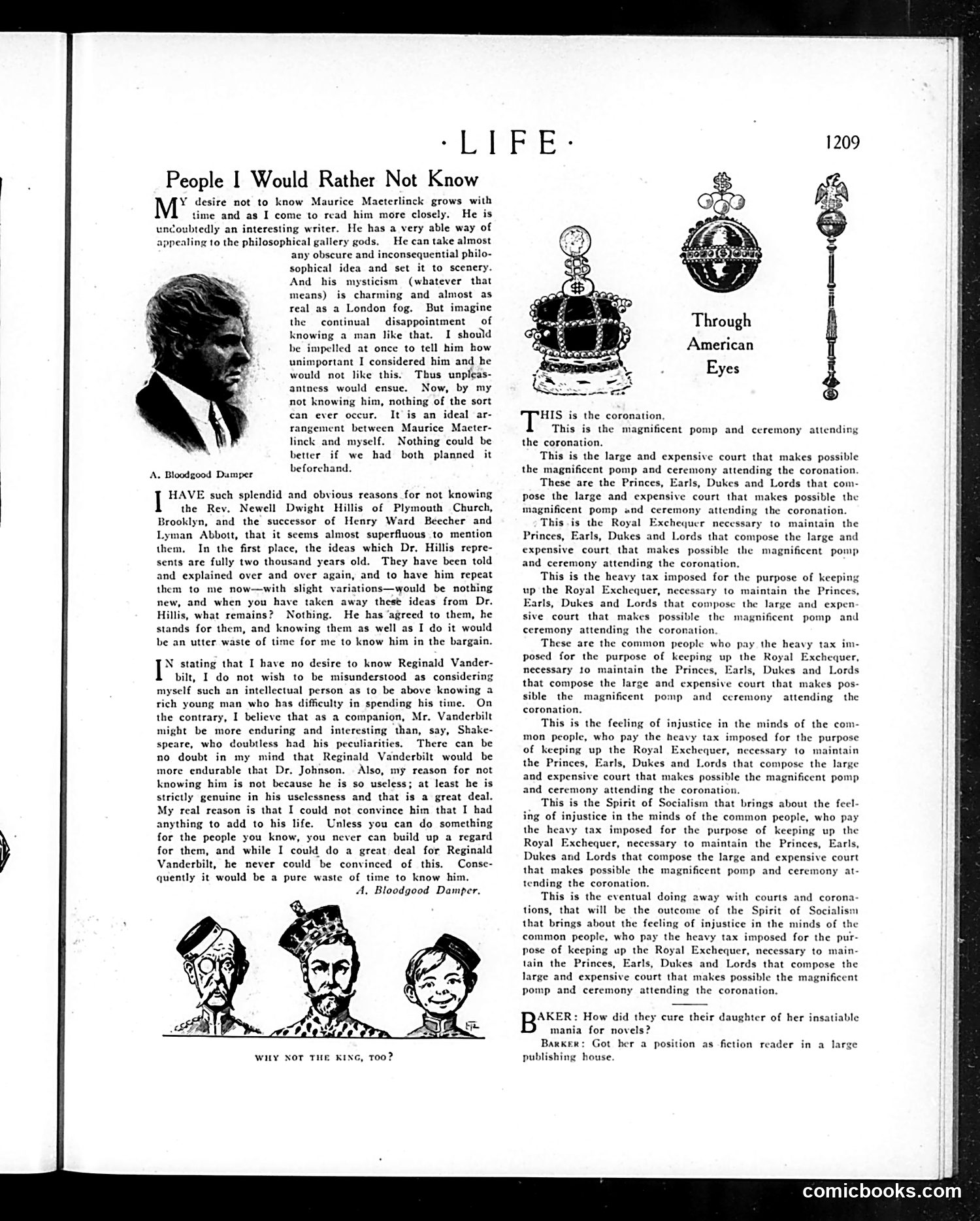
This page contains two distinct satirical pieces: **"People I Would Rather Not Know"** features three brief essays by "A. Bloodgood Damper" defending his refusal to know specific individuals: Maurice Maeterlinck (a Belgian symbolist playwright), Reverend Newell Dwight Hillis (Henry Ward Beecher's successor at Plymouth Church), and Reginald Vanderbilt (a wealthy industrialist). The humor lies in the tongue-in-cheek justifications—each explanation ironically reveals the author's pretentious reasoning while insulting his subjects. **"Through American Eyes"** critiques the British coronation ceremony through sardonic repetition, presenting a cascading chain of causation: coronation → expensive court → royal nobility → royal treasury → heavy taxation → common people paying the bills. The cartoon "Why Not the King, Too?" (three caricatured heads) reinforces this anti-monarchy sentiment. Together, these pieces mock both intellectual pretension and aristocratic excess—central Progressive Era concerns about inequality and Old World hierarchies.
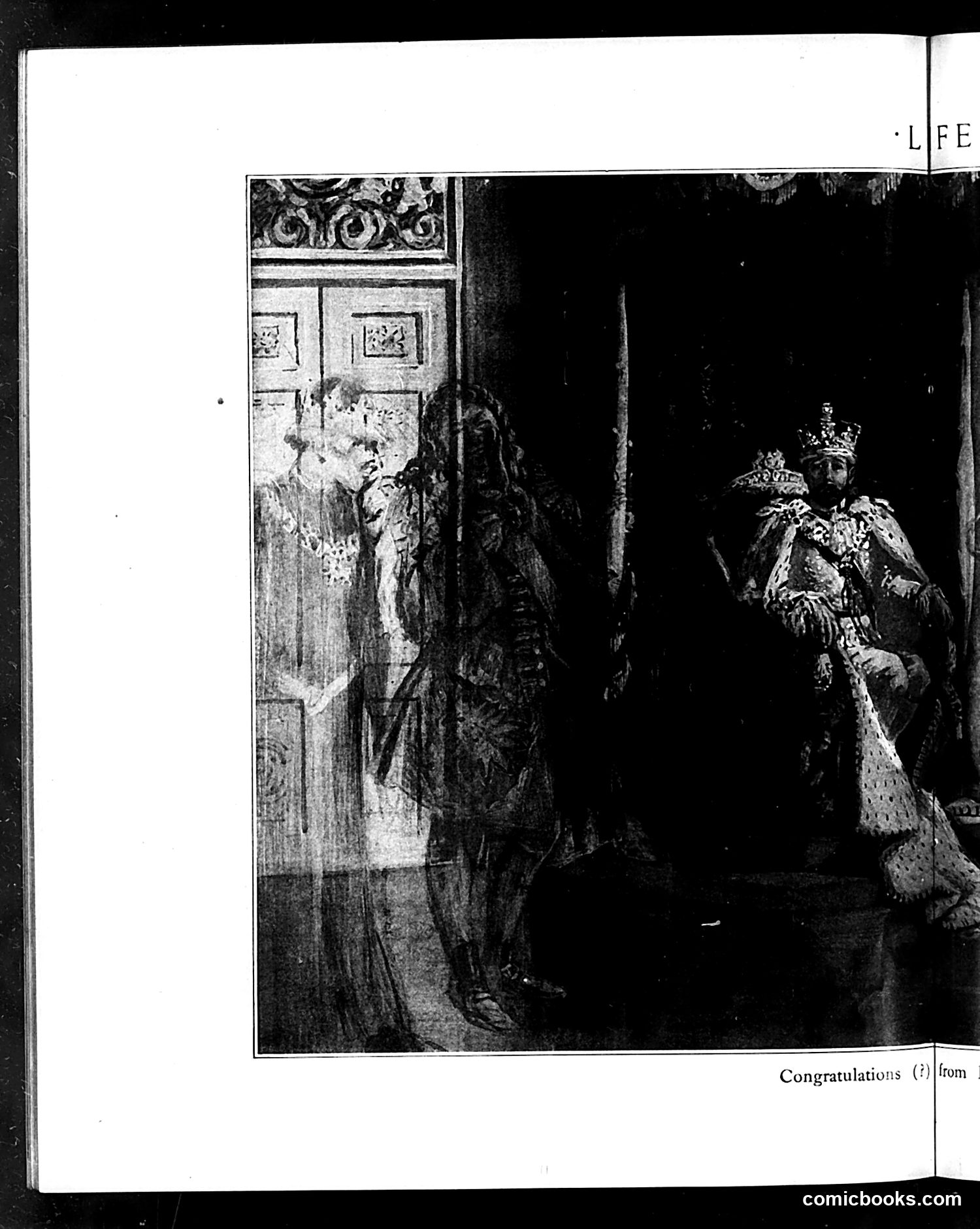
This satirical cartoon depicts a formal royal or state scene. On the left, a figure in elaborate formal dress stands at a doorway, while on the right, a crowned and richly robed monarch receives them. The question mark in the caption "Congratulations (?)" suggests ironic skepticism about the occasion being celebrated. Without the specific publication date visible, the exact political reference remains unclear. However, the composition suggests commentary on either a dubious diplomatic recognition, an awkward state visit, or an uncomfortable political accommodation between parties. The formal setting and the questioning tone indicate the cartoonist questions whether congratulations are genuinely warranted for whatever event or agreement is being depicted.
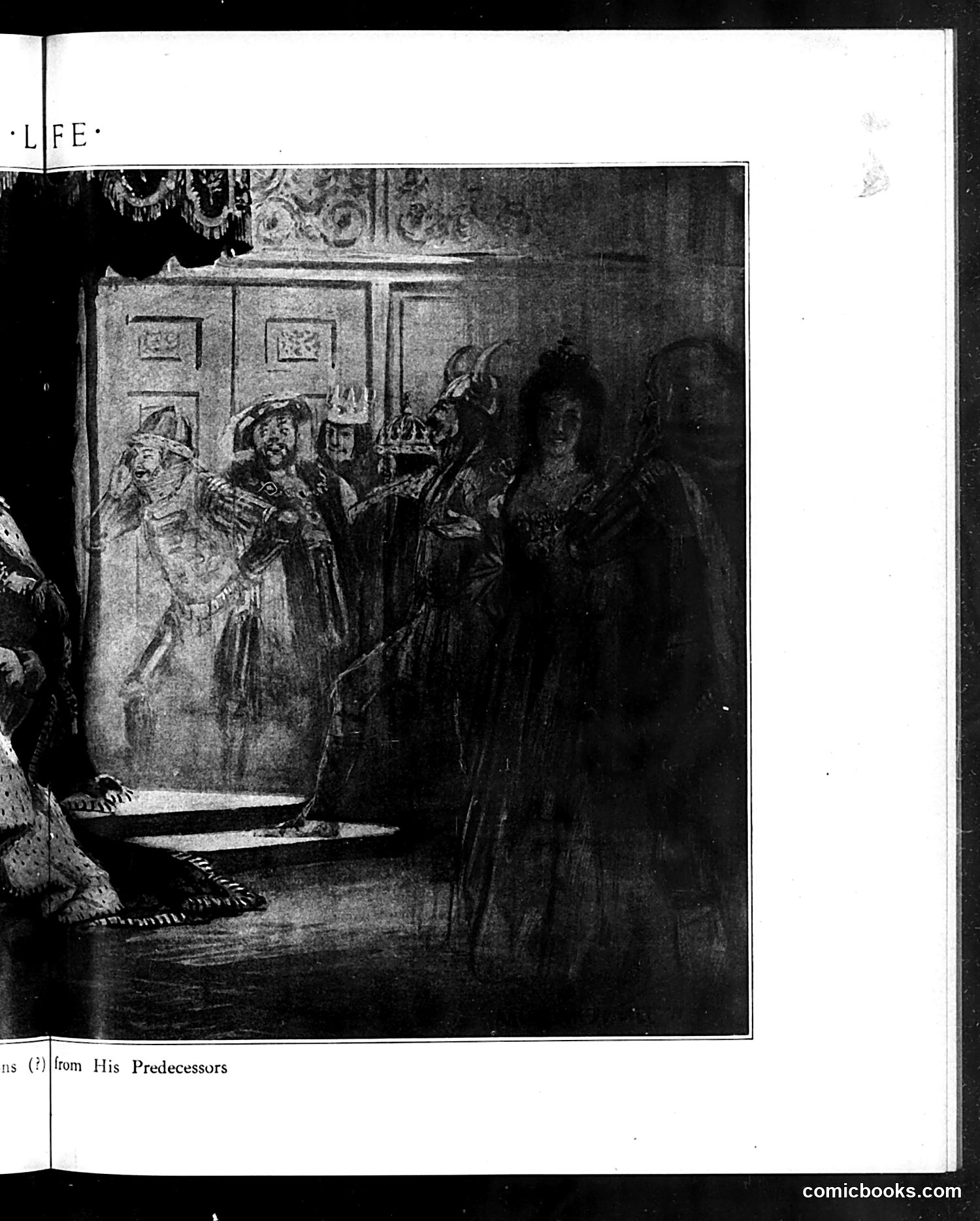
This page from *Life* magazine shows a historical or literary scene rather than political satire. The image depicts what appears to be a formal interior setting with elaborately dressed figures in period costume—possibly 18th or 19th century attire. One figure stands prominently at left near a doorway, while others stand in shadow to the right. The partial caption reads "from His Predecessors," suggesting this illustrates a narrative about succession or inheritance of power or position. Without the full page context and complete caption, the specific historical or literary reference is unclear—this could depict a scene from a novel, historical event, or allegorical tale about leadership transition. The artistic style and formal composition suggest this is illustrative rather than comedic satire.
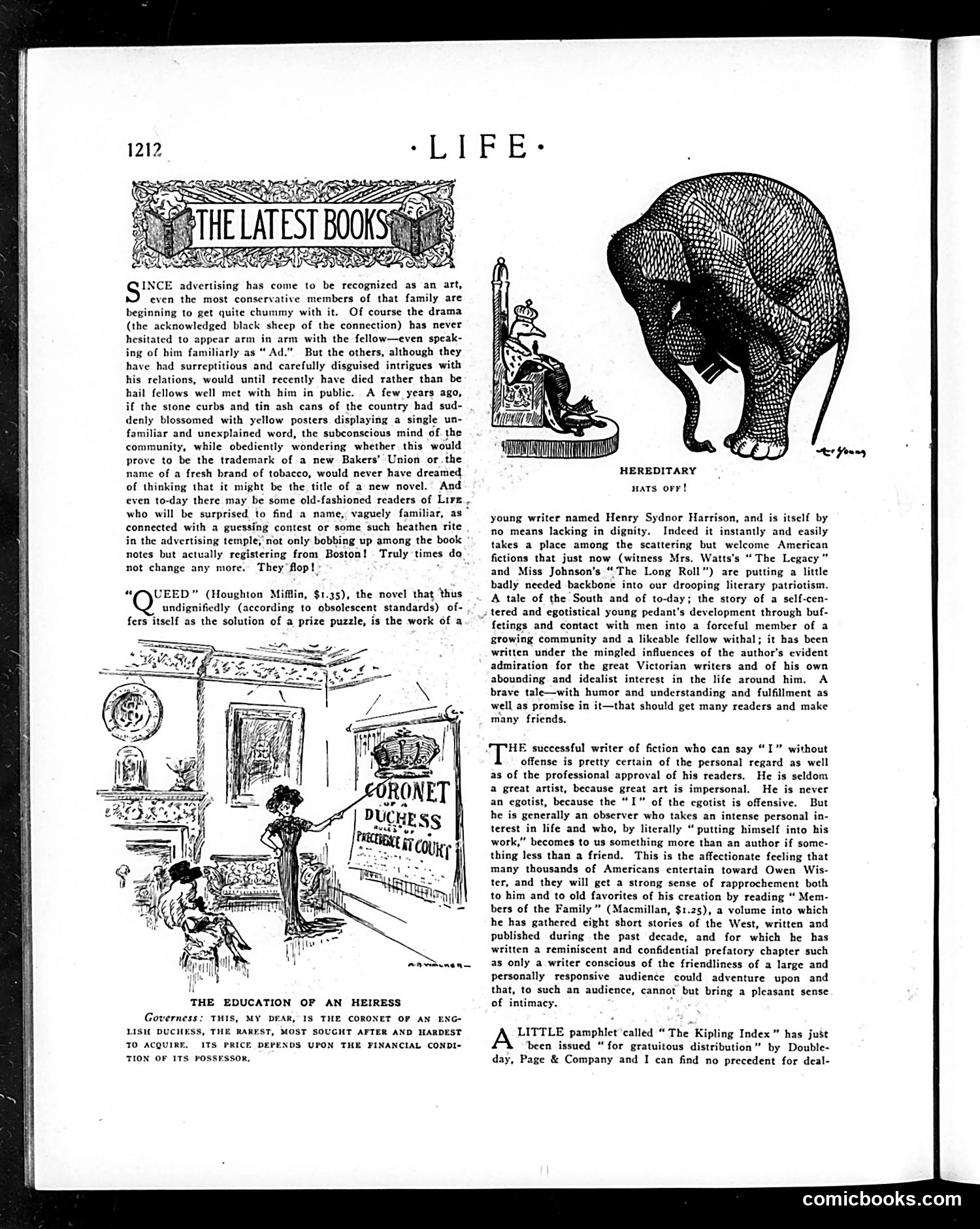
This cartoon satirizes the gilded age's obsession with aristocratic titles and wealth. The illustration shows an elephant (representing an heiress or wealthy American woman) being fitted with a coronet (crown), while her governess explains that a coronet's value depends entirely on "the financial condition of its possessor." The joke targets the American practice of marrying off wealthy heiresses to impoverished European nobility—essentially purchasing titles with money. The elephant emphasizes the absurdity: regardless of how valuable or prestigious the coronet appears, it's merely a commodity for sale to the highest bidder. The phrase "Hereditary Hats Off!" suggests mock deference to this shallow materialism. This reflects genuine historical tension: during this era, many American industrial fortunes were leveraged to acquire European titles through strategic marriages, which American satirists frequently mocked as both ridiculous and undemocratic.
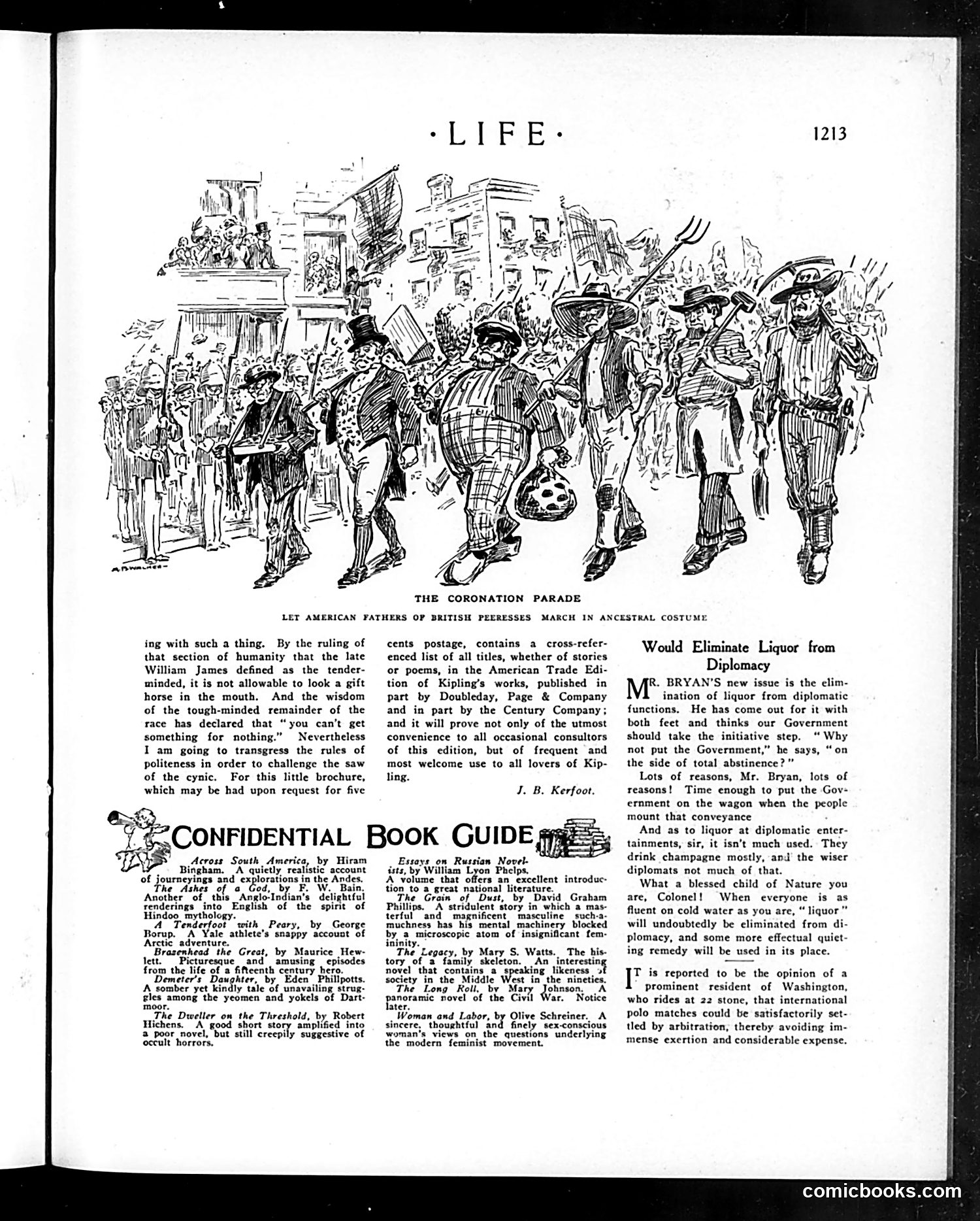
The main illustration satirizes American wealth and social climbing. It depicts the coronation parade of a British monarch, with the caption proposing that "American fathers of British peeresses march in ancestral costume." The joke targets wealthy American industrialists who had daughters marry into British aristocracy—a common phenomenon of the Gilded Age. These self-made American businessmen, lacking genuine aristocratic heritage, would absurdly attempt to parade in "ancestral costumes" they had no legitimate claim to wear. The cartoon mocks both American nouveau riche pretension and the willingness of cash-strapped British nobility to marry American heiresses for their fortunes. The accompanying text satirizes William Jennings Bryan's recent proposal to eliminate liquor from diplomatic functions, characterizing him as naïvely idealistic and out of touch with practical reality—diplomacy fundamentally requires such social lubricants.
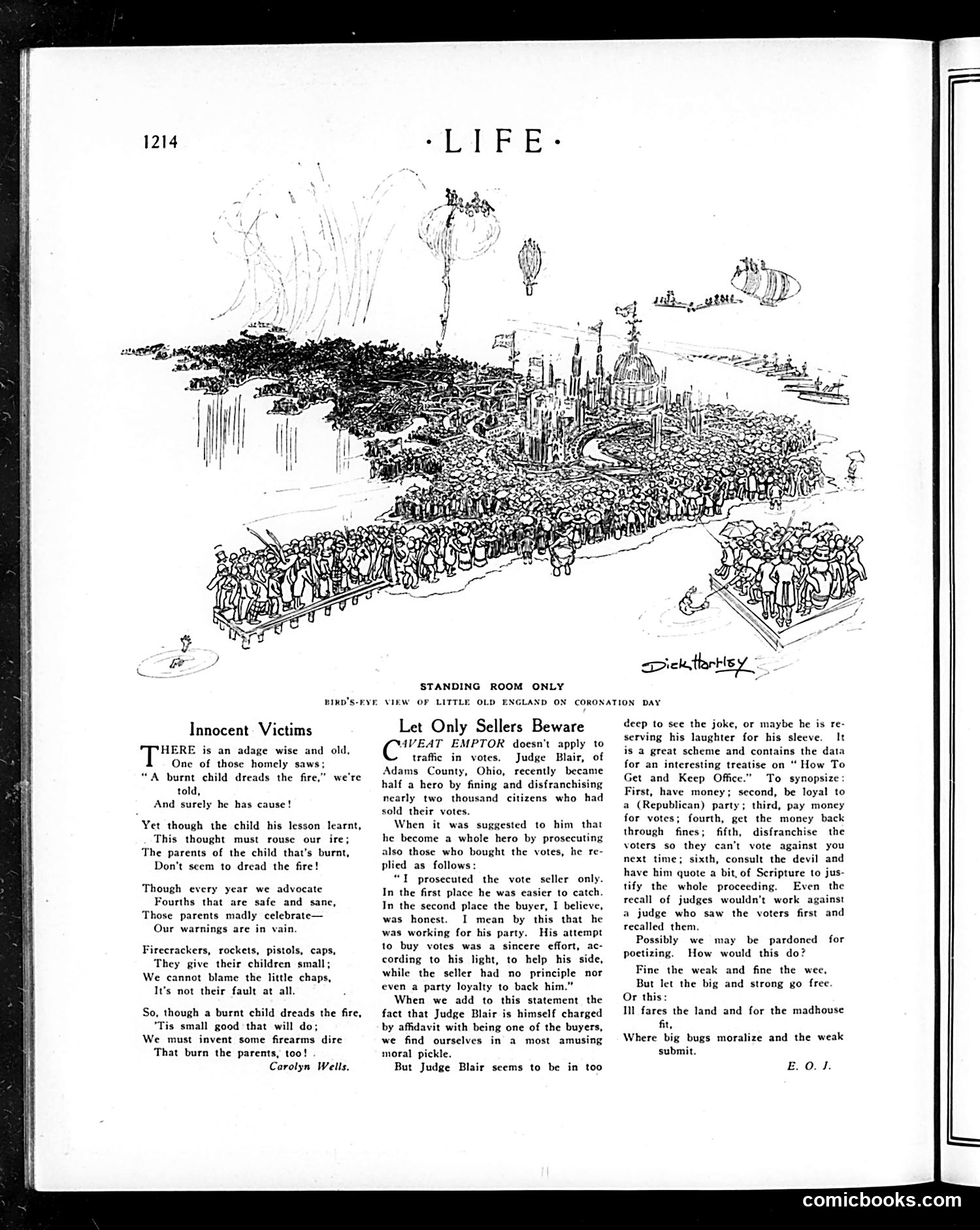
This page contains two distinct satirical pieces from *Life* magazine: **"Innocent Victims"** (left): A poem by Carolyn Wells mocking parental negligence during Fourth of July celebrations. It criticizes parents who give children firecrackers and dangerous fireworks despite annual safety warnings, suggesting the solution is to make the punishment so severe that parents themselves suffer injury. **"Let Only Sellers Beware"** (right): Sharp political commentary on vote-buying corruption in Adams County, Ohio. Judge Blair prosecuted citizens who *sold* their votes but refused to prosecute those who *bought* them—claiming buyers acted from sincere party loyalty. The satire highlights the hypocrisy: Blair himself was allegedly charged with vote-buying. Life's commentary mocks the absurd moral framework that excuses wealthy/powerful vote-buyers while punishing poor vote-sellers, and suggests the scheme allows politicians to fine voters into disfranchisement, ensuring they can't vote against them next election. Both pieces use bitter humor to expose corruption and double standards in American civic life.
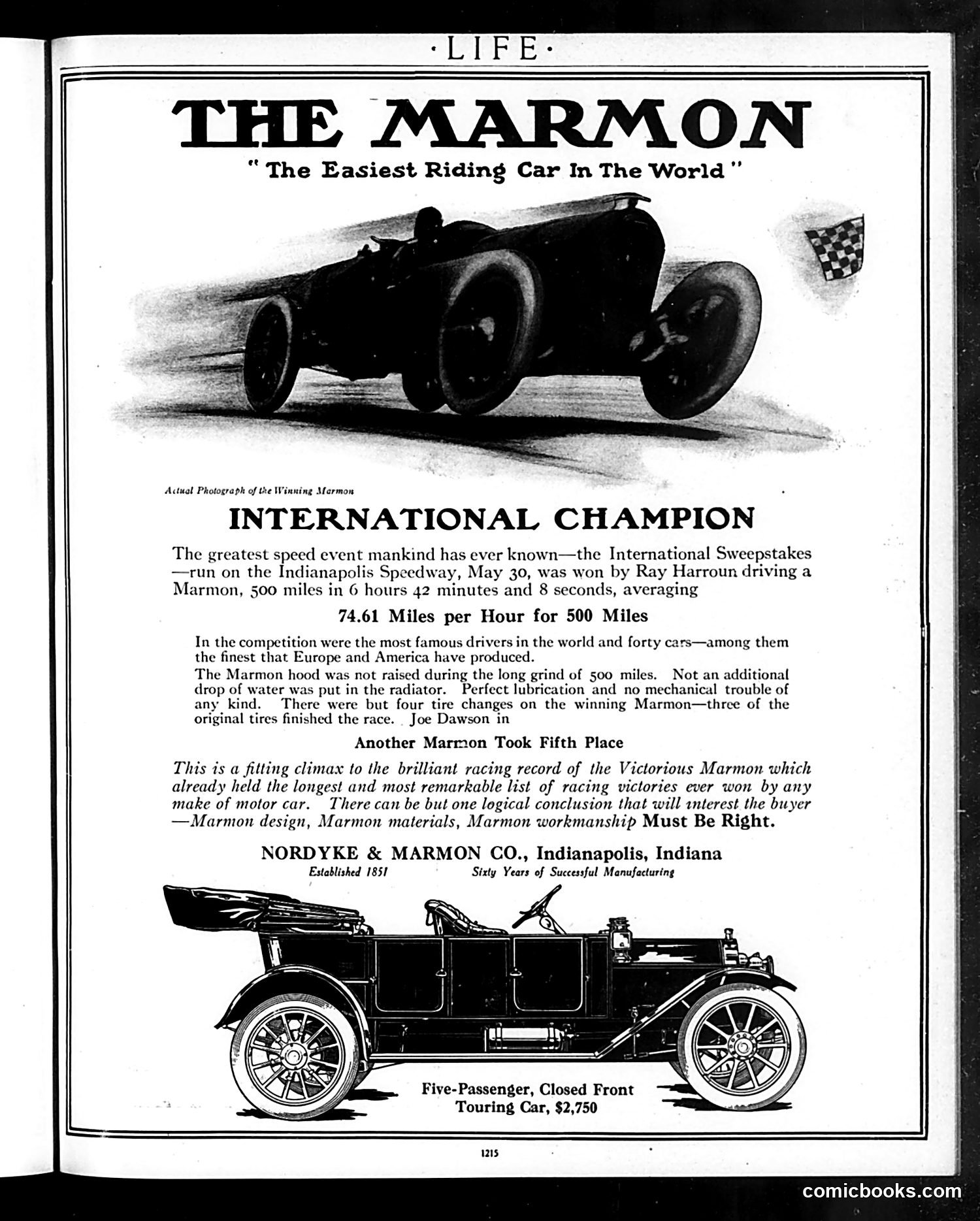
This is not a cartoon but a **car advertisement** disguised as news coverage. The page celebrates Ray Harroun's victory in the 1911 Indianapolis 500 (the "International Sweepstakes"), where he drove a Marmon automobile to win at 74.61 mph average speed. The advertisement uses the race victory as proof of the car's superiority—emphasizing reliability (hood never opened, minimal maintenance, only four tire changes) to appeal to consumers. The contrast between the racing car (top image) and the commercial touring model (bottom) suggests that technology from competition translates to family vehicles. This represents early automotive marketing strategy: leveraging sports achievement to establish brand credibility and performance claims. For modern readers, it's notable that such transparent advertising could appear in a supposedly satirical magazine like Life, blurring editorial and commercial content in ways that would raise ethical concerns today.
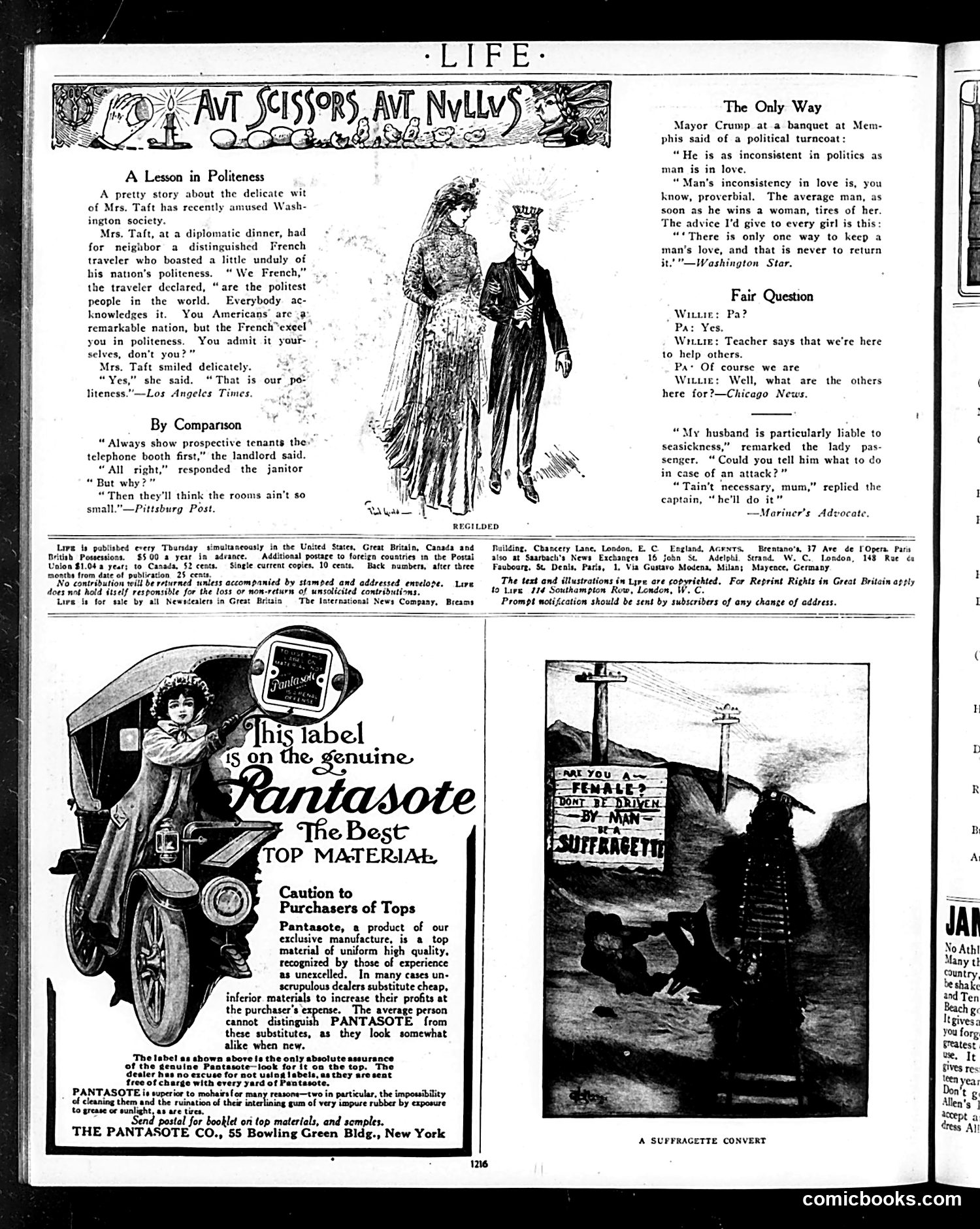
This page contains several brief humorous anecdotes and advertisements typical of early 20th-century Life magazine. **"A Lesson in Politeness"** satirizes French pretensions: a French diplomat boasts of French superiority in manners, but Mrs. Taft (wife of President William Howard Taft) deflates him by suggesting Americans' politeness consists of *politely accepting* French claims—a witty put-down. **Other short jokes** mock landlords, inconsistent politicians, children's logic, and seasickness remedies—standard light humor. **The Pantasote advertisement** warns consumers against counterfeit top materials, emphasizing the importance of checking labels. **"A Suffragette Convert"** (bottom right photograph) appears to reference the women's suffrage movement, though the specific context is unclear from visible text. The page is primarily **filler content**—short jokes and advertising—rather than substantial political commentary, reflecting Life's role as a humor and satire magazine for general audiences.
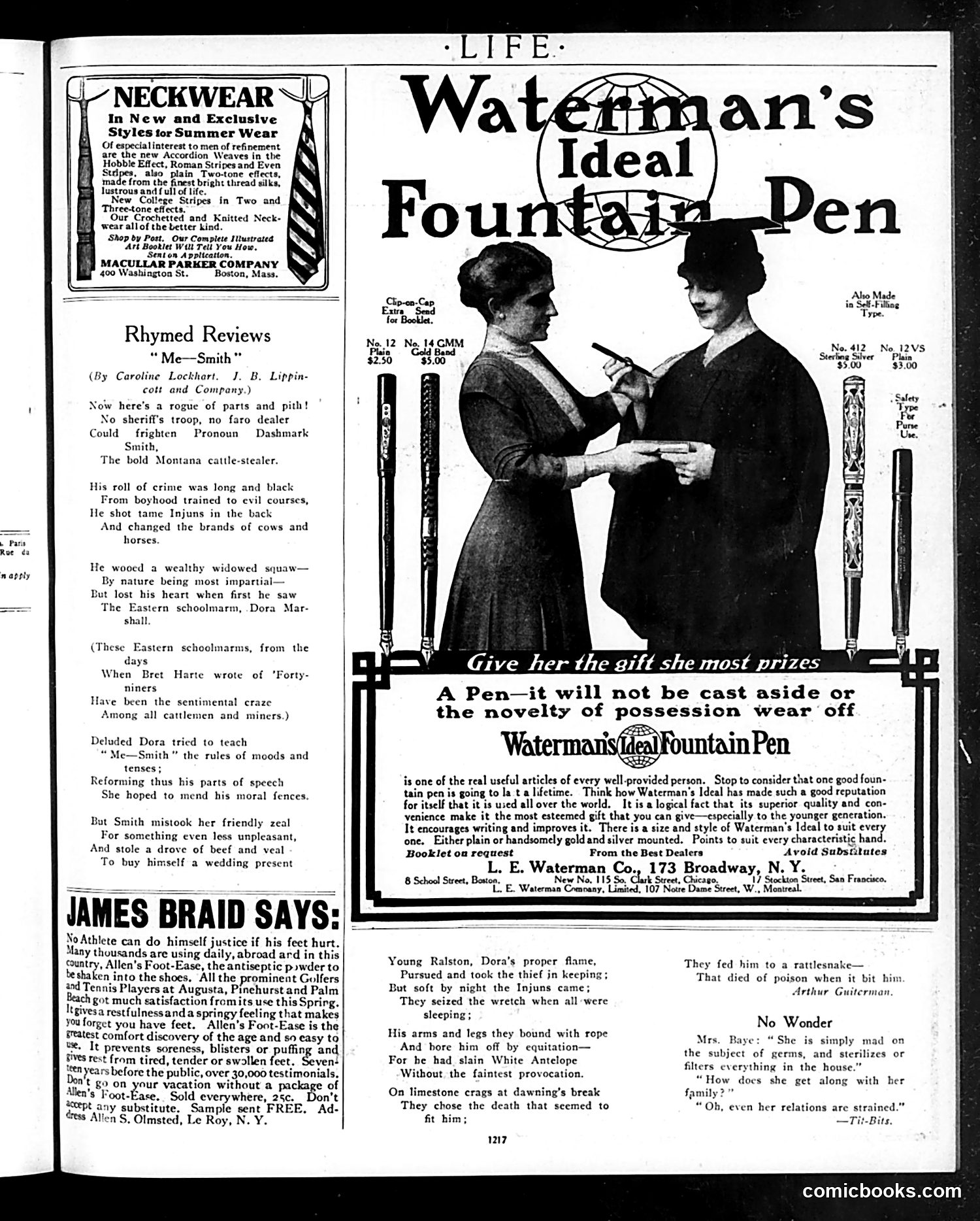
This page is primarily **advertising**, not satirical editorial content. The dominant feature is a Waterman's Ideal Fountain Pen advertisement showing two women—one presenting the pen as a gift to the other. The ad's pitch: fountain pens make ideal gifts because they're durable, improve writing, and won't lose their appeal over time. The page also contains: - A **neckwear advertisement** (McCullar Parker Company) promoting new summer styles - **"Rhymed Reviews,"** a book review of a Western novel called "Me—Smith" about a Montana cattle rustler reformed by an Eastern schoolteacher—a stock romantic trope of the era - **James Braid's endorsement** of Allen's Foot-Ease powder, leveraging the famous golfer's celebrity to sell an athlete's foot remedy There is **no political satire** on this page. It's a straightforward commercial publication mixing consumer goods advertising with light literary and sports content typical of early 20th-century Life magazine.
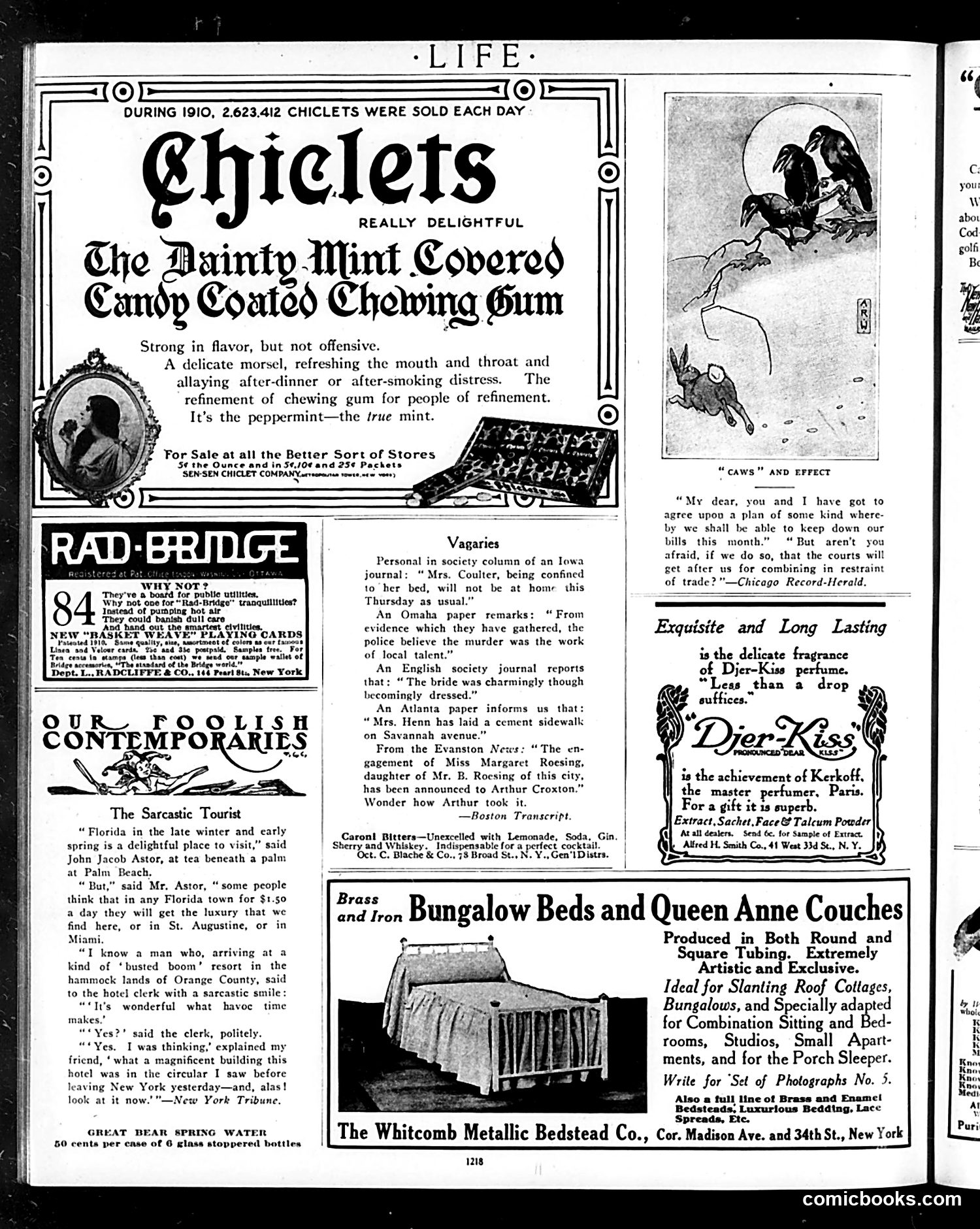
This page from *Life* magazine (circa 1910) is **primarily advertising**, with a small satirical section titled "Vagaries." The "Vagaries" column presents newspaper excerpts from various American cities, highlighting **unintentionally funny or absurd phrasing** in local journalism. Examples include: - An Iowa paper noting a woman confined to bed "will not be at home" (obvious/redundant) - A police report attributing a murder to "local talent" (euphemistic understatement) - An English journal praising a bride for being "charmingly though becomingly dressed" (stating the obvious) The page also features "The Sarcastic Tourist," where John Jacob Astor mocks a rundown Florida hotel by comparing it to its promising promotional circular—satirizing both exaggerated tourism marketing and the disappointment of budget travel. The satire is gentle, mocking poorly-written newspaper copy and inflated tourist expectations rather than targeting specific political figures or movements.
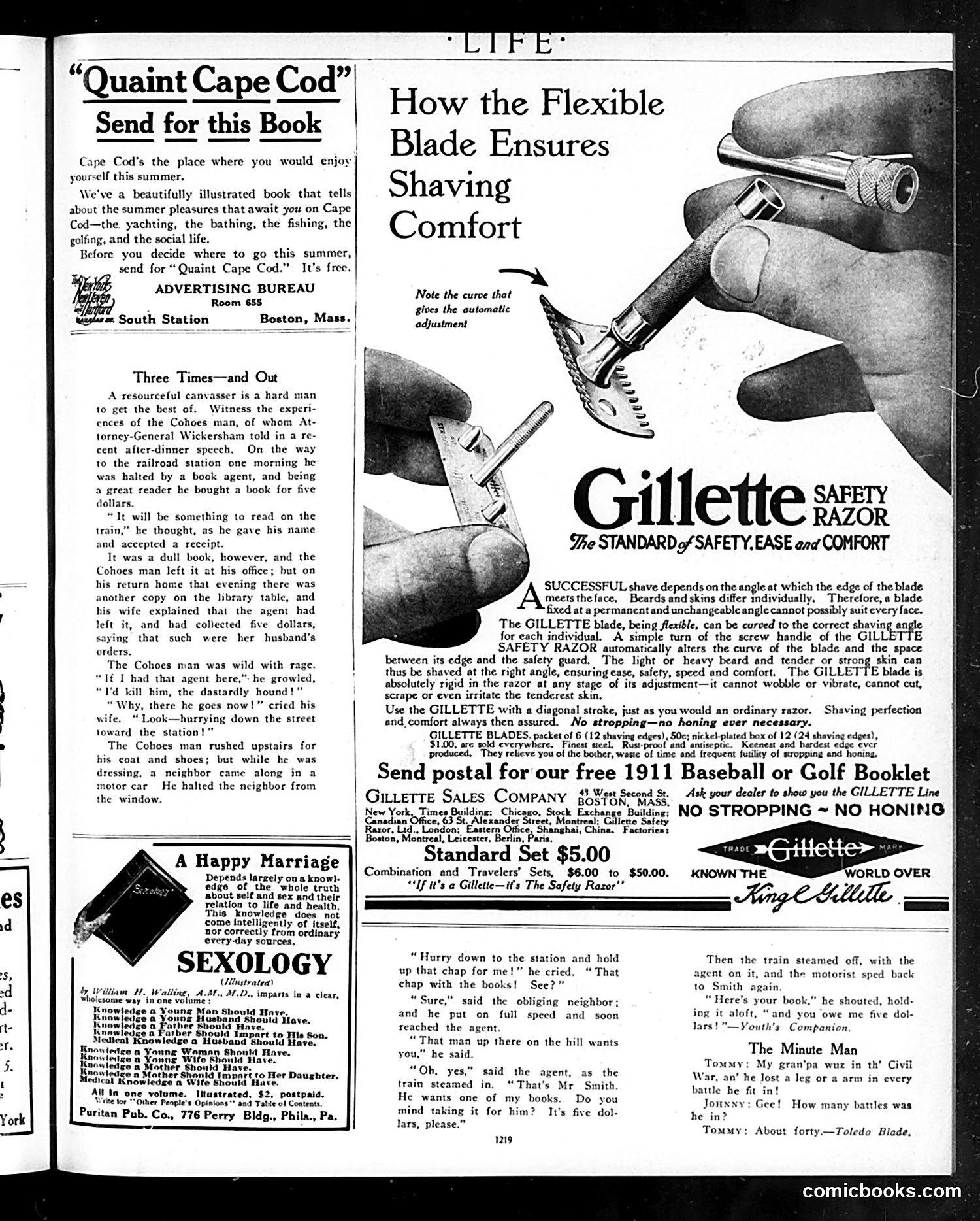
This brief comic narrative satirizes aggressive door-to-door salesmanship, a common frustration in early 20th-century American life. A persistent book agent sells the same volume twice to the same household—once to the husband, once claiming the husband ordered a second copy. When the enraged husband chases the agent down the street, a neighbor's motorcar interrupts the pursuit. The joke targets the resourcefulness of canvassers who exploit social conventions and inattention to make repeat sales. The "three times" likely refers to: the initial sale, the duplicate sale, and the implied third encounter as the husband pursues. It reflects growing annoyance with aggressive commercial tactics that exploited middle-class homes lacking consumer protections. The page is otherwise advertisements—Cape Cod tourism, a sexology book, and Gillette razors.
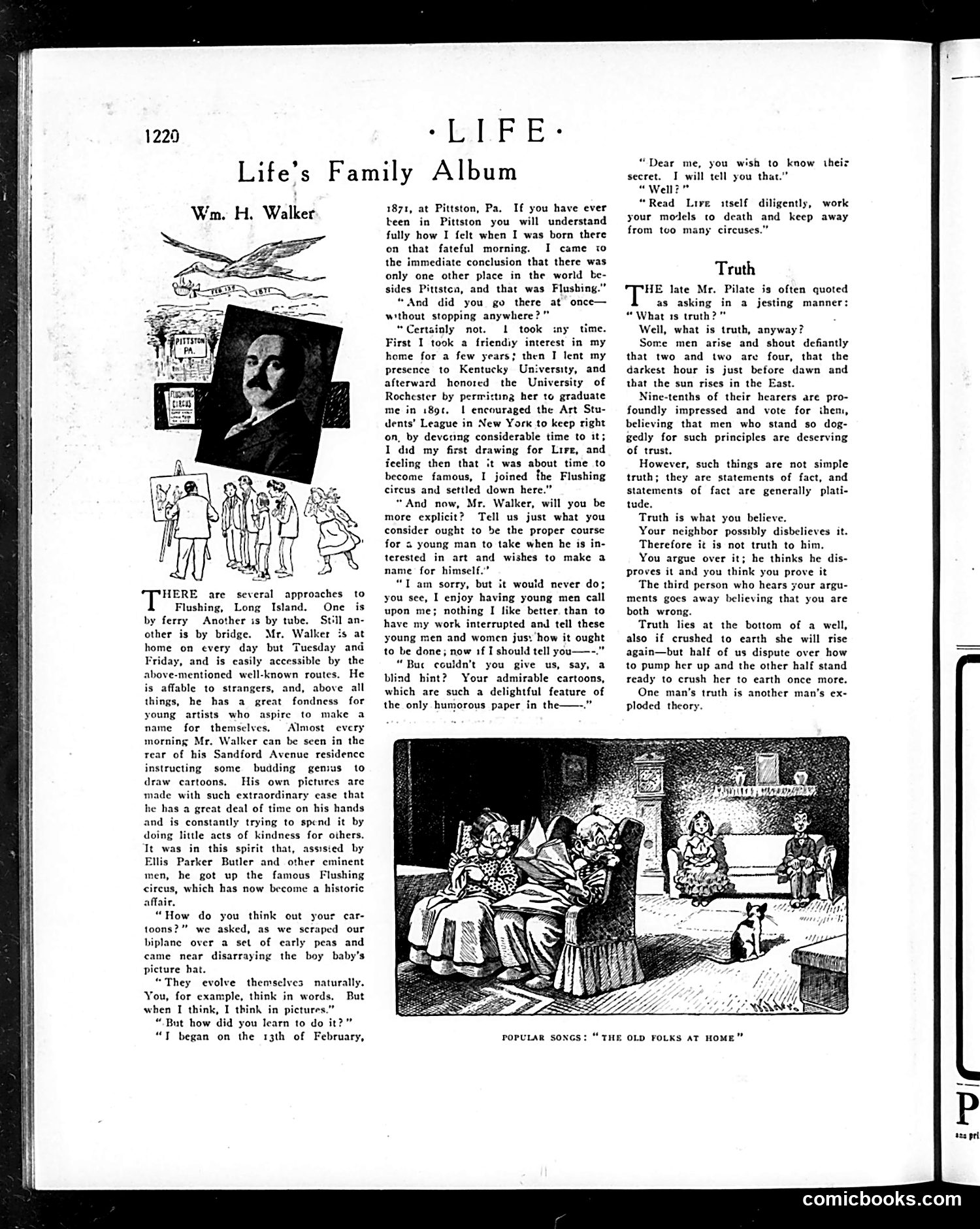
This page features **Wm. H. Walker**, a cartoonist for *Life* magazine, in an interview-style profile titled "Life's Family Album." The humor operates on multiple levels: **The Interview Format**: A journalist visits Walker at his Flushing, Long Island home, asking how he creates cartoons. Walker responds with self-aggrandizing anecdotes—he claims to have "honored" universities by attending them and founded the "famous Flushing circus." **The Satire**: Walker humorously deflects serious questions about artistic technique with rambling autobiography and false modesty. When asked for advice on becoming an artist, he refuses because he enjoys having young artists interrupt his work to ask him questions—a self-aware joke about his own vanity. **The Punchline**: His actual advice: read *Life* diligently, work hard, and avoid circuses—circular, unhelpful guidance that satirizes both Walker's pretentiousness and generic "success" advice. The accompanying illustration shows a domestic scene, supporting the *Life* magazine's typical focus on American middle-class life and humor.
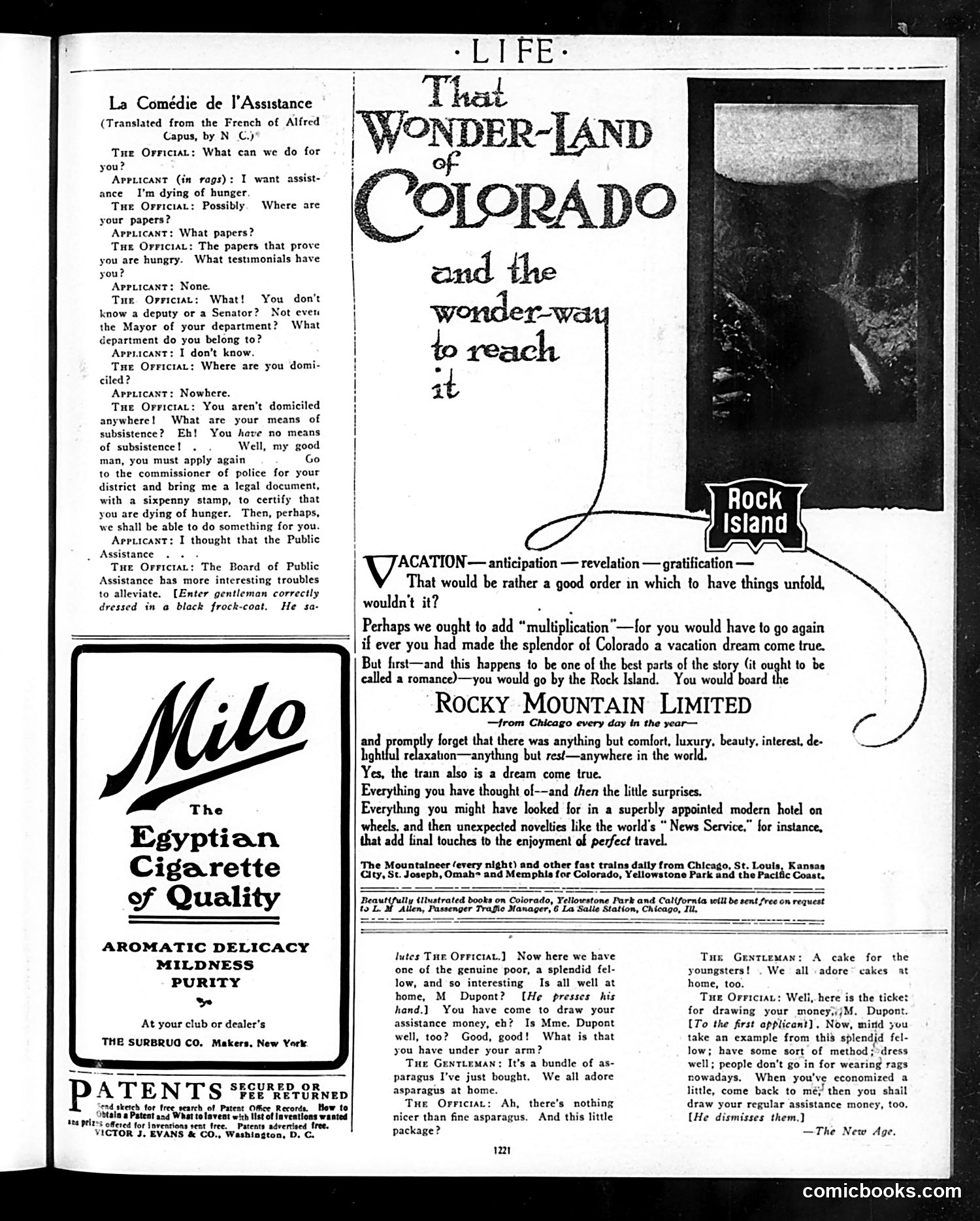
This page contains a French-translated satirical play, "La Comédie de l'Assistance," attacking welfare bureaucracy's callousness and class bias. A starving applicant seeks assistance but is denied—the official demands impossible documentation proving his hunger. He's turned away repeatedly for lacking papers, addresses, and connections. Immediately after, a well-dressed gentleman enters seeking the same assistance. The official greets him warmly, inquires about his family, and cheerfully provides money. The gentleman's only "qualification" is his appearance and gentility. **The satire's point:** Welfare officials prioritize respectability and proper procedure over actual need. The truly desperate poor are blocked by red tape, while the moderately poor—those who "dress well"—receive aid easily. It's a biting critique of how bureaucratic systems enable class discrimination while maintaining the illusion of impartial assistance.
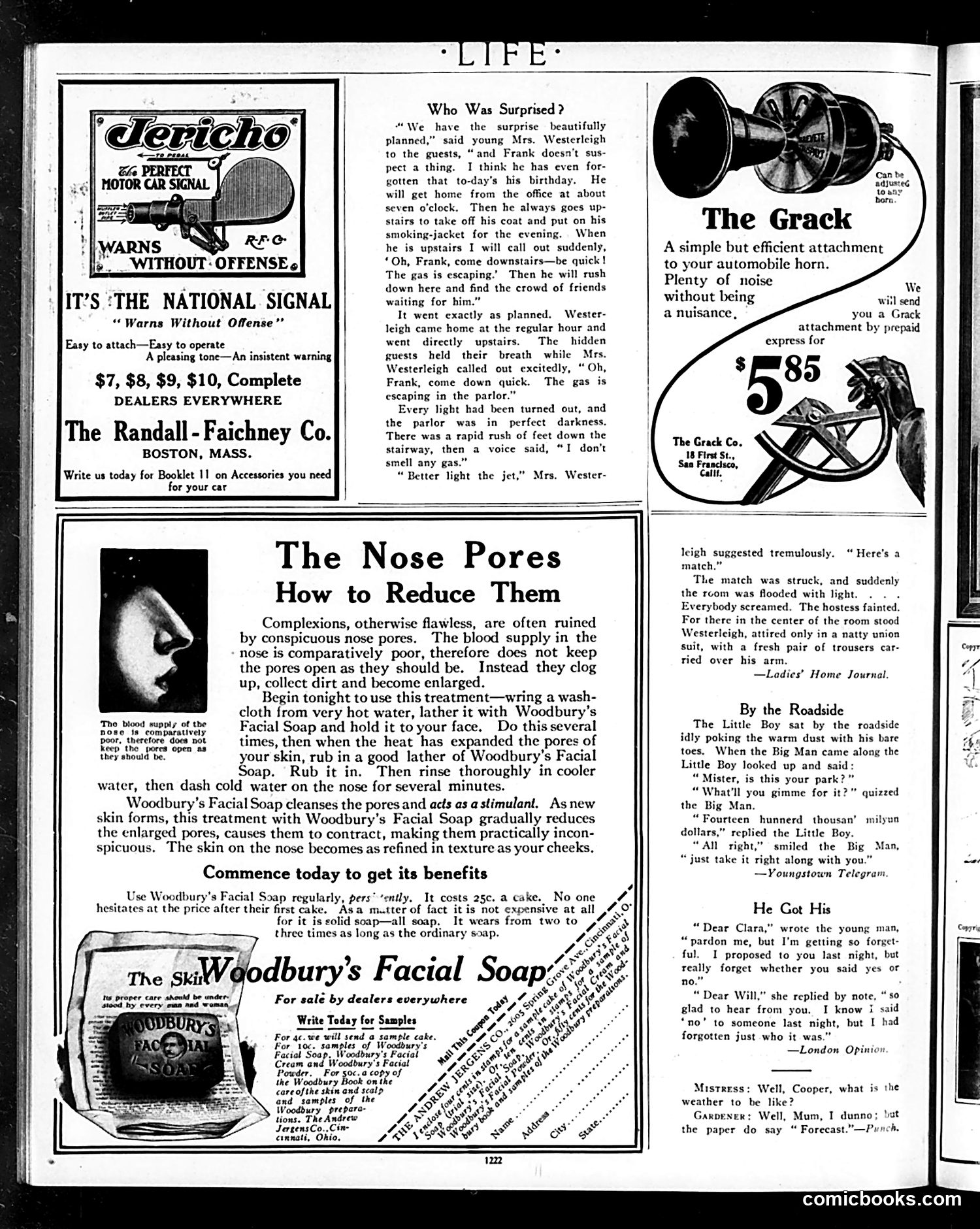
This page contains **humorous short stories and advertisements** typical of early 20th-century Life magazine satire. **"Who Was Surprised?"** is a comedic anecdote about a birthday surprise party that backfires. Mrs. Westerleigh plans to trick her husband Frank into thinking there's a gas leak, getting him downstairs where friends wait. However, when the lights turn on, Frank is revealed wearing only underwear—the real "surprise" is his embarrassment rather than the party. **"By the Roadside"** is a brief joke about a boy playing with dust who claims to be burying "fourteen hundred thousand million dollars," which the Big Man accepts with amusement. **"He Got His"** appears to be the start of another anecdote. The page also contains **product advertisements** (Jericho car signal horn, The Crack horn attachment, Woodbury's Facial Soap) typical of the era. The nose-pores article is essentially advertorial content promoting Woodbury's Soap as a beauty treatment. The humor relies on domestic scenarios and wordplay rather than political satire.
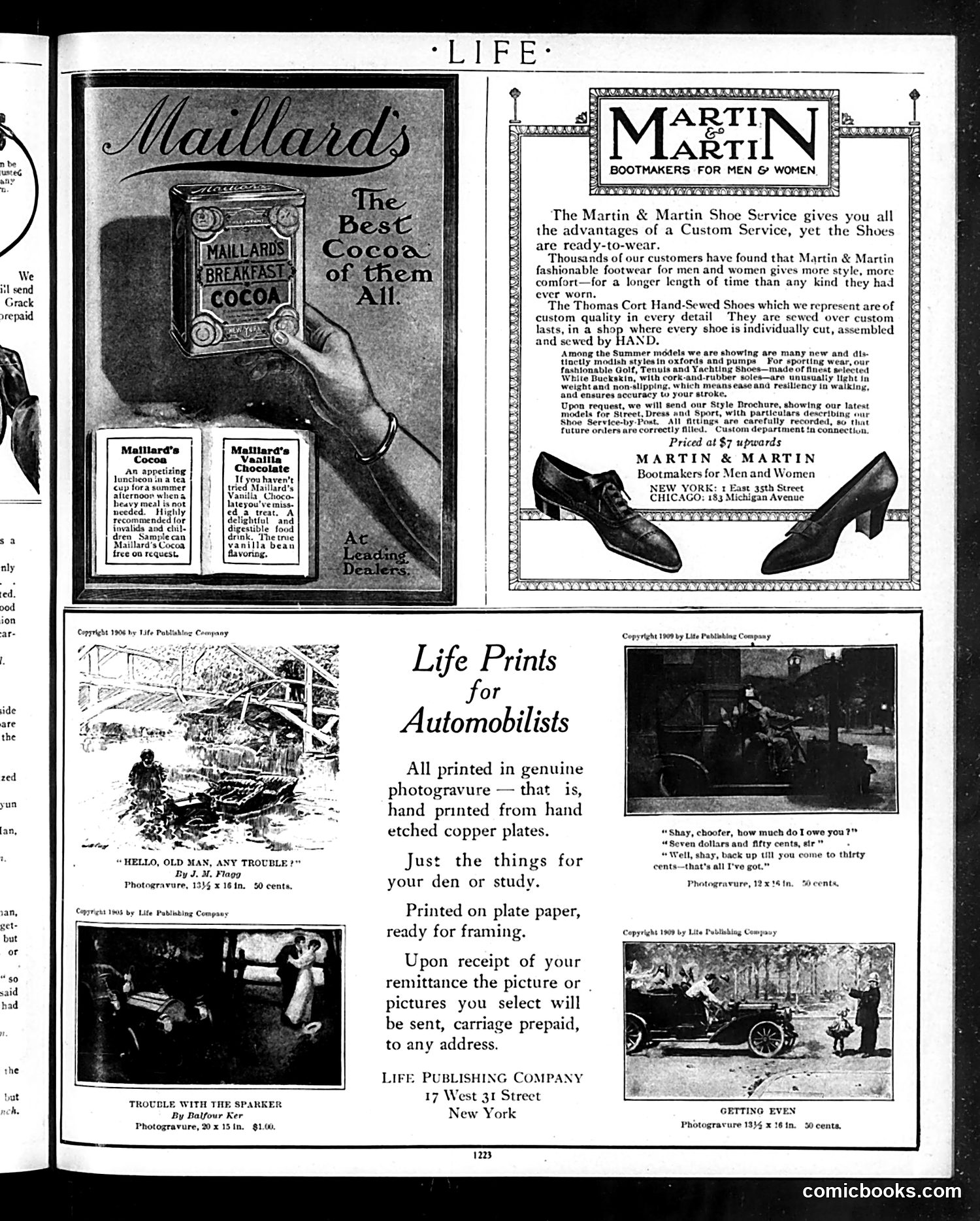
This page is primarily **advertising**, not editorial satire. It contains three distinct advertisements: 1. **Mailliard's Cocoa** (top left): A product advertisement emphasizing cocoa as a refreshing summer beverage, with sample availability. 2. **Martin & Martin Bootmakers** (top right): A shoe company advertisement highlighting custom-quality ready-to-wear footwear, particularly fashionable golf, tennis, and yachting shoes for affluent customers. 3. **Life Prints for Automobilists** (bottom): The magazine itself advertises photogravure prints featuring automobiles and humorous driving scenarios (like the "shay, choofer" exchange about taxi fare). These prints are marketed as affordable den decorations. The automobile-themed prints represent early 20th-century humor about emerging car culture. The "shay, choofer" dialogue satirizes working-class taxi drivers and passenger disputes—contemporary social friction as automobiles became common urban transport.
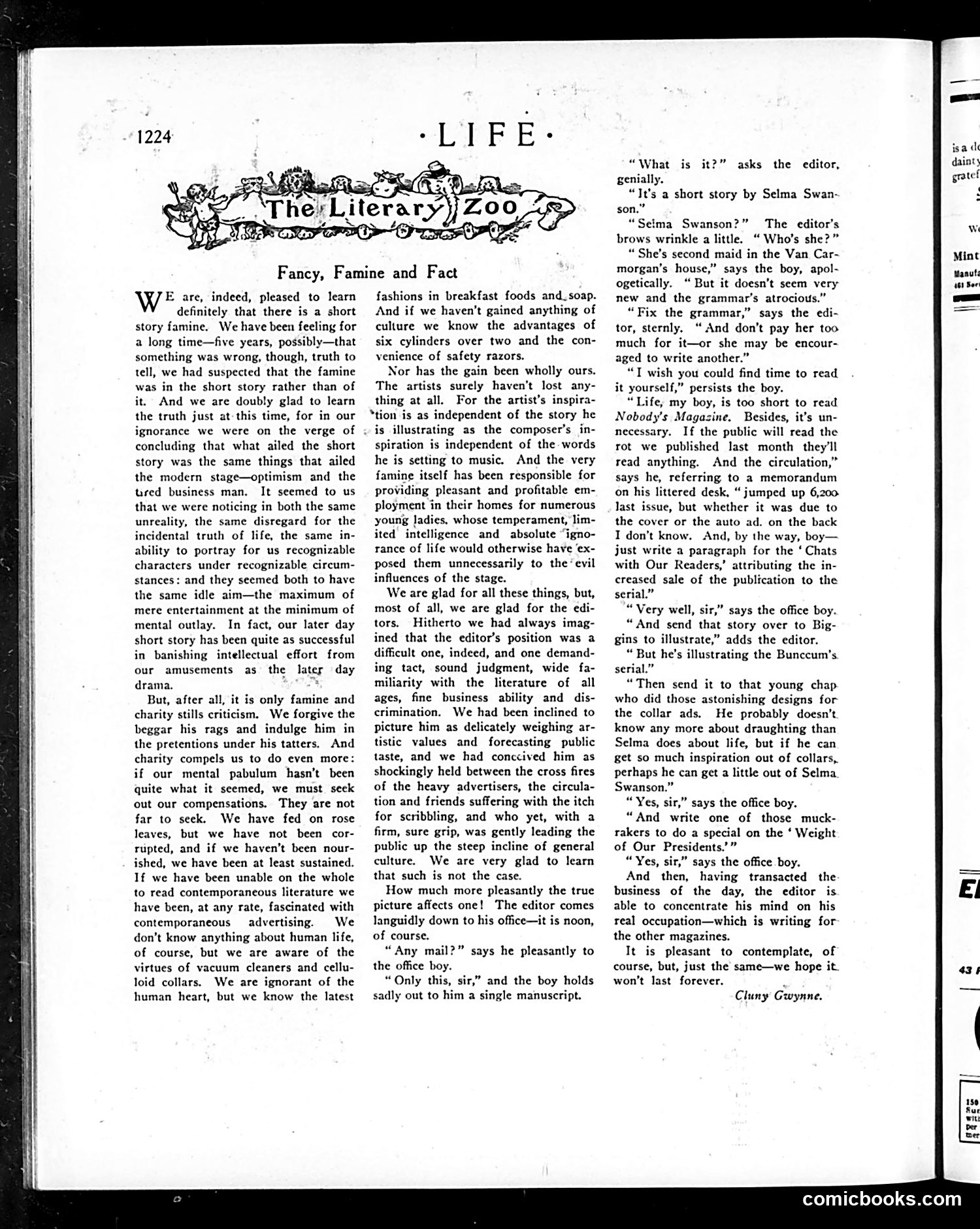
This is a satirical editorial about the alleged "short story famine" in contemporary American literature. The writer mockingly argues that while readers have been starved of quality short fiction, they've actually been well-fed by **advertising**—learning more about vacuum cleaners, safety razors, and breakfast cereals than about human nature or life itself. The piece takes particular aim at **magazine editors**, whom Life had previously imagined as intellectually rigorous gatekeepers of culture. Now, the satire reveals, an editor's actual job is merely bureaucratic drudgery: arriving at noon to receive a single manuscript submission from an office boy. The underlying critique targets both the **commercialization of magazines** and the decline in literary standards during this period. The editorial suggests that modern short stories lack substance and recognizable human truth—suffering from the same artificiality as contemporary theater. The cartoon header (showing a literary "zoo") visually reinforces this theme of literature becoming mere entertainment-spectacle rather than art.
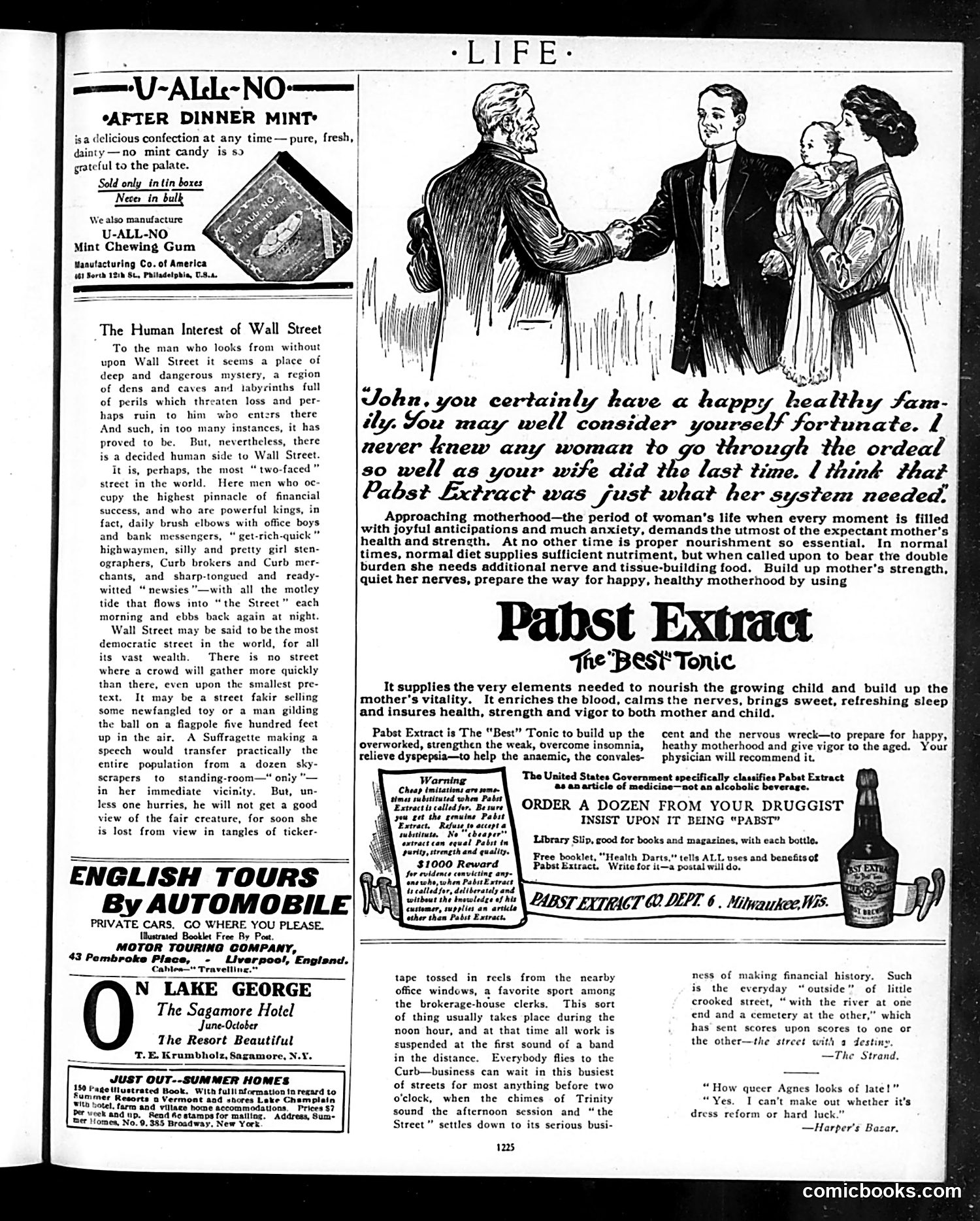
This page contains primarily **advertisements** rather than political satire. The main content is a large **Pabst Extract ad** featuring a domestic scene where a doctor congratulates a man ("John") on his wife's healthy pregnancy and recovery, crediting Pabst Extract as the restorative tonic. **The social context**: This reflects early 20th-century attitudes toward motherhood and women's health. The ad promises that Pabst Extract—a malt beverage extract—will "build up mother's strength" and prepare women for childbirth. This was common marketing before modern medicine; such tonics were widely advertised as cure-alls. **Notable detail**: The fine print explicitly states the product is "medicine—not an alcoholic beverage," suggesting regulatory scrutiny of alcohol-based tonics. The page also includes minor ads for U-All-No mints, English automobile tours, and Lake George resorts. The only editorial content is "The Human Interest of Wall Street," describing the street's social mixing of wealthy brokers and office workers—not satirical commentary.
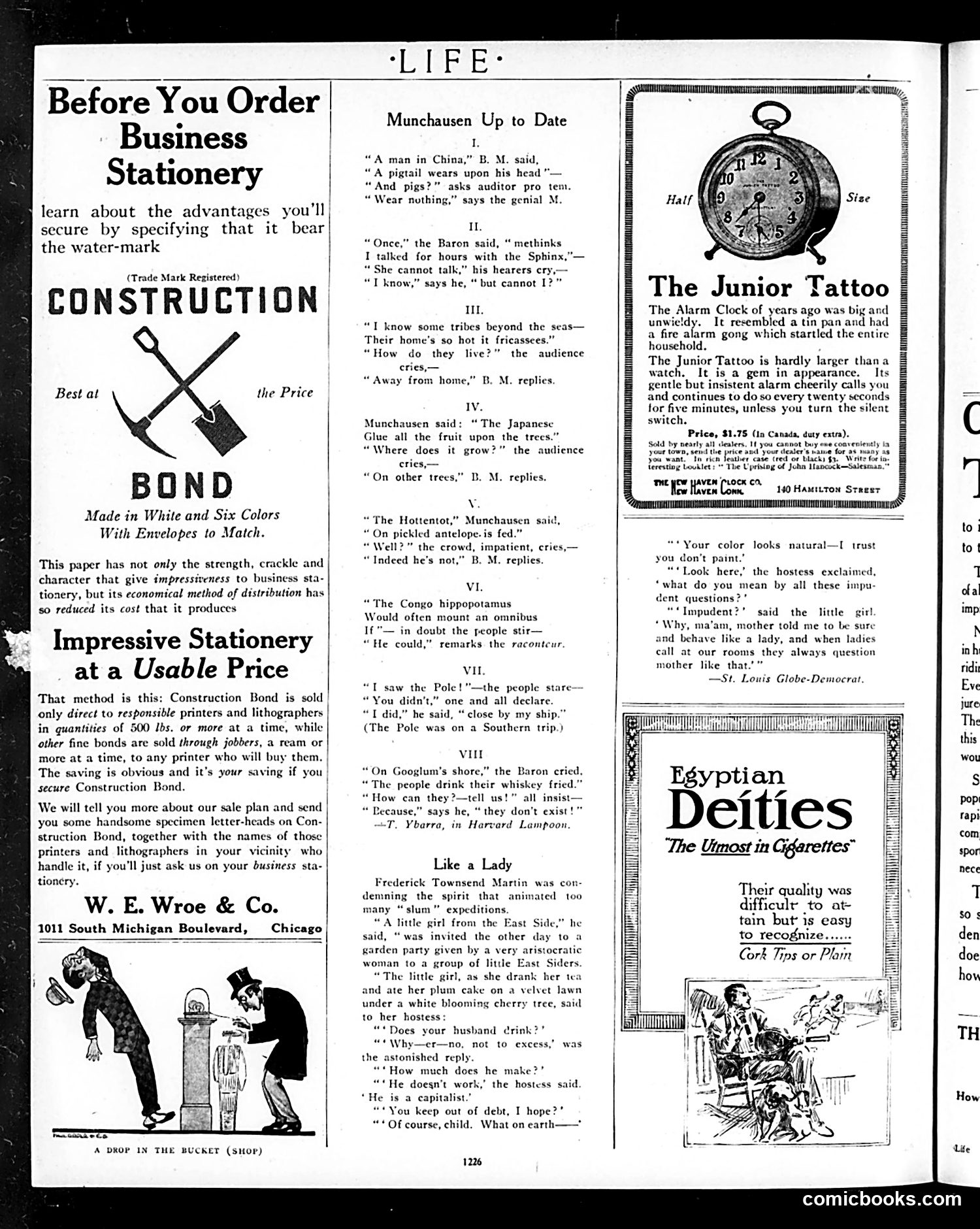
This page is primarily **advertising** with some humorous content interspersed. The main satirical piece is "Munchausen Up to Date," a series of tall tales attributed to "B. M." (Baron Munchausen). The humor derives from the classic literary character famous for absurd, impossible lies. Each vignette follows the same pattern: the Baron makes an outlandish claim, the audience questions its logic, and he responds with circular reasoning or admits the impossibility—yet insists he's told the truth anyway. Examples include gluing fruit to trees, hippopotamuses boarding omnibuses, and people drinking whiskey who "don't exist." The piece satirizes the tendency of people to tell exaggerated stories and stubbornly defend them despite logical contradiction. Below this is "Like a Lady," a brief anecdote by Frederick Townsend Martin about an East Side girl attending an aristocratic garden party who asks shockingly direct questions about the hostess's husband's drinking and employment—implying working-class directness contrasts with upper-class evasiveness. The remainder consists of advertisements for Construction Bond stationery, a Junior Tattoo alarm clock, and Egyptian Deities cigarettes.
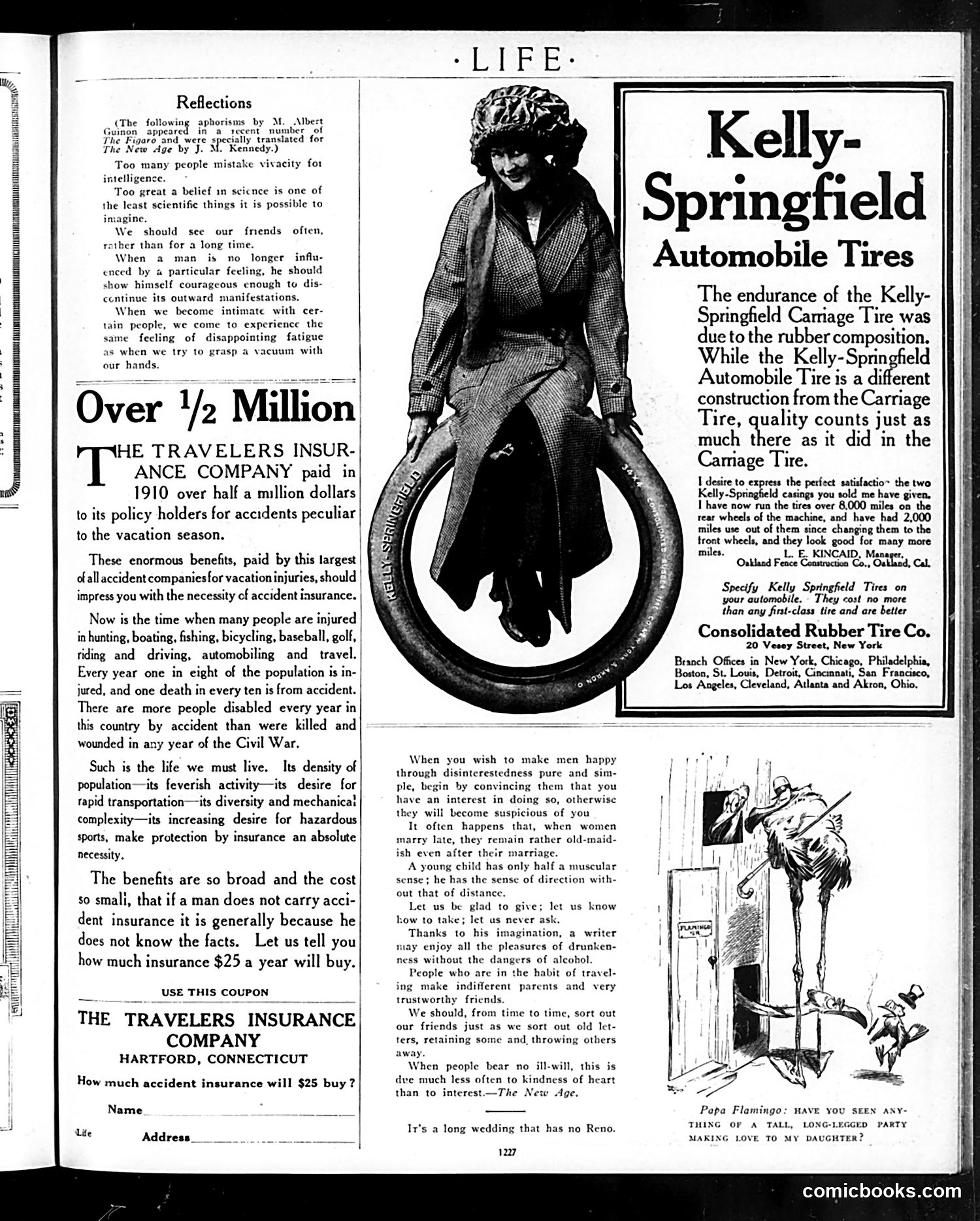
This page contains **primarily advertisements** alongside opinion content, typical of early 20th-century magazines. **Main Content:** The "Reflections" column presents French philosopher M. Gourmont's aphorisms about human nature—observations on friendship, science, marriage, and travel. These are philosophical musings rather than satire. **Advertisements:** - **Travelers Insurance Company**: Promotes accident insurance by citing statistics (1910 data showing half-million dollars paid for vacation injuries). The pitch emphasizes America's increasingly dangerous modern life—automobiles, sports, industrial activity. - **Kelly-Springfield Automobile Tires**: Features a woman sitting on a tire, advertising durability through customer testimonials. **Cartoon/Illustration:** A small sketch labeled "Papa Flamingo" appears at bottom-right, captioned with a joke about tall, long-legged parties and courtship—typical period humor about dating. **For Modern Readers:** The page reflects early automotive era anxieties: new technologies (cars, bicycles) created unprecedented accident risks, making insurance commercially viable. The ads suggest early-1900s America was experiencing rapid, sometimes dangerous modernization.
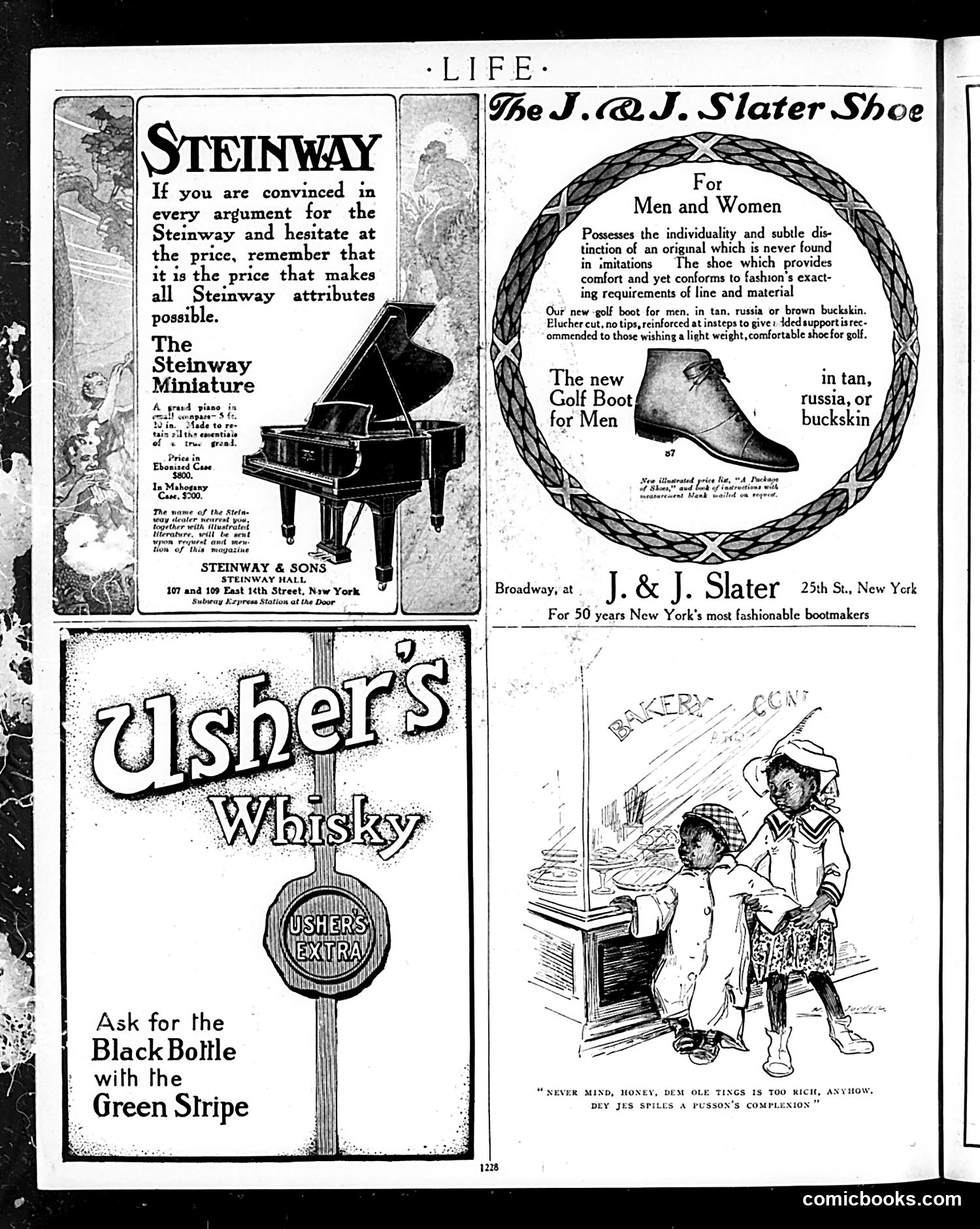
This page is primarily **advertising**, with one satirical cartoon. **The Advertisements:** - Steinway pianos (luxury instruments) - J. & J. Slater shoes (high-end footwear) - Usher's whisky **The Cartoon:** The small illustration at bottom right depicts two **Black children** outside a bakery, speaking in exaggerated dialect ("dem ole tings," "dey jes spills"). One child declines expensive pastries, claiming rich foods will "spill a pusson's complexion"—a racial stereotype suggesting Black skin is fragile or easily damaged. **The Satire's Point:** This reflects early 20th-century racist humor common in Life magazine. The joke relies on stereotypical speech patterns and pseudo-scientific racism linking diet to skin tone. The cartoon appears designed to accompany the luxury goods above it—creating contrast between expensive products and working-class characters, likely for comedic effect among the magazine's affluent readership. By modern standards, the racial caricature and dialect are offensive stereotypes, not clever satire.
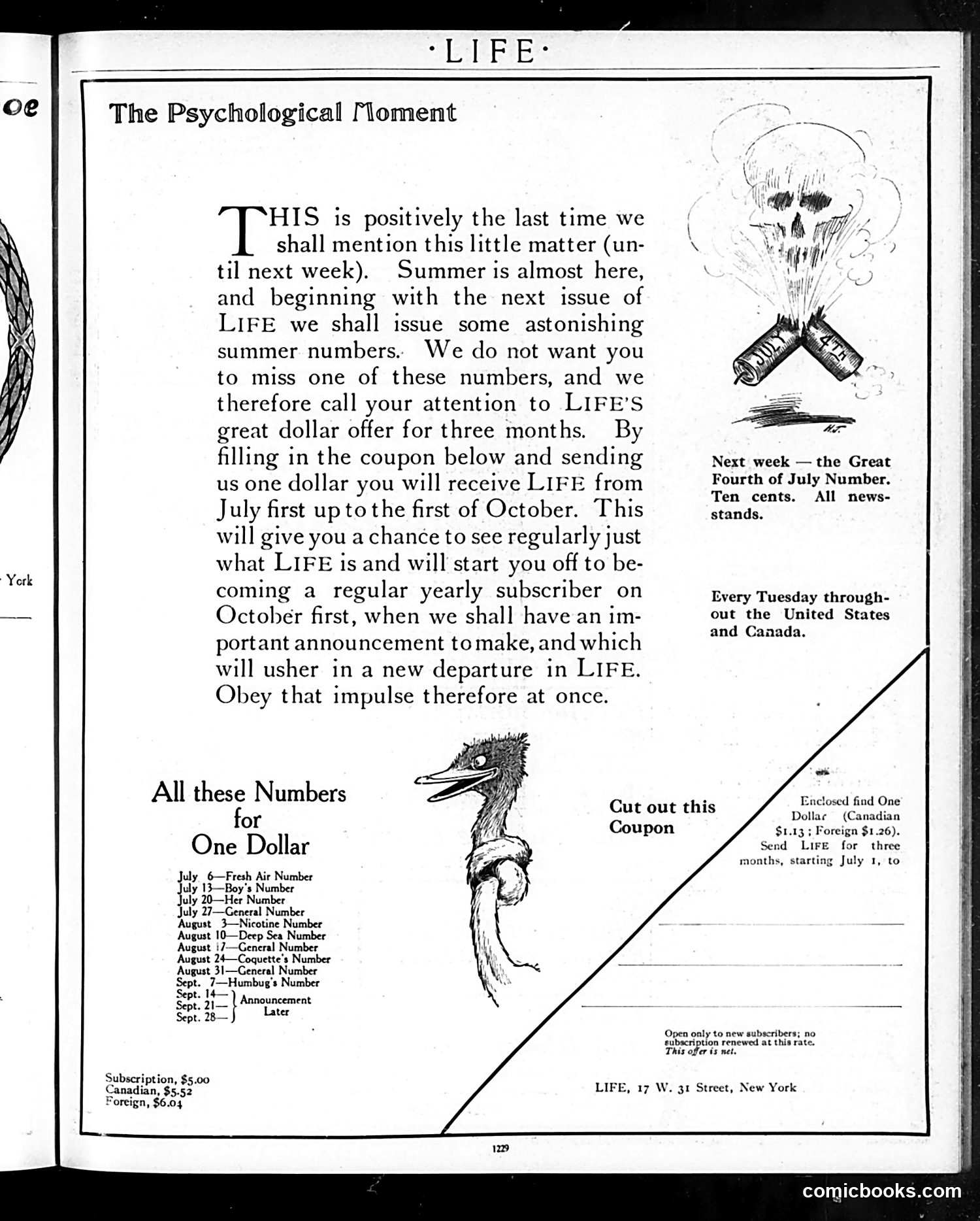
This page is primarily a **subscription advertisement**, not a political cartoon. The main content is Life magazine promoting a summer subscription offer: one dollar for three months of issues (July-September). The only illustration is an **ostrich** (likely representing foolishness or the "humbug" theme referenced in the issue list), used as decorative branding rather than satire. The "psychological moment" refers to the timing of their pitch—catching readers before summer, when Life promises "astonishing summer numbers" with themed issues ("Fresh Air," "Boy's," "Her," "Deep Sea," "Coquette's," "Humbug's," etc.). The text teases an important announcement coming October 1st to entice three-month subscriptions into annual ones. This is fundamentally a **marketing piece** using humor and urgency rather than political commentary.
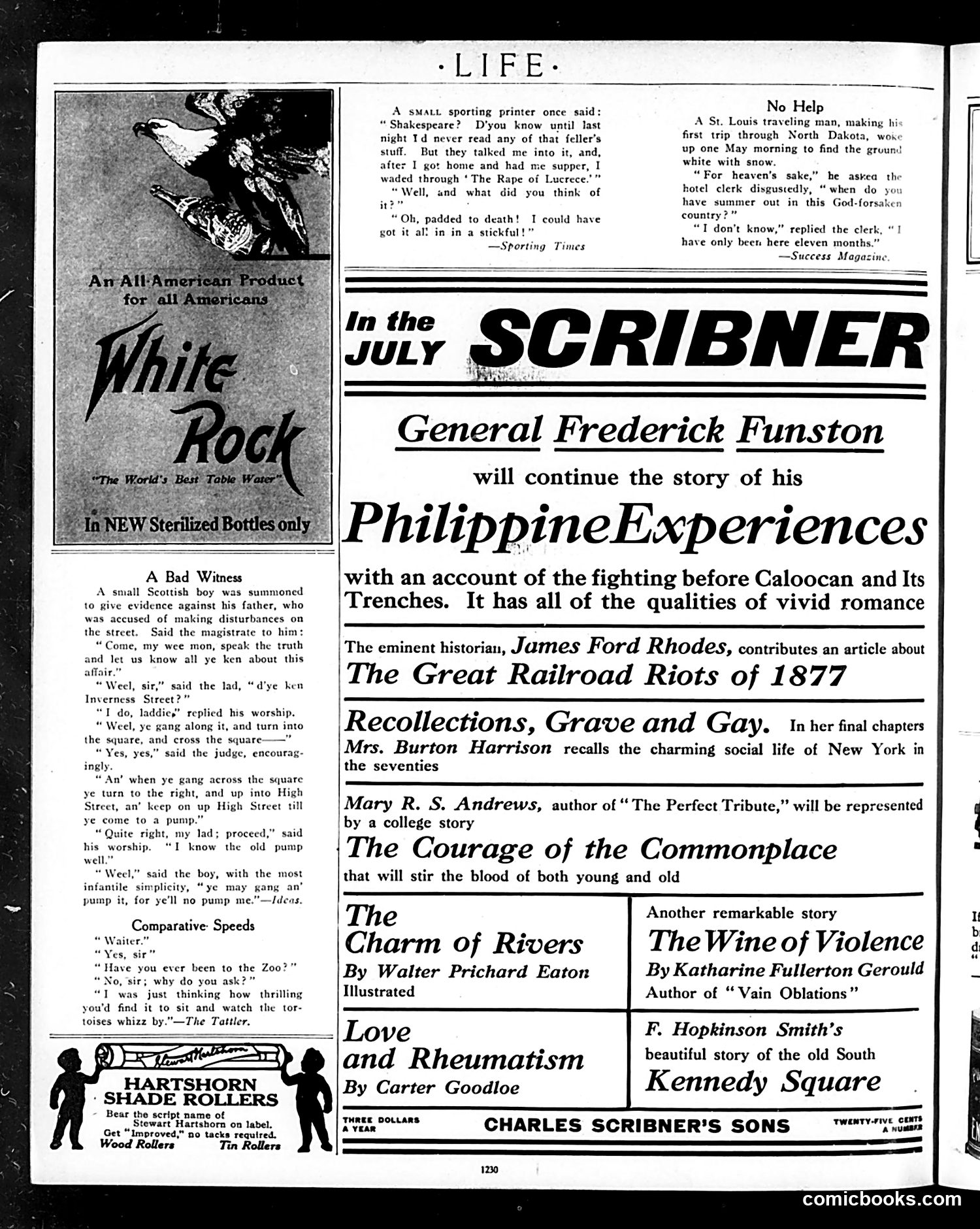
This is primarily a **table of contents/advertising page** for the July issue of Scribner's magazine, not a political cartoon page. The small humorous anecdotes scattered throughout represent typical early-20th-century joke content: - **"A Bad Witness"**: A Scottish boy, called to testify against his father, deliberately gives absurdly elaborate directions to a pump rather than answer the judge's questions—a joke about evasion and wit. - **"Comparative Speeds"**: A waiter compares watching zoo tortoises to the diner's slow eating—simple observational humor. - **"No Help"**: A traveling man asks a North Dakota hotel clerk when summer arrives; the clerk admits he's only been there eleven months—humor about the region's harsh climate and short employment. The page emphasizes Scribner's literary content, featuring articles by historian James Ford Rhodes and stories by authors Mary R.S. Andrews and F. Hopkinson Smith. There are also period product advertisements (White Rock water, Hartshorn Shade Rollers). No significant political satire is present on this page.
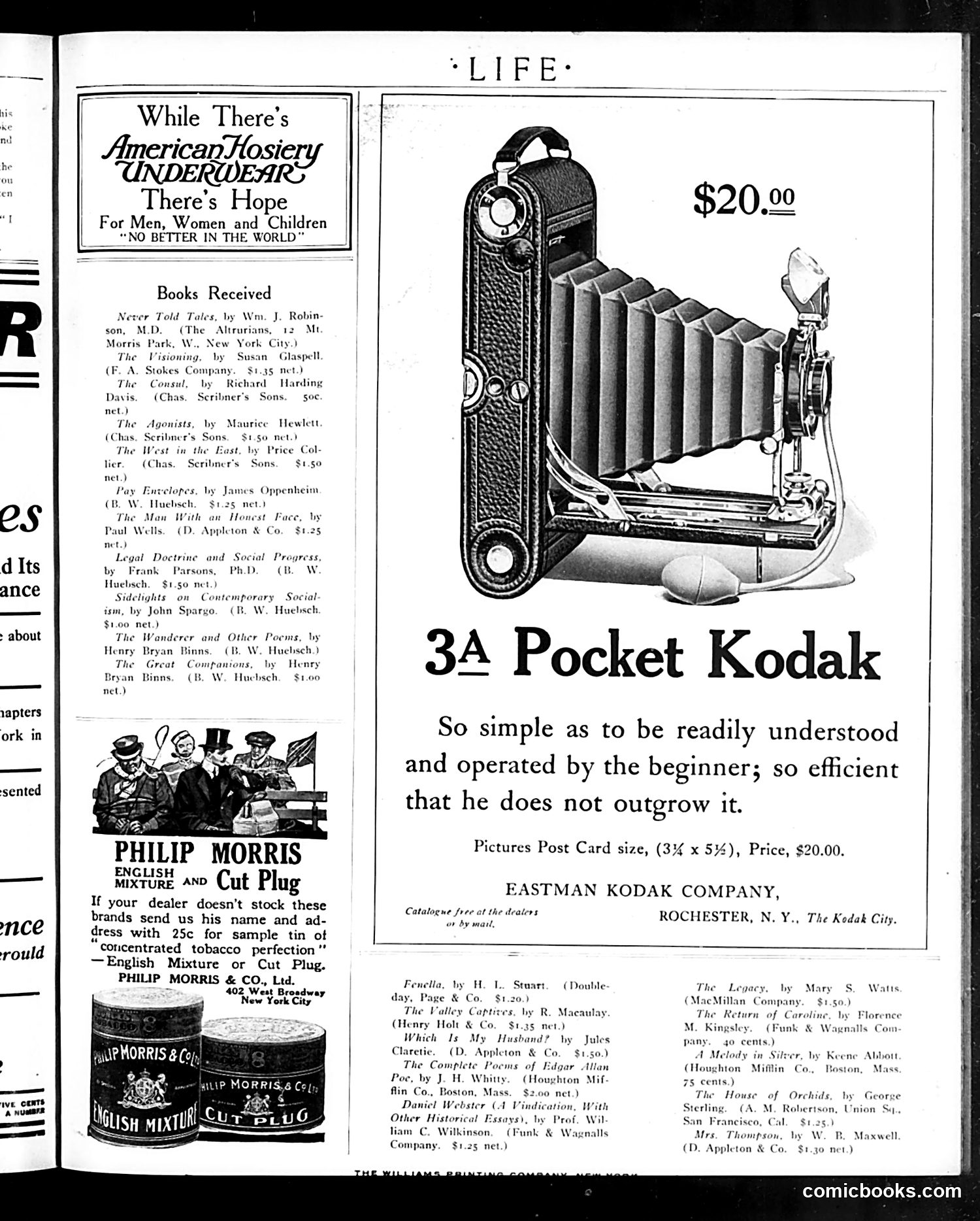
This page is primarily **advertising and book reviews**, not political satire. The main content consists of: **Left side:** A book review section listing recently published works (novels, poetry, essays) with publishers and prices, plus advertisements for American Hosiery and Philip Morris tobacco products. **Right side:** A full-page advertisement for the **3A Pocket Kodak camera** ($20.00), made by Eastman Kodak Company. The ad emphasizes the camera's simplicity for beginners and efficiency for experienced users, with sample photos showing the camera's compact accordion-style bellows design. The page reflects early 20th-century consumer culture, showcasing emerging technologies (portable photography) and leisure reading alongside traditional tobacco and clothing products. There is **no political cartoon or satire visible**—this is a typical magazine layout combining editorial content with commercial advertising.
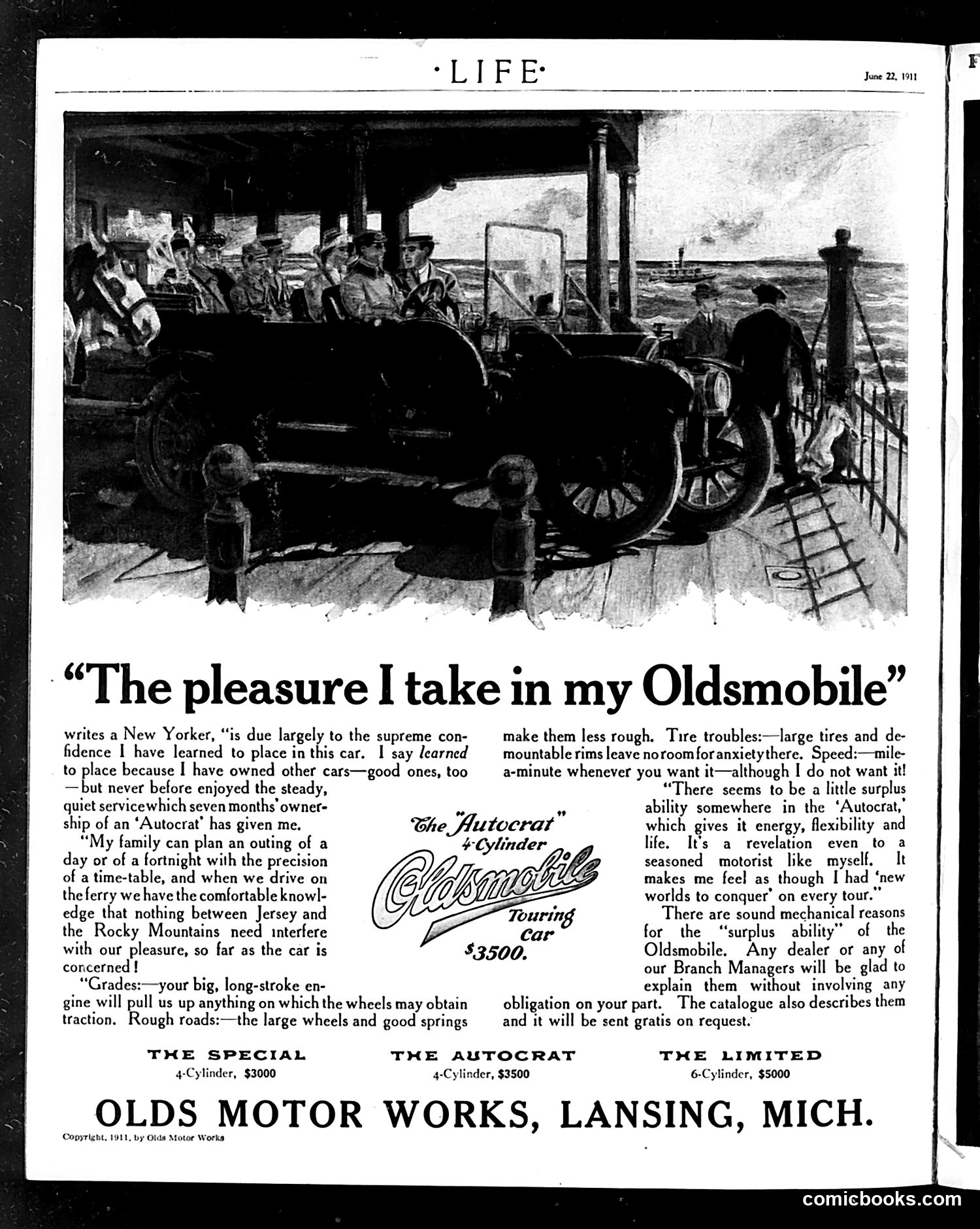
This is primarily an **automobile advertisement**, not political satire. It features a testimonial from a satisfied New York owner praising his Oldsmobile "Autocrat" model for reliability and performance on American roads. The "cartoon" element is the illustration showing an early motorcar on a ferry with passengers—depicting the car's capability for long-distance family travel, a novel luxury in 1911. The text emphasizes practical advantages: powerful engine for hills, sturdy wheels for rough roads, and reliable tires. The phrase "new worlds to conquer" references Napoleon, suggesting the car enables adventure and conquest of the American landscape. The advertisement positions Oldsmobile as dependable and superior to competitors, listing three models ($3,000–$5,000). This reflects the early automotive era when car ownership was still a status symbol and reliability claims were major selling points.