
Life, 1911-06-22 · page 32 of 44
Life — June 22, 1911 — page 32: what you’re looking at
What you’re looking at
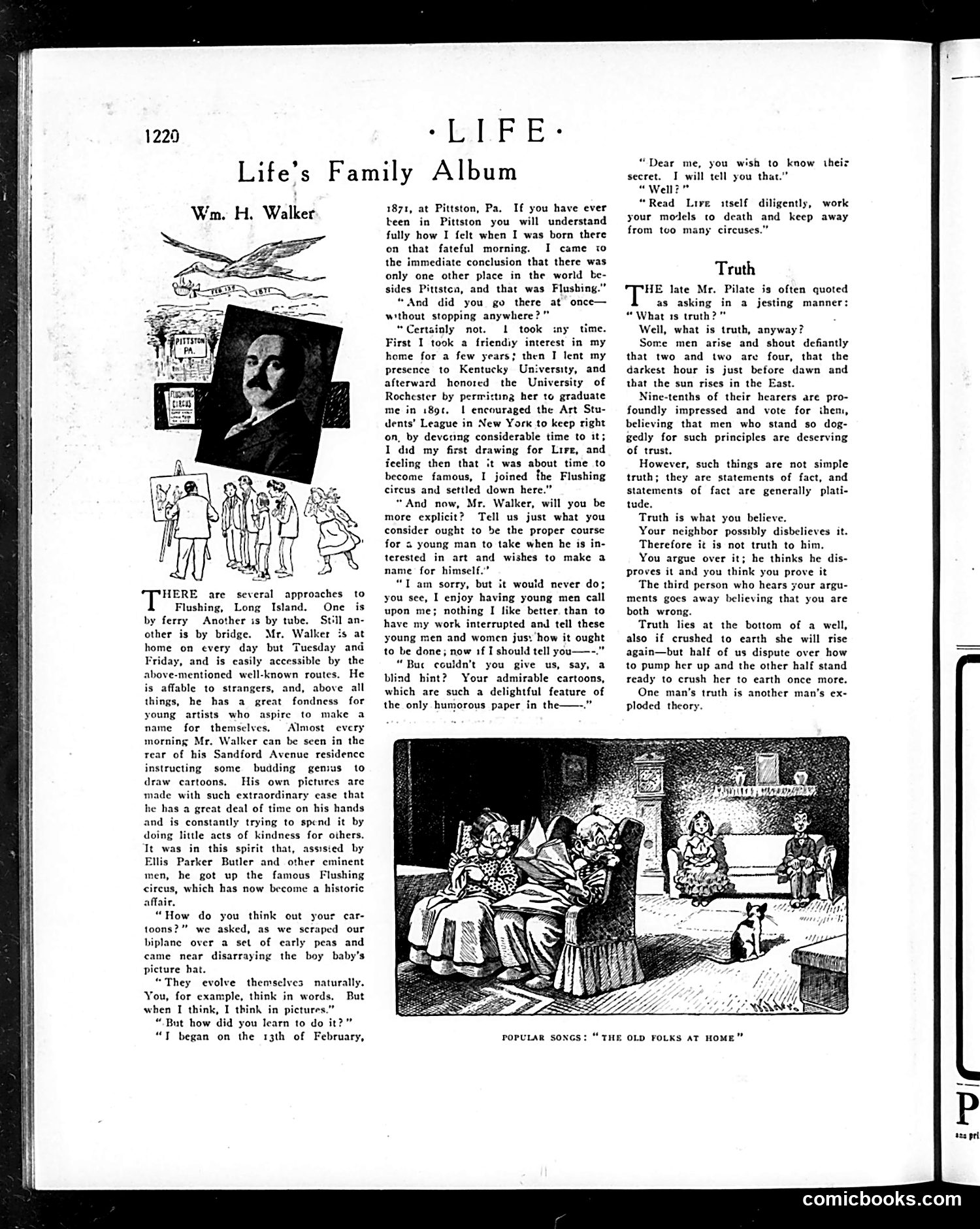
This page features **Wm. H. Walker**, a cartoonist for *Life* magazine, in an interview-style profile titled "Life's Family Album." The humor operates on multiple levels: **The Interview Format**: A journalist visits Walker at his Flushing, Long Island home, asking how he creates cartoons. Walker responds with self-aggrandizing anecdotes—he claims to have "honored" universities by attending them and founded the "famous Flushing circus." **The Satire**: Walker humorously deflects serious questions about artistic technique with rambling autobiography and false modesty. When asked for advice on becoming an artist, he refuses because he enjoys having young artists interrupt his work to ask him questions—a self-aware joke about his own vanity. **The Punchline**: His actual advice: read *Life* diligently, work hard, and avoid circuses—circular, unhelpful guidance that satirizes both Walker's pretentiousness and generic "success" advice. The accompanying illustration shows a domestic scene, supporting the *Life* magazine's typical focus on American middle-class life and humor.
📄 Transcribed text from this page (OCR, searchable)
Machine-transcribed from the original scan — historical spelling and the odd misread are preserved.
: i i «Jegl JF E™ Life’s Family Album Wa. H. Walker HERE are several approaches to Flushing, Long Island. One is by ferry Another is by tube, Still an- other is by bridge. Mr. Walker is at home on every day but Tuesday and Friday, and is easily accessible by the above-mentioned well-known routes. He is affable to strangers, and, above all things, he has a great fondness for young artists who aspire to make a name for themselves. Almost every morning Mr. Walker can be seen in the rear of his Sandford Avenue residence instructing some budding genius to draw cartoons, His own pictures are made with such extraordinary case that he has a great deal of time on his hands and is constantly trying to spend it by doing little acts of kindness for others. It was in this spirit that, assisied by Ellis Parker Butler and other eminent men, he got up the famous Flushing circus, which has now become a historic affair. “How do you think out your car- toons?” we asked, as we scraped our biplane over a set of early peas and came near disarraying the boy baby’s picture hat. “They evolve themselves naturally. You, for example, think in words. But when I think, I think in pictures, “But how did you learn to do it?” “T began on the 13th of February, 1871, at Pittston, Pa. If you have ever been in Pittston you will understand fully how I felt when I was born there on that fateful morning. I came io the immediate conclusion that there was only one other place in the world be- sides Pittstca, and that was Flushing.” “And did you go there at once— without stopping anywhere?” “Certainly not. 1 took iny time. First I took a friendiy interest in my home for a few years; then I lent my presence to Kentucky University, and afterward honored the University of Rochester by permitting her to graduate me in 189¢, | encouraged the Art Stu- dents’ League in New York to keep right on, by devcring considerable time to it; 1 did my first drawing for Lire, and iceling then that it was about time to become famous, I joined the Flushing circus and settled down here.” “And now, Mr. Walker, will you be more explicit? Tell us just what you consider ought to be the proper course for < young man to take when he is in- terested in art and wishes to make a name for himself.” “Tam sorry, but it would never do; you see, I enjoy having young men call upon me; nothing I like better. than to have my work interrupted and tell these young men and women jus: how it ought to be done; now if I should tell you—. “Buc couldn't you give us, sa) blind hint? Your admirable cartoons, which are such a delightful feature of the only humorous paper in the—-.” “Dear me, you wish to know iheiz secret. I HM tell you thar.” “Well?” “Read Live itself diligently, work your models co death and keep away from too many circuses.” Truth HE late Mr. Pilate is often quoted as asking in a jesting manner: “ What 1s truth?” Well, what is truth, anyway? Some men arise and shout defiantly that two and two are four, that the darkest hour is just before dawn and that the sun rises in the East. Nine-tenths of their hearers are pro- foundly impressed and vote for ihem, believing that men who stand so dog- gedly for such principles are deserving of trust. However, such things are not simple truth; they are statements of fact, and statements of fact are generally plati- tude. Truth is what you believe. Your neighbor possibly disbelieves it. Therefore it is not truth to him. You argue over it; he thinks he dis- proves it and you think you prove it ‘The third person who hears your argu- ments goes away believing that you are both wrong. Truth lies at the bottom of a well, also if crushed to earth she will rise again—but half of us dispute over how to pump her up and the other half stand ready to crush her to earth once more. One man’s truth is another man’s ex- ploded theory. POPULAR SONGS: “THE OLD FOLKS AT HOME” comicbooks.com