
Life, 1911-06-22 · page 8 of 44
Life — June 22, 1911 — page 8: what you’re looking at
What you’re looking at
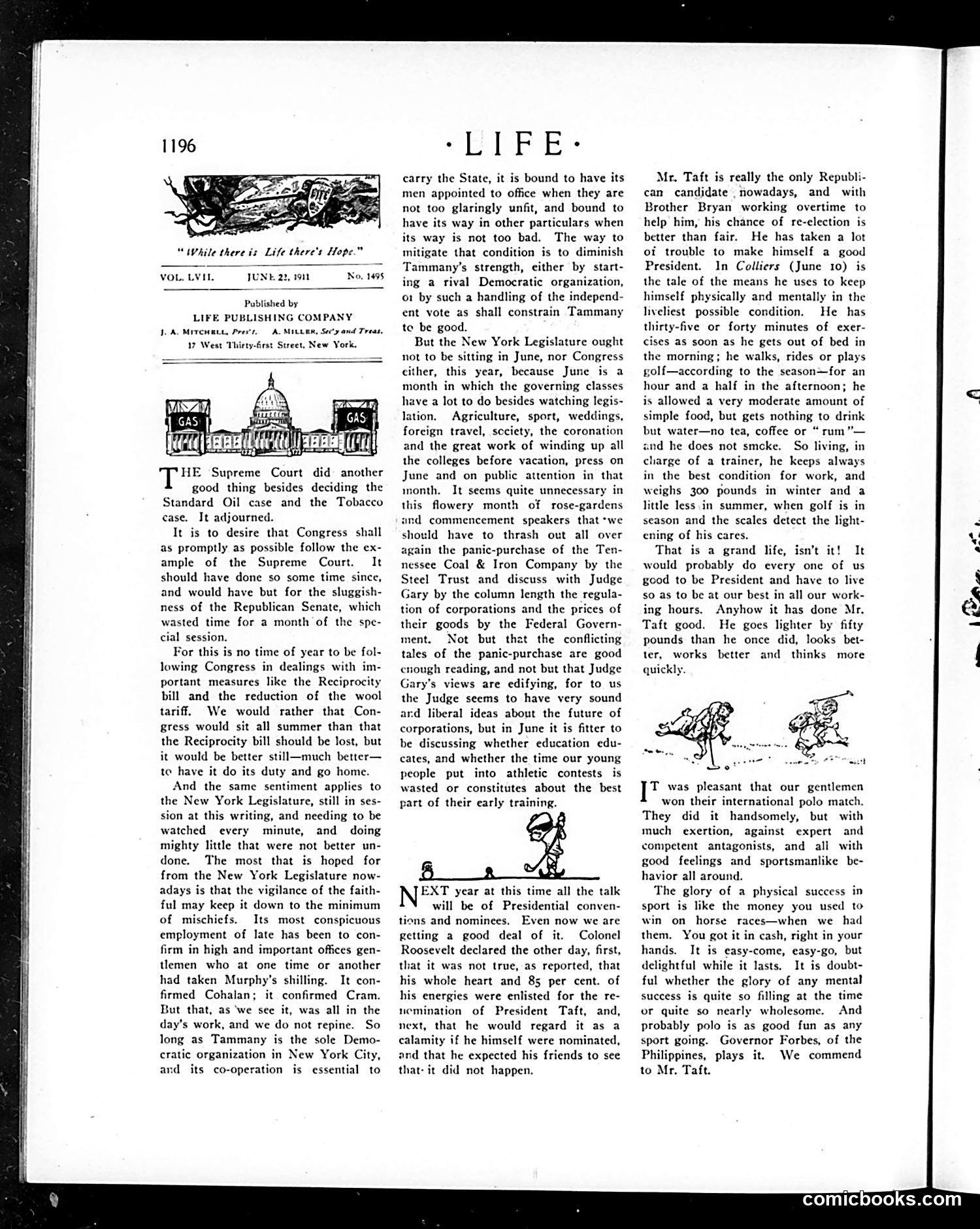
This page from *Life* magazine contains editorial commentary on President William Howard Taft's physical fitness and work habits. The text praises Taft for maintaining good health through moderate exercise—walking, golfing, and simple diet—while managing a demanding schedule. The piece suggests Taft is "the only Republican nowadays" with a genuine chance at re-election, contrasting him favorably with rival Theodore Roosevelt. The small illustrated vignettes appear to depict polo and athletic activities, supporting the article's theme about physical vigor in leadership. The commentary reflects contemporary anxieties about presidential fitness and the emerging 1912 election contest between the sitting president Taft and his predecessor Roosevelt.
📄 Transcribed text from this page (OCR, searchable)
Machine-transcribed from the original scan — historical spelling and the odd misread are preserved.
“While there is Life there's Hope.” No. 1495 VOL. LVI. JUNE 22, 1911 Published by LIFE PUBLISHING COMPANY JA. Meron mnt, Prese, W West Thirty- A. MiLLen, Sey and Treas, at Street, HE Supreme Court did another good thing besides deciding the Standard Oil case and the Tobacco case. It adjourned. It is to desire that Congress shall as promptly as possible follow the ex- ample of the Supreme Court. It should have done so some time since, and would have but for the sluggish- ness of the Republican Senate, which wasted time for a month of the spe- cial session. For this is no time of year to be fol- lowing Congress in dealings with im- portant measures like the Reciprocity bill and the reduction of the wool tariff. We would rather that Con- gress would sit all summer than that the Reciprocity bill should be lost, but it would be better still—much better— te have it do its duty and go home. And the same sentiment applies to the New York Legislature, still in ses- sion at this writing, and needing to be watched every minute, and doing mighty little that were not better un- done. The most that is hoped for from the New York Legislature now- adays is that the vigilance of the faith- ful may keep it down to the minimum of mischiefs. Its most conspicuous employment of late has been to con- firm in high and important offices gen- tlemen who at one time or another had taken Murphy’s shilling. It con- firmed Cohalan; it confirmed Cram. But that, as we see it, was all in the day’s work, and we do not repine. So long as Tammany is the sole Demo- cratic organization in New York City, and its co-operation is essential to Si) |e carry the State, it is bound to have its men appointed to office when they are not too glaringly unfit, and bound to have its way in other particulars when its way is not too bad. The way to mitigate that condition is to diminish Tammany’s strength, either by start- ing a rival Democratic organization, o1 by such a handling of the independ- ent vote as shall constrain Tammany te be good. But the New York Legislature ought not to be sitting in June, nor Congress either, this year, because June is a month in which the governing classes have a lot to do besides watching legis- lation. Agriculture, sport, weddings, foreign travel, scciety, the coronation and the great work of winding up all the colleges before vacation, press on June and on public attention in that month. It seems quite unnecessary in this flowery month of rose-gardens and commencement speakers that *we should have to thrash out all over again the panic-purchase of the Ten- nessee Coal & Iron Company by the Steel Trust and discuss with Judge Gary by the column length the regula- tion of corporations and the prices of their goods by the Federal Govern- ment. Not but that the conflicting tales of the panic-purchase are good cnough reading, and not but that Judge Gary's views are edifying, for to us the Judge seems to have very sound ard liberal ideas about the future of corporations, but in June it is fitter to be discussing whether education edu- cates, and whether the time our young people put into athletic contests is wasted or constitutes about the best part of their early training. XT year at this time all the talk will be of Presidential conven- tions and nominees. en now we are getting a good deal of it. Colonel Roosevelt declared the other day, first, that it was not true, as reported, that his whole heart and 85 per cent. of his energies were enlisted for the re- nomination of President Taft, and, next, that he would regard it as a calamity if he himself were nominated, and that he expected his friends to see that: it did not happen. Mr. Taft is really the only Republi- can candidate . nowadays, and with Brother Bryan working overtime to help him, his chance of re-election is better than fair. He has taken a lot of trouble to make himself a good President. In Colliers (June 10) is the tale of the means he uses to keep himself physically and mentally in the liveliest possible condition. He has thirty-five or forty minutes of exer- cises as soon as he gets out of bed in the morning; he walks, rides or plays golf—according to the season—for an hour and a half in the afternoon; he is allowed a very moderate amount of simple food, but gets nothing to drink but water—no tea, coffee or “ rum ”— and he does not smcke. So living, in charge of a trainer, he keeps always in the best condition for work, and weighs 300 pounds in winter and a little less in summer, when golf is in season and the scales detect the light- ening of his cares. That is a grand life, isn’t it! It would probably do every one of us good to be President and have to live so as to be at our best in all our work- ing hours. Anyhow it has done Mr. Taft good. He goes lighter by fifty pounds than he once did, looks bet- ter, works better and thinks more quickly. det T was pleasant that our gentlemen won their international polo match. They did it handsomely, but with much exertion, against expert and competent antagonists, and all with good feelings and sportsmanlike be- havior all around. The glory of a physical success in sport is like the money you used to win on horse races—when we had them. You got it in cash, right in your hands. It is easy-come, easy-go, but delightful while it lasts. It is doubt- ful whether the glory of any mental success is quite so filling at the time or quite so nearly wholesome. And probably polo is as good fun as any sport going. Governor Forbes, of the Philippines, plays it. We commend to Mr. Taft. comicbooks.com