
Life, 1911-06-22 · page 25 of 44
Life — June 22, 1911 — page 25: what you’re looking at
What you’re looking at
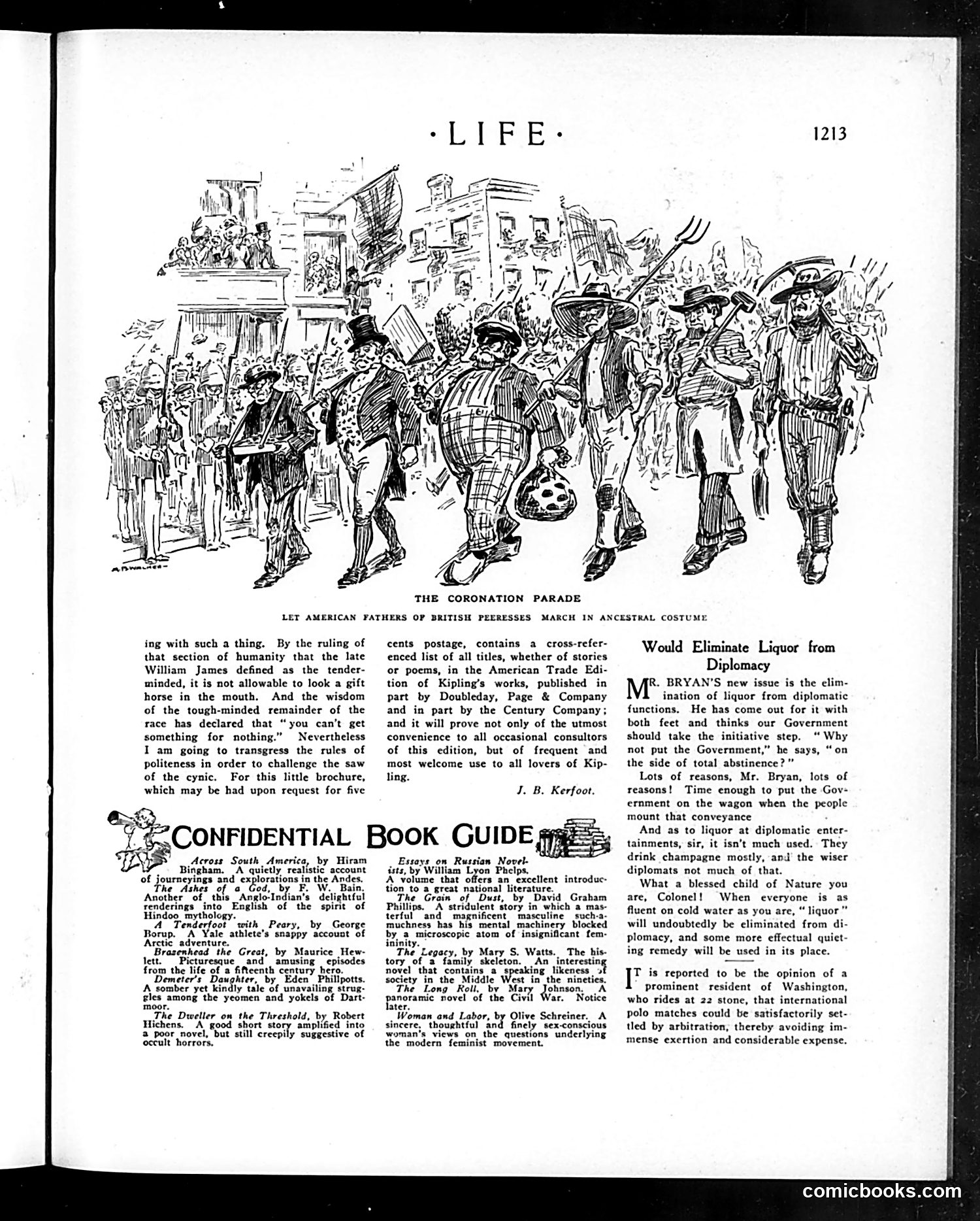
The main illustration satirizes American wealth and social climbing. It depicts the coronation parade of a British monarch, with the caption proposing that "American fathers of British peeresses march in ancestral costume." The joke targets wealthy American industrialists who had daughters marry into British aristocracy—a common phenomenon of the Gilded Age. These self-made American businessmen, lacking genuine aristocratic heritage, would absurdly attempt to parade in "ancestral costumes" they had no legitimate claim to wear. The cartoon mocks both American nouveau riche pretension and the willingness of cash-strapped British nobility to marry American heiresses for their fortunes. The accompanying text satirizes William Jennings Bryan's recent proposal to eliminate liquor from diplomatic functions, characterizing him as naïvely idealistic and out of touch with practical reality—diplomacy fundamentally requires such social lubricants.
📄 Transcribed text from this page (OCR, searchable)
Machine-transcribed from the original scan — historical spelling and the odd misread are preserved.
THE CORONATION PARADE If Hil i LET AMERICAN FATHERS OF BRITISH PEERESSES MARCH IN ANCESTRAL COSTUME. ing with such a thing. By the ruling of that section of humanity that the late William James defined as the tender- minded, it is not allowable to look a gift horse in the mouth. And the wisdom of the tough-minded remainder of the race has declared that “you can’t get something for nothing.” Nevertheless I am going to transgress the rules of politeness in order to challenge the saw of the cynic. For this little brochure, which may be had upon request for five CONFIDENTIAL BOOK GUIDE gees, Across South America, by Hiram Bingham. “A quietly realistic account of Journeyings and explorations in the Andes. The Ashes of a. Cod, by FE. W,, Bain, Another of, this Anglo-Indian’s delightful renderings into English of the spint of Hindoo_ mythology. Tenderfoot with Peary, by George Borup. A Yale athlete's snappy account of Arctic adventure. i Brasenhead the Great, by Maurice Hew- lett. Picturesque and’ amusing episodes from the life of a fifteenth century hero. Demeter’s Daughter, by Eden Phillpotts. A somber yet kindly tale of unavailing strug- gles among the yeomen and yokels of Dart- moor. The Dweller on the Threshold, by Robert Hichens. A good short story amplified into a poor novel, but still creepily suggestive of occult horrors. cents postage, contains a cross-refer- enced list of all titles, whether of stories or poems, in the American Trade Edi- tion of Kipling’s works, published in part by Doubleday, Page & Company and in part by the Century Company; and it will prove not only of the utmost convenience to all occasional consultors of this edition, but of frequent and most welcome use to all lovers of Kip- ling. J. B. Kerfoot. Essays on Russian Novel- ists, by William Lyon Phelps. : A volume that offers an excellent introduc- tion to a great national literature. The Grain of Dust, by David Graham Phillips. A stridulent story in which a mas- terful magnificent’ masculine such-a- muchness has his mental machinery blocked by 2 microscopic atom of insignificant fem- ninity. The Legacy, by Mary S. Watts. The his- tory of a family skeleton. An interestin; Rovel ‘that contain a speaking likeness. » ety i le West in the nineties. lohnson. =A Notice dl Ls by Mary panoramic novel of the Civil War. The Long later. Woman and Labor, by Olive Schreiner. A sincere, thoughtful and finely sex-conscious woman's views on the questions underlying the modern feminist movement. Would Eliminate Liquor from Diplomacy IR. BRYAN’S new issue is the elim- ination of liquor from diplomatic functions. He has come out for it with both feet and thinks our Government should take the initiative step. “ Why not put the Government,” he says, “on the side of total abstinence?” Lots of reasons, Mr. Bryan, lots of reasons! Time enough to put the Gov- ernment on the wagon when the people mount that conveyance And as to liquor at diplomatic enter- tainments, sir, it isn't mach used. They drink champagne mostly, and’ the wiser diplomats not much of that. What a blessed child of Nature you are, Colonel! When everyone is as fluent on cold water as you are, “ liquor” will undoubtedly be eliminated from d plomacy, and some more effectual quiet- ing remedy will be used in its place. T is reported to be the opinion of a Prominent resident of Washington, who rides at 22 stone, that international polo matches could be satisfactorily set- tled by arbitration, thereby avoiding im- mense exertion and considerable expense. comicbooks.com