
Life, 1911-06-22 · page 21 of 44
Life — June 22, 1911 — page 21: what you’re looking at
What you’re looking at
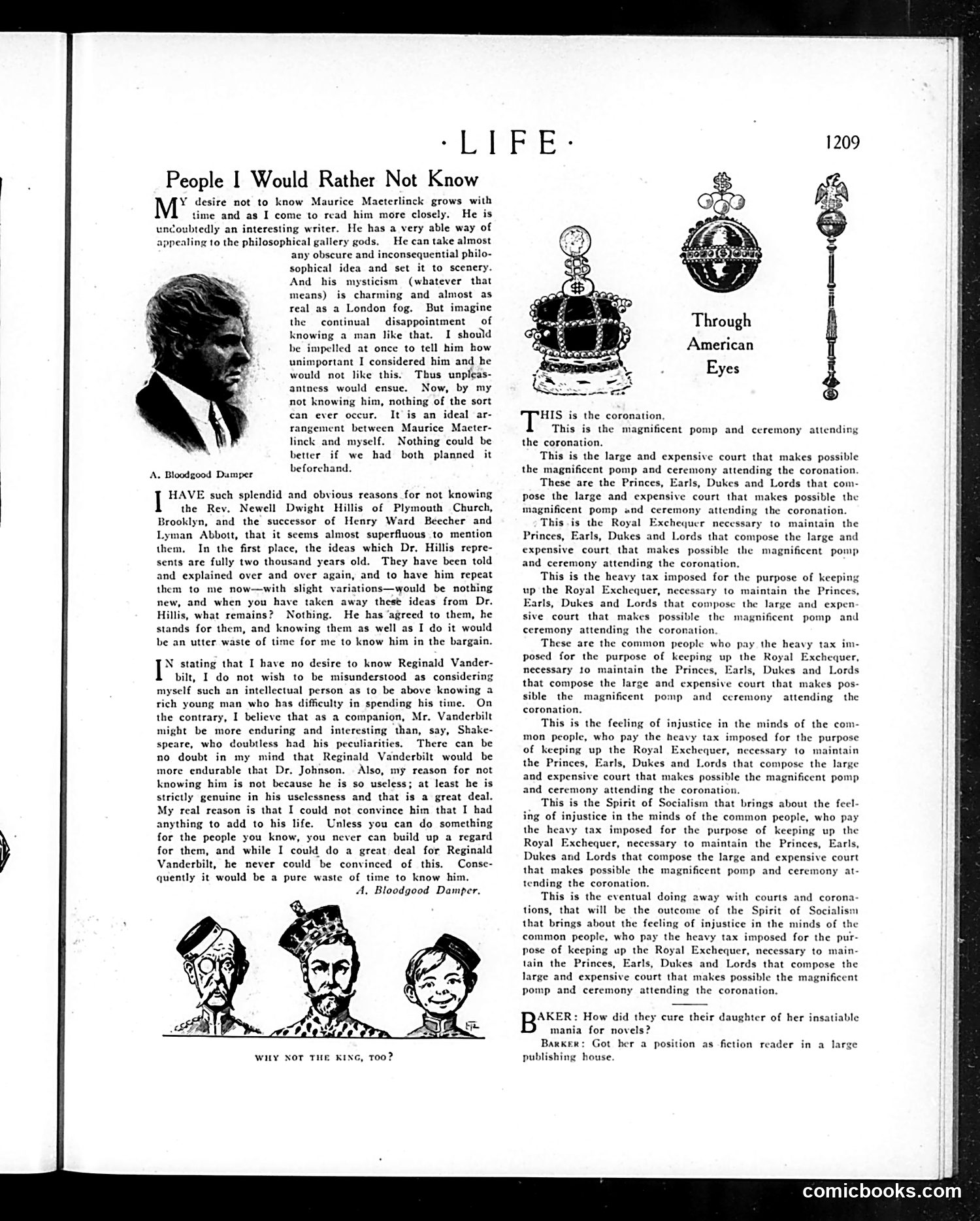
This page contains two distinct satirical pieces: **"People I Would Rather Not Know"** features three brief essays by "A. Bloodgood Damper" defending his refusal to know specific individuals: Maurice Maeterlinck (a Belgian symbolist playwright), Reverend Newell Dwight Hillis (Henry Ward Beecher's successor at Plymouth Church), and Reginald Vanderbilt (a wealthy industrialist). The humor lies in the tongue-in-cheek justifications—each explanation ironically reveals the author's pretentious reasoning while insulting his subjects. **"Through American Eyes"** critiques the British coronation ceremony through sardonic repetition, presenting a cascading chain of causation: coronation → expensive court → royal nobility → royal treasury → heavy taxation → common people paying the bills. The cartoon "Why Not the King, Too?" (three caricatured heads) reinforces this anti-monarchy sentiment. Together, these pieces mock both intellectual pretension and aristocratic excess—central Progressive Era concerns about inequality and Old World hierarchies.
📄 Transcribed text from this page (OCR, searchable)
Machine-transcribed from the original scan — historical spelling and the odd misread are preserved.
“LPB People 1 Would Rather Not Know Y desire not to know Maurice Maeterlinck grows with time and as I come to read him more closely, He is undoubtedly an interesting writer. He has a very able way of appealing to the philosophical gallery gods. He can take almost any obscure and inconsequential philo- sophical idea and set it to scenery. And his mysticism (whatever that means) is charming and almost as real as a London fog. But imagine the continual disappointment of knowing a man like that. I should be impelled at once to tell him how unimportant I considered him and he would not like this. Thus unplcas- antness would ensue. Now, by my not knowing him, nothing of the sort can ever occur. It is an ideal ar- rangement between Maurice Maeter- linck and myself. Nothing could be better if we had both planned it A. Bloodgood Damper beforehand: HAVE such splendid and obvious reasons for not knowing I the Rev. Newell Dwight Hillis of Plymouth Church, Brooklyn, and the successor of Henry Ward Beecher and Lyman Abbott, that it seems almost superfluous to mention them, In the first place, the ideas which Dr. Hillis repre- sents are fully two thousand years old. They have been told and explained over and over again, and to have him repeat them to me now—with slight variations—would be nothing new, and when you have taken away these ideas from Dr. Hillis, what remains? Nothing. He has ‘agreed to them, he stands for them, and knowing them as well as I do it would be an utter waste of time for me to know him in the bargain. N stating that I have no desire to know Reginald Vander- bilt, I do not wish to be misunderstood as considering myself such an intellectual person as to be above knowing a rich young man who has difficulty in spending his time. On the contrary, I believe that as a companion, Mr. Vanderbilt might be more enduring and interesting than, say, Shake- speare, who doubtless had his peculi There can be no doubt in my mind that Reginald Vanderbilt would be more endurable that Dr, Johnson. Also, my reason for not knowing him is not because he is so useless; at least he is strictly genuine in his usclessness and that is a great deal. My real reason is that I could not convince him that I had anything to add to his life. Unless you can do something for the people you know, you never can build up a regard for them, and while I could do a great deal for Reginald Vanderbilt, he never could be convinced of this. Conse- quently it would be a pure waste of time to know him. A, Bloodgood Damper. WHY NOT THE KING, TOO? Through American Eyes HIS is the coronati This is the magnificent pomp and ceremony attending the coronation. This is the large and expensive court that makes possible the magnificent pomp and ceremony attending the coronation. These are the Princes, Earls, Dukes and Lords that com- pose the large and expensive court that makes possible the magnificent pomp and ceremony attending the coronation. This is the Royal Exchequer necessary to maintain the Princes, Earls, Dukes and Lords that compose the large and expensive court that makes possible the magnificent pomp and ceremony attending the coronation. This is the heavy tax imposed for the purpose of keeping up the Royal Exchequer, necessary to maintain the Princes, rls, Dukes and Lords that compose the large and expen sive court that makes possible the magnificent pomp and ceremony attending the coronation. These are the common people who pay the heavy tax im- posed for the purpose of keeping up the Royal Exchequer, necessary 10 maintain the Princes, Earls, Dukes and Lords that compose the large and expensive court that makes pos- sible the magnificent pomp and ceremony attending the coronation. This is the feeling of injustice in the minds of the com- mon people, who pay the heavy tax imposed for the purpose of keeping up the Royal Exchequer, necessary to maintain the Princes, Earls, Dukes and Lords that compose the large and expensive court that makes possible the magnificent pomp and ceremony attending the coronation. This is the Spirit of Socialism that brings about the feel- ing of injustice in the minds of the common people, who pay the heavy tax imposed for the purpose of keeping up the Royal Exchequer, necessary to maintain the Princes, Earls, Dukes and Lords that compose the large and expensive court that makes possible the magnificent pomp and ceremony at- tending the coronation. This is the eventual doing away with courts and corona tions, that will be the outcome of the Spirit of Social that brings about the feeling of injustice in the minds of the common people, who pay the heavy tax imposed for the pur- pose of keeping up the Royal Exchequer, necessary to main- tain the Princes, Earls, Dukes and Lords that compose the large and expensive court that makes possible the magnificent pomp and ceremony attending the coronation. AKER: How did they cure their daughter of her insatiable mania for novels? Barker: Got her a position as fiction reader in a large publishing house. comicbooks.com