
Life, 1911-06-22 · page 24 of 44
Life — June 22, 1911 — page 24: what you’re looking at
What you’re looking at
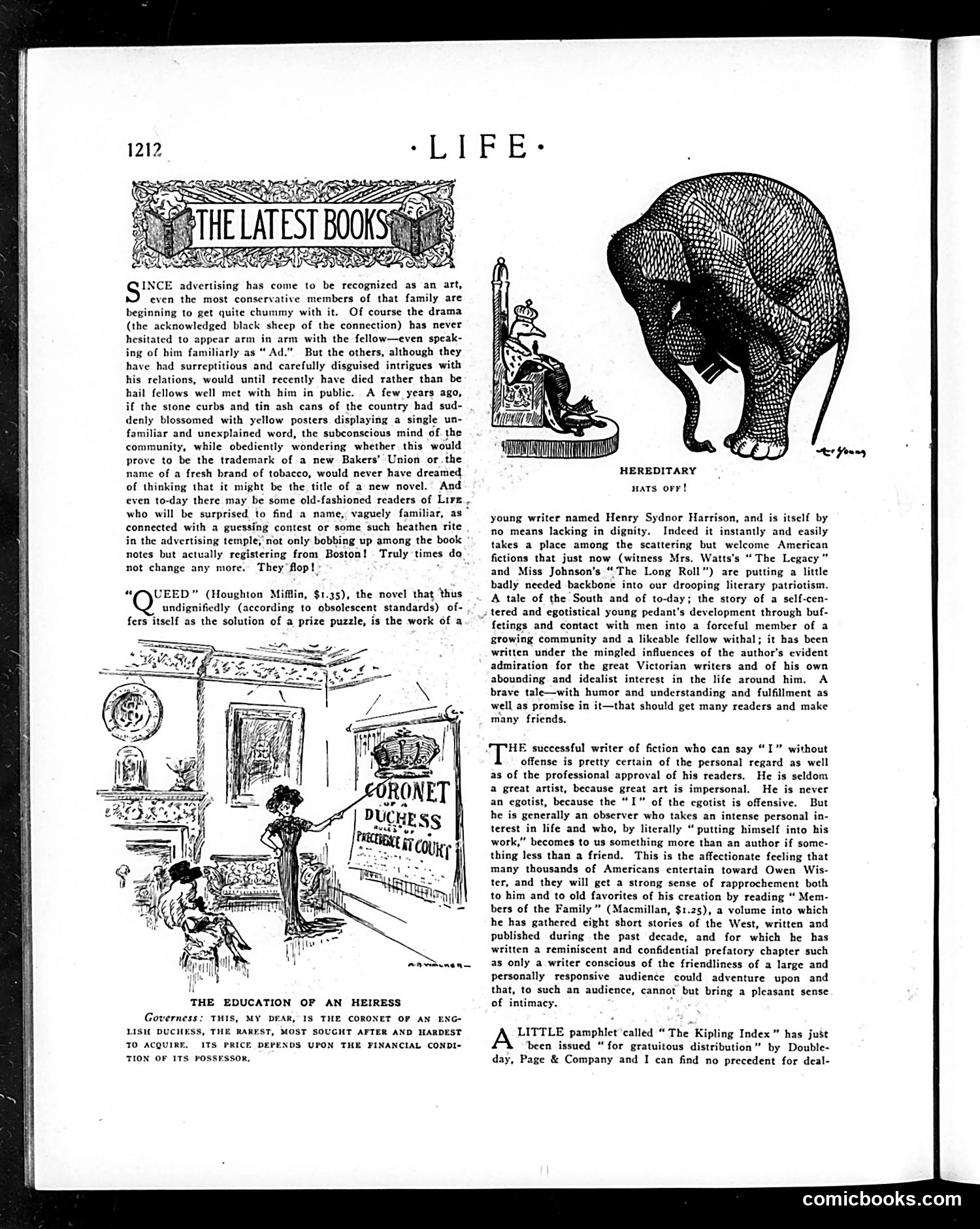
This cartoon satirizes the gilded age's obsession with aristocratic titles and wealth. The illustration shows an elephant (representing an heiress or wealthy American woman) being fitted with a coronet (crown), while her governess explains that a coronet's value depends entirely on "the financial condition of its possessor." The joke targets the American practice of marrying off wealthy heiresses to impoverished European nobility—essentially purchasing titles with money. The elephant emphasizes the absurdity: regardless of how valuable or prestigious the coronet appears, it's merely a commodity for sale to the highest bidder. The phrase "Hereditary Hats Off!" suggests mock deference to this shallow materialism. This reflects genuine historical tension: during this era, many American industrial fortunes were leveraged to acquire European titles through strategic marriages, which American satirists frequently mocked as both ridiculous and undemocratic.
📄 Transcribed text from this page (OCR, searchable)
Machine-transcribed from the original scan — historical spelling and the odd misread are preserved.
INCE advertising has come to be recognized as an art, even the most conservative members of that family are beginning to get quite chummy with it. Of course the drama (the acknowledged black sheep of the connection) has never hesitated to appear arm in arm with the fellow—even speak- ing of him familiarly as “Ad.” But the others, although they have had surreptitious and carefully disguised intrigues with his relations, would until recently have died rather than be hail fellows well met with him in public. A few years ago, if the stone curbs and tin ash cans of the country had sud- denly blossomed with yellow posters displaying a single un- familiar and unexplained word, the subconscious mind of the community, while obediently wondering whether this would prove to be the trademark of a new Bakers’ Union or.the name of a fresh brand of tobacco, would never have dreamed, of thinking that it might be the title of a new novel. And even to-day there may be some old-fashioned readers of Lire . who will be surprised to find a name, vaguely familiar, as” connected with a guessing contest or some such heathen rite in the advertising temple; not only bobbing up among the book notes but actually registering from Boston! not change any more. They flop! Truly times do “C)CEED” (Houghton Mifflin, $1.35), the novel that thus undignifiedly (according to obsolescent standards) of- fers itself as the solution of a prize puzzle, is the work of a Sapp, EET Y ah "34 THE EDUCATION OF AN HEIRESS Governess: THIS, MY DFAR, IS THE CORONET OP AN ENG- THE RAREST, MOST SOUGHT AFTER AND HARDEST To acgur ITS PRICE DEPENDS UPON THE PINANCIAL CONDI- TION OF ITS POSSESSOR, HEREDITARY HATS oFr! young writer named Henry Sydnor Harrison, and is itself by no means lacking in dignity. Indeed it instantly and easily takes a place among the scattering but welcome American fictions that just now (witness Mrs. Watts'’s “The Legacy ” and Miss Johnson’s “The Long Roll”) are putting a little badly needed backbone into our drooping literary patriotism. A tale of the South and of to-day; the story of a self-cen- J tered and egotistical young pedant’s development through buf- fetings and contact with men into a forceful member of a growing community and a likeable fellow withal; it has been written urider the mingled influences of the author's evident admiration for the great Victorian writers and of his own abounding and idealist interest in the life around him. A brave tale—with humor and understanding and fulfillment as well as promise in it—that should get many readers and make many friends. HE successful writer of fiction who can say “I” without offense is pretty certain of the personal regard as well as of the professional approval of his readers. He is seldom a great artist, because great art is impersonal. He is never an egotist, because the “I” of the cgotist is offensive. But he is generally an observer who takes an intense personal in- terest in life and who, by literally “ putting himself into his work,” becomes to us something more than an author if some- thing less than a friend. This is the affectionate feeling that many thousands of Americans entertain toward Owen Wis- ter, and they will get a strong sense of rapprochement both to him and to old favorites of his creation by reading “‘ Mem- bers of the Family” (Macmillan, $1.25), a volume into which he has gathered eight short stories of the West, written and published during the past decade, and for which he has written a reminiscent and confidential prefatory chapter such as only a writer conscious of the friendliness of a large and personally responsive audience could adventure upon and that, to such an audience, cannot but bring a pleasant sense of intimacy. . LITTLE pamphlet called “The Kipling Index” has just been issued “for gratuitous distribution” by Double- day, Page & Company and I can find no precedent for deal- comicbooks.com