
A complete issue · 44 pages · 1911
Life — May 11, 1911
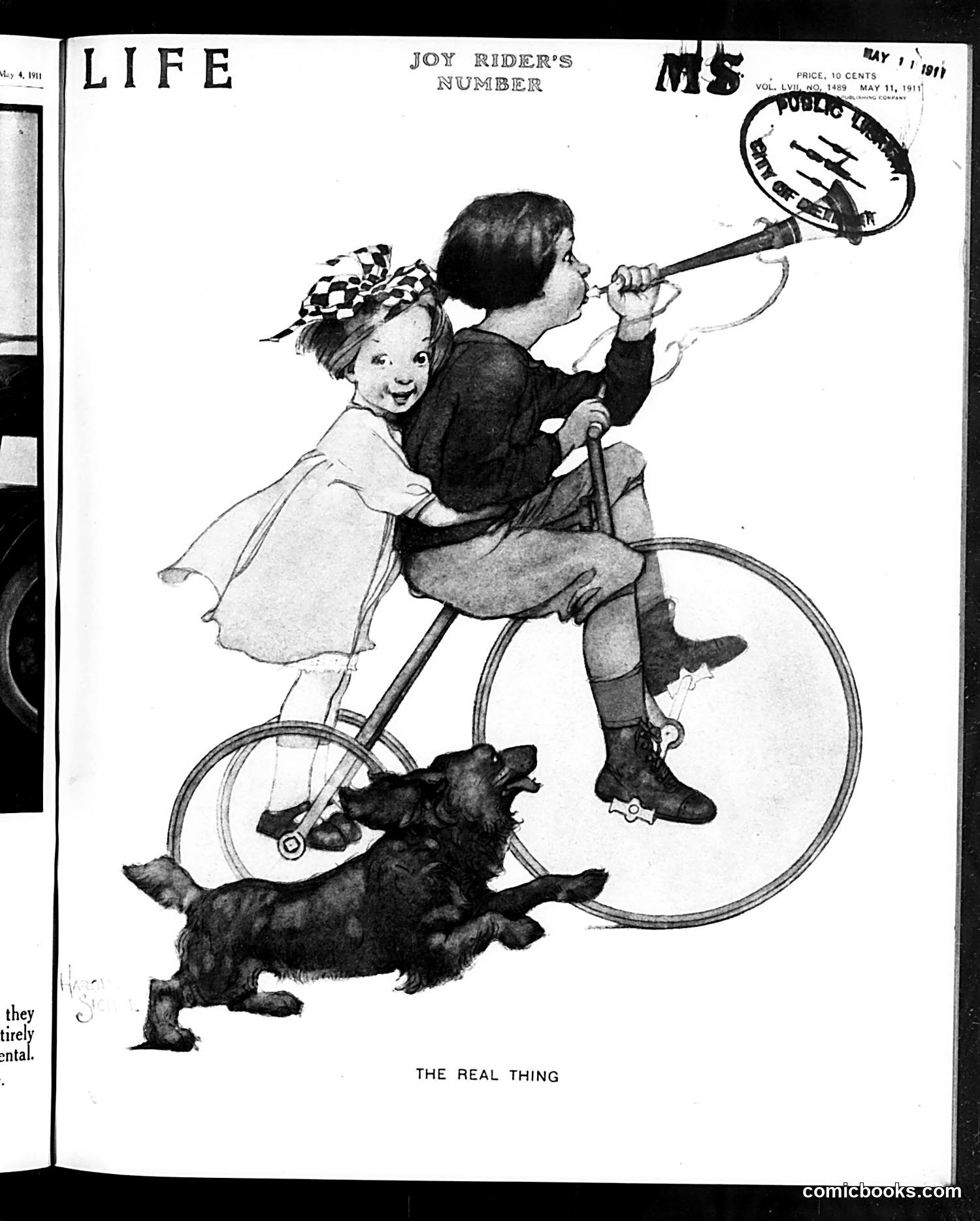
This is Life's "Joy Rider's Number" cover, satirizing the then-popular automotive craze of "joy riding"—reckless driving for entertainment. The illustration shows two young people on a bicycle (not a motorcar, notably) with a dog running alongside, all in exuberant, chaotic motion. The woman wears a fashionable checkered hat and waves a megaphone. The satire works through ironic understatement: the cover's title claims this bicycle scene is "the real thing"—suggesting that actual joy riding (in automobiles) was so dangerous and excessive that a bicycle ride with a dog and megaphone represents the genuine thrill-seeking spirit of the era, just in safer form. It mocks both the joy-riding fad and the era's automobile mania.
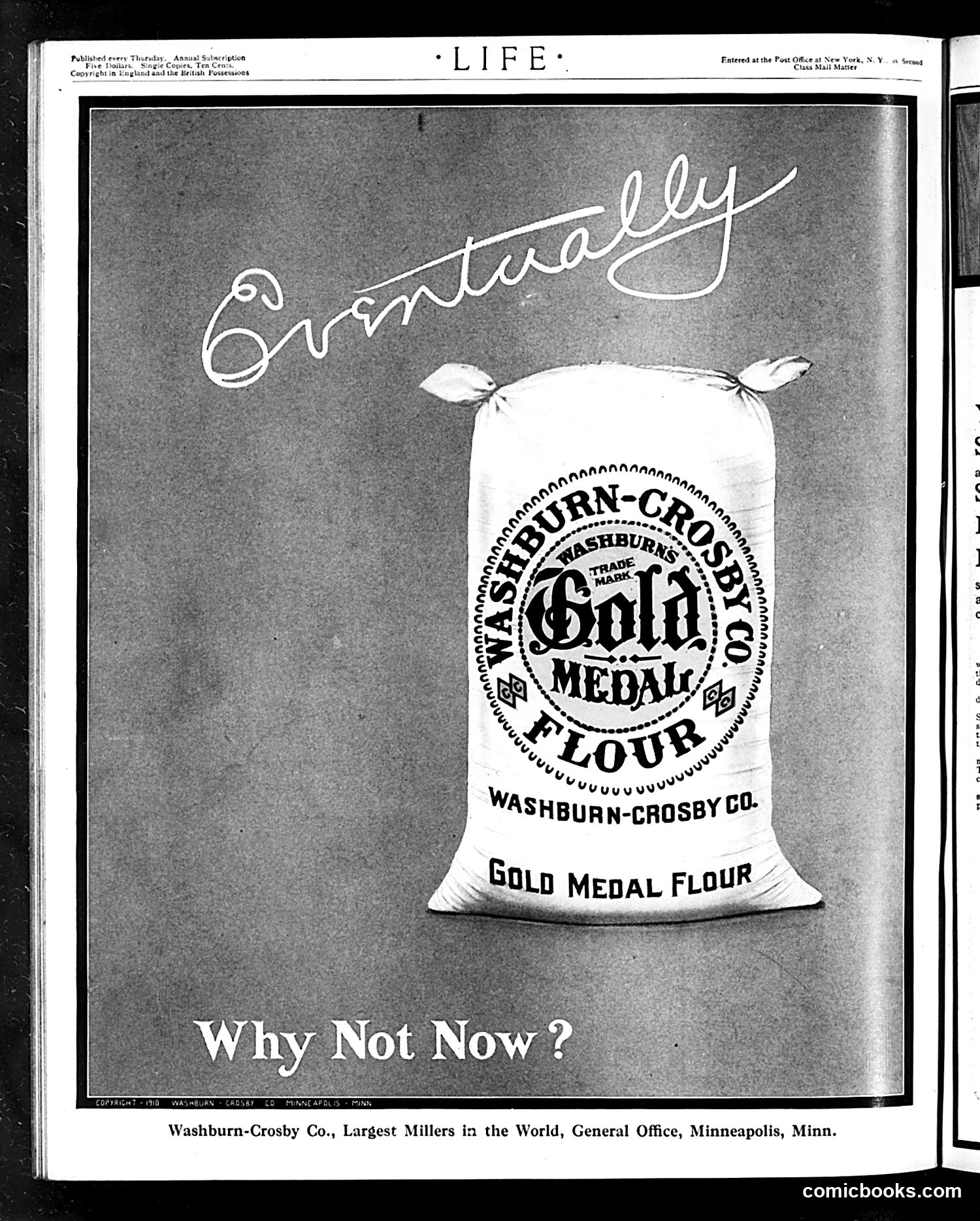
This page is **advertising, not satire or editorial content**. It's a commercial advertisement for Gold Medal Flour by the Washburn-Crosby Co. (which later became General Mills), published in *Life* magazine. The ad features a flour sack with the Gold Medal trademark and asks "Why Not Now?" — a straightforward marketing appeal encouraging consumers to purchase the product. The word "Courtially" [likely "Courtially" or similar stylized text] appears decoratively at top. There is no political cartoon, caricature, or satirical commentary present. This is simply a period print advertisement using clean, simple design to promote flour as a household staple product to American consumers.
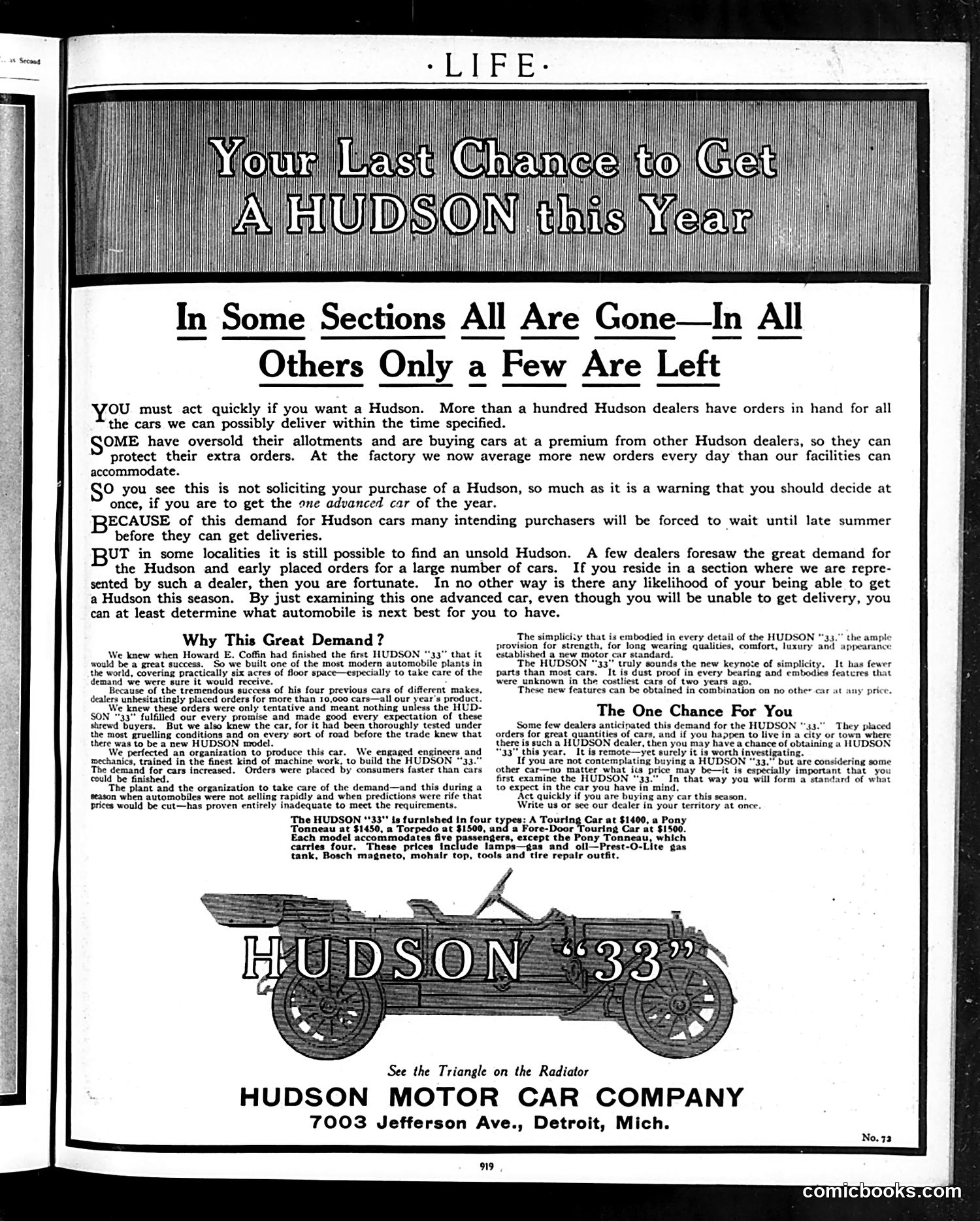
This is **not a cartoon or satirical content** — it's a straightforward automobile advertisement from the Hudson Motor Car Company, promoting their 1913 Hudson "33" model. The page uses urgent marketing language ("Your Last Chance," "All Are Gone") to create artificial scarcity and pressure potential buyers into immediate purchase decisions. The ad acknowledges high demand exceeds supply, claiming over 100 dealers have backorders and that customers may face summer delivery delays. The inclusion of technical details about the car's engineering and the illustration of the open-air touring car are typical period advertising conventions. This represents genuine commercial messaging, not satire or political commentary from *Life* magazine's editorial staff.
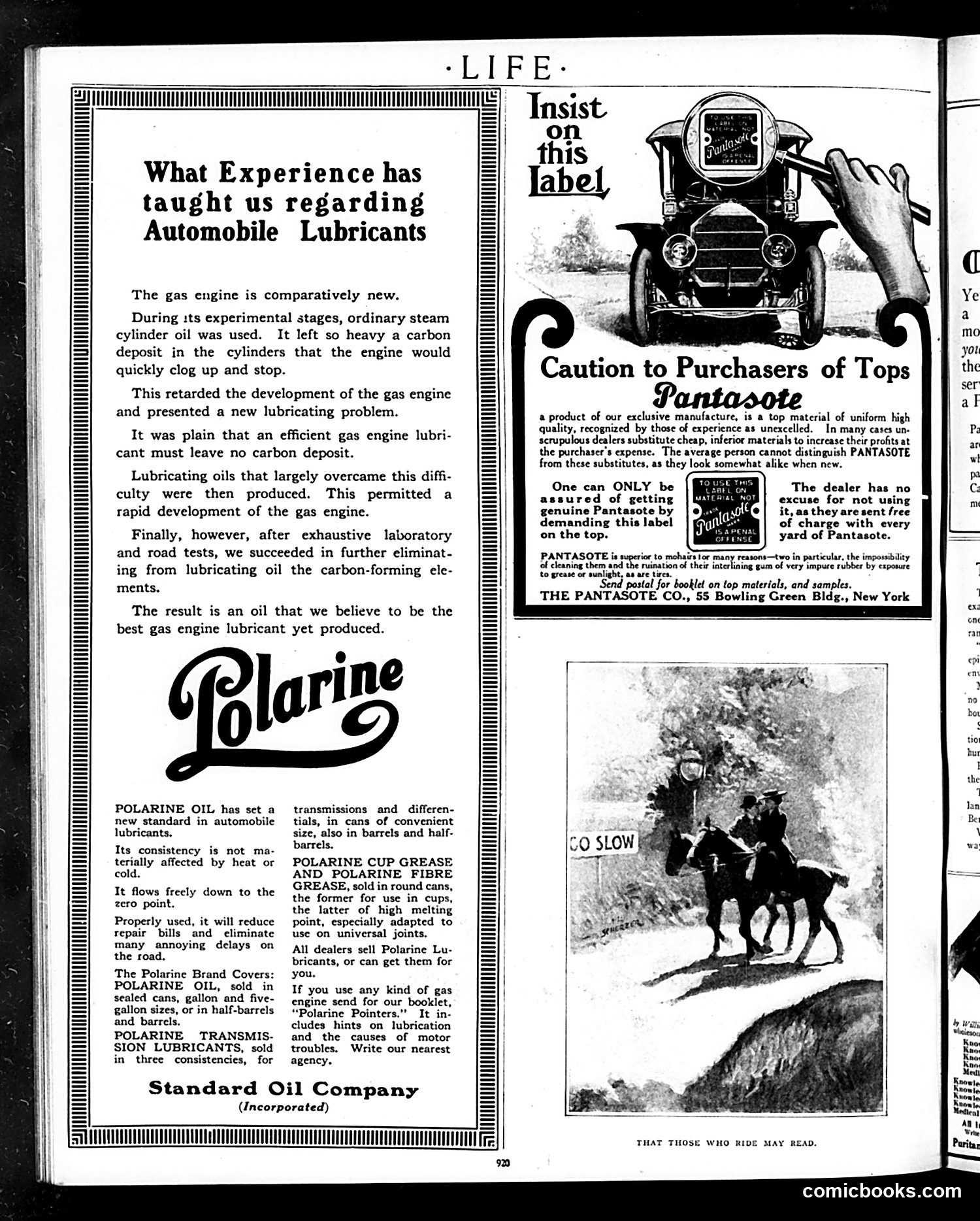
This page is primarily **advertising**, not satire or political commentary. It contains two product advertisements: 1. **Polarine Oil** (Standard Oil Company): An advertisement claiming their lubricant solved early gasoline engines' carbon-deposit problems through superior formulation. The text emphasizes technical innovation rather than humor. 2. **Pantasote Tops** (The Pantasote Co.): An advertisement warning car-top purchasers to verify authenticity by checking for the brand label, cautioning against counterfeits. The accompanying photograph shows a rural scene with a horse and rider, likely emphasizing durability/reliability. Neither contains political satire or caricature. The page reflects early automotive-era commercial messaging, showcasing how manufacturers marketed new products to a public still adapting to motorized transportation.
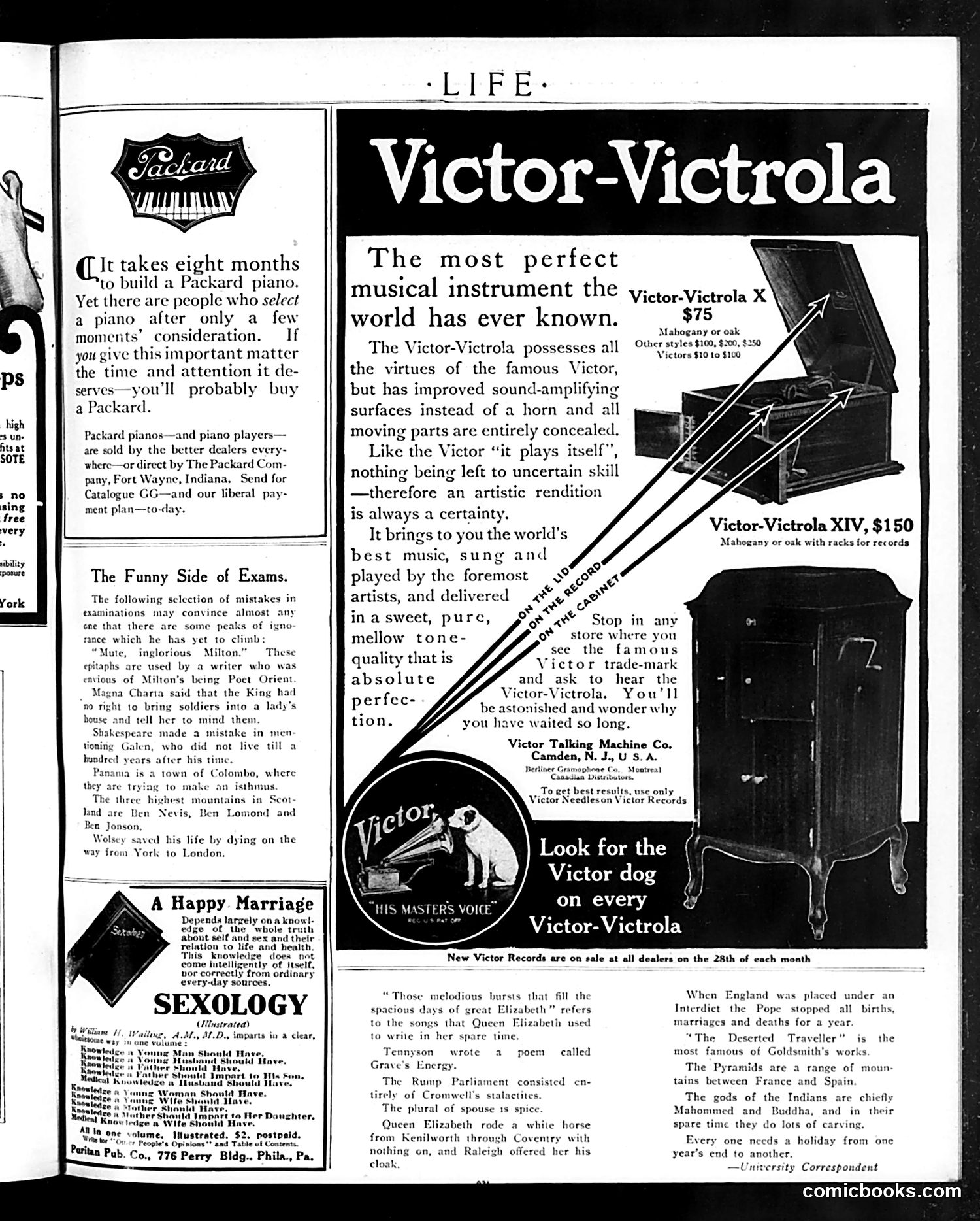
This page is **primarily advertising**, not political satire. The dominant content is a large Victor-Victrola phonograph advertisement promoting their record players as "the most perfect musical instrument the world has ever known," featuring the famous "His Master's Voice" dog logo. The left column contains minor content: a Packard piano advertisement, a brief humor piece titled "The Funny Side of Exams" (anecdotes about Milton and Shakespeare), and an advertisement for a "Sexology" book. No political cartoons or satirical commentary appear on this page. The humor is light and apolitical—examples of exam-related mistakes and literary misquotations. The page reflects early 20th-century consumer advertising and general-interest magazine content typical of *Life* during this period.
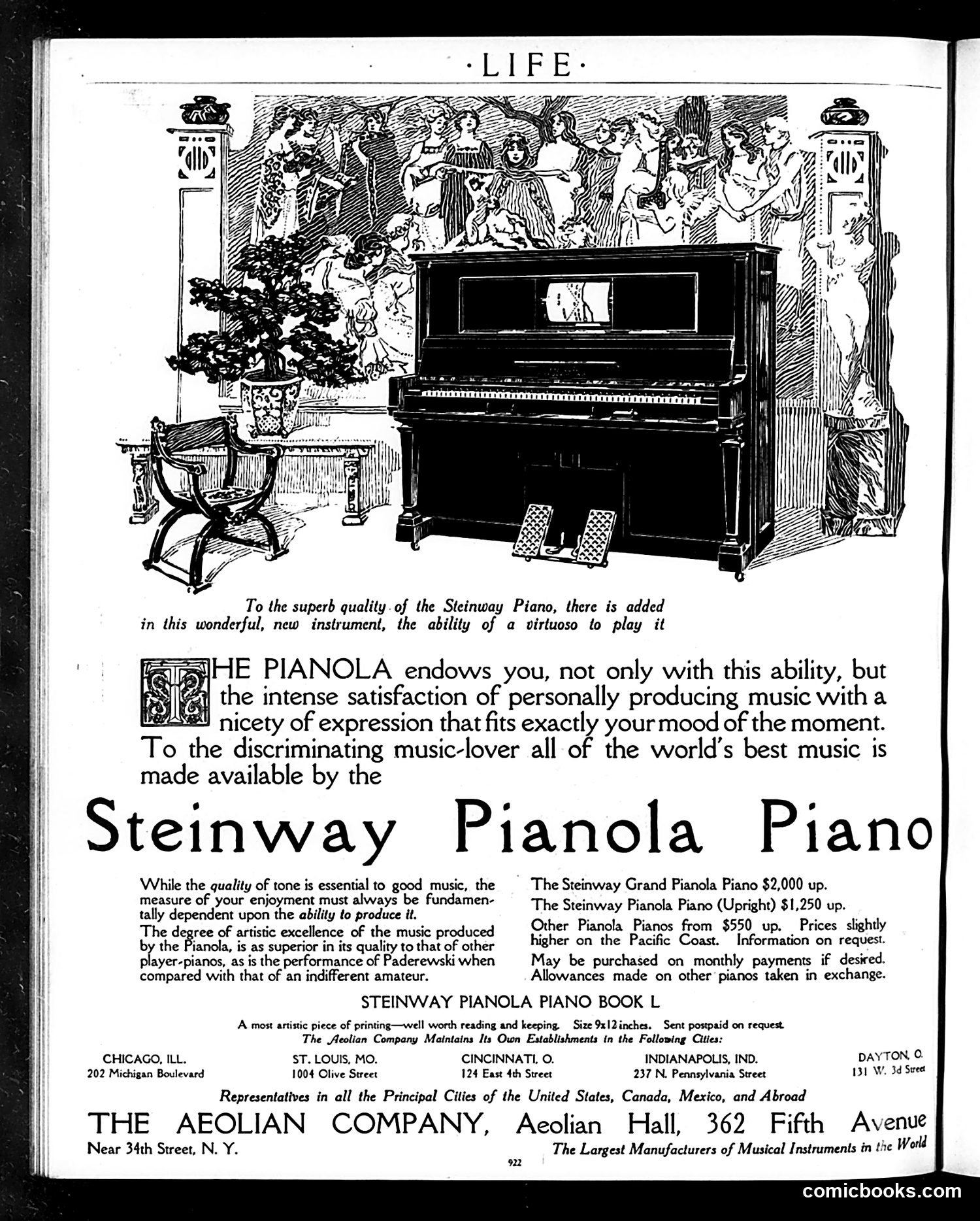
This page is **primarily an advertisement**, not a satirical cartoon or political content. It advertises the **Steinway Pianola Piano**—a player piano manufactured by The Aeolian Company. The illustration shows an elegant drawing room scene with well-dressed figures in the background, establishing aspirational social status. A potted plant and decorative chair accompany the prominent piano display. The ad's appeal is **social and artistic**: it promises buyers the satisfaction of producing music themselves while enjoying "the world's best music," comparing the player piano's quality favorably to amateur performance. Pricing ranges from $550 to $2,000 (substantial sums in this era). This represents early 20th-century marketing targeting affluent households seeking both musical sophistication and leisure entertainment technology.
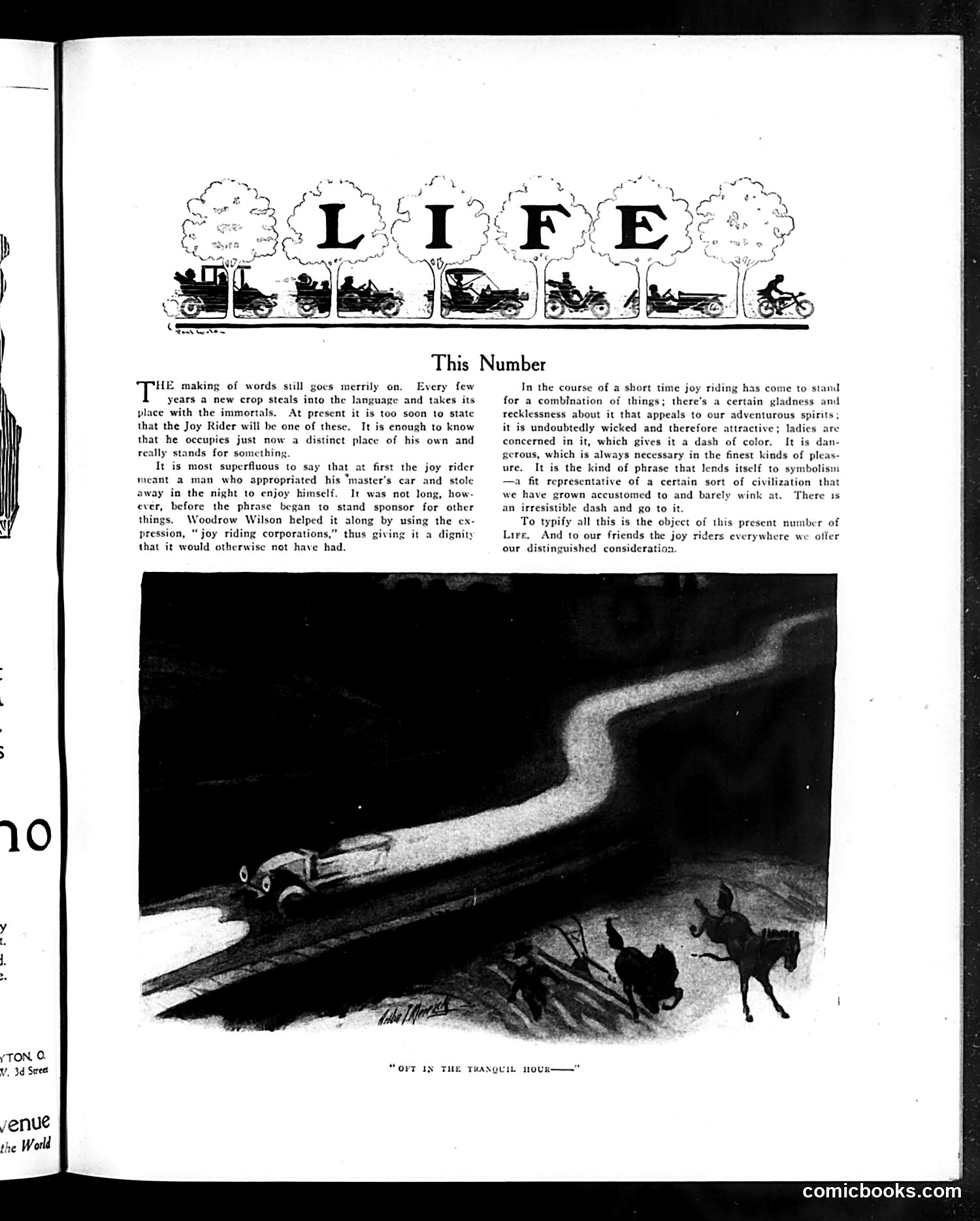
This page introduces a feature about "joy riding"—a then-contemporary phenomenon of young people stealing cars for recreational drives. The text credits President Woodrow Wilson with helping legitimize the phrase through official use, giving it dignity it "would otherwise not have had." The illustration titled "Off in the Tranquil Hour" depicts a car traveling a winding road at night, with silhouetted horseback riders nearby—likely suggesting the contrast between traditional transportation and modern automobile culture, or perhaps implying danger/lawlessness associated with nocturnal joy riding. The page appears satirical about how euphemistic language ("joy riding") sanitizes what is essentially car theft, a growing social concern among early-20th-century Americans.
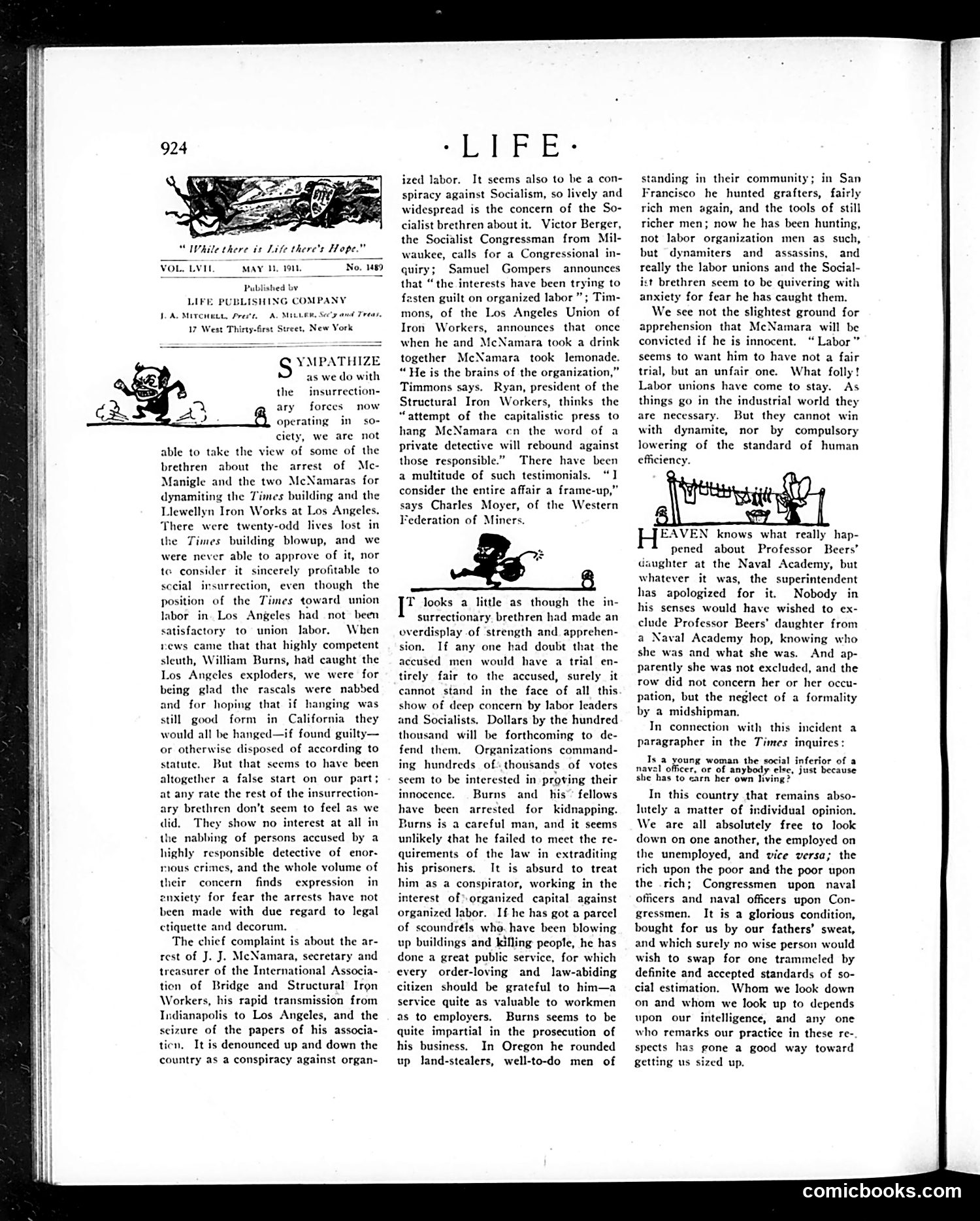
This page contains editorial commentary on labor unrest, particularly the arrest of J.J. McNamara, secretary of the International Association of Bridge and Structural Iron Workers. The text defends McNamara against accusations that he orchestrated dynamiting in Los Angeles, arguing the evidence appears fabricated—a "frame-up." The small cartoon visible shows what appears to be a figure labeled with dynamite or explosives, likely satirizing how authorities portrayed labor organizers. The editorial criticizes wealthy interests for blaming labor organizations while praising detective William Burns for exposing "land-stealers" and corrupt businessmen in Oregon. The text argues that convicting McNamara without solid evidence would be unjust, reflecting contemporary debates over labor's rights versus property owners' concerns.
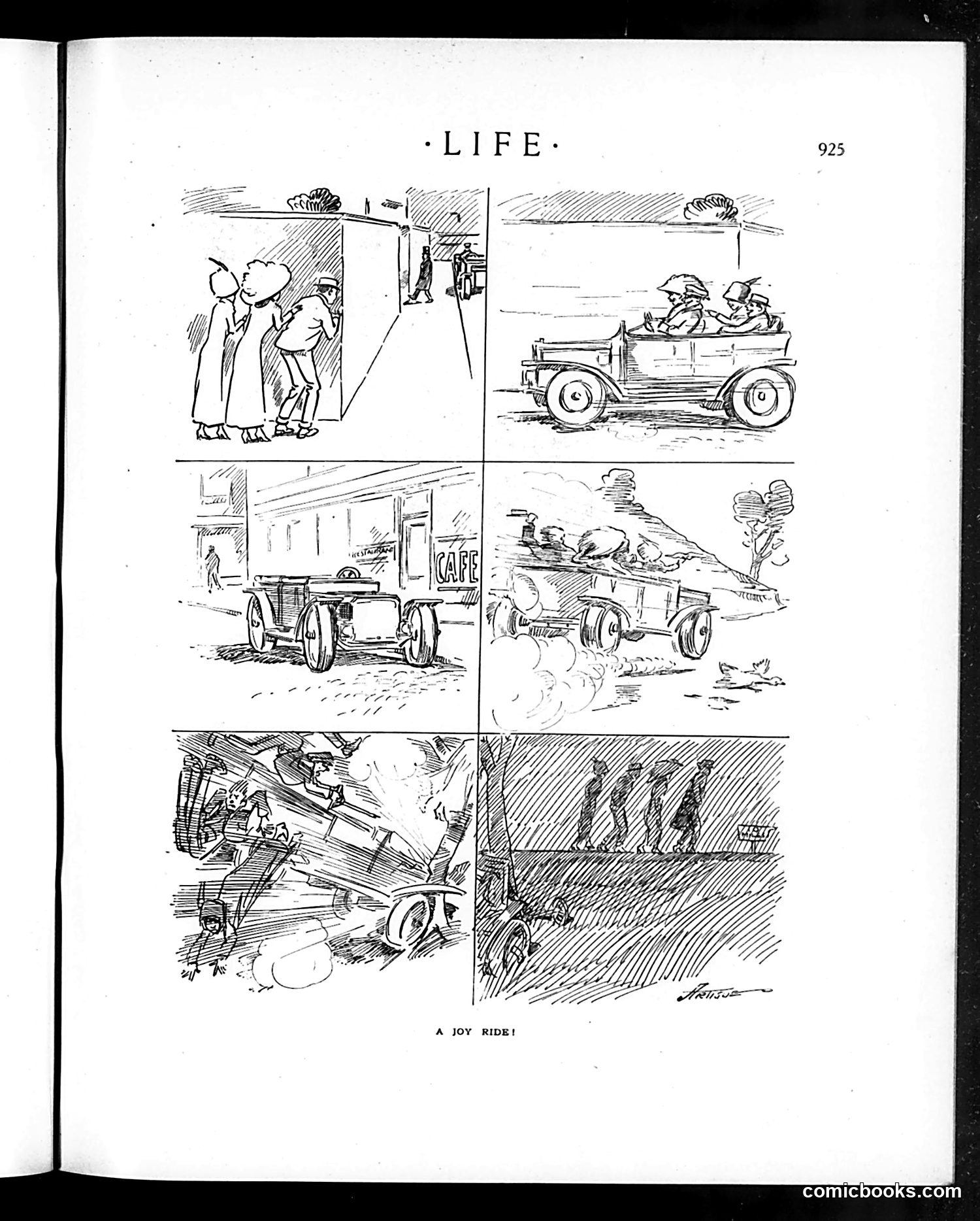
This six-panel comic satirizes the consequences of reckless automobile driving, a topical concern in the early automotive era. The narrative progresses from: 1. **Initial scene**: Figures (possibly children or young people) obtaining a vehicle 2. **Joy ride**: Two figures gleefully driving in an open-air car 3. **Café stop**: A mobile café vendor 4. **Countryside adventure**: Carefree driving through rural landscape 5. **Crash sequence**: The vehicle collides spectacularly with visible damage 6. **Aftermath**: Figures appear to face consequences (possibly law enforcement or punishment) The title "A Joy Ride!" delivers ironic commentary on the dangers of joy-riding—a cultural phenomenon where people drove recklessly for thrills. The comic illustrates how such recklessness inevitably leads to disaster, moralizing against dangerous driving behaviors common among young drivers of that era.
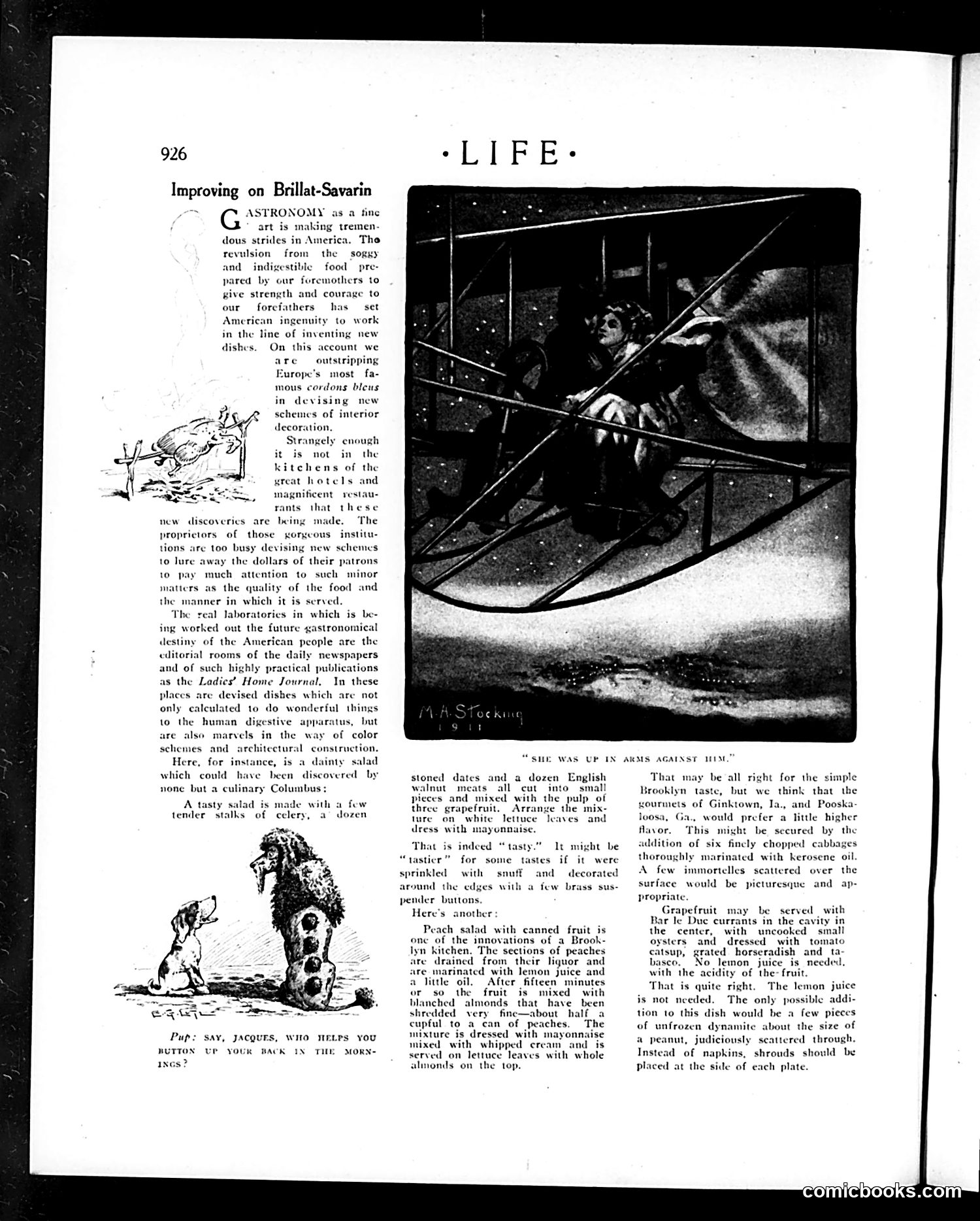
This page satirizes pretentious culinary innovation. The article mocks European haute cuisine's influence on American cooking, particularly in fancy hotels and newspapers like *Ladies' Home Journal*. The two small illustrations show animals (appearing to be a rabbit and a dog) labeled with humorous captions about food preparation—likely poking fun at overly complicated recipes or absurd ingredient combinations. The main text describes increasingly elaborate salad recipes as examples of unnecessary complexity. The satire suggests that while Americans adopted European culinary snobbery, they lost sight of simple, quality food and proper cooking technique. The author argues for practical, flavorful dishes over elaborate presentation and excessive decoration—a critique of culinary pretension masking mediocre results.
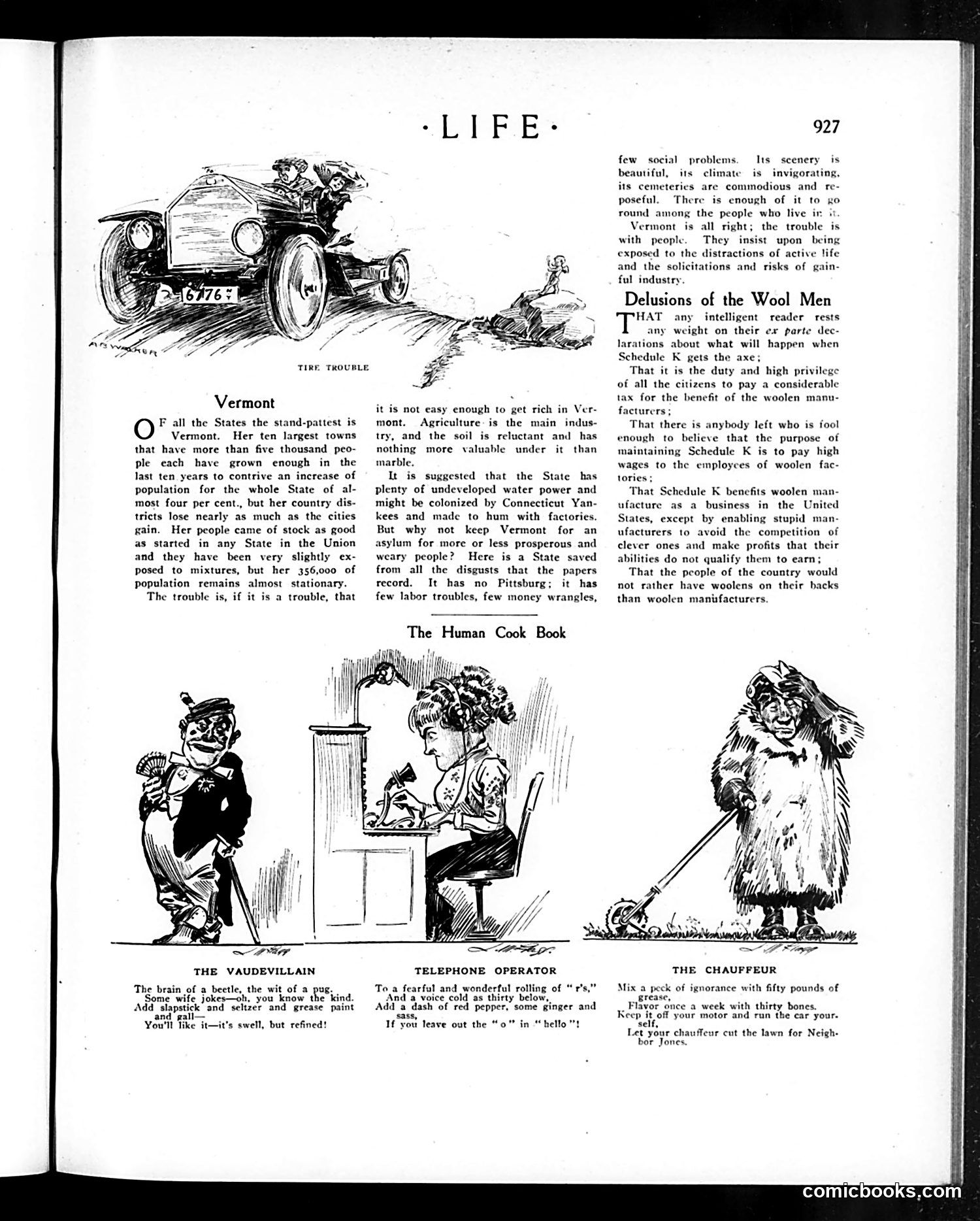
This page contains three distinct sections: **"Vermont" article** critiques the state's economic stagnation despite its natural beauty, noting agriculture's decline and suggesting industrial development (water power, factories) as solutions. **"Delusions of the Wool Men"** satirizes the wool industry's lobbying for protective tariffs (Schedule K), arguing manufacturers use high wages as justification while actually seeking profit protection. The piece ridicules their hypocrisy about supporting workers. **"The Human Cook Book"** presents three caricatured character types: "The Vaudvillain" (entertainer), "Telephone Operator," and "The Chauffeur"—satirizing contemporary social stereotypes through exaggerated physical caricatures and brief, mocking descriptions of their supposed traits and speech patterns. These appear to be social commentary on working-class occupations.
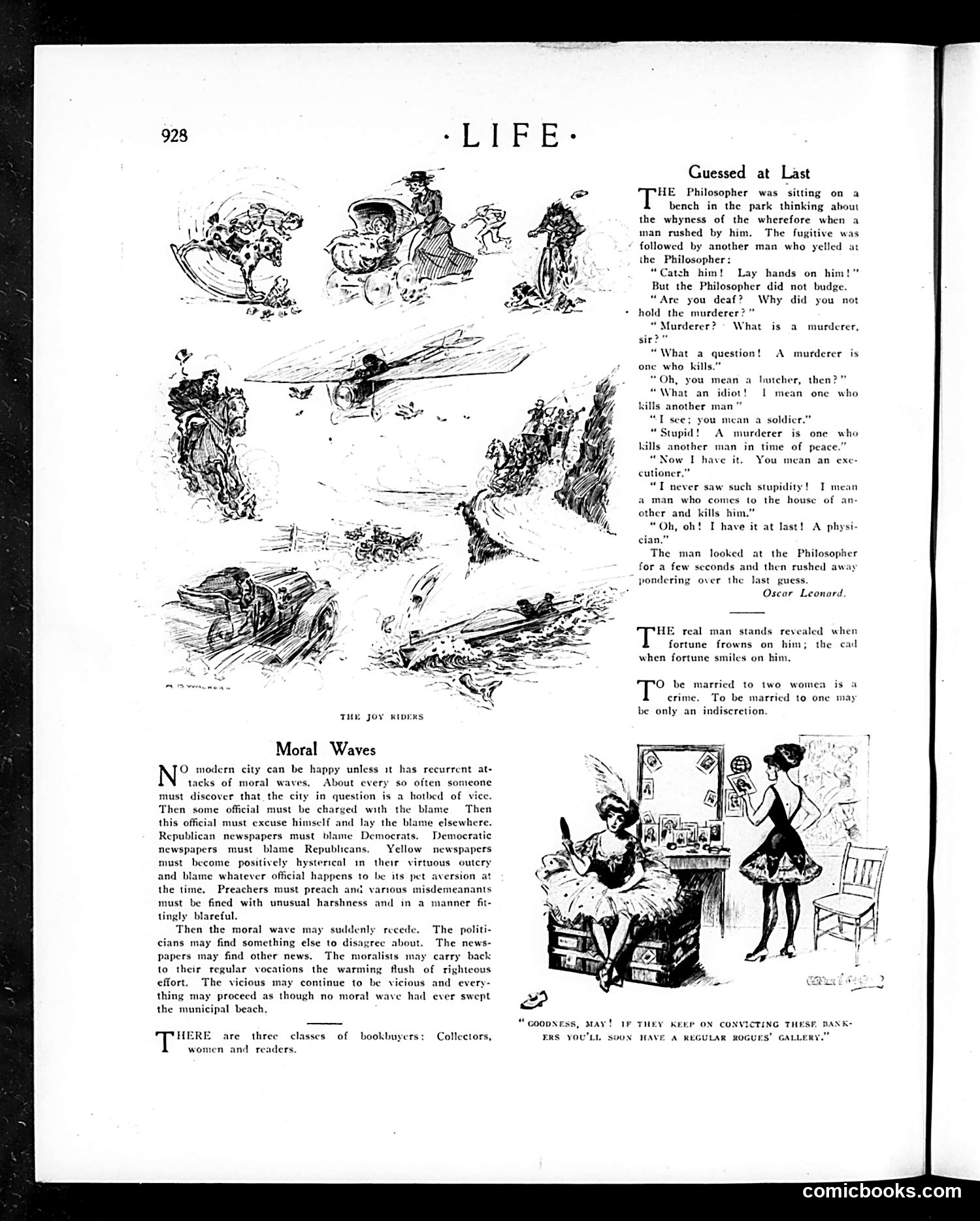
This page contains two distinct sections: **"The Joy Riders"** (top): A series of sketches depicting chaotic scenes of early automobiles and motorcycles, apparently satirizing reckless driving and the dangers of motorized vehicles to pedestrians and property. The sketches show collisions, crashes, and general mayhem. **"Moral Waves"** (bottom): A satirical commentary on urban moral crusades and hypocrisy. The text criticizes how cities experience periodic "moral panics" where officials blame specific groups (Republicans blame Democrats, newspapers blame each other) while vice persists. It mocks the cyclical nature of moral outrage and the tendency to scapegoat rather than address root causes. The accompanying cartoon shows two women discussing suspicious banking activity, satirizing concerns about financial impropriety. Both pieces reflect early 20th-century anxieties about modern urban life, transportation, and governance.
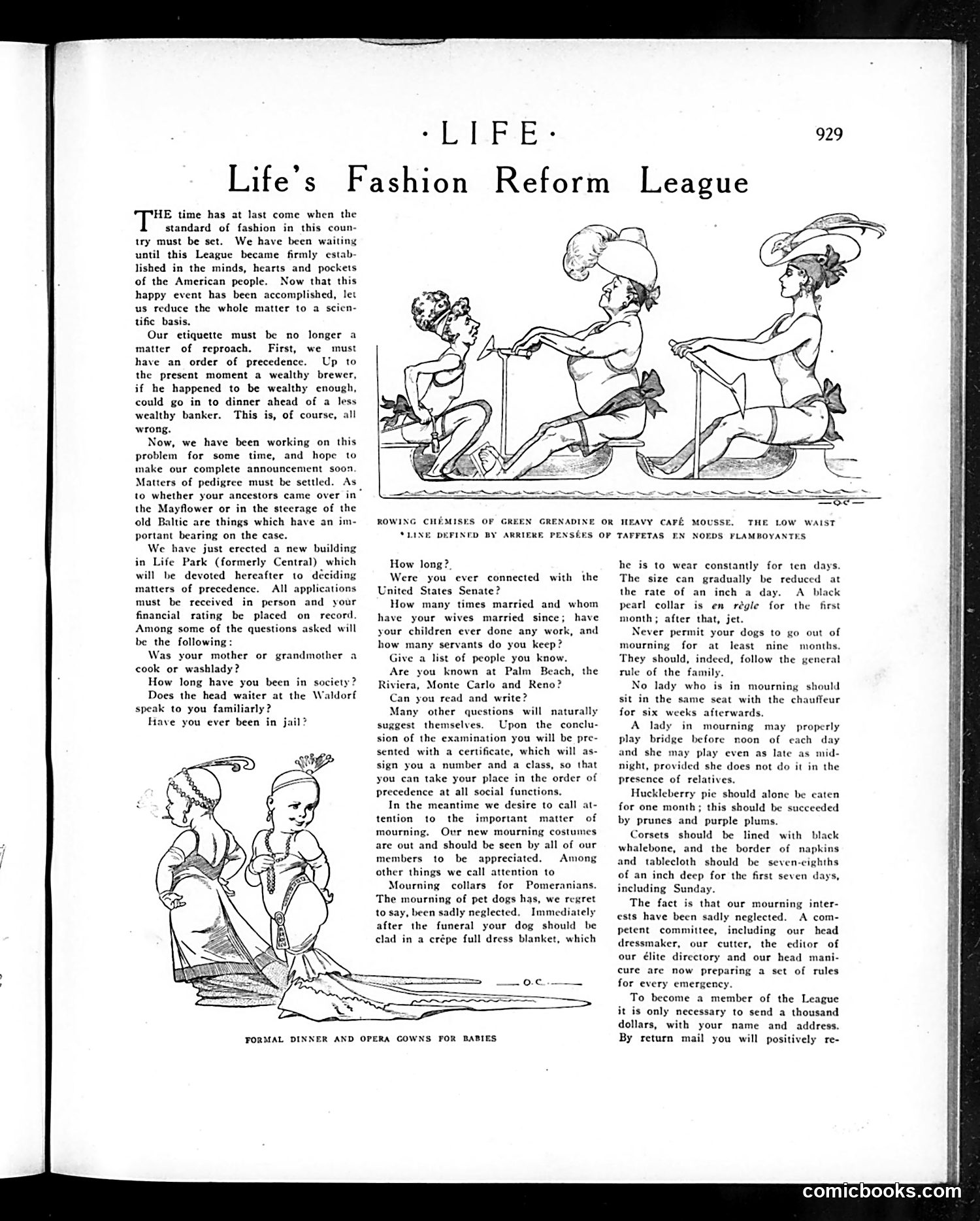
This page satirizes the emerging "Fashion Reform League," a real early-20th-century movement advocating rational dress standards. The top illustration shows cherubs in exaggerated poses illustrating fashionable silhouettes (low waists, heavy fabrics). The text mockingly presents an interrogation checklist for league membership—absurdly invasive questions about finances, ancestry, and social standing disguised as "fashion standards." The lower illustration depicts babies in formal dinner wear, satirizing the movement's impracticality. The satire suggests that while fashion reform claimed scientific basis, its actual enforcement was arbitrary, class-based gatekeeping. By showing infants in evening gowns and questioning members' wealth and social connections, Life ridicules how "rational" dress standards actually reflected snobbery rather than genuine reform.
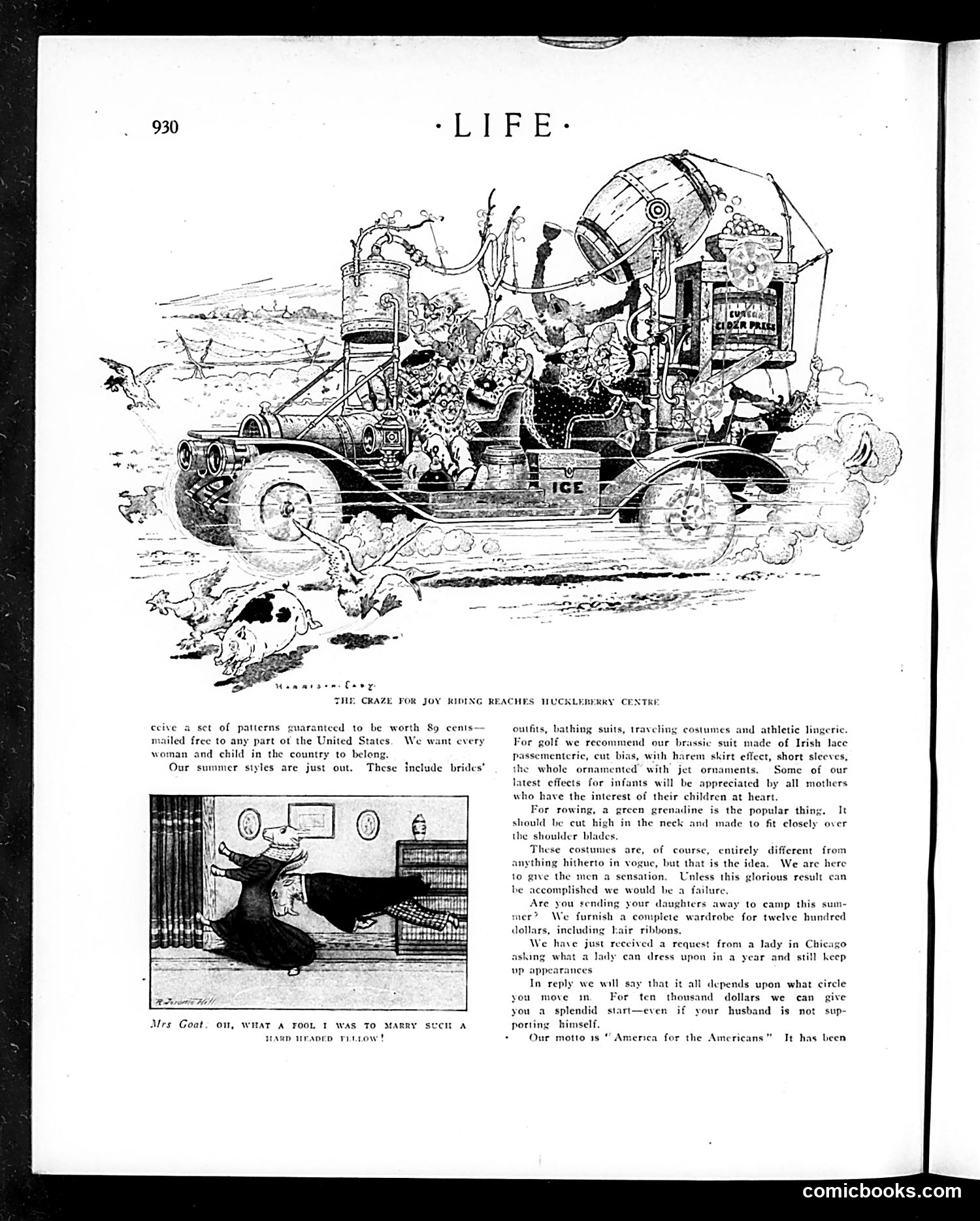
The main cartoon depicts an absurdly elaborate automobile overflowing with passengers, animals, and contraptions—satirizing the "craze for joy riding," a early 1900s phenomenon where car ownership became a status symbol of wealth and leisure. The accompanying text mocks excessive consumer spending and fashion snobbery. It advertises ridiculously expensive wardrobes (twelve hundred dollars for camp clothes, ten thousand for annual upkeep) with pretentious descriptions of garments for golf and rowing. The satire targets upper-class Americans' obsession with conspicuous consumption and ever-changing fashions. The small cartoon captioned "Mrs. Goat" shows a woman regretting marrying a poor man, reinforcing the page's theme: wealth determines social standing and happiness. The closing motto, "America for the Americans," ironically undercuts the elitist content, suggesting satire of wealthy Americans' self-importance and disconnect from ordinary citizens.
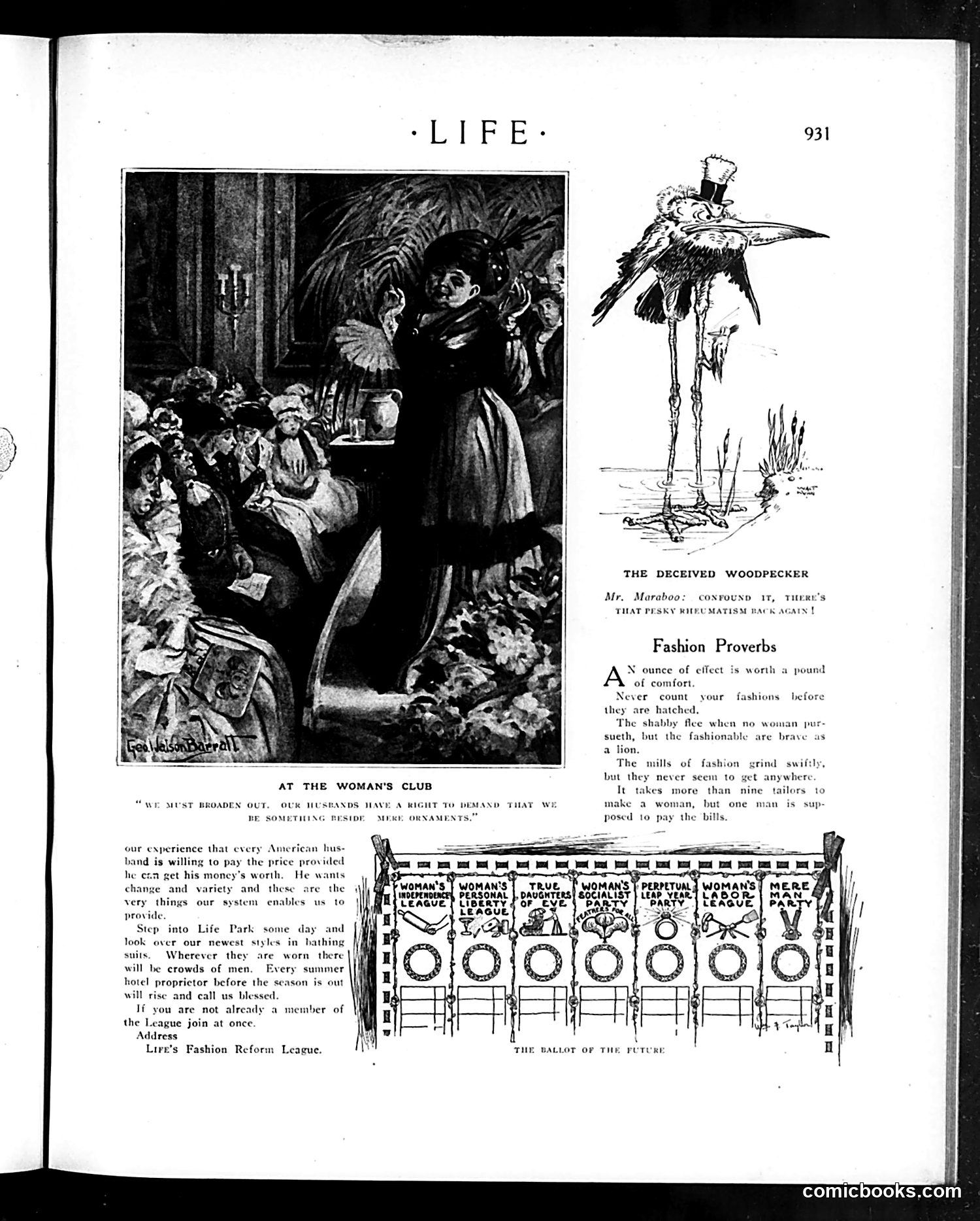
This Life magazine page contains two satirical pieces: **"At the Woman's Club"** (left illustration) depicts women at a club meeting discussing how husbands demand wives be more than mere decorative "ornaments." The satire targets both fashionable women's liberation rhetoric and marital economics—husbands want variety in their wives' appearances but expect to pay for it through constant fashion purchases. **"Fashion Proverbs"** (right column) mocks fashion industry absurdities through mock-wisdom statements. Key targets: the contradiction between fashion's constant change and lack of actual progress; the idea that expensive tailoring matters less than male financial support; and fashion's grip on women's behavior. **"The Deceived Woodpecker"** (top right) is a Fable-style cartoon where a woodpecker wearing a top hat appears foolish—likely satirizing someone (unclear who "Mr. Maraboo" is) who's been duped. **"The Ballot of the Future"** (bottom) shows voting booths labeled with various women's leagues and parties, satirizing women's emerging political participation as merely another fashion trend or social club affiliation rather than serious civic engagement.
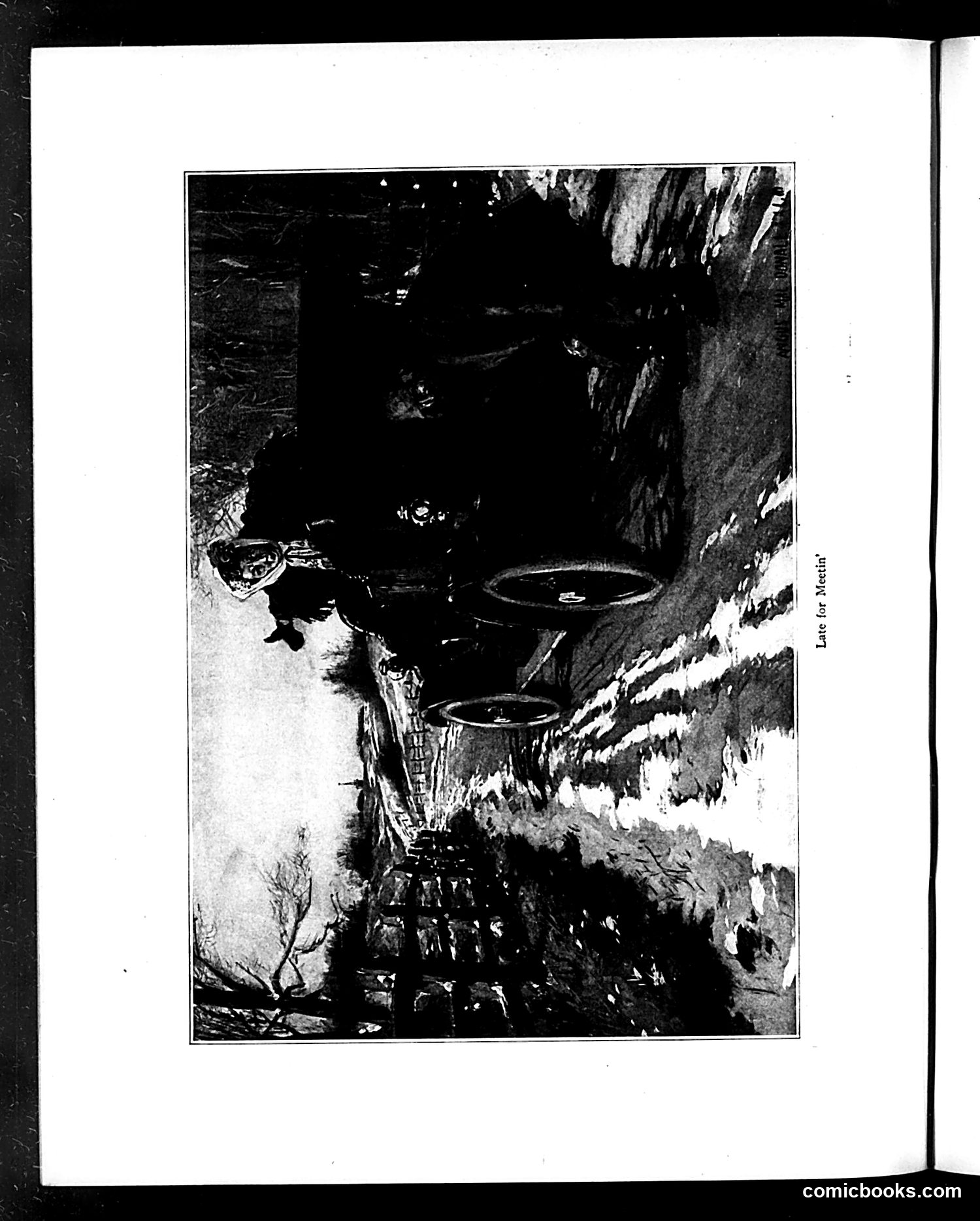
This appears to be a humorous illustration titled "Late for Meetin'" showing a figure in dark clothing hurrying through a snowy winter landscape. The image quality and reproduction make specific details difficult to discern with certainty. The caption suggests a comedic scenario about someone arriving late to an appointment or gathering. The winter setting and the figure's apparent haste convey the humor of the situation. Without clearer visibility of specific details, facial features, or additional context clues on the page, I cannot confidently identify whether this references a particular political figure, social commentary, or specific event that would have resonated with *Life* magazine's contemporary readers. The satire or joke's full meaning remains unclear from what's legible here.
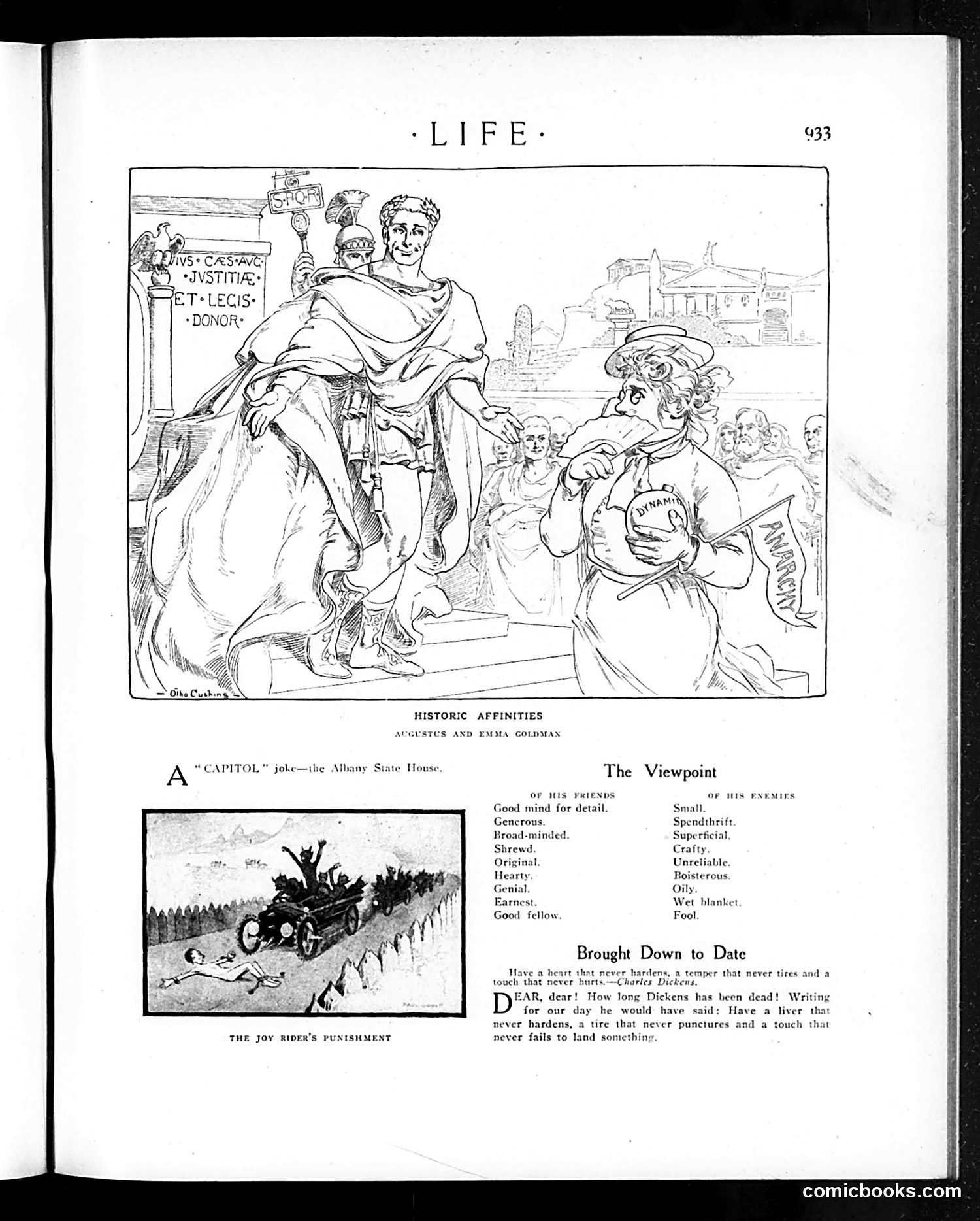
This satirical cartoon compares anarchist Emma Goldman to the Roman Emperor Augustus, suggesting parallels between her radical politics and imperial power. The Latin inscription translates roughly to "justice and law," ironic given Goldman's anarchist views. The bottom section, "The Viewpoint," presents contrasting character assessments—likely of a political figure—with friends' and enemies' interpretations listed side-by-side (generous vs. spendthrift, shrewd vs. crafty, etc.). This reflects Life magazine's common technique of exposing hypocrisy through opposing perspectives. "Brought Down to Date" cynically updates Dickens's idealistic quote about human virtue, replacing moral qualities with materialist concerns: a liver (drinking), tires, and "landing something" (profit/score). This mocks modern American values as having abandoned ethics for commercialism. The "Joy Rider's Punishment" cartoon below appears unrelated, depicting consequences of reckless behavior.
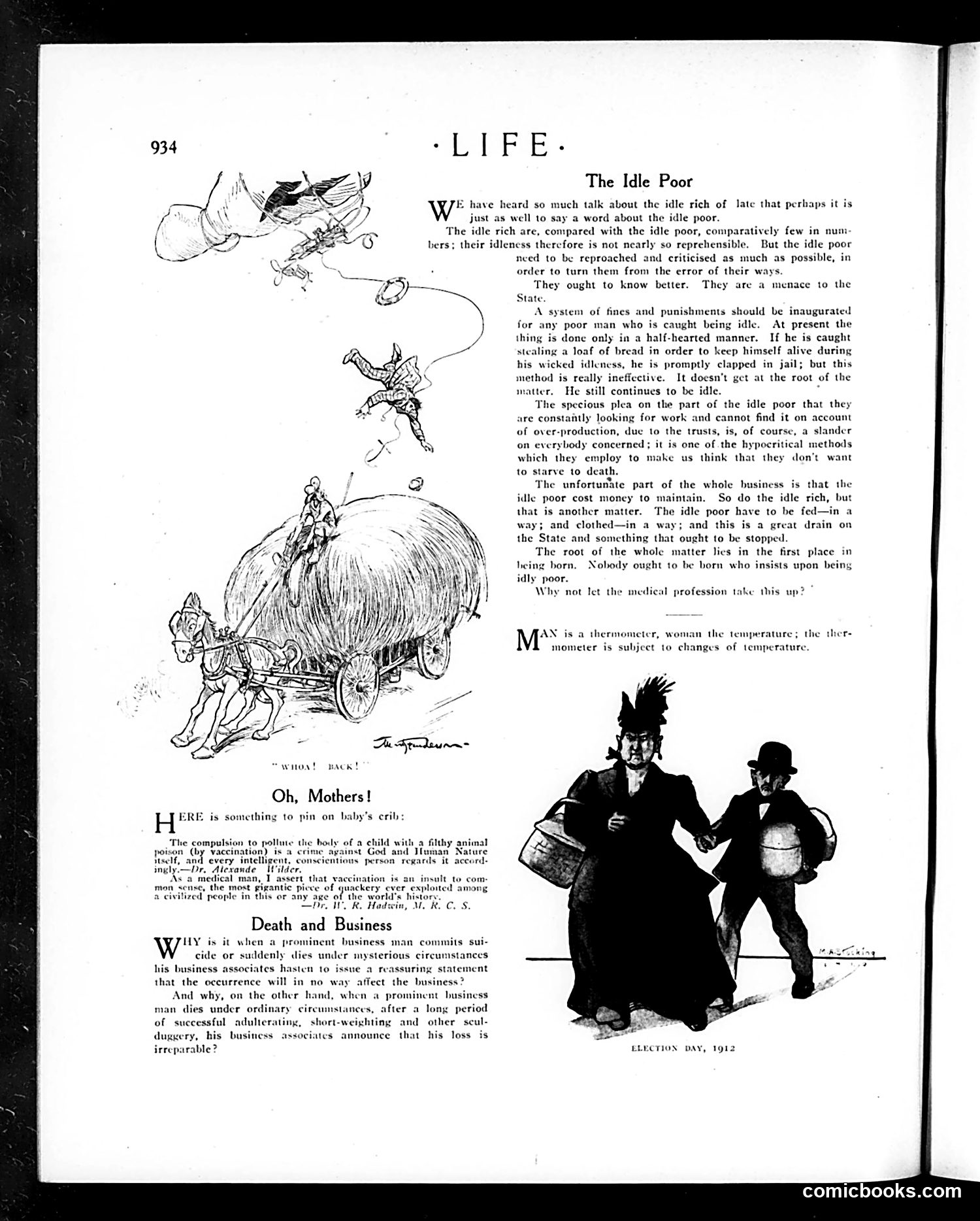
This page contains satirical essays typical of Life's early 1900s format. "The Idle Poor" is *sarcastic social criticism*: the author pretends to argue that poor people should be punished for idleness, but the absurdity (suggesting the medical profession prevent poor people from being born) reveals the piece *mocks* this attitude. The essay satirizes those who blame poverty on laziness while ignoring systemic problems like over-production and trust monopolies. "Oh, Mothers!" criticizes anti-vaccination advocates, calling vaccination opposition "guackery." "Death and Business" sardonically notes the hypocrisy: when businessmen die mysteriously, associates claim business won't suffer; when corrupt businessmen die naturally, they're called "irreplaceable." The illustration captioned "Election Day, 1912" shows figures in period dress, likely referencing that year's contentious presidential election.
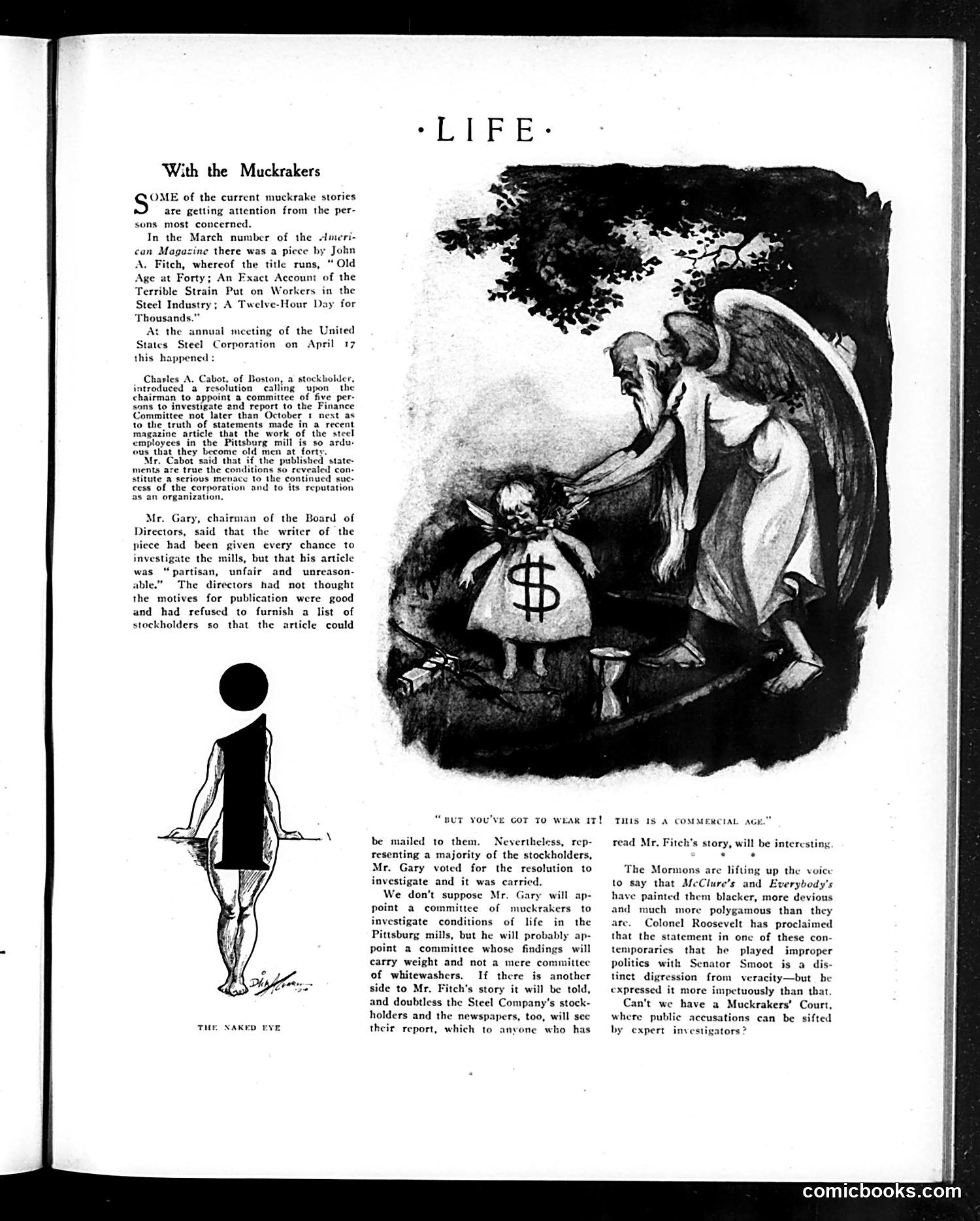
This page satirizes the "muckraking" journalism movement of the early 1900s, which exposed corporate abuses. **The situation:** John A. Fitch published an article in *American Magazine* claiming U.S. Steel workers aged prematurely from brutal twelve-hour shifts. At Steel's April 17 stockholders meeting, shareholder Charles Cabot proposed investigating Fitch's claims. Chairman Elbert Gary dismissed the article as "partisan, unfair and unreasonable" but paradoxically voted for the investigation anyway. **The satire:** The large cartoon depicts a corrupt figure—likely representing Gary or corporate interests—holding a money bag ($) while a skeletal Death/Old Age figure looms overhead. The caption "But you've got to wear it! This is a commercial age" mocks the hypocrisy: corporations exploit workers ruthlessly while claiming business necessity. **The broader point:** The article proposes a "Muckrakers' Court" for objective investigation. Life notes even Mormons and President Roosevelt disputed muckraking claims, suggesting sensationalism. Yet the visual argument—that capitalism prematurely destroys workers—remains the underlying critique.
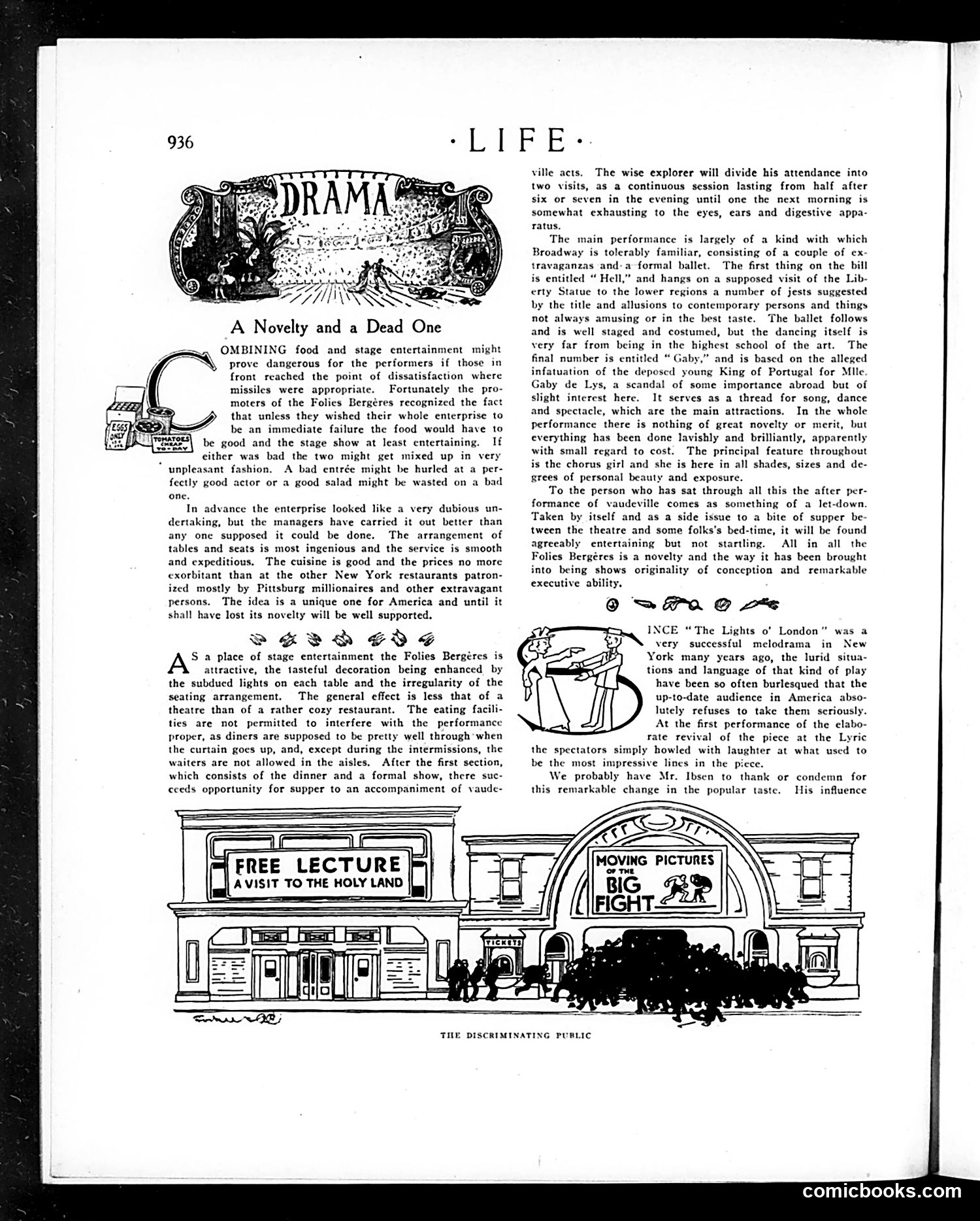
This page reviews the Folies Bergères, a new dinner-theater venue that opened in New York (likely early 1900s). The satire concerns combining food service with live entertainment—the critic humorously warns that if either the meal or show disappoints, angry patrons might throw food at performers. The review is mostly positive about execution: good cuisine, clever seating arrangements, and professional service. However, the performances themselves are dismissed as mediocre Broadway fare—a "Hell" sketch with topical jokes of varying taste, a poorly-danced ballet, and a musical finale ("Gaby") based on a minor European scandal about a deposed Portuguese king. The critic notes the show's main attraction is the chorus girls themselves rather than artistic merit. The bottom cartoon depicts two competing movie theaters (showing "Free Lecture: A Visit to the Holy Land" and "Big Fight"), illustrating how entertainment venues competed for audiences, with the caption "The Discriminating Public" suggesting satire about popular taste.
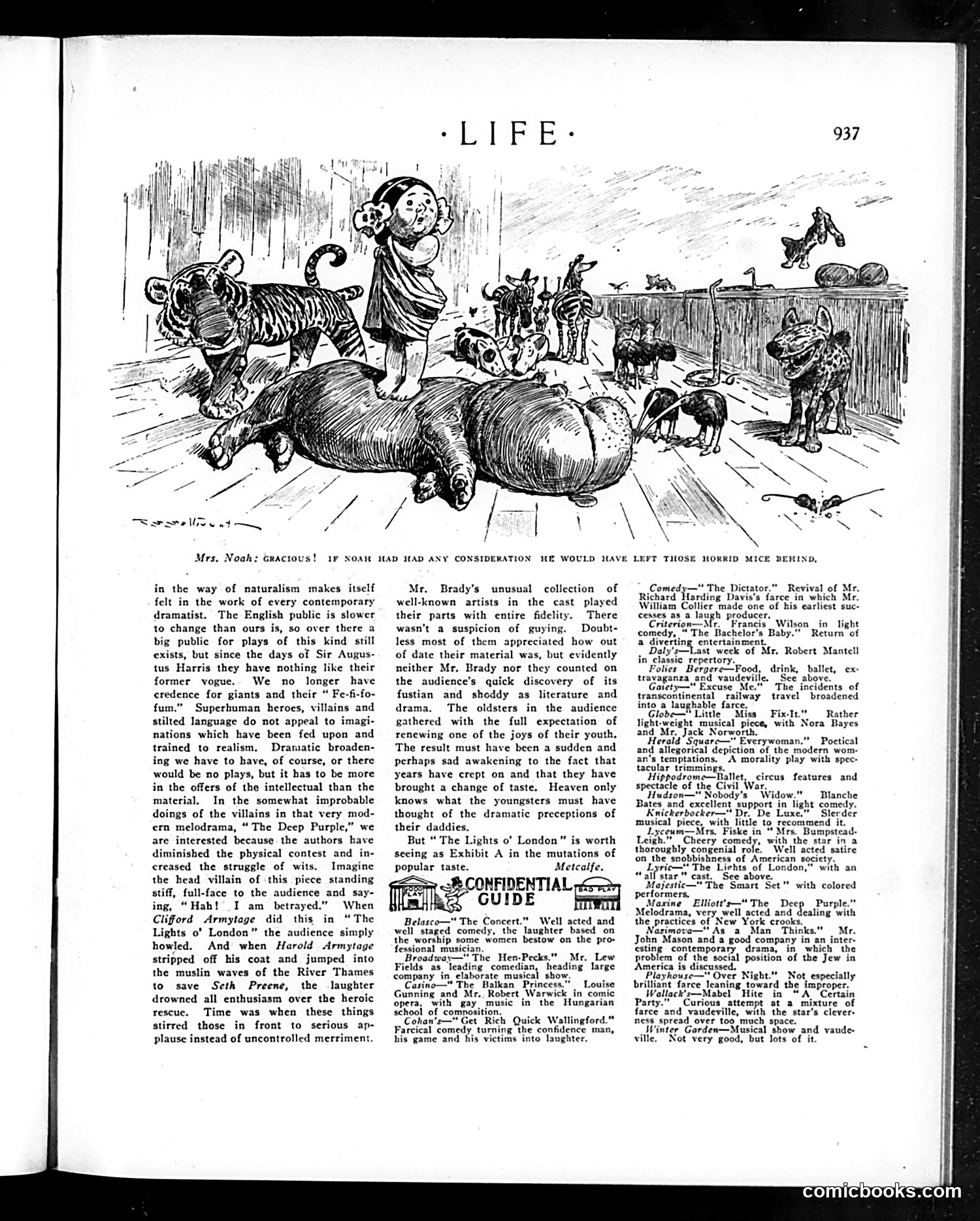
This page contains a satirical cartoon and theater reviews. The cartoon depicts **Mrs. Noah** (from the Biblical flood story) expressing shock at a chaotic scene with elephants, tigers, and various animals—a visual pun on Noah's Ark. The caption reads she's upset Noah didn't consider leaving "those horrid mice behind," mocking the absurdity of saving every creature. The accompanying text critiques a theatrical revival of **"The Lights o' London,"** an outdated melodrama. The author argues that modern audiences, trained by realistic drama, now find the play's exaggerated theatrical conventions laughable rather than moving. What once stirred genuine emotion in earlier generations now provokes uncontrolled laughter at its artificiality. The satire targets how theatrical tastes have evolved—audiences have grown more sophisticated and no longer accept "superhuman heroes" and "stilted language." The revival serves as "Exhibit A" in how popular taste has fundamentally shifted away from Victorian-era theatricality toward psychological realism.
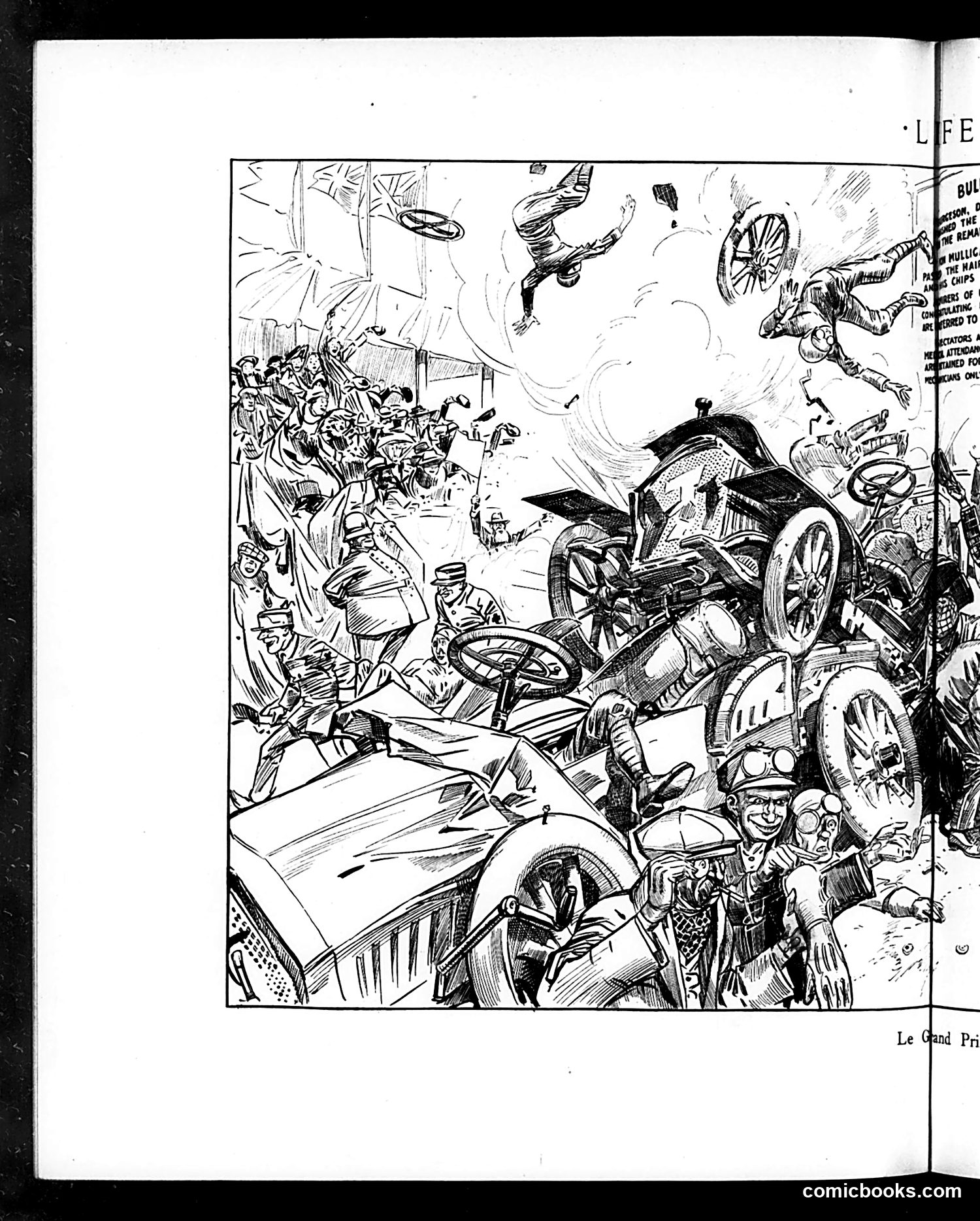
This is a satirical illustration depicting a chaotic automobile racing accident or crash scene. The drawing shows multiple early-model cars colliding or overturned, with spectators fleeing in panic from the left side. Several figures are airborne, apparently thrown from vehicles. The style and vehicle designs suggest this dates from the early 1900s. The satire likely critiques the dangers of early automobile racing or the recklessness of motorists and spectators during this period. The exaggerated chaos—with people flying through the air and vehicles twisted together—mocks both the hazards of racing culture and perhaps society's fascination with it despite obvious dangers. The page appears titled "Le Grand Pri" (likely "Grand Prix"), referencing famous racing events of that era.
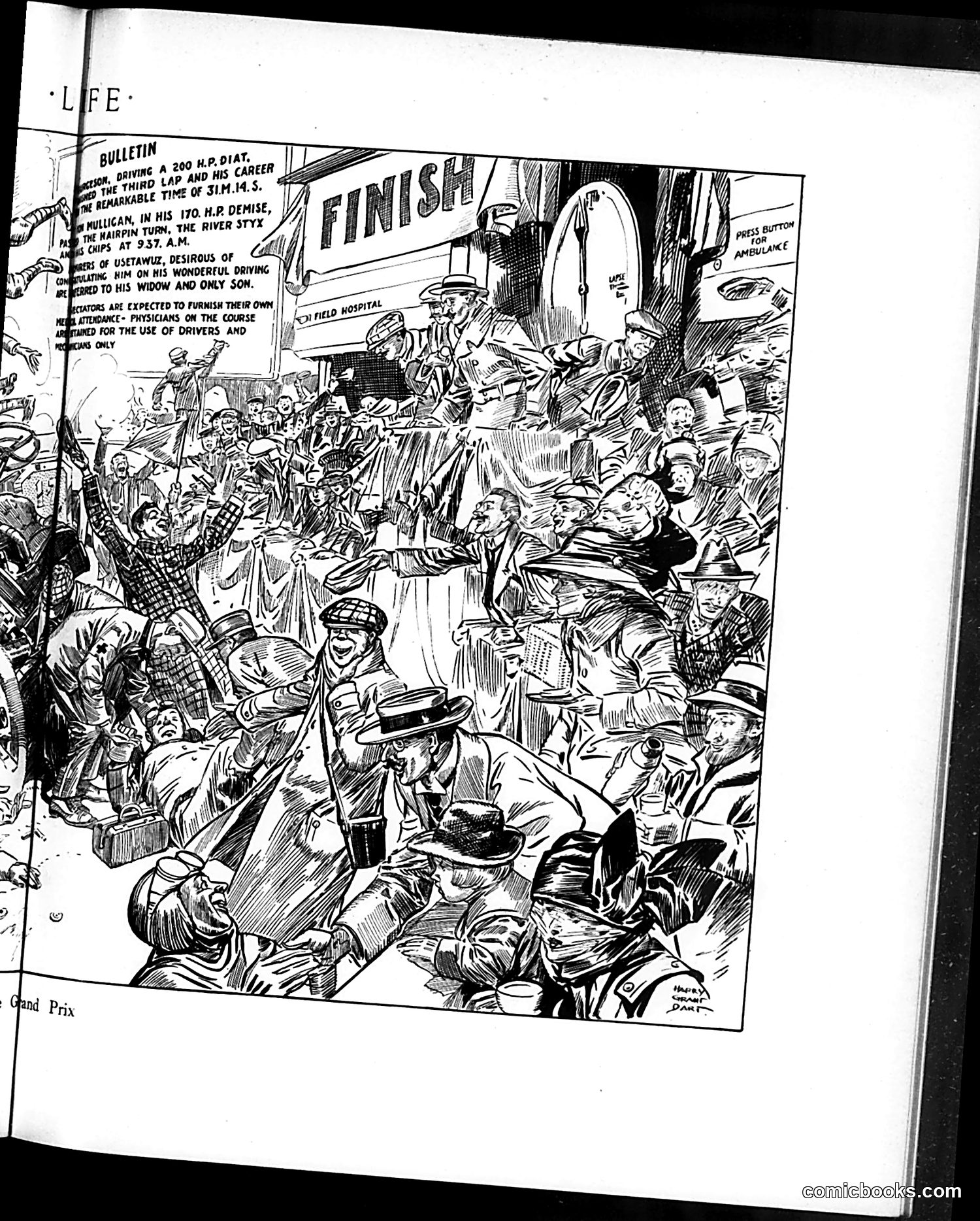
This Life magazine cartoon depicts a **racing accident at a finish line**, showing a dramatic crash scene with spectators, medical personnel, and an ambulance. The "FINISH" banner and "FIELD HOSPITAL" sign indicate this is a motorsports event. The accompanying text (partially legible) appears to be satirizing a **fatal auto racing incident**. It references "170 H.P." (horsepower), "hairpin turn," "River Styx" (classical reference to death), and mentions the deceased driver's "widow and only son"—suggesting this mocks a real racing fatality with dark humor typical of early Life magazine satire. The cartoon critiques the **dangerous, glamorous nature of early automobile racing** and society's fascination with it despite fatal risks. The detail about spectators needing to "furnish their own" physicians hints at the sport's inherent hazards and lack of safety infrastructure. Without a visible date or specific driver name, the exact incident remains unclear, but this represents Life's satirical commentary on auto racing mortality circa the 1920s-1930s.
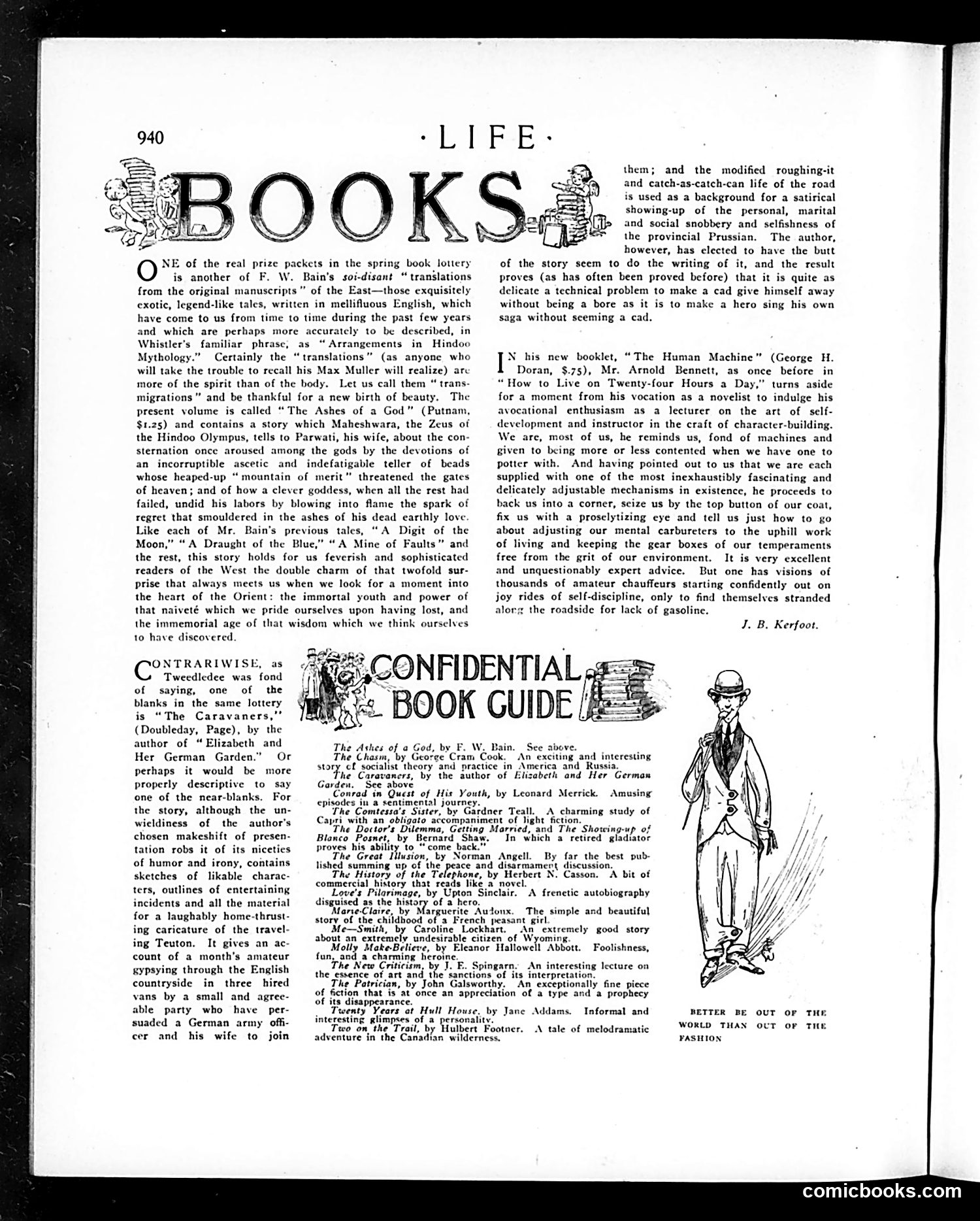
This is a **book review section**, not primarily political satire. The page discusses new literary releases, notably F.W. Bain's "The Ashes of a God"—exotic tales presented as "translations from original manuscripts" of Hindu mythology, which the reviewer suggests are actually creative "arrangements" (following art critic Whistler's term). The reviews are largely favorable toward literary sophistication: Bain's work appeals to "feverish and sophisticated readers of the West" seeking the "immortal youth" and "naiveté" of Eastern wisdom alongside Western worldliness. **The single cartoon** (right margin) shows a well-dressed man in profile with the caption "BETTER BE OUT OF THE WORLD THAN OUT OF THE FASHIONS"—a straightforward satirical jab at fashion-obsessed vanity, mocking society's prioritization of style over substance. The "Confidential Book Guide" provides brief reviews of contemporary titles, mostly praising their literary merit. No major political figures or events are caricatured here.
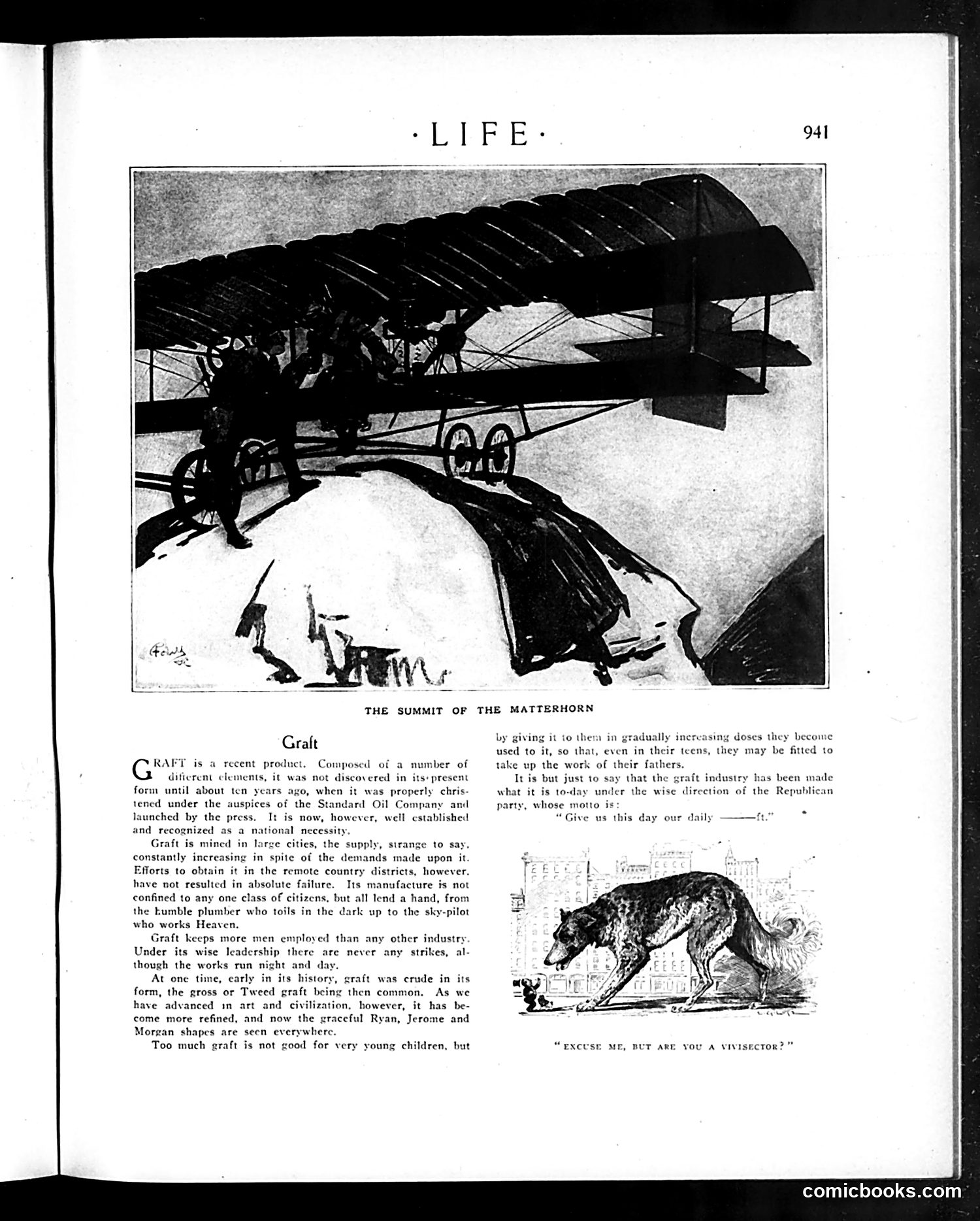
This is a satirical article from Life magazine attacking **political and corporate corruption** under Republican leadership. The text uses mock-earnest language to describe "graft" (bribes and embezzlement) as if it were a legitimate industry, ironically praising it as a "national necessity" that employs many workers. The article references specific historical figures associated with corruption scandals: - **"Tweed graft"** refers to Boss Tweed's notorious NYC machine corruption - **Ryan, Jerome, and Morgan** likely reference wealthy industrialists/politicians implicated in graft schemes The top illustration shows an early airplane, titled "The Summit of the Matterhorn"—a visual pun suggesting corruption has reached new heights. The bottom cartoon depicts a woman confronting a man about being a "vivisector" (someone who dissects living creatures), likely a satirical jab at those who profit from exploiting others. The overall message: corruption is so embedded in American society (especially under Republicans) that it's passed down generationally and normalized, treated as respectable business practice.
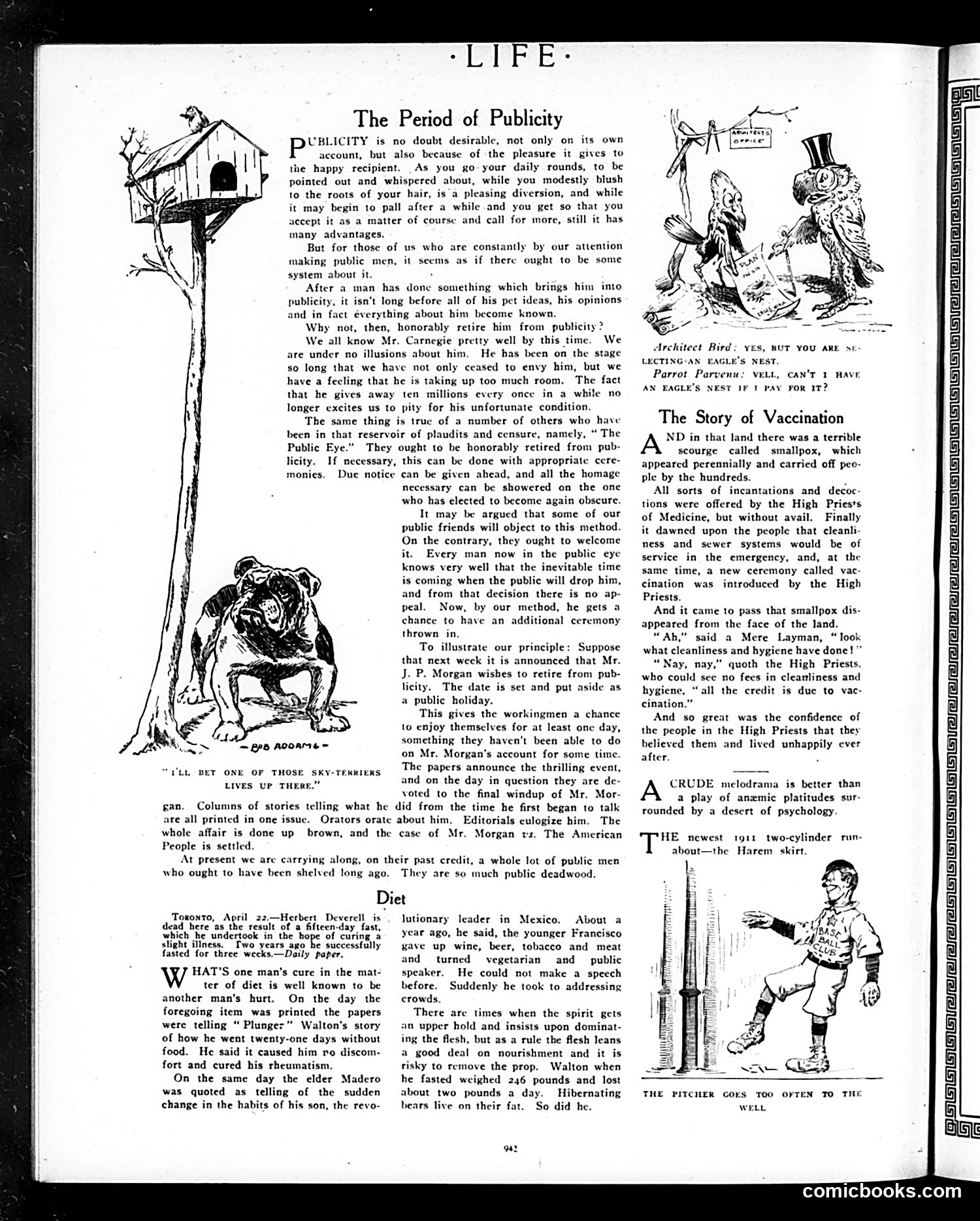
This satirical piece critiques two separate social phenomena: **"The Period of Publicity"** attacks the exhausting permanence of public figures. The author argues that famous men like Andrew Carnegie and J.P. Morgan should be ceremonially "retired" from public attention after their initial accomplishments, rather than remaining in constant scrutiny. The cartoons show a dog in a tree (illustrating absurd public fixation) and someone pointing at a birdhouse, mocking how relentlessly we pursue public figures' every detail. The satire suggests that persistent publicity creates "deadwood"—figures no longer relevant but still commanding attention. **"Diet"** juxtaposes contrasting medical anecdotes: one man died fasting for fifteen days; another ("Plunger" Walton) fasted twenty-one days and claimed wellness benefits. This highlights the era's confused, individualized health theories where the same treatment produced opposite results—mocking the lack of scientific consensus on nutrition and the danger of following unproven health trends. Both sections exemplify *Life's* technique of using current events and ironic commentary to satirize American social obsessions.
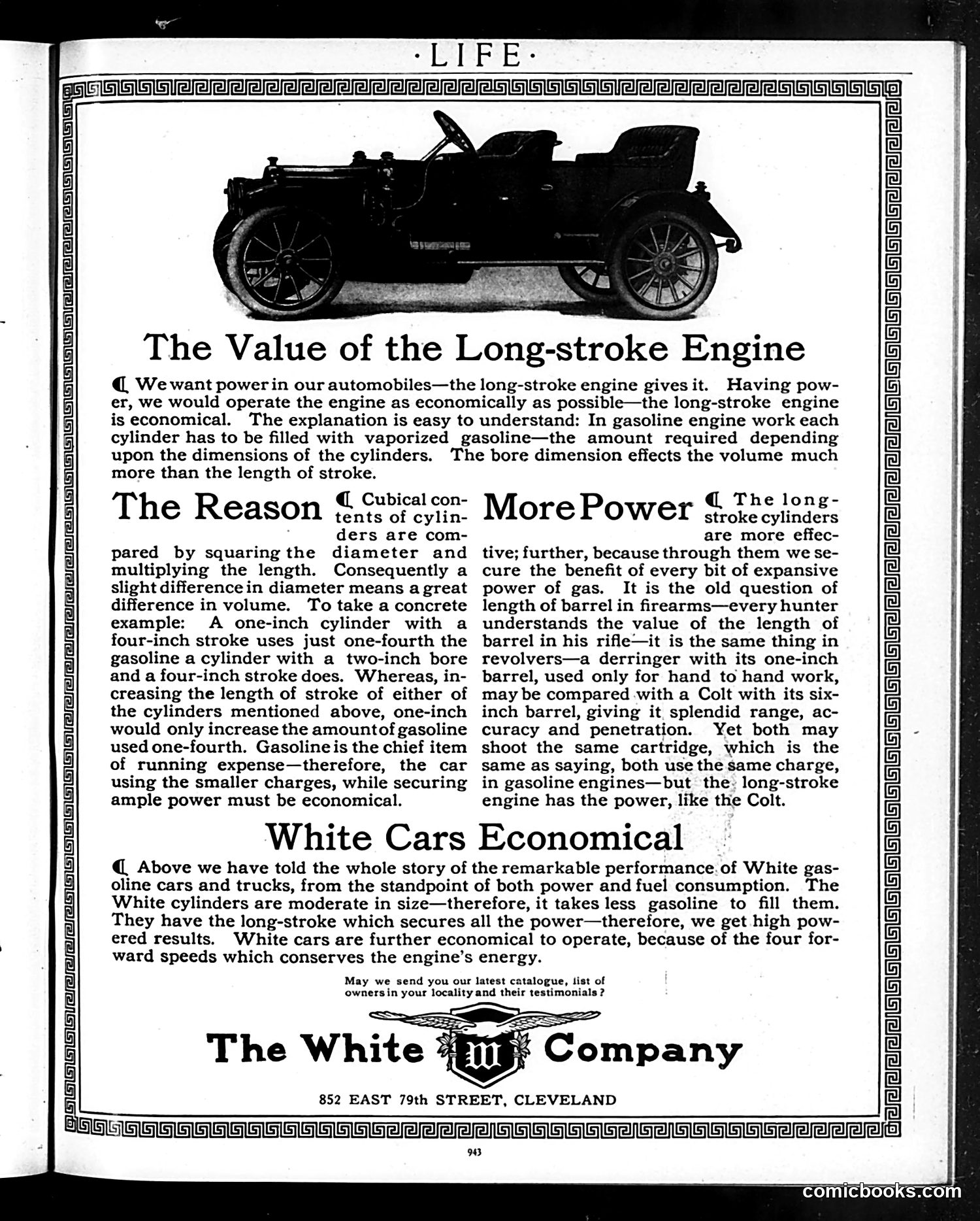
This is a **White automobile company advertisement** (not satire or cartoon), published in *Life* magazine. The page promotes White automobiles' engine technology to potential buyers. The ad uses technical explanation and analogy to argue that White cars offer superior **power and fuel economy** through their "long-stroke engine" design. The key argument: cylinder bore diameter affects fuel consumption more than stroke length, so White's moderate-sized cylinders use less gasoline while long strokes maximize power output. The ad compares engine design to **rifle barrels**—a longer barrel (like a Colt revolver versus a derringer) achieves greater range and accuracy with the same ammunition charge. Similarly, long-stroke engines extract more power from identical fuel amounts. The section "White Cars Economical" summarizes the pitch: moderate cylinders reduce fuel needs; long strokes deliver power; four forward speeds conserve energy. This reflects early automotive marketing when engine specifications and efficiency were novel selling points to relatively new car buyers.
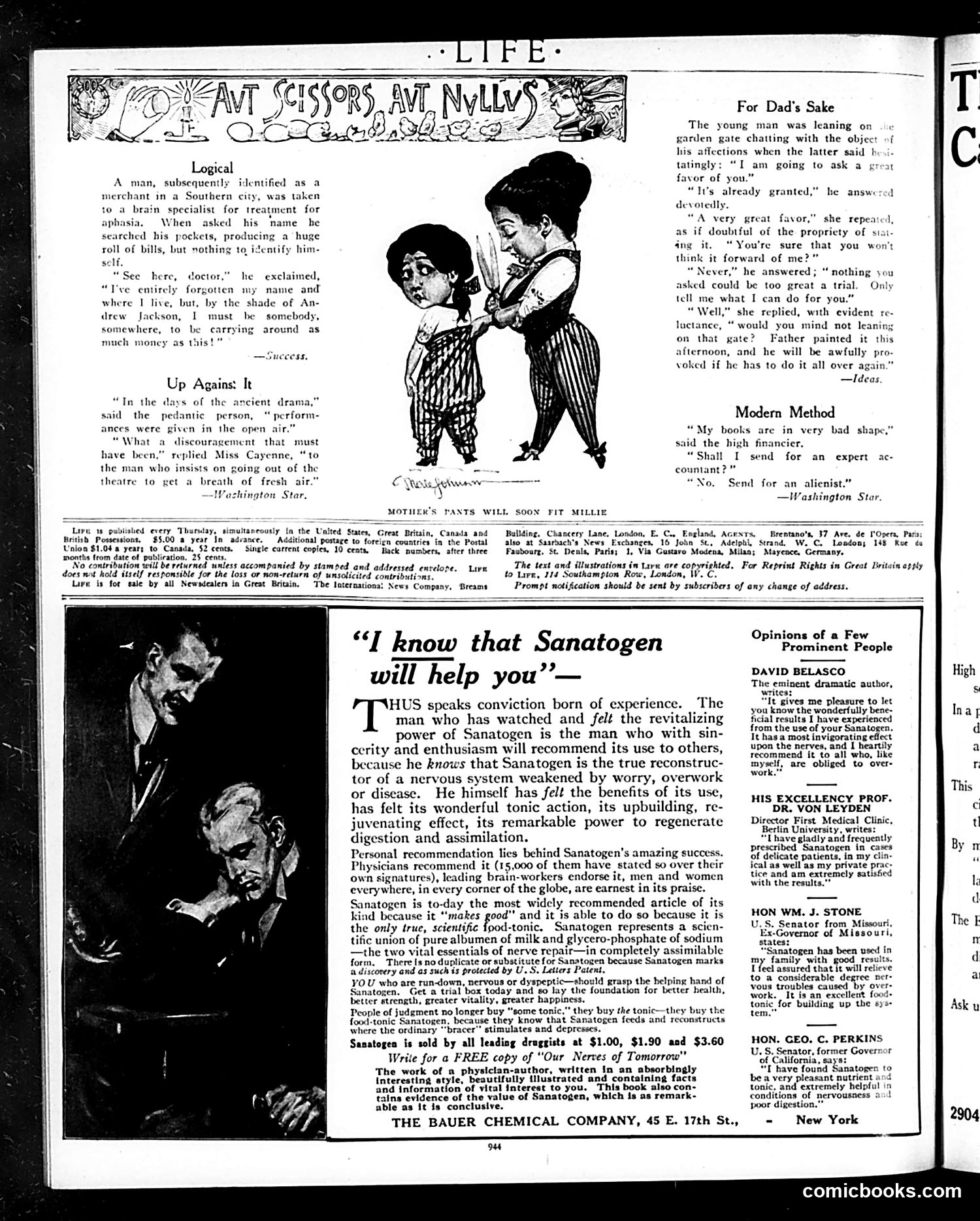
This page contains three separate humor pieces typical of early 20th-century Life magazine's satirical style: **"Logical"**: A merchant with aphasia (speech disorder) cannot remember his name but can produce a large roll of bills, joking that money is his identity. The satire targets materialism and the assumption that wealth defines a person. **"Up Again: It"**: A pedantic person argues ancient Greek drama was performed outdoors for fresh air. The joke mocks pretentious intellectuals who construct absurd justifications for trivial matters. **"For Dad's Sake"**: A young suitor agrees to any favor from his sweetheart, only to learn she wants him to stop leaning on her father's freshly-painted gate. The humor lies in his dramatic overstatement versus her mundane request. The central cartoon "Mother's Pants Will Soon Fit Millie" depicts a child who will grow into adult-sized clothing, a simple visual gag. The page is largely dominated by a **Sanatogen advertisement**—a patent medicine marketed as a nerve tonic and health restorative, featuring endorsements from prominent figures. This reflects the era's widespread promotion of dubious medicinal products.
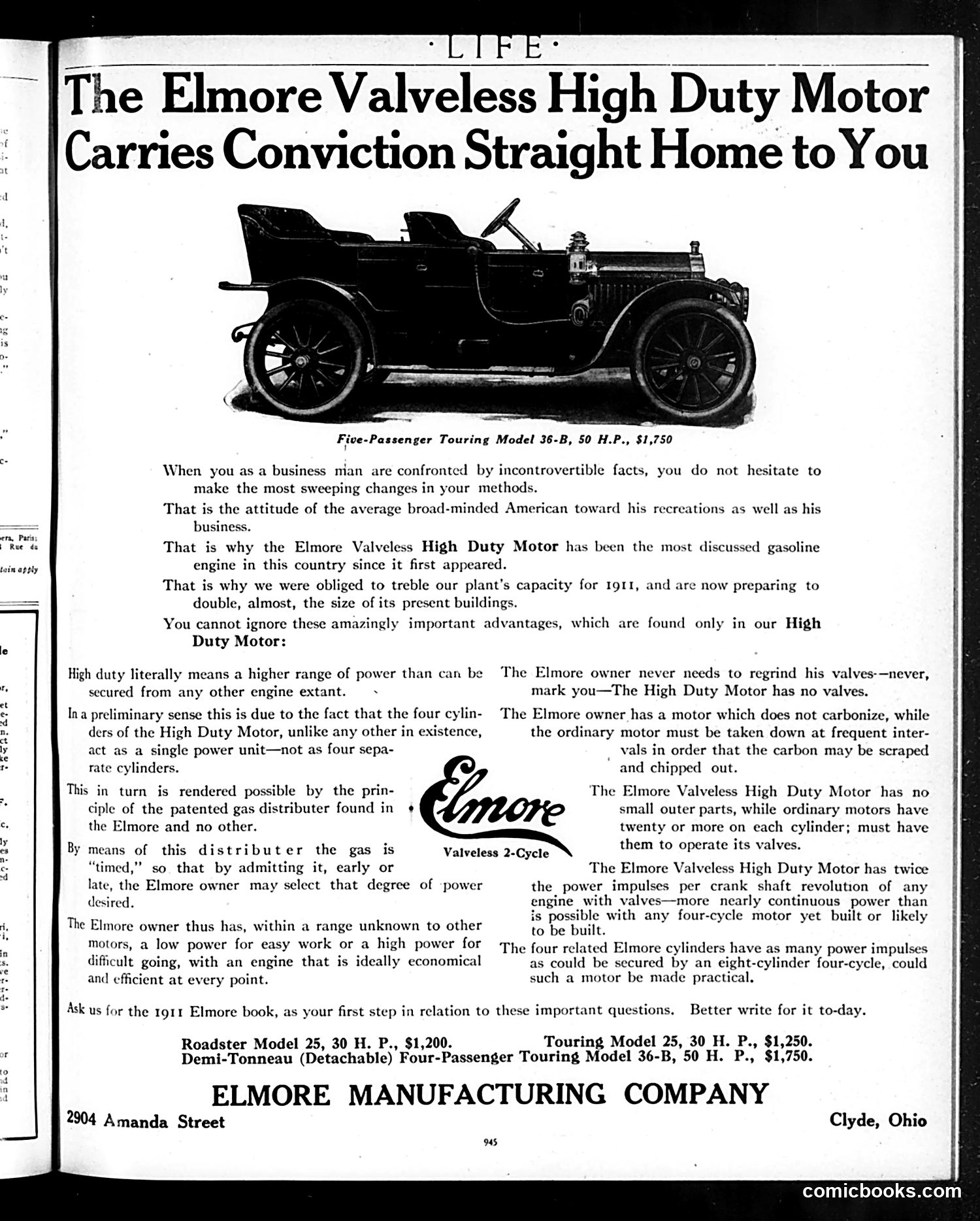
This is **not a cartoon or satire** but a straightforward automobile advertisement. The page promotes the Elmore Manufacturing Company's "Valveless High Duty Motor," a genuine competing technology in early automotive history. The ad's rhetorical strategy appeals to "broad-minded" American businessmen by framing the valveless engine as a logical, fact-based choice. It emphasizes technical advantages: the four cylinders work as a single unit via a patented gas distributor, eliminating the need for traditional valves (which required frequent maintenance and regrinding). This design supposedly produced more continuous power and less carbonization than conventional motors. The heading's phrase "Carries Conviction Straight Home to You" uses confrontational language typical of 1911 advertising—essentially claiming the evidence is irrefutable. Multiple car models and prices are listed, indicating this was a serious competitor in the pre-Model T automotive market, not a satirical subject. The valveless design ultimately proved inferior and disappeared from the market by the 1920s.
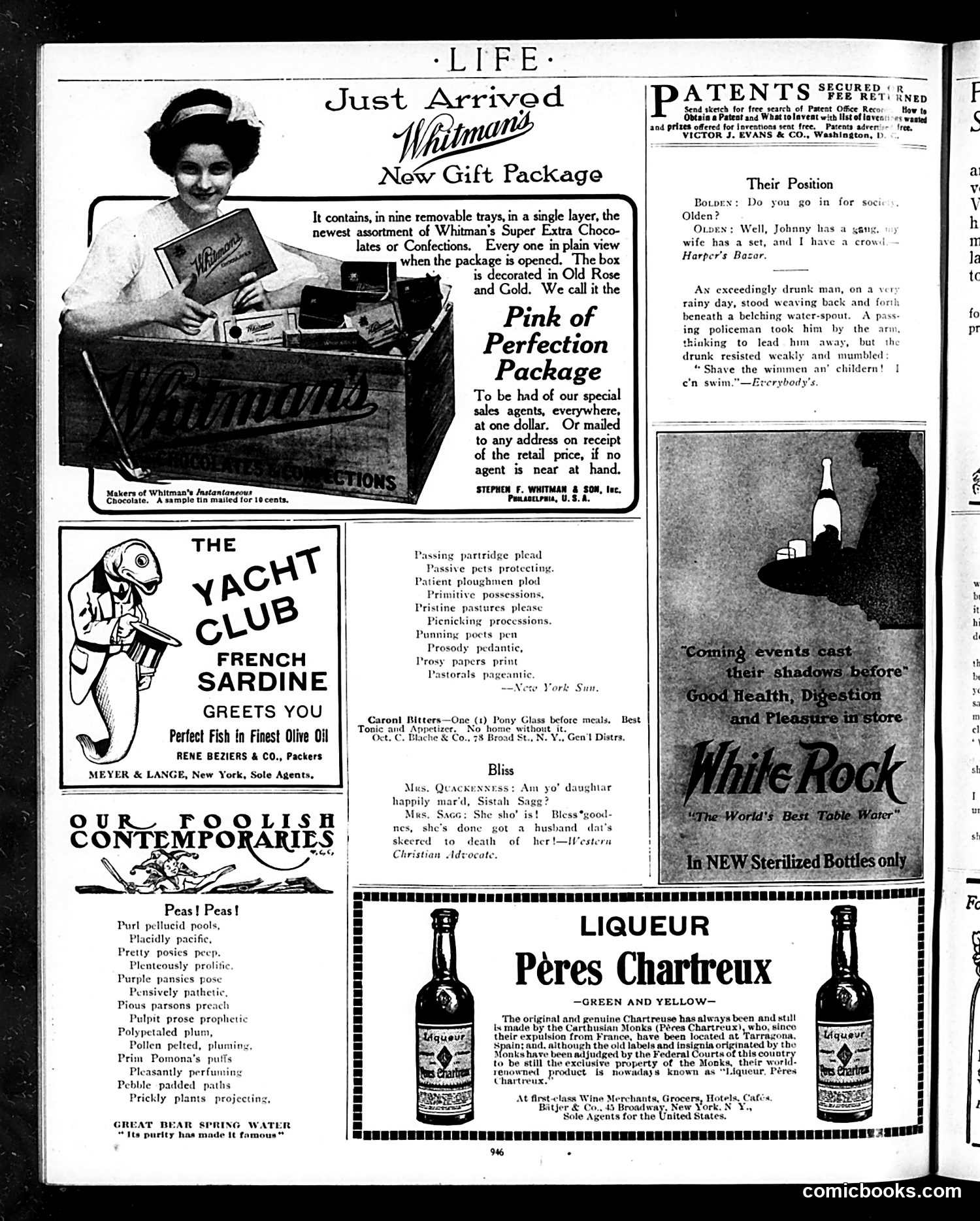
This page is primarily **advertising with minimal satirical content**. The main items are commercial advertisements for Whitman's chocolates, French sardines, White Rock mineral water, and Péres Chartreux liqueur. The only clearly satirical elements are brief **humor snippets**: 1. **"Their Position"** — a domestic joke about social circles: a husband claims to have a "crowd" while his wife has a "set" and their son has a "gang," poking fun at class pretensions and social stratification. 2. **"Bliss"** — a satirical exchange between Black women about one's new husband being "skeered to death of her," inverting traditional power dynamics in marriage as humor. 3. **"Our Foolish Contemporaries"** — alliterative verse mocking overwrought poetic language through absurd repetition ("Purl pellucid pools..."). These are minor filler jokes typical of Life's format, not substantial political or social satire. The page's primary purpose is revenue generation through product advertising.
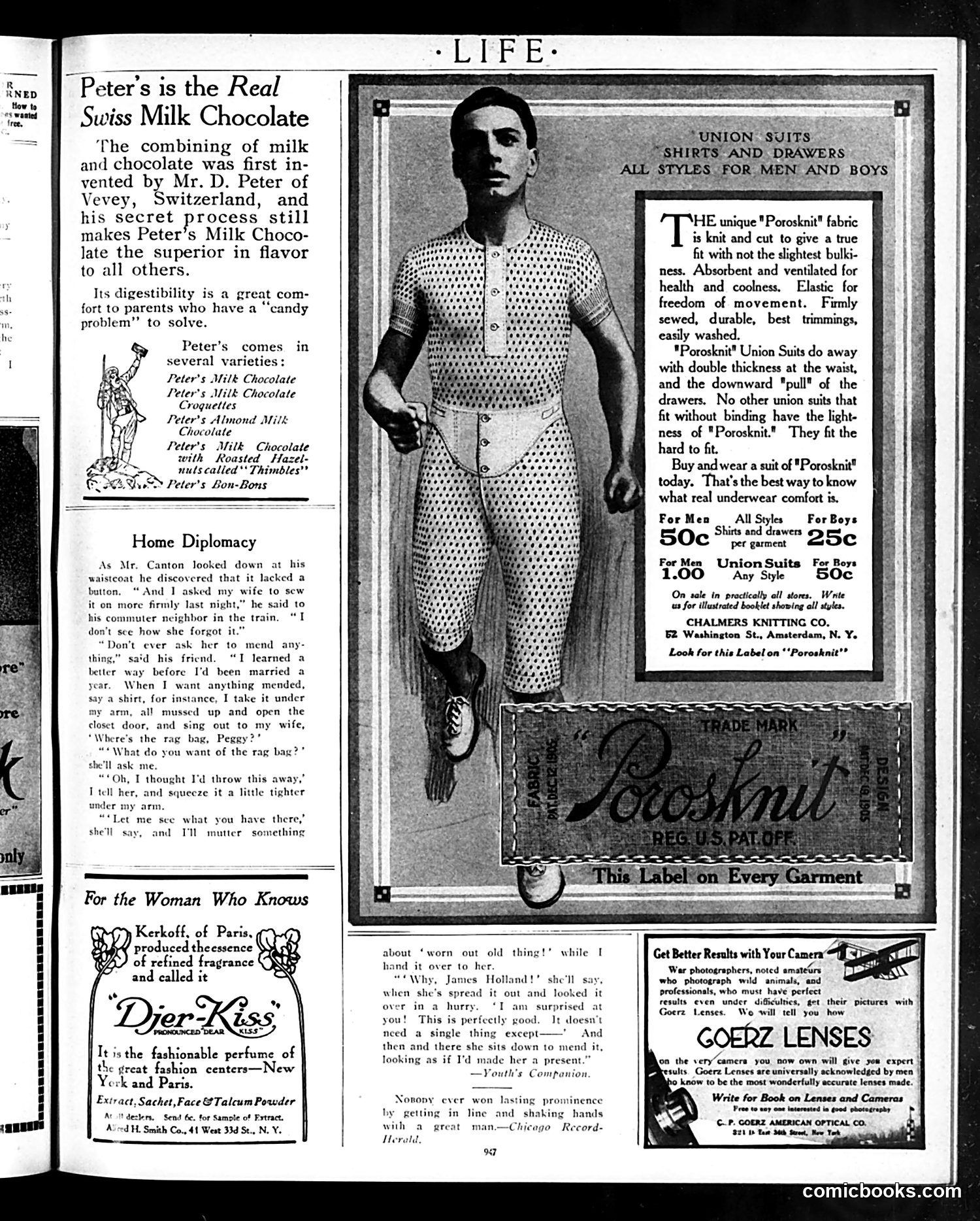
This page is primarily **advertising and humor**, not political satire. The main content includes: **"Home Diplomacy"** — A humorous domestic anecdote about marital negotiation. A husband wanting his shirt mended uses reverse psychology, pretending to discard it as a "rag," prompting his wife to voluntarily repair it rather than see good clothing wasted. The joke relies on early 20th-century gender dynamics: wives as domestic managers and menders, husbands as clever manipulators of household labor. **Advertisements** dominate the page: - Peter's Swiss Milk Chocolate (emphasizing digestibility for children) - Dier-Kiss perfume (marketed to fashionable women) - Porosknit union suits (men's/boys' underwear) - Goerz camera lenses The page reflects **period consumer culture** and assumes gender-specific roles typical of the 1910s-1920s era. There is no political commentary—it's entertainment and marketing aimed at middle-class American readers.
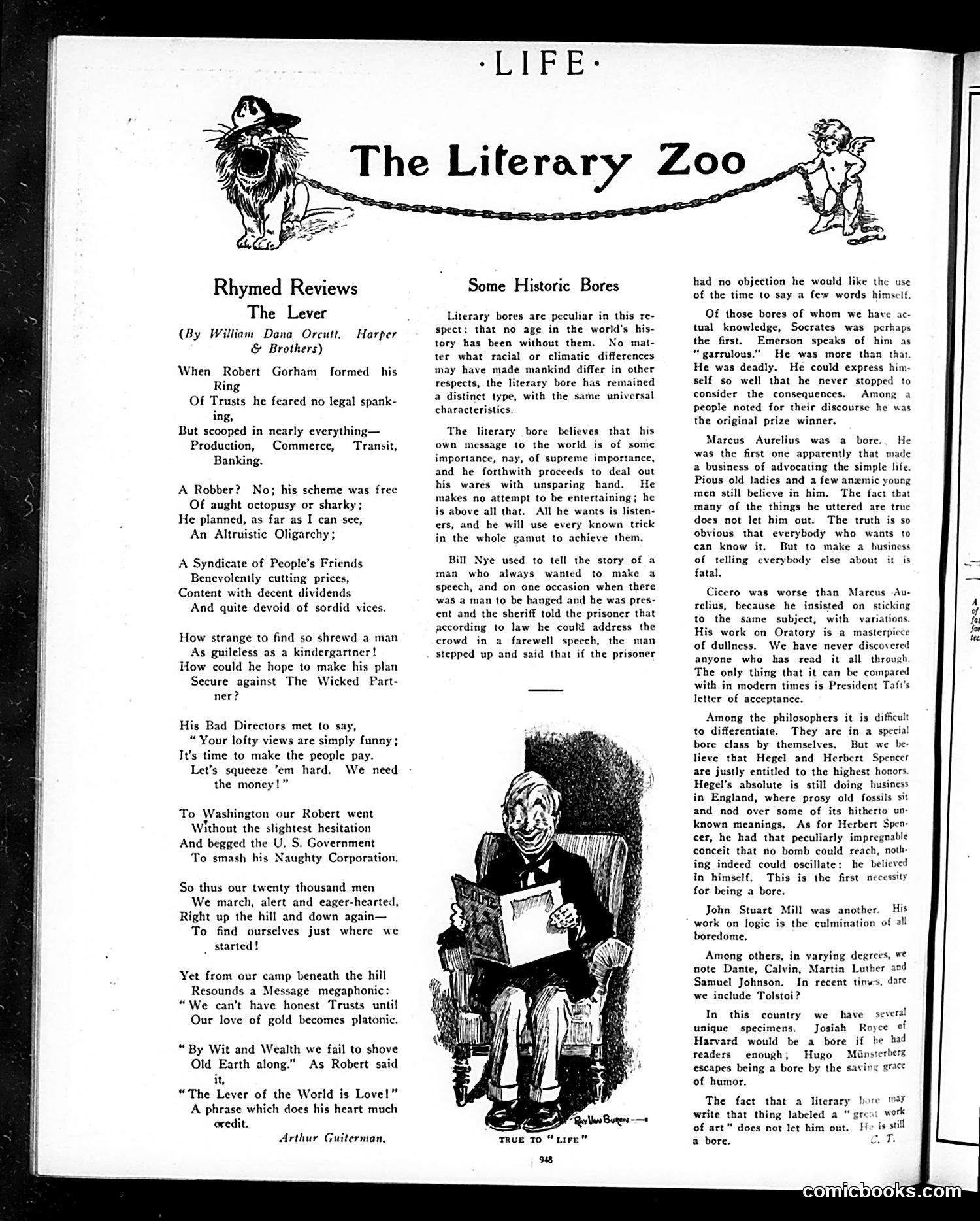
This page satirizes two targets: **"The Lever" (poem by Arthur Guiterman):** A verse-review mocking a naive industrialist, Robert Gorham, who forms a trust claiming altruistic motives but is undone by corrupt directors. The satire targets the Progressive Era's trust-busting debates—Gorham's naïve belief that businessmen can act virtuously without regulation is presented as absurd. His desperate appeal to the government to dissolve his own corporation results in futility. **"Some Historic Bores":** An essay ridiculing famous figures—Socrates, Marcus Aurelius, and Cicero—not for being wrong but for tediously lecturing others about truths everyone already knows. The humor lies in equating ancient philosophers with contemporary literary bores. A jab at President Taft's "letter of acceptance" (likely his 1908 campaign letter) suggests even modern politicians bore audiences with obvious platitudes. The cartoon shows an elderly man reading—representing the suffering audience.
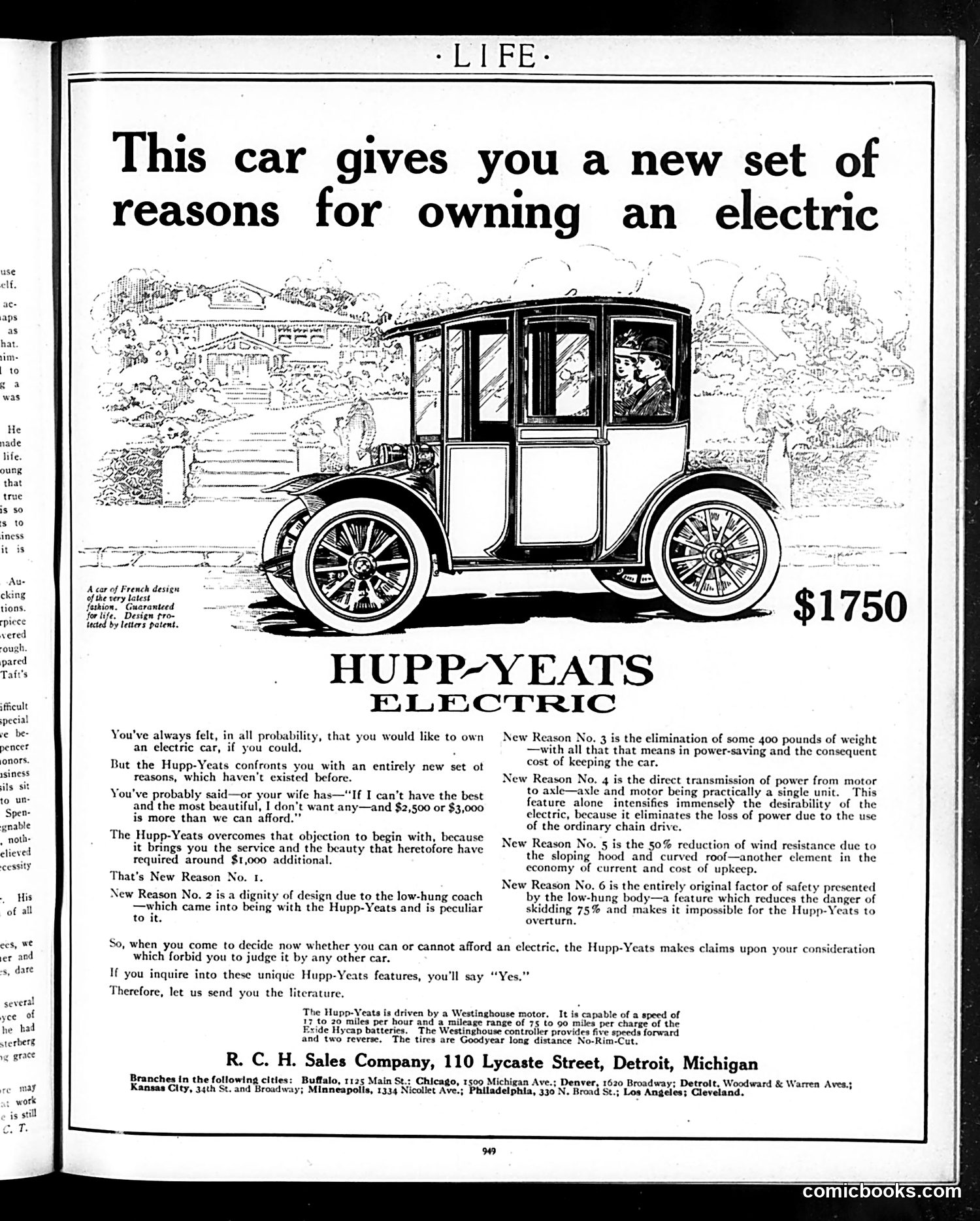
This is a straightforward product advertisement, not satire. It promotes the Hupp-Yeats Electric automobile (priced at $1,750) to early 20th-century consumers by listing six practical advantages of electric vehicles: weight reduction, direct motor-to-axle transmission, reduced wind resistance, improved safety features, elegant design, and a Westinghouse motor capable of 17-20 mph with 75-90 mile range per battery charge. The ad addresses common objections to electric cars—particularly cost and perceived inferiority to gasoline vehicles—by emphasizing technological innovations and refined engineering. The illustration shows an elegant enclosed carriage with well-dressed occupants, positioning electrics as sophisticated, reliable transportation for affluent buyers. This represents the pre-1920s period when electric vehicles were competitive luxury options before gasoline engines became dominant.
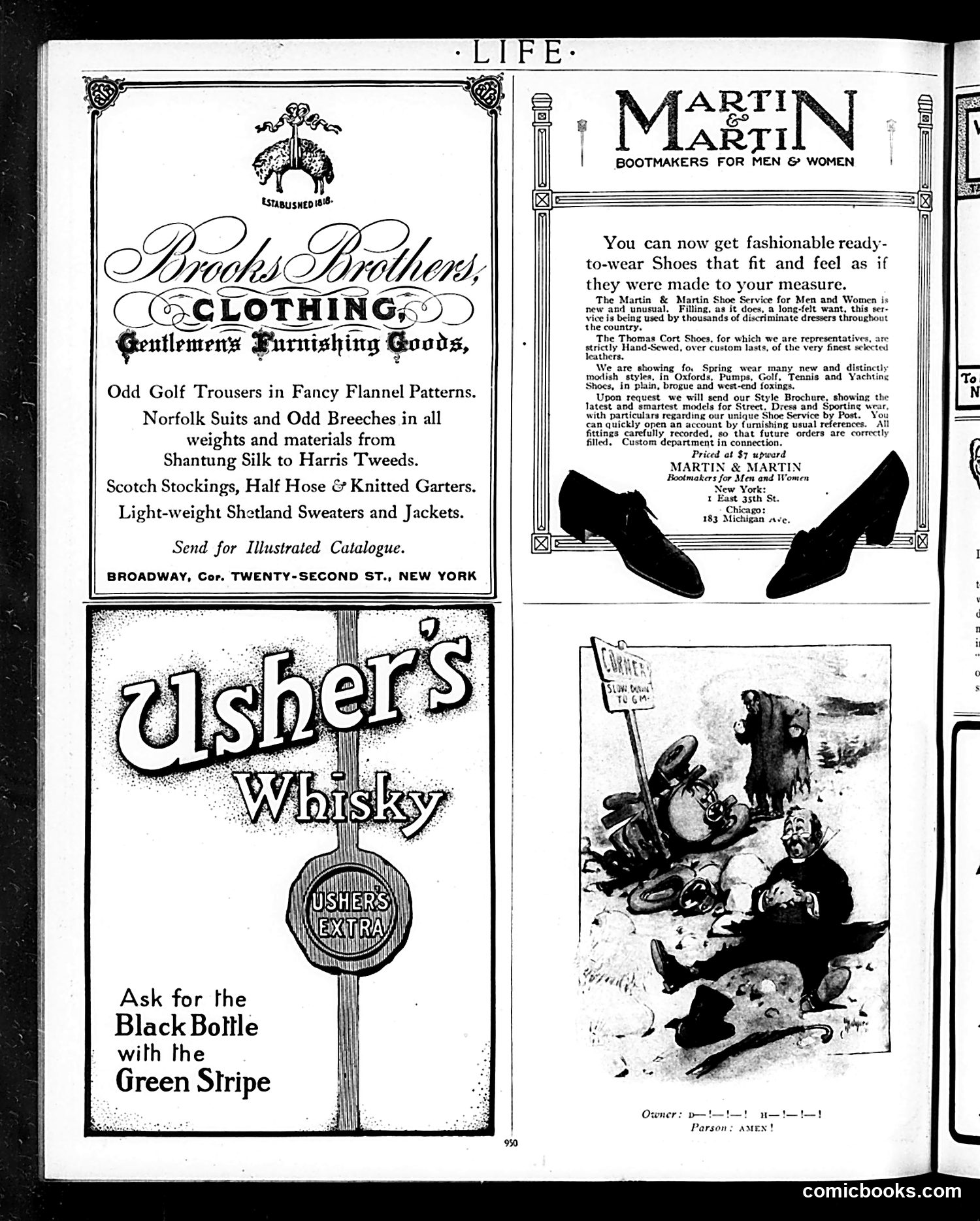
This page is primarily **advertising**, not political satire. It contains three advertisements: 1. **Brooks Brothers** (top left): Gentlemen's clothing and furnishings, emphasizing quality fabrics like Harris Tweeds and Shetland materials—targeting affluent male readers. 2. **Martin & Martin Bootmakers** (top right): Custom-fitted ready-made shoes, promoting a mail-order shoe service with custom lasts for discriminating dressers. 3. **Usher's Whisky** (bottom left): A liquor advertisement promoting "Usher's Extra" whisky, instructing consumers to request the "Black Bottle with the Green Stripe." The only cartoon element is a small illustration accompanying the whisky ad (bottom right), showing what appears to be a humorous scene, though its specific satirical meaning is unclear without additional context. The page reflects early 20th-century consumer culture targeting wealthy gentlemen.
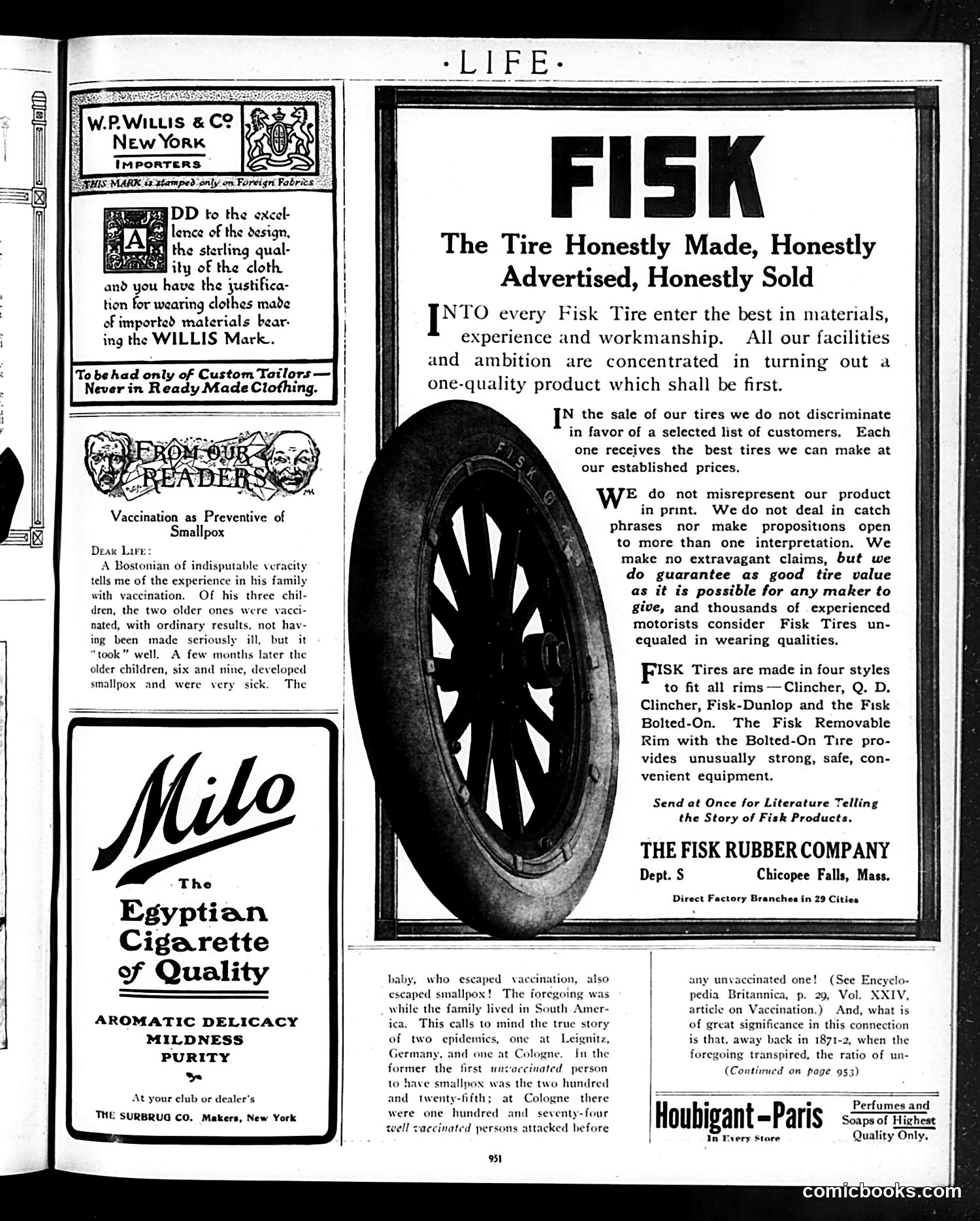
This page contains primarily **advertisements rather than political cartoons**. The main content includes: 1. **W.P. Willis & Co.** (top left): An ad for imported custom tailoring, emphasizing quality materials and craftsmanship over ready-made clothing. 2. **"From Our Reader" letter** (left): A Boston reader shares an anecdote questioning vaccination's effectiveness against smallpox. The writer describes vaccinated children who later contracted smallpox, while an unvaccinated child escaped it. The letter references historical disease patterns in 19th-century German cities to suggest vaccination may be unreliable—reflecting contemporary vaccine skepticism. 3. **Milo Egyptian Cigarettes** (left): A product advertisement. 4. **Fisk Tires** (right): The largest ad, emphasizing honest manufacturing, pricing, and marketing claims—a notable rhetorical stance during an era of industrial expansion and consumer skepticism about product quality. The page reflects early 20th-century consumer culture and public health debates rather than satirical commentary.
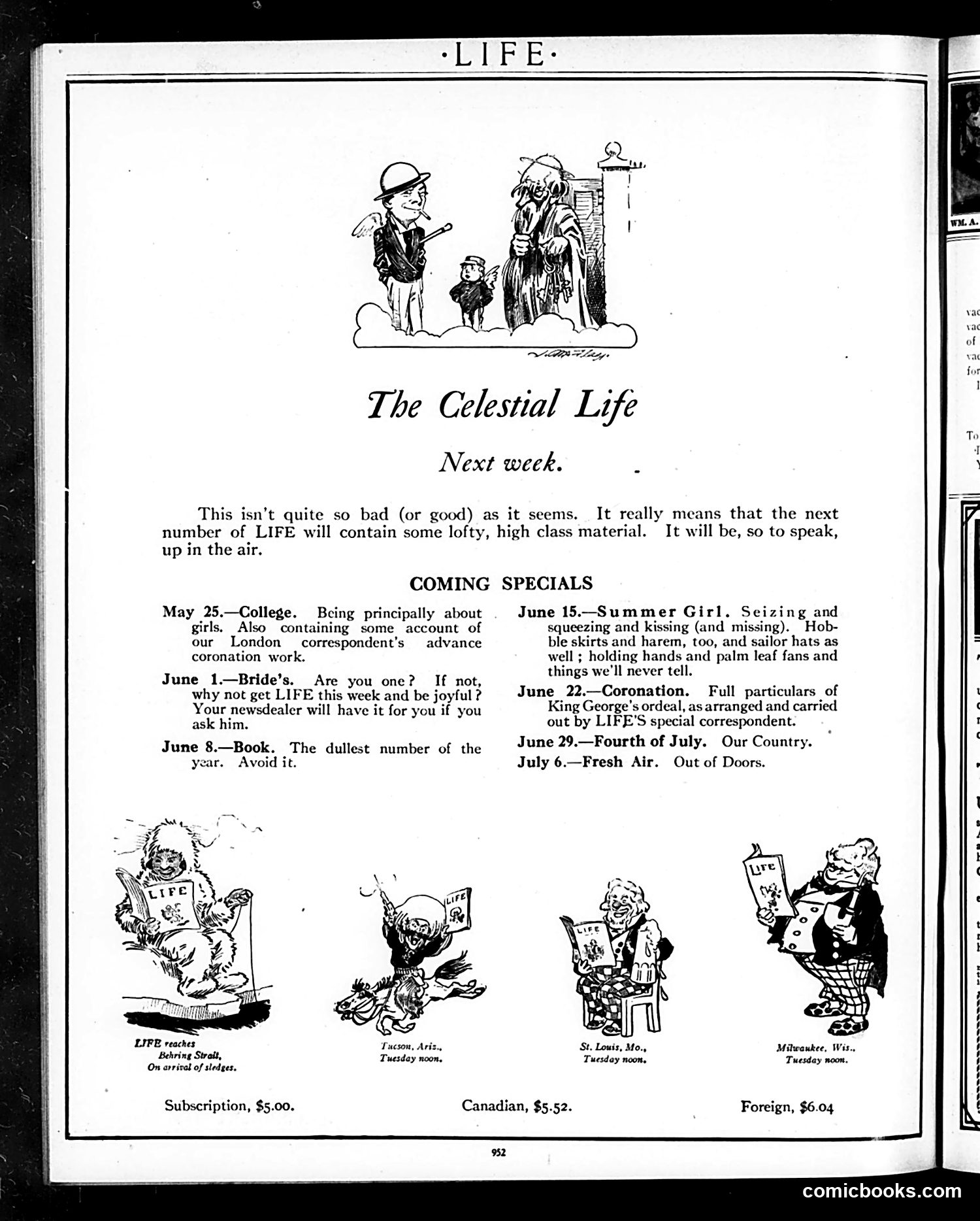
This is a self-promotional advertisement for upcoming issues of *Life* magazine, using humorous teasing to entice readers. The header illustration depicts figures ascending to heaven on a cloud, punning on "celestial life" as both heavenly and the magazine's upcoming content. The page lists coming special issues with satirical descriptions. Notable references include: - **June 1 (Bride's issue)**: Mocking unmarried readers, urging them to buy the magazine - **June 8 (Book issue)**: Openly admits this will be "the dullest number of the year"—a self-deprecating joke - **June 15 (Summer Girl)**: Flirtatious content about fashions (hobble skirts, harem styles) and romantic behavior - **June 22 (Coronation)**: References King George V's coronation, which occurred in 1911 - Four small cartoons at bottom show *Life* being read in different locations The satire relies on *Life*'s frank, irreverent advertising style—essentially saying "most of our content is frivolous, but buy it anyway."
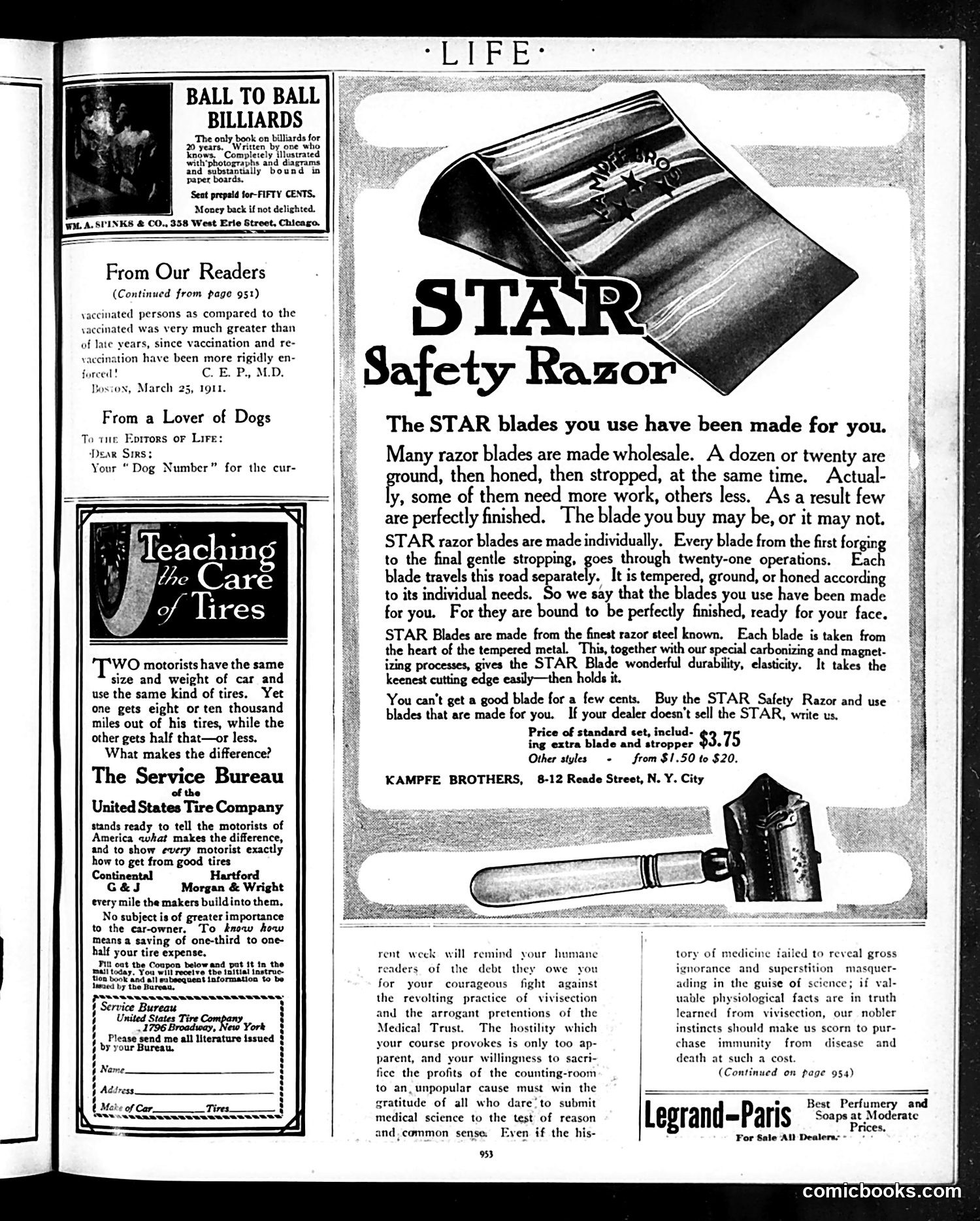
This page is primarily **advertising**, with the STAR Safety Razor dominating the right side. The ad emphasizes individual craftsmanship—each blade undergoes twenty-one separate operations rather than mass-production batching. This appeals to early-20th-century consumer concerns about quality and care in manufacturing. The left side contains reader letters and smaller ads (billiards book, tire maintenance bureau). One letter from "A Lover of Dogs" criticizes **vivisection** (animal testing in medical research), praising Life's editorial stance against this practice. The writer argues that animal testing is morally indefensible and that vivisection represents "arrogant pretensions of the Medical Trust." This reflects a genuine early-1900s debate: anti-vivisection was a serious reform movement, and Life apparently championed animal welfare against medical establishment practices. The juxtaposition of this passionate moral letter with consumer advertising about craftsmanship is typical of Life's mixed editorial-commercial format.
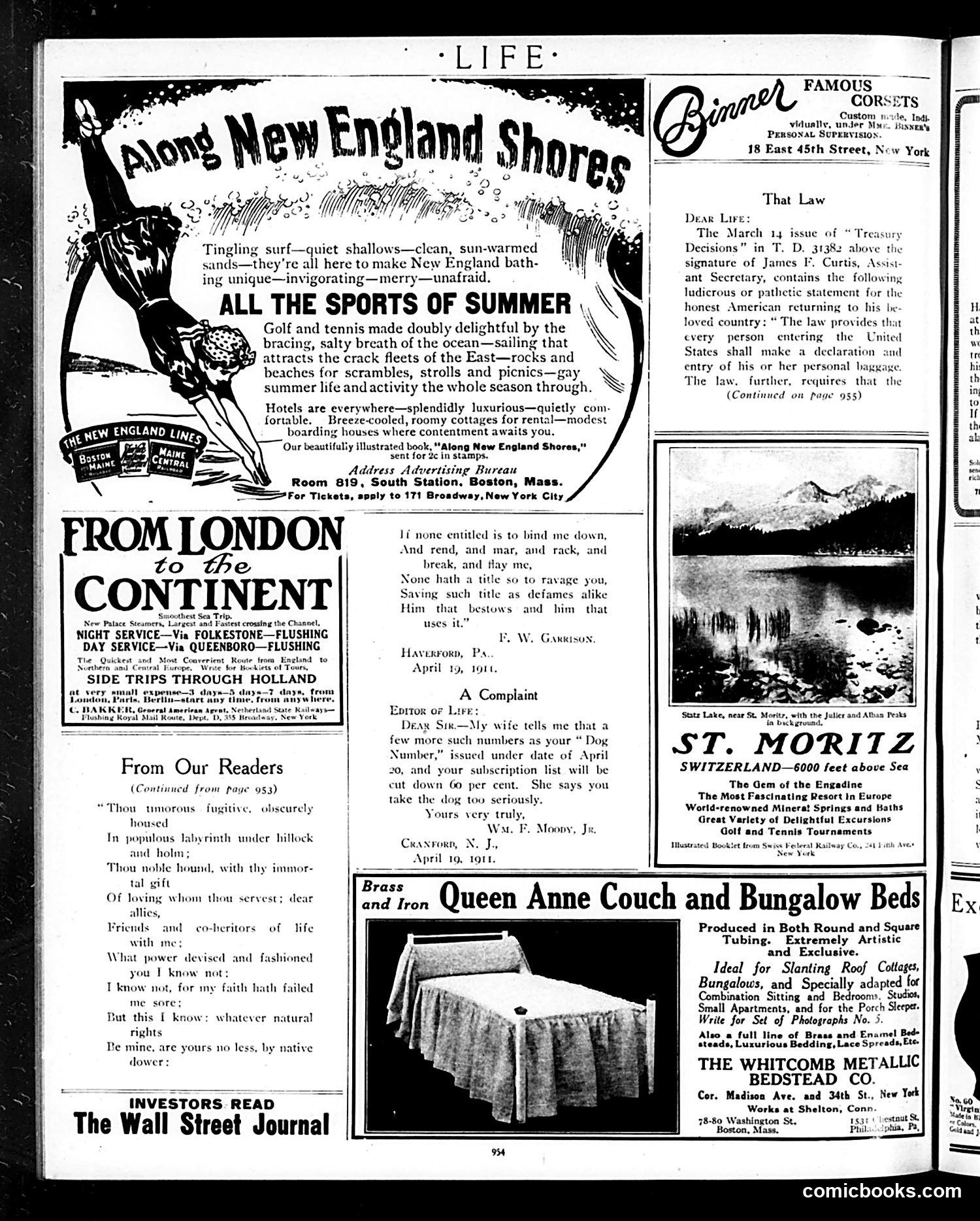
This is primarily an **advertising and reader-correspondence page** from *Life* magazine (circa 1911, based on the April 19 date visible). The main satirical content appears in the "From Our Readers" section, where **W. F. Moody Jr. complains** that his wife threatens to cancel their *Life* subscription if the magazine publishes more issues like the recent "Dog Number." The humor lies in his exaggeration—claiming she'll reduce the subscription by 60 percent—suggesting *Life*'s tendency toward lighthearted, frivolous content (like an entire issue devoted to dogs) rather than serious journalism. The page otherwise consists of **travel and luxury advertisements**: New England shore trips, European steamship routes, Swiss resort hotels, and high-end furniture like brass beds and bedsteads. There's also a corset advertisement and a reference to *The Wall Street Journal*, suggesting the magazine's audience included affluent, well-traveled readers. No significant political cartoons or caricatures appear on this page.
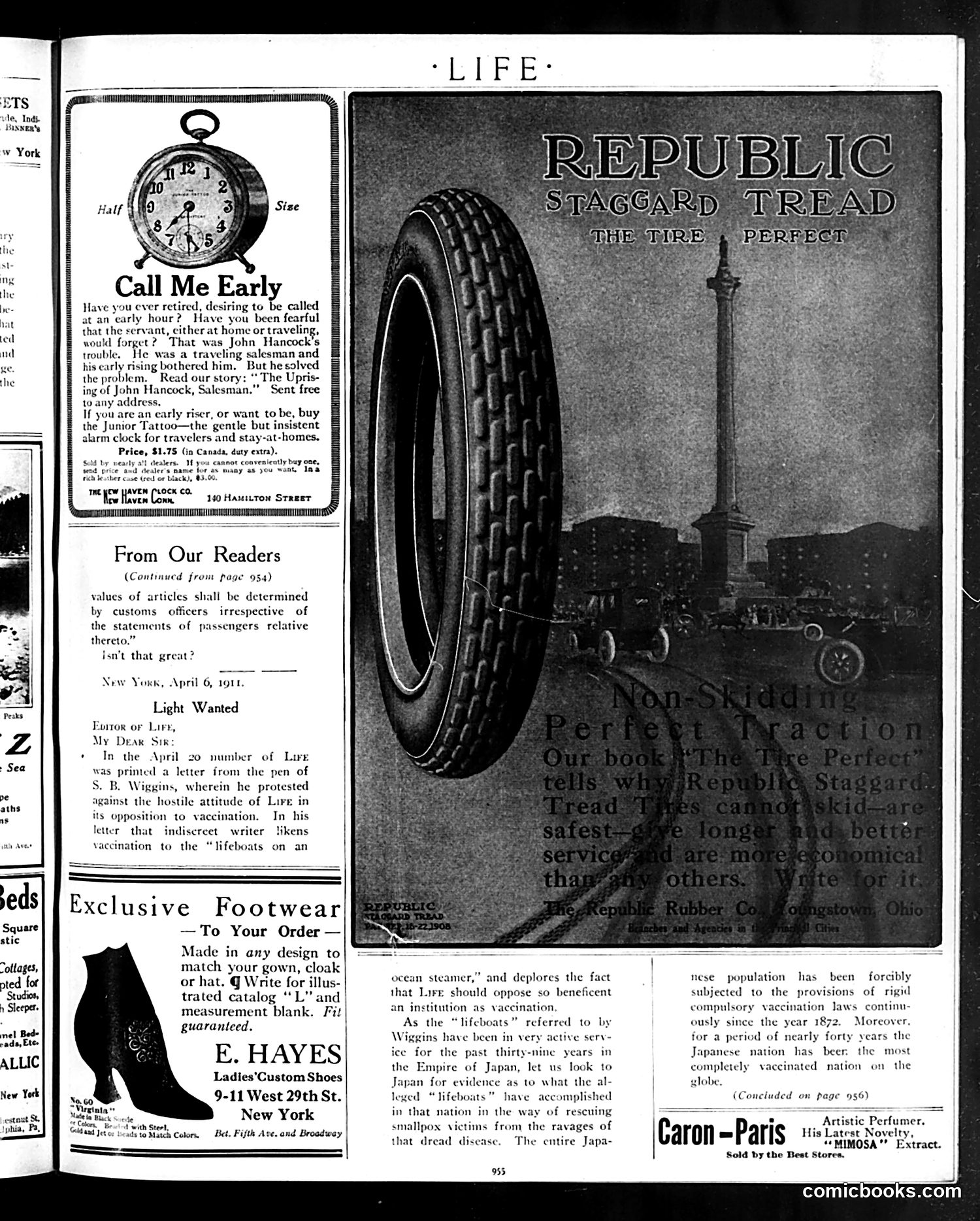
This page contains **advertisements and reader letters**, not political cartoons. The main content includes: **"Call Me Early"** advertisement: promotes the "Junior Tattoo" alarm clock for travelers and salesmen—a practical device addressing a common problem of unreliable servants forgetting wake-up calls. **"From Our Readers"** section: contains a heated letter debating **vaccination policy**. The writer defends mandatory vaccination laws by citing Japan's experience. He sarcastically compares vaccination to ship lifeboats, then argues that Japan's 40-year compulsory vaccination program (since 1872) successfully eliminated smallpox, making it a public health triumph rather than oppression. **Context for modern readers**: This reflects the early 20th-century conflict between public health authorities advocating mandatory vaccination and anti-vaccination advocates. The letter writer uses Japan's success to counter arguments that vaccination violated individual liberty—a debate that remains relevant today. The page otherwise contains shoe and tire advertisements typical of the era.
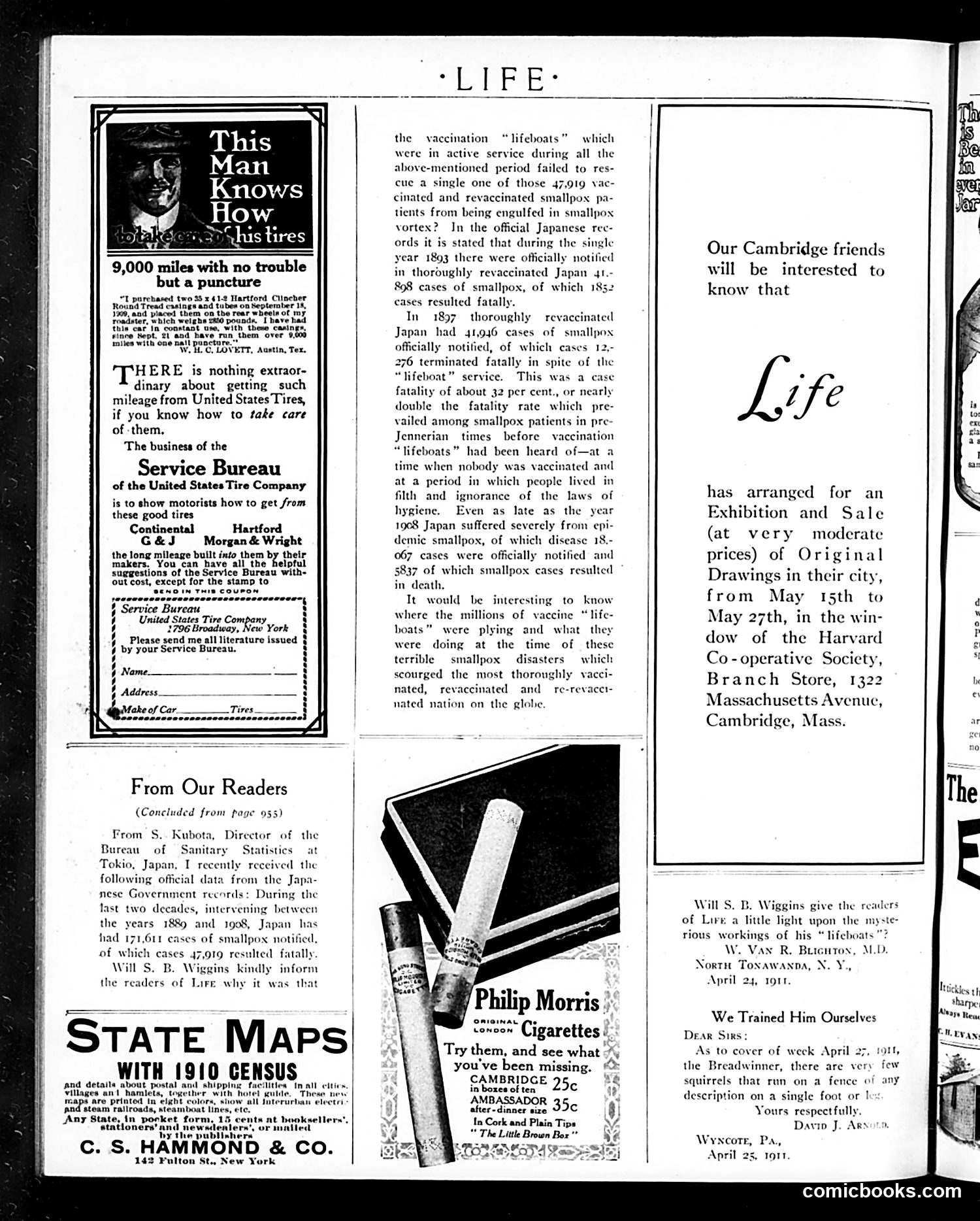
This page is primarily **advertising and reader correspondence**, not political satire. The main advertisement (left) promotes United States Tires, featuring a testimonial from a Texas motorist claiming 9,000 miles with minimal trouble. The "Service Bureau" offer provides free tire-care advice. The significant editorial content is a letter from S. Kubota, Director of Japan's Bureau of Sanitary Statistics. It presents **anti-vaccination arguments** using Japanese smallpox mortality data from 1889-1908. The writer sarcastically calls vaccines "lifeboats" and argues they failed to prevent smallpox deaths—even citing higher fatality rates in vaccinated Japan versus pre-vaccination eras, claiming vaccination was ineffective. This represents **early anti-vaccine sentiment** published in *Life* magazine. The letter uses selective statistical comparison to question vaccination's value, a rhetorical strategy that predates modern vaccine hesitancy but follows identical logical patterns. The page also includes advertisements for Philip Morris cigarettes and C.S. Hammond state maps, plus brief reader letters.
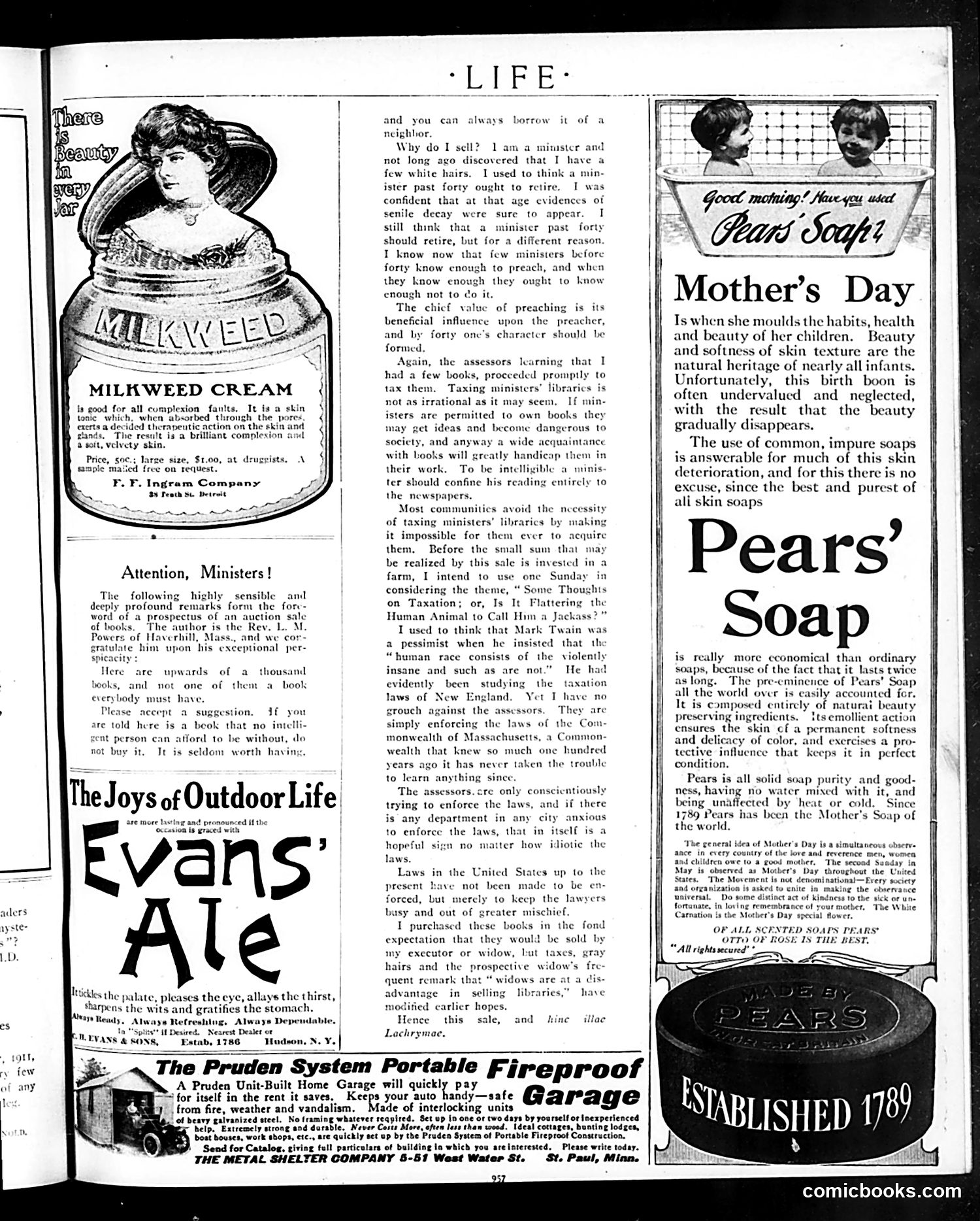
This page primarily consists of **advertisements** rather than political satire or cartoons, though it does contain one noteworthy editorial piece. The main content is an article titled "Attention, Ministers!" which satirizes the taxation of ministers' personal libraries in Massachusetts. The author argues that ministers should be permitted to own books without taxation, defending intellectualism against what he characterizes as narrow-minded government policy. The piece references Mark Twain and the "Commonwealth of Massachusetts" to mock what it presents as absurd bureaucratic overreach—taxing the very tools of a minister's profession. The advertisements—including **Milkweed Cream**, **Evans' Ale**, **Pears' Soap**, and a **Fireproof Garage**—are typical early 20th-century product promotions, with Pears' Soap notably emphasizing "Mother's Day" as a marketing angle centered on feminine beauty and child-rearing. The satire, such as it is, targets government taxation policy and ministerial education rather than serving as a political cartoon.
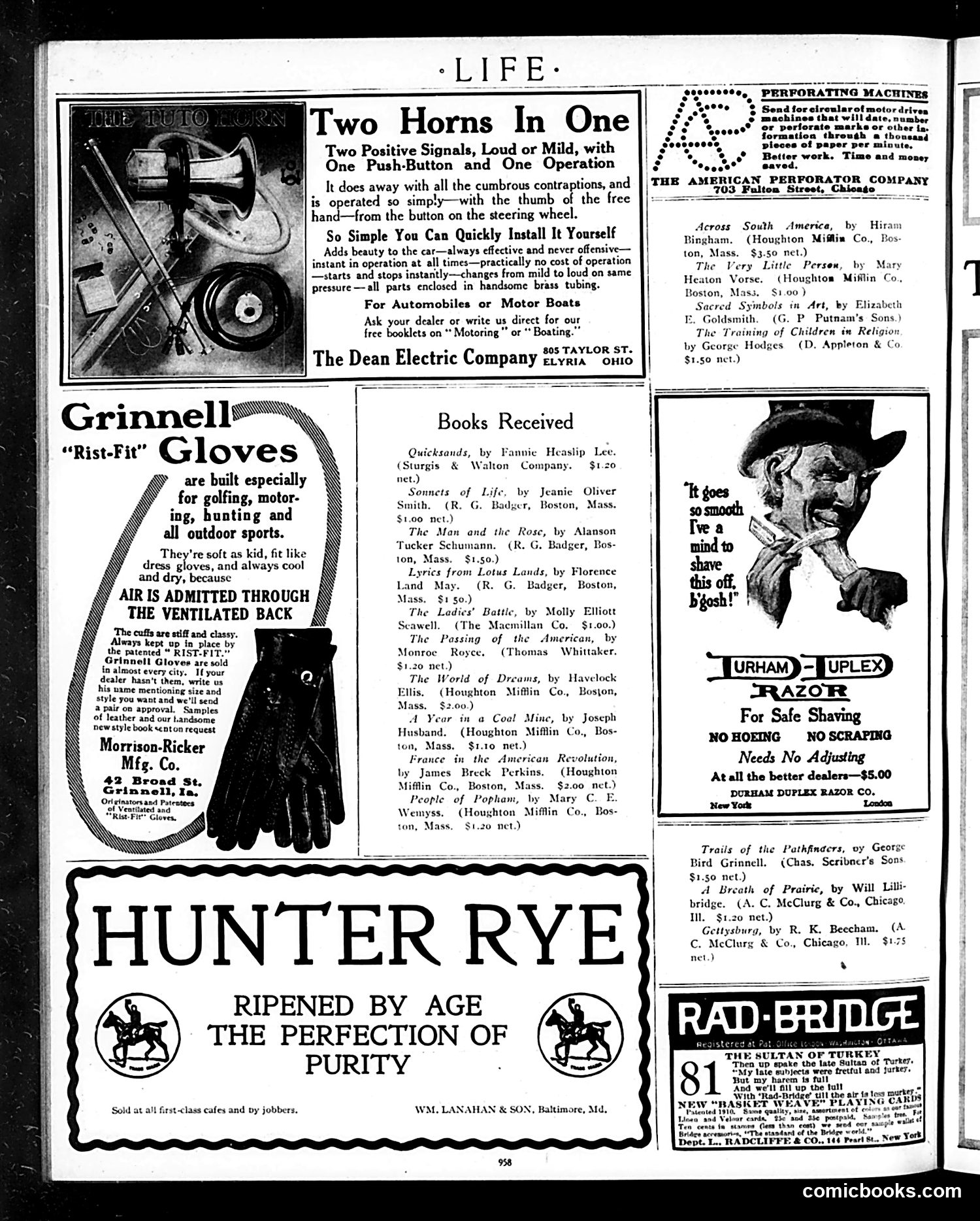
This page is primarily **advertising and book reviews** with no significant political cartoon or satirical content requiring historical context. The main advertisements feature: - **Dean Electric Company**: A car horn that produces two different sound levels via one button - **Grinnell "Rist-Fit" Gloves**: Ventilated sports gloves - **Durham Duplex Razor**: A safety razor - **Hunter Rye whiskey**: An alcohol advertisement - **Rad-Bridge playing cards**: A minor card game advertisement The "Books Received" section lists contemporary 1910s-era novels and non-fiction titles from publishers like Houghton Mifflin and G.P. Putnam's Sons—standard literary fare of the period. There is no discernible political satire, caricature, or commentary requiring historical interpretation. This appears to be a routine commercial page from Life's advertising section.
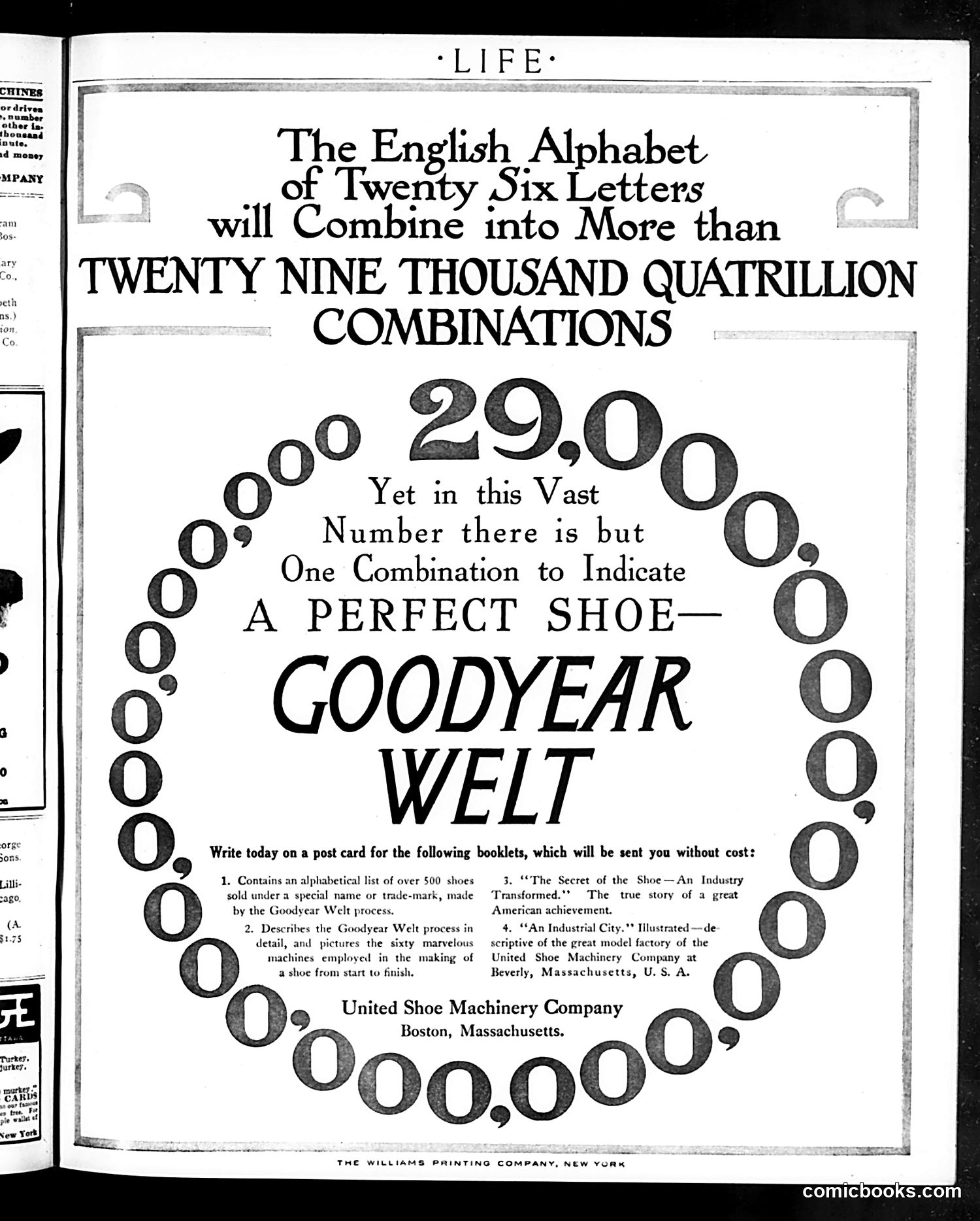
This is a **full-page advertisement**, not satire or political commentary. It promotes Goodyear Welt shoes and the United Shoe Machinery Company. The ad uses a mathematical hook: the English alphabet's 26 letters can create over 29 quadrillion combinations, yet among this vast number exists "one combination to indicate a perfect shoe"—Goodyear Welt. This appeals to consumers by suggesting their product achieves rare perfection through precise engineering. The large circular numbers (29,000,000,000,000,000) frame the text dramatically, emphasizing the astronomical odds. The ad offers free booklets about shoe manufacturing and the company's factory in Beverly, Massachusetts, typical of early 20th-century direct-mail marketing tactics. This represents *Life* magazine's advertising content—the publication supported itself through paid ads alongside satirical editorial material.
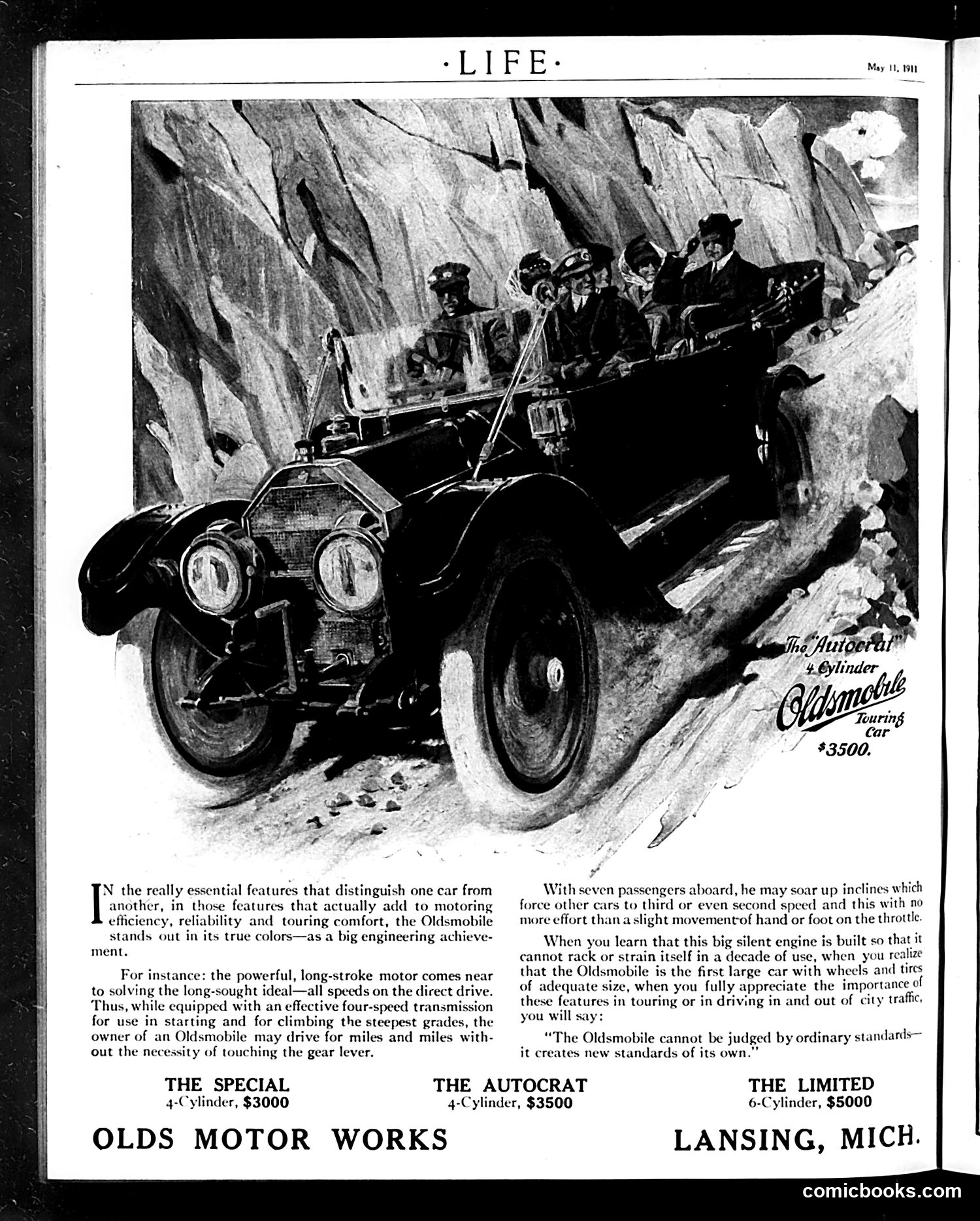
This is primarily an **automobile advertisement**, not a political cartoon. It appears in *Life* magazine from May 11, 1911, promoting Oldsmobile vehicles manufactured in Lansing, Michigan. The image shows a luxury touring car navigating a steep mountain road with well-dressed passengers aboard, illustrating the vehicle's climbing power and reliability. The advertisement emphasizes engineering innovations: a powerful long-stroke motor, four-speed transmission, and ability to handle steep grades without frequent gear-shifting. Three models are advertised: the Special ($3,000), the Autocrat ($3,500), and the Limited ($6,000—the six-cylinder model). The text's claim that "The Oldsmobile cannot be judged by ordinary standards—it creates new standards of its own" reflects early 1900s automobile marketing rhetoric, positioning the brand as superior through engineering achievement rather than price competition alone. This reflects the era when automobiles were luxury goods primarily for wealthy consumers.