
Life, 1911-05-11 · page 32 of 44
Life — May 11, 1911 — page 32: what you’re looking at
What you’re looking at
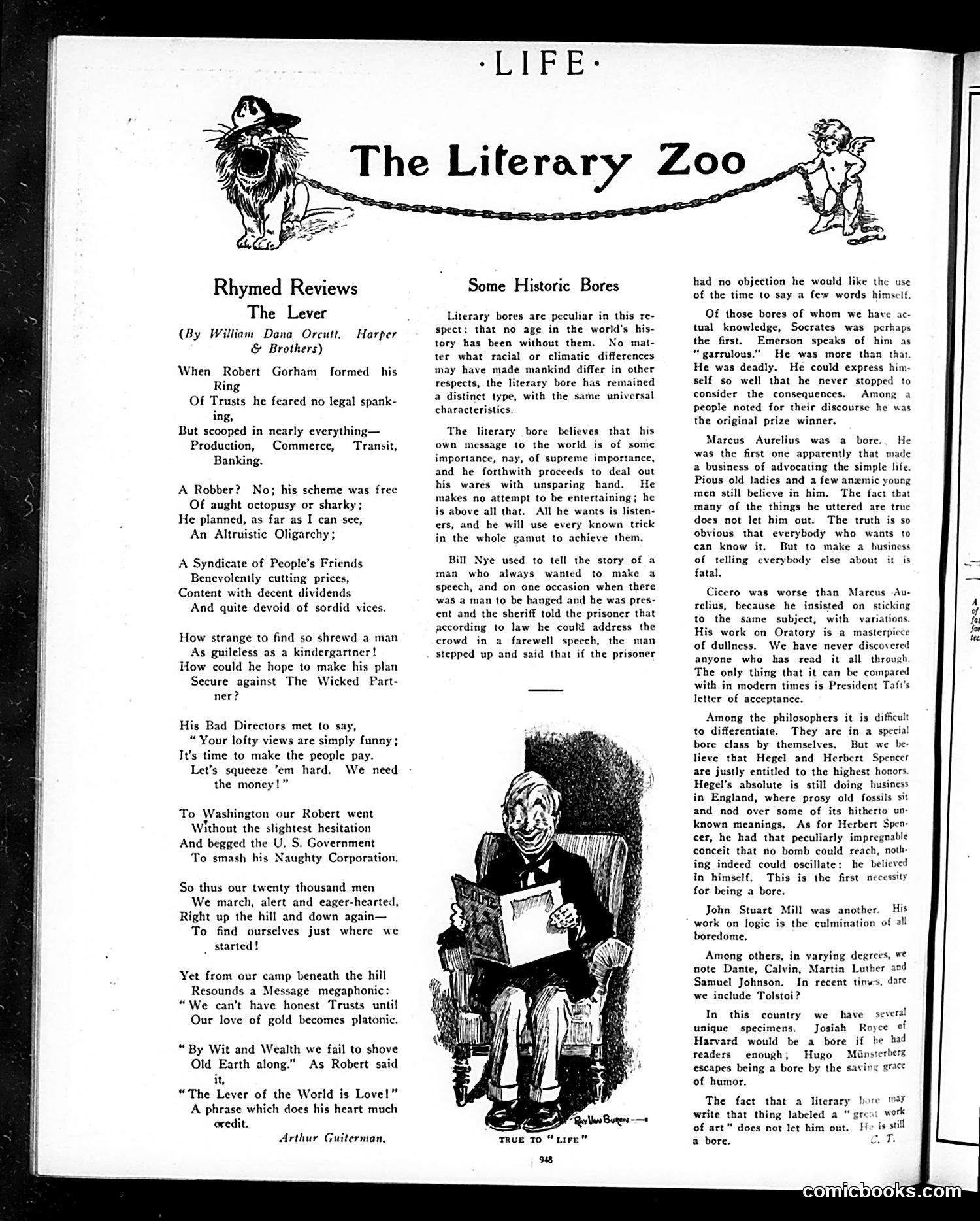
This page satirizes two targets: **"The Lever" (poem by Arthur Guiterman):** A verse-review mocking a naive industrialist, Robert Gorham, who forms a trust claiming altruistic motives but is undone by corrupt directors. The satire targets the Progressive Era's trust-busting debates—Gorham's naïve belief that businessmen can act virtuously without regulation is presented as absurd. His desperate appeal to the government to dissolve his own corporation results in futility. **"Some Historic Bores":** An essay ridiculing famous figures—Socrates, Marcus Aurelius, and Cicero—not for being wrong but for tediously lecturing others about truths everyone already knows. The humor lies in equating ancient philosophers with contemporary literary bores. A jab at President Taft's "letter of acceptance" (likely his 1908 campaign letter) suggests even modern politicians bore audiences with obvious platitudes. The cartoon shows an elderly man reading—representing the suffering audience.
📄 Transcribed text from this page (OCR, searchable)
Machine-transcribed from the original scan — historical spelling and the odd misread are preserved.
Rhymed Reviews The Lever (By William Dana Orcutt. Harper & Brothers) When Robert Gorham formed his Ring Of Trusts he feared no legal spank- ing, But scooped in nearly everything— Production, Commerce, Transit, Banking. A Robber? No; his scheme was free Of aught octopusy or sharky; He planned, as far as I can see, An Altruistic Oligarchy; A Syndicate of People’s Friends Benevolently cutting prices, Content with decent dividends And quite devoid of sordid vices. How strange to find so shrewd a man As guileless as a kindergartner! How could he hope to make his plan Secure against The Wicked Part- ner? His Bad Directors met to say, “Your lofty views are simply funny; It’s time to make the people pay. Let’s squeeze ’em hard. We need the money!” To Washington our Robert went Without the slightest hesitation And begged the U. S. Government To smash his Naughty Corporation, So thus our twenty thousand men We march, alert and eager-hearted, Right up the hill and down again— To find ourselves just where we started ! Yet from our camp beneath the hill Resounds a Message megaphonic: “We can’t have honest Trusts until Our love of gold becomes platonic. “ By Wit and Wealth we fail to shove Old Earth along.” As Robert said it, “The Lever of the World is Love!” A phrase which does his heart much oredit. Arthur Guiterman, aE Some Historic Bores Literary bores are peculiar in this re- spect: that no age in the world’s his- tory has been without them. No mat- ter what racial or climatic differences may have made mankind differ in other respects, the literary bore has remained a distinet type, with the same universal characteristics. The literary bore believes that his own message to the world is of some importance, nay, of supreme importance, and he forthwith proceeds to deal out his wares with unsparing hand. He makes no attempt to be entertaining; he is above all that. All he wants is listen- ers, and he will use every known trick in the whole gamut to achieve them. Bill Nye used to tell the story of a man who always wanted to make a speech, and on one occasion when there was a man to be hanged and he was pres- ent and the sheriff told the prisoner that according to law he could address the crowd in a farewell specch, the man stepped up and said that if the prisoner TRUE To “Lire” 8 had no objection he would like the use of the time to say a few words himself. Of those bores of whom we have ac- tual knowledge, Socrates was perhaps the first. Emerson speaks of him as “garrulous.” He was more than that He was deadly. He could express him- self so well that he never stopped to consider the consequences. Among a people noted for their discourse he was the original prize winner. Marcus Aurelius was a bore. He was the first one apparently that made a business of advocating the simple life. Pious old ladies and a few anemic young men still believe in him, The fact that many of the things he uttered are truc does not let him out. The truth is so obvious that everybody who wants to can know it. But to make a business of telling everybody else about it is fatal. Cicero was worse than Marcus Au- relius, because he insisted on sticking to the same subject, with variations His work on Oratory is a masterpiece of dullness, We have never discovered anyone who has read it all through. The only thing that it can be compared with in modern times is President Taft's letter of acceptance. Among the philosophers it is difficult to differentiate. They are in a special bore class by themselves, But we be- lieve that Hegel and Herbert Spencer are justly entitled to the highest honors. Hegel’s absolute is still doing business in England, where prosy old fossils sit and nod over some of its hitherto un- known meanings, As for Herbert Spen- cer, he had that peculiarly impregnable conceit that no bomb could reach, noth- ing indeed could oscillate: he believed in himself. This is the first necessity for being a bore. John Stuart Mill was another. His work on logic is the culmination of all boredome. Among others, in varying degrees, ¥¢ note Dante, Calvin, Martin Luther and Samuel Johnson. In recent timws, dare we include Tolstoi? In this country we have several unique specimens. Josiah Royce of Harvard would be a bore if he had readers enough; Hugo Miinsterbers escapes being a bore by the saving grace of humor. The fact that a literary bore ™3v write that thing labeled a “ great work of art” does not let him out. He is stil a bore, oT.