
Life, 1911-05-11 · page 24 of 44
Life — May 11, 1911 — page 24: what you’re looking at
What you’re looking at
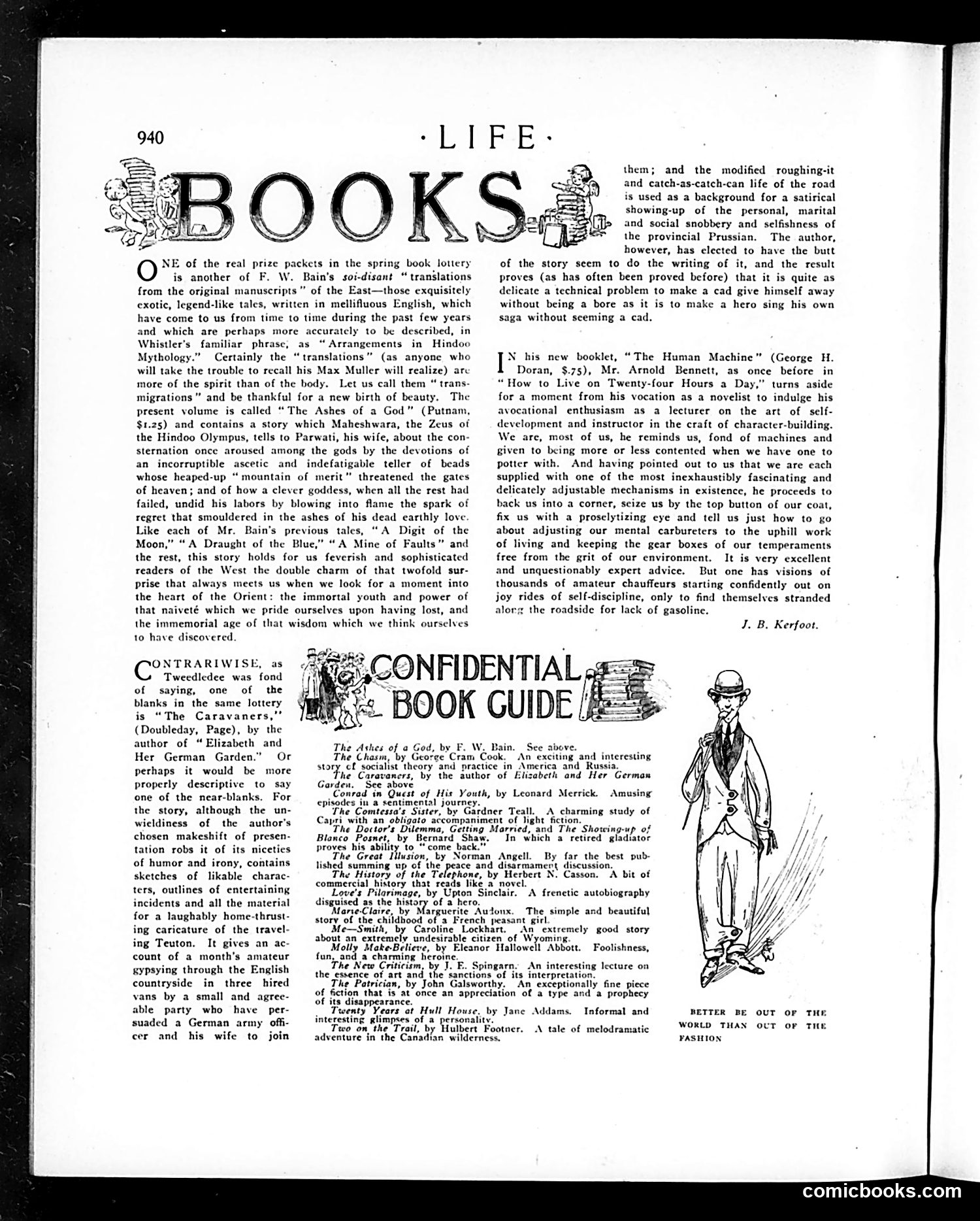
This is a **book review section**, not primarily political satire. The page discusses new literary releases, notably F.W. Bain's "The Ashes of a God"—exotic tales presented as "translations from original manuscripts" of Hindu mythology, which the reviewer suggests are actually creative "arrangements" (following art critic Whistler's term). The reviews are largely favorable toward literary sophistication: Bain's work appeals to "feverish and sophisticated readers of the West" seeking the "immortal youth" and "naiveté" of Eastern wisdom alongside Western worldliness. **The single cartoon** (right margin) shows a well-dressed man in profile with the caption "BETTER BE OUT OF THE WORLD THAN OUT OF THE FASHIONS"—a straightforward satirical jab at fashion-obsessed vanity, mocking society's prioritization of style over substance. The "Confidential Book Guide" provides brief reviews of contemporary titles, mostly praising their literary merit. No major political figures or events are caricatured here.
📄 Transcribed text from this page (OCR, searchable)
Machine-transcribed from the original scan — historical spelling and the odd misread are preserved.
iL. PB wes 2 of the real prize packets in the spring book lottery is another of F. W. Bain’s soi-disant “ translations from the original manuscripts” of the East—those exquisitely exotic, legend-like tales, written in mellifluous English, which have come to us from time to time during the past few years and which are perhaps more accurately to be described, in Whistler's familiar phrase, as “Arrangements in Hindoo Mythology.” Certainly the “translations” (as anyone who will take the trouble to recall his Max Muller will realize) arc more of the spirit than of the body. Let us call them “ trans- migrations” and be thankful for a new birth of beauty. The present volume is called “The Ashes of a God” (Putnam, $1.25) and contains a story which Maheshwara, the Zeus of the Hindoo Olympus, tells to Parwati, his wife, about the con- sternation once aroused among the gods by the devotions of an incorruptible ascetic and indefatigable teller of beads whose heaped-up “mountain of merit” threatened the gates of heaven; and of how a clever goddess, when all the rest had failed, undid his labors by blowing into flame the spark of regret that smouldered in the ashes of his dead earthly love. Like cach of Mr. Bain’s previous tales, “A Digit of the Moon,” “A Draught of the Blue,” “A Mine of Faults” and the rest, this story holds for us feverish and sophisticated readers of the West the double charm of that twofold sur- prise that always mects us when we look for a moment into the heart of the Orient: the immortal youth and power of that naiveté which we pride ourselves upon having lost, and the immemorial age of that wisdom which we think ourselves to have discovered. ONTRARIWISE Tweedledee was fond of saying, one of the blanks in the same lottery is “The Caravaners,” (Doubleday, Page), by the author of “Elizabeth and Her German Garden.” Or perhaps it would be more properly descriptive to say one of the near-blanks. For Garden. See above The Ashes of a God, by F. W. Bain. The Chasm, by George Cram Cook. story ef socialist theory and practice in “America and Russia, Tne Caravoners, by the author of Elizabeth and Her German Conrad in Quest of His Youth, by Leonard Merrick. them; and the modified roughing-it and catch-as-catch-can life of the road is used as a background for a satirical showing-up of the personal, marital and social snobbery and selfishness of the provincial Prussian. The author, however, has elected to have the butt of the story seem to do the writing of it, and the result proves (as has often been proved before) that it is quite as delicate a technical problem to make a cad give himself away without being a bore as it is to make a hero sing his own saga without sceming a cad. I* his new booklet, “The Human Machine” (George H. Doran, $.75), Mr. Arnold Bennett, as once before in “How to Live on Twenty-four Hours a Day,” turns aside for a moment from his vocation as a novelist to indulge his avocational enthusiasm as a lecturer on the art of self- development and instructor in the craft of character-building. We arc, most of us, he reminds us, fond of machines and given to being more or less contented when we have one to potter with. And having pointed out to us that we are each supplied with one of the most inexhaustibly fascinating and delicately adjustable mechanisms in existence, he proceeds to back us into a corner, scize us by the top button of our coat, fix us with a proselytizing eye and tell us just how to go about adjusting our mental carbureters to the uphill work of living and keeping the gear boxes of our temperaments free from the grit of our environment. It is very excellent and unquestionably expert advice. But one has visions of thousands of amateur chauffeurs starting confidently out on joy rides of self-discipline, only to find themselves stranded alors the roadside for lack of gasoline. J. B. Kerfoot. See above. | An exciting and interesting Amusing the story, although the un- wieldiness of the author's chosen makeshift of presen- tation robs it of its niceties of humor and irony, contains sketches of likable charac- ters, outlines of entertaining incidents and all the material for a laughably home-thrust- ing caricature of the travel- ing Teuton. It gives an ac- count of a month’s amateur gypsying through the English countryside in three hired vans by a small and agree- able party who have per- suaded a German army offi- cer and his wife to join episodes in a sentimental journey. The Comtessa’s Sister, by Gardner Teall. A charming study of Capri with an obligato accompaniment of light fiction. The Doctor’s Dilemma, Getting Married, and The Showing-up of Blonco Posnet, by Bernard Shaw. In which a retired gladiator proves his ability to “come back.” The Great Illusion, by Norman Angell. By far the best pubd- lished summing up of the peace and disarmament discussion. The History of the Telephone, by Herbert N. Casson. A commercial history that reads like a novel. Love's Pilarimage, by Upton Sinclair. disguised as the history of a hero. Marse-Claire, by Marguerite Autonx. The simple and beautiful story of the childhood of a French peasant gitl Me—Smith, by Caroline Lockhart. An extremely good story about an extremely undesirable citizen of Wyoming. Molly Make-Believe, by Eleanor Hallowell Abbott. fun, and a charming heroine. The New Criticism, by J. F. Spingarn. An interesting lecture on the essence of art and the sanctions of its interpretation, The Patrician, by John Galsworthy. An exceptionally fine piece of fiction that is at once an appreciation of a type and a prophecy of its disappearance. _ Twenty Years at Hull House. by Jane Addams. interesting glimpses of a personality. Two on, the Trail, by Hulbert Footner. adventure in the Canadian wilderness, bit of A frenetic autobiography Foolishness, Informal and A tale of melodramatic BETTER BE OUT OF THE WORLD THAN ocT FASHION or THe comicbooks.com