
Life, 1911-05-11 · page 26 of 44
Life — May 11, 1911 — page 26: what you’re looking at
What you’re looking at
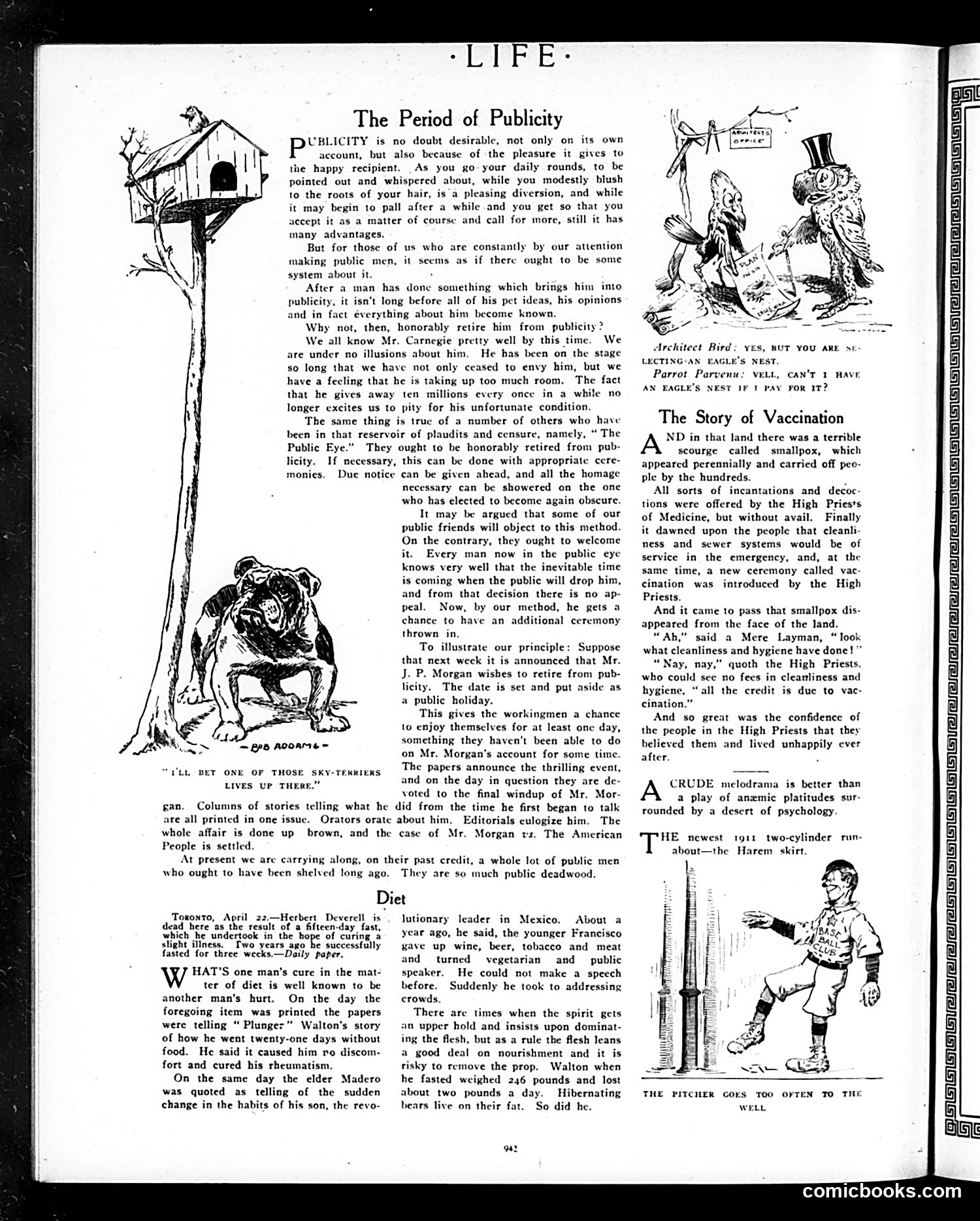
This satirical piece critiques two separate social phenomena: **"The Period of Publicity"** attacks the exhausting permanence of public figures. The author argues that famous men like Andrew Carnegie and J.P. Morgan should be ceremonially "retired" from public attention after their initial accomplishments, rather than remaining in constant scrutiny. The cartoons show a dog in a tree (illustrating absurd public fixation) and someone pointing at a birdhouse, mocking how relentlessly we pursue public figures' every detail. The satire suggests that persistent publicity creates "deadwood"—figures no longer relevant but still commanding attention. **"Diet"** juxtaposes contrasting medical anecdotes: one man died fasting for fifteen days; another ("Plunger" Walton) fasted twenty-one days and claimed wellness benefits. This highlights the era's confused, individualized health theories where the same treatment produced opposite results—mocking the lack of scientific consensus on nutrition and the danger of following unproven health trends. Both sections exemplify *Life's* technique of using current events and ironic commentary to satirize American social obsessions.
📄 Transcribed text from this page (OCR, searchable)
Machine-transcribed from the original scan — historical spelling and the odd misread are preserved.
oi Galli) el eho The Period of Publicity UBLICITY is no doubt desirable, not only on its own P account, but also because of the pleasure it gives to the happy recipient. As you go-your daily rounds, to be pointed out and whispered about, while you modestly blush to the roots of your hair, is'a pleasing diversion, and while it may begin to pall after a while and you get so that you accept it as a matter of course and call for more, still it has many advantages. But for those of us who are constantly by our attention making public men, it seems as if there ought to be some system about it. . After a man has done something which brings him into publicity, it isn't long before all of his pet ideas, his opinions and in act éverything about him become known. Why not, then, honorably retire him from publicity? We all know Mr. Carnegie pretty well by this time. We are under no illusions about him. so long that we have not only ceased to envy him, He has been on the stage but we have a fecling that he is taking up too much room. The fact that he gives away ten millions every once in a while no longer excites us to pity for his unfortunate condition. The same thing is truc of a number of others who have been in that reservoir of plaudits and censure, namely, “ The Public Eye.” icity. monies. = BP8 AOOAME = “LLL BET ONE OF THOSE SKY-TERKIERS LIVES UP THERE.” They ought to be honorably retired from pub- If necessary, this can be done with appropriate cere- Due notice can be given ahead, and all the homage necessary can be showered on the one who has elected to become again obscure. It may be argued that some of our public friends will object to this method. On the contrary, they ought to welcome it. Every man now in the public eye knows very well that the inevitable time is coming when the public will drop him, and from that decision there is no ap- peal. Now, by our method, he gets a chance to have an additional ceremony thrown in. To illustrate our principle: Suppose that next week it is announced that Mr. J. P. Morgan wishes to retire from pub- licity, The date is set and put aside as a public holiday. This gives the workingmen a chance to enjoy themselves for at least onc day, something they haven't been able to do on Mr. Morgan's account for some time. The papers announce the thrilling event, and on the day in question they are de- voted to the final windup of Mr. Mor- gan. Columns of stories telling what he did from the time he first began to talk are all printed in one issue. Orators orate about him. Editorials eulogize him. The whole affair is done up brown, and the case of Mr. Morgan vs. The American People is settled. At present we are carrying along, on their past credit, a whole lot of public men who ought to have been shelved long ago. They are so much public deadwood. Diet Toronto, April 22.—Herbert Deverell is dead here ‘as the result of a fifteen-day fast, which he undertook in the hope of curing a slight illness. Iwo years ago he successfully fasted for three weeks. aily paper. HAT’S one man’s cure in the mat- ter of diet is well known to be another man’s hurt. On the day the foregoing item was printed the papers were telling “ Plunger" Walton's story of how he went twenty-one days without food. He said it caused him ro discom- fort and cured his rheumatism. On the same day the elder Madero was quoted as telling of the sudden change in the habits of his son, the revo- lutionary leader in Mexico. About a year ago, he said, the younger Francisco xave up wine, beer, tobacco and meat and turned vegetarian and public speaker. He could not make a speech before. Suddenly he took to addressing crowds. There are times when the spirit gets an upper hold and insists upon dominat- ing the flesh, but as a rule the flesh leans a good deal on nourishment and it is risky to remove the prop. Walton when he fasted weighed 246 pounds and lost about two pounds a day. Hibernating bears live on their fat. So did he. Architect Bird : BUT YOU ARE st- LECTING*AN EAGLE'S NEST. Parrot Parvenu; vet, AN EAGLE'S NEST IP 1 PAY CAN'T 1 HAVE FOR IT? The Story of Vaccination A ND in that land there was a terrible scourge called smallpox, which appeared perennially and carried off peo- ple by the hundreds. . All sorts of incantations and decoc tions were offered by the High Priests of Medicine, but without avail. Finally it dawned upon the people that cleanli- ness and sewer systems would be of service in the emergency, and, at the same time, a new ceremony called vac- cination was introduced by the High Priests, And it came to pass that smallpox dis- appeared from the face of the land. “Ah,” said a Mere Layman, “look what cleanliness and hygiene have done!” “Nay, nay,” quoth the High Priests, who could see no fees in cleanliness and hygiene, “all the credit is due to vac- cination.” And so great was the confidence of the people in the High Priests that they believed them and lived unhappily ever after. CRUDE melodrama is better than a play of anzmic platitudes sur- rounded by a desert of psychology. HE newest 1911 two-cylinder run- about—the Harem skirt. THE PITCHER GOES TOO OFTEN TO THE WELL comicbooks.com