
Life, 1911-05-11 · page 21 of 44
Life — May 11, 1911 — page 21: what you’re looking at
What you’re looking at
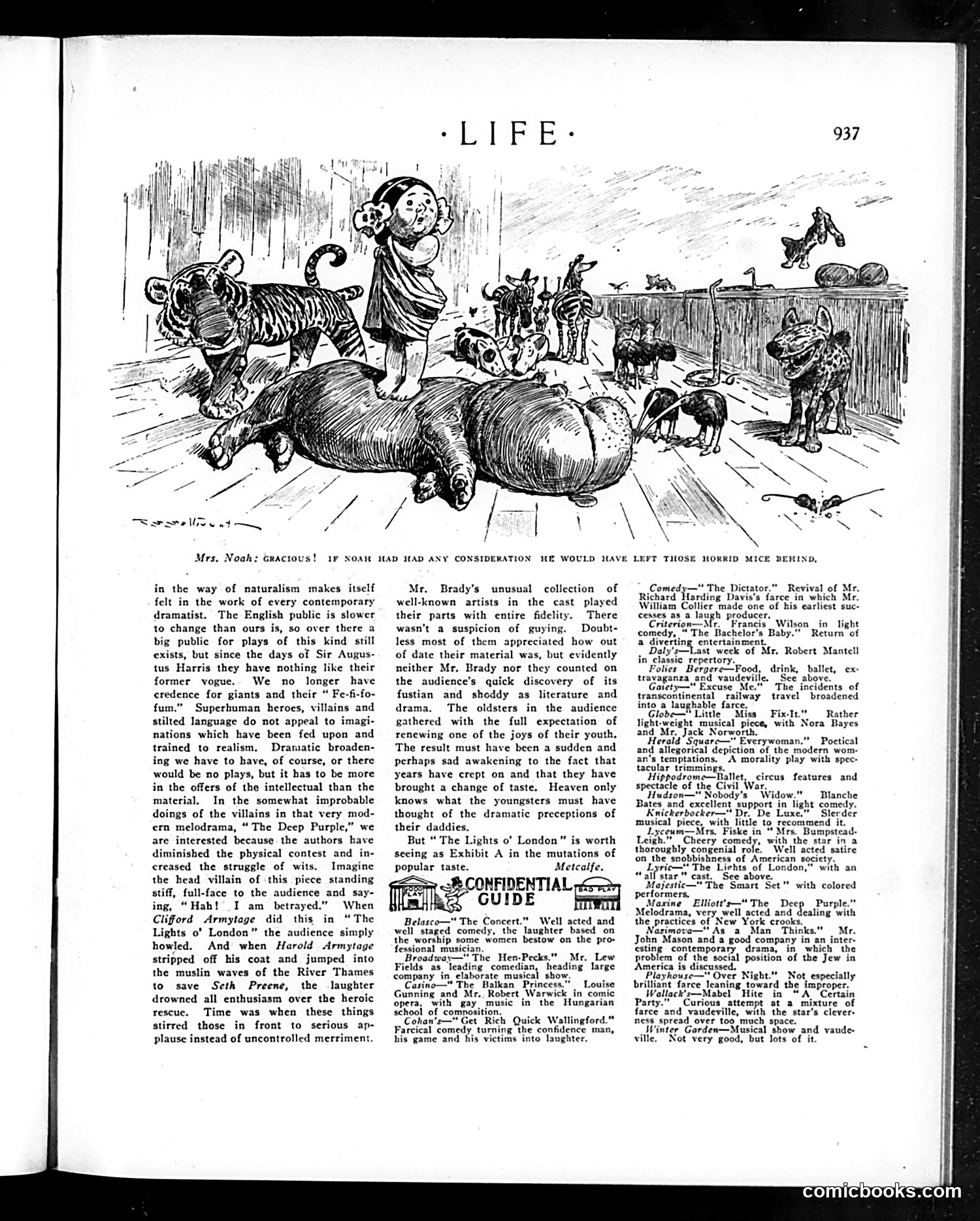
This page contains a satirical cartoon and theater reviews. The cartoon depicts **Mrs. Noah** (from the Biblical flood story) expressing shock at a chaotic scene with elephants, tigers, and various animals—a visual pun on Noah's Ark. The caption reads she's upset Noah didn't consider leaving "those horrid mice behind," mocking the absurdity of saving every creature. The accompanying text critiques a theatrical revival of **"The Lights o' London,"** an outdated melodrama. The author argues that modern audiences, trained by realistic drama, now find the play's exaggerated theatrical conventions laughable rather than moving. What once stirred genuine emotion in earlier generations now provokes uncontrolled laughter at its artificiality. The satire targets how theatrical tastes have evolved—audiences have grown more sophisticated and no longer accept "superhuman heroes" and "stilted language." The revival serves as "Exhibit A" in how popular taste has fundamentally shifted away from Victorian-era theatricality toward psychological realism.
📄 Transcribed text from this page (OCR, searchable)
Machine-transcribed from the original scan — historical spelling and the odd misread are preserved.
Serle, Mrs. Noah: Gracious! in the way of naturalism makes itself felt in the work of every contemporary dramatist. The English public is slower to change than ours is, so over there a big public for plays of this kind. still exists, but since the days of Sir Augus- tus Harris they have nothing like their former vogue. We no longer have credence for giants and their “ Fe-fi-fo- fum.” Superhuman heroes, villains and stilted language do not appeal to imagi- nations which have been fed upon and trained to realism. Dramatic broaden- ing we have to have, of course, or there would be no plays, but it has to be more in the offers of the intellectual than the material. In the somewhat improbable doings of the villains in that very mod- ern melodrama, “The Deep Purple,” we are interested because the authors have diminished the physical contest and in- creased the struggle of wits. Imagine the head villain of this piece standing stiff, full-face to the audience and say- ing, “Hah! I am_ betrayed.” When Clifford Armytage did this in “The Lights o’ London” the audience simply howled. And when Harold Armytage stripped off his coat and jumped into the muslin waves of the River Thames to save Seth Preene, the laughter drowned all enthusiasm over the heroic rescue. Time was when these things stirred those in front to serious ap- plause instead of uncontrolled merriment. IF NOAH MAD MAD ANY CONSIDERATION Mr. Brady's unusual collection of well-known artists in the cast played their parts with entire fidelity. There wasn’t a suspicion of guying. Doubt- less most of them appreciated how out of date their material was, but evidently neither Mr, Brady nor they counted on the audience’s quick discovery of its fustian and shoddy as literature and drama. The oldsters in the audience gathered with the full expectation of renewing one of the joys of their youth. The result must have been a sudden and perhaps sad awakening to the fact that years have crept on and that they have brought a change of taste. Heaven only knows what the youngsters must have thought of the dramatic preceptions of their daddies. But “ The Lights o’ London” is worth seeing as Exhibit A in the mutations of popular taste. Metcalfe. CONFIDENTIAL, eng iar Belasco—" The Concert.” Well acted and well staged comedy, the laughter based on the worship some women bestow on the pro- fessional musician. Broadway—" The Hen-Pecks.” Mr. Lew Fields as leading comedian, heading large company in, elaborate musical show, Casino—* The Balkan Princess.” Louise Gunning and Mr. Robert Warwick in comic opera, with gay music in the Hungarian school of comnosition. Cohan's—" Get Rich Quick Wallingford.” Farcical comedy turning the confidence man, his game and his victims into laughter. ME WOULD HAVE LEFT THOSE NORRID MICE BEHIND, Comedy—" The Dictator.” Revival of Mr. Richard Harding Davis's farce in which Mr. William Collier made one of his earliest suc- cesses as a laugh producer. Criterion—Mr. Francis Wilson in light comedy, “ The Bachelor's Baby.” Return of a diverting entertainment, | Daly's—Last week of Mr. Robert Mantell in classic repertory. Folies Bergere—Food, drink, ballet, ex- travaganza and vaudeville. See above. Gaiety—"" Excuse Me.” The incidents of transcontinental railway travel broadened into a laughable farce. sie eO ee tS a Miss, Find ight-weight musical piece, wit and Mr. Jack Norworth. Herald’ Squarc—" Everywoman.” Rather Nora Bayes Poetical lern wom- and allegorical depiction of the mod. an’s temptations. A morality play with spec- tacular trimmings. Hippodrome—Dallet, spectacle of the Civil War. circus features and Hudson—" Nobody's Widow." Blanche Bates and excellent support in light comedy. Knickerbocker—" Dr. De Luxe.” Slerder musical piece, with little to recommend it. Lyceum—Mrs, Fiske in “ Mrs. Bumpstead- Leigh.” Cheery comedy, with the star in a thoroughly congenial role. Well acted satire on the snobbishness of American society. Lyric—"" The Livhts of London,” with an Dee Melodrama, very well acted and dealing with the practices of New York crooks. Nasimove—" As a Man Thinks.” Mr. John Mason and a good company in an inter- esting contemporary, drama, in which the problem of the social position of the Jew in America is discussed. Playhouse—" Over brilliant farce leaning | Purple.” ht.” Not especially d the improper. “A Certain f a mixture of farce and vaudeville, with the star's clever- ness spread over too much space. Winter Gorden—Musical show and vaude- ville, Not very good, but lots of it.