
Life, 1911-05-11 · page 8 of 44
Life — May 11, 1911 — page 8: what you’re looking at
What you’re looking at
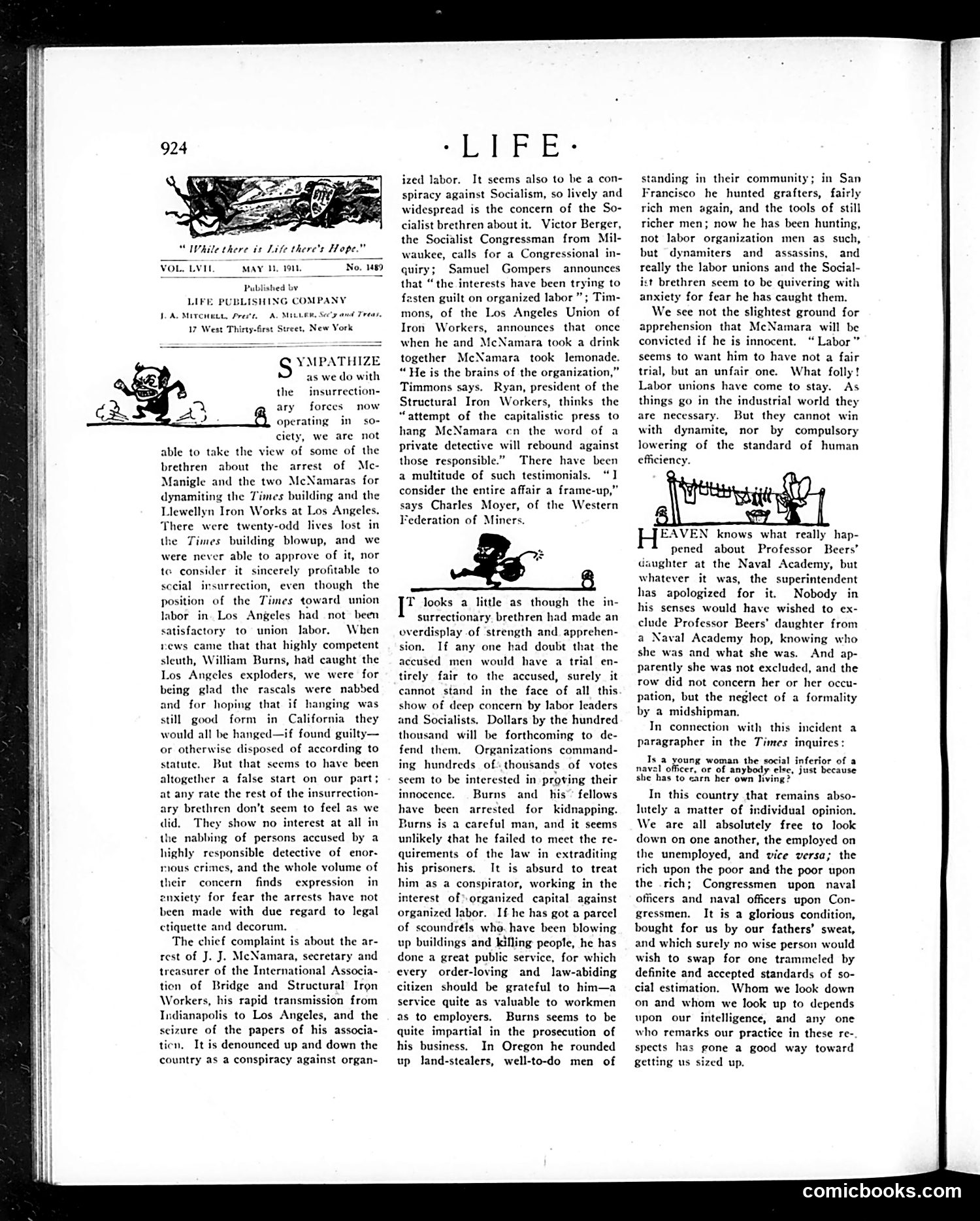
This page contains editorial commentary on labor unrest, particularly the arrest of J.J. McNamara, secretary of the International Association of Bridge and Structural Iron Workers. The text defends McNamara against accusations that he orchestrated dynamiting in Los Angeles, arguing the evidence appears fabricated—a "frame-up." The small cartoon visible shows what appears to be a figure labeled with dynamite or explosives, likely satirizing how authorities portrayed labor organizers. The editorial criticizes wealthy interests for blaming labor organizations while praising detective William Burns for exposing "land-stealers" and corrupt businessmen in Oregon. The text argues that convicting McNamara without solid evidence would be unjust, reflecting contemporary debates over labor's rights versus property owners' concerns.
📄 Transcribed text from this page (OCR, searchable)
Machine-transcribed from the original scan — historical spelling and the odd misread are preserved.
“ While there is Life there's Hope.” No. 1489 LVI MAY 11, 1911, Published by LIFE P ISHING COMPANY JA. Mivonmnt, Pre 17 West AL MILLER, See'y aned Treas. yefirst Street, New Vork S YMPATHIZE as we do with the — insurrection- ary forces now operating in so- ciety, we are not able to take the view of some of the brethren about the arrest of Mc- Manigle and the two McNamaras for dynamiting the Times building and the Llewellyn Iron Works at Los Angeles. There were twenty-odd lives lost in the Times building blowup, and we were never able to approve of it, nor te consider it sincerely profitable to secial insurrection, even though the position of the Times toward union labor in. Los Angeles had not been satisfactory to union labor, When news came that that highly competent sleuth, William Burns, had caught the Los Angeles exploders, we were for being glad the rascals were nabbed and for hoping that if hanging was still good form in California they would all be hanged—if found guilty— or otherwise disposed of according to statute. But that seems to have been altogether a false start on our part; at any rate the rest of the insurrection- ary brethren don’t seem to feel as we did. They show no interest at all in the nabbing of persons accused by a highly responsible detective of enor. rious crimes, and the whole volume of their concern finds expression in enxiety for fear the arrests have not been made with due regard to legal ctiquette and decorum. The chief complaint is about the ar- rest of J. J. McNamara, secretary and treasurer of the International Associa- tion of Bridge and Structural Iron Workers, his rapid transmission from Indianapolis to Los Angeles, and the seizure of the papers of his associa- t It is denounced up and down the country as a conspiracy against organ- oo Be | aio) ie ized labor. It seems also to be a con- spiracy against Socialism, so lively and widespread is the concern of the So- cialist brethren about it. Victor Berger, the Socialist Congressman from Mil- waukee, calls for a Congressional in- quiry; Samuel Gompers announces that “the interests have been trying to fasten guilt on organized labor ”; Tim- mons, of the Los Angeles Union of Iron Workers, announces that once when he and McNamara took a drink together McNamara took lemonade. “ He is the brains of the organization,” Timmons says. Ryan, president of the Structural Iron Workers, thinks the “attempt of the capitalistic press to hang McNamara cn the word of a private detective will rebound against those responsible.” There have been a multitude of such testimonials. “J consider the entire affair a frame-up,” says Charles Moyer, of the Western Federation of Miners. I looks a little as though the in- surrectionary brethren had made an overdisplay -of strength and apprehen- sion. If any one had doubt that the accused men would have a trial en- tirely fair to the accused, surely it cannot stand in the face of all this show of deep concern by labor leaders and Socialists. Dollars by the hundred thousand will be forthcoming to de- fend them. Organizations command- ing hundreds of: thousands of votes seem to be interested in proving their innocence. Burns and _ his” fellows have been arrested for kidnapping. Burns is a careful man, and it seems unlikely that he failed to meet the re- quirements of the law in extraditing his prisoners. It is absurd to treat him as a conspirator, working in the interest of organized capital against organized labor. If he has got a parcel of scoundréls who. have been blowing up buildings and killing peopte, he has done a great public service, for which every order-loving and law-abiding citizen should be grateful to him—a service quite as valuable to workmen as to employers. Burns seems to be quite impartial in the prosecution of his business. In Oregon he rounded up land-stealers, well-to-do men of standing in their community; in San rancisco he hunted grafters, fairly rich men again, and the tools of still richer men; now he has been hunting, not labor organization men as such, but dynamiters and assassins, and really the labor unions and the Social- ist brethren seem to be quivering with anxiety for fear he has caught them, We see not the slightest ground for apprehension that McNamara will be convicted if he is innocent. “ Labor” seems to want him to have not a fair trial, but an unfair one. What folly! Labor unions have come to stay. As things go in the industrial world they are necessary. But they cannot win with dynamite, nor by compulsory lowering of the standard of human efficiency. -AVEN knows what really hap- pened about Professor Beers’ daughter at the Naval Academy, but whatever it was, the superintendent has apologized for i Nobody in his senses would have wished to ex- clude Professor Beers’ daughter from a Naval Academy hop, knowing who she was and what she was. And ap- parently she was not excluded, and the row did not concern her or her occu- pation, but the neglect of a formality by a midshipman. In connection with this incident a paragrapher in the Times inquires: Ts a young woman the social inferior of a naval officer, or of anybody else, just because she has to earn her own living? In this country that remains abso- lutely a matter of individual opinion. We are all absolutely free to look down on one another, the employed on the unemployed, and vice versa; the rich upon the poor and the poor upon the rich; Congressmen upon naval officers and naval officers upon Con- gressmen. It is a glorious condition, bought for us by our fathers’ sweat, and which surely no wise person would wish to swap for one trammeled by definite and accepted standards of so- cial estimation. Whom we look down on and whom we look up to depends upon our intelligence, and any one who remarks our practice in these re- s has gone a good way toward gf us sized up. comicbooks.com