
A complete issue · 44 pages · 1910
Life — December 22, 1910
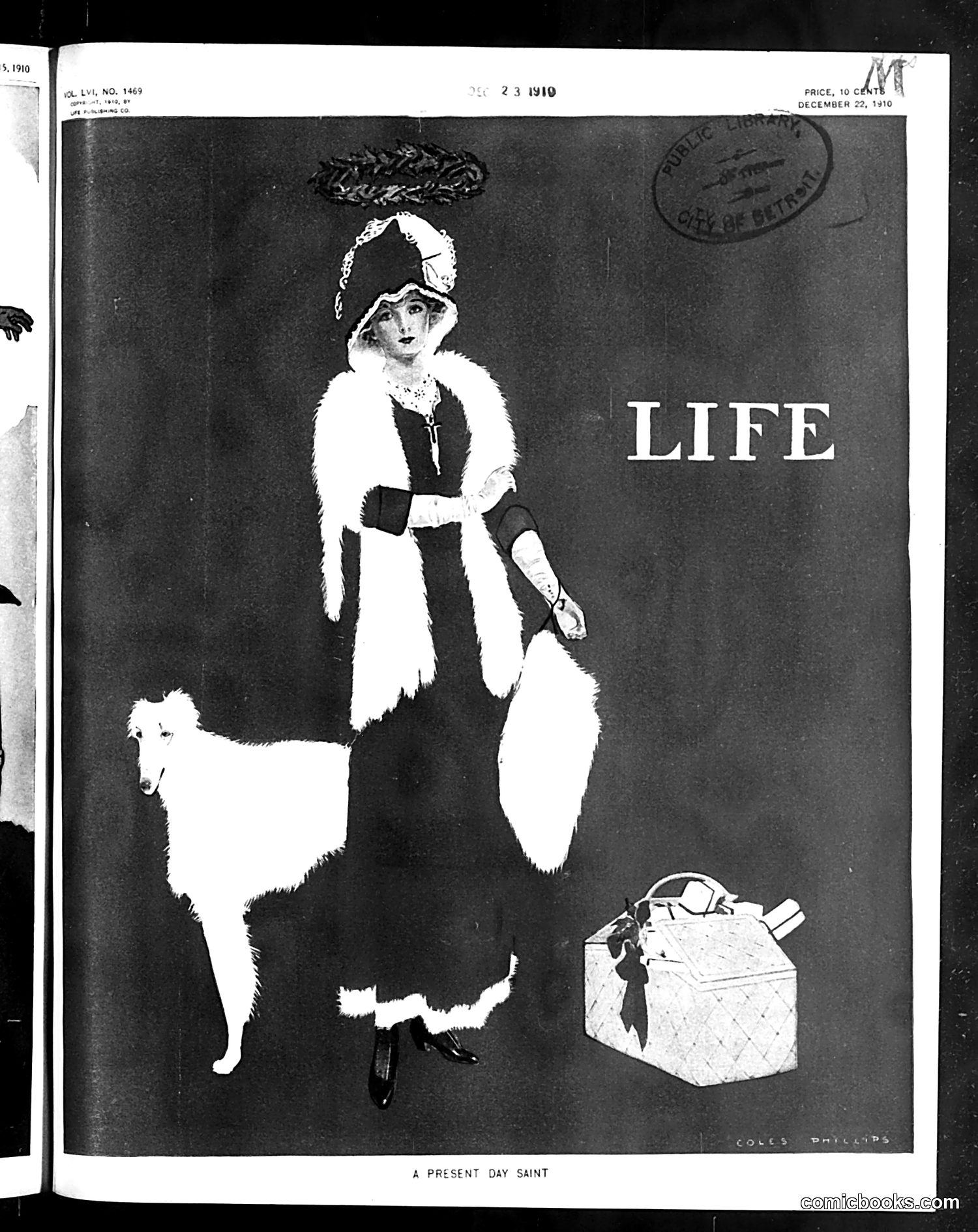
This satirical cover depicts a fashionably dressed woman in an elaborate white fur stole and decorative hat, walking a small dog while carrying a shopping basket. The title "A Present Day Saint" uses irony to critique early 20th-century affluent women. The satire appears to mock the disconnect between the wealthy woman's ostentatious display of luxury goods (expensive furs, fashionable accessories) and contemporary notions of saintliness or virtue. The shopping basket and pet suggest leisure and consumption as her primary concerns. The cartoon likely satirizes the hypocrisy of wealthy society women who might present themselves as morally upstanding while their lifestyle contradicts actual charitable or virtuous conduct. The exaggerated fashion elements emphasize material excess.
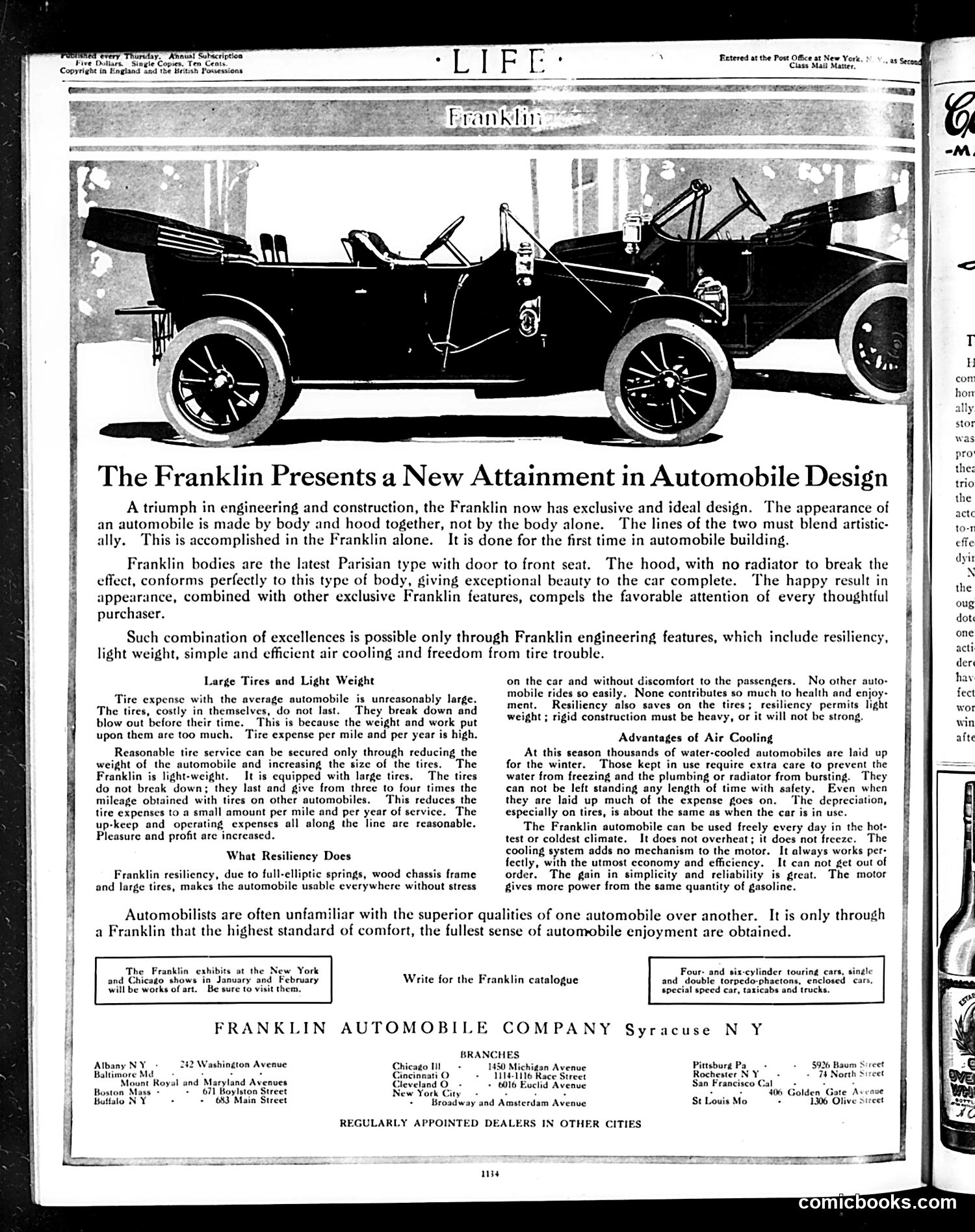
This page is **not a cartoon or satirical content**—it's a straightforward automobile advertisement for the Franklin Automobile Company of Syracuse, NY. The image shows a side-profile technical drawing of an early 1900s Franklin motorcar, emphasizing its open-air touring design. The accompanying text promotes the vehicle's engineering innovations: air cooling (eliminating radiators), lightweight construction, resilient suspension, and large tires. This represents early automotive marketing, highlighting the Franklin's distinctive features against competitors. The mention of exhibits at New York and Chicago shows and the extensive dealer network indicate this was a significant manufacturer of the era, though Franklin eventually ceased production in 1934. The page is purely commercial—no satire or political commentary is present.
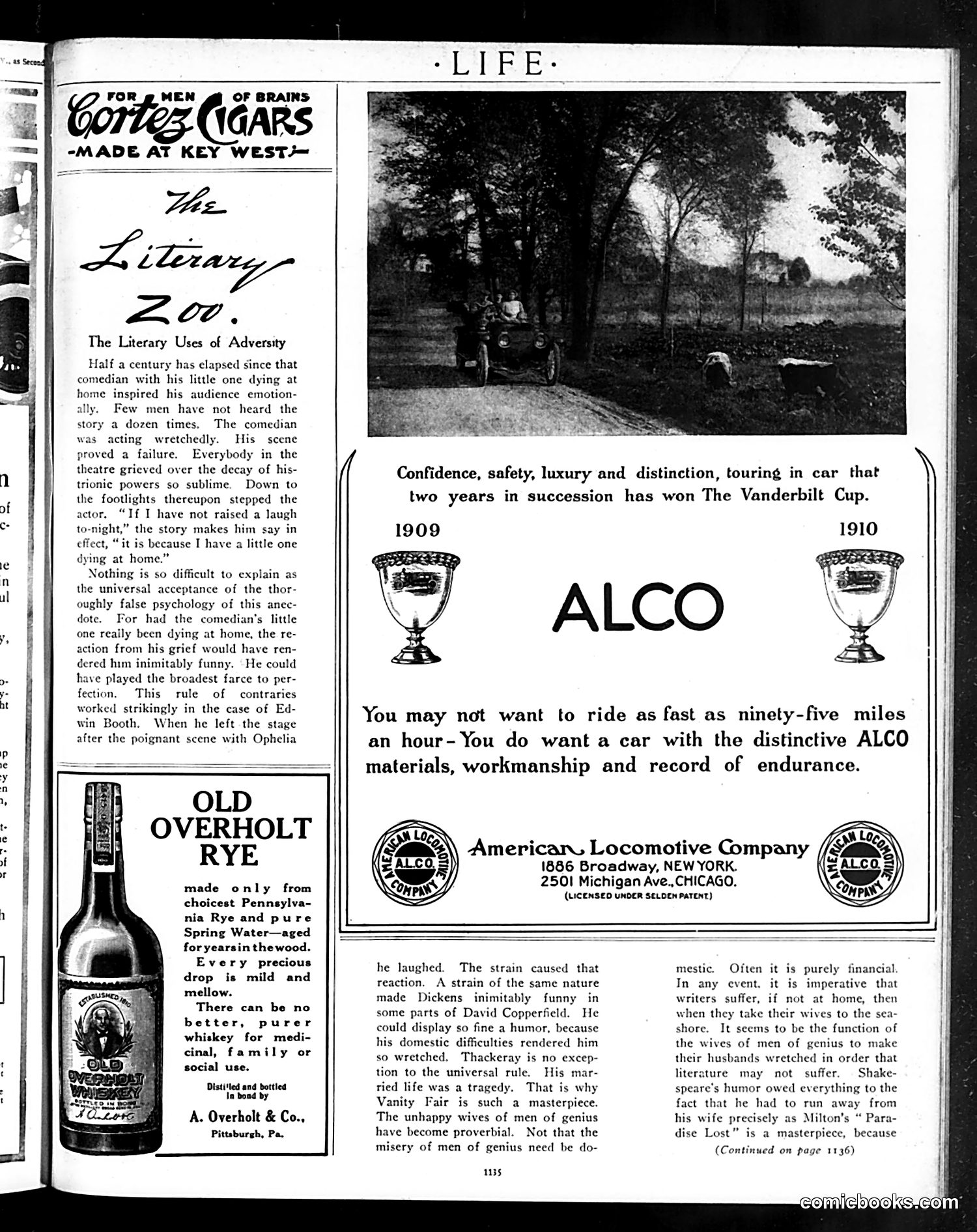
This page is primarily **advertising**, not editorial content or satire. The main advertisements are: 1. **Cortez Cigars** (top left) — marketed to "men of brains," made in Key West 2. **ALCO automobiles** (center/right) — American Locomotive Company promotes their cars, emphasizing quality materials and endurance over speed 3. **Old Overholt Rye** (bottom left) — whiskey made from Pennsylvania rye The only editorial content is "The Literary Zoo" column discussing how comedians use adversity for dramatic effect, referencing 19th-century stage comedians and dramatist Edwin Booth. No political cartoons or social satire appear on this page. It's a standard early-20th-century magazine layout mixing advertisements with literary commentary.
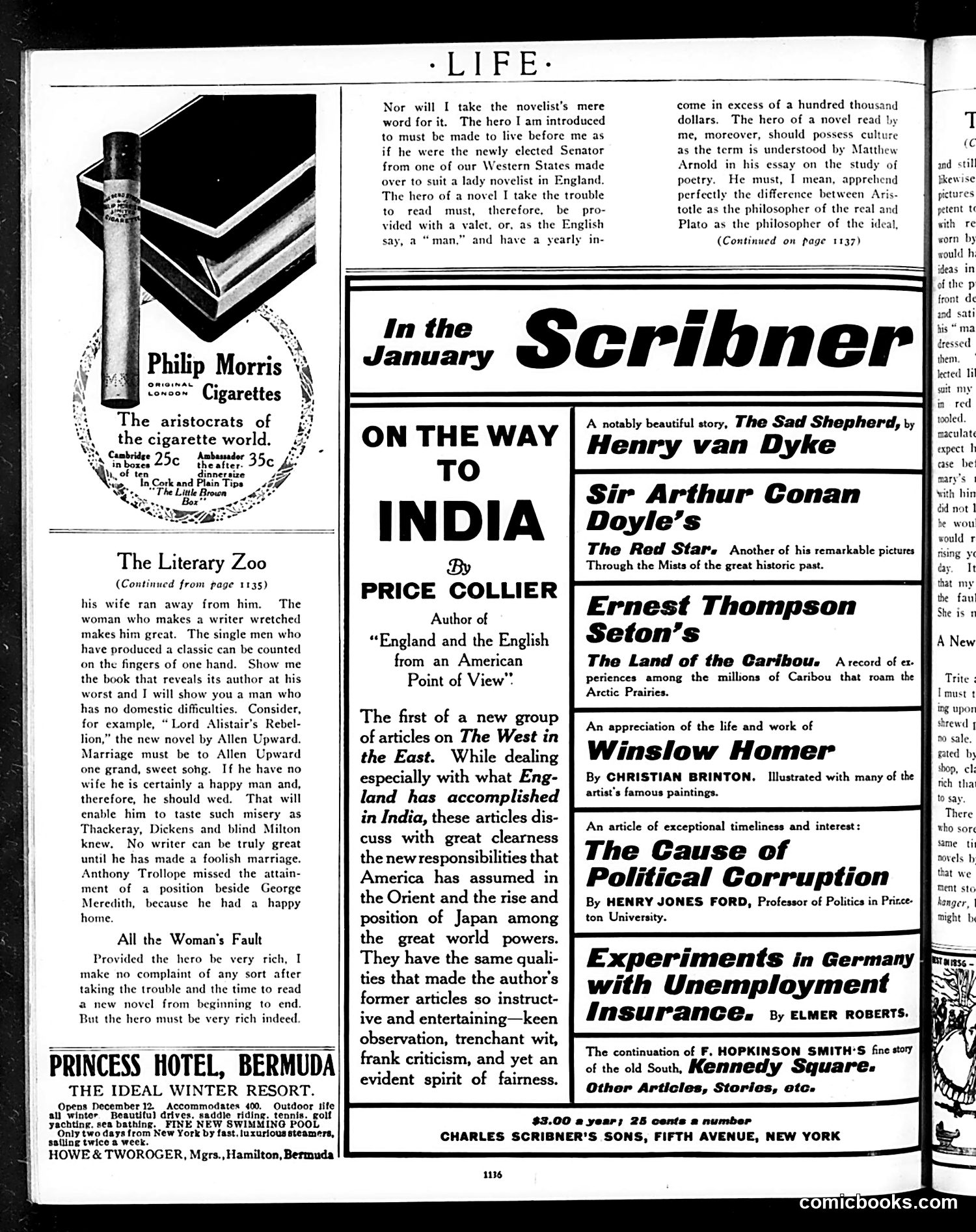
This page is primarily **advertising and literary promotion** rather than political satire. The main content announces upcoming January articles in *Scribner's* magazine, including pieces by Henry van Dyke, Arthur Conan Doyle, and Ernest Thompson Seton. The only distinct advertisement is for **Philip Morris Cigarettes** (left), which uses the slogan "The aristocrats of the cigarette world"—a straightforward luxury brand appeal with no satirical intent. Below that is a brief literary column discussing how novels require wealthy protagonists to avoid seeming "wretched," referencing writers like Allen Upward and Anthony Trollope. This is light social commentary on fiction conventions, not political satire. The remaining content is hotel advertising and standard magazine promotion. No significant political cartoons or satirical commentary appear on this page.
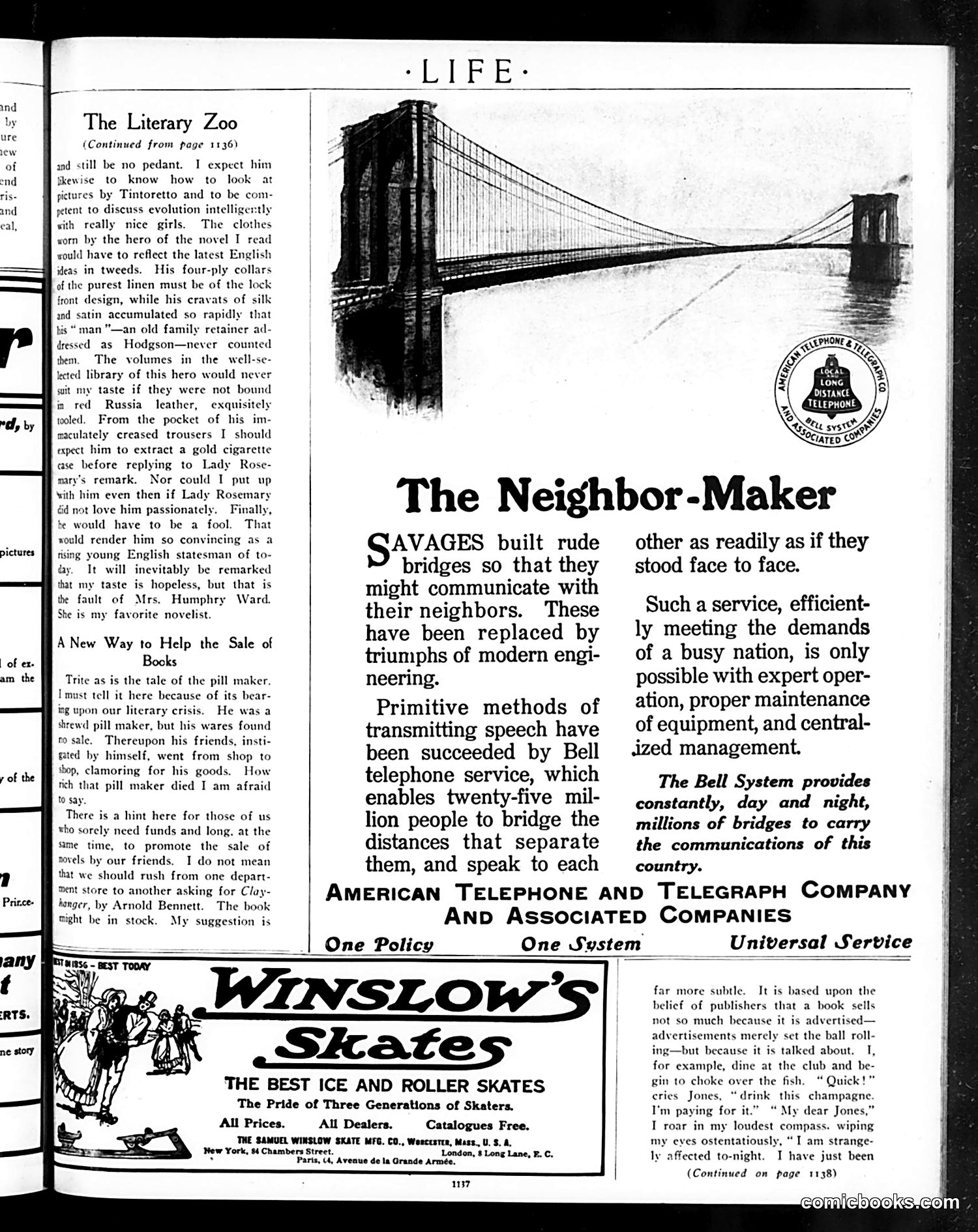
This page is primarily **advertising and editorial content** rather than political satire. The main advertisement is for **American Telephone and Telegraph Company**, celebrating telephone infrastructure as a "neighbor-maker" that connects distant communities. It references how telephone service has replaced "primitive methods" and "rude bridges," enabling 25 million people to communicate across distances. A secondary ad promotes **Winslow's Skates** ("The Best Ice and Roller Skates"), marketed as "The Pride of Three Generations of Skaters." The left column contains book reviews, including discussion of "The Literary Zoo" and suggestions for promoting book sales. This is a typical Life magazine page from the early 20th century mixing product advertisements with cultural commentary—not political cartoon satire.
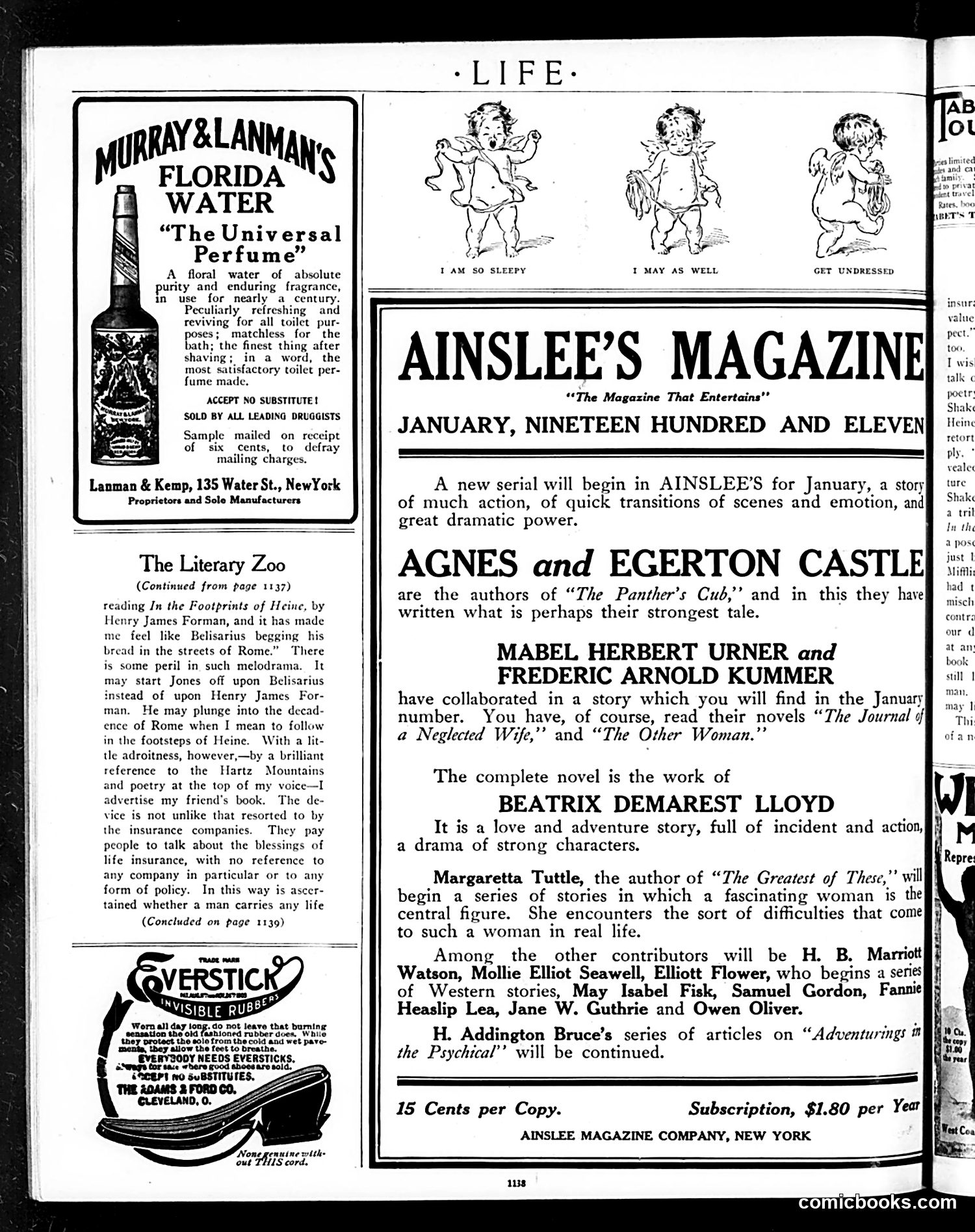
This page is primarily **advertising and magazine promotion**, not political satire. The top cartoon strip shows three cherubs labeled "I am so sleepy," "I may as well," and "Get undressed"—a gentle joke about bedtime routines, unrelated to politics. The main content advertises **Ainslee's Magazine** for January 1911, promoting upcoming fiction by popular authors including Agnes and Egerton Castle, Beatrix Demarest Lloyd, and Margaretta Tuttle. It's a straightforward circulation pitch. The left sidebar contains two advertisements: **Murray & Lanman's Florida Water** (a toilet perfume) and **Everstick Pebble Rubber** (shoe repair). There is no political commentary or satirical content on this page—it's a commercial publication space typical of early 1900s magazines.
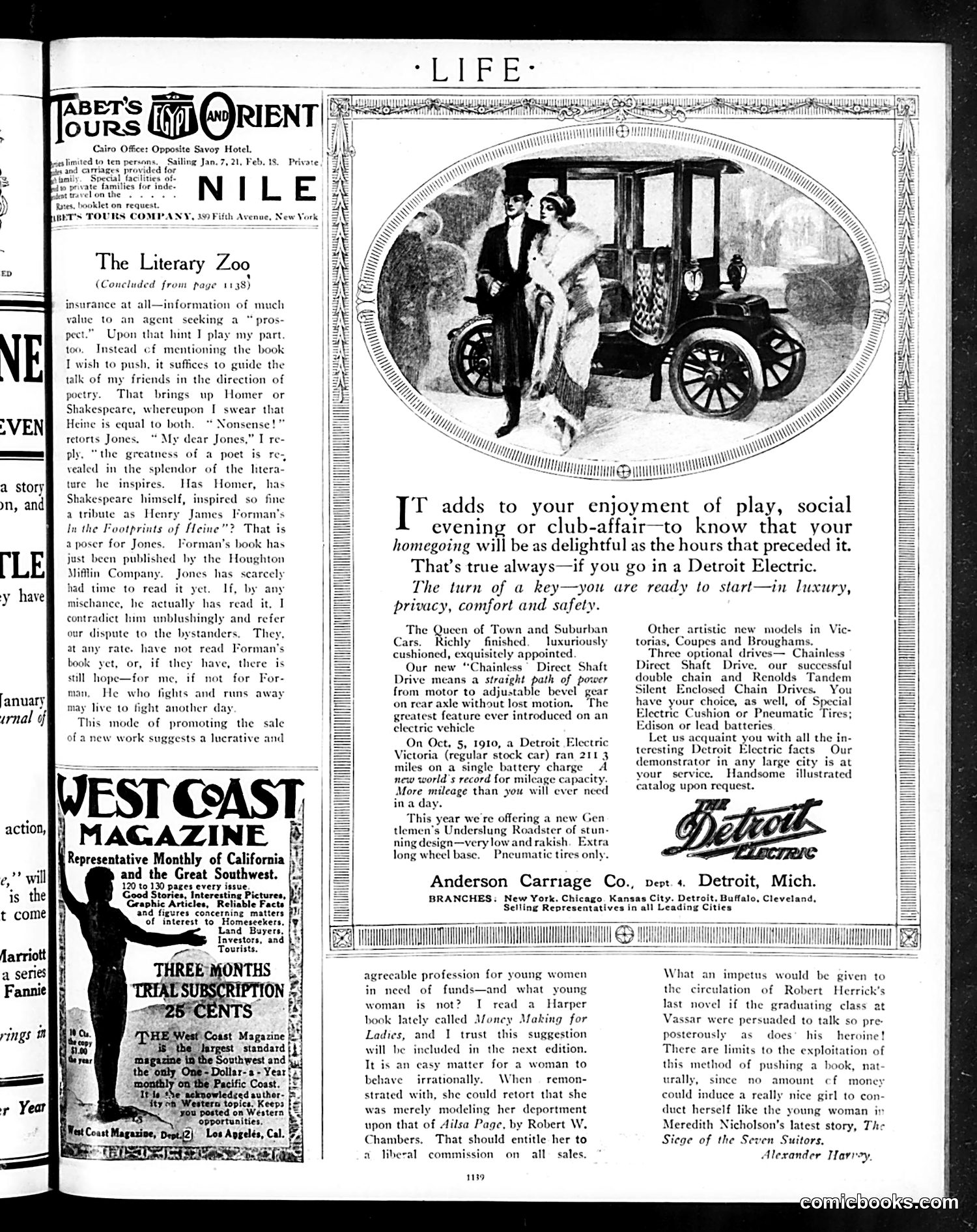
This page is primarily **advertising**, not satire or political commentary. The central image shows a well-dressed couple in a Detroit Electric automobile—an early electric car marketed as a luxury vehicle for social occasions. The accompanying text emphasizes comfort, safety, and convenience: "The turn of a key—you are ready to start—in luxury, privacy, comfort and safety." This appeals to affluent buyers seeking modern transportation without the noise and complexity of gasoline engines. The advertisement highlights various models ("Chainless Direct Shaft Drive") and notes Detroit Electric's branches across major American cities. The left sidebar contains unrelated magazine advertisements. There is no political satire present—this is straightforward early automotive marketing targeting wealthy consumers around 1910.
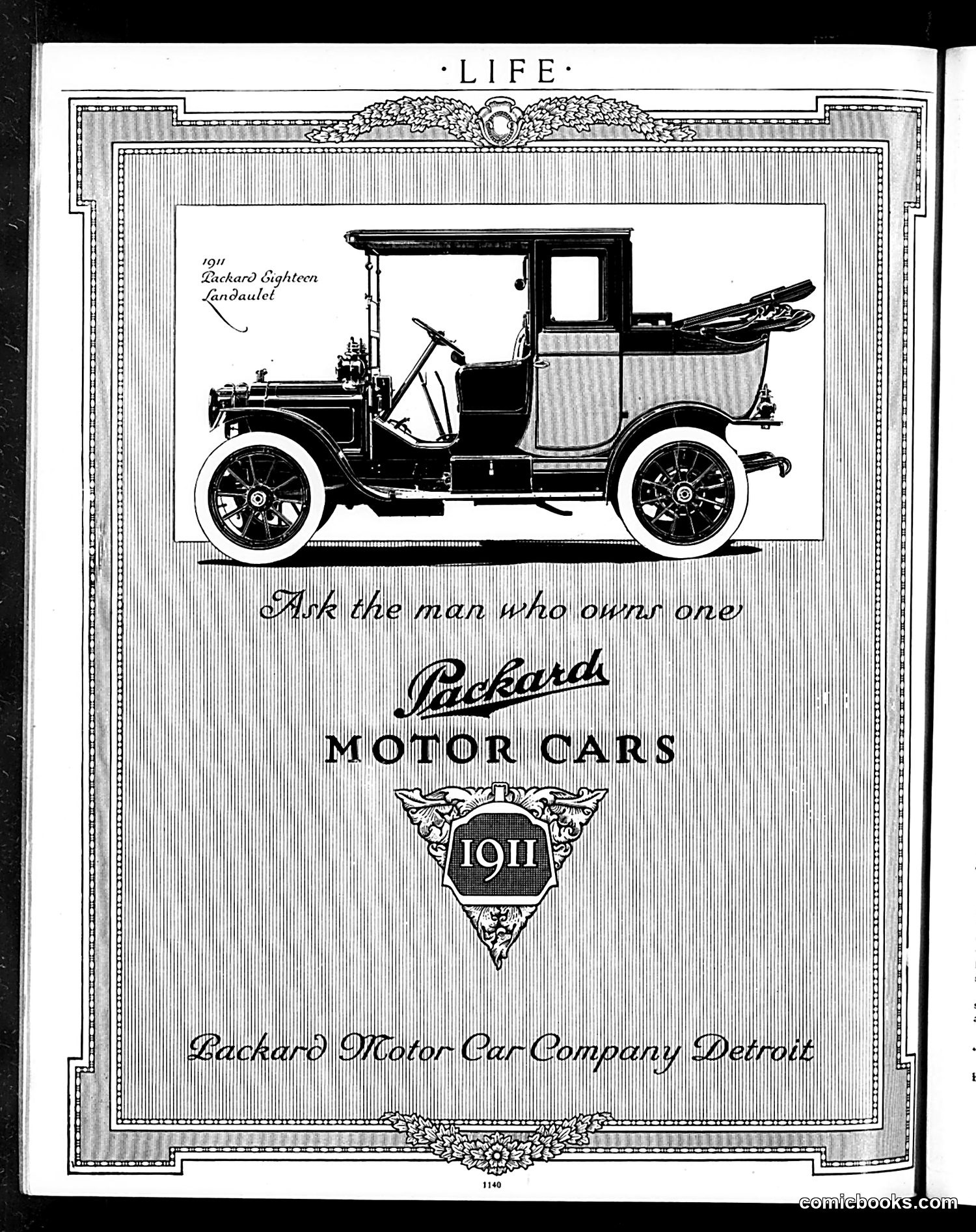
This is a 1911 advertisement for Packard Motor Cars, not a political cartoon. The page shows a side-view illustration of a 1911 Packard Eighteen Landaulet—a luxury automobile with an open-air configuration and storage for sporting equipment (skis visible on the roof). The advertising slogan reads: "Ask the man who owns one," a famous Packard marketing phrase emphasizing owner satisfaction and reliability. The ornate decorative border and placement in *Life* magazine (published in Detroit by Packard Motor Car Company) indicate this targets affluent readers. The inclusion of sporting gear suggests the car appeals to wealthy, active leisure-class consumers. This is straightforward early automotive advertising rather than satire.
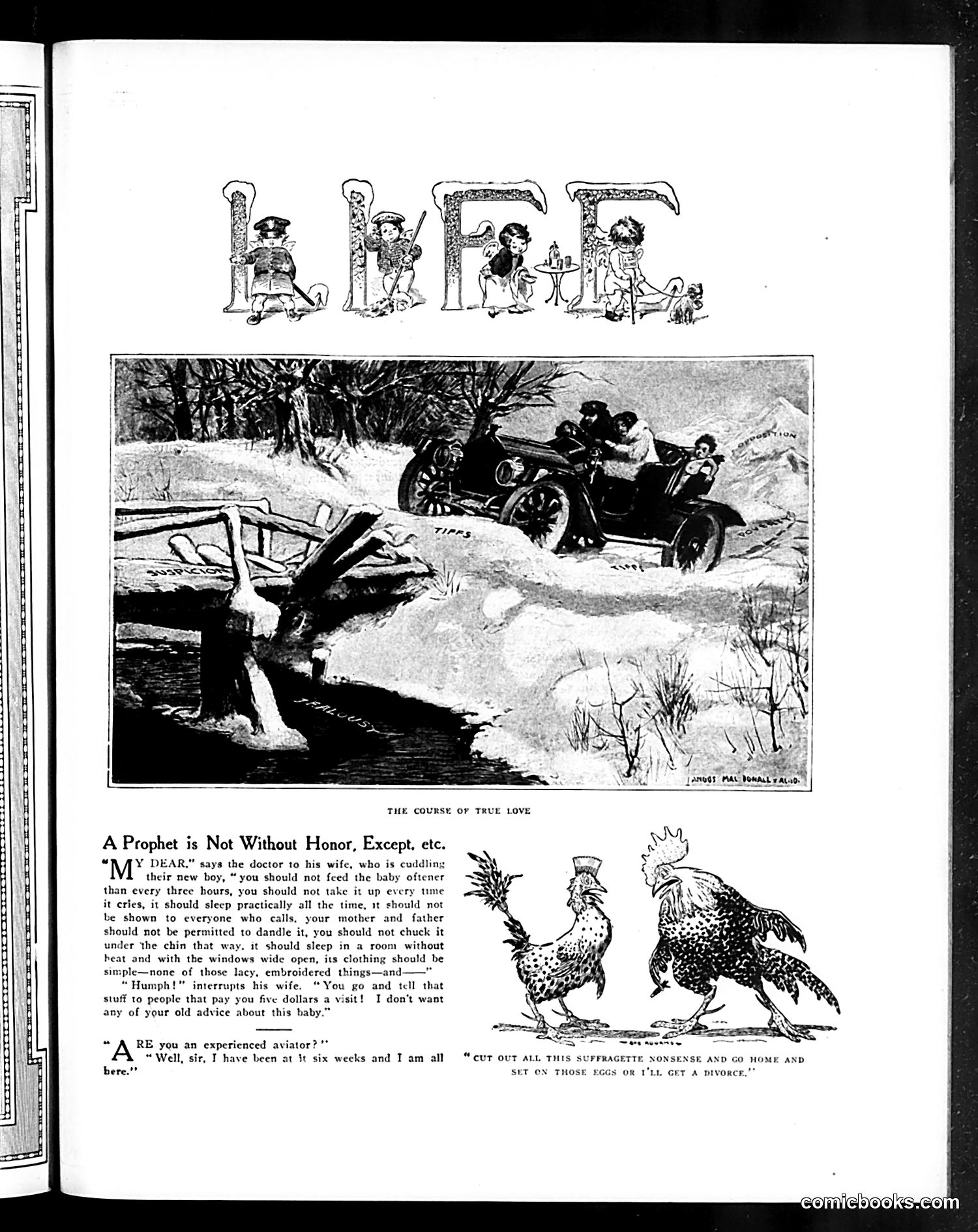
This page contains satirical domestic humor typical of early 20th-century Life magazine. The top illustration "The Course of True Love" depicts a motorcycle accident—a couple crashes while driving, with passengers thrown about. Below, two brief dialogue exchanges mock marriage advice and gender relations. The first sketch jokes about a new father receiving unsolicited parenting advice from a doctor. The wife interrupts to shut down his pompous instruction, establishing the familiar "nagging wife" trope. The second features roosters discussing an aviator's boasting about six weeks' flying experience. One rooster threatens divorce, sarcastically suggesting she'll "set on those eggs" herself rather than endure his nonsense. The humor relies on domestic conflict stereotypes and the relative novelty of aviation and motorcars as markers of modernity.
This page contains two small political cartoons satirizing President Theodore Roosevelt's administration. The **left cartoon** mocks the debate over Alaska coal lands. It depicts Roosevelt as a figure of hope, referencing Interior Secretary Ballinger's handling of public lands. The text criticizes how Ballinger "exonerates" himself while the Alaska coal fields remain "practically untouched"—suggesting the administration failed to develop these resources despite claiming conservation. The **right cartoon** appears to comment on wool tariffs and trade policy, showing a bull (likely representing American interests or the wool industry). The accompanying text discusses wool manufacturing and imports, suggesting satire about protectionist trade policies affecting domestic industry. Both cartoons critique Roosevelt-era conservation and economic policies as ineffective or contradictory.
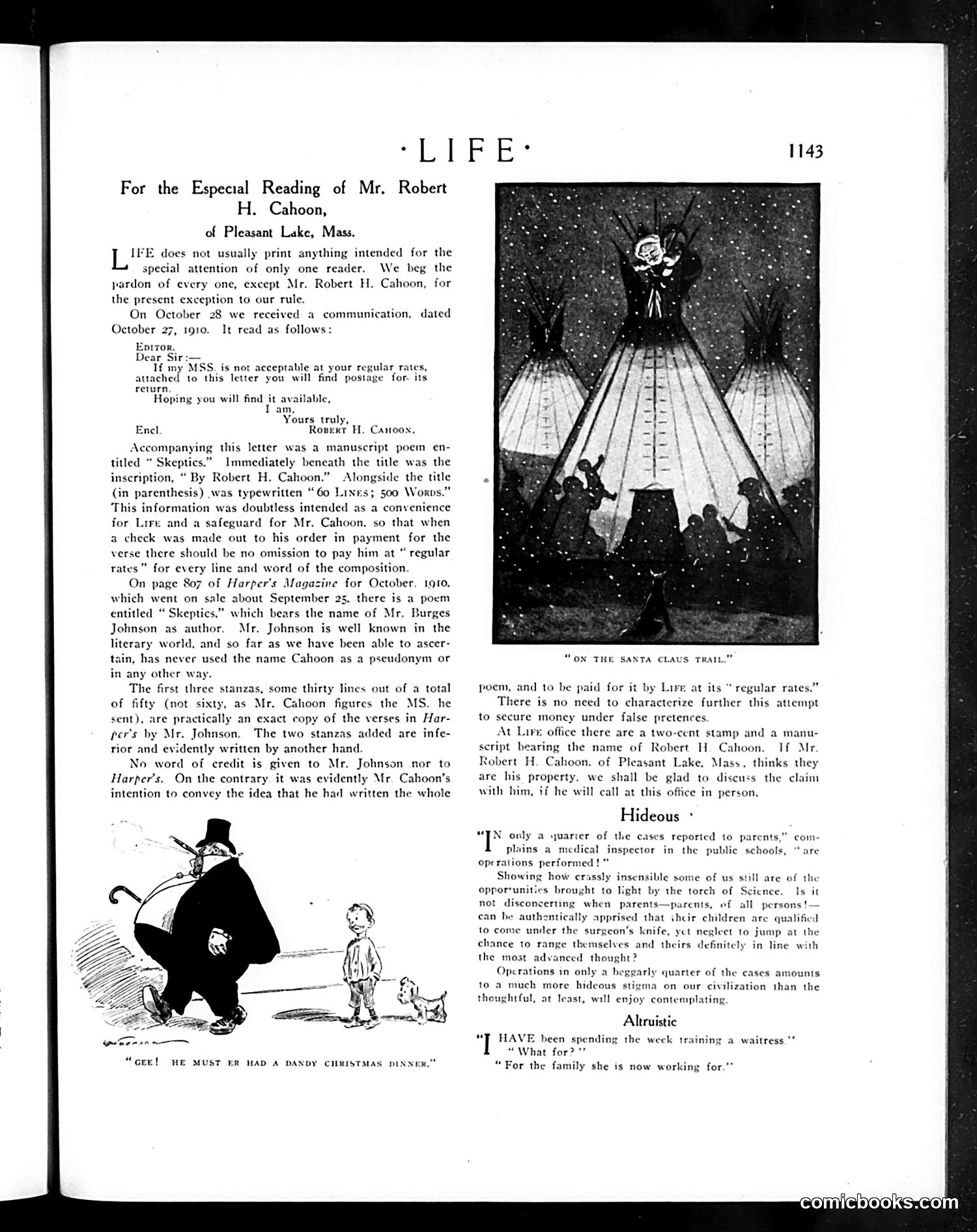
This page primarily contains editorial content rather than political commentary. The main article discusses a dispute over a poem titled "Skeptics" attributed to Robert H. Cahoon of Pleasant Lake, Massachusetts. Life received a letter from Cahoon claiming the manuscript was his, but investigation revealed the poem actually appeared in Harper's Magazine under author Burgess Johnson. Life is calling out what appears to be either plagiarism or false attribution. The two cartoon illustrations are humorous but unrelated to this controversy. The top cartoon ("On the Santa Claus Trail") shows a figure on snowy rooftops; the bottom ("Gee! He Must Be Having a Dandy Christmas Dinner") depicts an adult and child with a dog. These appear to be seasonal, lighthearted pieces rather than satirical commentary.
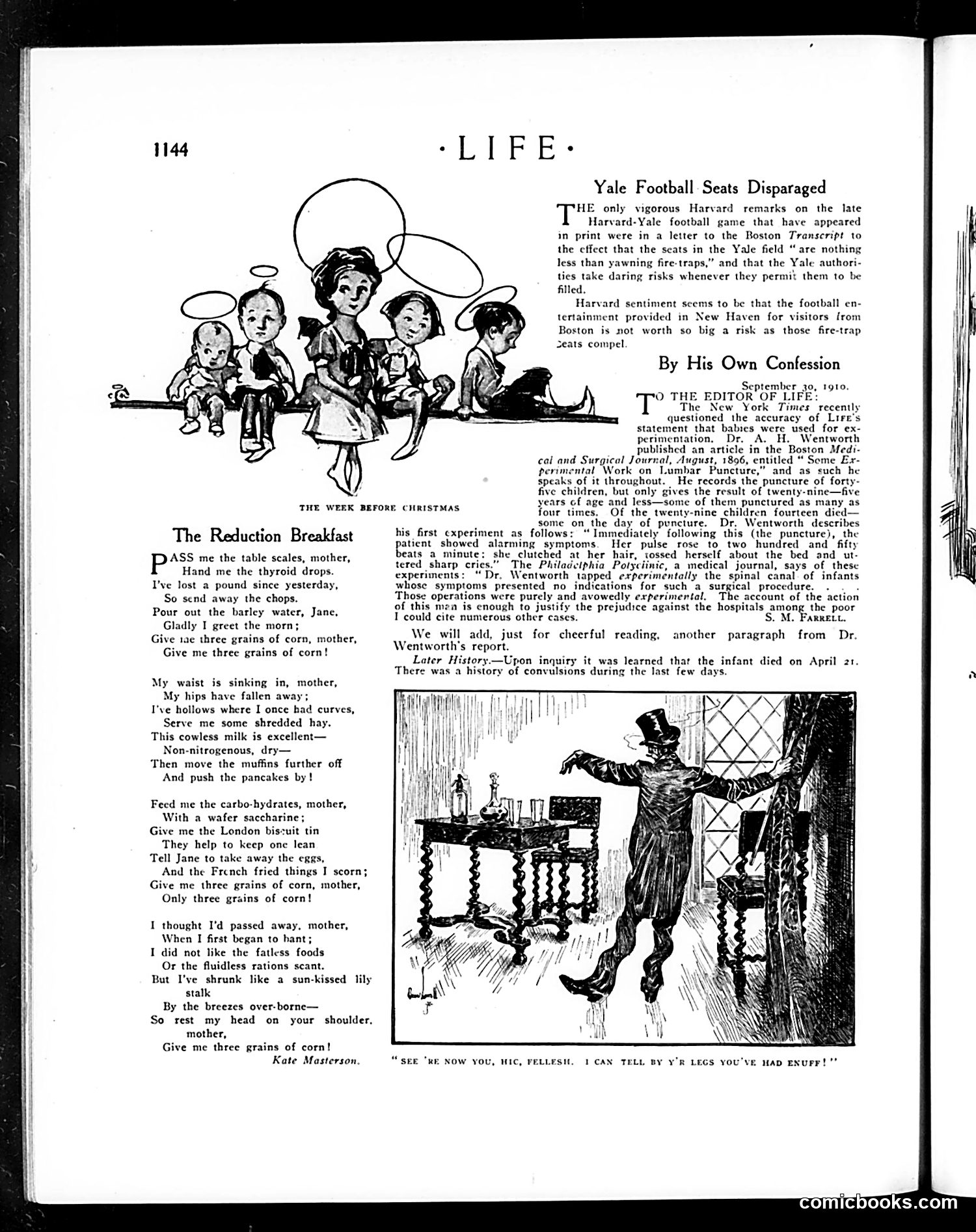
This page contains two distinct pieces: **"The Reduction Breakfast"** is a satirical poem by Kate Masterson mocking fad diets. The accompanying illustration shows children with halos, suggesting they're being reduced to angelic thinness through restrictive eating (thyroid drops, minimal carbohydrates, sparse meals). The satire targets the era's obsession with weight-loss schemes, presenting extreme dietary restriction as absurd and potentially dangerous—especially when applied to children. **"Yale Football Seats Disparaged"** discusses a Harvard critique of Yale's football stadium safety, calling the seating "fire traps." The article references a Dr. Wentworth's controversial medical experiments on infants, using this as dark comparison to Yale's supposedly dangerous facilities. **The bottom illustration** shows a man being ejected from a window by a porter, with the caption referencing "legs you've had enough!" This appears to be a separate humorous vignette about overindulgence or rowdy behavior.
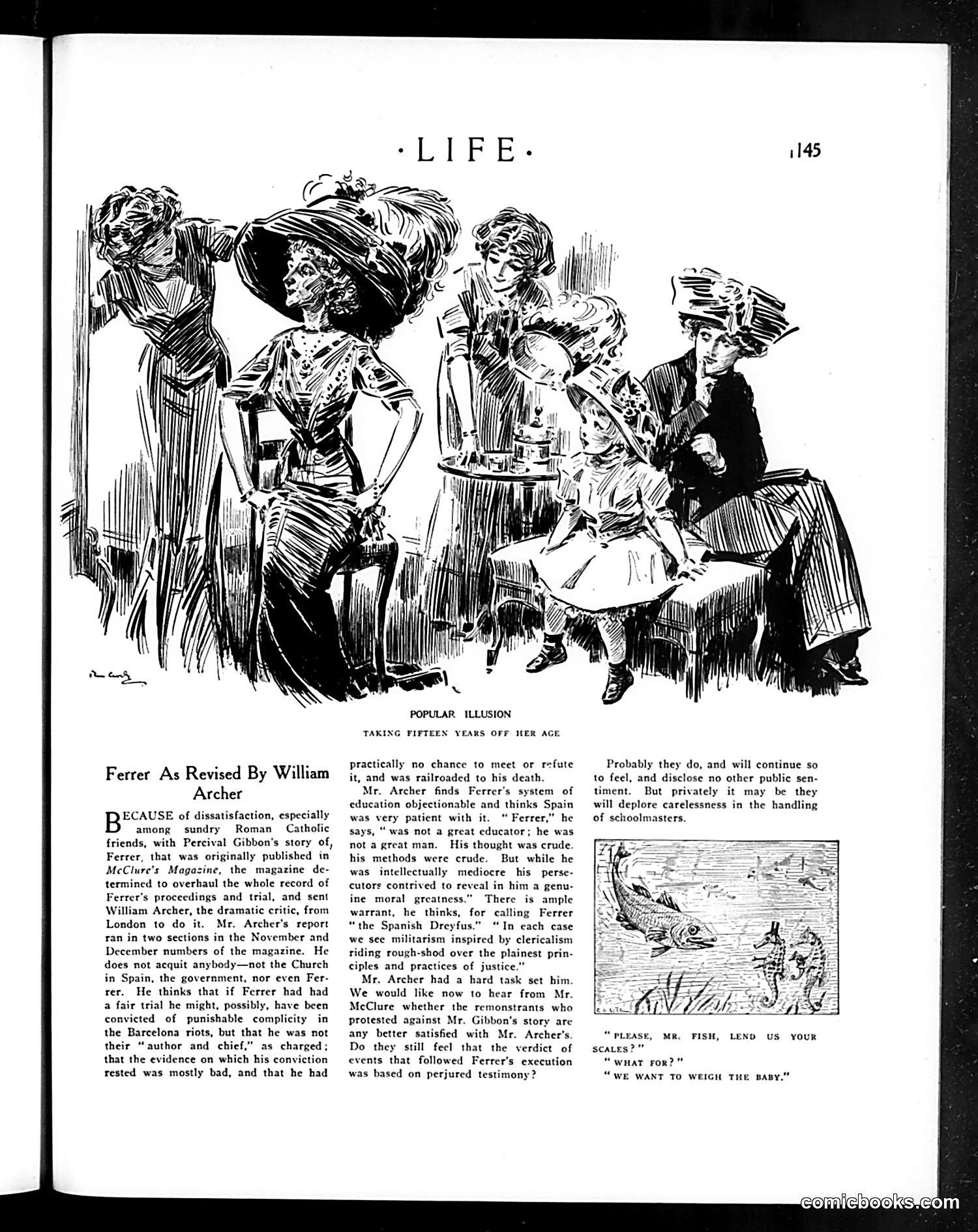
**Main Cartoon Title:** "Popular Illusion: Taking Fifteen Years Off Her Age" The top illustration depicts fashionably dressed women of the Edwardian era using exaggerated styling—large elaborate hats, corsets, and fine clothing—to appear younger than they actually are. The satire mocks the social pressure on women to conceal their age through fashion and cosmetics, suggesting that such efforts are mere "illusion." **Article:** "Ferrer As Revised By William Archer" discusses a Spanish legal case, likely referencing Francisco Ferrer, an anarchist educator executed in 1909. The article appears skeptical of revisionist accounts of the case. **Bottom Comic:** Shows a fish-weighing scene, with text "Please, Mr. Fish, lend us your scales?" / "We want to weigh the baby"—a visual pun about using fish scales instead of proper infant scales.
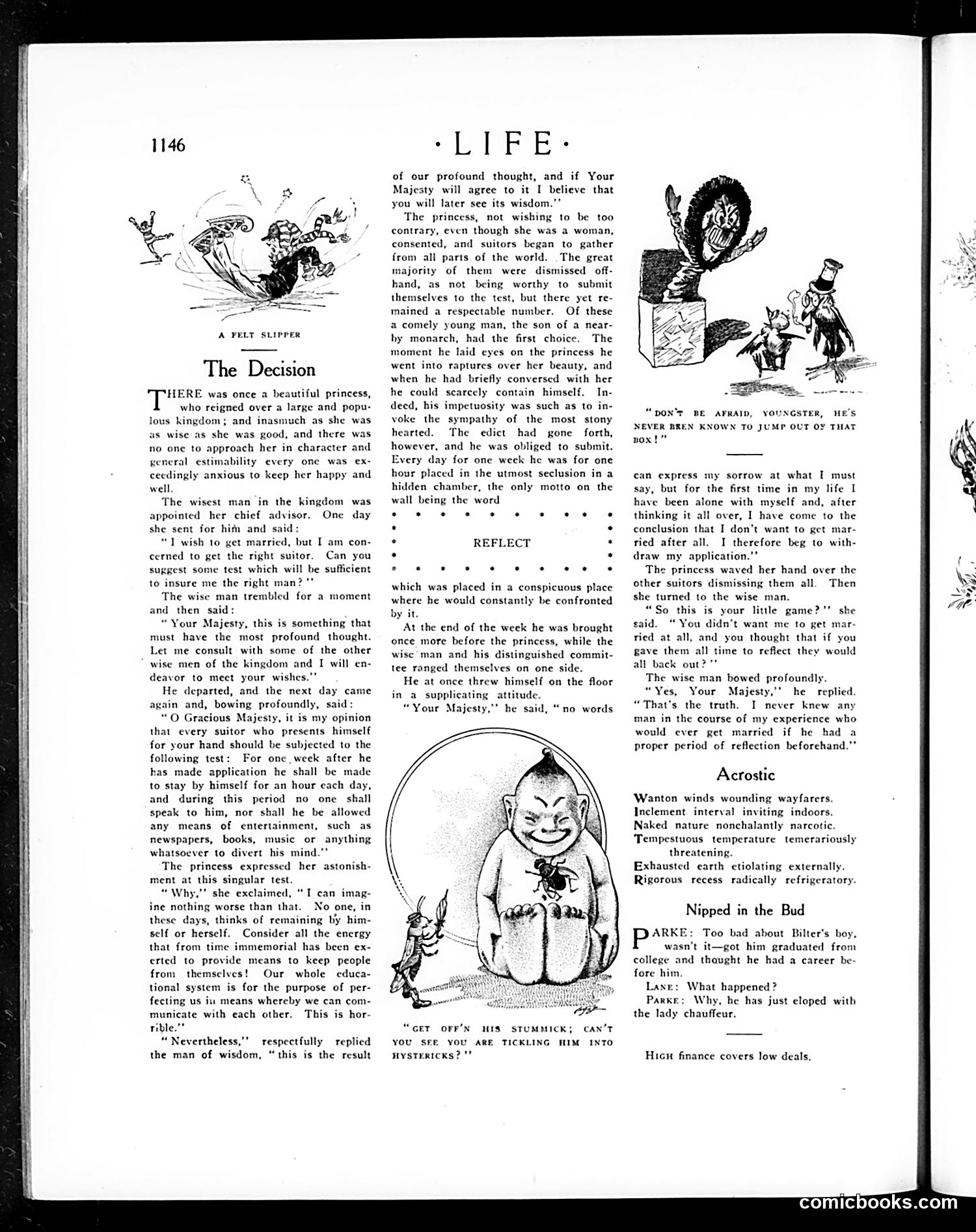
This story-based cartoon satirizes early 20th-century American culture's addiction to constant stimulation and entertainment. A wise advisor proposes that suitors for a princess must spend one hour daily in solitude with only the word "REFLECT" for company—a radical deprivation in an era of newspapers, books, and music. The joke: a young suitor, forced to be alone with himself for the first time, discovers he doesn't actually want to marry the princess. The satire targets the modern avoidance of introspection and self-examination. By constantly filling time with external diversions, people avoid confronting their true desires and character. The accompanying crude illustrations (a slipper, a cherub) are decorative. The acrostic poem "Acrostic" and the brief joke "Nipped in the Bud" are filler content typical of Life magazine's satirical format, mocking social pretense and romantic delusions respectively.
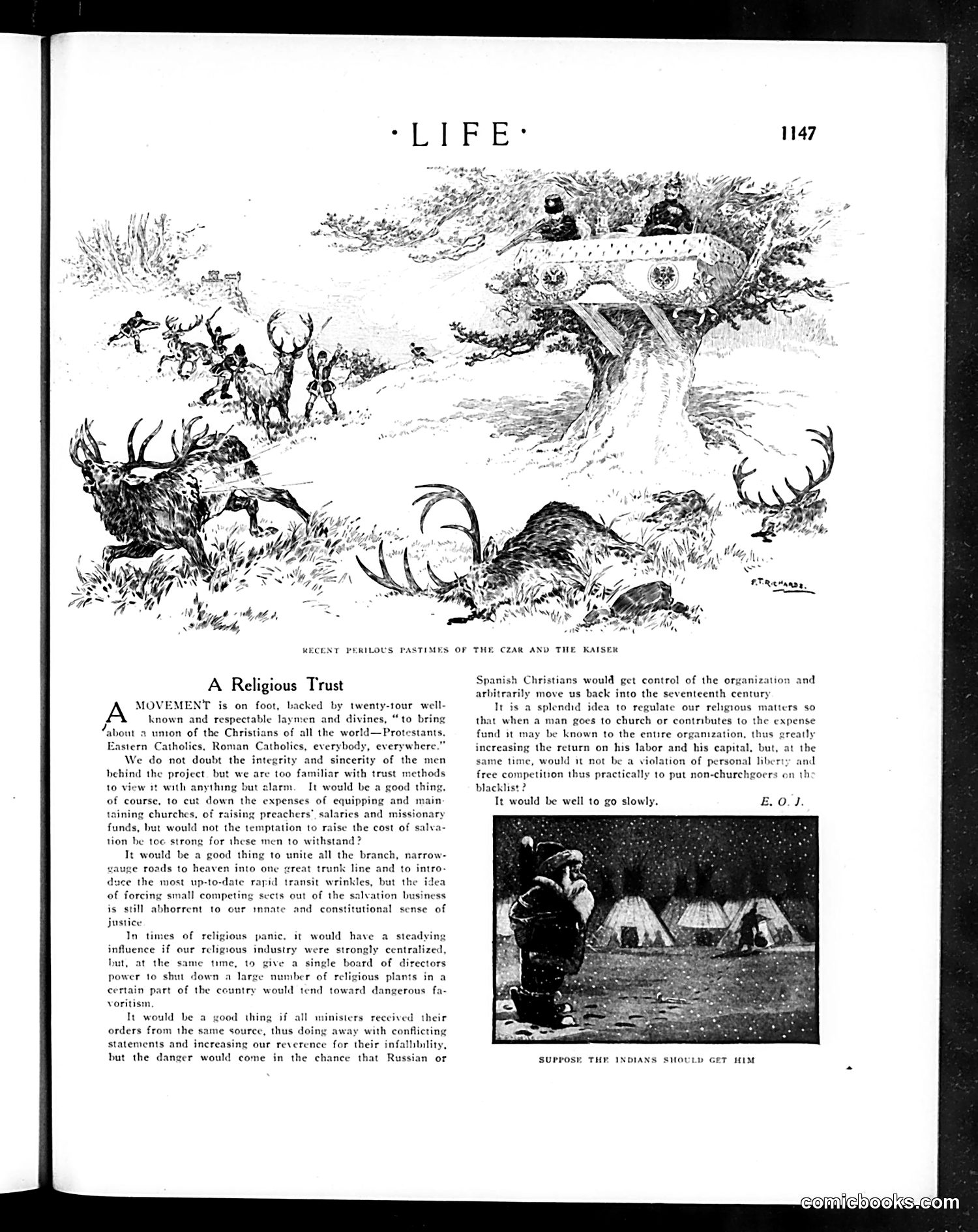
This satirical article critiques a proposed ecumenical movement to unite all Christian denominations worldwide. Life's editors mock the plan by drawing parallels to corporate monopolies ("trusts")—a major Progressive-era concern about anti-competitive business consolidation. The satire highlights fears that religious unification would: - Raise costs of salvation like monopolies raise prices - Eliminate competing "sects" (smaller denominations) - Centralize power dangerously under foreign control (referencing the Russian Czar and Spanish Catholics) - Violate personal liberty and blacklist non-churchgoers The cartoon above shows deer and humans in a treehouse, captioned "Recent Perilous Pastimes of the Czar and the Kaiser"—likely mocking European leaders' leisure activities as frivolous distractions from serious governance. The accompanying photograph ("Suppose the Indians Should Get Him") appears to show Native Americans with a European, sarcastically suggesting role-reversal consequences. The overall message: religious monopolization poses the same dangers as industrial trusts.
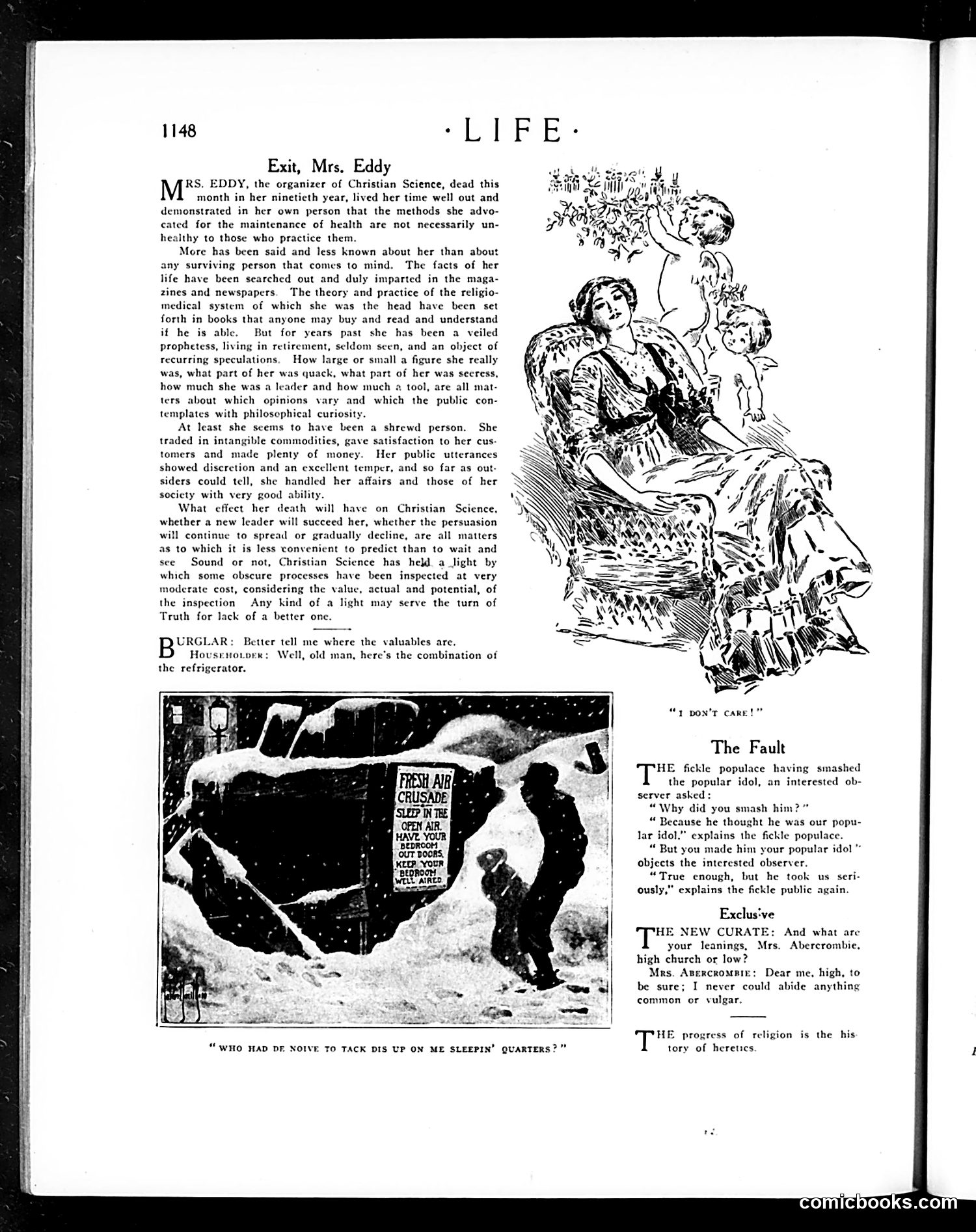
This page commemorates **Mary Baker Eddy's death**, founder of Christian Science. The obituary essay acknowledges her as a shrewd businesswoman who profited from "intangible commodities" (spiritual healing) while remaining enigmatic—the text notes uncertainty about how much she was genuine "secress" versus "quack." The **cartoon about the refrigerator** satirizes Depression-era burglary: a burglar demands valuables from a householder, who jokes that the refrigerator's combination is the only "valuable" he owns—commenting on widespread poverty and empty pantries. **"The Fault"** satirizes fickle public opinion: crowds destroy their own celebrity idol, then blame the idol for taking their adulation seriously. It critiques mass hysteria and the public's responsibility for their own hero-worship. **"Exclusive"** mocks snobbish class pretension: a woman claims "high" (Anglican) church preference solely to avoid appearing "common or vulgar," revealing her values are purely social status, not spiritual.
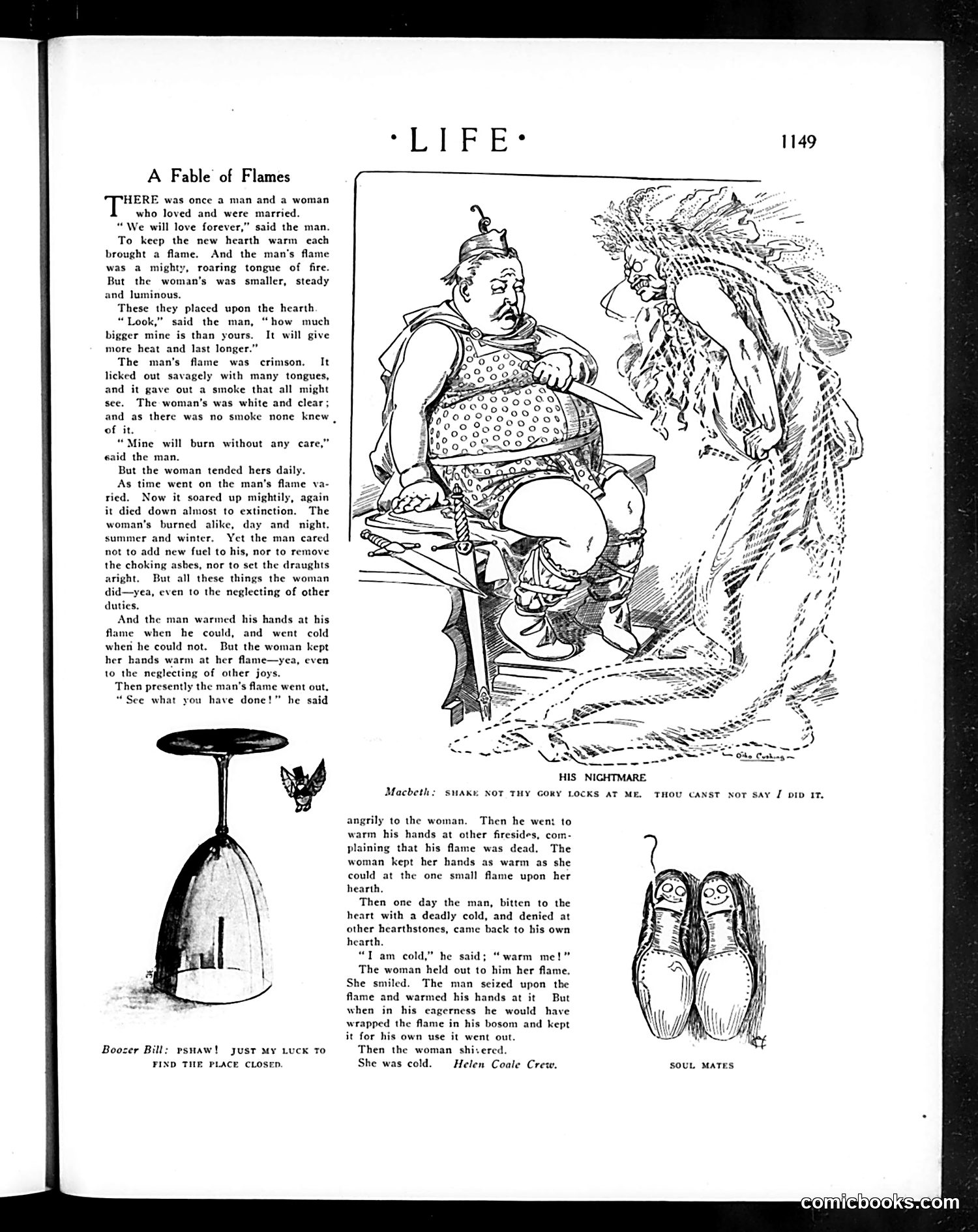
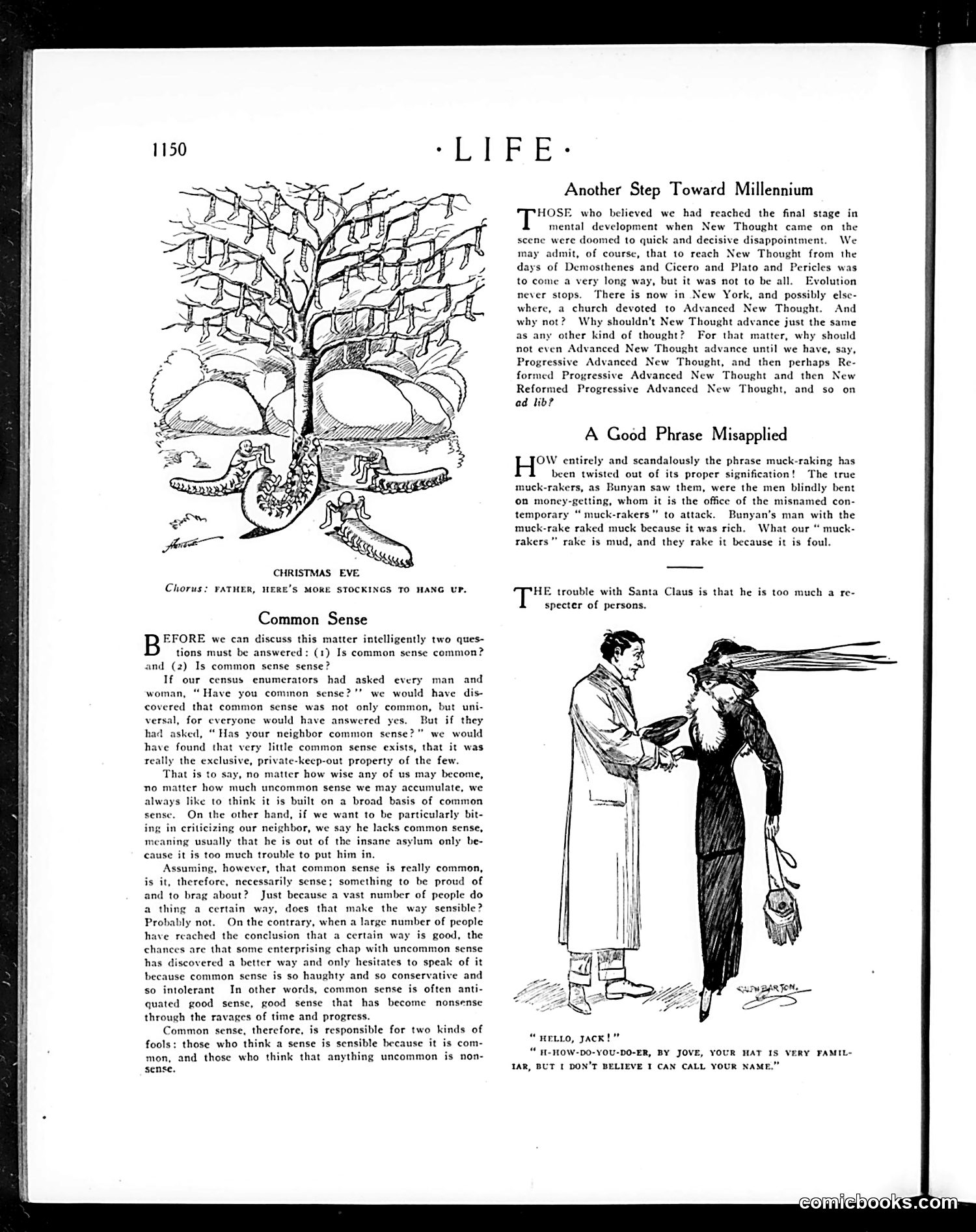
This page from *Life* magazine contains three satirical essays targeting contemporary American attitudes and language. **"Common Sense"** mocks the paradox that everyone claims to possess common sense while denying it to others. The essay argues that "common sense" is often outdated thinking masquerading as wisdom, and that blind adherence to majority opinion represents foolishness rather than sense. **"Another Step Toward Millennium"** satirizes the proliferation of "New Thought" religious movements (a popular late 19th/early 20th-century spiritual trend). The satire suggests these movements endlessly subdivide into progressively absurd variations—"Advanced New Thought," "Progressive Advanced New Thought," etc.—mocking their pretension to constant improvement. **"A Good Phrase Misapplied"** critiques contemporary "muck-rakers" (investigative journalists exposing corruption). The author argues they've perverted John Bunyan's original meaning: Bunyan's "muck-raker" symbolized greed; modern journalists should expose such greed, not merely rake through mud for sensationalism. The cartoon shows a man embarrassed at forgetting someone's name—a gentle social commentary unrelated to the essays.
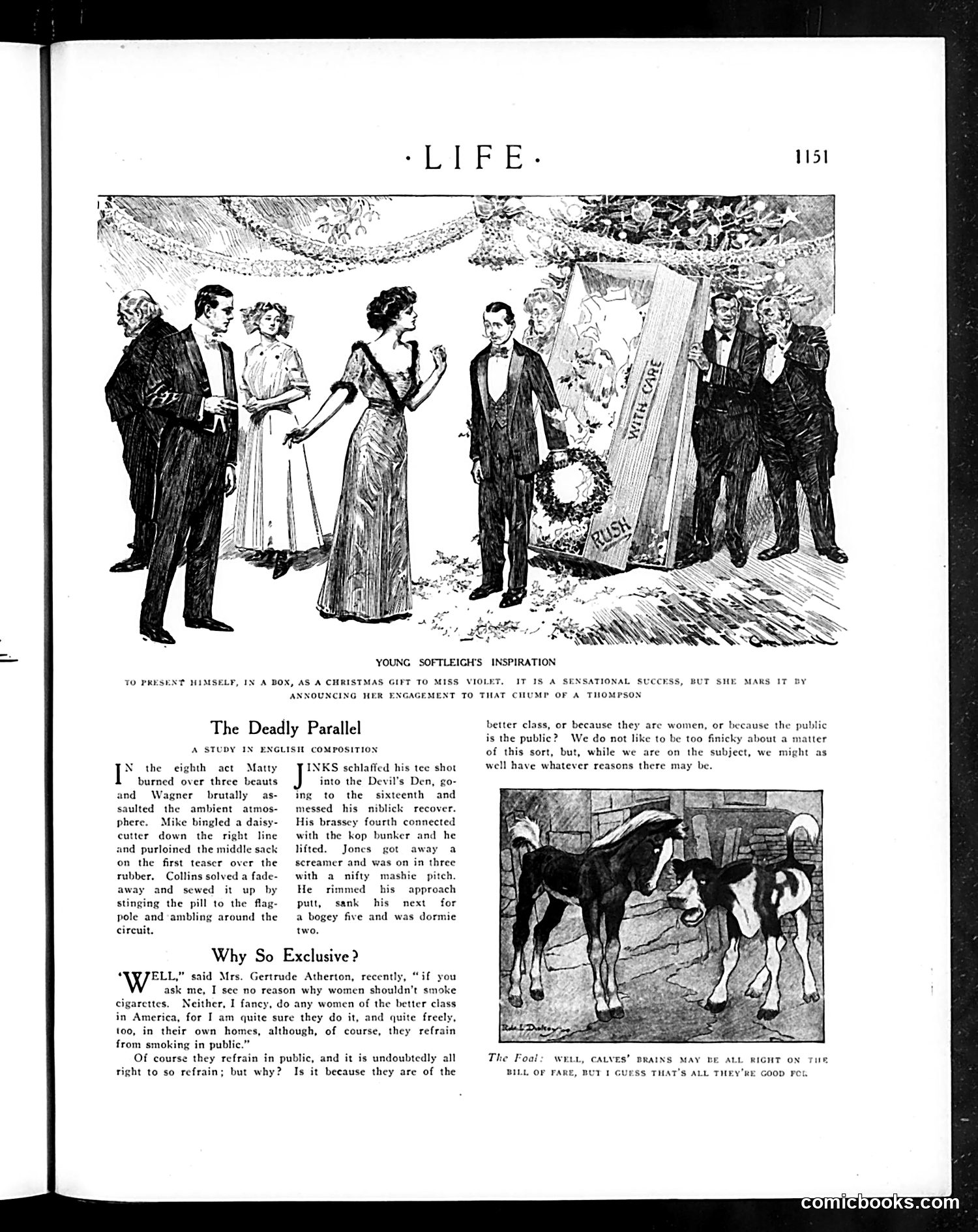
**Top Cartoon ("Young Softleigh's Inspiration"):** A young man presents himself in a decorated box as a Christmas gift to Miss Violet, but she announces her engagement to someone else ("that chump of a Thompson"). The satire mocks both the young man's theatrical romantic gesture and Miss Violet's apparent indifference to it. **"The Deadly Parallel":** This is a humorous composition study contrasting two writing styles. The left side uses absurdist, nonsensical sports jargon ("schlaffed his tee shot," "bingled a daycutter") to mock overwrought literary prose. It appears to satirize inflated or affected writing in contemporary literature. **"Why So Exclusive?":** References Mrs. Gertrude Atherton's recent comments about women smoking. The piece questions why women refrain from smoking in public if they do so privately at home—questioning the hypocrisy of social conventions around women's behavior. **Bottom cartoon ("The Foal"):** A horse with visible ribs—satirizing that while brains may be valuable currency, that's "all they're good for" (a cynical comment on society's actual values).
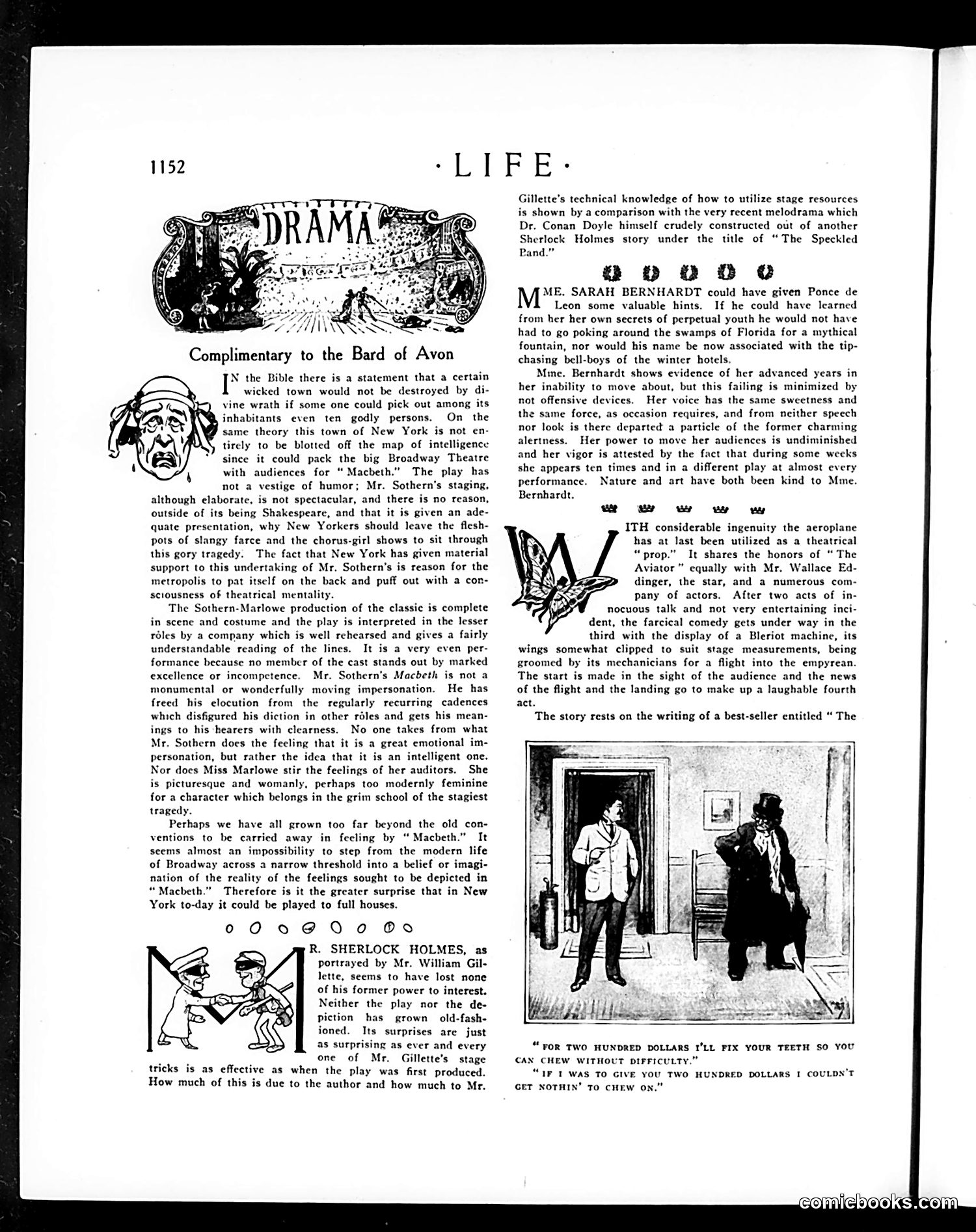
This page reviews three theatrical productions. The main critique concerns a Broadway production of Shakespeare's *Macbeth* starring actor E.H. Sothern and Julia Marlowe. Life sarcastically praises New York for supporting Shakespeare despite its preference for frivolous entertainment ("slangy farce and chorus-girl shows"), suggesting the city deserves credit for cultural sophistication. Sothern's performance is judged competent but uninspired—intelligent rather than emotionally moving. The page also reviews William Gillette's *Sherlock Holmes* play, praising its enduring effectiveness and stagecraft, and notes that a competing Sherlock Holmes melodrama by author Conan Doyle himself lacks Gillette's technical skill. Finally, it discusses Sarah Bernhardt's continued theatrical power despite her advancing age and physical limitations.
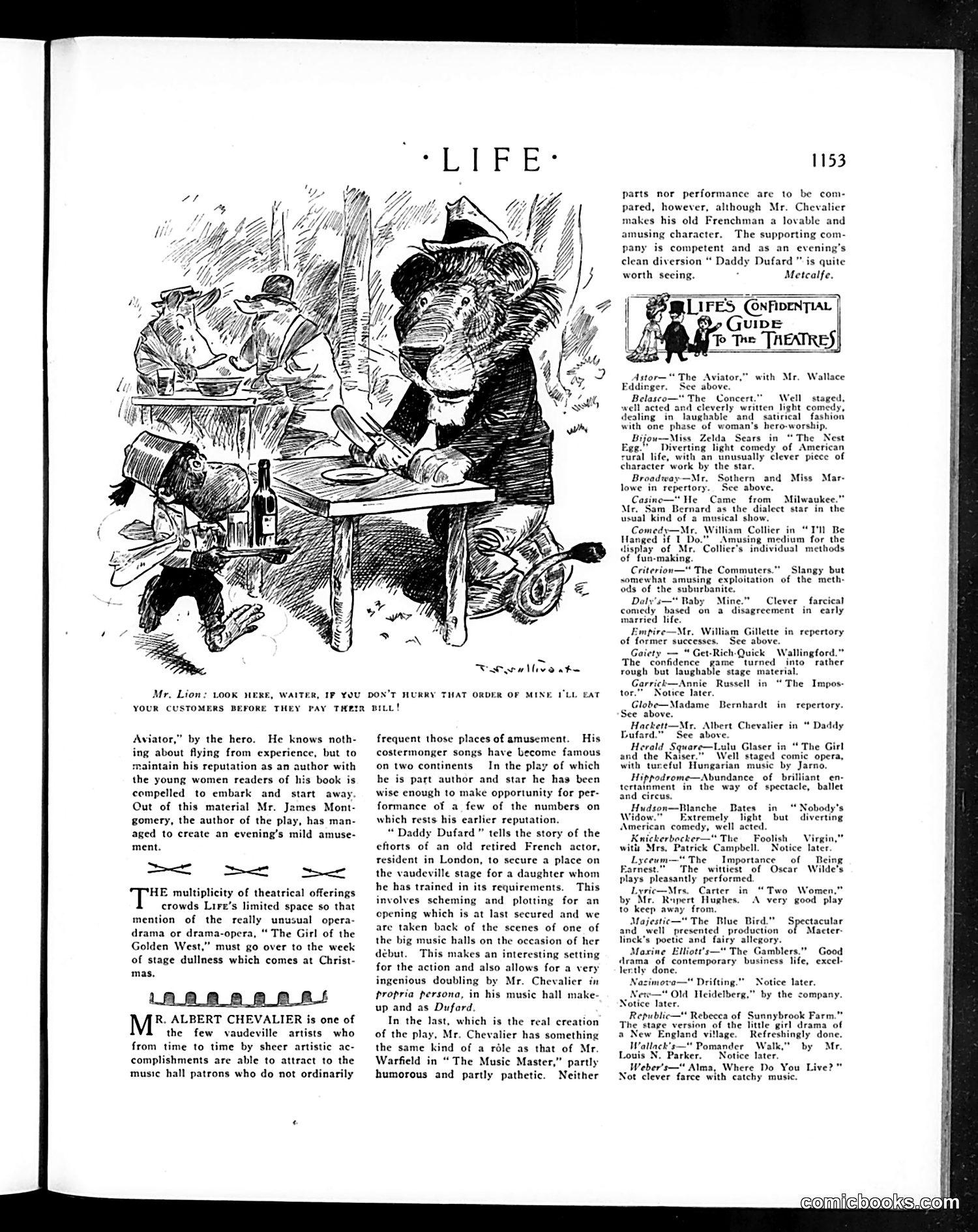
The main cartoon depicts a lion seated at a restaurant table, threatening the waiter: "Look here, waiter, if you don't hurry that order of mine I'll eat your customers before they pay their bill!" This is a simple visual gag playing on the lion's nature as a predator. The humor derives from the absurdity of a wild animal dining at a civilized establishment and the waiter's predicament—the threat isn't about unpaid bills but literal consumption of patrons. The page's bulk consists of theatre reviews covering current Broadway productions and vaudeville performances. Notable mentions include Albert Chevalier in "Daddy Dufard" (a play about a retired French actor securing his daughter's stage debut) and various other comedies and light operas. The "Confidential Guide to the Theatres" section provides brief assessments of multiple shows running during this period. This appears to be a typical Life magazine arts/entertainment page blending satirical humor with practical theatre criticism for contemporary readers.
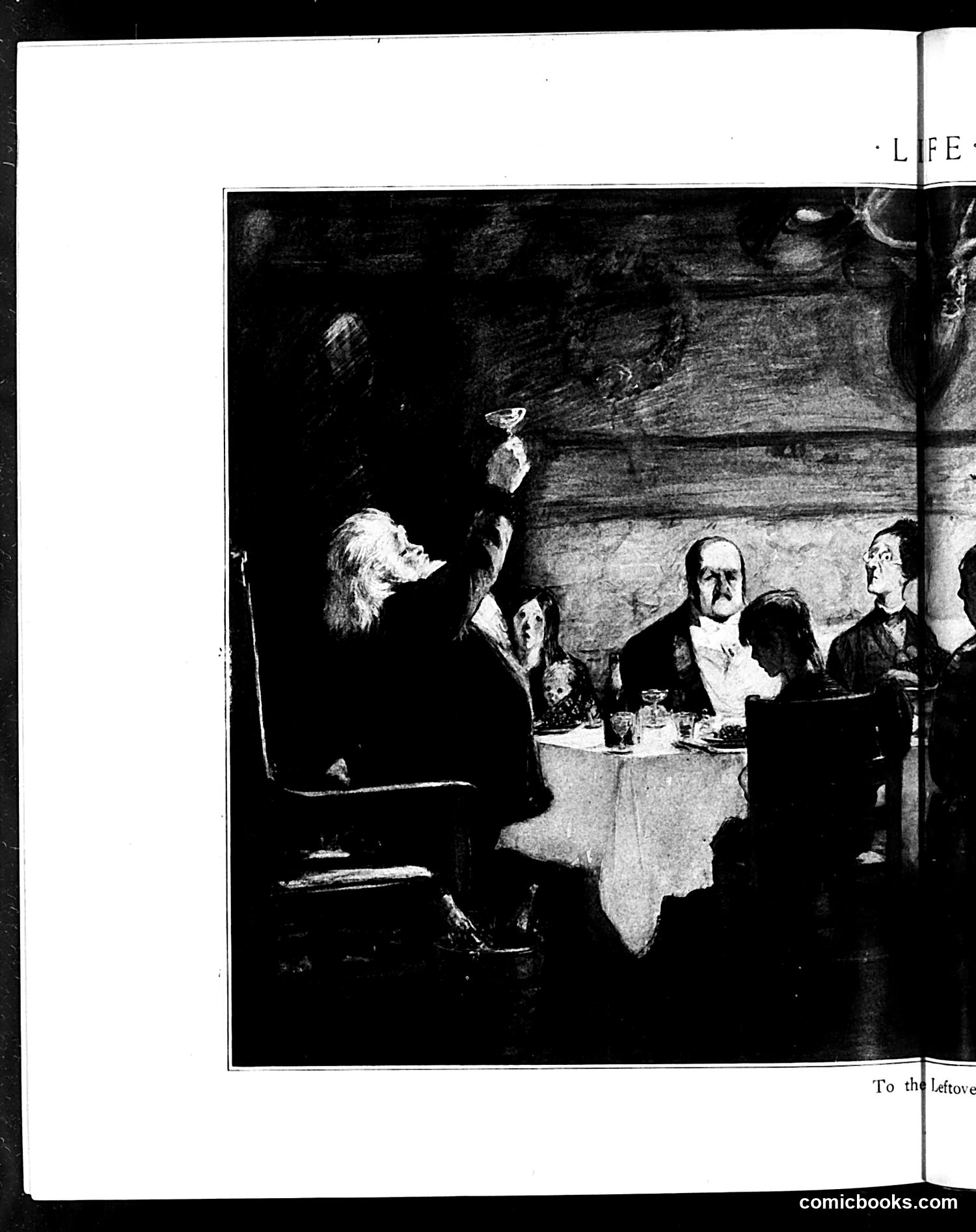
This black and white illustration depicts a formal dining scene. On the left sits an elderly man with distinctive wild hair, gesturing expressively while speaking or toasting. He appears to be addressing a table of well-dressed men in formal attire seated to the right, who regard him with varying degrees of attention or skepticism. The caption "To the Leftove[r]" (text appears cut off) suggests this is political satire, likely critiquing someone's speech or influence at a formal gathering. The elderly speaker's animated posture contrasts with his audience's reserved demeanor, implying mockery of his oratory or ideas. However, without the complete caption, date, or other identifying context visible on this page, I cannot definitively identify the specific historical figures or event being satirized.
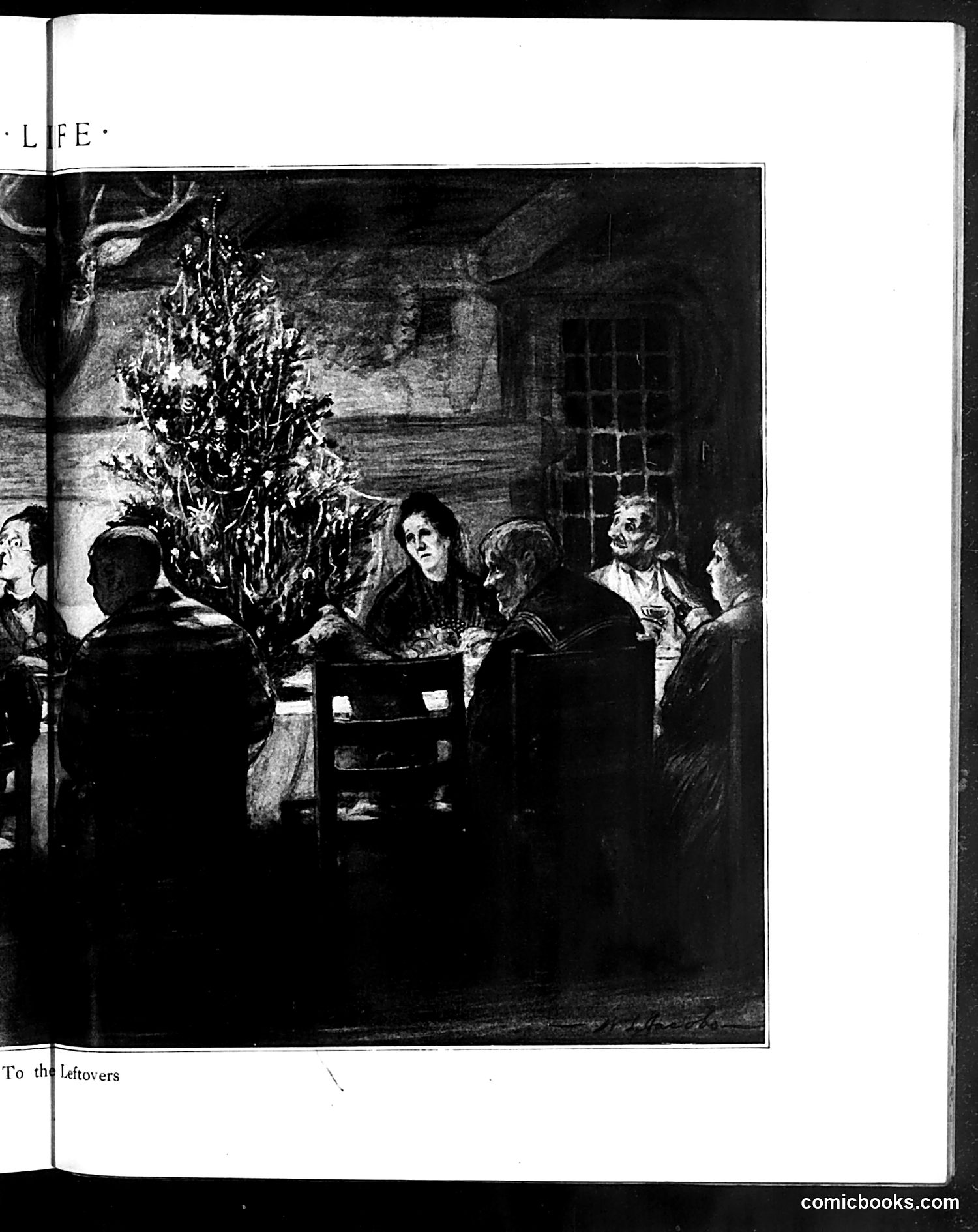
This appears to be a satirical illustration, likely from early-to-mid 20th century *Life* magazine, depicting a nighttime scene with several figures gathered around what looks like a decorated plant or small tree indoors. The caption "To the Leftovers" suggests social satire about post-holiday gatherings or parties. The dark, expressionistic style and gathering of formally-dressed figures suggests this mocks either: - The dreary aftermath of holiday celebrations - Social pretense at gatherings with minimal refreshments - Possibly critiques of frugality or diminished circumstances among the upper classes Without clearer identifying details or additional context, the specific satirical target remains unclear, though the tone appears gently mocking of social conventions around entertaining and gathering.
This is satirical commentary on early 20th-century women's suffrage activism, written *against* the suffrage movement itself. The author uses a fictional character, Priscilla, to mock suffragettes by having her express their supposed views in exaggerated, contradictory ways. Priscilla defends boycotting *Life* magazine for mocking suffragettes, then undermines her own cause by abandoning serious argument to shop for hobble skirts. She claims women's "superior intellectuality" while praising sensationalism over domestic duty. She ridicules a theatrical scene emphasizing motherhood as women's highest calling, yet reveals that seeking newspaper attention—not voting itself—is her actual priority. The cartoons (a caricatured woman and garden scene) reinforce the satire: Life magazine is mocking suffragettes as hypocritical and trivial, prioritizing fashion and publicity over genuine political argument. The piece suggests activists undermine their own credibility through contradictions and superficiality.
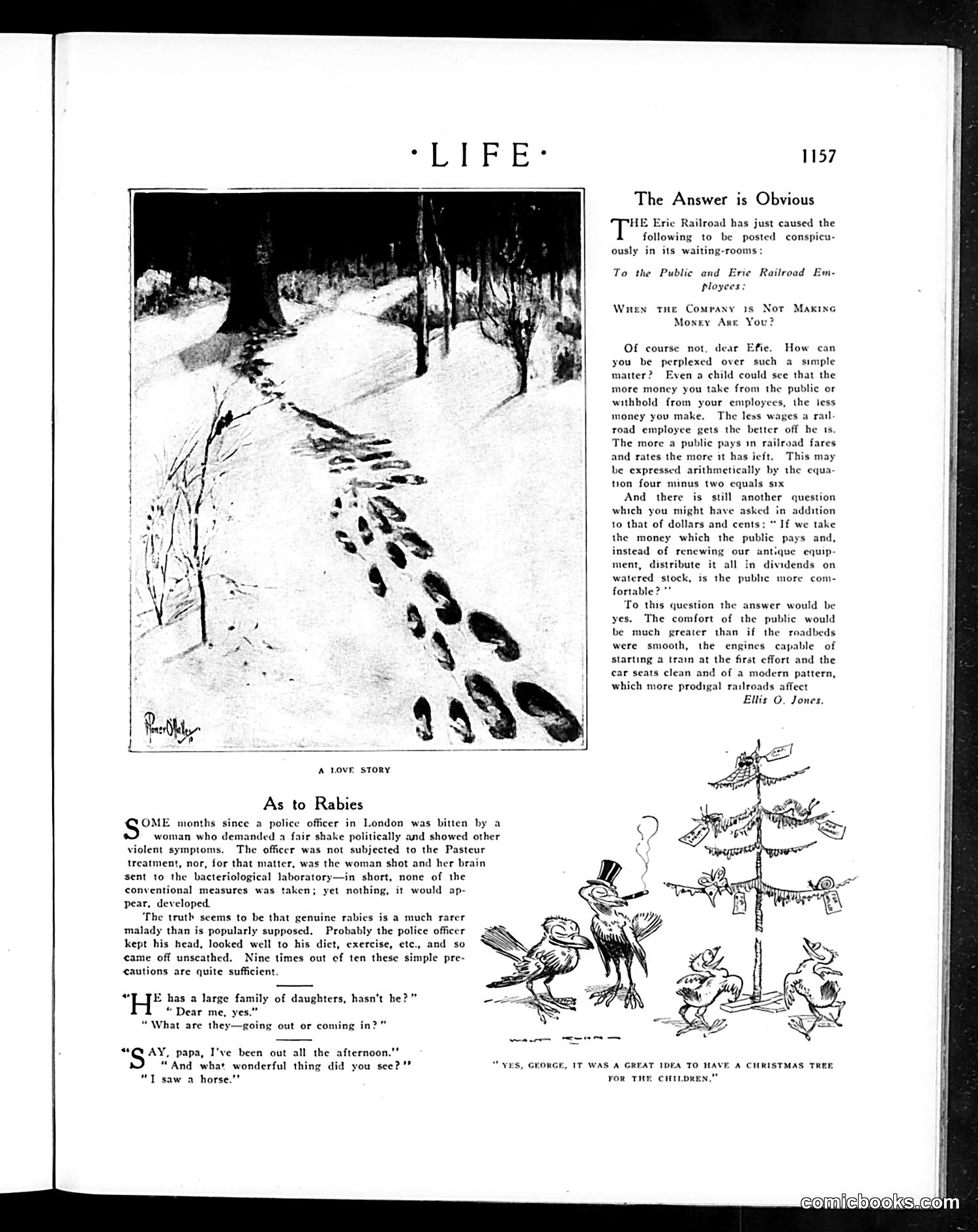
This 1157-page from *Life* magazine contains two satirical pieces: **"As to Rabies"** is a brief story mocking suffragettes. It references a woman who "demanded a fair shake politically" and bit a London police officer. The story uses this incident to suggest that rabies (literal disease) is rarer than thought—a crude joke implying that violent suffragettes were common during women's rights activism, particularly in early 20th-century Britain. **"The Answer is Obvious"** directly satirizes the Erie Railroad's posted notice claiming workers and the public both benefit when the company withholds wages and maintains poor service. The piece uses sarcastic logic ("four minus two equals six") to expose the railroad's absurd reasoning: better profits through reduced wages and deteriorating conditions actually harm workers and passengers. Ellis O. Jones attacks corporate greed disguised as mutual benefit. Both pieces target institutional hypocrisy—one social, one economic.
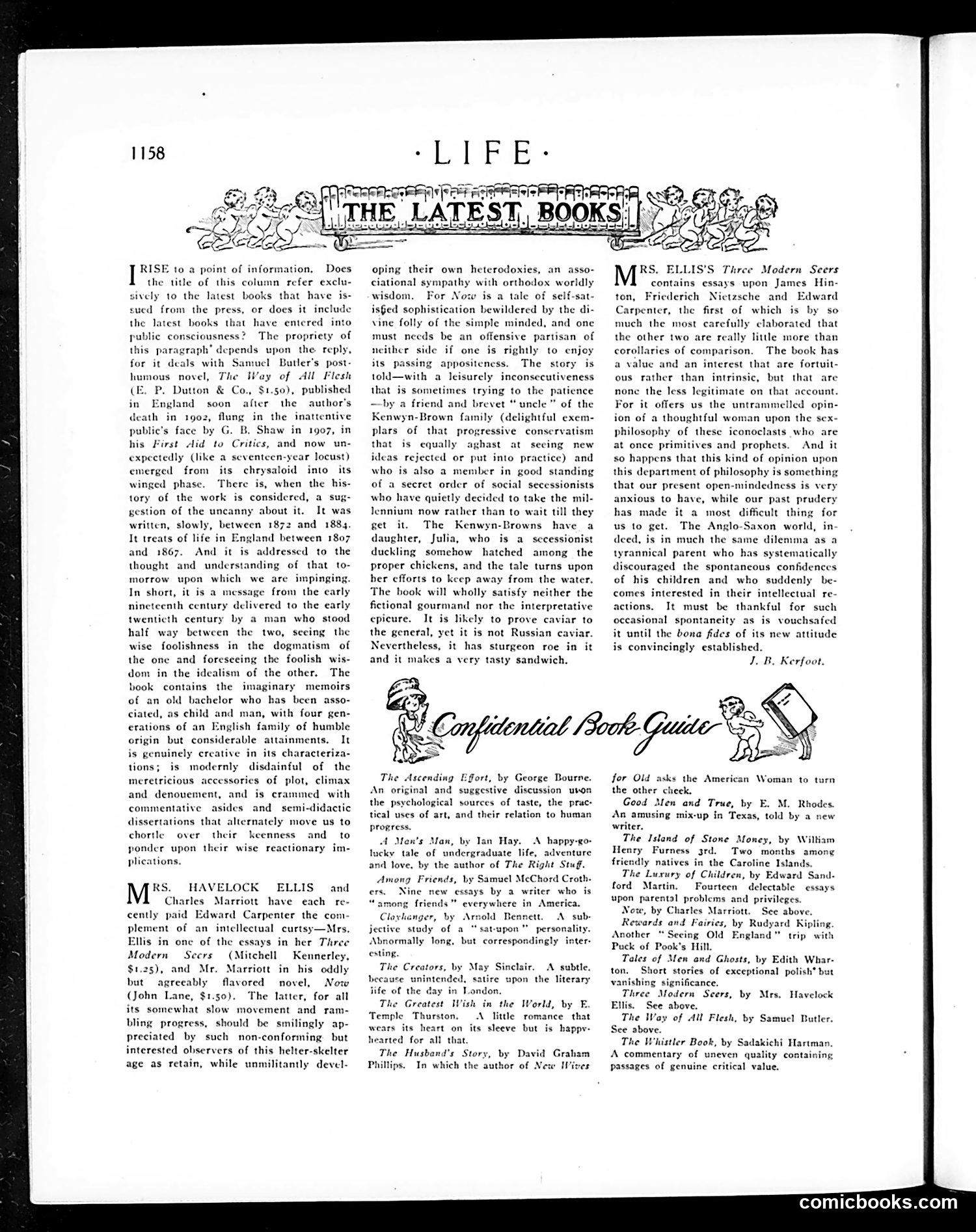
This is a book review column from Life magazine discussing recently published novels. The page contains no political cartoons or caricatures—it is primarily literary criticism. The column opens with philosophical debate about whether "latest books" refers only to newly published works or includes older books recently entering public consciousness. It then reviews Samuel Butler's *The Way of All Flesh* (published posthumously in 1907), describing it as addressing timeless questions about family, religion, and social convention across generations. Additional reviews discuss works by Havelock Ellis, Charles Marriott, and others. A secondary section, "Confidential Book Guide," lists other recent publications with brief descriptions. The page is essentially a serious literary review section with no satirical or humorous cartoon content—just substantive book criticism typical of Life's intellectual content from this era.
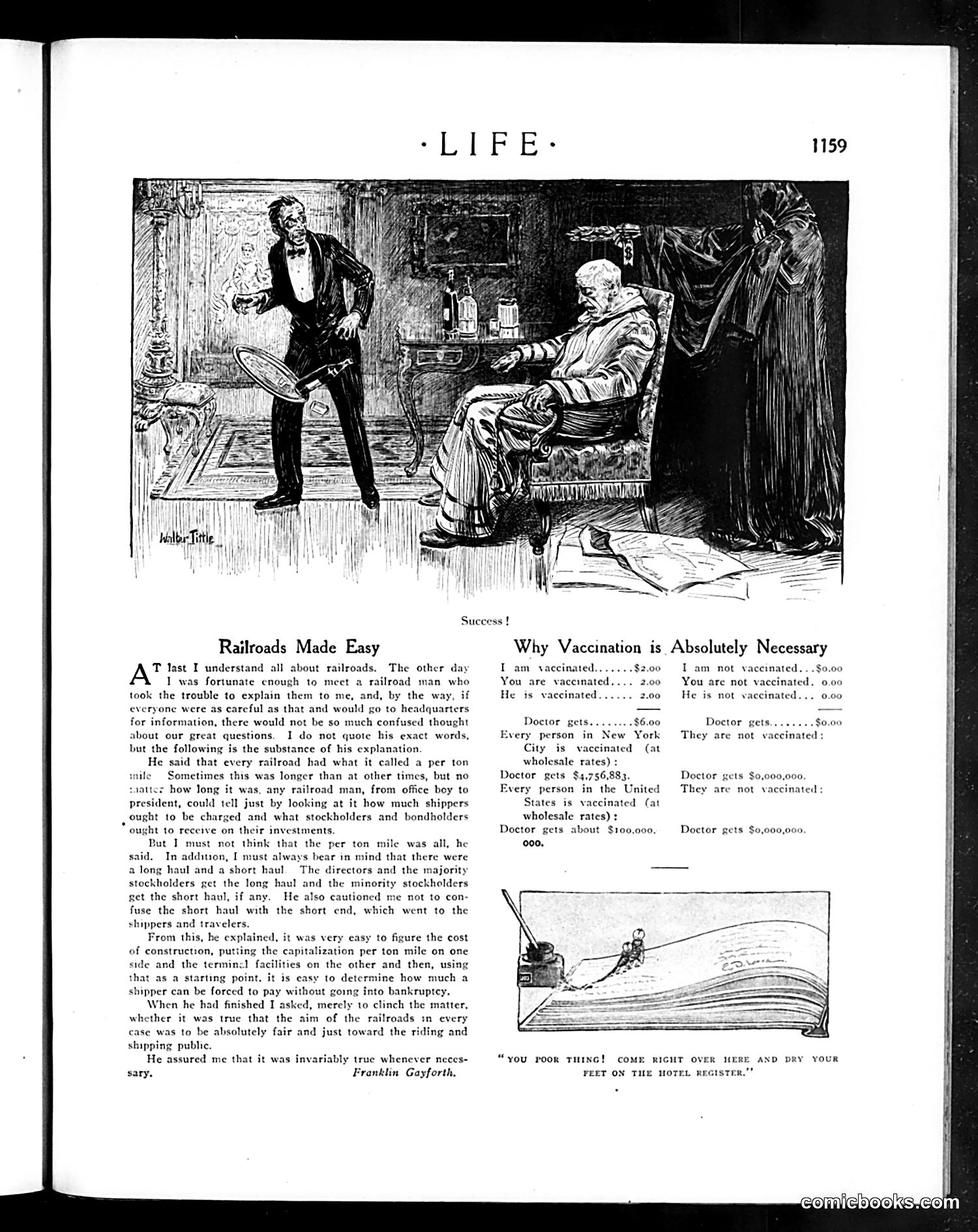
This page contains two satirical pieces mocking American institutions: **"Railroads Made Easy"** ridicules railroad pricing practices through a fictional explanation. The unnamed "railroad man" describes deliberately opaque systems—the "per ton mile" calculation and "long haul/short haul" distinction—that allow railroads to charge shippers whatever they want while enriching directors and majority stockholders at the expense of minority shareholders and the traveling public. The satire's point: railroad pricing is deliberately confusing and designed to benefit insiders, not serve the public fairly. **"Why Vaccination is Absolutely Necessary"** uses darkly comic math to suggest doctors profit enormously from mass vaccination campaigns. The joke implies doctors benefit financially from public health initiatives, questioning their motives—a common early-20th-century skepticism about medical professionalization. The bottom cartoon shows a drenched traveler at a hotel desk, likely mocking poor hospitality or service.
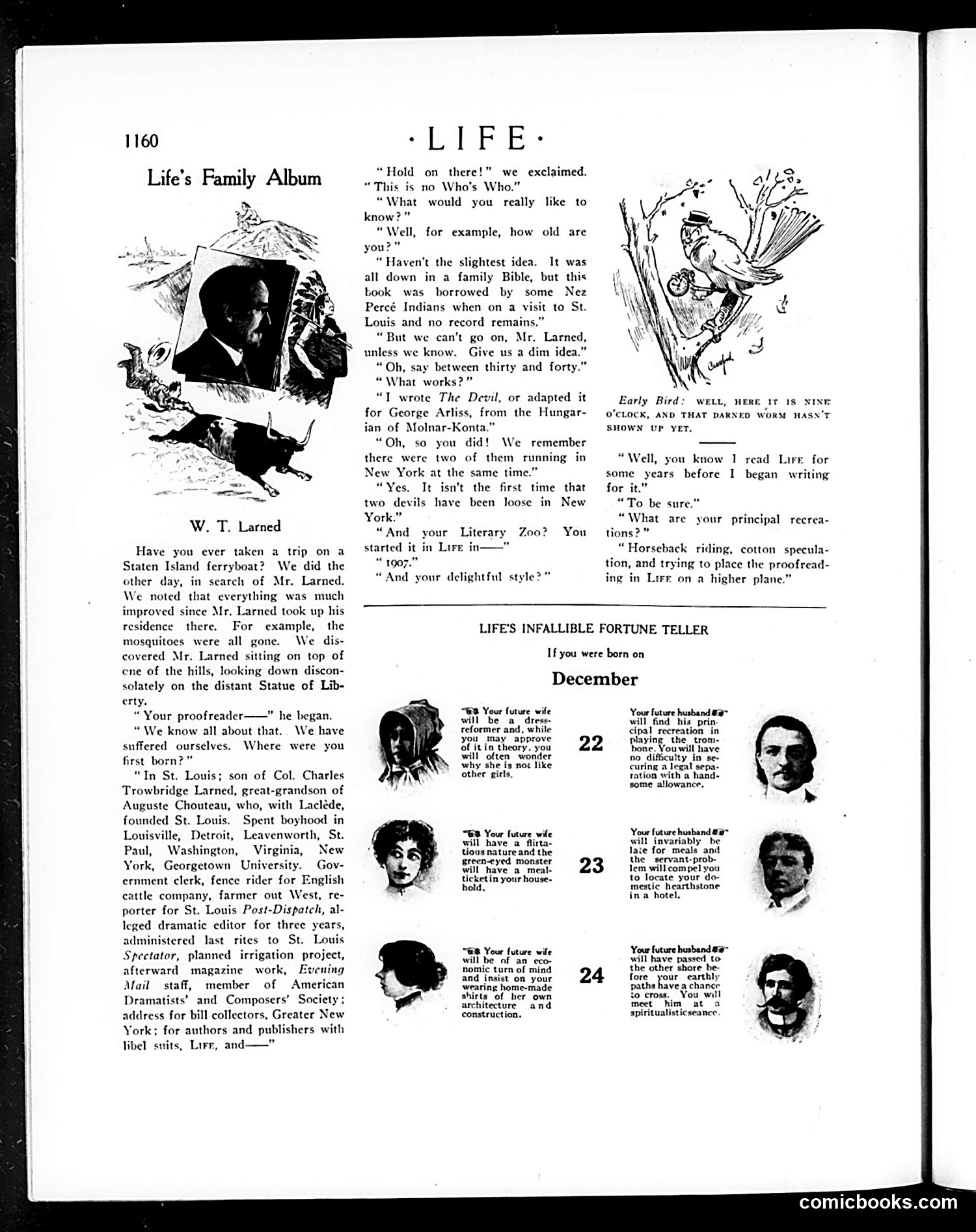
This page features W.T. Larned, a dramatist and writer for *Life* magazine, in a humorous biographical interview. The humor derives from Larned's deliberately vague or absurd answers to straightforward questions—he can't recall his age (says "between thirty and forty"), has lost his birth record to Nez Percé Indians, and claims his recreational activities include "trying to place the proofreading in *Life* on a higher plane" (a self-deprecating joke about the magazine). The page also includes "Life's Infallible Fortune Teller," a satirical fortune-telling section predicting husbands and wives for December-born readers. These are tongue-in-cheek predictions: wives will be dress reformers, flirtatious, or economical; husbands will play trombone, be perpetually late, or be dead. The satire mocks both popular fortune-telling and marital stereotypes of the era. The illustrations throughout are period-typical decorative sketches accompanying the text.
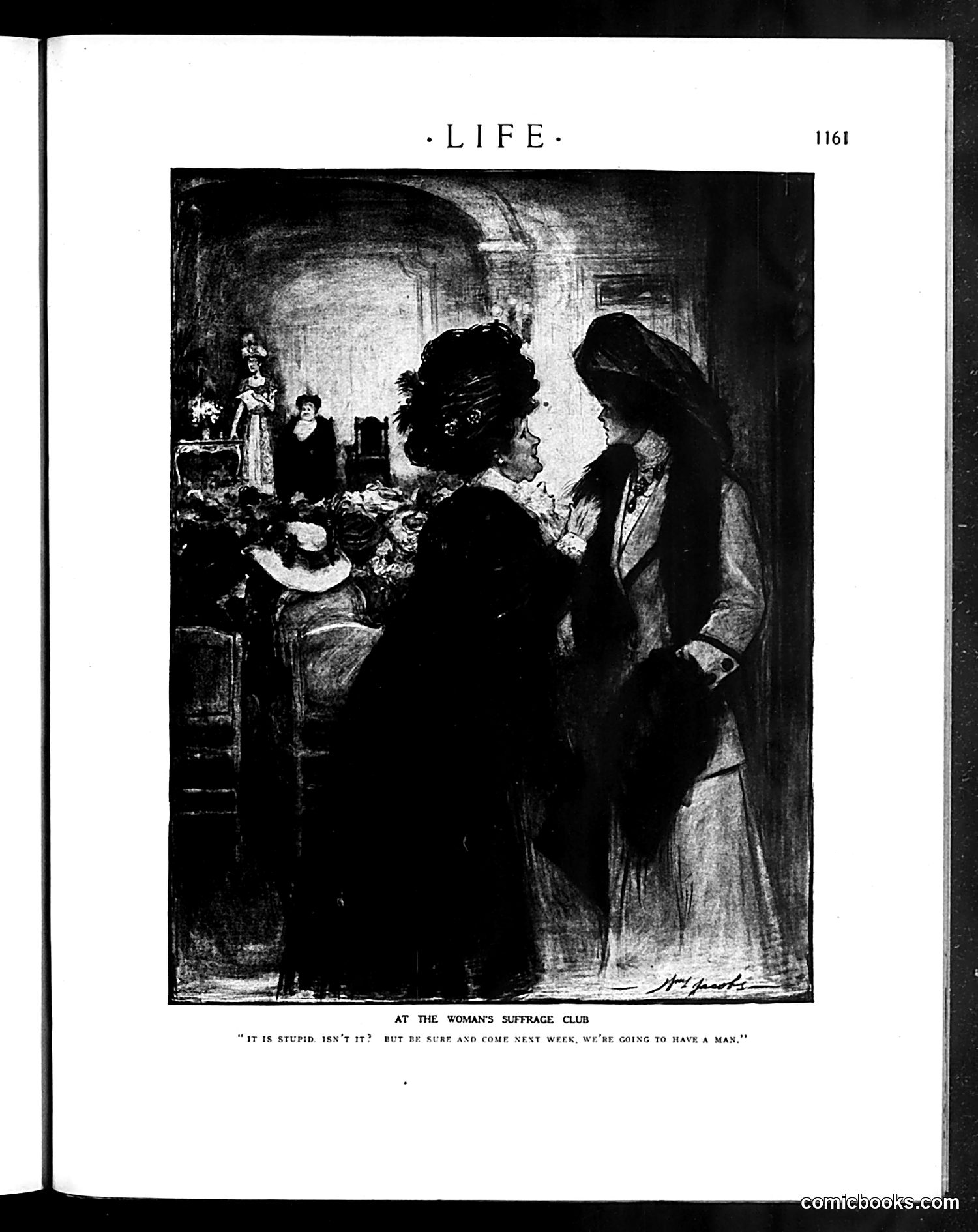
This is a satirical cartoon about the women's suffrage movement. The scene depicts women at a suffrage club meeting, with the caption showing one woman dismissing the current gathering as "stupid," while urging others to return next week because they'll have "a man" present. The joke mocks both the suffrage movement and early 20th-century gender attitudes. It suggests that women found their own political activism boring or ineffectual—and that the real draw would be male attendance or approval. The satire cuts two ways: it ridicules women's supposed lack of interest in serious political matters, while simultaneously mocking the idea that a man's presence would legitimize their cause. This reflects the anti-suffrage sentiment common in Life magazine during the women's voting rights campaigns.
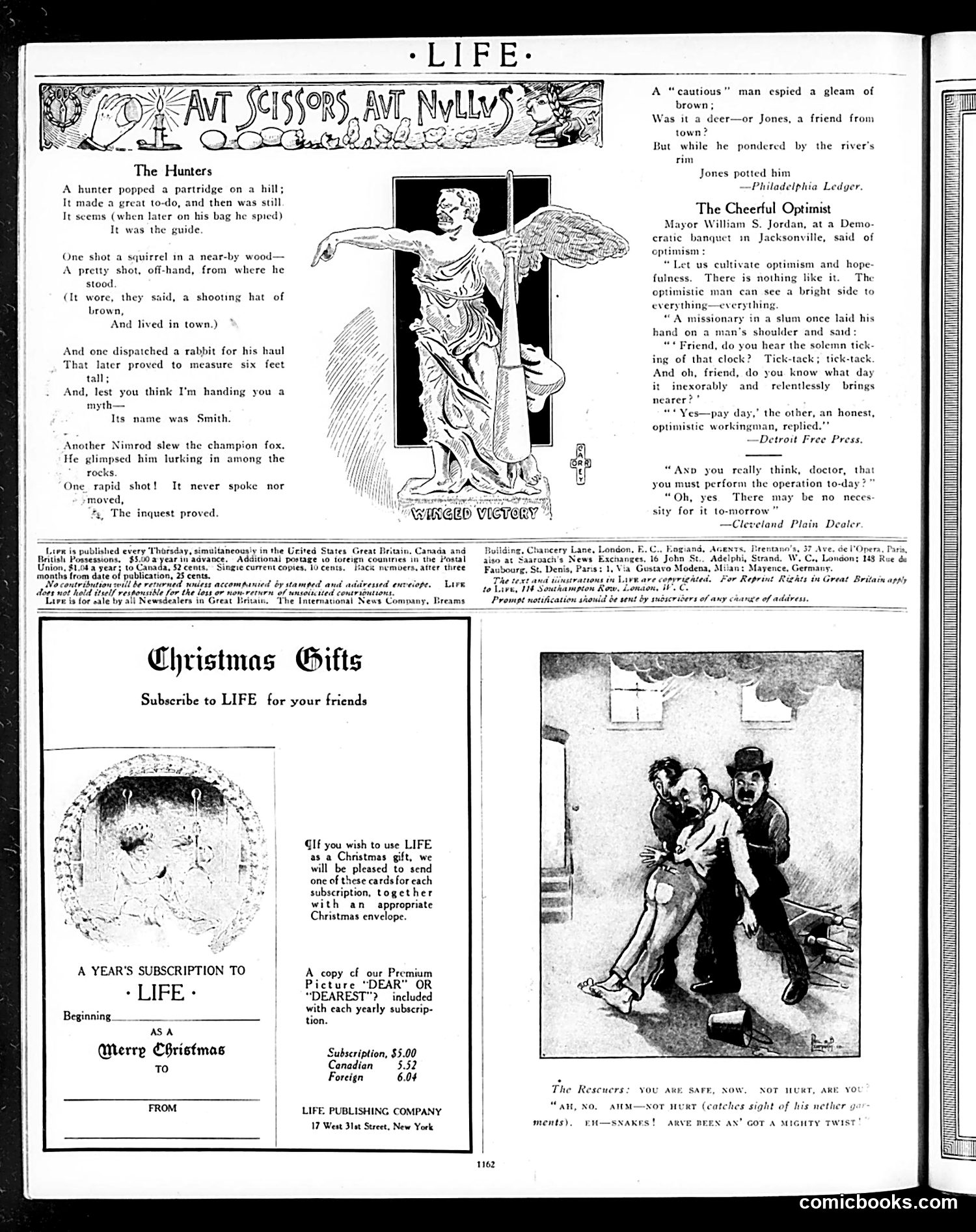
This page contains three humorous pieces satirizing incompetence and poor judgment: **"The Hunters"** mocks careless sportsmen whose terrible aim or judgment leads to absurd outcomes. They shoot a guide thinking he's game, mistake a town-dwelling rabbit for wild game (it's actually a man named Smith, six feet tall), and kill a fox without even seeing it properly. The satire targets wealthy hunters as bumbling, dangerous, and oblivious. **"The Cheerful Optimist"** quotes Mayor William S. Jordan and includes anecdotes about misplaced optimism—a missionary's moral lesson about time gets reframed as "payday," and a doctor assures surgery is necessary "today" because tomorrow might not require it. This ridicules naive or self-serving optimism. **"The Rescuers"** (photograph right) shows two men helping an apparently distressed woman, with her exclaiming about snakes. The humor derives from her concern about the "mighty twist"—likely a sexual double entendre about the rescuers' intentions. The page also advertises Life subscriptions as Christmas gifts, a common early 20th-century magazine practice.
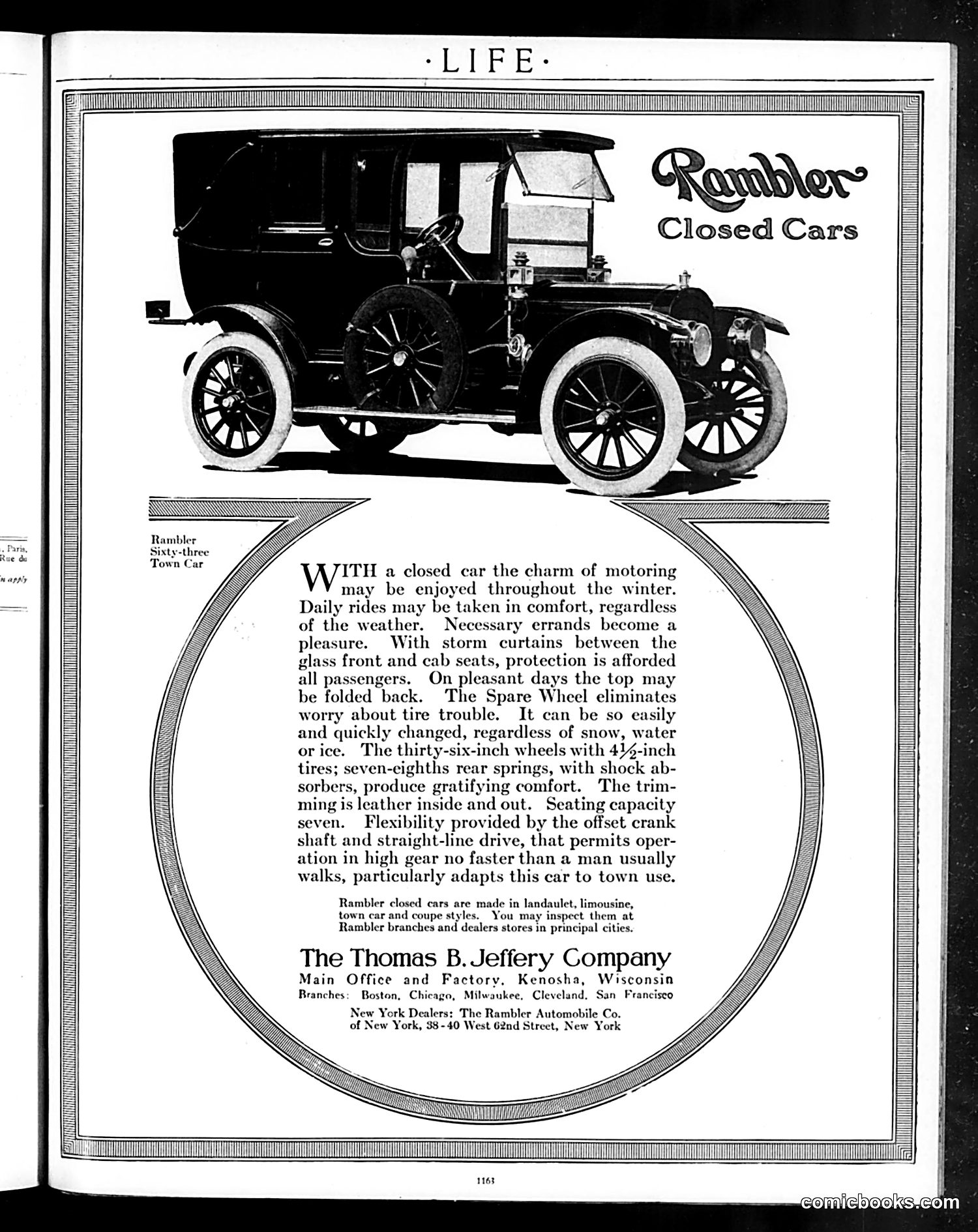
This is **not a cartoon or satire**—it's a straightforward automobile advertisement for the Rambler closed car, manufactured by the Thomas B. Jeffery Company. The page appears in *Life* magazine but functions as paid advertising rather than editorial content. It promotes the Rambler's practical features for winter driving: weather protection via storm curtains, a folding top for pleasant days, a spare wheel for tire emergencies, comfortable suspension, and a low top speed ("no faster than a man usually walks") suited to town driving. The emphasis on comfort, reliability, and year-round usability reflects early 1910s automotive marketing—when closed cars were still relatively novel and winter motoring a significant selling point. The detailed specifications (36-inch wheels, leather trimming, seven-passenger capacity) address buyer concerns about durability and practicality typical of that era. There is no political satire or hidden meaning present.
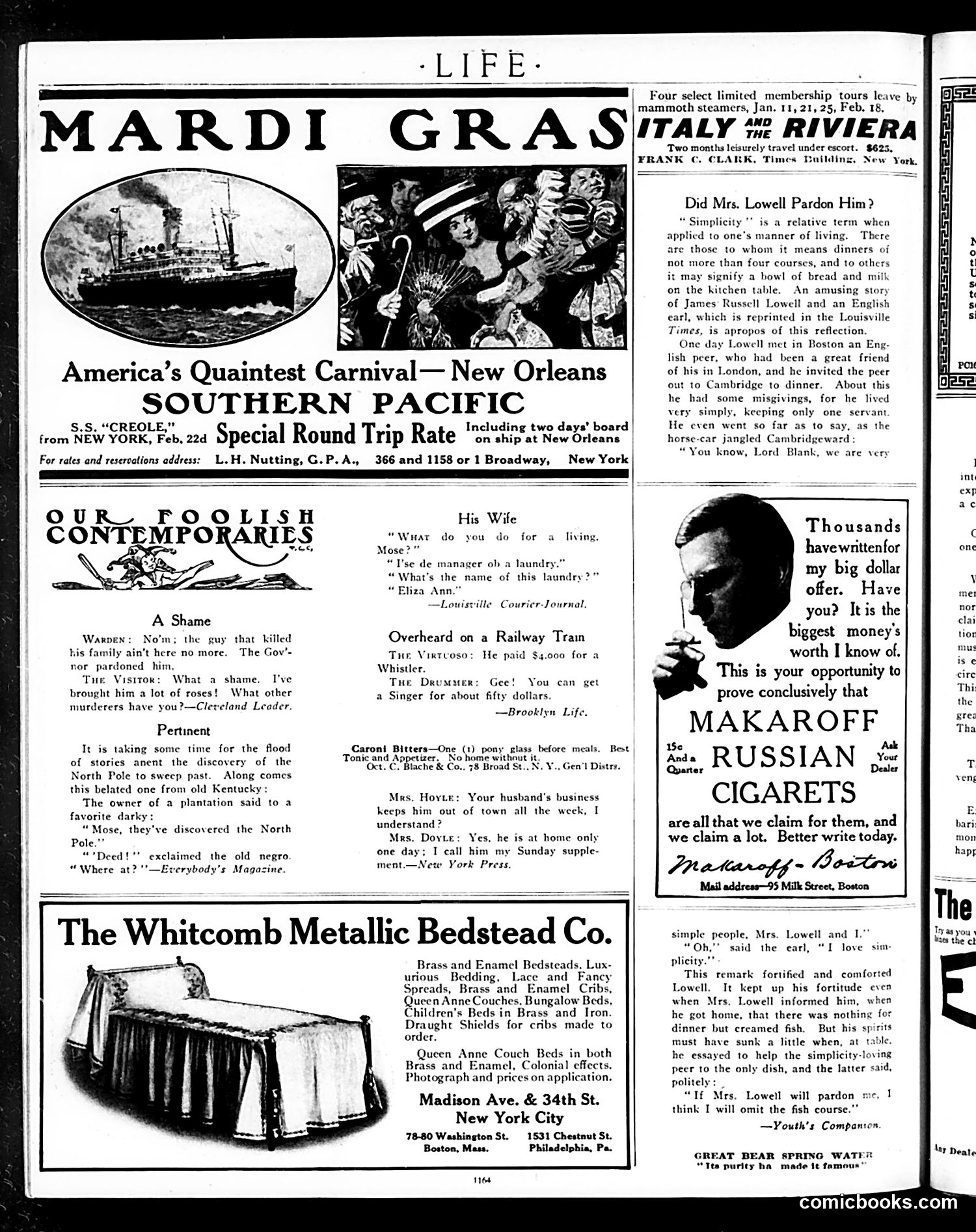
This page is primarily **advertisements and humor pieces**, not political cartooning. The content reflects early 1900s American attitudes: **Main content:** A humorous anecdote about poet James Russell Lowell entertaining an English peer. Lowell worried his simple living (one servant, minimal dinners) would embarrass him, but the peer claimed to love simplicity. The joke's punchline is cut off, but the setup mocks both American anxiety about appearing unsophisticated to European aristocracy and false claims of modesty. **Surrounding humor:** Brief jokes about racism ("darky" dialect humor discovering the North Pole), gender roles (wife called husband's day off her "Sunday supplement"), and class differences (confusion between a Whistler painting and Singer sewing machine). **Ads:** Travel promotions, Russian cigarettes, and a bedstead company dominate the page. The racial stereotypes and gender assumptions reflect period conventions now considered offensive.
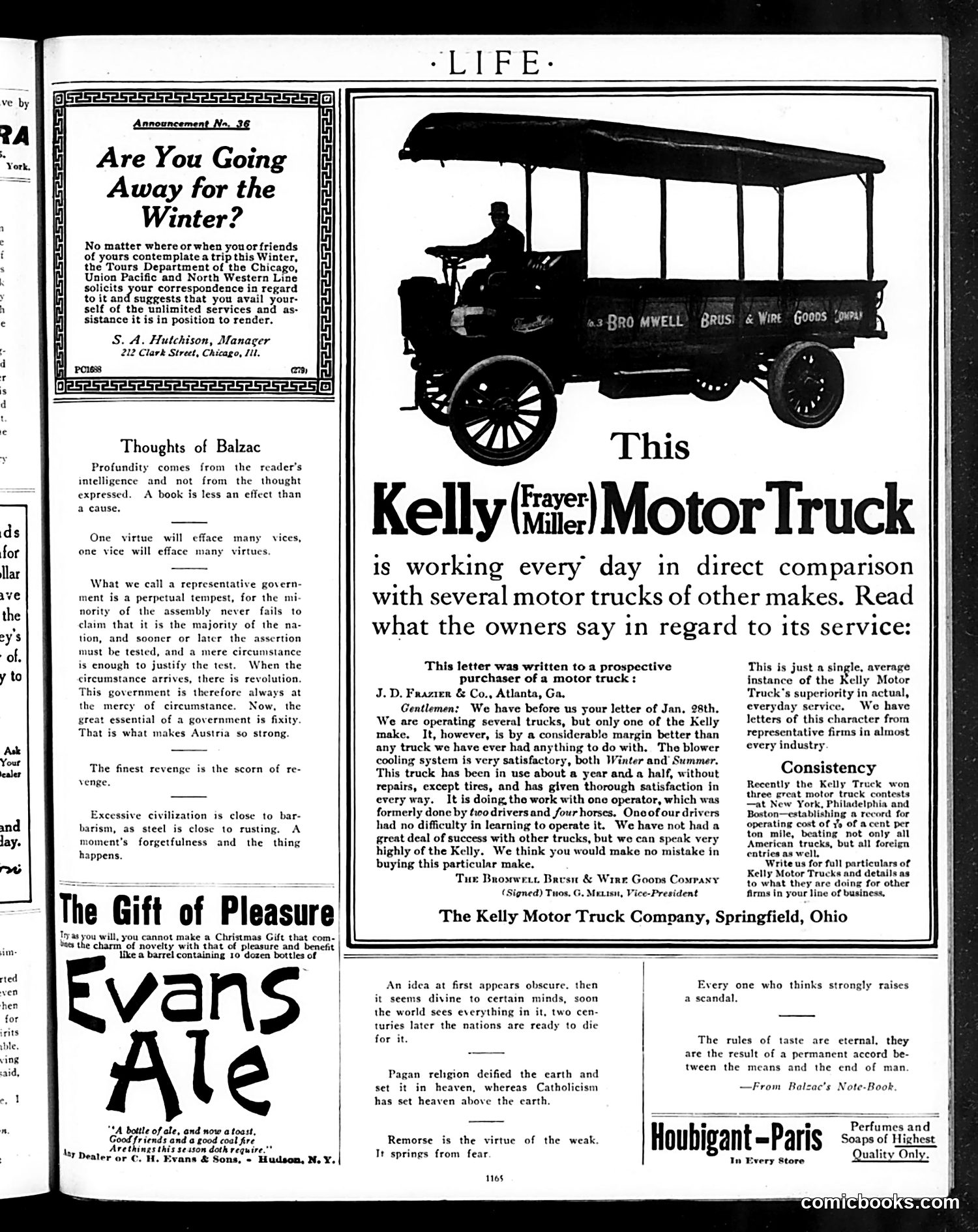
This page is primarily **advertising and philosophical content**, not political satire. The dominant feature is a **Kelly Motor Truck advertisement** showcasing an early commercial vehicle. The ad presents testimonial evidence from actual business users (J.D. Frazier & Co., Atlanta) praising the truck's reliability, efficiency, and low operating costs compared to competitors. It emphasizes practical superiority: the Kelly truck allegedly performs work previously requiring multiple horses and drivers, with minimal repairs. The left column contains **"Thoughts of Balzac,"** philosophical quotations about virtue, government, and civilization—unrelated to the truck advertisement. Additional small ads appear for Evans Ale and Houbigant-Paris perfumes. There is **no political cartoon or satire** on this page. It represents straightforward early-20th-century industrial advertising aimed at business owners considering motorized transport, combined with literary filler typical of Life magazine's mixed content format.
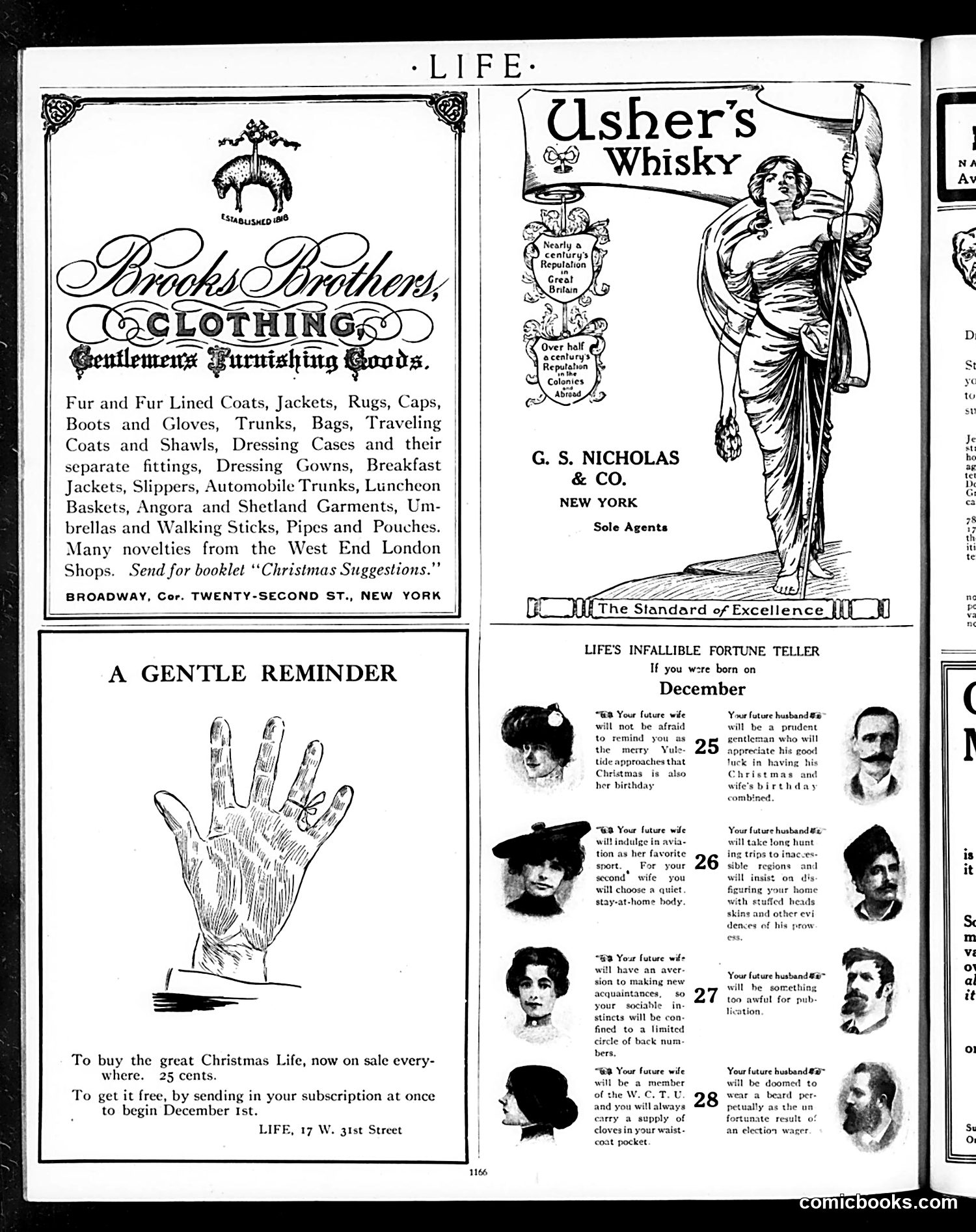
This page is primarily **advertisements and a humor column**, not a political cartoon. The main content is "Life's Infallible Fortune Teller"—a joke feature predicting the romantic futures of people born in December. It's satirical domestic humor typical of early 20th-century magazines, playing on contemporary anxieties about marriage and gender roles. The predictions humorously mock both men and women: wives who'll nag about Christmas birthdays, take up aviation, join the Women's Christian Temperance Union (W.C.T.U.—a real prohibitionist organization), and husbands who'll be henpecked or forced to wear beards as election bets. The page also features ads for Brooks Brothers clothing and Usher's Whisky, positioned with classical allegorical imagery typical of luxury brand marketing of the era. There's no identifiable political figure or specific historical event referenced—it's generic domestic satire aimed at Life's middle-class readership.
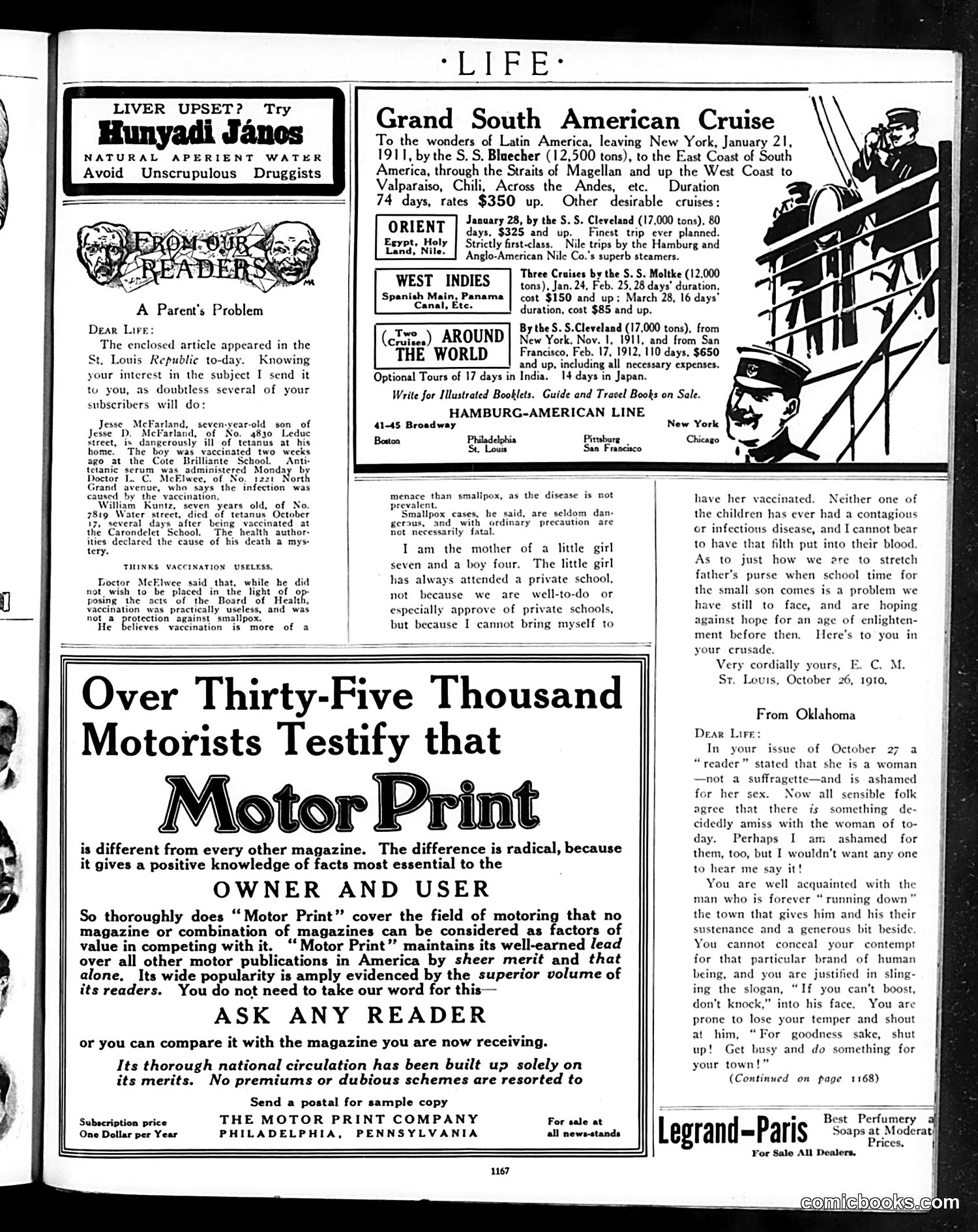
This page is primarily **advertising and reader letters**, not political satire. The main content includes: **Letters section ("From Our Readers"):** A St. Louis mother expresses anti-vaccination sentiment, citing cases of children who died from tetanus following school vaccinations. She refuses to vaccinate her own children, preferring private school to avoid mandatory vaccination policies. A second letter from Oklahoma criticizes suffragettes. **Advertisements:** The page features cruise line promotions (Grand South American Cruise, Hamburg-American Line) and a major ad for *Motor Print* magazine, claiming superiority through reader testimonials. **Context:** This 1910-1911 era page reflects genuine public vaccine hesitancy—not modern anti-vax conspiracy, but real concerns about early vaccination safety standards and medical autonomy. The vaccination debate was legitimate then, predating modern public health consensus. The page lacks cartoons or pointed satire; it's a typical magazine layout mixing reader correspondence with commercial promotions.
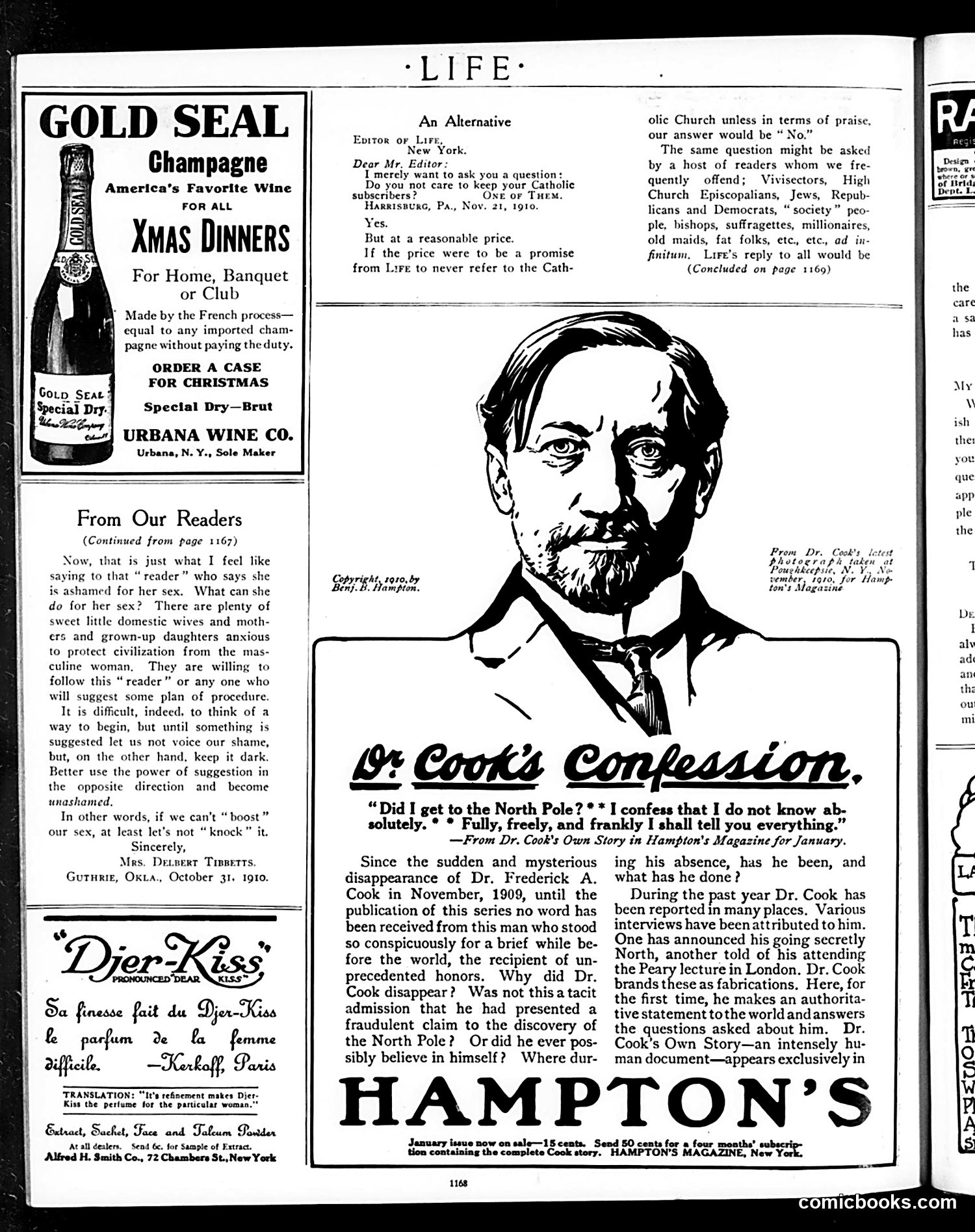
This page features advertising and reader letters, but centers on a major scandal: **Dr. Frederick Cook's disputed claim to reaching the North Pole**. Cook vanished in November 1909 after claiming discovery of the North Pole—a claim contested by rival explorer Robert Peary. The portrait shows Cook; Hampton's Magazine is promoting his exclusive confession story ("Did I get to the North Pole? I confess that I do not know absolutely"). The satire is implicit: Cook's evasive admission—that he cannot definitively confirm reaching the Pole despite his celebrated claim—exposes him as either a fraud or a charlatan who never truly believed his own story. His mysterious disappearance and subsequent silence fueled public suspicion that he fabricated the achievement for fame and honors. This was a genuine 1909-1910 sensation; both Cook and Peary claimed the Pole, but Peary's account prevailed historically. Hampton's capitalized on public fascination with Cook's belated, non-committal "confession."
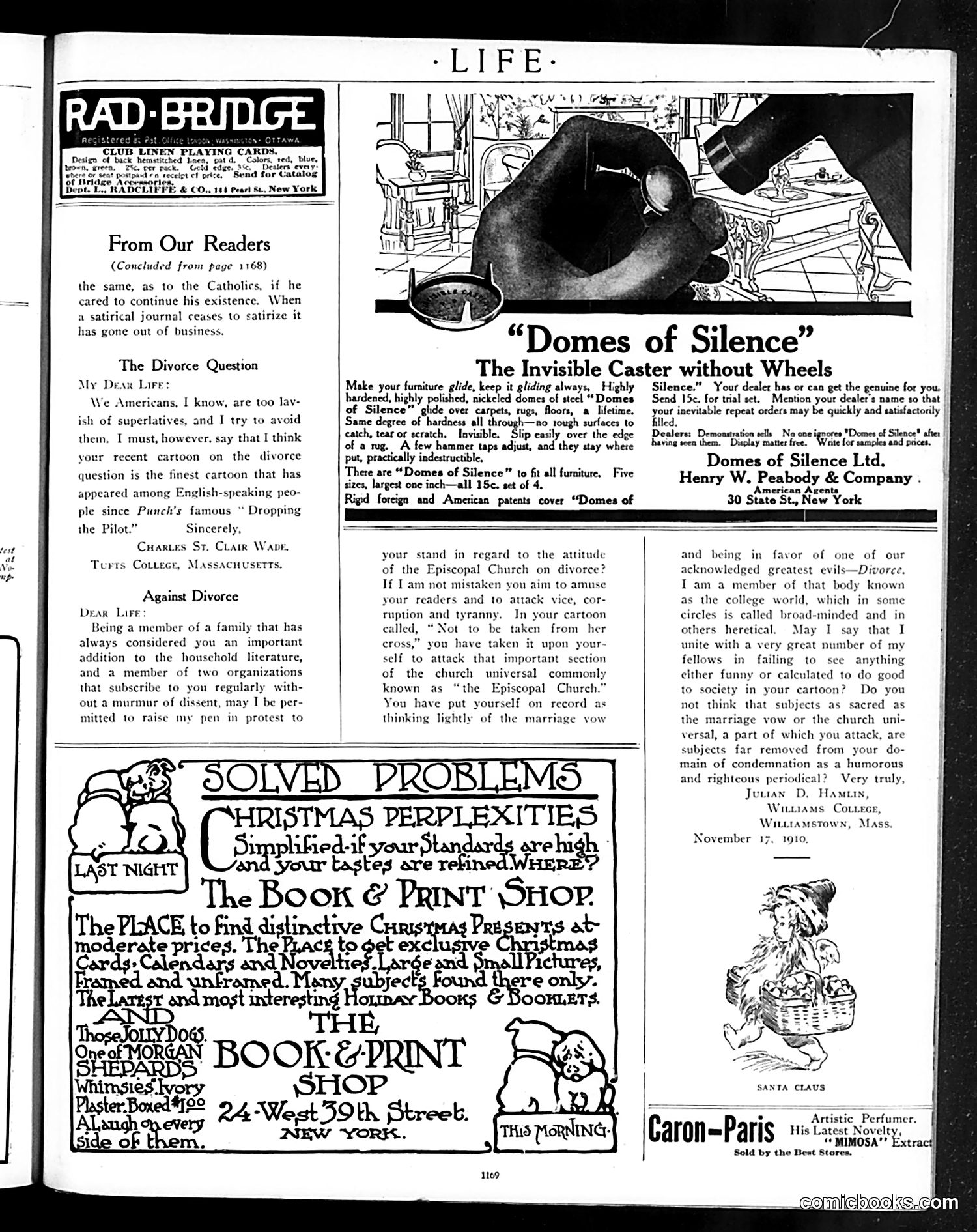
This page contains reader letters debating **Life's editorial stance on divorce**, which was a major social and religious controversy in 1910s America. Two readers clash: one praises Life's divorce cartoon as the finest satire since Punch's famous "Dropping the Pilot"; another protests that Life—a publication he respects—has attacked the sacred institution of marriage by mocking divorce as humorous. The second writer, from Williams College, argues that such sacred subjects should be beneath Life's satirical domain. The letters reveal that Life had recently published a cartoon titled "Not to be taken from her cross" criticizing the Episcopal Church's stance on divorce. This was evidently controversial: defenders saw it as legitimate social critique; opponents felt it profaned religious matters. The page also contains period advertisements (playing cards, furniture casters, a print shop, perfume) typical of early-20th-century magazines.
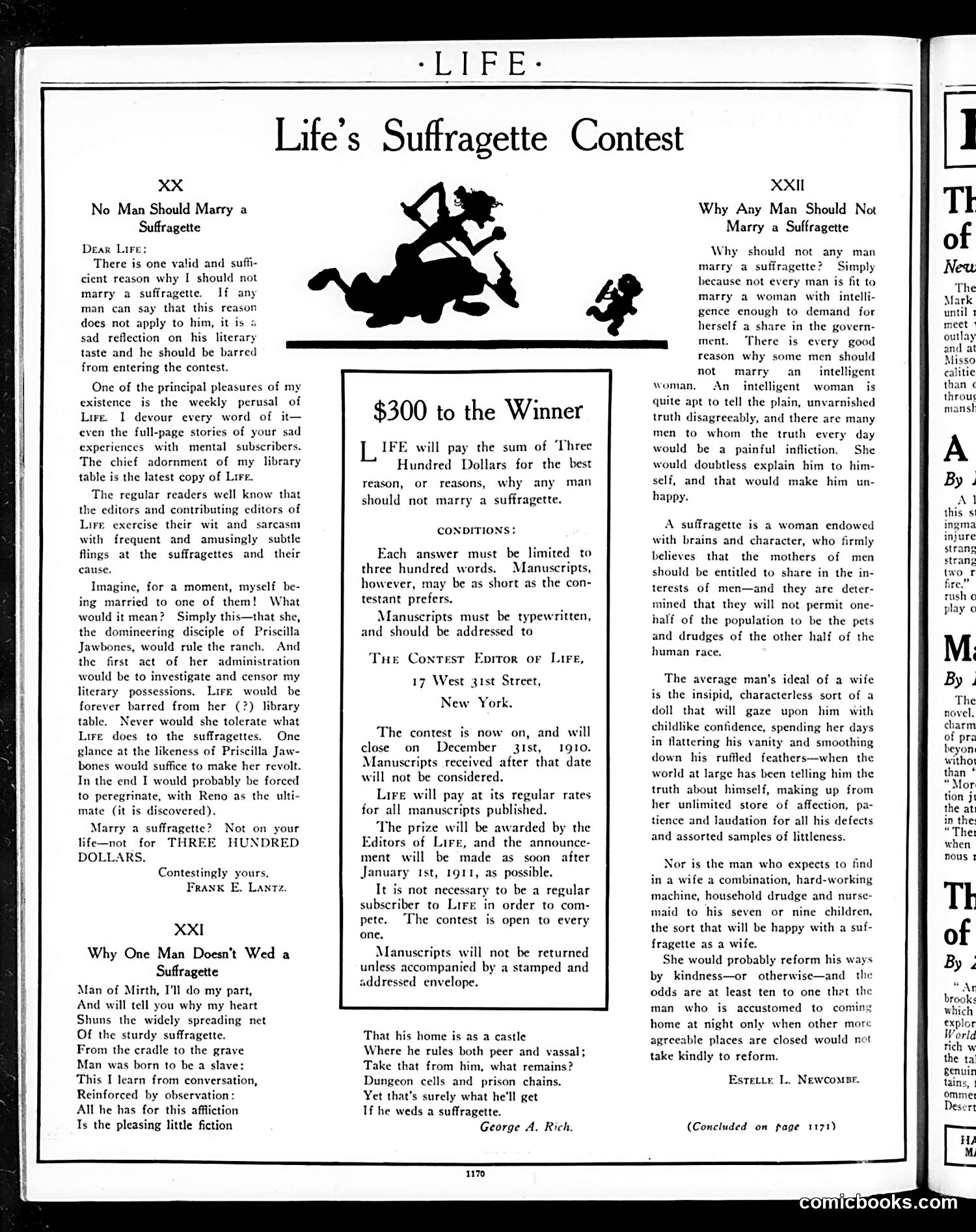
This 1910 *Life* magazine page satirizes anti-suffragette sentiment through a contest offering $300 for the best argument against marrying a suffragette. The cartoon at top shows a woman (representing a suffragette) physically overpowering a man, illustrating the central satirical premise: men's fear that suffragettes would dominate marriages. The three submitted entries mock common male anxieties about women's rights activists: 1. **Frank E. Lantz** fears a suffragette wife would censor his *Life* magazines and "rule the ranch" 2. **George A. Rich** claims men are "born to be slaves" and marriage to a suffragette would worsen this condition 3. An unnamed third entry sarcastically argues that intelligent women who demand political equality are unfit wives because they'd speak uncomfortable truths *Life's* editors use humor to expose the absurdity of these objections—essentially ridiculing men who oppose women's suffrage by letting them voice their most petty, self-serving fears.
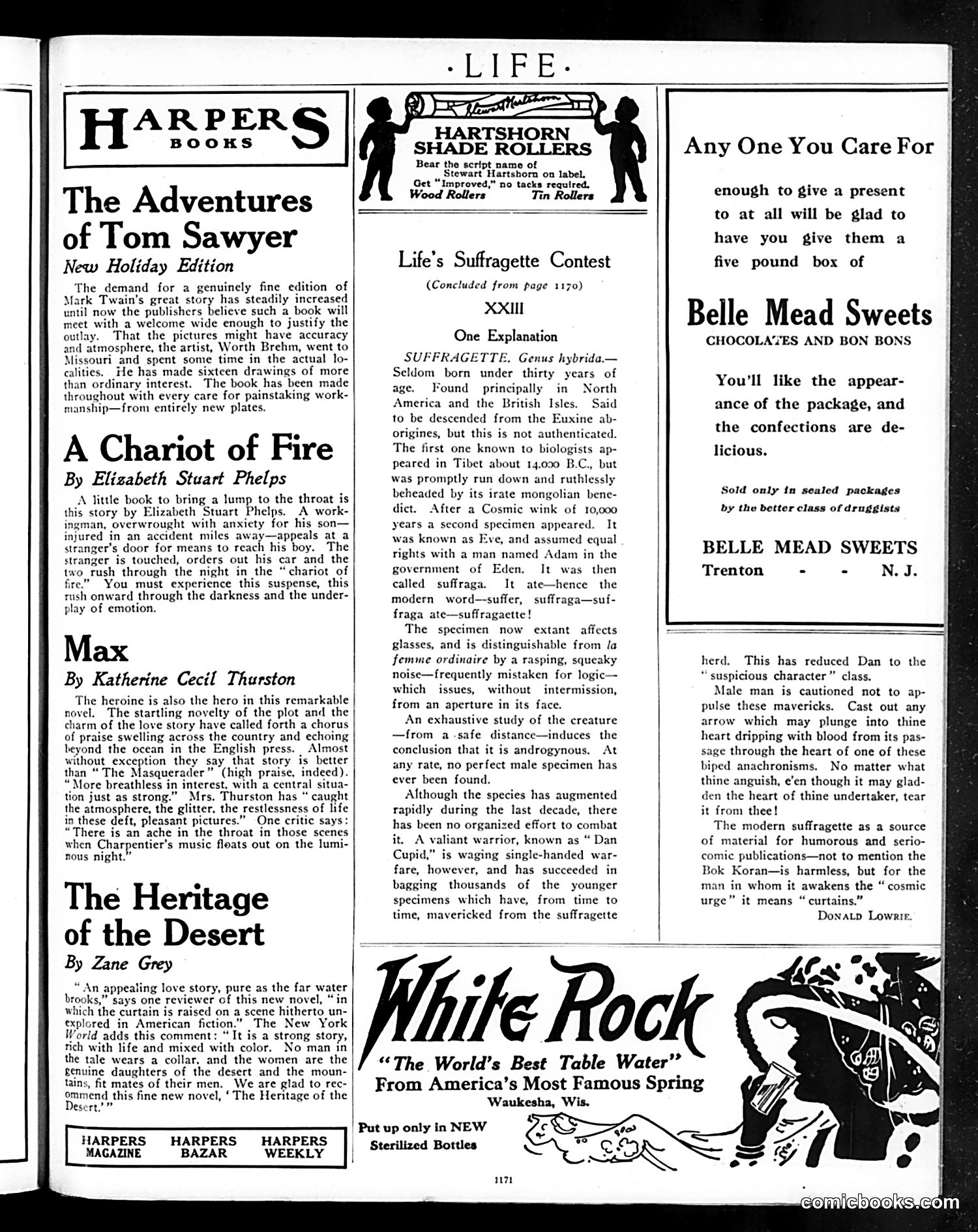
This page features a mock-scientific "explanation" of the suffragette—a woman advocating for voting rights. The piece uses faux-taxonomic language to ridicule suffragists as a strange, barely-human "species." The satire employs several dehumanizing tactics: suffragettes are described as physically peculiar (wearing glasses, making "rasping, squeaky" noises mistaken for logic), evolutionarily suspect (possibly descended from prehistoric beings), and fundamentally "androgynous"—implying they're not properly feminine. The crude etymology joke ("suffraga ate = suffragette") mocks their intellect. The reference to Eve claiming "equal rights" with Adam in Eden frames women's equality as against natural order. The overall tone treats women's political demands as comical aberrations rather than legitimate aspirations. This reflects pre-suffrage American attitudes when women's voting rights remained controversial, particularly in magazines like *Life* that catered to conservative audiences.
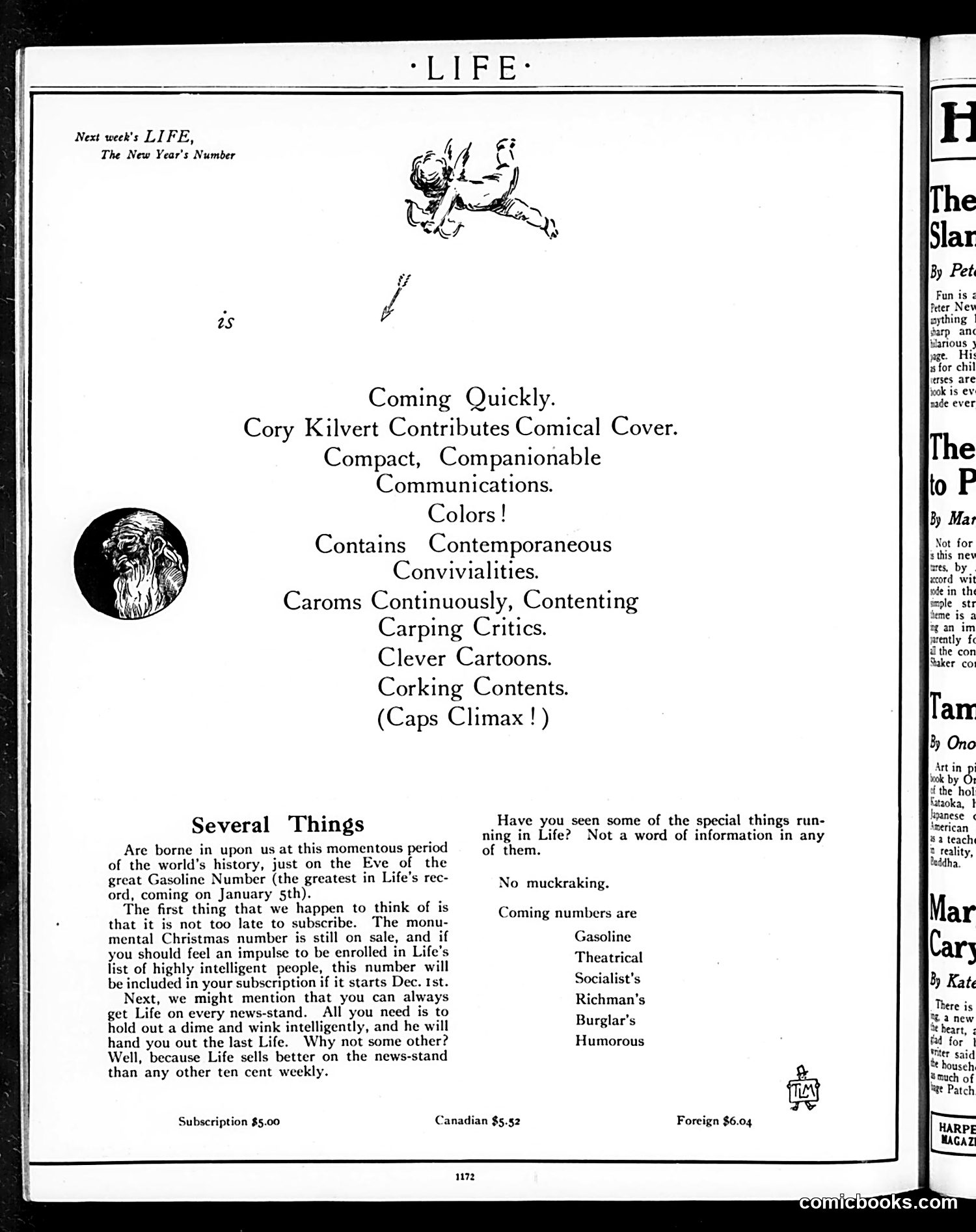
This is primarily a **subscription advertisement and promotional page** for *Life* magazine's upcoming New Year's issue, rather than a political cartoon. The page announces the next week's edition will feature cover art by Cory Kilvert and promises content including a "Gasoline Number" (apparently a special issue on automobiles—a contemporary topic of interest). The alliterative description ("Compact, Companionable Communications...Clever Cartoons...Corking Contents") is playful copy designed to attract readers. The small Cupid-like figure at top and bearded face illustration are generic decorative elements. The text humorously pitches subscription value: *Life* sells better than competitors because it's superior content, costs only ten cents, and can be found on every newsstand. It encourages readers to subscribe before December 1st to include the Christmas number. The listed upcoming special numbers (Gasoline, Theatrical, Socialist's, Richman's, Burglar's, Humorous) suggest *Life*'s editorial focus on contemporary American life and social commentary.
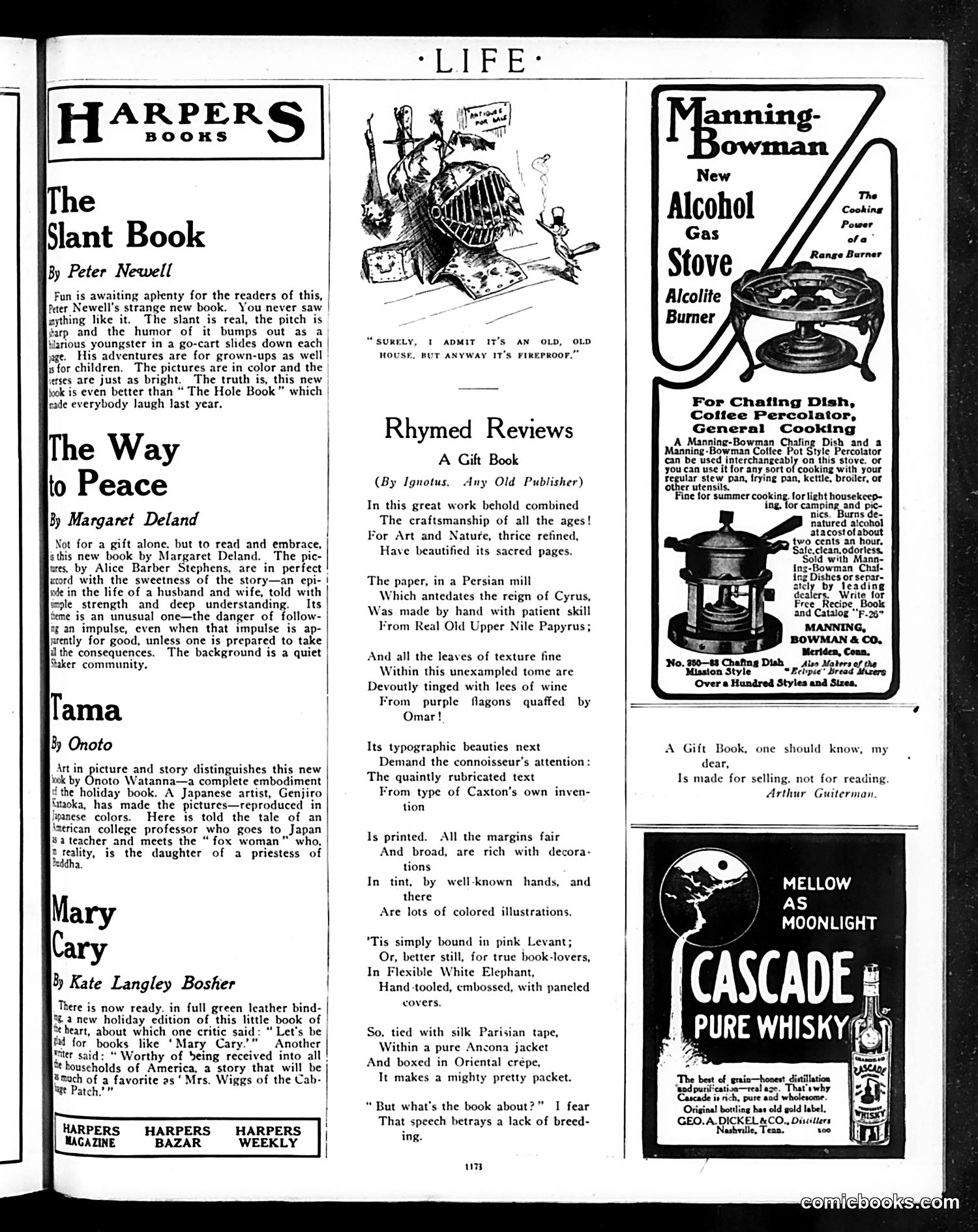
This page is primarily **book advertisements and reviews**, not political satire. The central content is a humorous poem titled "Rhymed Reviews" that mocks pretentious gift books. The satire targets the snobbish publishing industry: the poem describes an elaborate, ridiculously over-designed book with expensive materials (Persian paper, Caxton typeface, hand-tooled covers, Oriental crepe) and precious provenance (dating to ancient times, made by hand, decorated by famous artists). The punchline—"But what's the book about? I fear / That speech betrays a lack of breeding"—reveals the joke: **the book's content is irrelevant; such luxury gift books exist purely for conspicuous consumption and social status**, not actual reading. A closing quote mocks this further: "A Gift Book...is made for selling, not for reading." The surrounding ads for children's books and cooking equipment are standard commercial content.
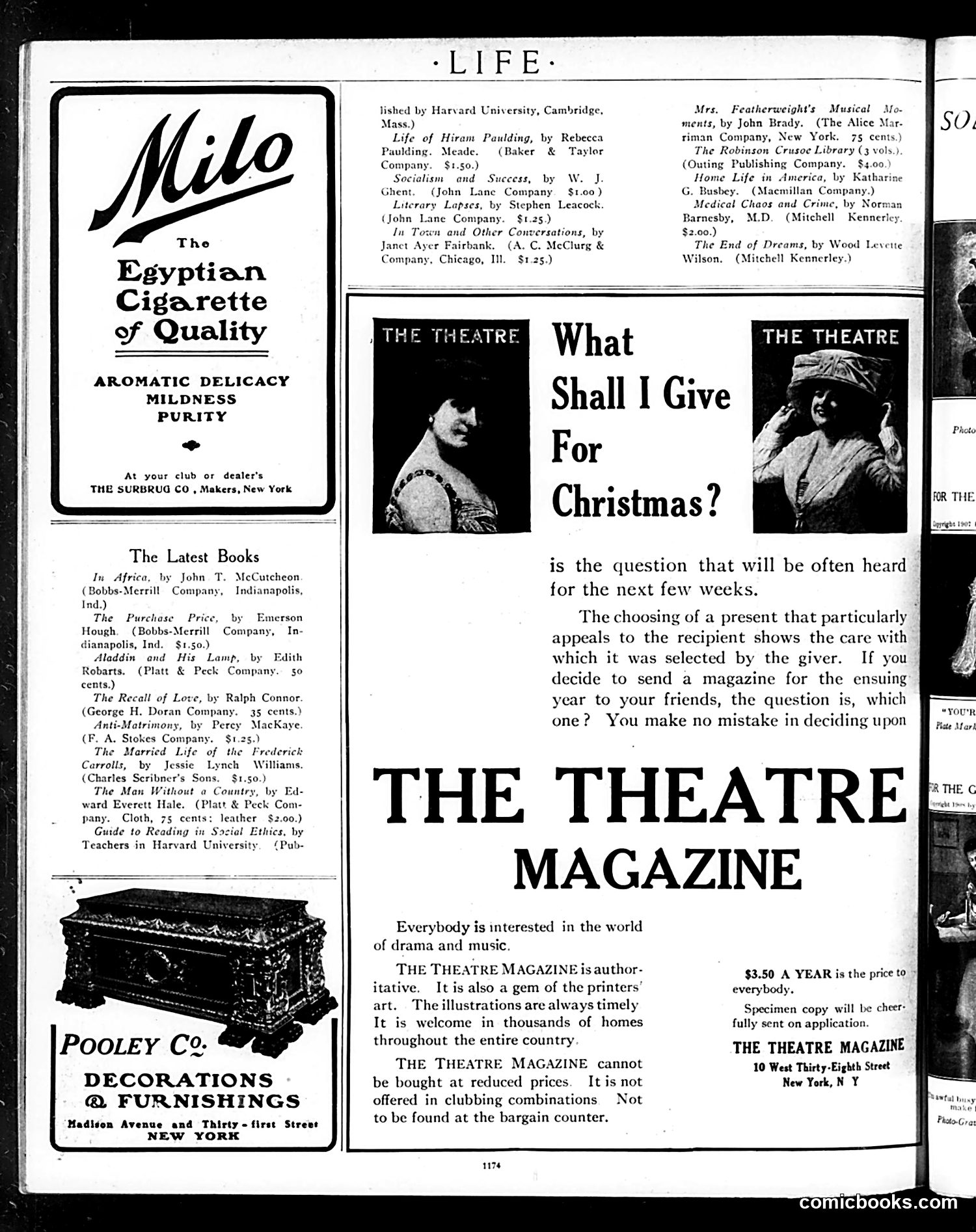
This page is primarily **advertising and book listings** from *Life* magazine, not a political cartoon. The main content consists of: 1. **Book reviews/listings** in the upper section—titles like *Life of Hiram Paulding*, *Socialism and Success*, and *Literary Lapses*—standard fare for an early 20th-century literary magazine. 2. **Product advertisements**: A Milo Egyptian Cigarette ad (emphasizing "aromatic delicacy, mildness, purity") and a Pooley Co. furniture/decorations ad. 3. **The Theatre Magazine advertisement** (center/lower), which is the largest feature. It uses two theatrical photographs flanking the headline "What Shall I Give For Christmas?" to promote *The Theatre Magazine* as a gift subscription ($3.50/year). The copy argues it's authoritative, well-illustrated, and appeals to drama enthusiasts—thus a superior Christmas present. **No satire or political commentary is present.** This is a straightforward commercial page using holiday shopping season messaging to market both books and a specialty magazine.
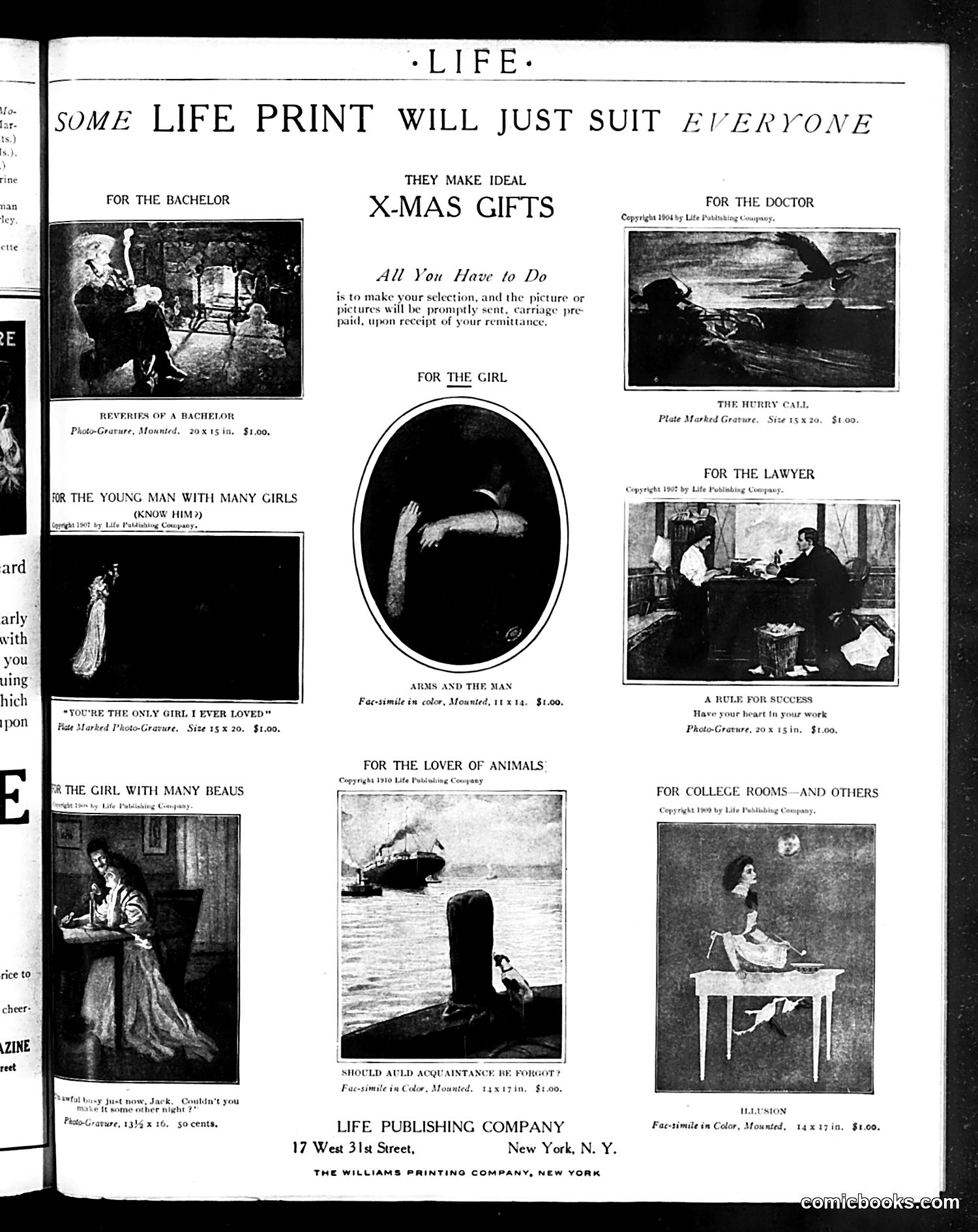
This is a 1904 advertisement for Life Publishing Company's art prints—not political satire. The page offers framed reproductions as Christmas gifts, organized by recipient type: bachelor, doctor, girl, lawyer, lover of animals, and college students. Each print title uses gentle social humor reflecting early 1900s stereotypes. "Reveries of a Bachelor" and "The Young Man with Many Girls" playfully mock romantic entanglements. "Arms and the Man" and "A Rule for Success" offer more aspirational themes. "The Girl with Many Beaus" and "You're the Only Girl I Ever Loved" use ironic titles suggesting romantic complications. The prints were photo-gravures (high-quality photographic reproductions) costing 50 cents to $1, marketed as affordable art for every social type. This reflects the era's commercial expansion of art reproduction and gift-giving culture, targeting middle-class consumers seeking tasteful, ready-made decoration for homes and offices.
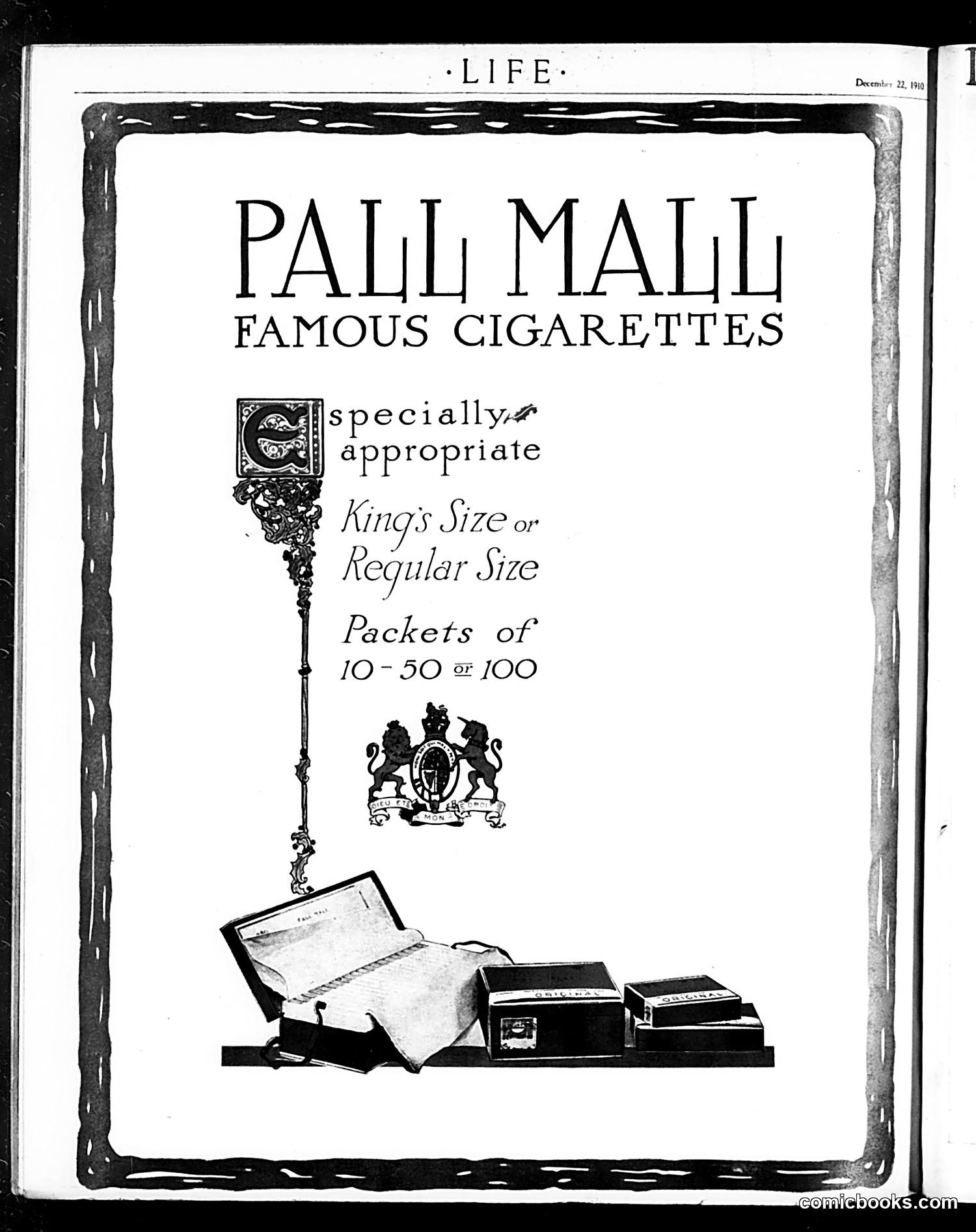
This is a straightforward cigarette advertisement from *Life* magazine (dated December 22, 1921, visible in header). It promotes Pall Mall "Famous Cigarettes" as "specially appropriate" for both Kings Size and Regular Size formats, available in packets of 10, 50, or 100. The ad features decorative heraldic imagery—including what appears to be a coat of arms with lions and a crown—suggesting prestige and sophistication. An ornate cigarette is illustrated at top, with opened cigarette packets displayed below. This is not satire or political commentary, but rather a premium cigarette brand leveraging royal symbolism and formal design to convey luxury and refinement to early 1920s consumers. The emphasis on "Kings Size" may reference the cigarette format rather than monarchy specifically.