
Life, 1910-12-22 · page 13 of 44
Life — December 22, 1910 — page 13: what you’re looking at
What you’re looking at
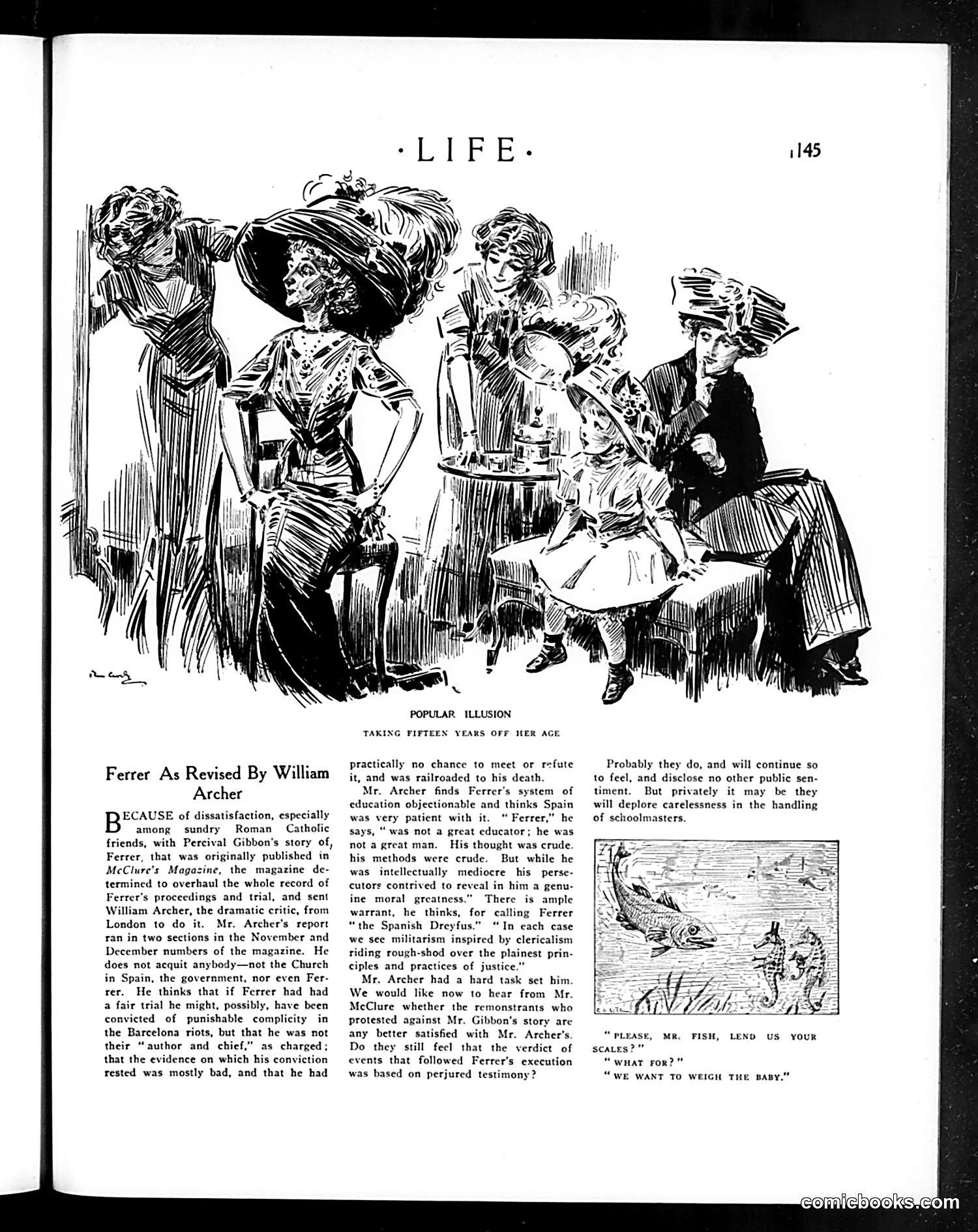
**Main Cartoon Title:** "Popular Illusion: Taking Fifteen Years Off Her Age" The top illustration depicts fashionably dressed women of the Edwardian era using exaggerated styling—large elaborate hats, corsets, and fine clothing—to appear younger than they actually are. The satire mocks the social pressure on women to conceal their age through fashion and cosmetics, suggesting that such efforts are mere "illusion." **Article:** "Ferrer As Revised By William Archer" discusses a Spanish legal case, likely referencing Francisco Ferrer, an anarchist educator executed in 1909. The article appears skeptical of revisionist accounts of the case. **Bottom Comic:** Shows a fish-weighing scene, with text "Please, Mr. Fish, lend us your scales?" / "We want to weigh the baby"—a visual pun about using fish scales instead of proper infant scales.
📄 Transcribed text from this page (OCR, searchable)
Machine-transcribed from the original scan — historical spelling and the odd misread are preserved.
Ferrer As Revised By William Archer ECAUSE of dissatisfaction, especially among sundry Roman Catholic friends, with Percival Gibbon’s story of, Ferrer, that was originally published in McClure’s Magazine, the magazine de- termined to overhaul the whole record of Ferrer’s proceedings and trial, and sent William Archer, the dramatic critic, from London to do it. Mr. Archer’s report ran in two sections in the November and December numbers of the magazine. He does not acquit anybody—not the Church in Spain, the government, nor even Fer- rer. He thinks that if Ferrer had had a fair trial he might, possibly, have been convicted of punishable complicity in the Barcelona riots, but that he was not their “author and chief,” as charged; that the evidence on which his conviction rested was mostly bad, and that he had POPULAR ILLUSION TAKING FIFTEEN YEARS OFF IER AGE practically no chance to meet or refute it, and was railroaded to his death. Mr. Archer finds Ferrer’s system of education objectionable and thinks Spain was very patient with it. “ Ferrer,” he says, “ was not a great educator; he was not a great man. His thought was crude. his methods were crude. But while he was intellectually mediocre his perse- cutors contrived to reveal in him a genu- ine moral greatness,” There is ample warrant, he thinks, for calling Ferrer “the Spanish Dreyfu “In each case we see militarism inspired by clericalism riding rough-shod over the plainest prin- ciples and practices of justice.” Mr. Archer had a hard task set him. We would like now to hear from Mr. McClure whether the remonstrants who protested against Mr. Gibbon's story are any better satisfied with Mr. Archer's. Do they still fecl that the verdict of events that followed Ferrer’s execution was based on perjured testimony? Probably they do, and will continue so to feel, and disclose no other public sen- timent. But privately it may be they will deplore carelessness in the handling of schoolmasters. MR. FISH, LEND US YOUR “wnat For?" “WE WANT TO WEIGH THE BABY.”