
Life, 1910-12-22 · page 15 of 44
Life — December 22, 1910 — page 15: what you’re looking at
What you’re looking at
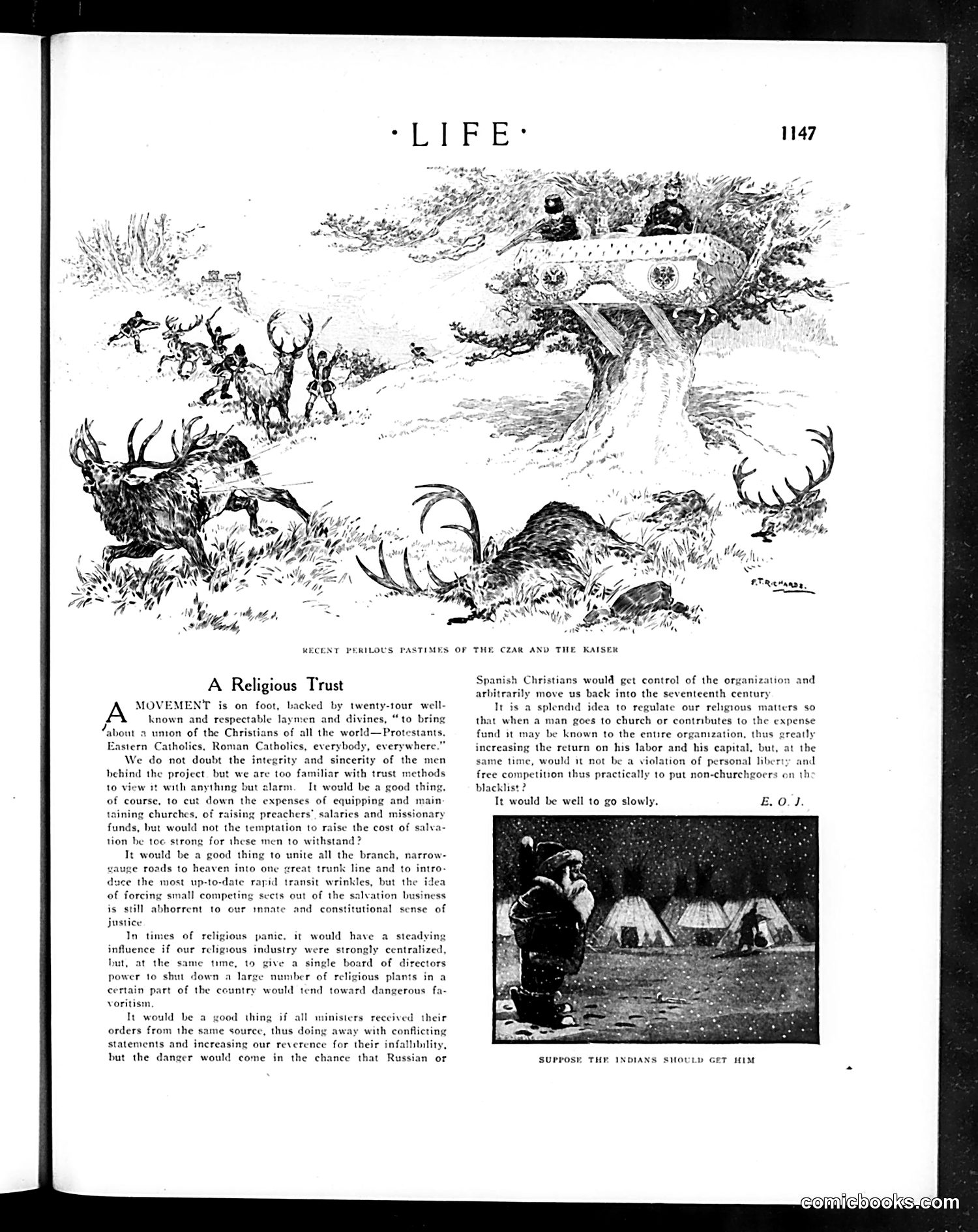
This satirical article critiques a proposed ecumenical movement to unite all Christian denominations worldwide. Life's editors mock the plan by drawing parallels to corporate monopolies ("trusts")—a major Progressive-era concern about anti-competitive business consolidation. The satire highlights fears that religious unification would: - Raise costs of salvation like monopolies raise prices - Eliminate competing "sects" (smaller denominations) - Centralize power dangerously under foreign control (referencing the Russian Czar and Spanish Catholics) - Violate personal liberty and blacklist non-churchgoers The cartoon above shows deer and humans in a treehouse, captioned "Recent Perilous Pastimes of the Czar and the Kaiser"—likely mocking European leaders' leisure activities as frivolous distractions from serious governance. The accompanying photograph ("Suppose the Indians Should Get Him") appears to show Native Americans with a European, sarcastically suggesting role-reversal consequences. The overall message: religious monopolization poses the same dangers as industrial trusts.
📄 Transcribed text from this page (OCR, searchable)
Machine-transcribed from the original scan — historical spelling and the odd misread are preserved.
RECENT PERILOUS PASTIMES. A Religious Trust MOVEMENT is on foot, backed by twenty-tour well- known and respectable laymen and divines, “to bring about a unton of the Christians of all the world—Protestants. Eastern Catholics, Roman Catholics, everybody, everywhere. We do not doubt the integrity and sincerity of the men behind the project but we are too familiar with trust methods to view st with anything but alarm. It would be a good thing, of course, 10 cut down the expenses of equipping and 1 taining churches, of raising preachers’ salaries and missionary funds, but would not the temptation to raise the cost of salva- tion be toc strong for these men to withstand? It would be a good thing to unite all the branch, ge roads to heaven into one trunk line and to intro- ce the most up-to-date rapid transit wrinkles, but of forcing small competing sects out of the sal is still abhorrent to our imnate and constitutional sense of justice In times of religious panic. it would have a steadying influence if our religious industry but, at the same time, to give a single board of directors power to shut down a large number of religious plants in a certain part of the country would tend toward dangerous fa- Voritism, in rrow- re: dea ation business were strongly centralized, It would be a good thing if all ministers received their orders from the same source, thus doing away with conflicting statements and increasing our reverence for their infallibnlity, but the danger would come in the chance that Russian or OF THE CZAR AND THE KAISER Spanish Christians would get control of the organization and arbitrarily move us back into the seventeenth century It is a splendid idea to regulate our religious matters so that when a man goes to church or contributes to the expense fund it may be known to the entire organization, thus greatly increasing the return on his labor and his capital, but, at the same time, would it not be a violation of personal libe free competition thus practically to put non-churchgoers blacklist ? Tt would be well to go slowly. and en th £.0.J. OSE THR INDIANS SHOULD GET HIM