
Life, 1910-12-22 · page 26 of 44
Life — December 22, 1910 — page 26: what you’re looking at
What you’re looking at
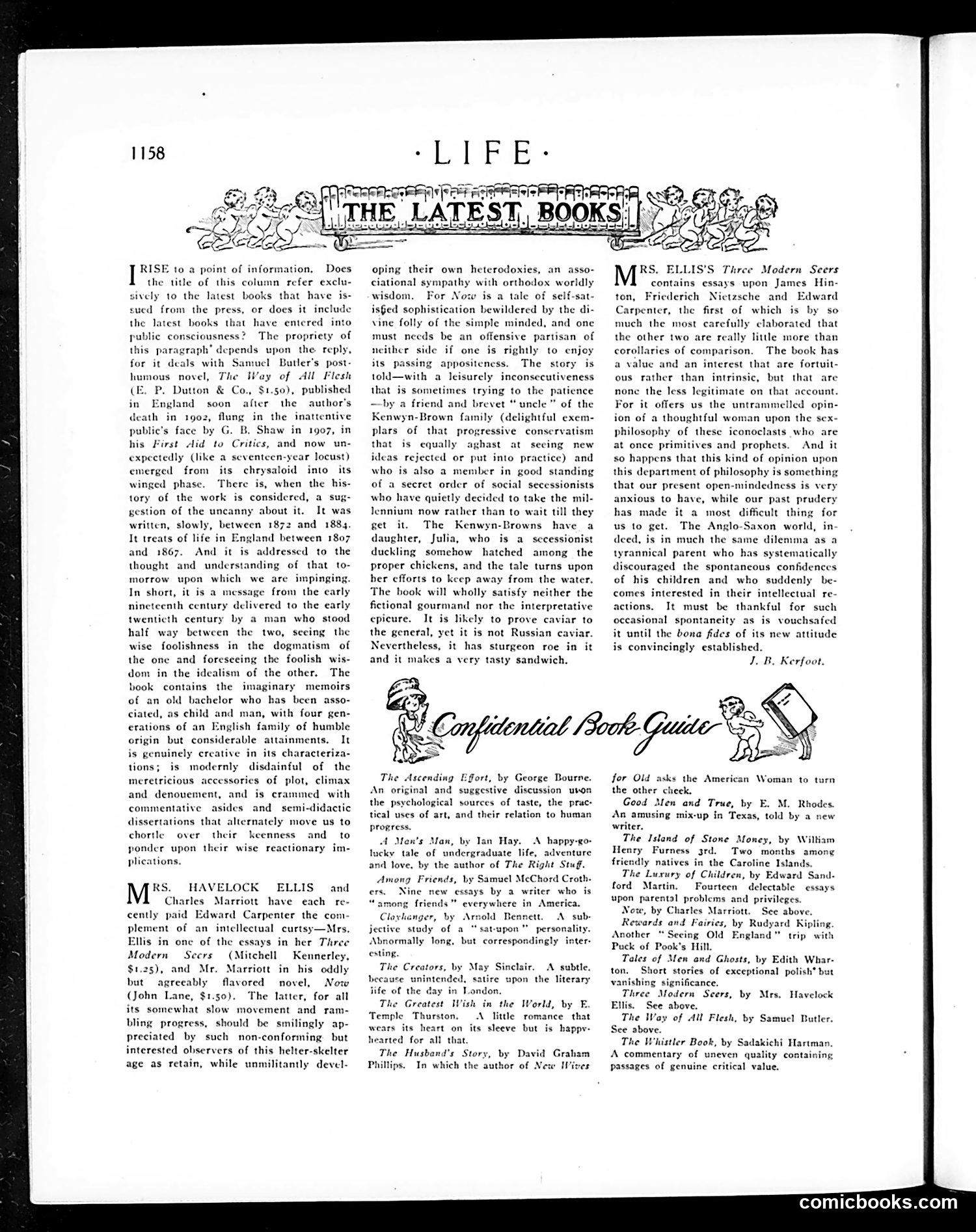
This is a book review column from Life magazine discussing recently published novels. The page contains no political cartoons or caricatures—it is primarily literary criticism. The column opens with philosophical debate about whether "latest books" refers only to newly published works or includes older books recently entering public consciousness. It then reviews Samuel Butler's *The Way of All Flesh* (published posthumously in 1907), describing it as addressing timeless questions about family, religion, and social convention across generations. Additional reviews discuss works by Havelock Ellis, Charles Marriott, and others. A secondary section, "Confidential Book Guide," lists other recent publications with brief descriptions. The page is essentially a serious literary review section with no satirical or humorous cartoon content—just substantive book criticism typical of Life's intellectual content from this era.
📄 Transcribed text from this page (OCR, searchable)
Machine-transcribed from the original scan — historical spelling and the odd misread are preserved.
RISE to a point of information, Does the title of this column refer exclu- sively to the latest books that have is- sued from the press, or does it include the latest books that have entered into ? iety of this paragraph’ depends upon the reply, for it deals with Samucl Butler's post- humous novel, The Way of All Flesh (E. P. Dutton & Co. $1.50), published in England soon after the author's death in 1902, flung in the inattentive public's face by G. B. Shaw in 1907, in his First Aid to Critics, and now un- expectedly (like a seventeen-year locust) emerged from its chrysaloid into. its winged phase. There is, when the his- tory of the work is considered, a sug- gestion of the uncanny about it. It was written, slowly, between 1872 and 1885. It treats of life in England between 1807 and 1867. And it is addressed to the thought and understanding of that to- morrow upon which we are impinging. In short, it is a message from the early nineteenth century delivered to the early twenticth century by a man who stood half way between the two, secing the wise foolishness in the dogmatism of the one and foreseeing the foolish wis- dom in the idealism of the other. The book contains the imaginary memoirs of an old bachelor who has been asso- ciated, as child and man, with four gen- erations of an English family of humble origin but considerable attainments. It is genuinely creative in its characteriza- modernly disdainful of the meretricious accessories of plot, climax and denouement, and is crammed with commentative asides and semi-didactic dissertations that alternately move us to chortle over their keenness and to ponder upon their wise reactionary im- plications. public consciousness? The pro; tions; is RS. HAVELOCK ELLIS and Charles Marriott have each re- cently paid Edward Carpenter the com- plement of an intellectual curtsy—Mrs. Ellis in one of the essays in her Three Modern Scers (Mitchell Kennerley. $1.25), and Mr. Marriott in his oddly but agreeably flavored novel, Now GJohn Lane, $1.50). The latter, for all its somewhat slow movement and ram- bling progress, should be smilingly ap- preciated by non-conforming but interested observers of this helter-skelter age as retain, while unmilitantly devel- such oping their own heterodoxies, an asso- ciational sympathy with orthodox worldly wisdom. For Now is a tale of self-sat- is§ed sophistication bewildered by the di- vine folly of the simple minded, and one must necds be an offensive partisan of neither side if one is rightly to enjoy its passing appositen The story is told—with a leisurely inconsccutiveness that is sometimes trying to the patience —by a friend and brevet “uncle” of the Kenwyn-Brown family (delightful exem- plars of that progressive conservatism that aghast at seeing new ideas rejected of put into practice) and who is also a member in good standing of a secret order of social secessionists who have quietly decided to take the mil- lennium now rather than to wait till they get it. The Kenwyn-Browns have a daughter, Julia, who is a secessionist duckling somehow hatched among the proper chickens, and the tale turns upon her efforts to keep away from the water. The book will wholly satisfy neither the fictional gourmand nor the interpretative epicure. It is likely to prove caviar to the general, yet it is not Russian caviar. evertheles: has sturgeon roe in it and it makes a very tasty sandwich. is equally The Ascending Efort, by George Bourne. An original and suggestive discussion uvon the psychological sources of taste, the prac: tical uses of art, and their relation to human progress. A Men’s Man, by Tan Hay. A happy-go- lucky tale of undergraduate life, adventure and love, by the author of The Right Stuf. Among Friends, by Samuel McChord Croth- ers. Nine mew essays by a writer who is “among friends” everywhere in America. Clavhenger, by Arnold Bennett. A sub- jective study of a“ sat-upon personalit Abnormally long, but correspondingly inter- esting. The Creators, by May Sinclair. A subtle, becauce unintended, satire upon the literary life of the London. The Greatest Wish in the World, by EF. Temple Thurston. A little romance that wears its heart on its sleeve but is bappy- arted for all that The Husband's Story, by David Graham Phillips. In which the author of New Wives Modern Seers ton, Friederich Nietzsche and Edward Carpenter, the first of which is by so much the most carefully claborated that the other two are really little more than corollaries of comparison. The book has a value and an interest that are fortuit- ous rather than intrinsic, but that are none the less legitimate on that account. For it offers us the untrammelled opin- ion of a thoughtful woman upon the sex- philosophy of these iconoclasts who are at once primitives and prophets. And it so happens that this kind of opinion upon this department of philosophy is something that our present open-mindedness is very anxious to have, while our past prudery has made it a most difficult thing for us to get. The Anglo-Saxon world, in- deed, is in much the same dilemma as a tyrannical parent who has systematically discouraged the spontaneous confidences of his children and who suddenly be- comes interested in their intellectual re- actions, It must be thankful for such occasional spontaneity as is vouchsafed it until the bona fides of its new attitude is convincingly established. J.B. Kerfoot. the American Woman to turn the other cheek, Good Men and True, by E. M. Rhodes. An amusing mix-up in Texas, told by a new writer. The Island of Stone Money, by Wiliam ry Furness 3rd. Two months amon dly natives in the Caroline Islands. The Luxury of Children, by Edward Sand- ford Martin. Fourteen delectable upon parental problems and privileges. Now, by Charles Marriott. See abov. Rewards and Fairies, by Rudyard Kipling. Another “Seeing Old England” trip with Puck of Pook’s Hill, Tales of Men and Ghosts, by Edith Whar ton. Short stories of exceptional polish’ but vanishing significance. Three Modern Seers, by Mrs. Havelock Ellis. See above. The Way of All Flesh, by Samuel Butler. See above. The Whistler Book, by Sadakichi Hartman, A commentary of uneven quality containing passages of genuine critical value. essays comicbooks.com