
Life, 1910-12-22 · page 10 of 44
Life — December 22, 1910 — page 10: what you’re looking at
What you’re looking at
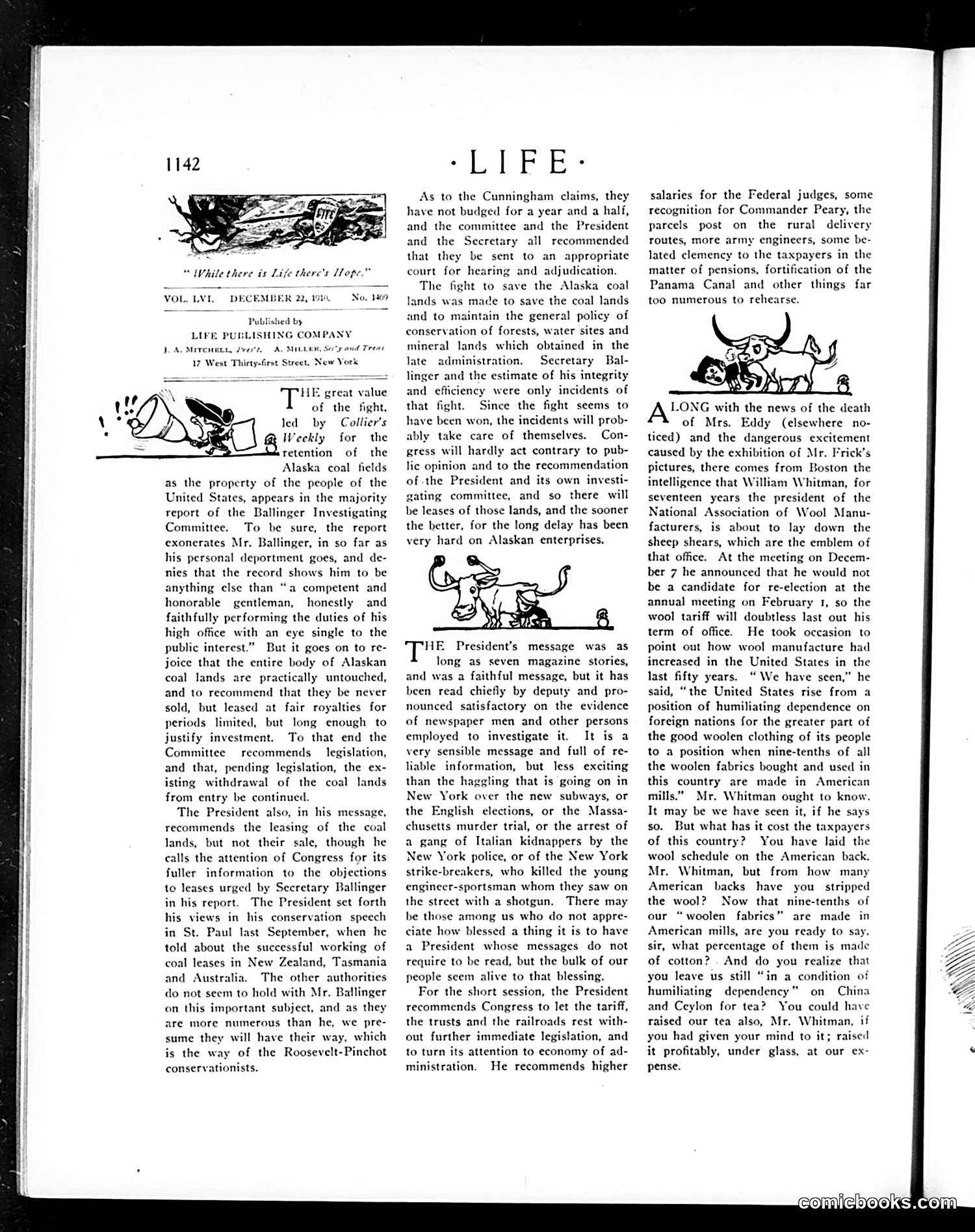
This page contains two small political cartoons satirizing President Theodore Roosevelt's administration. The **left cartoon** mocks the debate over Alaska coal lands. It depicts Roosevelt as a figure of hope, referencing Interior Secretary Ballinger's handling of public lands. The text criticizes how Ballinger "exonerates" himself while the Alaska coal fields remain "practically untouched"—suggesting the administration failed to develop these resources despite claiming conservation. The **right cartoon** appears to comment on wool tariffs and trade policy, showing a bull (likely representing American interests or the wool industry). The accompanying text discusses wool manufacturing and imports, suggesting satire about protectionist trade policies affecting domestic industry. Both cartoons critique Roosevelt-era conservation and economic policies as ineffective or contradictory.
📄 Transcribed text from this page (OCR, searchable)
Machine-transcribed from the original scan — historical spelling and the odd misread are preserved.
“ While there is Li, 22, 1910, VOL. LVI, DECEML Published by LISHING COMPANY AL MILLER, Secty LIFE PU. JA. Mevenetty Jest, 17 West Thirty great value the fight, led by Collier's Weekly for the retention of the Alaska coal fields as the property of the people of the United States, appears in the majority report of the Ballinger Investigating Committee. To be sure, the report exonerates Mr. Ballinger, in so far as his personal deportment goes, and de- nies that the record shows him to be anything else than “a competent and honorable gentleman, honestly and faithfully performing the duties of his high office with an eye single to the public interest.” But it goes on to re- joice that the entire body of Alaskan coal lands are practically untouched, and to recommend that they be never sold, but leased at fair royalties for periods limited, but long enough to justify investment. To that end the Committee recommends _ legislation, and that, pending legislation, the ex- isting withdrawal of the coal lands from entry be continued. The President also, in his message, recommends the leasing of the coal lands, but not their sale, though he calls the attention of Congress for its fuller information to the objections to leases urged by Secretary Ballinger in his report. The President set forth his views in his conservation speech in St. Paul last September, when he told about the successful working of coal leases in New Zealand, Tasmania and Australia. The other authorities do not seem to hold with Mr. Ballinger on this important subject, and as they are more numerous than he, we pre- sume they will have their way, which is the y of the Roosevelt-Pinchot conservationists. ‘LIFE: As to the Cunningham claims, they have not budged for a year and a half, and the committee and the President and the Secretary all recommended that they be sent to an appropriate court for hearing and adjudication. The fight to save the Alaska coal lands was made to save the coal lands and to maintain the general policy of conservation of forests, water sites and mineral lands which obtained in the late administration. Secretary Bal- linger and the estimate of his integrity and efficiency were only incidents of that fight. Since the fight seems to have been won, the incidents will prob- ably take care of themselves. Con- gress will hardly act contrary to pub- lic opinion and to the recommendation of.the President and its own investi- gating committee, and so there will be leases of those lands, and the sooner the better, for the long delay has been very hard on Alaskan enterprises. HE President’s message was as long as seven magazine stories, and was a faithful message, but it has been read chiefly by deputy and pro- nounced satisfactory on the evidence of newspaper men and other persons employed to investigate it. It is a very sensible message and full of re- liable information, but less exciting than the haggling that is going on in New York over the new subways, or the English elections, or the Massa- chusetts murder trial, or the arrest of a gang of Italian kidnappers by the New York police, or of the New York strike-breakers, who killed the young engineer-sportsman whom they saw on the street with a shotgun, There may be those among us who do not appre- ciate how blessed a thing it is to have a President whose messages do not require to be read, but the bulk of our people scem alive to that blessing. For the short session, the President recommends Congress to let the tariff, the trusts and the railroads rest with- out further immediate legislation, and to turn its attention to economy of ad- ministration. He recommends higher salaries for the Federal judges, some recognition for Commander Peary, the parcels post on the rural delivery routes, more army engineers, some be- lated clemency to the taxpayers in the matter of pensions, fortification of the Panama Canal and other things far too numerous to rehearse. LONG with the news of the death of Mrs, Eddy (elsewhere no- ticed) and the dangerous excitement caused by the exhibition of Mr. Frick’s pictures, there comes from Boston the intelligence that William Whitman, for seventeen years the president of the National Association of Wool Manu- facturers, is about to lay down the sheep shears, which are the emblem of that office. At the meeting on Decem- ber 7 he announced that he would not be a candidate for re-election at the annual meeting on February 1, so the wool tariff will doubtless last out his term of office. He took occasion to point out how wool manufacture had increased in the United States in the last fifty years. “We have seen,” he said, “the United States rise from a position of humiliating dependence on foreign nations for the greater part of the good woolen clothing of its people to a position when nine-tenths of all the woolen fabrics bought and used in this country are made in American mills.” Mr. Whitman ought to know. It may be we have seen it, if he says so. But what has it cost the taxpayers of this country? You have laid the wool schedule on the American back. Mr. Whitman, but from how many American backs have you stripped the wool? Now that nine-tenths of our “woolen fabrics” are made in American mills, are you ready to say. what percentage of them is made of cotton? And do you realize that you leave us still “in a condition of humiliating dependency” on China and Ceylon for tea? You could have raised our tea also, Mr. Whitman, if you had given your mind to it; raised it profitably, under glass, at our ex- pense.