
Life, 1910-12-22 · page 21 of 44
Life — December 22, 1910 — page 21: what you’re looking at
What you’re looking at
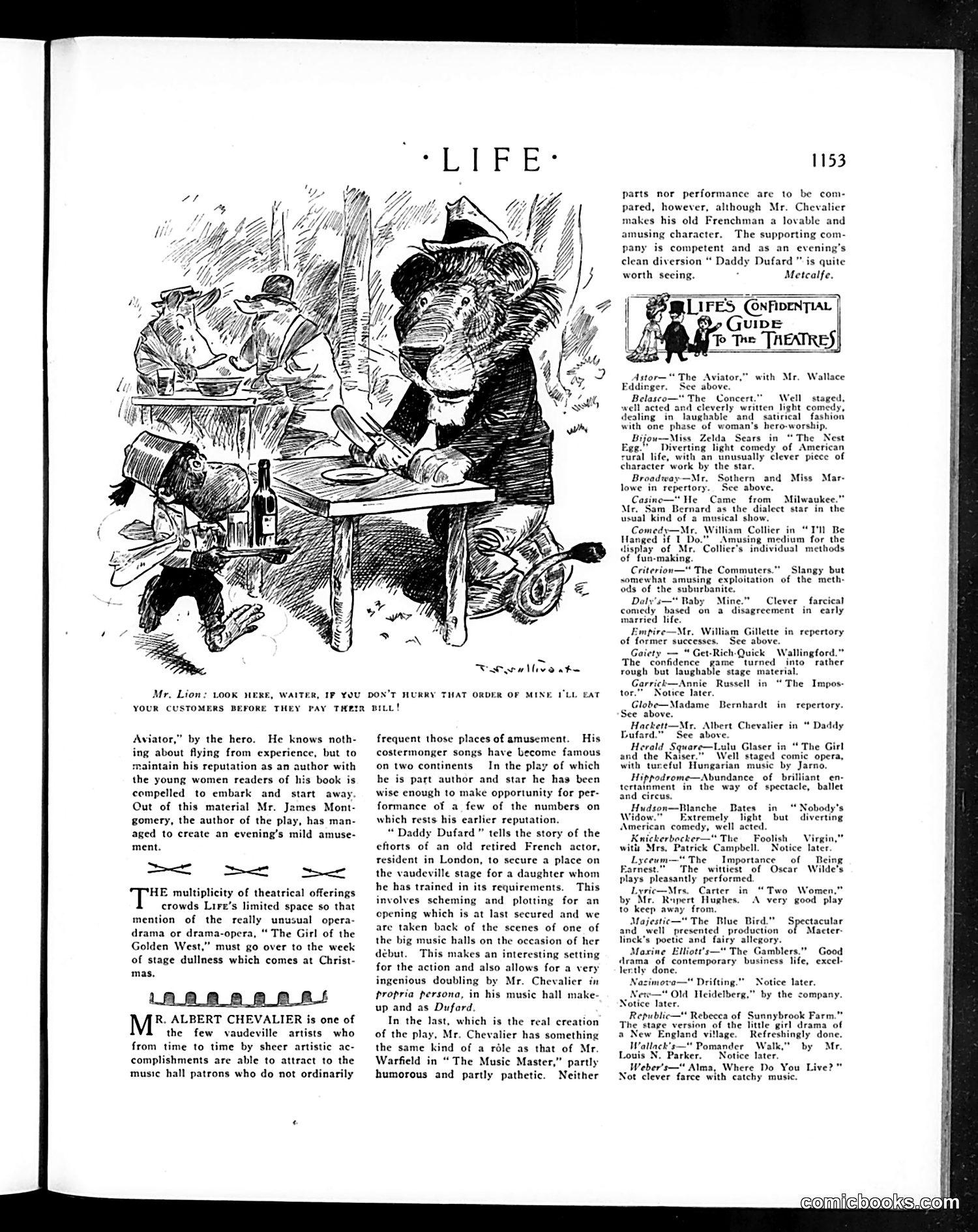
The main cartoon depicts a lion seated at a restaurant table, threatening the waiter: "Look here, waiter, if you don't hurry that order of mine I'll eat your customers before they pay their bill!" This is a simple visual gag playing on the lion's nature as a predator. The humor derives from the absurdity of a wild animal dining at a civilized establishment and the waiter's predicament—the threat isn't about unpaid bills but literal consumption of patrons. The page's bulk consists of theatre reviews covering current Broadway productions and vaudeville performances. Notable mentions include Albert Chevalier in "Daddy Dufard" (a play about a retired French actor securing his daughter's stage debut) and various other comedies and light operas. The "Confidential Guide to the Theatres" section provides brief assessments of multiple shows running during this period. This appears to be a typical Life magazine arts/entertainment page blending satirical humor with practical theatre criticism for contemporary readers.
📄 Transcribed text from this page (OCR, searchable)
Machine-transcribed from the original scan — historical spelling and the odd misread are preserved.
Terie ate Mr. Lion: Look MERE, WAITER, IF YOU DON’T HURRY THAT ORDER OF MINE LL EAT YOUR CUSTOMERS BEFORE THEY Pay THEIR BILL! Aviator,” by the hero. He knows noth- ing about flying from experience, but to maintain his reputation as an author with the young women readers of his book is compelled to embark and start away. Qut of this material Mr. Ja gomery, the author of the play, aged to create an evening’s mild amuse- ment. nd HE multiplicity of theatrical offerings crowds Lire’s limited space so that mention of the really unusual opera- drama or drama-opera, “ The Girl of the Golden West,” must go over to the week of stage dullness which comes at Christ- mas, IAA AO 6 OAS R. ALBERT CHEVALIER is one of the few vaudeville artists who from time to time by sheer artistic ac- complishments are able to attract to the music hall patrons who do not ordinarily frequent those places of amusement. His costermonger songs have become famous on two continents In the play of which he is part author and star he has been wise enough to make opportunity for per- formance of a few of the numbers on which rests his earlier reputation. Daddy Dufard” tells the story of the efiorts of an old retired French actor, resident in London, to secure a place on the vaudeville stage for a daughter whom he has trained in its requirements. This involves scheming and plotting for an opening which is at last secured and we are taken back of the scenes of one of the big music halls on the occasion of her début. This makes an interesting setting for the action and also allows for a very ingenious doubling by Mr. Chevalier in propria persona, in his music hall make- up and as Dufard. In the last, which is the real creation of the play, Mr. Chevalier has something the same kind of a réle as that of Mr. Warfield in “The Music Master,” partly humorous and partly pathetic. Neither 1153 parts nor performance are to be com- pared, however, although Mr. Chevalier makes his old Frenchman a lovable and amusing character. The supporting com- pany is competent and as an evening’s clean diversion “ Daddy Dufard " is quite worth secing. Metcalfe. GNFIDENTIAL 1 m > GUIDE RAS To The THEATRES Astor—" The Aviator,” with Mr. Wallace Eddinger. Sce above. Belasco—* The Concert.” Well staged, well acted and cleverly written light comedy, dealing in laughable and satirical fashion with one phase of woman's hero-worship, Bijou-—Miss. Zelda Sears in “The Nest Egg.” Diverting light comedy of American rural life, with an unusually clever piece of character work by the star. Broadway—Mr. Sothern and Miss Mar- lowe in repertory. See above. Casine—"* He Came from Milwaukee.” Mr. Sam Bernard as the dialect star in the usual kind of a musical show. Comedy—Mr. William Collier in “I'll Be Hanged if I Do.” Amusing medium for the display of Mr. Collier's individual methods of fun-making. Criterion—" The Commuters.” Slangy but somewhat amusing exploitation of the meth- ods of the suburbanite. Daly's—" Raby Mine.” — Clever comedy based on a disagreement married life. Empire—Mr. William Gillette in repertory of former successes. See above. Gaiety — “ Get-Rich-Quick Wallingford.” The confidence game turned into rather rough but laughable stage material. Garrick—Annie Russell in “The Impos- tor.” Notice later. Globe—Madame See above. Hackett—Mr. Albert Chevalier in “ Daddy Dufard.” See above. Herald Square—Lulu Glaser in “ The Girl and the Kaiser.” Well staged comic opera, with tureful Hungarian music by Jarno. Hippodrome—Abundance_ of brilliant en- tertainment in the way of spectacle, ballet and circus. (Hudson—Dlanche Bates in Widow.” Extremely light but American comedy, well acted. Knickerbocker—" The Foolish Virgin,” with Mrs, Patrick Campbell. Notice later Lye The Importance of Being Farnest."”" The wittiest of Oscar Wilde's plays pleasantly performed. Lyric—Mrs. Carter in by Mr. Rupert Hughes. to keep away from. Majestic—" The Blue Bird.” and well presented production of linck’s poetic and fairy allegory. Marine Elliott's—* The Gamblers." Good drama of contemporary business life, excel- lently done. N —"* Drifting.” Notice later. New—" Old Heidelberg.” by the company. Notice later. Republic—" Rebecea of Sunnybrook Farm.” The stage version of the little girl drama of New England village. Refreshingly done. Wallack’s—"" Pomander Walk," by Mr. Louis N. Parker. Notice later. _ Weber’s—" Alma, Where Do You Live?" Not clever farce with catchy music. farcical in early Bernhardt in repertory. “ Nobody's diverting “Two Women,” A very good play Spectacular Maeter