
Life, 1910-12-22 · page 20 of 44
Life — December 22, 1910 — page 20: what you’re looking at
What you’re looking at
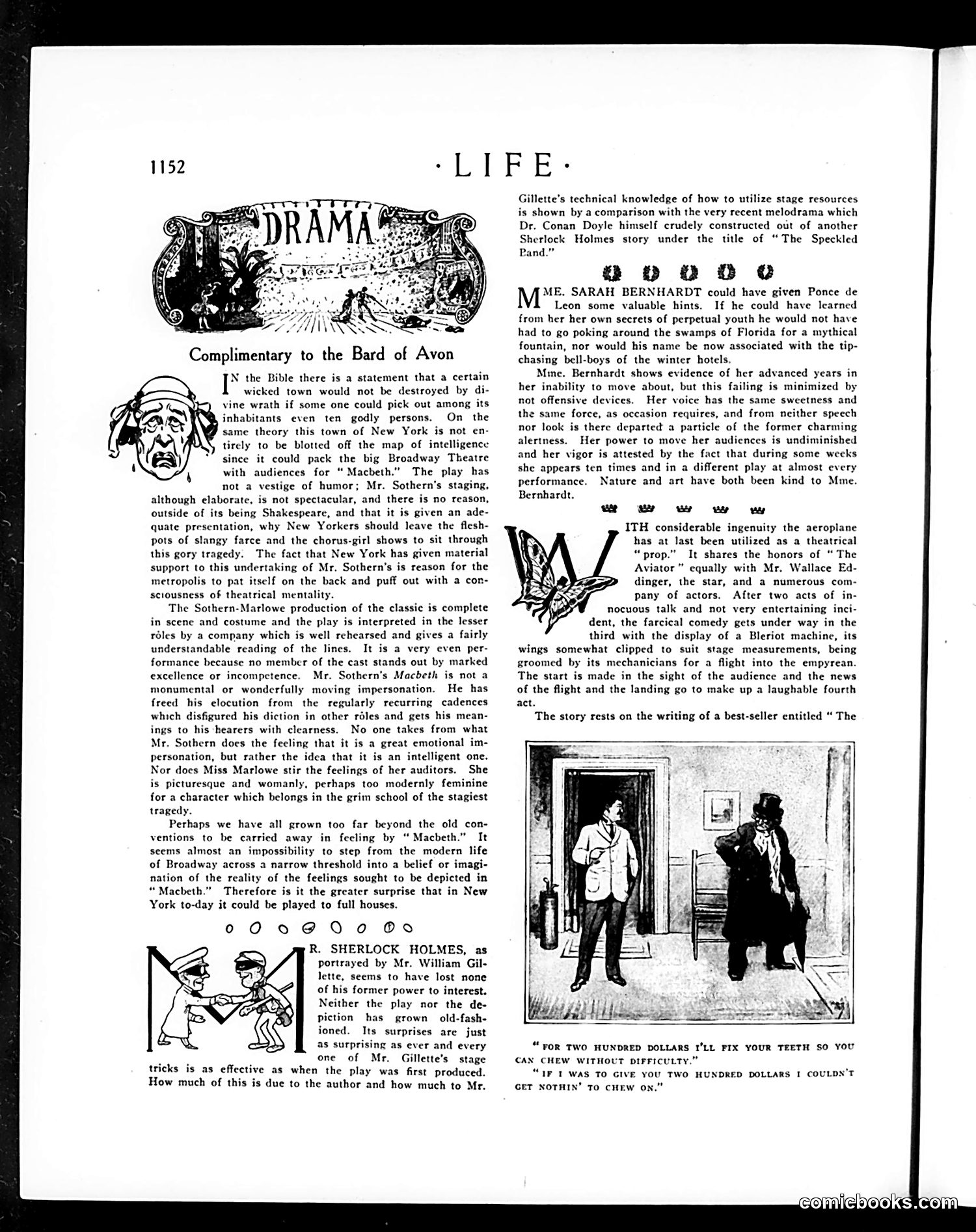
This page reviews three theatrical productions. The main critique concerns a Broadway production of Shakespeare's *Macbeth* starring actor E.H. Sothern and Julia Marlowe. Life sarcastically praises New York for supporting Shakespeare despite its preference for frivolous entertainment ("slangy farce and chorus-girl shows"), suggesting the city deserves credit for cultural sophistication. Sothern's performance is judged competent but uninspired—intelligent rather than emotionally moving. The page also reviews William Gillette's *Sherlock Holmes* play, praising its enduring effectiveness and stagecraft, and notes that a competing Sherlock Holmes melodrama by author Conan Doyle himself lacks Gillette's technical skill. Finally, it discusses Sarah Bernhardt's continued theatrical power despite her advancing age and physical limitations.
📄 Transcribed text from this page (OCR, searchable)
Machine-transcribed from the original scan — historical spelling and the odd misread are preserved.
*LIPE: Complimentary to the Bard of Avon I the Bible there is a statement that a certain wicked town would not be destroyed by di- vine wrath if some one could pick out among its inhabitants even ten godly persons. On the same theory this town of New York is not en- tirely to be blotted off the map of intelligence since it could pack the big Broadway Theatre with audiences for “ Macbeth.” The play has not a vestige of humor; Mr. Sothern’s staging, although elaborate, is not spectacular, and there is no reason, outside of its being Shakespeare, and that it is given an ade- quate presentation, why New Yorkers should leave the fiesh- pots of slangy farce and the chorus-girl shows to sit through this gory tragedy. The fact that New York has given material support to this undertaking of Mr. Sothern’s is reason for the metropolis to pat itself on the back and puff out with a con- sciousness of theatrical mentality. The Sothern-Marlowe production of the classic is complete in scene and costume and the play is interpreted in the lesser réles by a company which is well rehearsed and gives a fairly understandable reading of the lines. It is a very even per- formance because no member of the cast stands out by marked excellence or incompetence. Mr. Sothern’s Macbeth is not a monumental or wonderfully moving impersonation. He has freed his elocution from the regularly recurring cadences which disfigured his diction in other rdles and gets his mean- ings to his hearers with clearness. No one takes from what Mr. Sothern does the feeling that it is a great emotional im- personation, but rather the idea that it is an intelligent one. Nor does Miss Marlowe stir the feelings of her auditors. She is picturesque and womanly, perhaps too modernly feminine for a character which belongs in the grim school of the stagiest tragedy. Perhaps we have all grown too far beyond the old con- ventions to be carried away in feeling by “ Macbeth.” It seems almost an impossibility to step from the modern life of Broadway across a narrow threshold into a belief or imagi- nation of the reality of the feelings sought to be depicted in “Macbeth.” Therefore is it the greater surprise that in New York to-day it could be played to full houses. 00098200 09 R. SHERLOCK HOLMES, as portrayed by Mr. William Gil- lette, seems to have lost none of his former power to interest. Neither the play nor the de- piction has grown old-fash- ioned. Its surprises are just as surprising as ever and every ; one of Mr. Gillette’s stage tricks is as effective as when the play was first produced. How much of this is due to the author and how much to Mr. Gillette’s technical knowledge of how to utilize stage resources is shown by a comparison with the very recent melodrama which Dr. Conan Doyle himself crudely constructed out of another Sherlock Holmes story under the title of “The Speckled Pand.” ooo 8 @ ME. SARAH BERNHARDT could have given Ponce de Leon some valuable hints. If he could have learned from her her own secrets of perpetual youth he would not have had to go poking around the swamps of Florida for a mythical fountain, nor would his name be now associated with the tip- chasing bell-boys of the winter hotels. Mine. Bernhardt shows evidence of her advanced years in her inability to move about, but this failing is minimized by not offensive devices. Her voice has the same sweetness and the same force, as occasion requires, and from neither speech nor look is there departed a particle of the former charming alertness. Her power to move her audiences is undiminished and her vigor is attested by the fact that during some weeks she appears ten times and in a different play at almost every performance. Nature and art have both been kind to Mme. Bernhardt. wa ew ow wow ITH considerable ingenuity the aeroplane has at last been utilized as a theatrical “prop.” It shares the honors of “ The Aviator" equally with Mr. Wallace Ed- dinger, the star, and a numerous com- pany of actors. After two acts of in- nocuous talk and not very entertaining inci- dent, the farcical comedy gets under way in the third with the display of a Bleriot machine, its wings somewhat clipped to suit stage measurements, being groomed by its mechanicians for a flight into the empyrean. The start is made in the sight of the audience and the news of the flight and the landing go to make up a laughable fourth act. The story rests on the writing of a best-seller entitled “ The t } “POR TWO HUNDRED DOLLARS I'LL FIX YOUR TEETH SO YOU CAN CHEW WITHOUT DIFFICULTY.” “IP 1 WAS TO GIVE YOU TWO HUNDRED DOLLARS I COULDN'T GET NOTHIN’ TO CHEW ON.”