
Life, 1910-12-22 · page 25 of 44
Life — December 22, 1910 — page 25: what you’re looking at
What you’re looking at
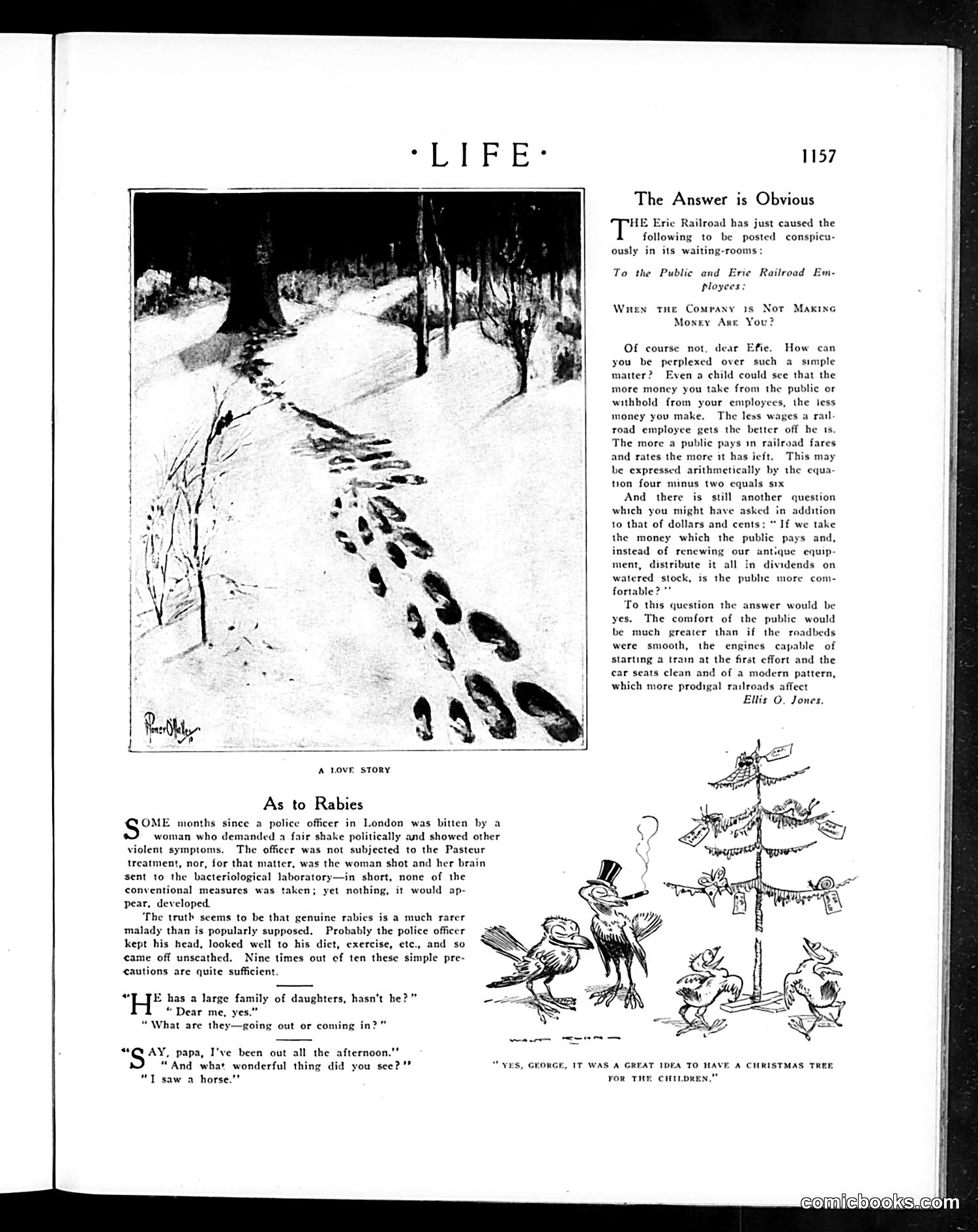
This 1157-page from *Life* magazine contains two satirical pieces: **"As to Rabies"** is a brief story mocking suffragettes. It references a woman who "demanded a fair shake politically" and bit a London police officer. The story uses this incident to suggest that rabies (literal disease) is rarer than thought—a crude joke implying that violent suffragettes were common during women's rights activism, particularly in early 20th-century Britain. **"The Answer is Obvious"** directly satirizes the Erie Railroad's posted notice claiming workers and the public both benefit when the company withholds wages and maintains poor service. The piece uses sarcastic logic ("four minus two equals six") to expose the railroad's absurd reasoning: better profits through reduced wages and deteriorating conditions actually harm workers and passengers. Ellis O. Jones attacks corporate greed disguised as mutual benefit. Both pieces target institutional hypocrisy—one social, one economic.
📄 Transcribed text from this page (OCR, searchable)
Machine-transcribed from the original scan — historical spelling and the odd misread are preserved.
A LOVE STORY As to Rabies OME months since a police officer in London was bitten by a woman who demanded a fair shake politically and showed other violent symptoms, The officer was not subjected to the Pasteur treatment, nor, for that matter, was the woman shot and her brain sent to the bacteriological laboratory—in short, none of the conventional measures was taken; yet nothing, it would ap- pear, developed. ‘The truth seems to be that genuine rabies is a much rarer malady than is popularly supposed. Probably the police officer kept his head, looked well to his dict, exercise, etc. and so came off unscathed. Nine times out of ten these simple pre- cautions are quite sufficient. “TLJE has a large family of daughters, hasn't he?” “ Dear me, yes.” “What are they—going out or coming in?” “Q AY, papa, I've been out all the afternoon.” “And what wonderful thing did you sce?’ “T saw a horse.” 1157 The Answer is Obvious HE Eric Railroad has just caused the following to be posted conspicu- ously in its waiting-rooms: To the Public and Erie Railroad Em- ployees: Wuen tne Company 1s Not Maxine Money Are You? Of course not, dear Efie. How can you be perplexed over such a simple matter? Even a child could sce that the more money you take from the public or withhold from your employees, the less money you make, The less wages a rail road employee gets the better off he 1s. The more a public pays in railroad fares and rates the more it has ieft. This may be expressed arithmetically by the equa- tion four minus two equals six And there is. still another question which you might have asked in addition to that of dollars and cents: “If we take the money which the public pays and, instead of renewing our ue equip- ment, distribute it all in dividends on watered stock, is the pubhe more com- fortable? To this question the answer would be yes. The comfort of the public would be much greater than if the roadbeds were smooth, the engines capable of starting a train at the first effort and the car seats clean and of a modern pattern, which more prodigal railroads affect Ellis O. Jones. “YES, GEORGE, IT WAS A GREAT IDEA TO HAVE. A CHRISTMAS TREE FOR THE CHILDREN