
A complete issue · 44 pages · 1910
Life — December 8, 1910
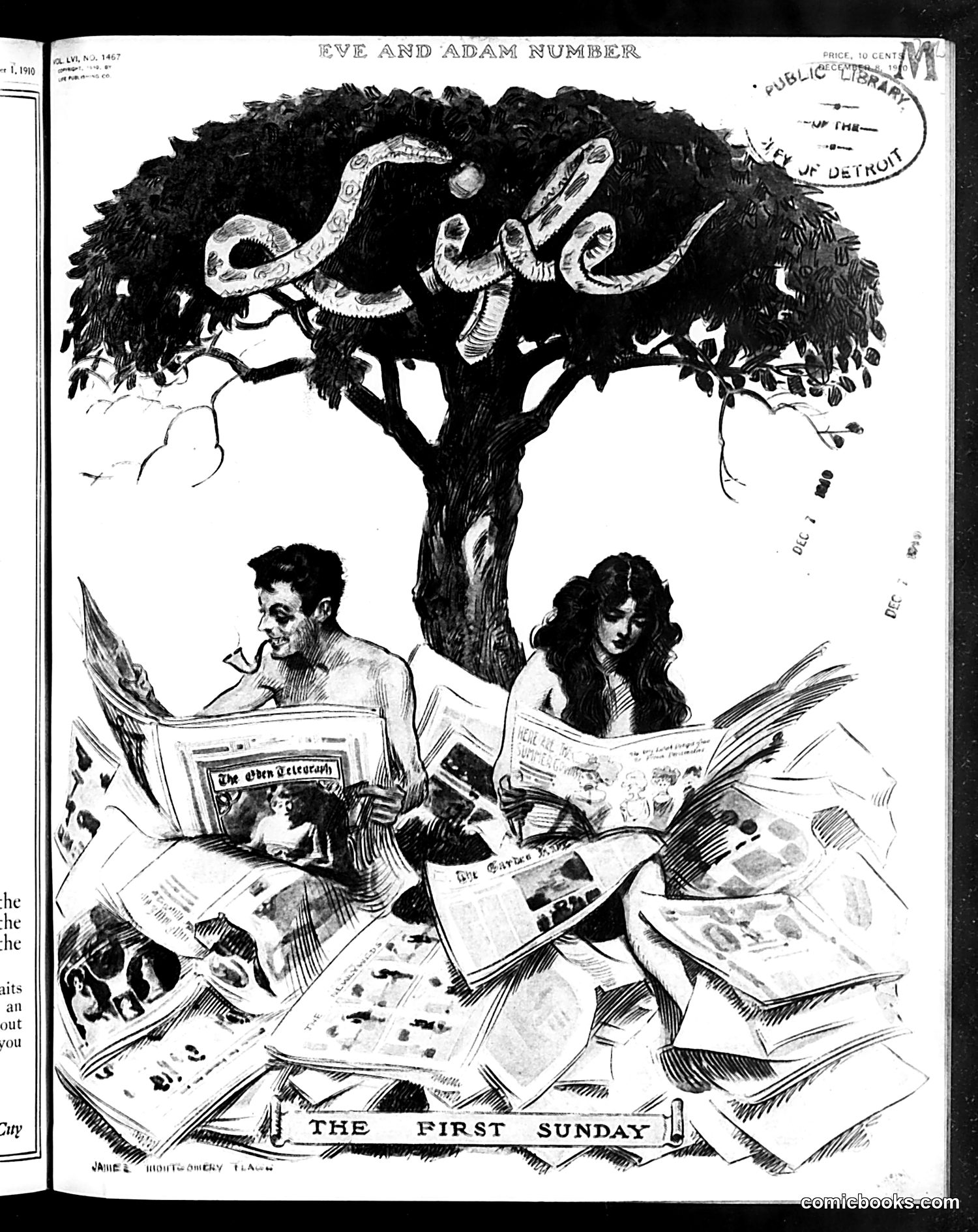
This satirical cartoon depicts Adam and Eve beneath the Tree of Knowledge, now replaced by serpents spelling "LIFE" (the magazine's title). Below them, a modern couple sits surrounded by newspapers—"The Ohio Telegraph" and other publications visible—reading the Sunday papers rather than enjoying nature or each other. The satire contrasts biblical Eden's innocence with modern urban life's distraction. Instead of forbidden fruit tempting them toward sin, newspapers and media consumption occupy their leisure time. "The First Sunday" suggests this represents humanity's new form of indulgence or spiritual emptiness—replacing natural paradise with mass-produced information and entertainment. The cartoon critiques how modern media has become humanity's substitute for genuine experience or connection.
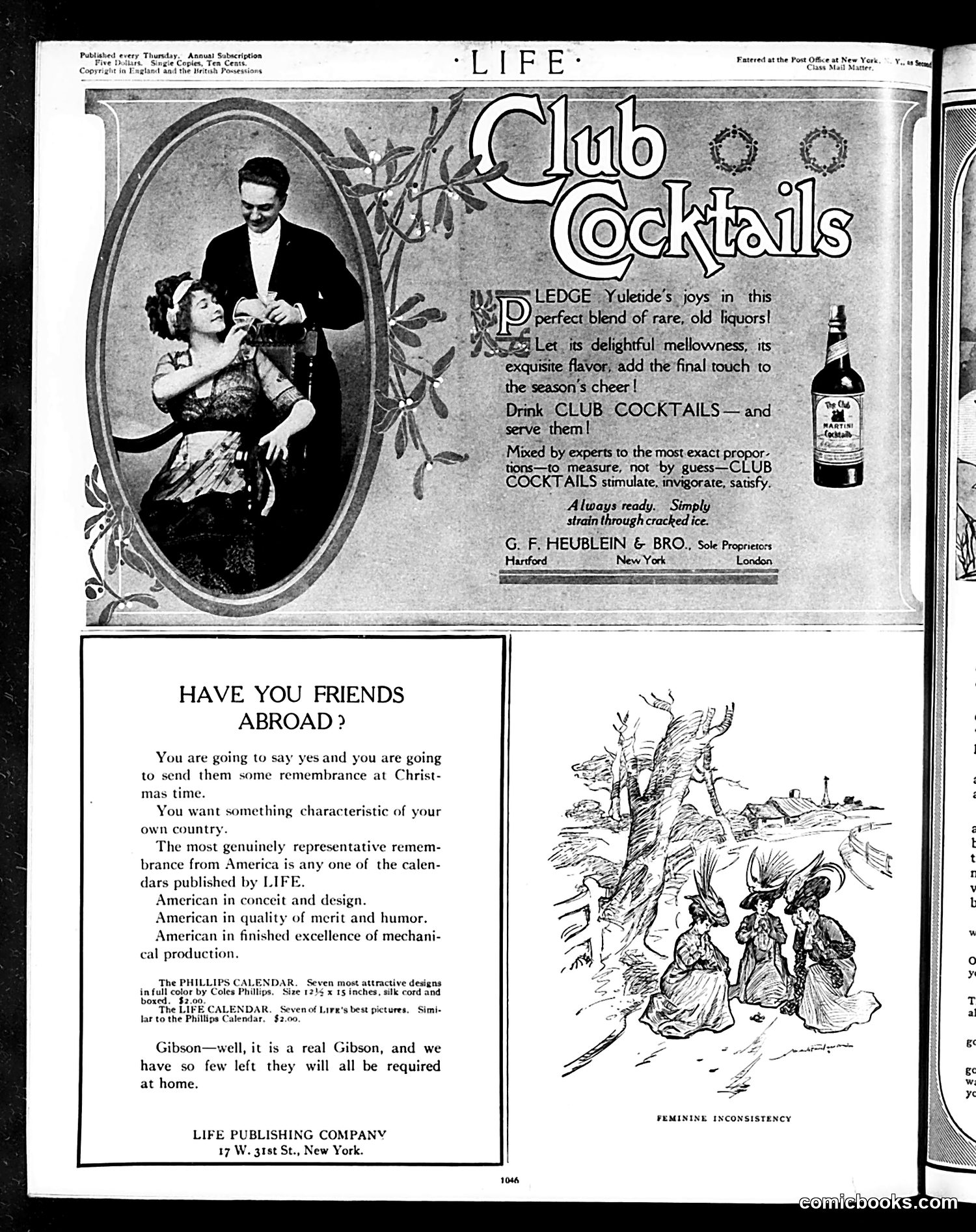
This page is primarily **advertising and self-promotion** rather than political satire. The top half advertises **Club Cocktails** by G.F. Heublein & Bro., featuring an elegant couple in formal dress—a typical early-20th-century advertisement emphasizing sophistication and leisure. The bottom half contains two unrelated items: 1. A **LIFE Publishing Company advertisement** promoting their calendars as ideal Christmas gifts for friends abroad, emphasizing American design, humor, and mechanical excellence as representative of American character. 2. A small cartoon titled **"Feminine Inconsistency"** showing women in winter clothing near a bare tree—likely a mild joke about women's contradictory behavior or fashion choices, though the specific humor is unclear today. The page reflects early 1900s consumer culture and magazine self-advertising practices.
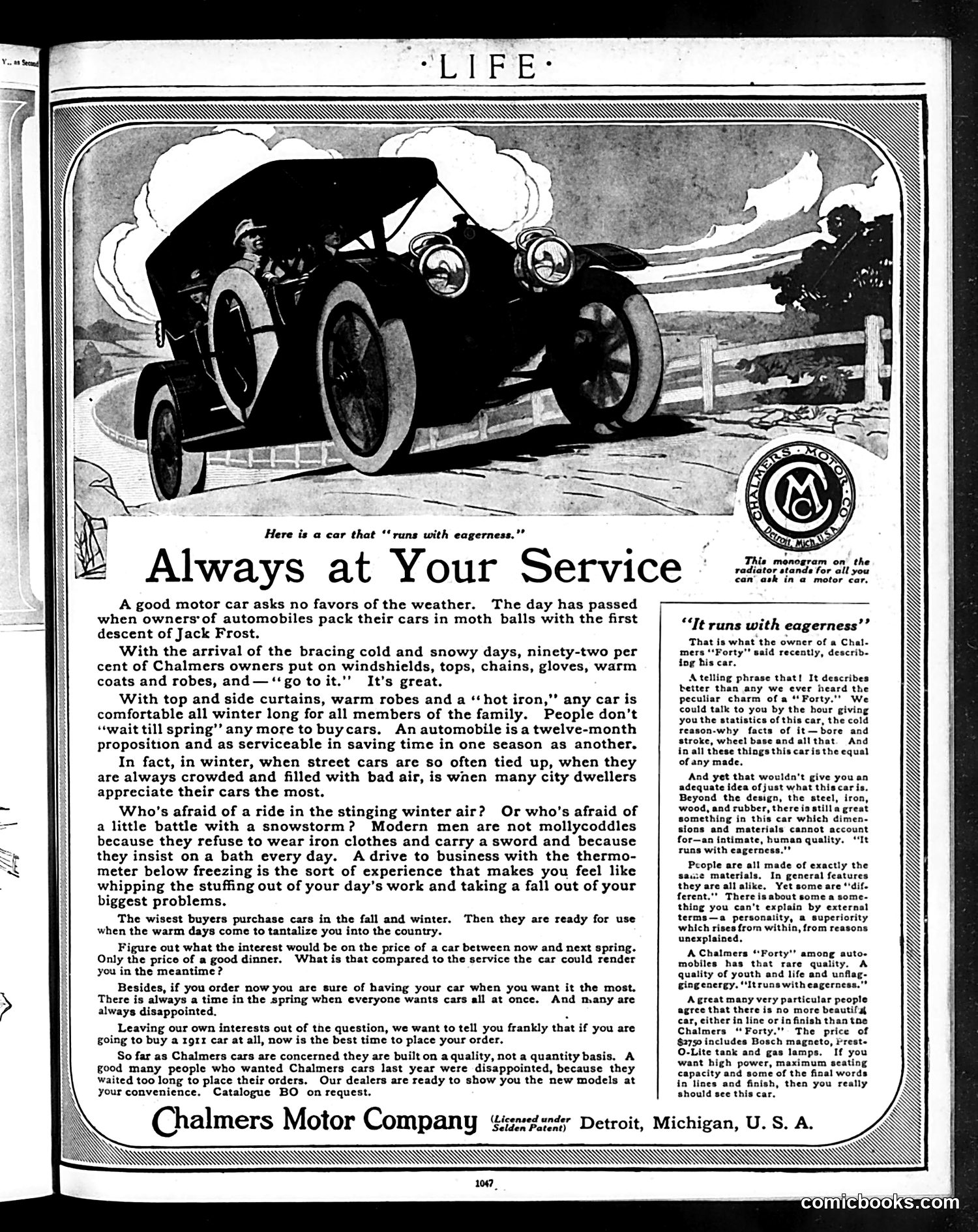
This page is **primarily an advertisement**, not political satire. It's a Chalmers Motor Company ad from *Life* magazine (page 1047) promoting automobiles for winter driving. The ad uses persuasive copy arguing that cars are practical year-round vehicles, not seasonal luxuries requiring storage during cold months. The illustration shows a Chalmers automobile on a snowy road, emphasizing reliability in harsh conditions. The tagline "It runs with eagerness" anthropomorphizes the car as eager and capable. The advertisement targets middle-class car buyers, suggesting that purchasing now (before spring) offers better value than waiting, and that winter ownership proves a car's durability and utility. There is **no political cartoon or satire** on this page—it's straightforward commercial messaging typical of early automotive advertising.
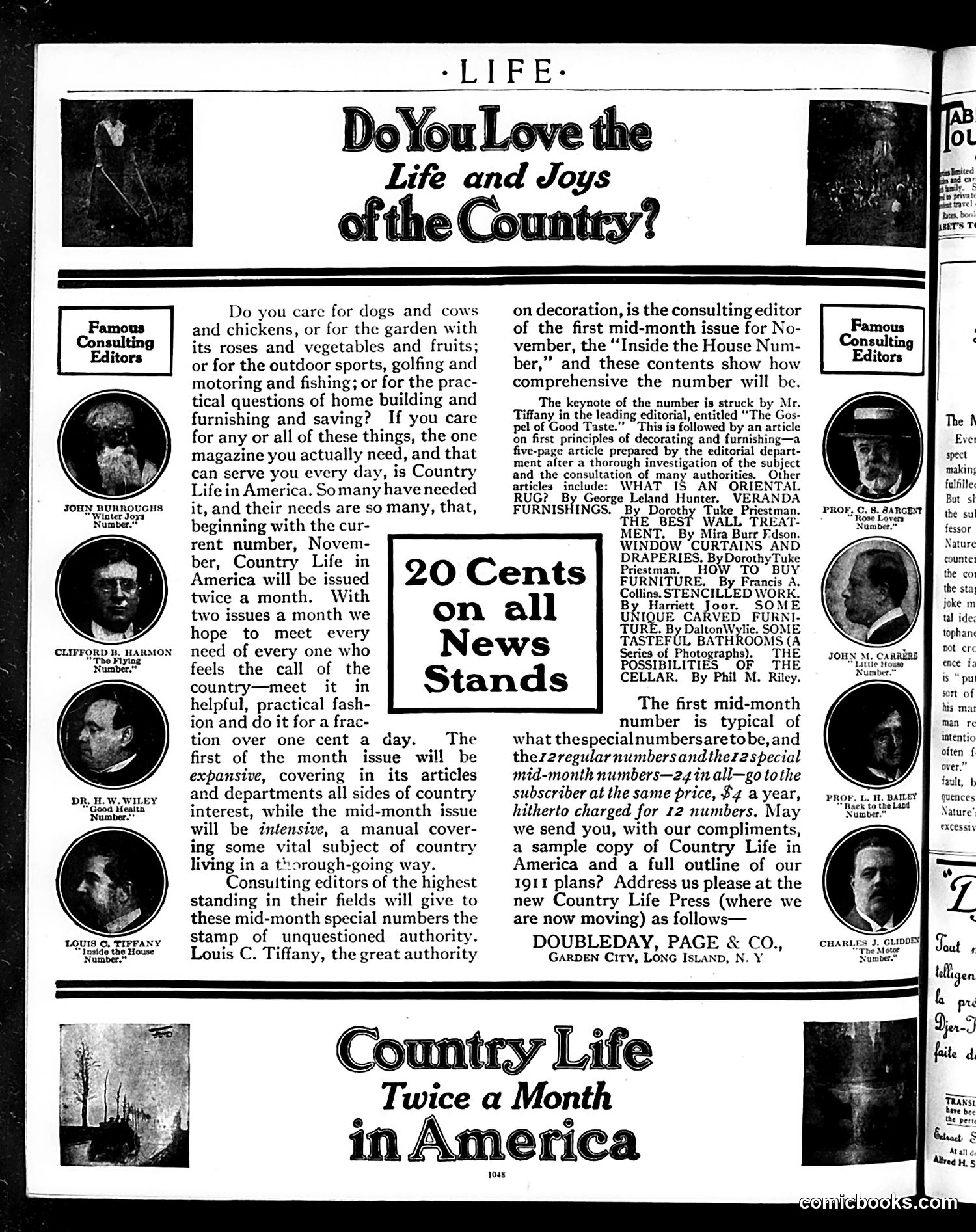
This page is primarily **advertising and promotional content**, not political satire. It announces the launch of a new magazine called *Country Life in America*, promoting its twice-monthly publication. The page features portraits of five "Famous Consulting Editors" (John Burroughs, Clifford B. Harmon, Dr. H.W. Wiley, and Louis C. Tiffany are identified), establishing the magazine's authority on rural living, gardening, architecture, and home furnishing. The central promotional box offers "20 Cents on all News Stands"—a competitive subscription rate. The text emphasizes the magazine will address practical country interests: dogs, farming, home building, and outdoor sports. This is **not satirical commentary** but rather a straightforward early-20th-century magazine advertisement targeting educated, affluent readers interested in country estates and rural lifestyle.
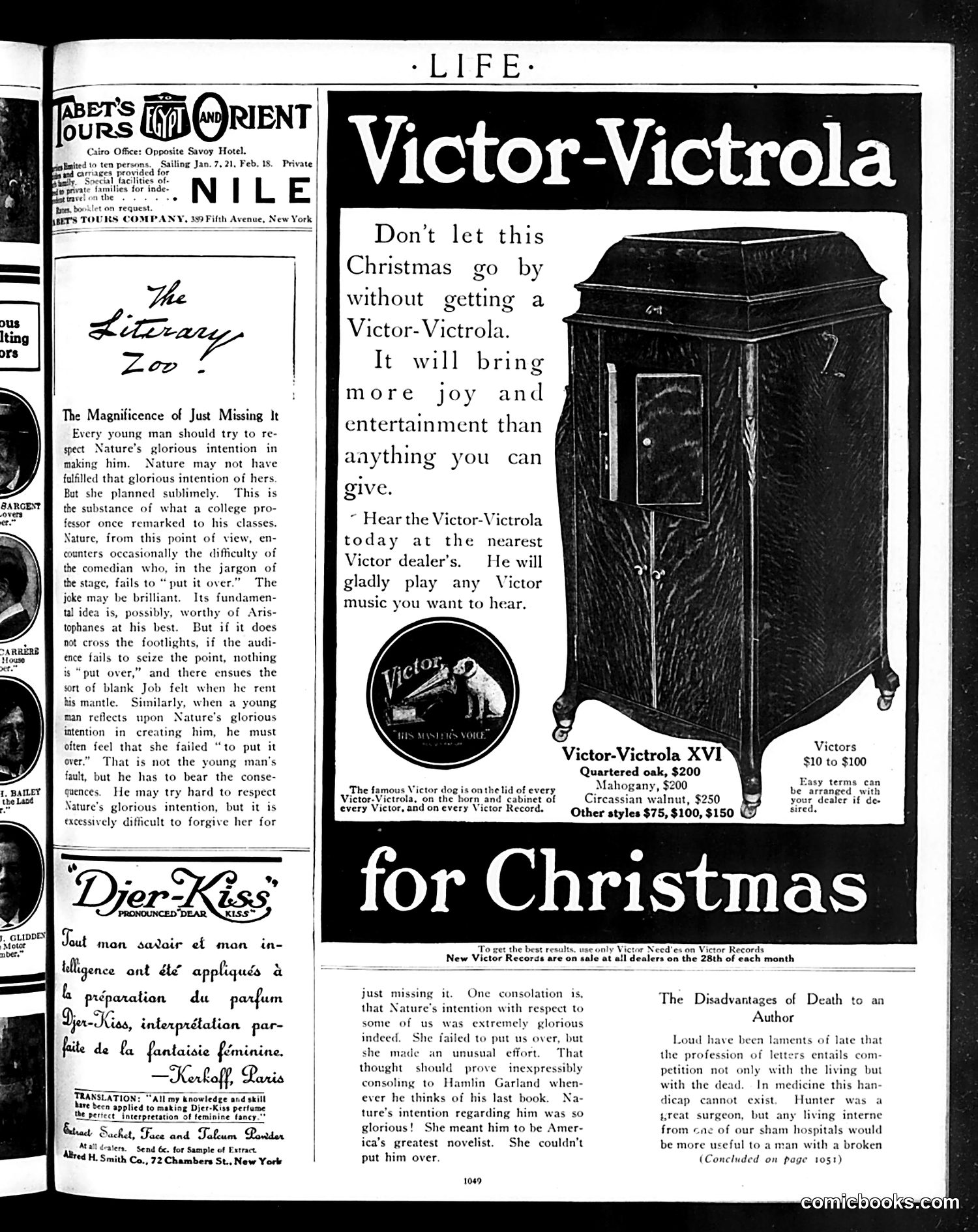
This page is primarily **advertising**, not political satire. The dominant content is a large Victor-Victrola advertisement promoting phonographs as Christmas gifts. The ad features an ornate wooden cabinet model and emphasizes the entertainment value of recorded music, urging readers to visit dealers to hear demonstrations. The smaller left-column piece titled "The Literary Zoo" appears to be a humorous essay about human nature using animal metaphors—discussing how young men should respect "Nature's glorious intention." Below that is a brief "Dior-Kiss" perfume advertisement in French. The page reflects **early 20th-century consumer culture**, marketing new technologies (recorded music) and luxury goods for holiday gift-giving to middle and upper-class readers.
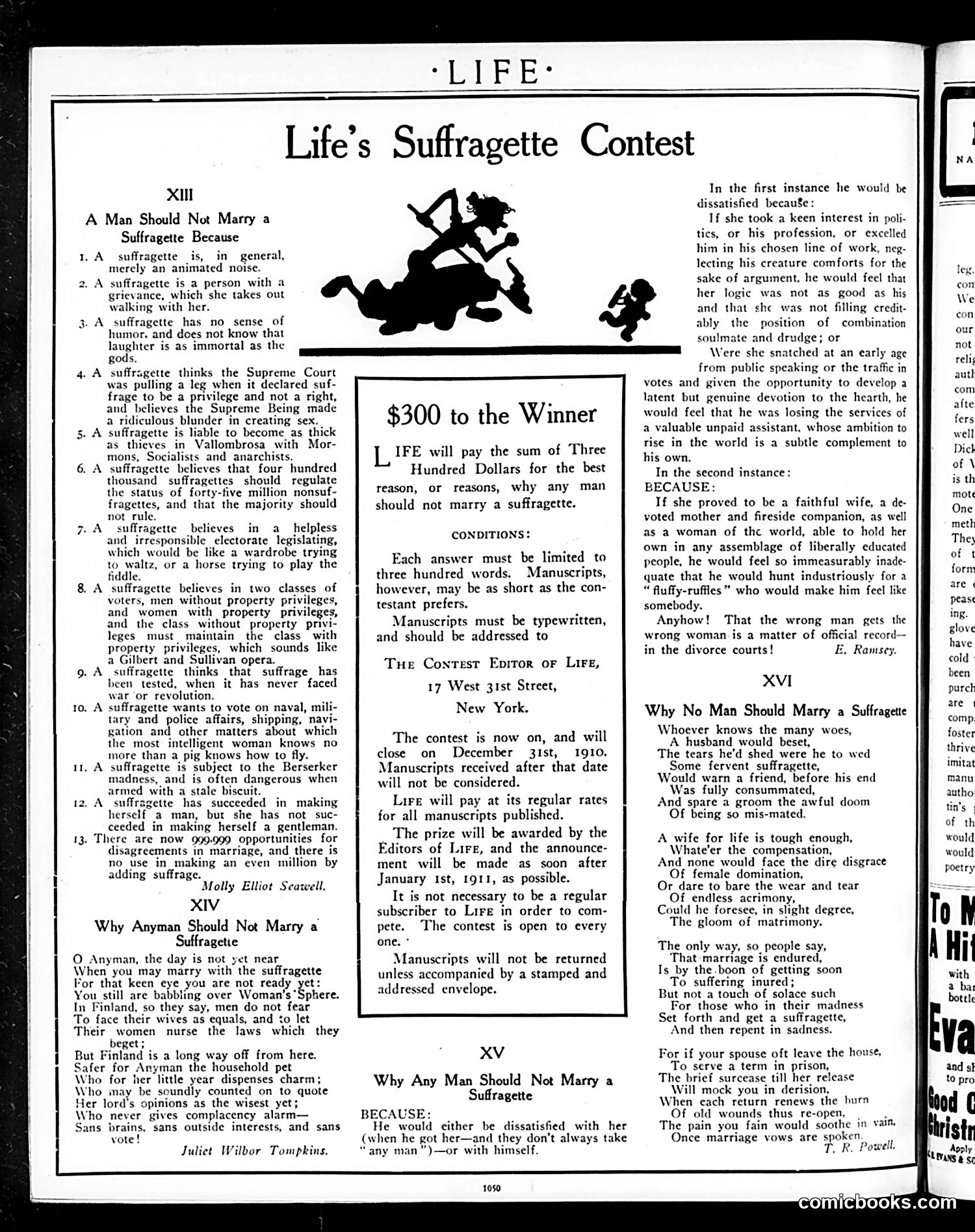
This page satirizes the women's suffrage movement through a mock contest offering $300 for essays explaining "Why a Man Should Not Marry a Suffragette." The silhouette cartoon depicts a woman activist in aggressive poses—fighting, lunging—stereotyping suffragettes as combative and unfeminine. This visual characterization supports the written arguments below, which present anti-suffrage talking points: that suffragettes are unfit wives, lack domestic sense, threaten property rights, and represent dangerous socialism. The satire works by presenting these prejudiced arguments earnestly as contest entries, allowing readers to laugh at suffragettes' alleged absurdities. Rather than engaging substantive equality arguments, *Life* mocks the movement by suggesting no rational man would marry an activist—implying women's activism itself is ridiculous and unnatural. This reflects 1910 anti-suffrage sentiment using gendered stereotypes rather than political debate.
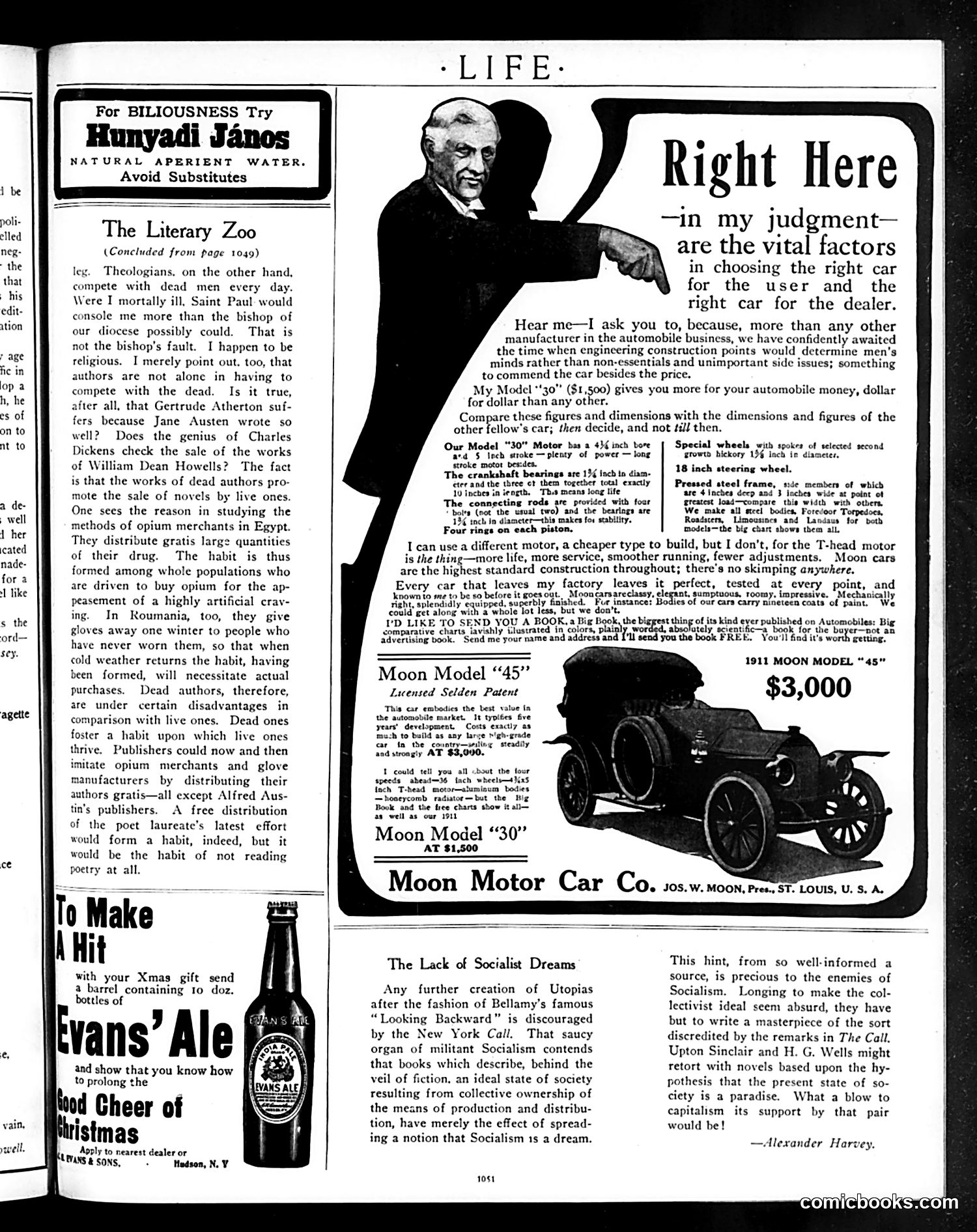
This page contains primarily **advertisements and literary commentary**, not political cartoons. The main image features a large silhouetted figure (identity unclear from image alone) making an argument about automobile manufacturing. The accompanying text discusses choosing the right car, emphasizing the Moon Motor Car Company's models as superior values. This appears to be **advocacy advertising** rather than satire—the company is making a genuine commercial pitch about construction quality and price. Below this, an article titled "The Lack of Socialist Dreams" critiques utopian socialist literature, arguing that books describing ideal socialist societies have lost credibility. The author suggests socialism itself has become discredited as a serious political proposition. The page also includes ads for Hunyadi János water and Evans' Ale, typical period advertising. Overall, this is a **commercial and opinion page** rather than satirical political commentary.
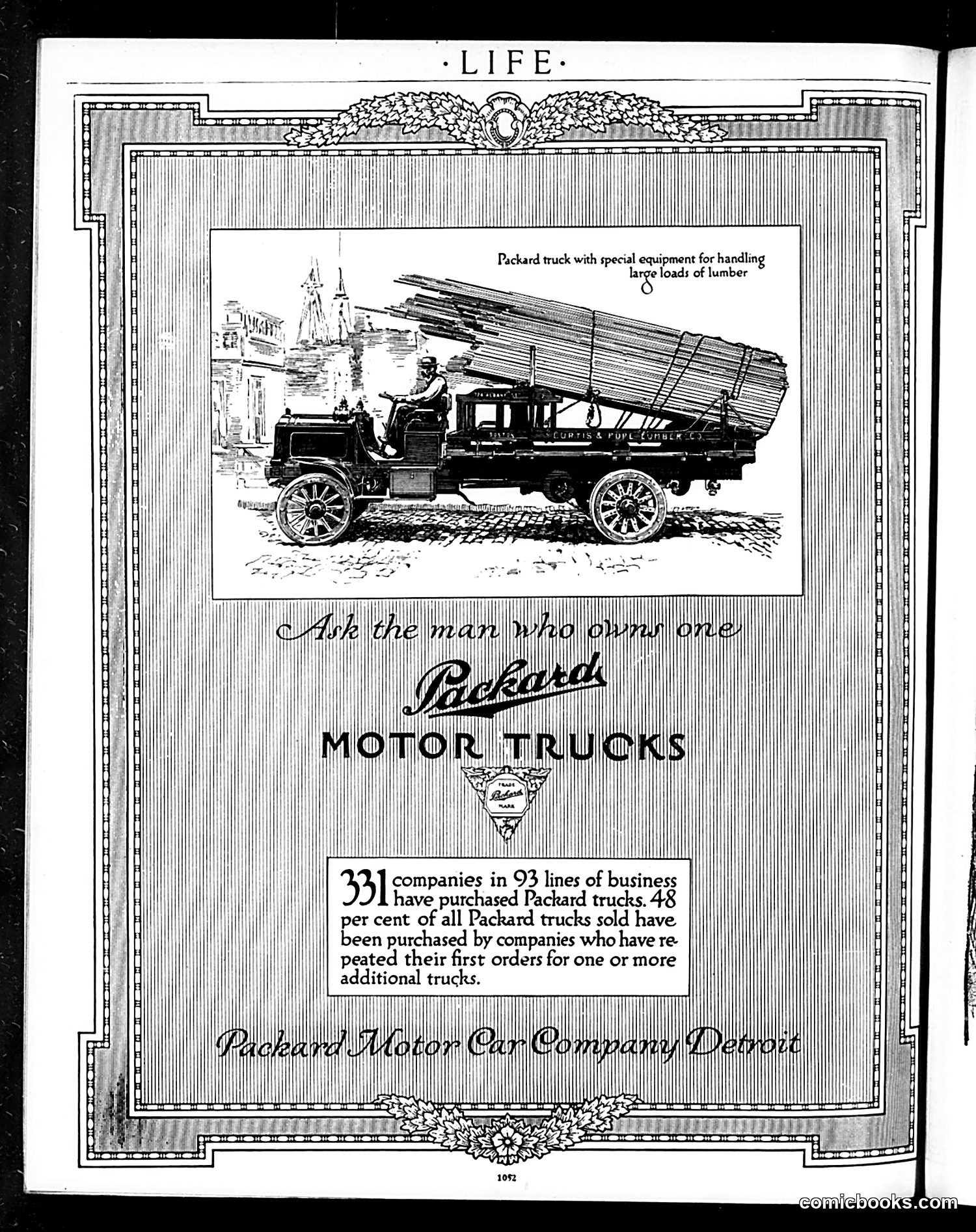
This is a **Packard Motor Car Company advertisement**, not political satire. The page promotes Packard motor trucks to a business audience in *Life* magazine. The ad features an illustration of a heavy-duty truck laden with large lumber loads, depicting practical commercial use. The headline urges readers to "Ask the man who owns one," a common advertising appeal to customer testimonials. The key sales pitch appears in the text box: 331 companies across 93 business lines have purchased Packard trucks, with 48 percent of buyers ordering additional vehicles—claiming strong repeat-customer satisfaction. The decorative borders and formal layout are typical of early-20th-century magazine advertising design. This is straightforward product promotion targeting business owners, not satirical commentary.
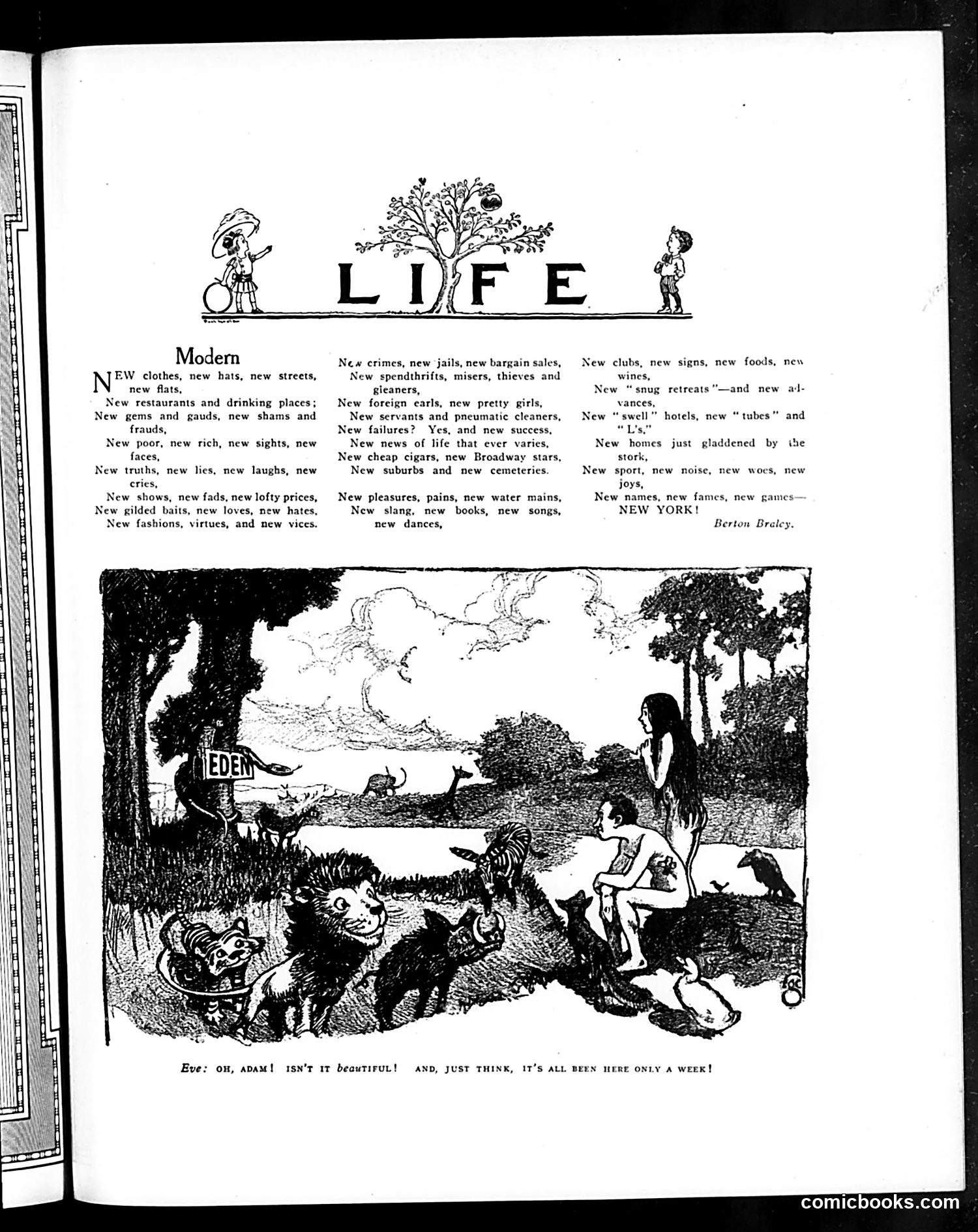
This page satirizes modern urban life in early 20th-century New York through poet Berton Braley's poem titled "LIFE." The text catalogs relentless novelty—new clothes, restaurants, crimes, dances, and fads—capturing rapid social change. The illustration below depicts the Garden of Eden with Adam and Eve surrounded by modern intrusions: a "EDEN" sign, automobiles, and contemporary figures. Eve's caption—"Oh, Adam! Isn't it beautiful! And just think, it's all been here only a week!"—is the joke's punchline. The satire contrasts paradise with modernity's chaos. Even in Eden, humanity cannot escape constant commercialization and manufactured "newness." The page mocks how Americans relentlessly pursue novelty while losing touch with simplicity, suggesting that modern life's relentless pace corrupts even paradise itself.
This page features an article about **Tolstoy**, the Russian author. The decorative initial letter shows a classical figure, standard for the era's typography. The article discusses Tolstoy's spiritual evolution and his attempts to apply Christian principles to life. It critiques his contradictions—particularly how he preached Christian ideals while remaining a landowner in Russia's rigid class system. The text references his political naiveté (comparing him unfavorably to Kansas insurgents) and suggests his methods wouldn't translate to American business or progress. The satire is **subtle**: the piece gently mocks Tolstoy's impractical idealism and his inability to truly live by his own Christian teachings within his social context. For 1916 readers, this would comment on the tension between intellectual philosophy and material reality in both Russian and American society.
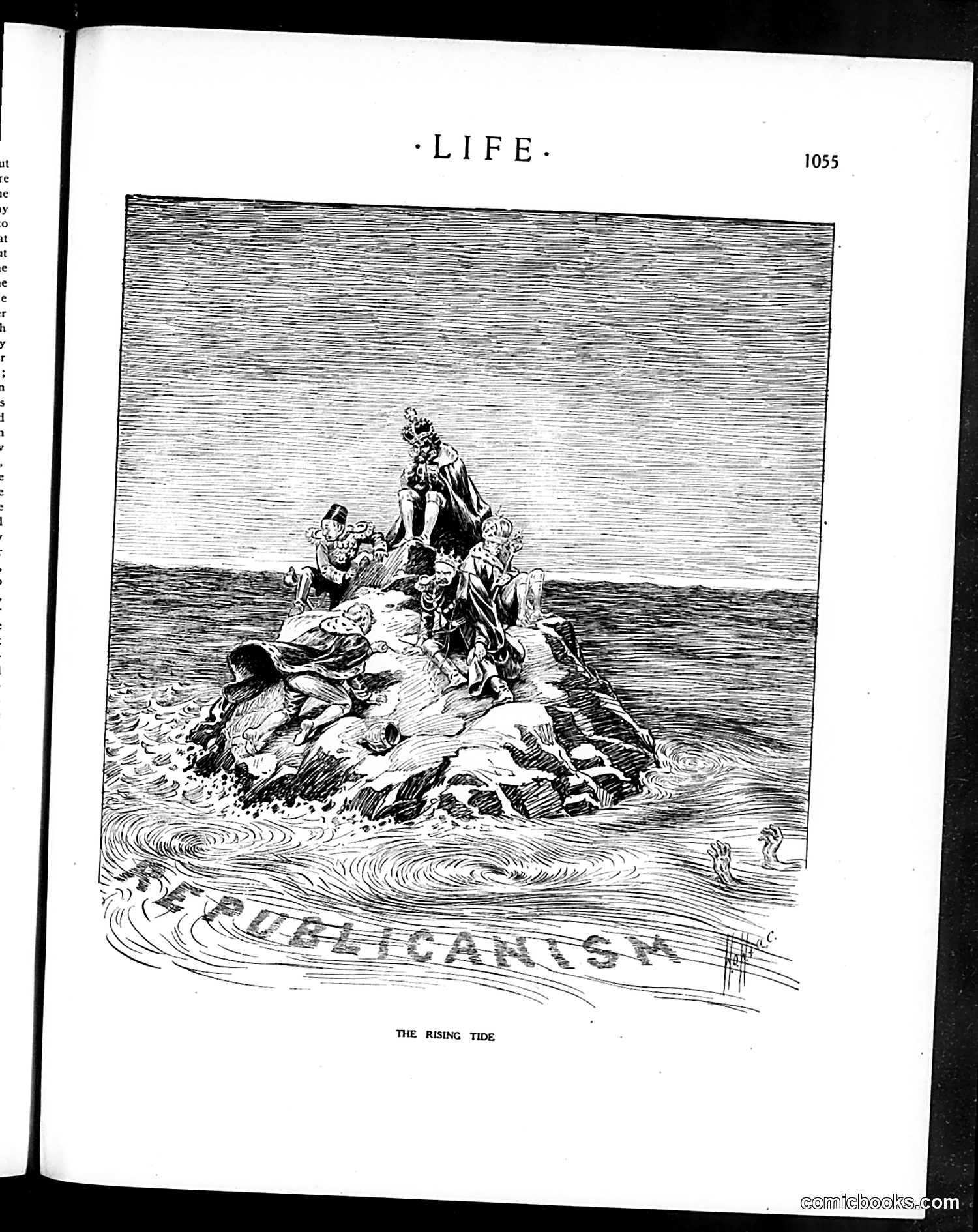
This political cartoon depicts a group of figures clinging to a rock as water rises around them, labeled "THE RISING TIDE." The figures appear to represent political or social establishment figures threatened by rising popular movement or change—likely referring to labor unrest, socialist/radical politics, or populist sentiment that was surging in early 20th-century America. The rock serves as their shrinking refuge as the tide (representing the masses or social upheaval) rises inexorably. The cartoon satirizes the establishment's precarious position against forces they cannot control. Without additional context from the magazine's date and surrounding articles, the specific political movement referenced remains unclear, though such imagery was common during periods of labor activism or radical political organizing.
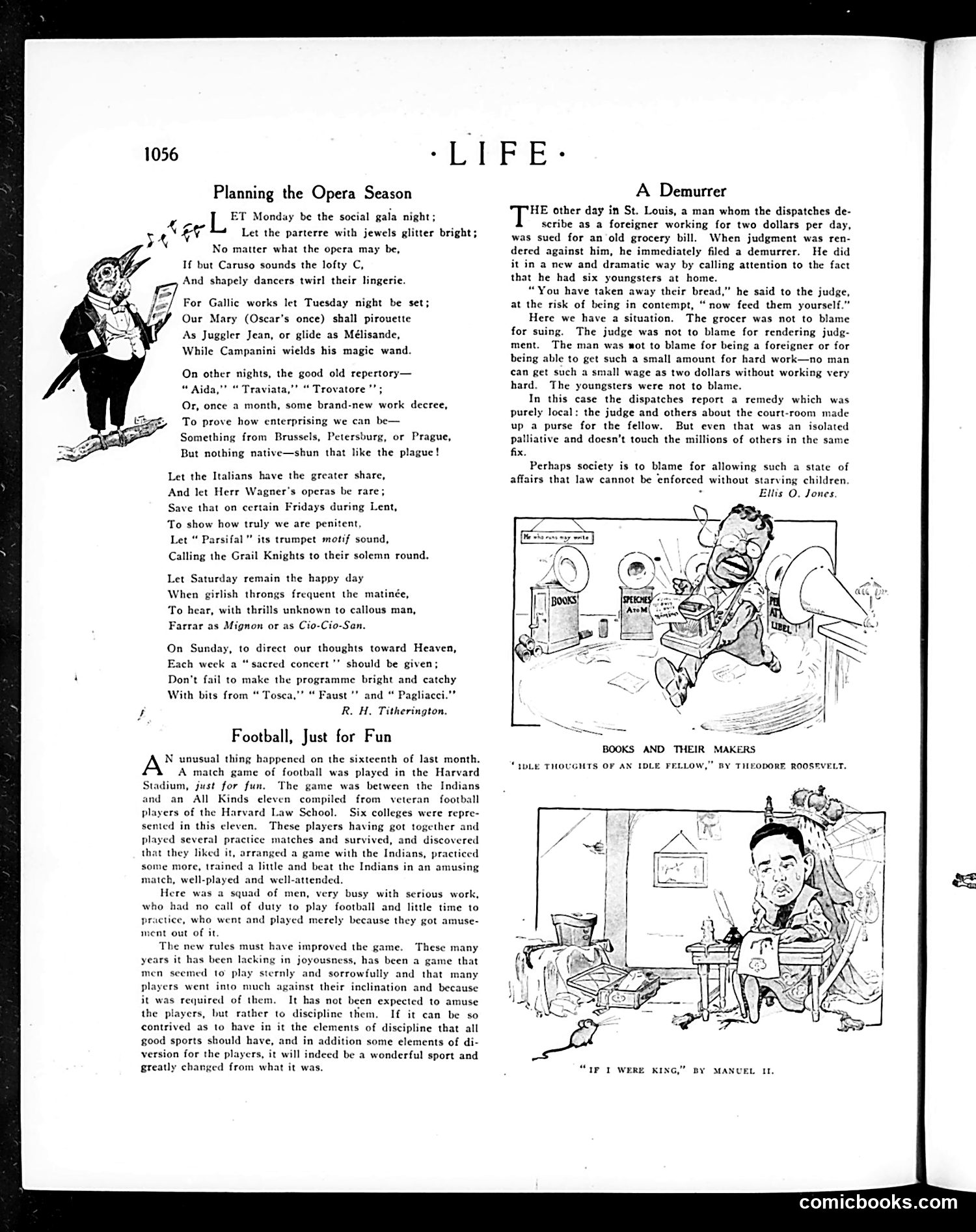
This page contains two main sections: **"Planning the Opera Season"** (top): A poem by R. H. Titherton humorously listing opera performances for the season, with an illustration of performers in period costume. The satire targets opera's perceived pretentiousness and foreign (particularly Italian) dominance of American cultural institutions. **"Football, Just for Fun"** (middle): An article describing an unusual Harvard Law School football game where newly-trained Indiana players defeated the law students. The piece argues this demonstrates football's potential as disciplined sport rather than mere amusement—suggesting contemporary concerns that American football had become chaotic and corrupting rather than character-building. **Two cartoon illustrations** appear below, including one captioned "If I Were King" by Manuel II, showing a figure surrounded by books and creative chaos—likely satirizing artistic pretension or bohemian lifestyle.
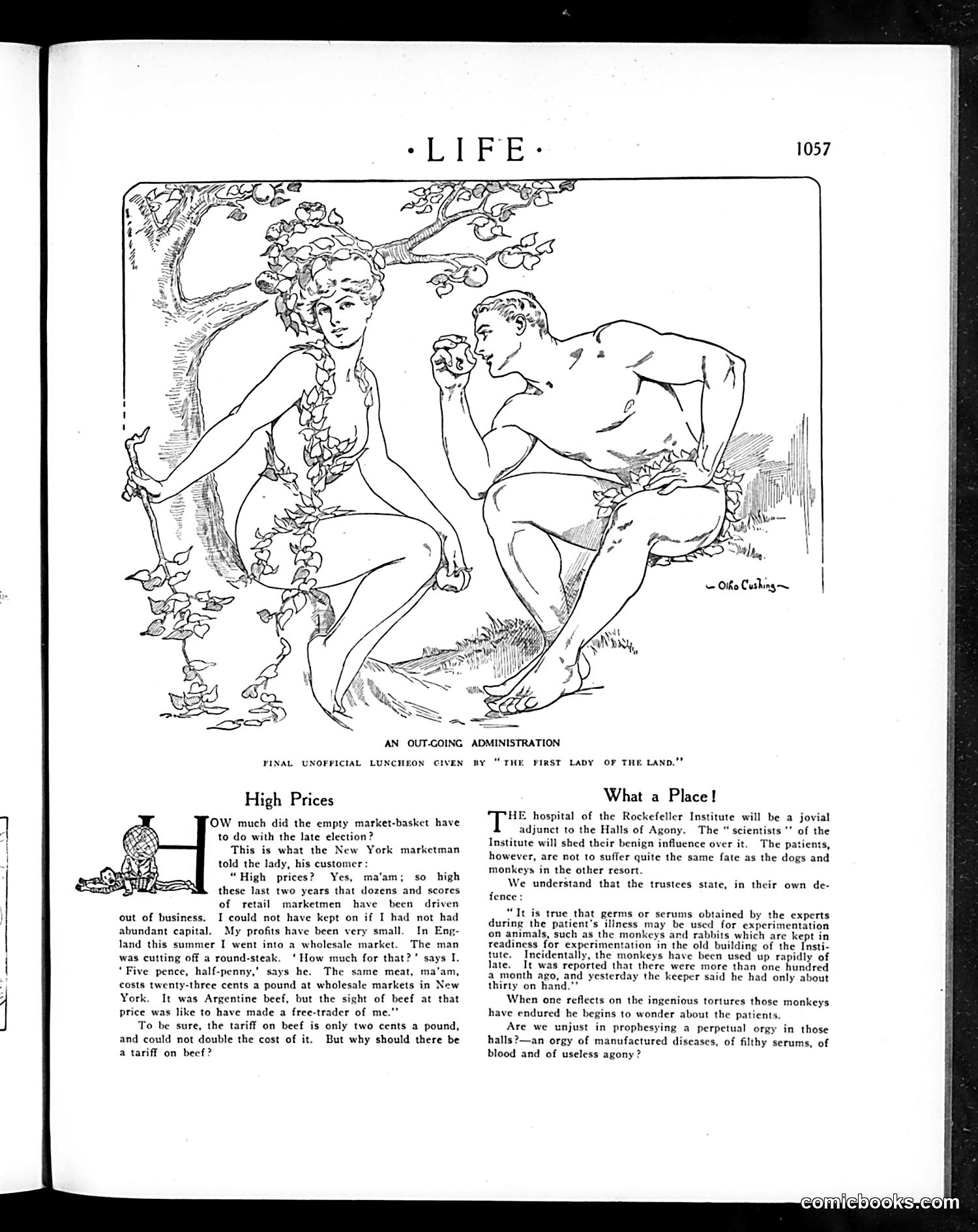
**The Cartoon:** The illustration depicts two cherubic figures beneath an apple tree, captioned "An Out-Going Administration: Final Unofficial Luncheon Given by 'The First Lady of the Land.'" This is political satire about a departing presidential administration. "The First Lady of the Land" likely refers to Lady Liberty or America itself, portrayed ironically as hosting a final meal. The apple tree references Eden—suggesting paradise lost or an administration ending in disgrace. **The Articles Below:** "High Prices" discusses post-war inflation and tariffs on beef, while "What a Place!" satirizes the Rockefeller Institute's plans to use monkeys for medical experimentation, critiquing both animal cruelty and the institution's arrogance. The page combines economic anxiety and institutional criticism typical of 1920s American satirical journalism.
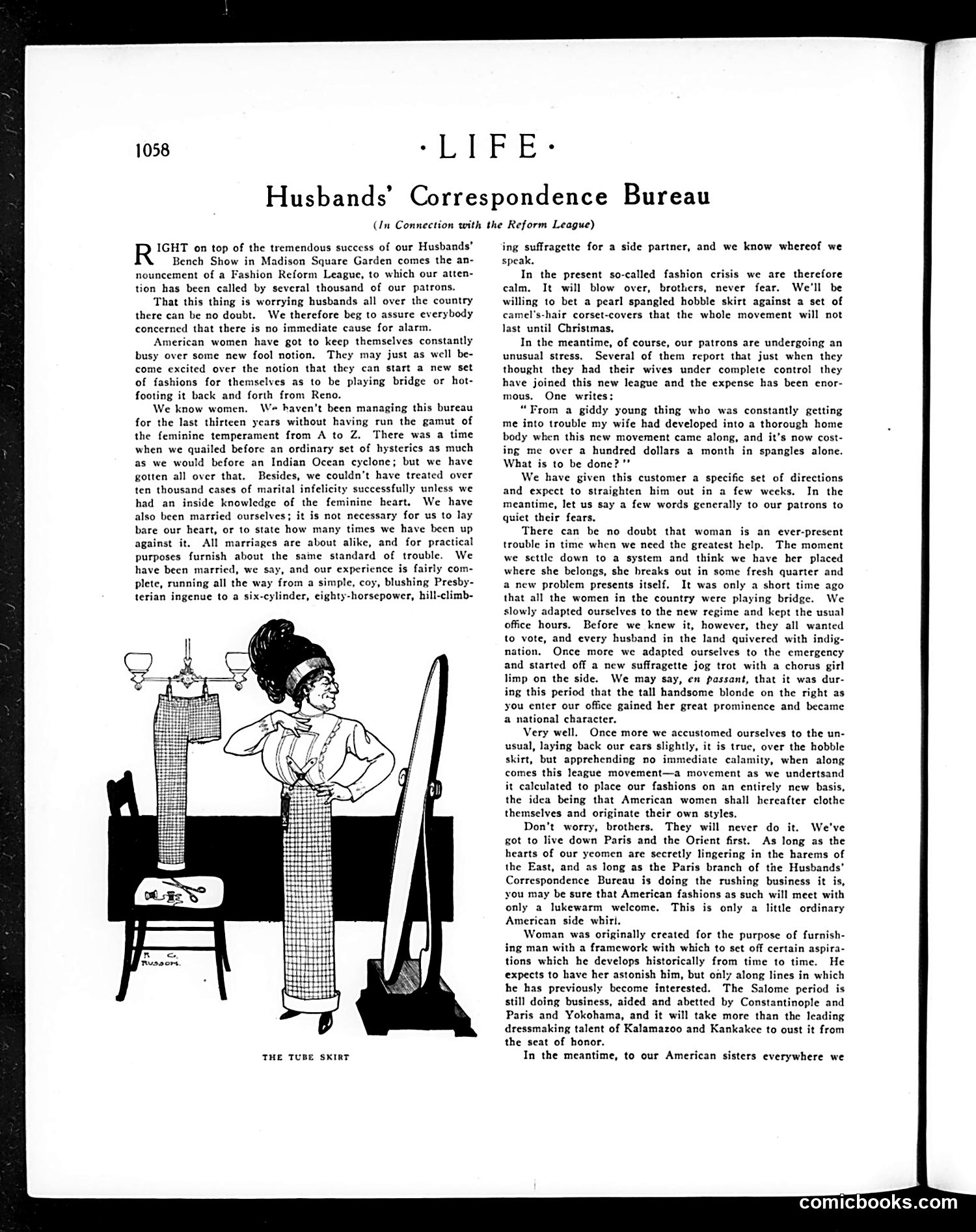
This is satirical commentary on women's fashion reform and suffrage movements of the early 1910s. The "Husbands' Correspondence Bureau" presents itself as an advice service helping men cope with their wives' involvement in these causes. The cartoon shows "The Tube Skirt"—a narrow, restrictive silhouette that was fashionable then. The satire mocks husbands' anxiety about women's independence: they fear losing control as wives join reform leagues, demanding new clothes and voting rights instead of staying home. The text is deliberately patronizing, treating women's activism as passing "fool notions" like bridge-playing or trips to Reno (divorce destination). The author claims expertise in "feminine temperament" while admitting marriage is troublesome—positioning women as inherent problems requiring management. The joke targets anxious husbands and dismisses women's legitimate reform efforts as frivolous, reflecting the era's resistance to suffrage and women's autonomy.
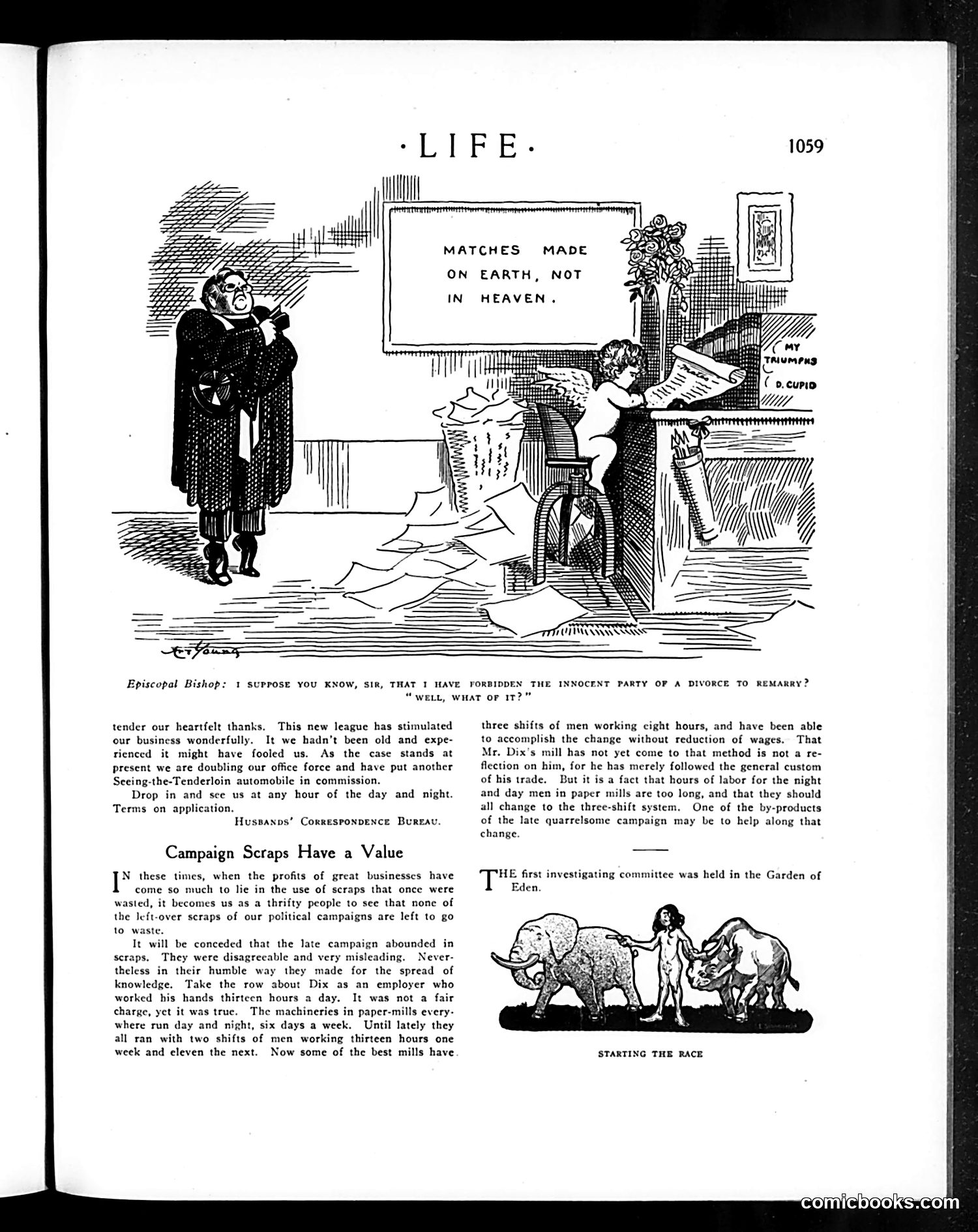
The top cartoon satirizes the Episcopal Church's divorce policies. An Episcopal Bishop confronts a man about remarrying after divorce, insisting the church forbids the "innocent party" from remarrying. The man's dismissive response ("Well, what of it?") mocks the Bishop's moral authority—suggesting the church's rules are out of touch with modern attitudes and unenforceable against those who simply ignore them. Below, "Campaign Scraps Have a Value" argues that despite being "disagreeable and misleading," negative campaign claims serve a purpose: they spread awareness of labor issues. The piece cites criticism of employer "Dix" for working men thirteen-hour days, acknowledging this attack was unfair but factually accurate. It advocates reform toward eight-hour shifts, suggesting even dirty campaign tactics can produce beneficial social change. The bottom cartoon appears to reference Adam and Eve as humanity's "first investigating committee"—likely commenting on original sin or human nature's investigative origins.
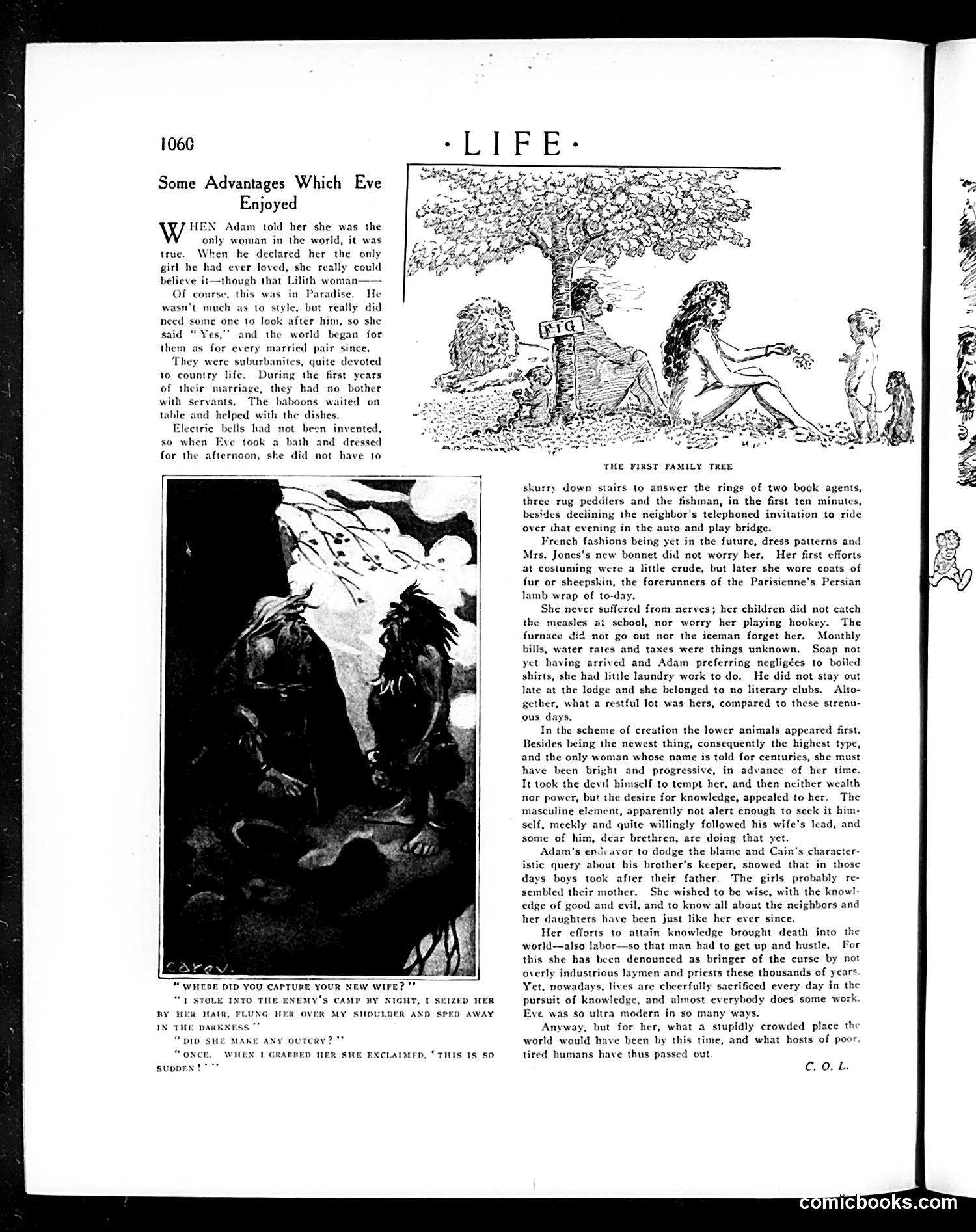
This is a humorous essay contrasting Eve's life in Paradise with modern (early 1900s) married women's lives. The small cartoon depicts a caveman-era couple, illustrating the text's ironic premise: that Eve enjoyed remarkable advantages. The satire argues Eve had it easy—no servants to manage, no electric bills, no neighbors dropping by, no laundry, no social obligations. The essay's real target is modern married women burdened by domestic complexity, servants who need managing, social expectations, and constant interruptions. The cartoon's dialogue ("Where did you capture your new wife?") plays on primitive courtship, humorously contrasting ancient simplicity with modern complications. The essay's final point is backhanded praise: Eve's disobedience brought knowledge and progress to humanity, though it also brought labor and death—implying modern women's restlessness and desire for knowledge (like Eve's) creates the stress they now endure. The overall tone mocks both traditional domesticity *and* modern women's aspirations.
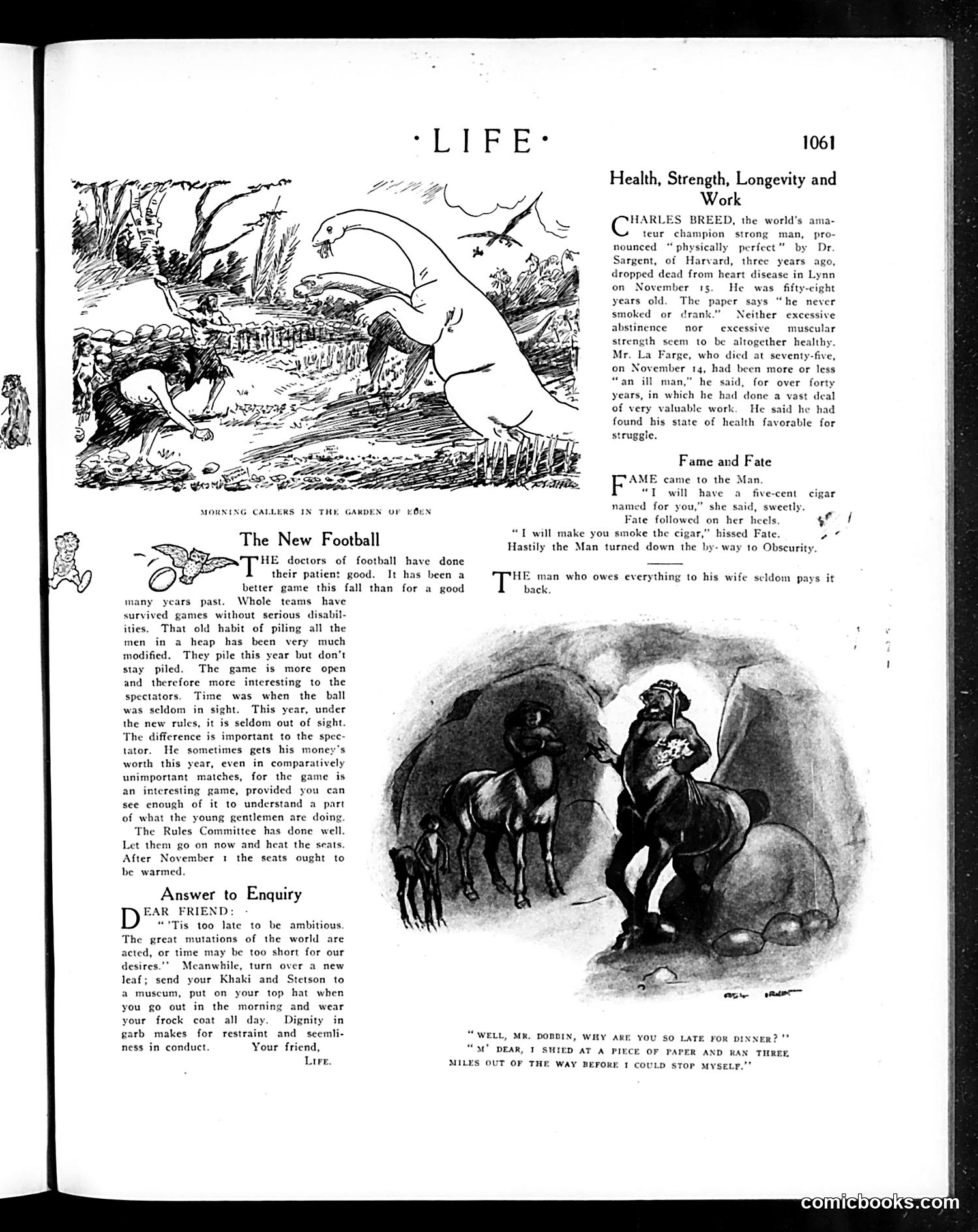
This page contains several satirical pieces typical of Life's social commentary: **"Health, Strength, Longevity and Work"** opens with the ironic deaths of Charles Breed (a celebrated "physically perfect" strong man) and Mr. La Farge (chronically ill but productive). The satire suggests that extreme health obsession and muscular perfection don't guarantee longevity—implying early 1900s anxieties about physical culture movements were misguided. **"Fame and Fate"** is a brief morality tale: Fame offers a man a five-cent cigar; Fate forces him to smoke it, driving him toward obscurity. This satirizes how small temptations or choices lead to ruin. **"The New Football"** praises recent rule changes that keep the ball visible and reduce dangerous pile-ups, making the sport more spectator-friendly. It's gentle advocacy for modernized sports safety. **"Answer to Enquiry"** advises an aspiring man that ambition is too late; instead, wear formal dress for dignity and restraint. The bottom cartoon shows a horse that shied at paper during a three-mile panic—humorous commentary on irrational animal behavior, possibly reflecting on human irrationality.
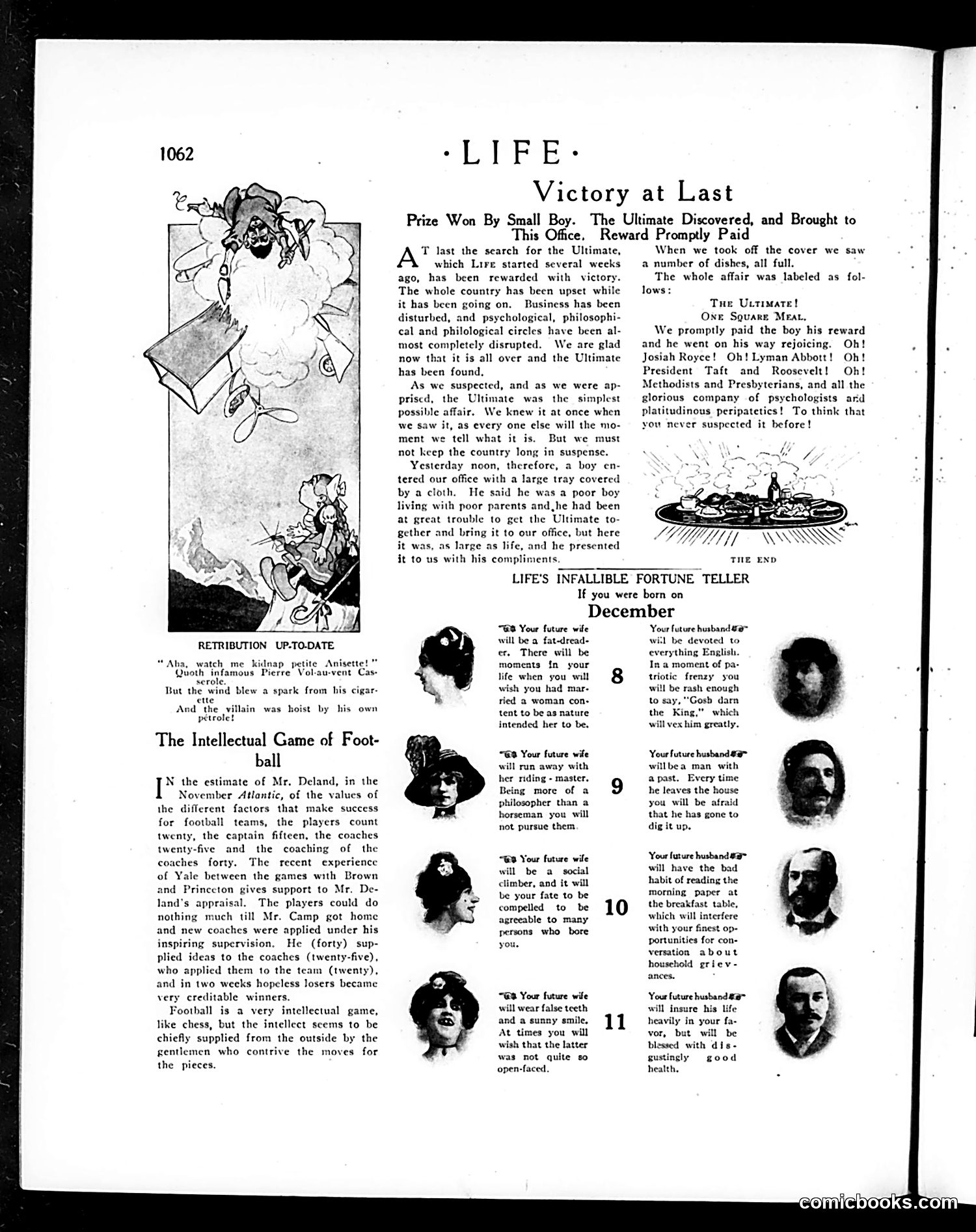
This page contains **two unrelated pieces of satire**: **"Retribution Up-to-Date"** (top left): A brief comic verse about a villain named Pierre Volau-vent Casserole who attempts to kidnap a woman but is foiled when his own cigar spark ignites petroleum/oil on him—he's destroyed by his own actions. It's a pun-heavy joke playing with French names and the word "pétrole." **"The Intellectual Game of Football"** (middle): Critiques Yale football's recent turnaround, arguing that coaching strategy matters far more than players themselves. It compares football to chess, suggesting the "pieces" (players) are moved by outside intellects (coaches). This satirizes the cult of coaching expertise in early 1900s college sports. **"Victory at Last"** (right): A humorous "Ultimate" prize joke—Life magazine had apparently run a contest seeking "the Ultimate," and the winner brought in a tray of dishes labeled "One Square Meal." The satire mocks philosophical pretension by reducing grand intellectual pursuits to basic food. The fortune-teller section is unrelated filler content about December births and marriage predictions.
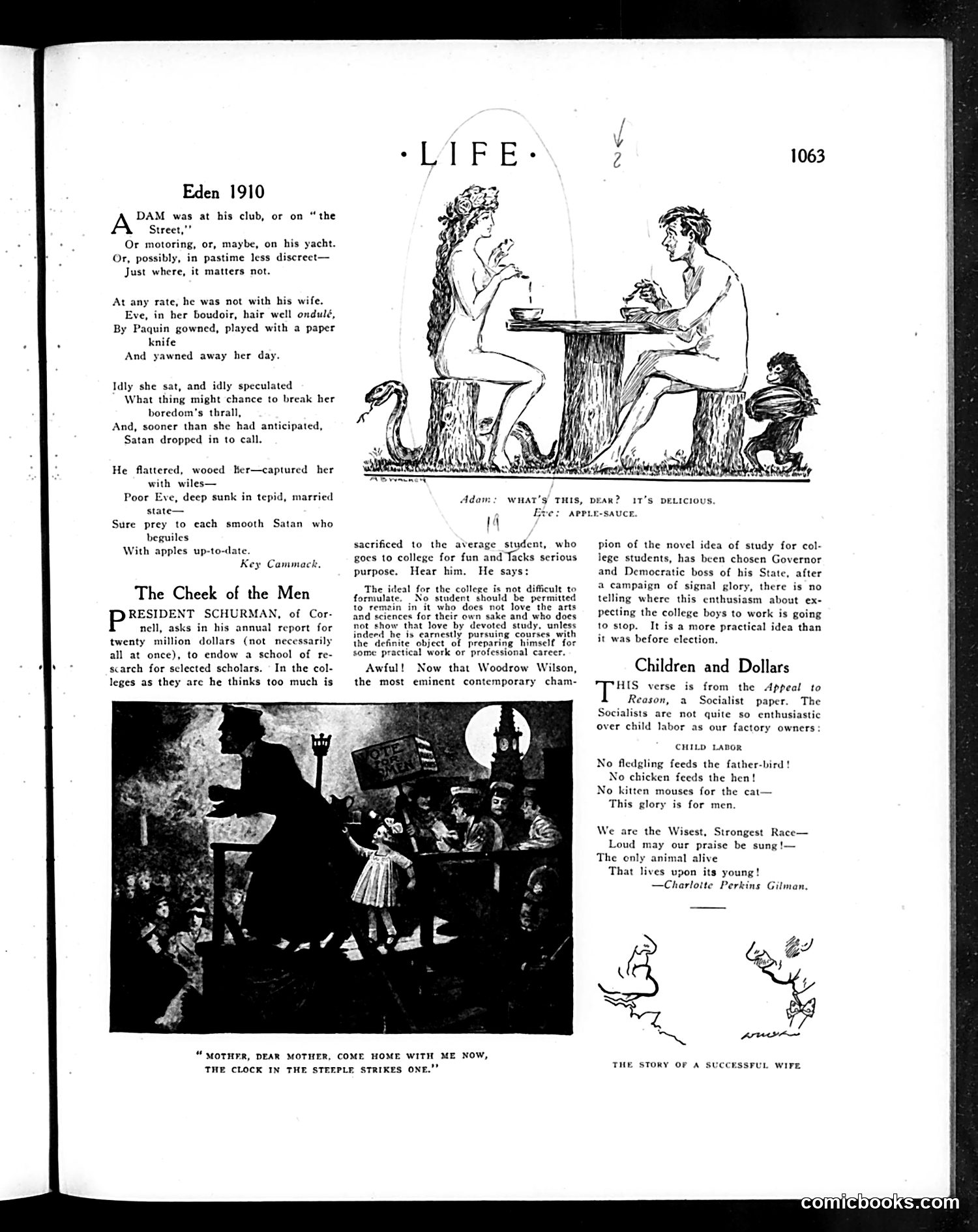
This page contains multiple satirical pieces mocking early 1900s upper-class gender dynamics and educational philosophy. **"Eden 1910"** (top) updates the Adam-and-Eve myth to mock married boredom. A neglectful husband frequents clubs, yachts, and unspecified entertainments while his fashionably dressed wife (Eve) sits idle at home. Satan's "temptation" arrives as modern "apples up-to-date"—suggesting contemporary temptations lure neglected wives. The humor satirizes how wealthy marriages isolate women while men enjoy freedom. **"The Cheek of the Men"** criticizes Cornell President Schurman's proposal to fund elite research universities excluding average students. Life sarcastically endorses this "practical" elitism, noting even newly elected Governor Woodrow Wilson supports rigorous academic standards. **"Children and Dollars"** (bottom) reprints Socialist verse from *Appeal to Reason* mocking American industrialization. It argues humans alone exploit their young through child labor—contrasting this with animals that nurture offspring, attacking factory owners' reliance on child workers. The page targets class privilege, marital inequality, and labor exploitation.
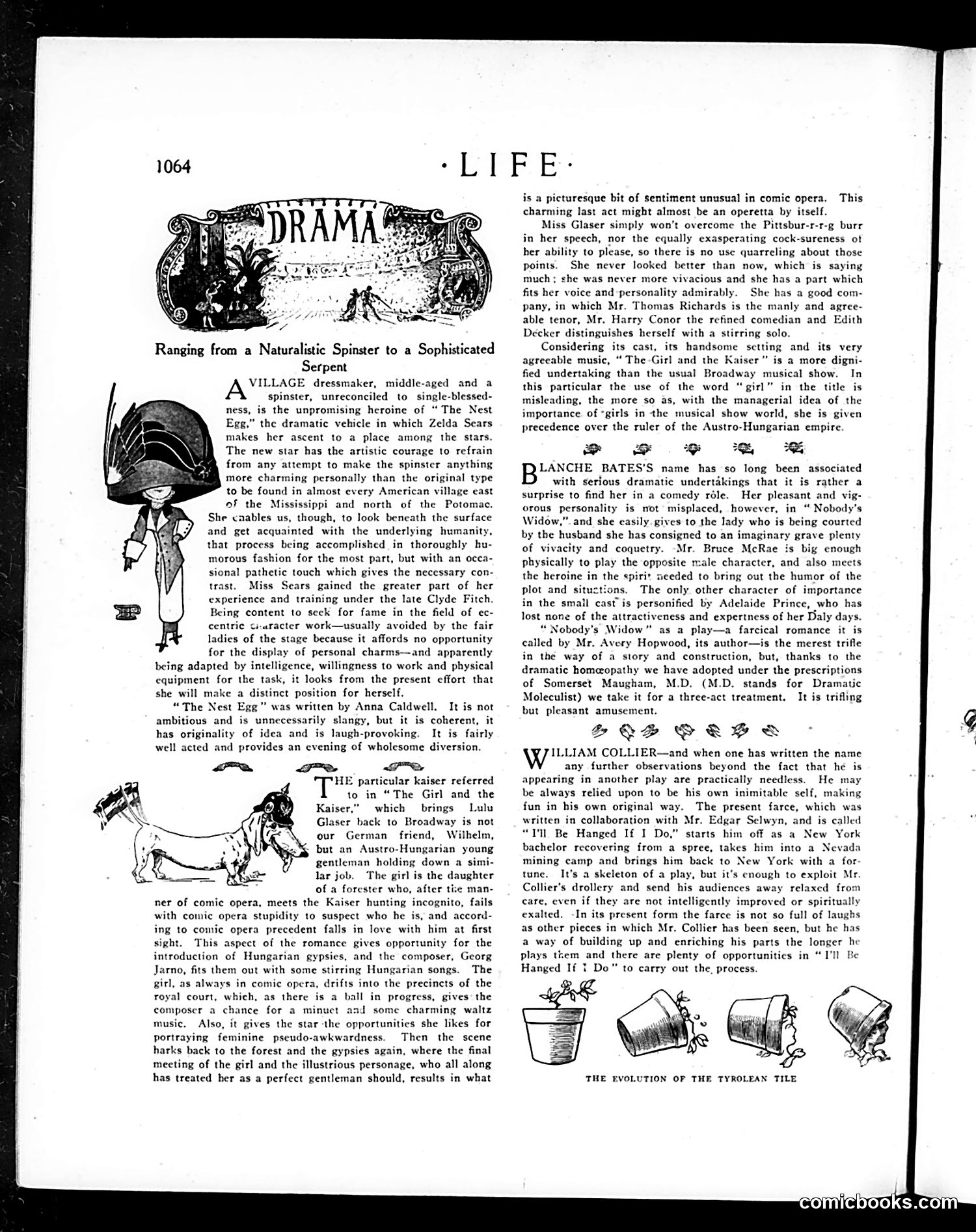
This page reviews two Broadway theatrical productions. The main content discusses "The Nest Egg," starring actress Zelda Sears as an unmarried village spinster—a rare choice since stage actresses typically avoided unglamorous character roles. The review praises her courage in accepting this unflattering but humanizing part, written by Anna Caldwell. The secondary review covers "The Girl and the Kaiser," a comic operetta featuring an Austro-Hungarian (not German) kaiser who falls in love with a forester's daughter. The plot follows typical operetta conventions: secret royal identity, Hungarian gypsies, elaborate court balls, and romantic sentiment. The review notes star Lulu Glaser's vivacity and appearance, though criticizes her Pittsburgh accent, while praising the male leads and the production's sophistication compared to typical Broadway musical fare. Both reviews exemplify early 20th-century theater criticism focused on character acting and production quality.
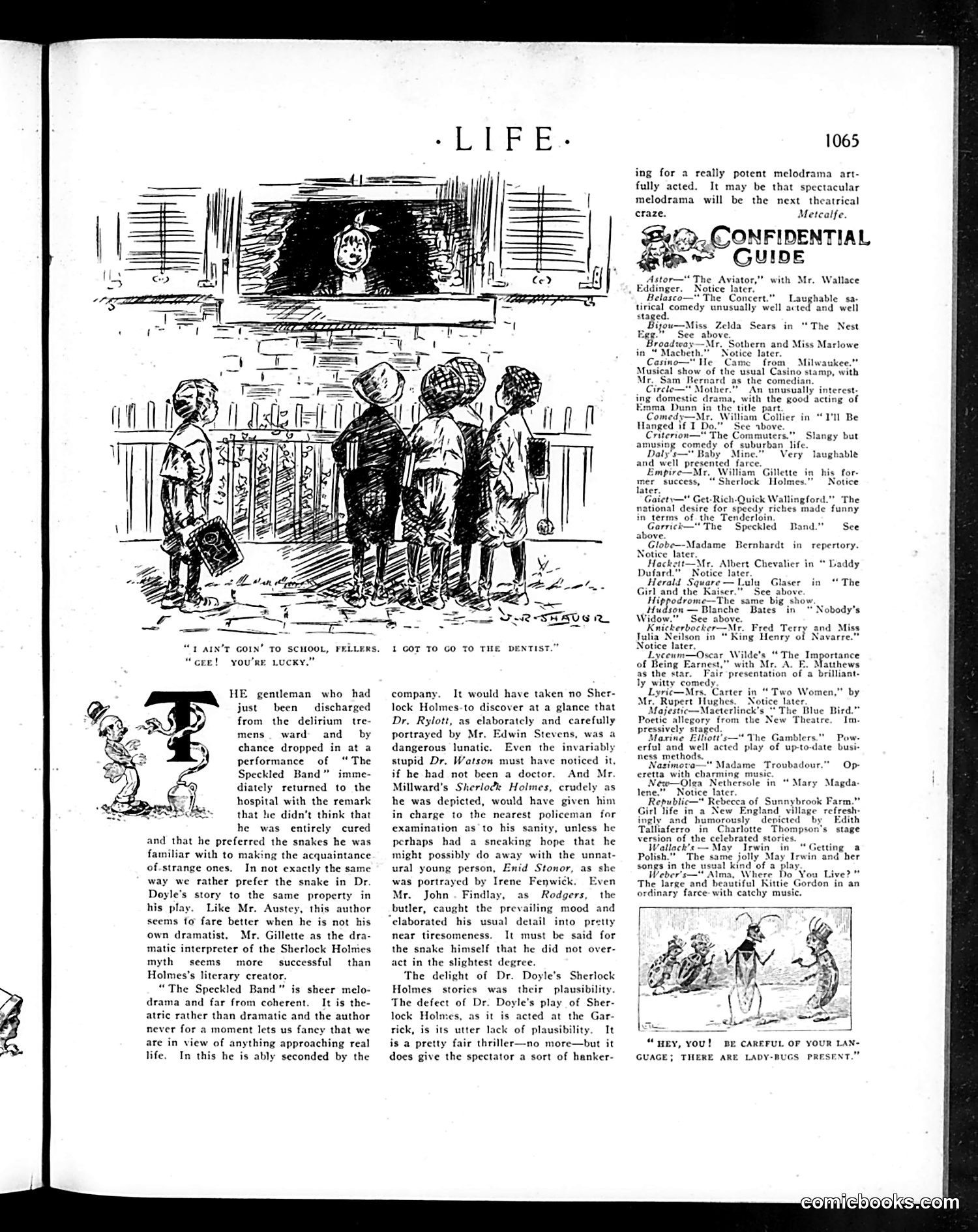
**Main Cartoon:** The top illustration shows children outside a theater, with one saying "I ain't goin' to school, fellers. I got to go to the dentist"—a joke about preferring dental work to school. **Primary Content:** A theater review of "The Speckled Band," a stage adaptation of Arthur Conan Doyle's Sherlock Holmes story, performed at the Garrick Theatre. The critic (identified as Metcalfe) argues the play lacks the plausibility that made Doyle's original stories successful. The review notes that Mr. Millward plays Holmes "crudely," and praises only the snake character for not "over-acting." **The Satire:** The opening anecdote compares the play's implausibility to a delirious patient seeing snakes—suggesting the theatrical production is equally unrealistic and disturbing. The critic finds it mere "melodrama" rather than genuine drama, criticizing the cast's exaggeration. **Bottom Section:** A "Confidential Guide" listing current Broadway and theater productions with brief reviews.
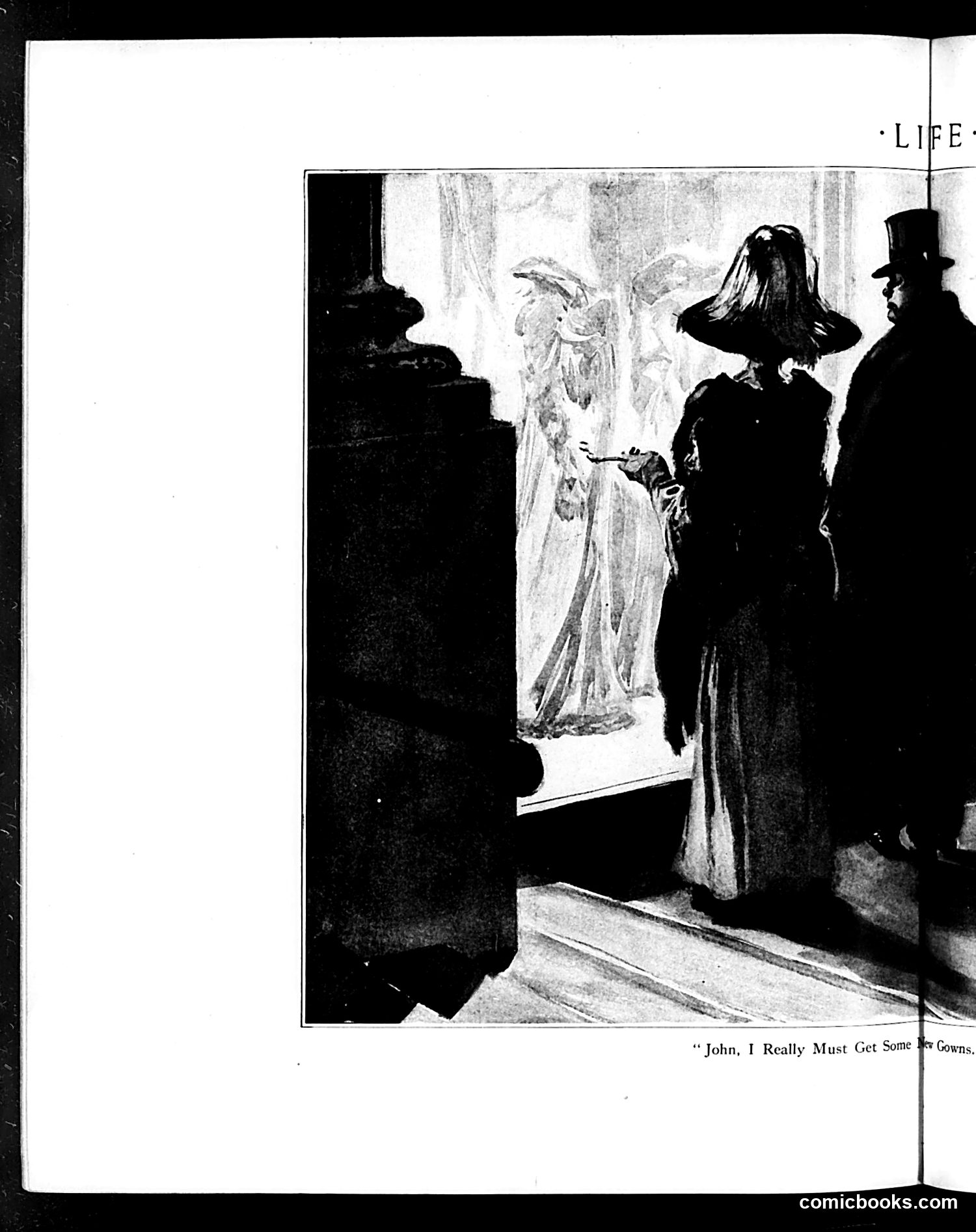
This appears to be a satirical cartoon from *Life* magazine depicting a domestic scene. A woman in fashionable attire points to a display window while speaking to a man beside her, saying "John, I Really Must Get Some New Gowns." The cartoon satirizes consumer spending habits and materialism, likely from the early-to-mid 20th century based on the clothing styles and illustration technique. The woman's insistence on acquiring new clothing, despite presumably already owning garments, mocks the perceived frivolousness of female shoppers and the pressure of fashion consumption. The silhouetted figures in the foreground and the window display create a voyeuristic quality typical of *Life*'s social commentary cartoons, using everyday marital situations to critique broader cultural values around spending and fashion.
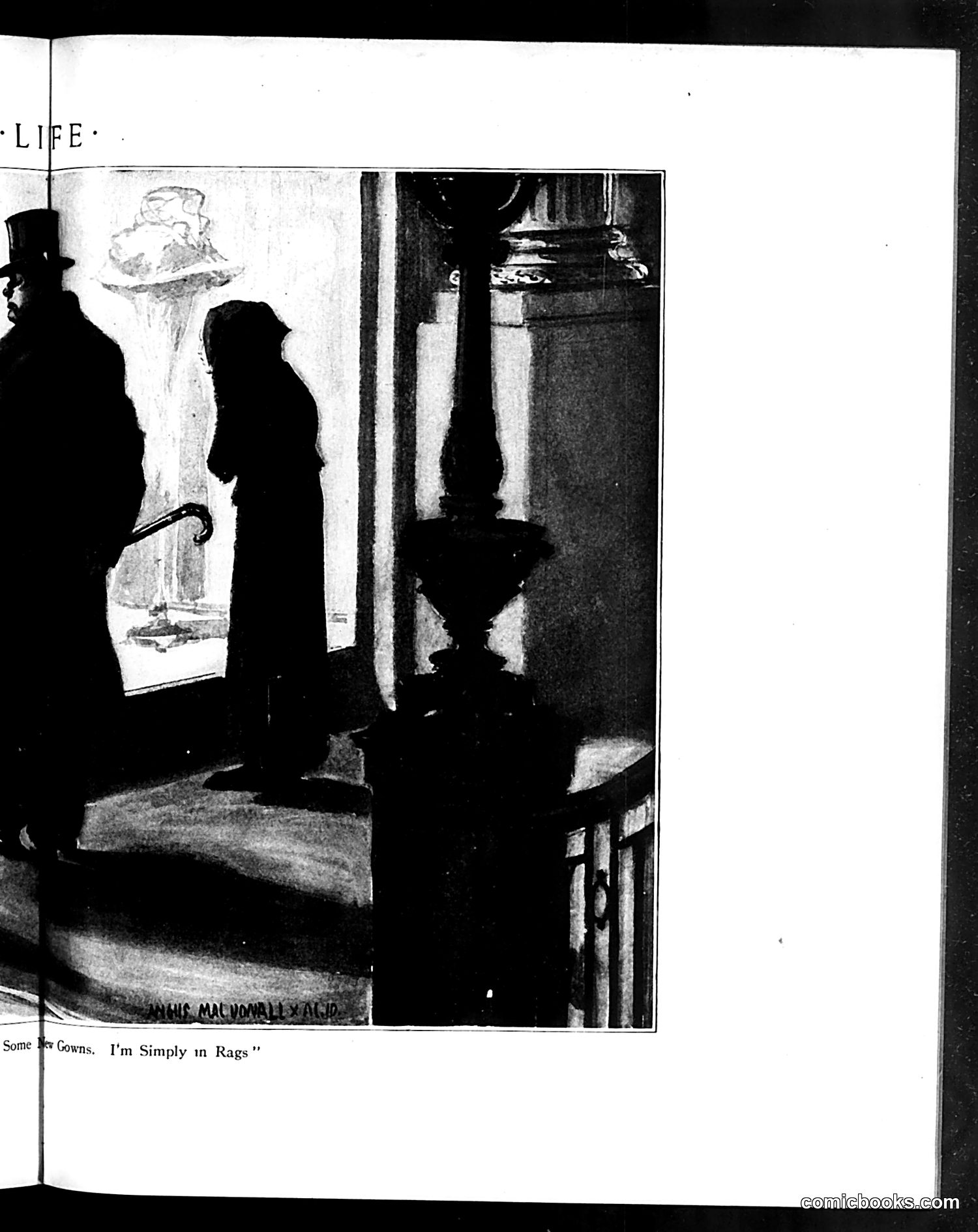
This Life magazine page shows a satirical scene titled "Some Gowns, I'm Simply in Rags." The image depicts silhouetted figures in what appears to be an elegant interior—likely a fashion salon or wealthy home—examining or displaying garments. The satire appears to target **fashion pretension and wealth disparity**. The phrase "simply in rags" is ironic—suggesting someone claiming poverty while actually dressed in fine clothing in a luxurious setting. This mocks the affectations of wealthy women who complain about their wardrobes despite obvious affluence. The stark silhouettes emphasize the figures' poses and posturing rather than individual identity, suggesting the cartoon critiques the superficiality and vanity of fashion-obsessed high society during this period. The exact publication date remains unclear from this page alone.
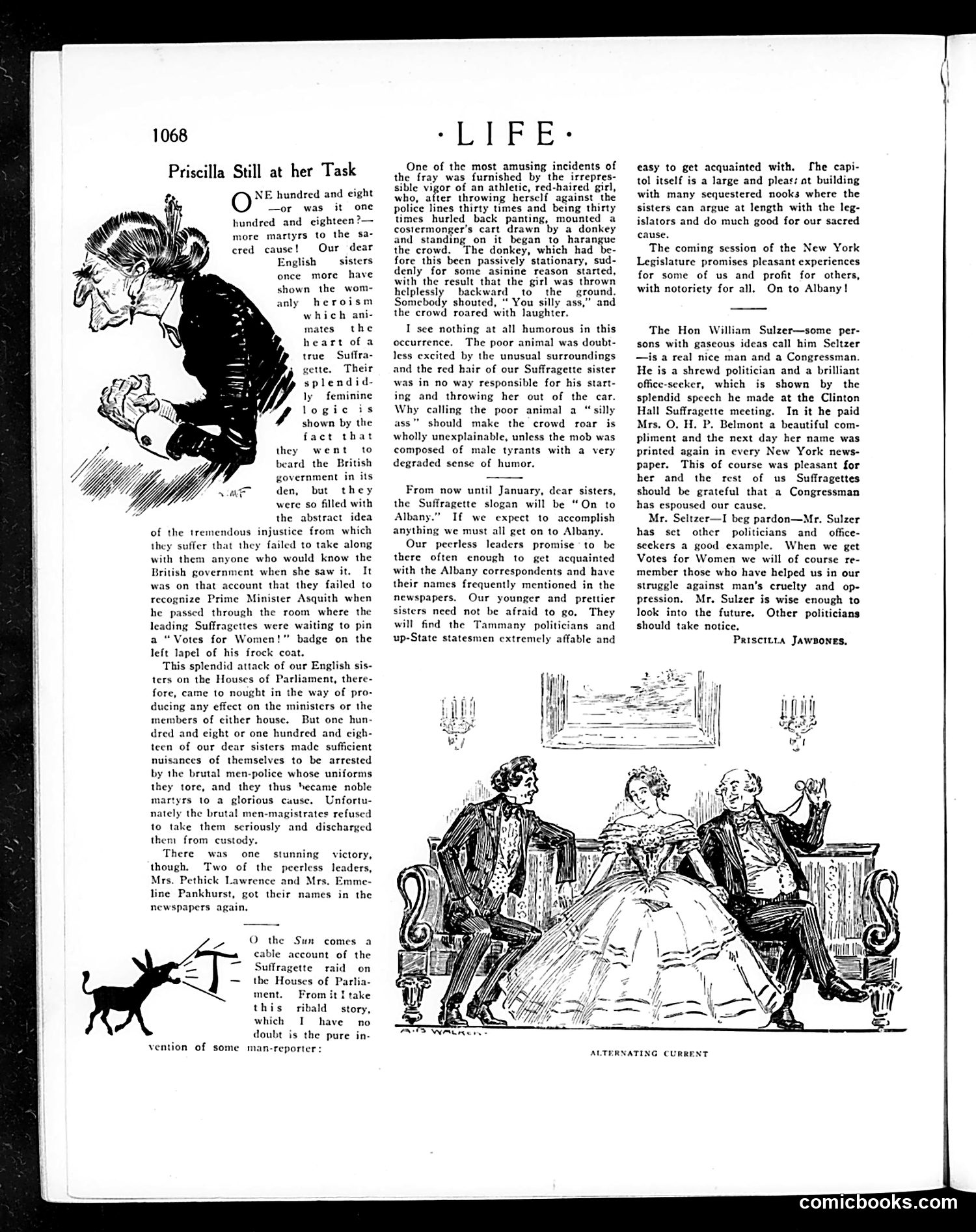
This page satirizes the British suffragette movement, particularly their 1909 raid on Parliament. The author mocks their ineffectiveness: they arrested 100+ women but failed to even locate Prime Minister Asquith to pin their "Votes for Women!" badge on him. The magistrates released them without serious charges. The satire extends to their planned "On to Albany" campaign targeting New York legislators. The author sarcastically "warns" younger, prettier sisters that they'll find Tammany politicians "extremely affable"—implying predatory interest rather than political engagement. He suggests the sequestered Capitol nooks offer opportunity for "argument," clearly meant as innuendo. The cartoon at top depicts Priscilla—a suffragette character—at her "task." The lower illustration ("Alternating Current") shows three figures in a drawing room, likely satirizing the romanticized notion of political persuasion through feminine charm. Overall, Life ridicules both suffragettes' tactical failures and their reliance on femininity as political strategy.
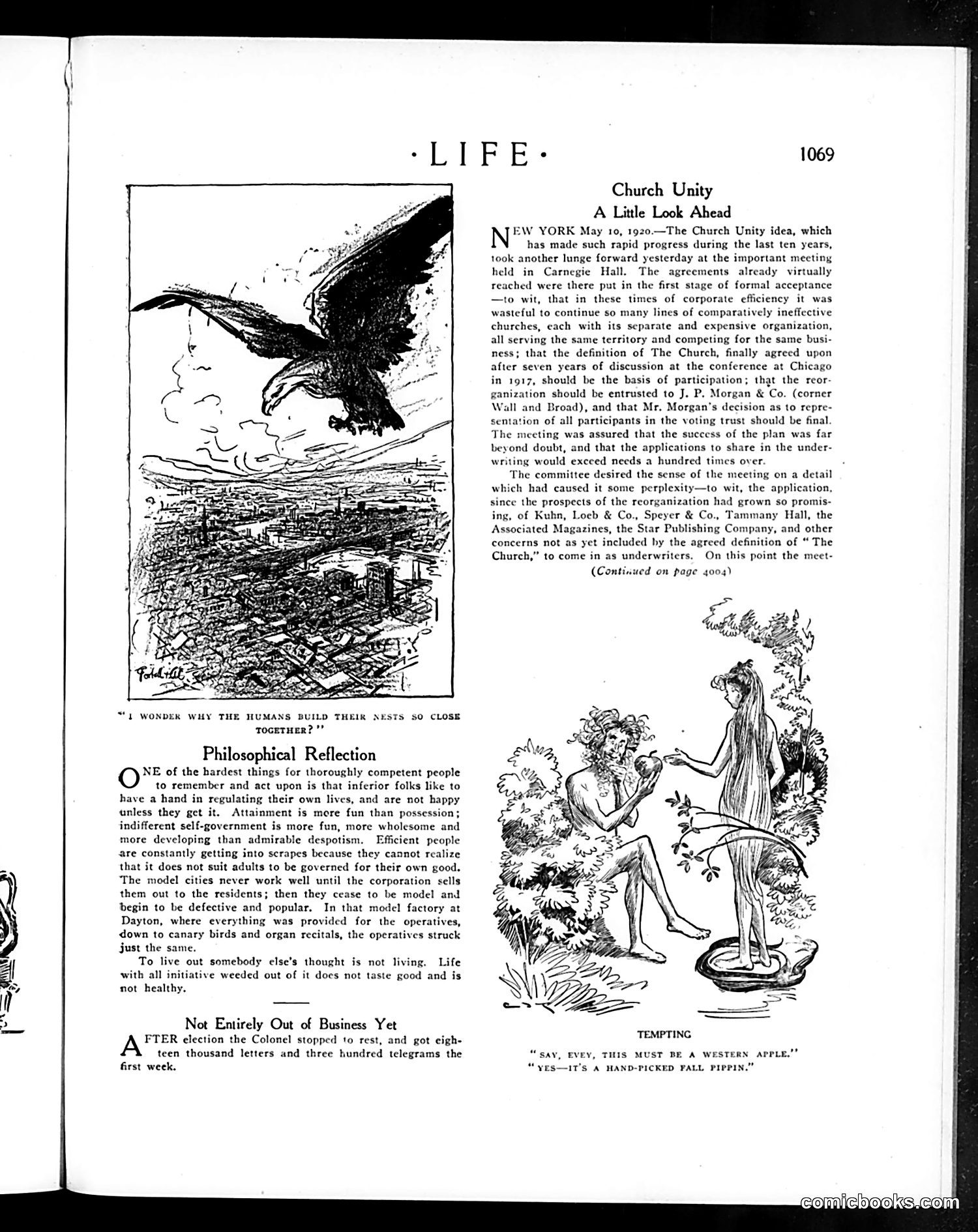
**Top Cartoon**: An eagle observes a densely packed cityscape, wondering why "humans build their nests so close together." This satirizes urban overcrowding and inefficient city planning. **"Philosophical Reflection"**: A lengthy editorial criticizing paternalistic management. It argues that even poorly self-governed people prefer autonomy to benevolent dictatorship—citing a model factory in Dayton where workers struck despite being provided comforts like "canary birds and organ recitals." The piece mocks efficient elites who cannot accept that ordinary people value agency. **"Church Unity" Article**: A satirical account of a May 10, 1920 Carnegie Hall meeting proposing church consolidation. The satire lies in its business-like tone: reorganization would be "entrusted to J.P. Morgan & Co.," with Morgan having final say on voting representation. This mocks the application of corporate efficiency to religious institutions, and the absurdity of financial firms seeking to "underwrite" churches. **Bottom Cartoon ("Tempting")**: A woman tempts another with an apple, claiming it's a "Western apple"—actually a "hand-picked Fall Pippin." This is mild wordplay on apple varieties and deception.
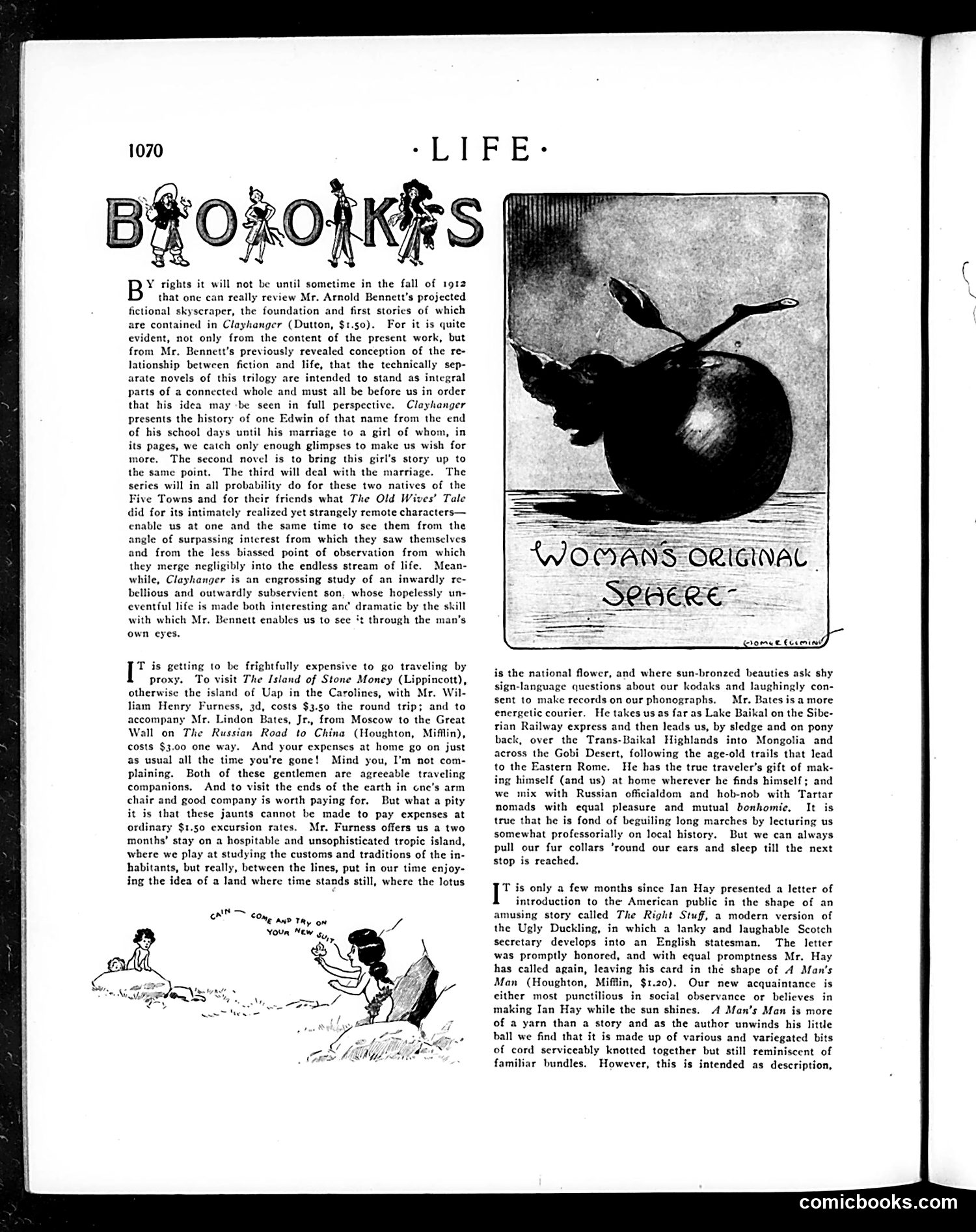
This page from *Life* magazine (circa 1912) contains two main elements: **Book Reviews Section ("Brookoks"):** The text discusses Arnold Bennett's novel *Clayhanger*, praising his technique of presenting characters from both their internal perspective and external observation. It's a serious literary critique. **Travel Books Satire:** The second section mocks the growing trend of armchair travel through expensive guidebooks. The author notes that visiting remote locations (Stone Money island in the Carolines, the Great Wall via Russia) costs $3.50-$3.00 through these books, while home expenses continue unchanged—an absurd financial reality. The satire targets how readers use such books to fantasize about exotic locales ("where the lotus is the national flower") rather than genuinely engage with foreign cultures, and how travel writers present themselves as sophisticated guides ("hob-nob with Tartar nomads"). The small cartoon at bottom-left appears to illustrate this armchair travel concept, showing someone comfortably at home while supposedly experiencing distant adventures.
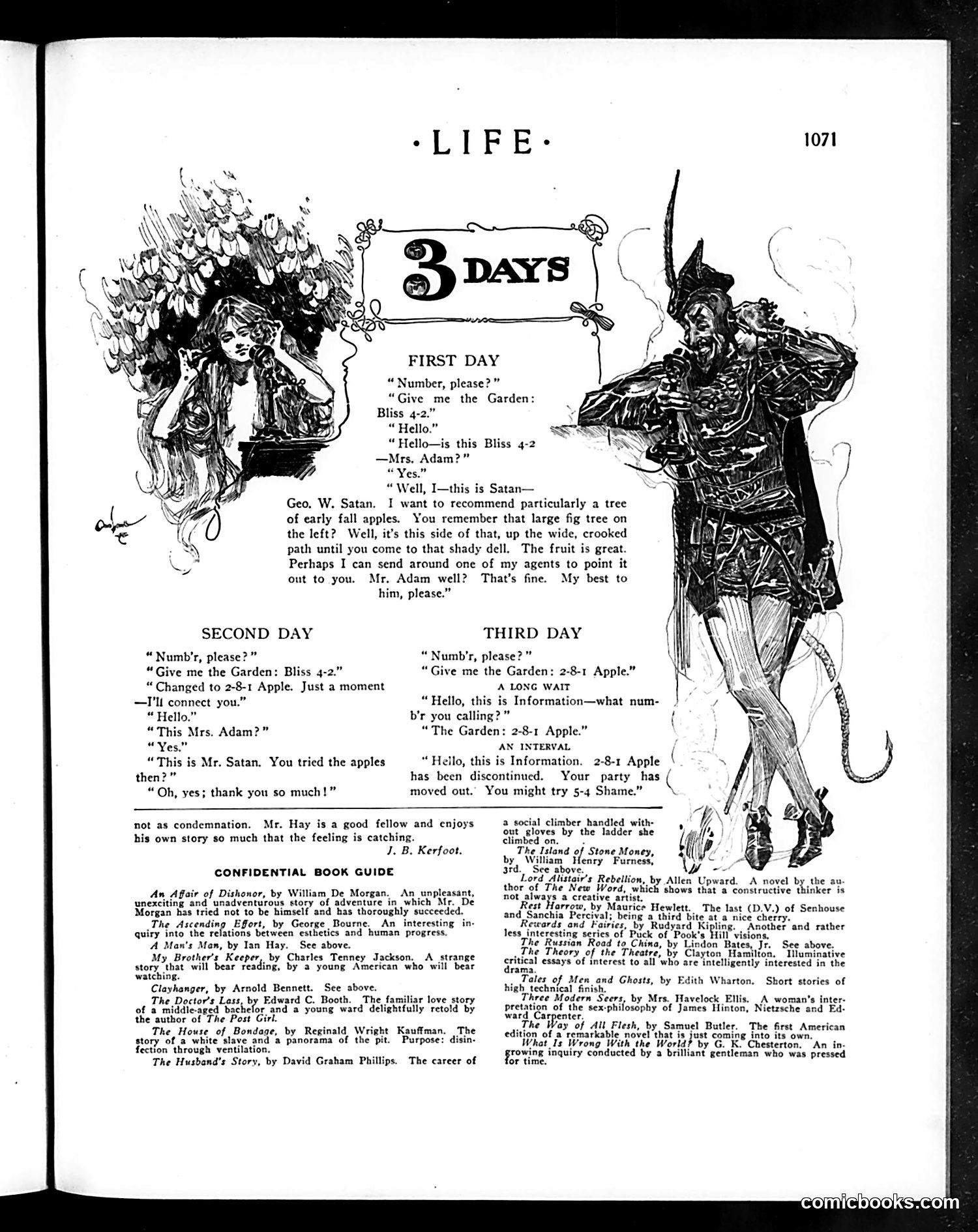
This cartoon depicts the biblical Fall of Man through a darkly comic telephone exchange. Satan (caricatured as a demonic figure on the right) calls Mrs. Adam in the Garden of Eden, recommending forbidden fruit—initially framed as innocent apples. Over three days, the narrative shows temptation's progression: Mrs. Adam initially resists, then succumbs, and finally loses everything when "the Garden: 2-8-1 Apple" is discontinued and she's told to "try 5-4 Shame"—implying expulsion and disgrace. The joke satirizes how temptation operates through incremental persuasion and how easily human weakness enables our downfall. The telephone technology (with operators and phone numbers) is anachronistic to Eden, adding absurdist humor. The reference to a "social climber" in the book guide suggests broader commentary on vanity and moral compromise in contemporary society.
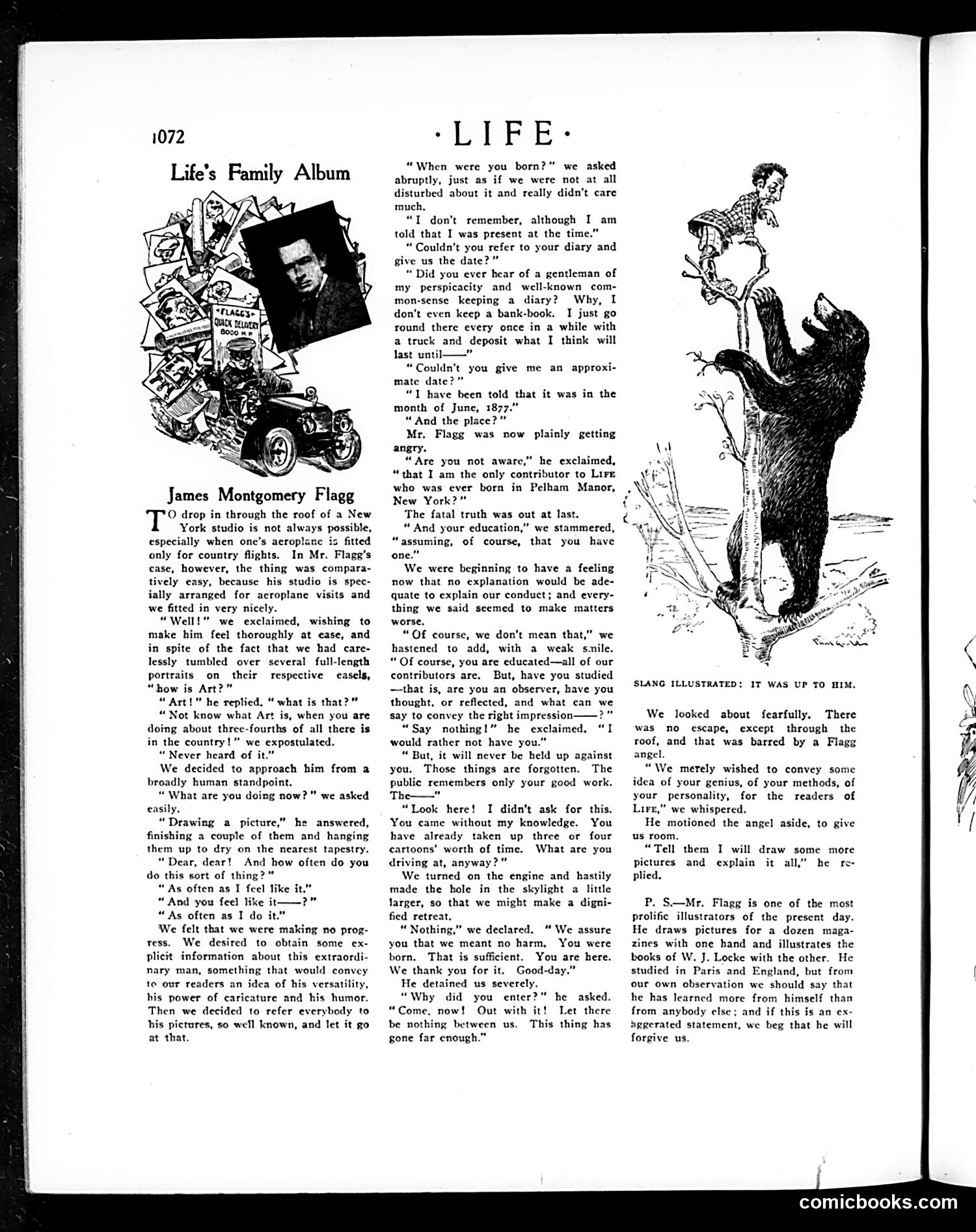
This is a profile of **James Montgomery Flagg**, a prominent American illustrator and cartoonist (the text confirms he contributed to *Life* magazine). The piece is satirical humor about an interview with him. The joke hinges on Flagg's persona: he's portrayed as deliberately evasive, contradictory, and combative when asked basic biographical questions. He claims not to know what "Art" is, refuses to keep records, won't provide birth dates despite claiming June 1877 in Pelham Manor, NY, and grows increasingly irritated with the interviewer. The cartoon illustrations show Flagg as somewhat disheveled and uncooperative. The satire mocks both his artistic temperament and *Life*'s breathless profile approach—the interviewers keep trying to make him seem interesting, but he actively resists, ultimately demanding they leave through the skylight they entered. The humor assumes readers know Flagg as a recognizable *Life* contributor whose quirky personality was worth lampooning.
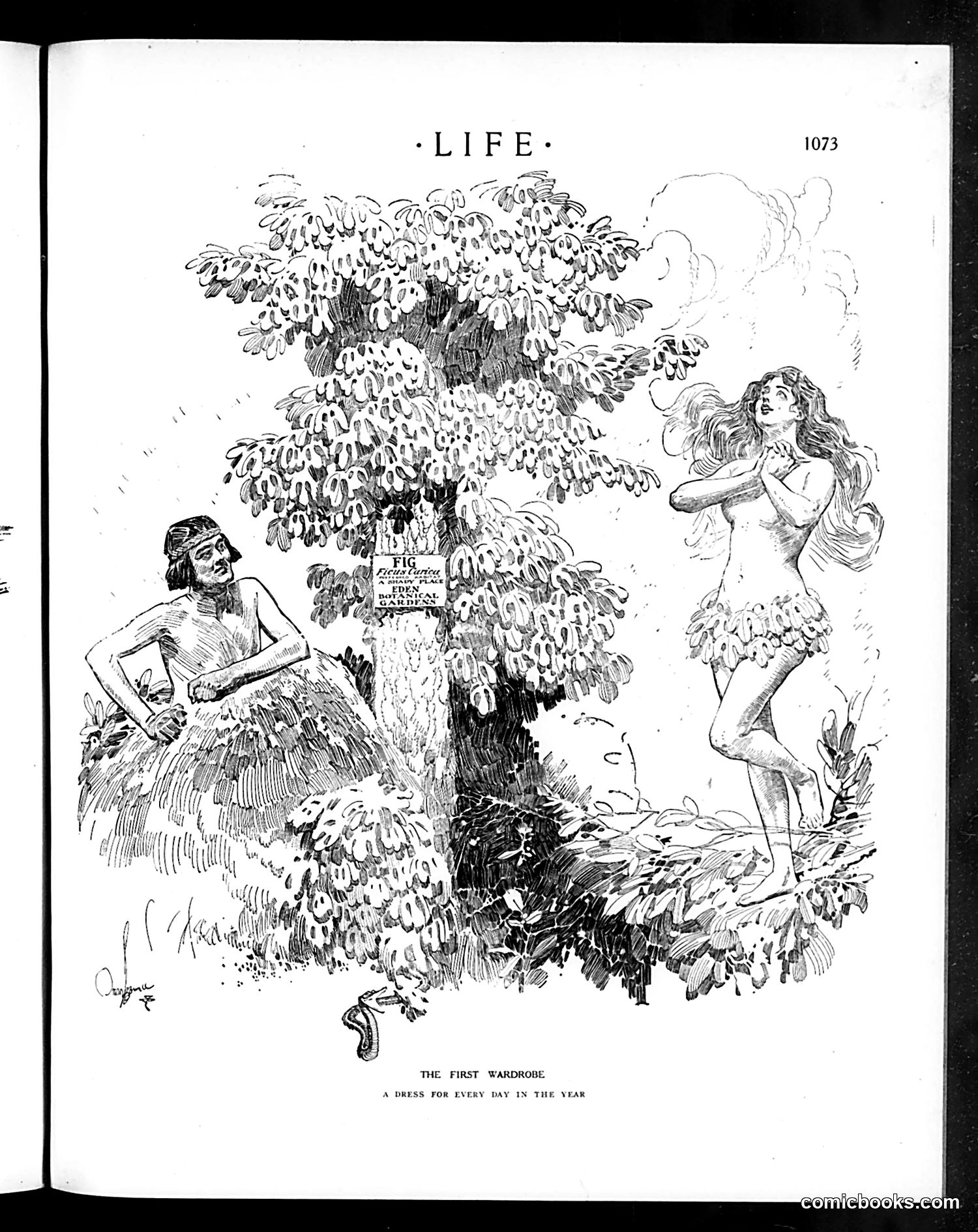
This illustration satirizes the biblical Garden of Eden origin story. Two nude figures representing Adam and Eve stand beside the Tree of Knowledge bearing fruit. The caption "A Dress for Every Day in the Year" is the joke's centerpiece. The satire works on multiple levels: it references the religious narrative where humanity's first "wardrobe" was literally nothing (innocence in Eden), then contrasts this with the modern consumer culture obsession with owning extensive clothing. The image suggests that Eve, often blamed in Christian tradition for humanity's fall from grace, is here implicitly blamed for introducing fashion excess. This reflects early 20th-century social commentary about women's consumption habits and fashion trends, using biblical mythology to critique contemporary materialism.
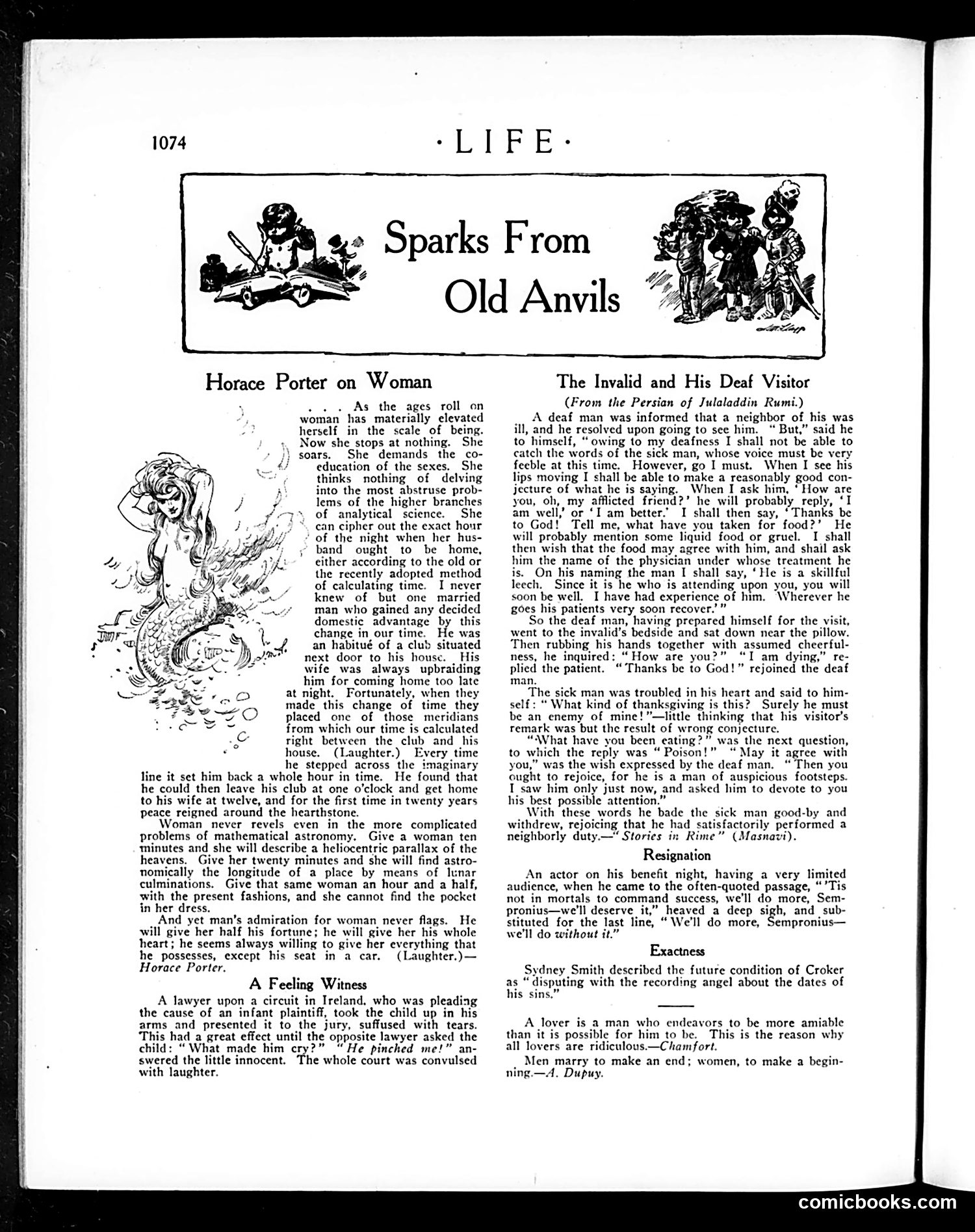
This page from *Life* magazine contains three humorous pieces satirizing social customs and human nature: **"Horace Porter on Woman"** mocks expanding female education and independence. Porter jokes that women master complex astronomy yet cannot find pockets in their dresses—a jab at the era's tension between women's intellectual ambitions and domestic realities. The punchline about men reluctant to give up train seats suggests male anxiety about women's social advancement. **"A Feeling Witness"** is a brief courtroom anecdote: a lawyer manipulates a jury by presenting an weeping child as evidence, but the child innocently reveals the lawyer pinched him to produce tears—exposing theatrical courtroom manipulation. **"The Invalid and His Deaf Visitor"** adapts Persian poetry about a deaf man visiting a sick neighbor. The deaf man rehearses sympathetic responses but fundamentally misreads the situation, saying "Thanks be to God!" when told the patient is dying. It satirizes how people project assumptions rather than truly listening. All three pieces mock human folly: vanity, performative emotion, and selective hearing.
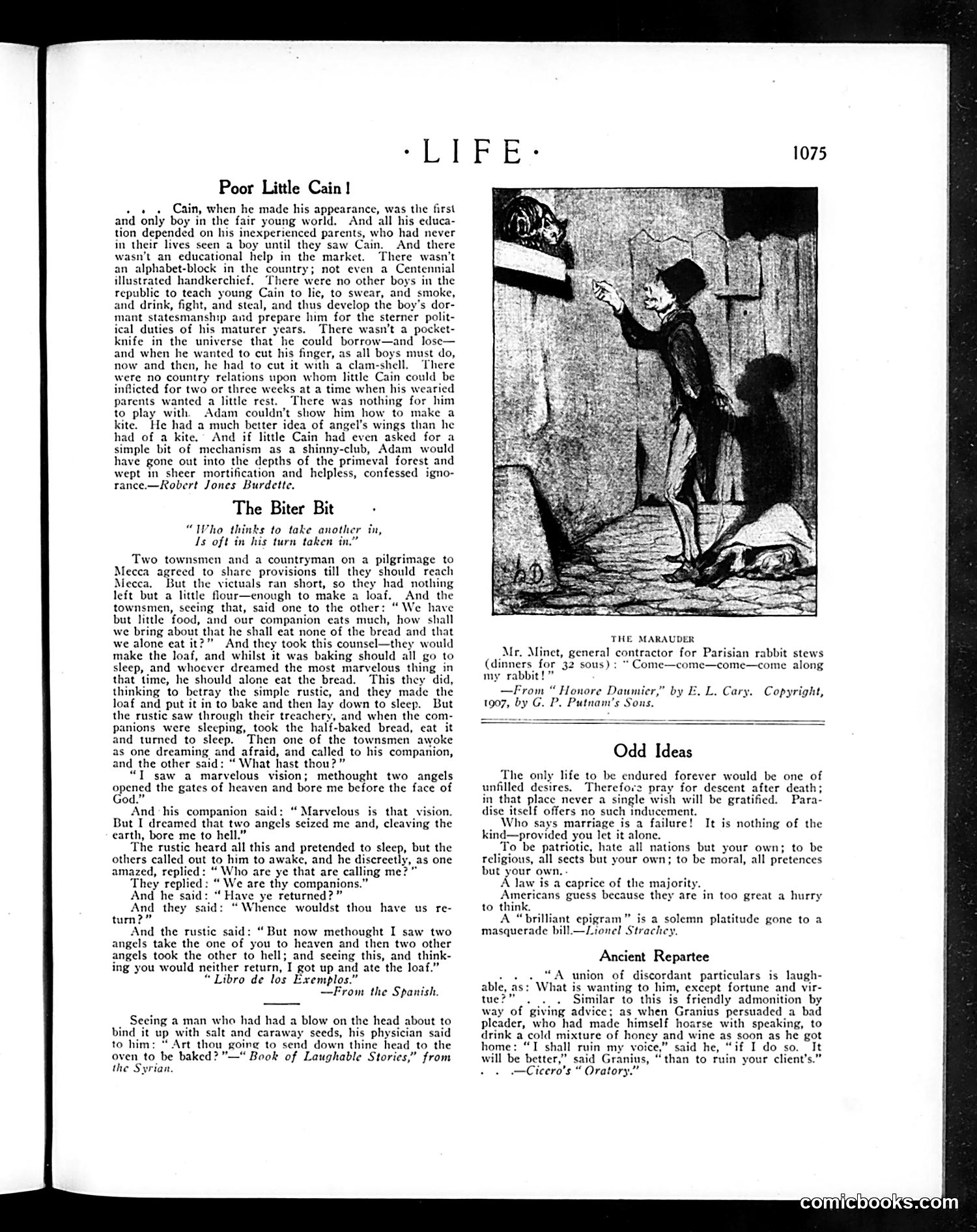
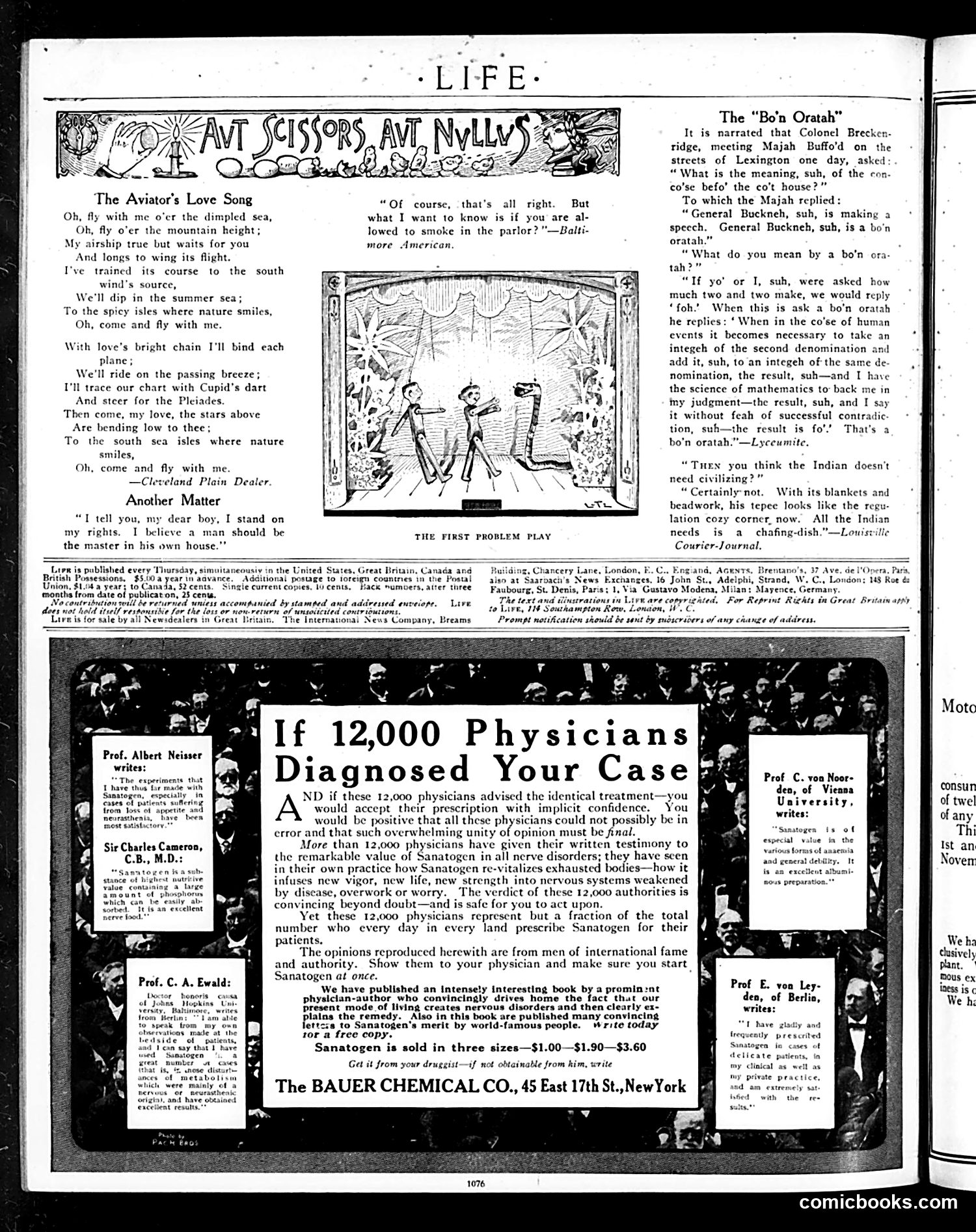
This page from *Life* magazine contains several satirical pieces typical of early 20th-century American humor: **"The Aviator's Love Song"** is a romantic poem playing on the then-fashionable aviation craze, with lovers using airplane imagery for courtship. **"Another Matter"** and **"The Bo'n Oratah"** are brief humorous anecdotes. The latter uses exaggerated Southern dialect to satirize verbose public speakers—a "bo'n oratah" being someone who overcomplicates simple answers with grandiose language. **The large advertisement** for Sanatogen (a patent medicine) quotes numerous physicians claiming its efficacy for nerve disorders and exhaustion. This represents the era's widespread pharmaceutical marketing that often made dubious health claims, exploiting consumer anxiety and relying on testimonials rather than scientific evidence. The page reflects early 1900s concerns: aviation as novel technology, regional dialect humor, and unregulated medicine marketing—all capturing period preoccupations now historically distant.
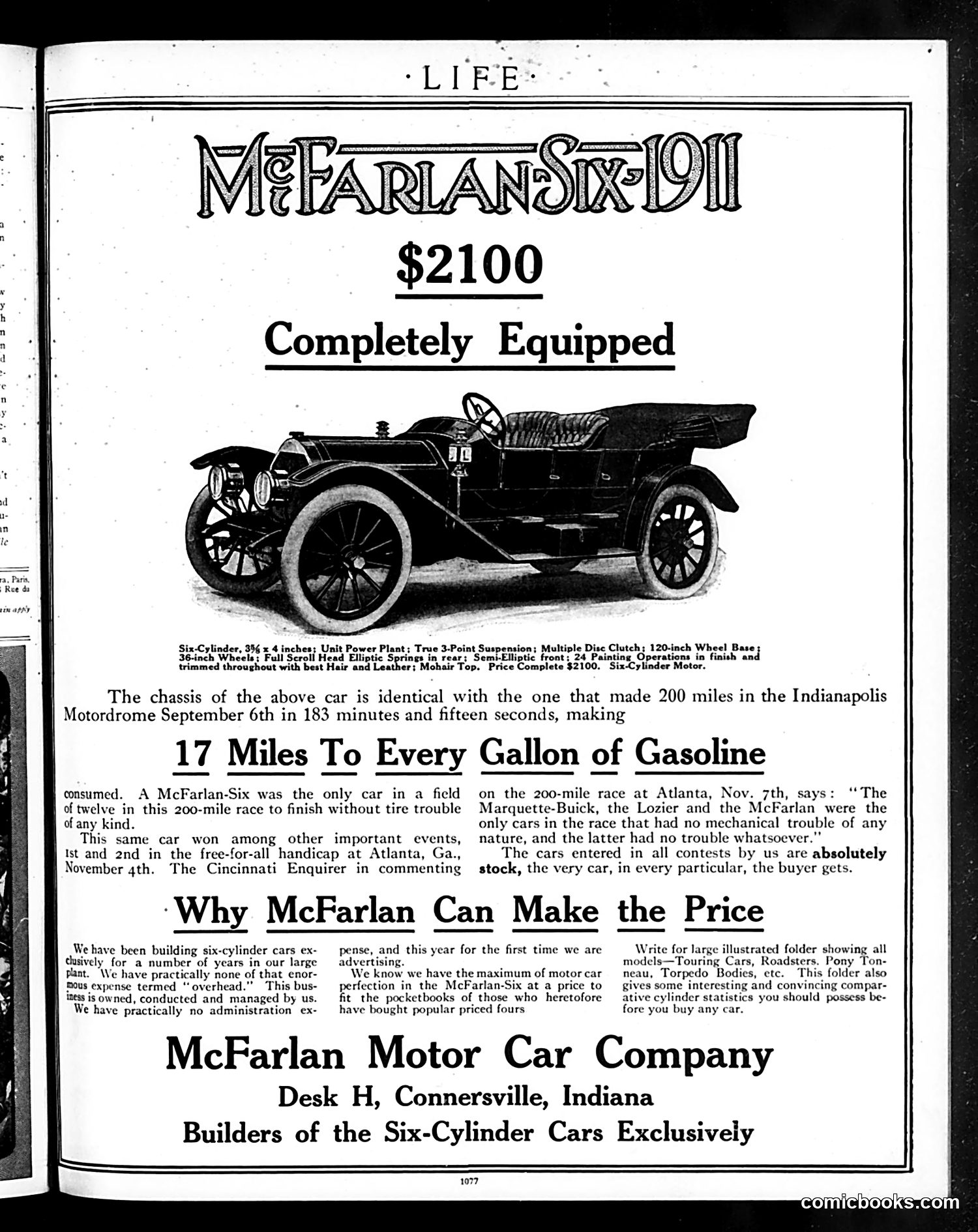
This is a **full-page automobile advertisement**, not satire or political content. The McFarlan Motor Car Company advertises their "Six" model for $2,100, emphasizing engineering credentials rather than price competition. The ad highlights a racing victory: their chassis won a 200-mile Indianapolis race without mechanical failure, achieving "17 Miles To Every Gallon of Gasoline"—positioning fuel efficiency as a luxury selling point. The company stresses that contest vehicles are identical to consumer models, establishing reliability credibility. The "Why McFarlan Can Make the Price" section targets affluent buyers moving *up* from cheaper four-cylinder cars. McFarlan claims efficiency through direct ownership (minimal overhead, no external advertising), positioning the $2,100 price as competitive for a six-cylinder vehicle. **For modern readers**: This reflects 1910s automotive culture where racing success directly sold cars, and early-adopter wealth consumers sought engineering proof of quality rather than mass-market affordability.
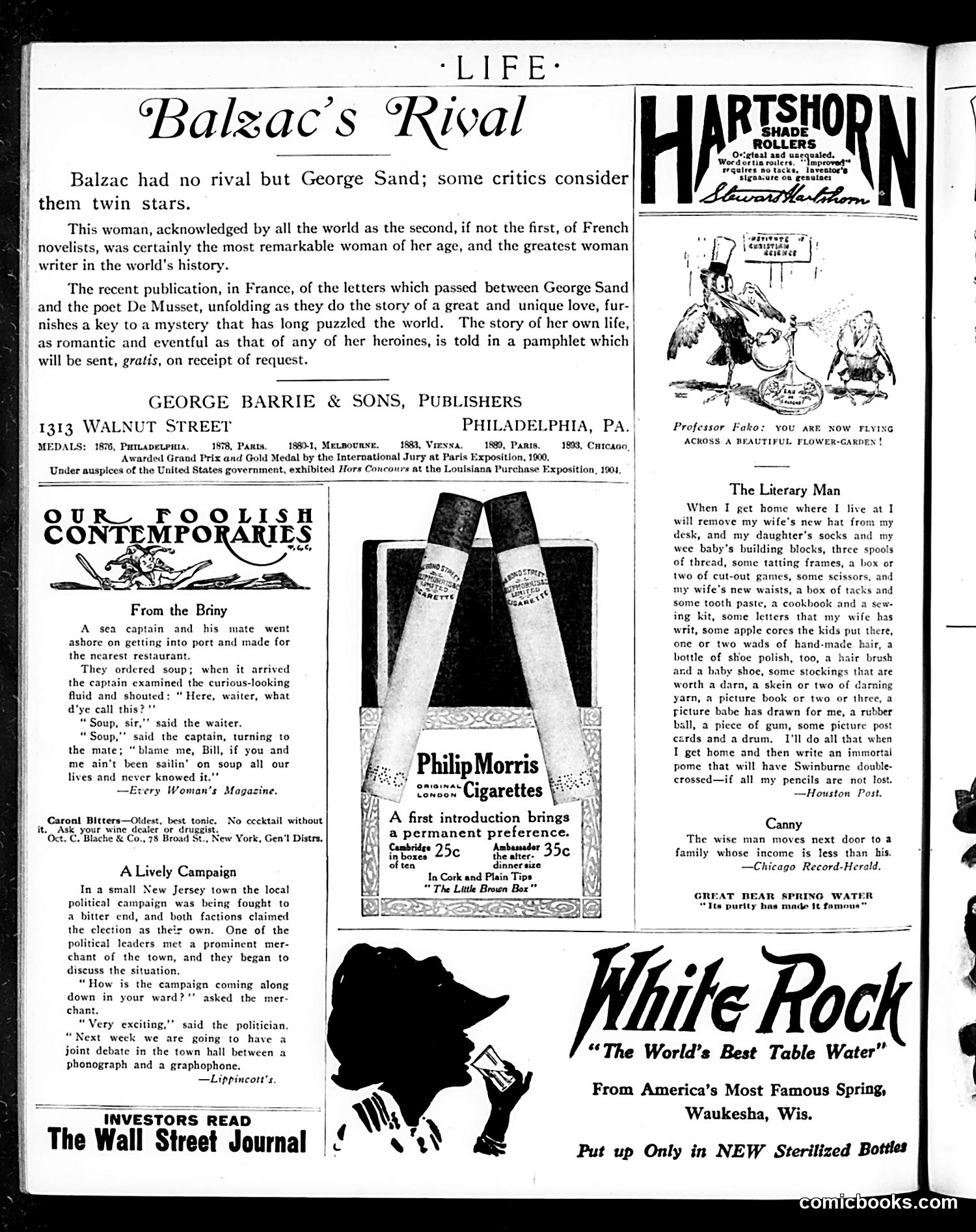
This page is primarily **advertising and literary promotion**, not political satire. The main feature advertises **George Sand**, the French novelist, promoting a publisher's pamphlet about her life and recently published letters exchanged with poet De Musset. The text positions Sand as one of history's greatest writers and emphasizes the romantic mystery of her relationship with Musset. The page includes several **humorous anecdotes** ("Our Foolish Contemporaries" section): a joke about a sea captain mistaking soup for ocean water, a New Jersey political campaign promising to debate "a phonograph and a graphophone" (mocking absurdity), and witty observations about domestic clutter and financial prudence. The **cartoons** (Professor Fako flying, The Literary Man's cluttered home) illustrate these jokes rather than making political points. The remainder consists of **period product advertisements**: Philip Morris cigarettes, White Rock table water, Carol Bitters tonic, and Hartshorn Shade Rollers—typical commercial content for Life magazine.
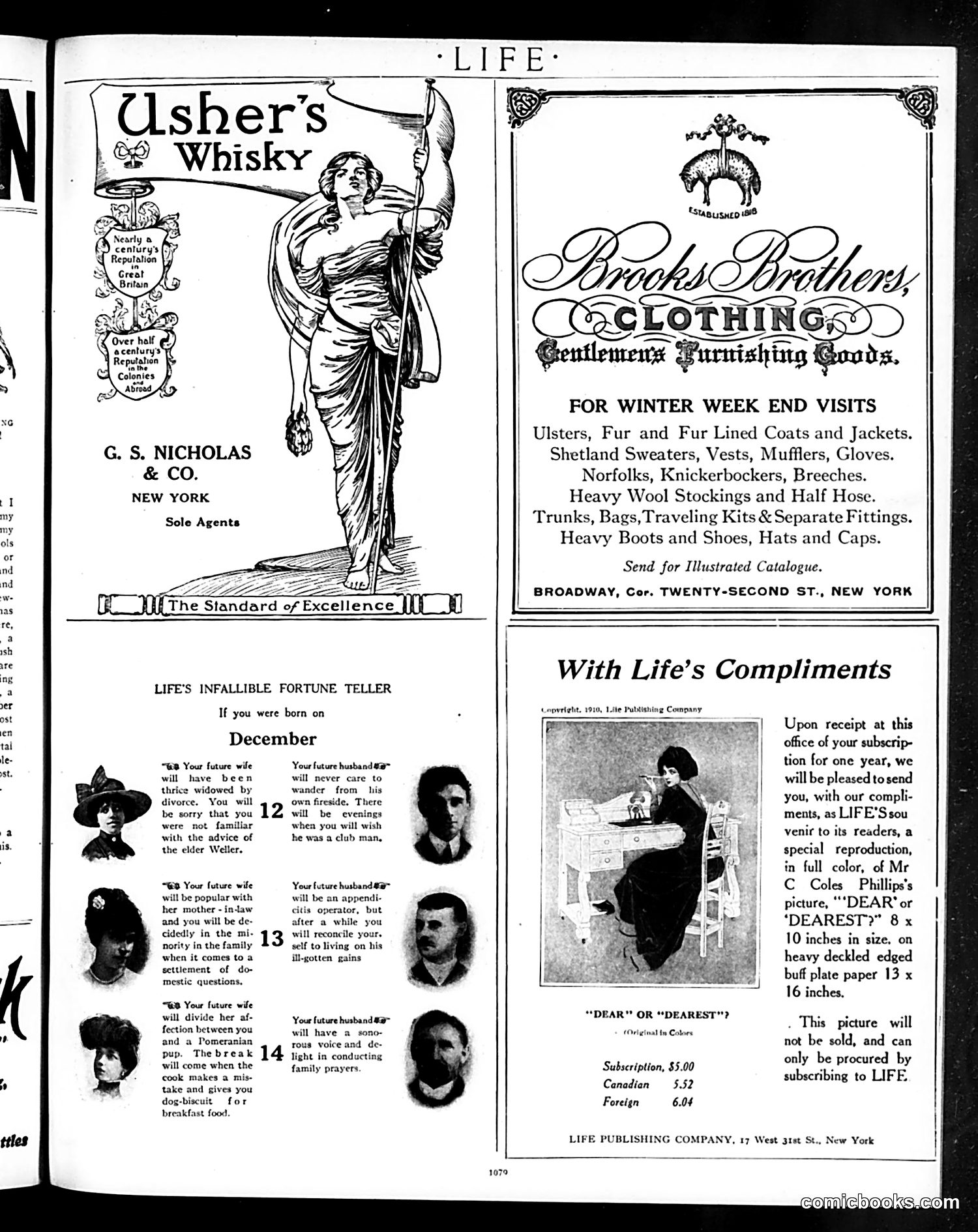
This page contains satirical fortune-telling and period advertising rather than political cartoons. **"Life's Infallible Fortune Teller"** mocks marriage prospects for people born in December by predicting unfavorable domestic futures. The jokes target both genders: women will marry serial divorces or controlling husbands; men will marry women distracted by pets or in-laws. These gags reflect early 20th-century anxieties about marriage, divorce (then scandalous), and domestic power dynamics. The format parodies actual fortune-telling almanacs popular at the time. The remaining content is advertising: Usher's Whisky emphasizes its British reputation, Brooks Brothers promotes winter clothing for leisure travel, and Life Publishing offers a color reproduction of a C. Coles Phillips illustration as a subscription incentive—a common practice to boost magazine circulation. The humor relies on period-specific concerns about courtship and matrimony rather than current events.
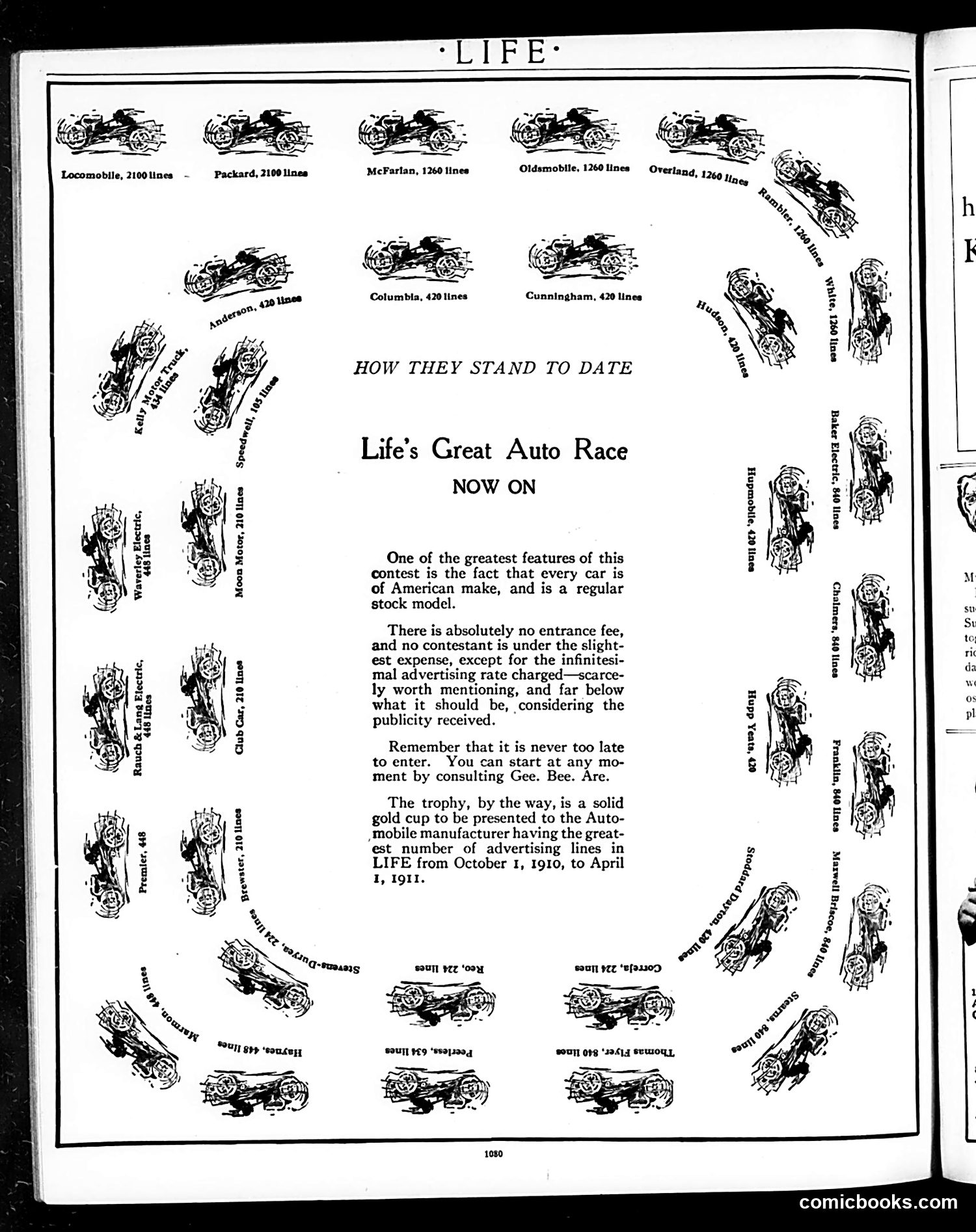
This page announces **Life magazine's satirical "auto race" contest**—not a literal vehicle competition, but a competition for advertising space. The joke is transparent: manufacturers compete to buy the most advertising lines in *Life* between October 1, 1910, and April 1, 1911, with a gold trophy as the prize. The humor lies in mocking both the automobile industry's aggressive marketing and consumer enthusiasm for cars. By presenting advertising purchases as a "race," Life ridicules how manufacturers frantically compete for visibility during this early auto boom era. The page displays various American car brands (Locomobile, Packard, Oldsmobile, etc.) ranked by advertising line count, framing commercial competition as athletic spectacle. The electric cars listed (Waverley, Rauch & Lang) indicate the period when electric vehicles still competed with gasoline models. This reflects the early 1910s automotive market's explosive growth and the magazines' dependence on automobile advertising revenue—turned into satirical commentary.
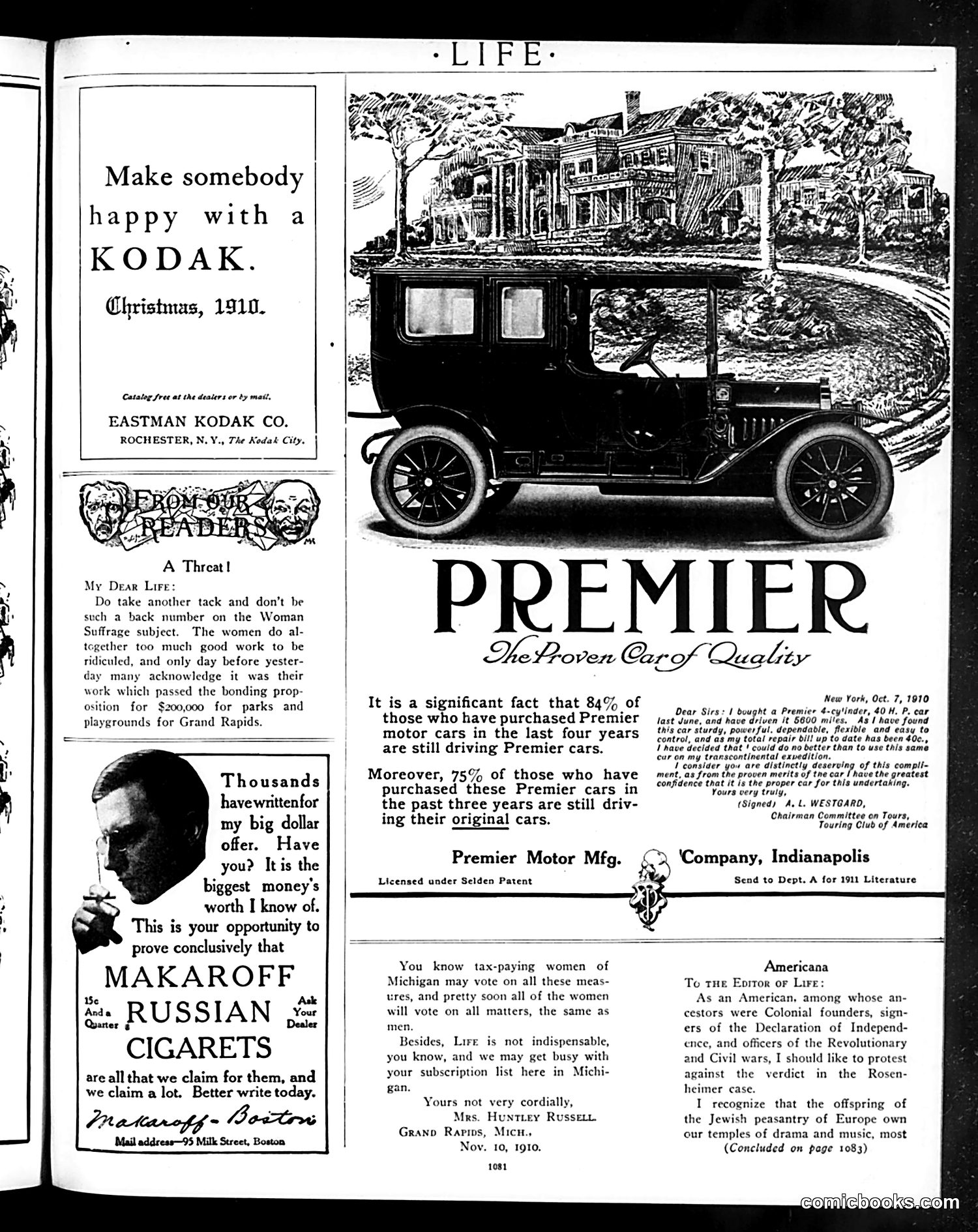
This page combines advertisements with readers' letters addressing contemporary social issues. **The "Threat" Letter**: A woman writes to *Life* magazine demanding they stop ridiculing women's suffrage. She cites women's concrete civic achievements—specifically their work securing a $200,000 parks bond in Grand Rapids—as proof of their competence. The letter's tone ("Yours not very cordially") is pointedly sarcastic; she threatens to organize women to cancel *Life* subscriptions in Michigan if the magazine doesn't change its editorial stance. This reflects the actual political pressure suffragists applied to media outlets in 1910. **The Americana Letter**: A reader protests a court verdict in an unstated "Rosenheimer case," noting that Jewish immigrants now dominate American theater and music. The letter appears to be about discrimination or antisemitism in legal proceedings, though details are unclear from this excerpt alone. Both letters reveal *Life*'s satirical reputation and its readers' expectation that the magazine would engage with pressing social debates of the era.
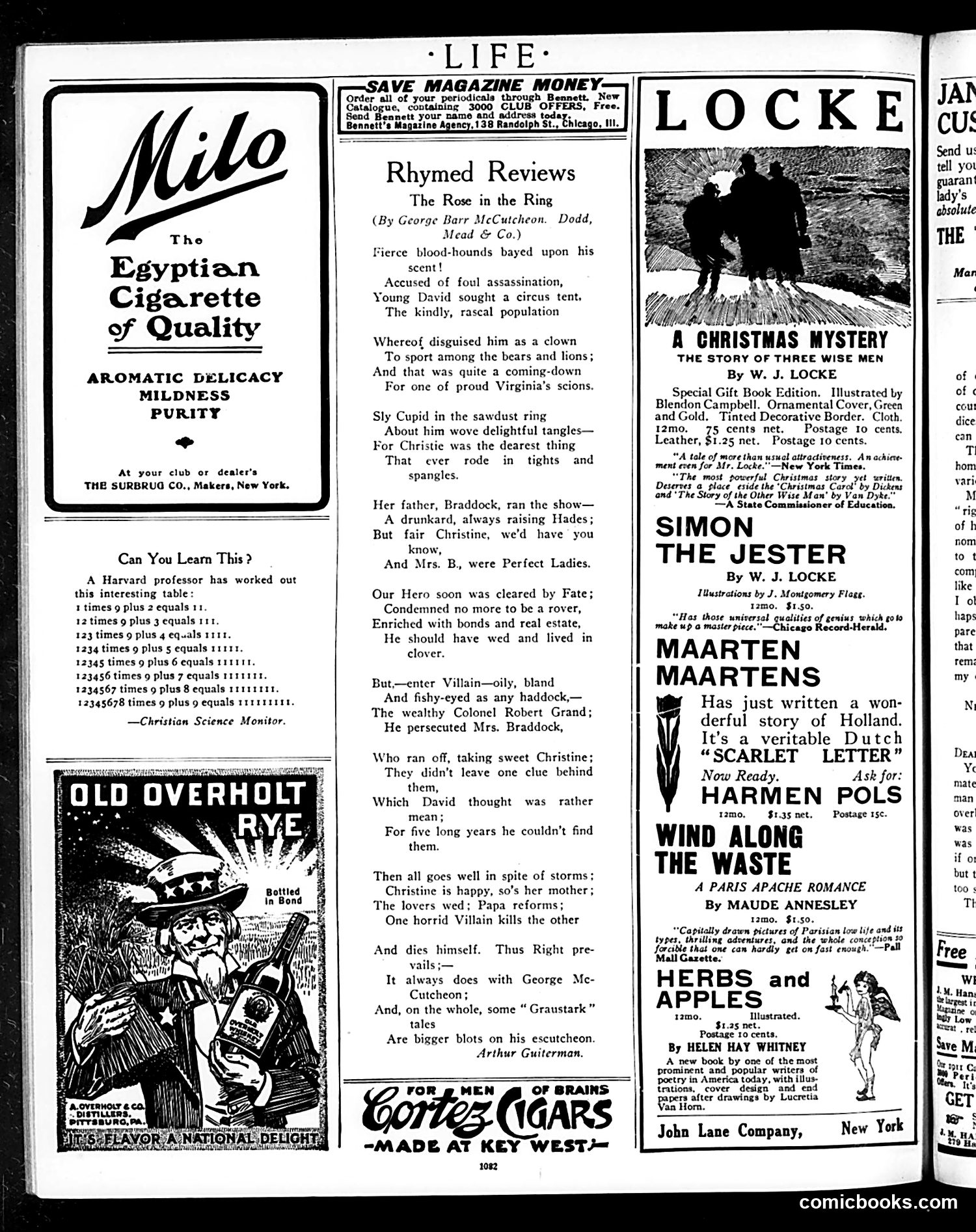
This page is primarily **advertising and book reviews**, not political cartoons. The main content includes: 1. **Cigarette and liquor ads** (Milo Egyptian cigarettes, Old Overholt Rye whiskey, Cortes cigars)—typical early 20th-century advertising 2. **"Rhymed Reviews"** by Arthur Guiterman—a satirical book review of George Barr McCutcheon's novel *The Rose in the Ring*. Guiterman mocks McCutcheon's predictable plot formulas: virtuous heroine, wronged hero, villains defeated, love conquers all, and moral triumph. The phrase "Graustark tales" (McCutcheon's fictional country) suggests his work was formulaic melodrama. 3. **Book advertisements** for novels by W.J. Locke, Maarten Maartens, and Helen Hay Whitney The only humor is Guiterman's literary mockery of McCutcheon's conventional, sentimental storytelling conventions popular with contemporary readers.
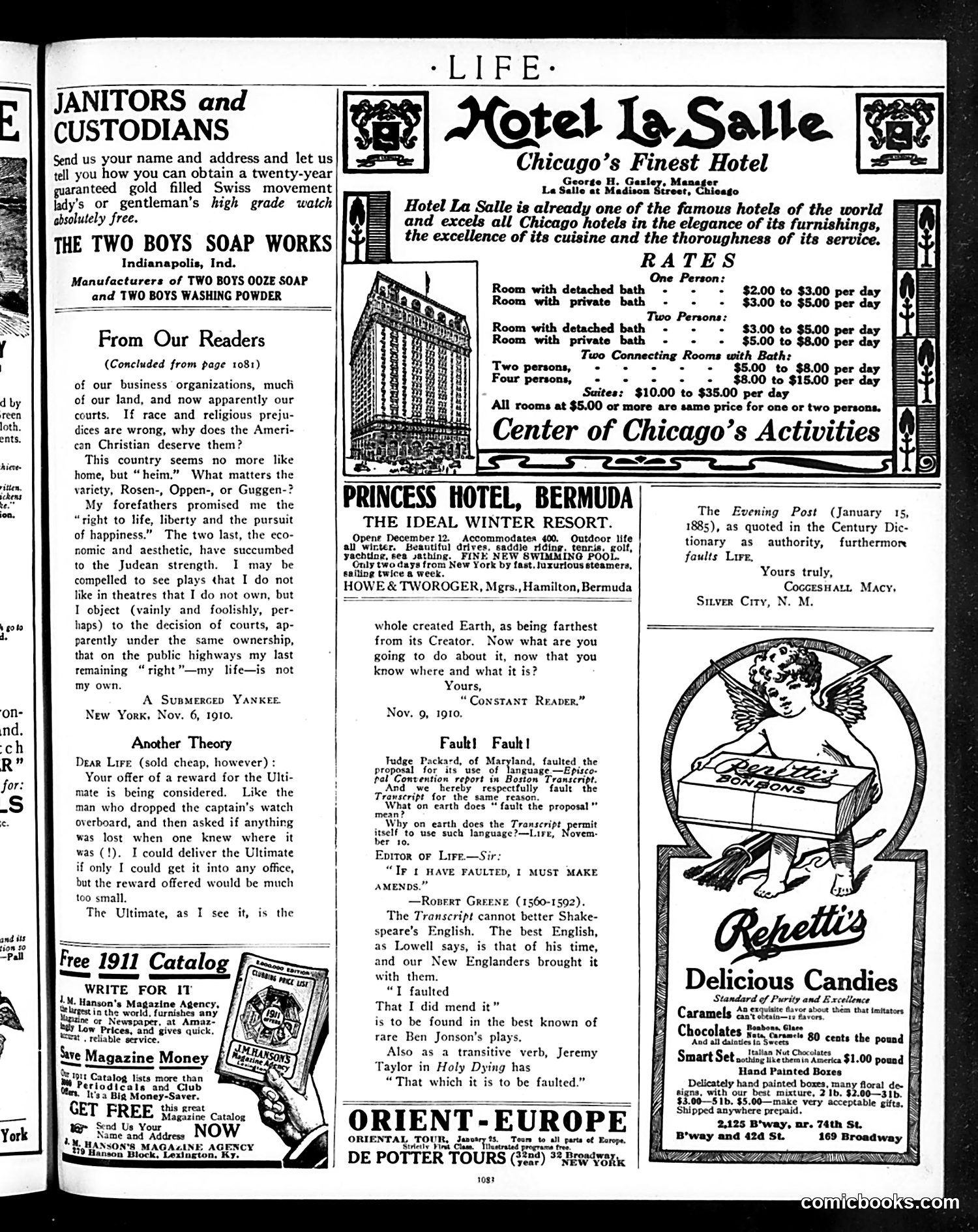
This is primarily an **advertising and letters page** with minimal satire. The main content includes: **"From Our Readers" section:** Letters to the editor addressing social grievances. Most notably, "A Submerged Yankee" complains about Jewish and German-Jewish immigration and their economic/cultural influence in America, claiming they control businesses, real estate, and courts—reflecting the antisemitic prejudices common in 1910. He laments losing his "right to life" on public highways. **"Fault! Fault!"**: A brief humorous item mocking the *Boston Transcript* for awkwardly using "fault the proposal" when discussing an Episcopal Convention—it's a light joke about poor word choice, not political satire. **Advertisements dominate**: Hotel La Salle (Chicago), Princess Hotel (Bermuda), soap works, candy, and magazines fill most of the page. The page illustrates early-20th-century American attitudes—including casual antisemitism presented in a readers' forum—alongside commercial advertisements typical of *Life* magazine.
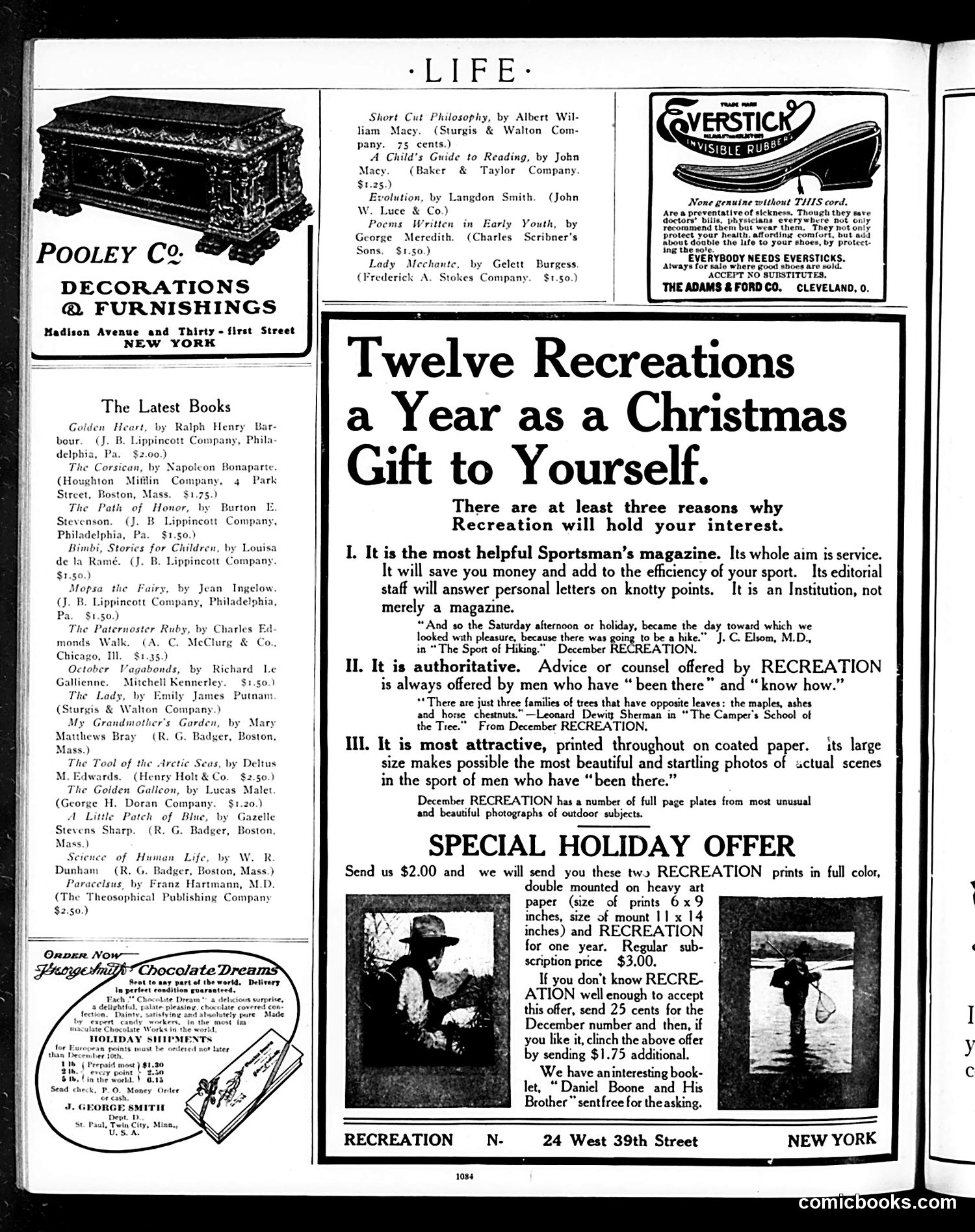
This page is primarily **advertising and book listings**, not satirical content. It contains: 1. **Book advertisements** listing recent publications from major publishers 2. **Commercial ads** for Pooley Co. (furniture), Everstick (rubber heels), and J. George Smith (chocolates) 3. **A large advertisement for Recreation magazine** (center/right), pitching annual subscription as a Christmas gift for outdoor sportsmen The Recreation ad uses testimonial quotes and emphasizes the magazine's authority ("men who have 'been there'"), attractive photography, and practical advice on hunting, hiking, and camping. The special holiday offer—$2.00 for prints and a year's subscription—targets affluent readers interested in outdoor recreation. There are **no political cartoons** on this page. It reflects early 20th-century American consumer culture and the sporting interests of Life's educated, middle-to-upper-class readership.
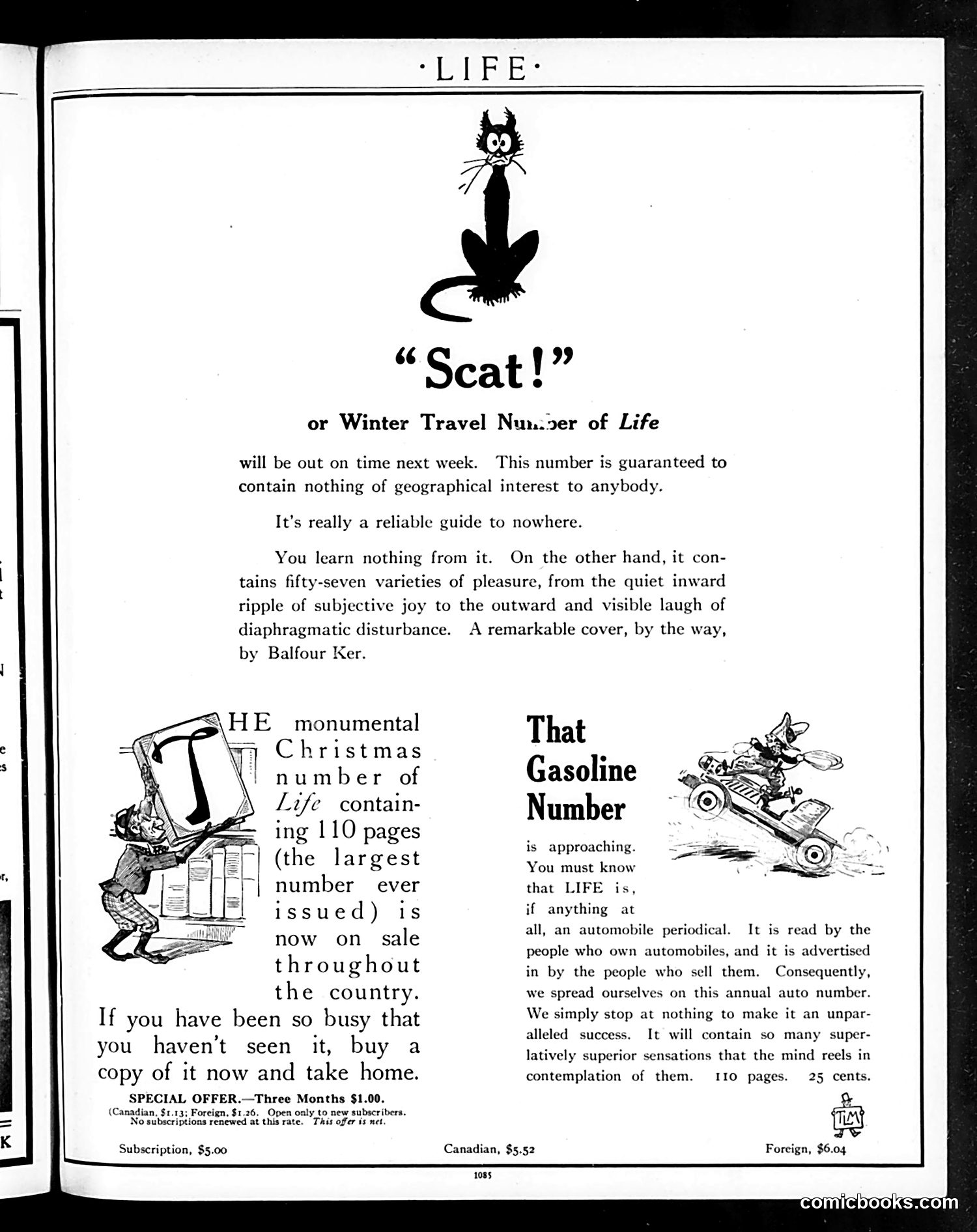
This is primarily **advertising and self-promotion** for Life magazine's upcoming issues. The page announces two special editions: 1. **"Scat!" (Winter Travel Number)**: A humorous teaser promising the issue contains "nothing of geographical interest" and is "a reliable guide to nowhere"—self-deprecating satire about the magazine's comedic rather than informative purpose. 2. **The Christmas/Gasoline Number**: A 110-page issue (Life's largest) devoted heavily to automobiles. The text **sarcastically admits** that Life functions essentially as an auto industry publication, read by car owners and advertised in by car manufacturers. The phrase "we simply stop at nothing" pokes fun at their own single-minded focus on making this number a commercial success. The cartoon of a cat saying "Scat!" reinforces the winter travel issue's humorous irreverence. Overall, this is Life magazine's self-aware mockery of its own editorial priorities and advertiser relationships—using satire to promote its own product.
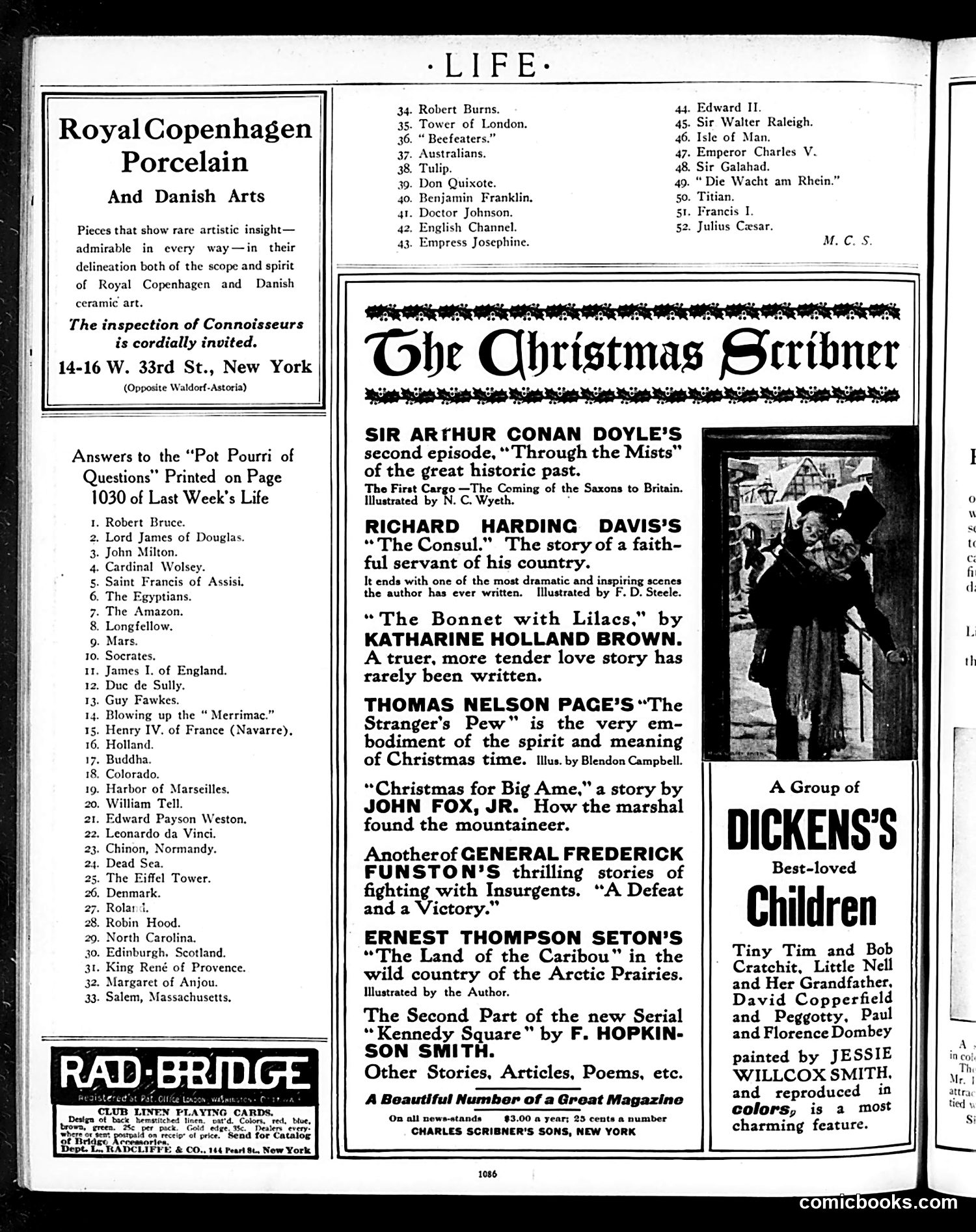
This is primarily a **table of contents and advertising page** for *Life* magazine, not a political cartoon page. The main content advertises the magazine's Christmas issue featuring literary serializations and stories by prominent authors of the era (Arthur Conan Doyle, Richard Harding Davis, Ernest Thompson Seton, F. Hopkinson Smith). The page includes: 1. **Left column**: Answers to a trivia quiz from the previous week (historical figures and places) 2. **Center**: Holiday fiction announcements, including General Frederick Funston's war stories about fighting Filipino insurgents—likely referencing the Philippine-American War (1899-1902) 3. **Right**: Advertisement for *Dickens's Best-loved Children* illustrated by Jessie Willcox Smith 4. **Top left**: Royal Copenhagen Porcelain advertisement There are **no political cartoons** on this page. The only potentially satirical element is the trivia quiz itself, which tests readers' knowledge of historical and literary references typical of educated audiences of that era.
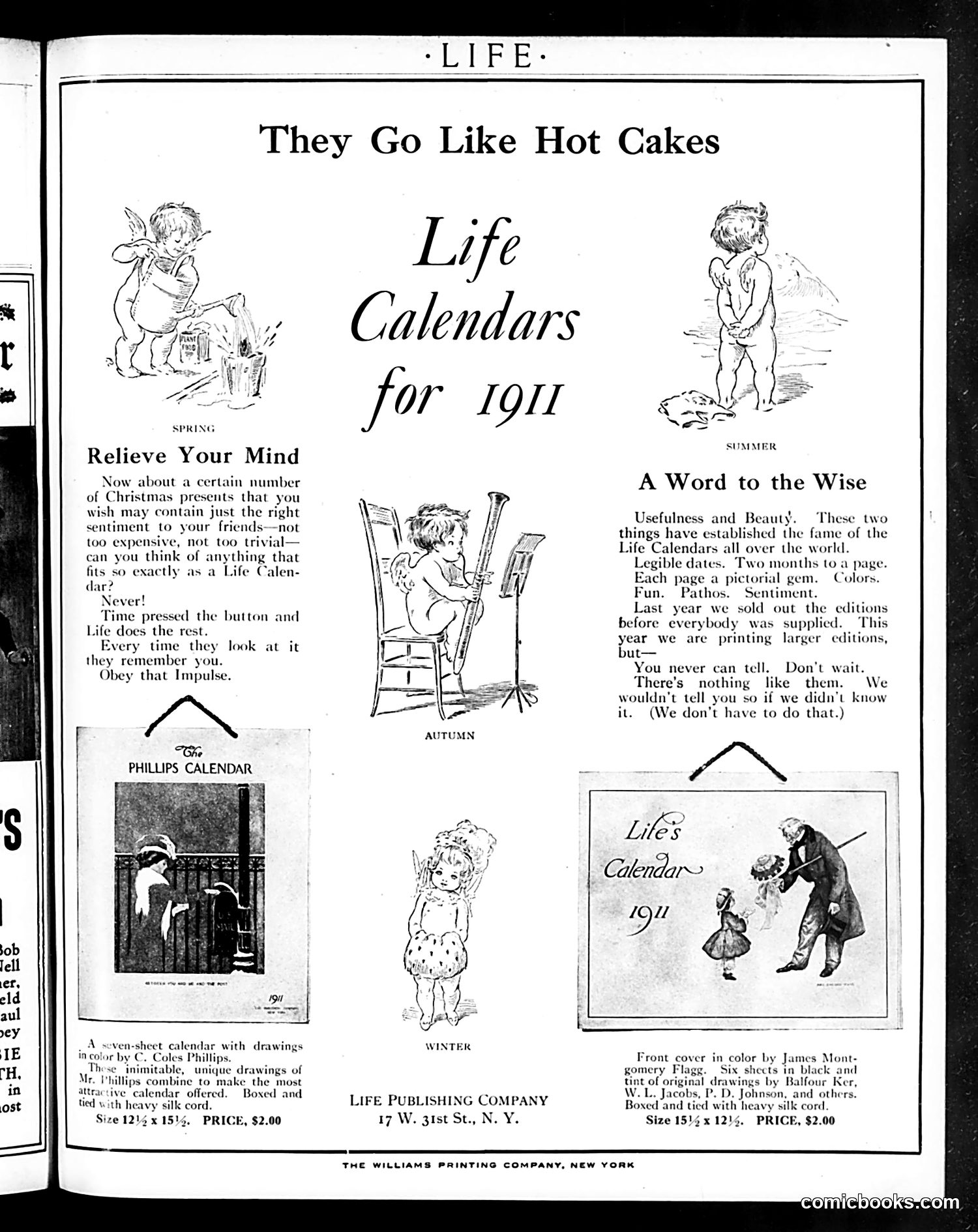
This is primarily an **advertisement page** for Life brand calendars for 1911, not political satire. The page promotes three calendar products: 1. **Phillips Calendar** — featuring illustrations by C. Coles Phillips, a prominent commercial artist known for stylized figures 2. **Life Calendar** — the main product, with seasonal illustrations (Spring, Summer, Autumn, Winter) showing cherubic children in various activities 3. A third calendar with cover art by James Montgomery Flagg The "satire" here is gentle **consumer humor**: the left column's "Relieve Your Mind" section jokingly frames the calendar as the *perfect* Christmas gift for the indecisive shopper—not too expensive, not too trivial, and guaranteed to make recipients remember the giver. The right column's "A Word to the Wise" uses mock-urgent language ("Don't wait") and false modesty ("We wouldn't tell you so if we didn't know it") to humorously sell the product's popularity. The illustrations are decorative rather than satirical, typical of early 20th-century commercial art.

This is an advertisement, not a cartoon or satirical content. It promotes Michelin's "Semelle" Anti-Skids tire product, featuring a large tire cross-section diagram. The ad emphasizes safety features: a leather tread to prevent skidding and embedded steel rivets for traction. It highlights that the tire's flexible rubber sidewalls aren't restricted by the leather tread, making for a smoother ride. The Michelin company logo and tagline encourage customers to look for their sign at "Leading Garages" worldwide. This reflects early automotive safety concerns from the 1910s era, when tire technology was rapidly evolving to address accident prevention on increasingly congested roads.