
Life, 1910-12-08 · page 30 of 44
Life — December 8, 1910 — page 30: what you’re looking at
What you’re looking at
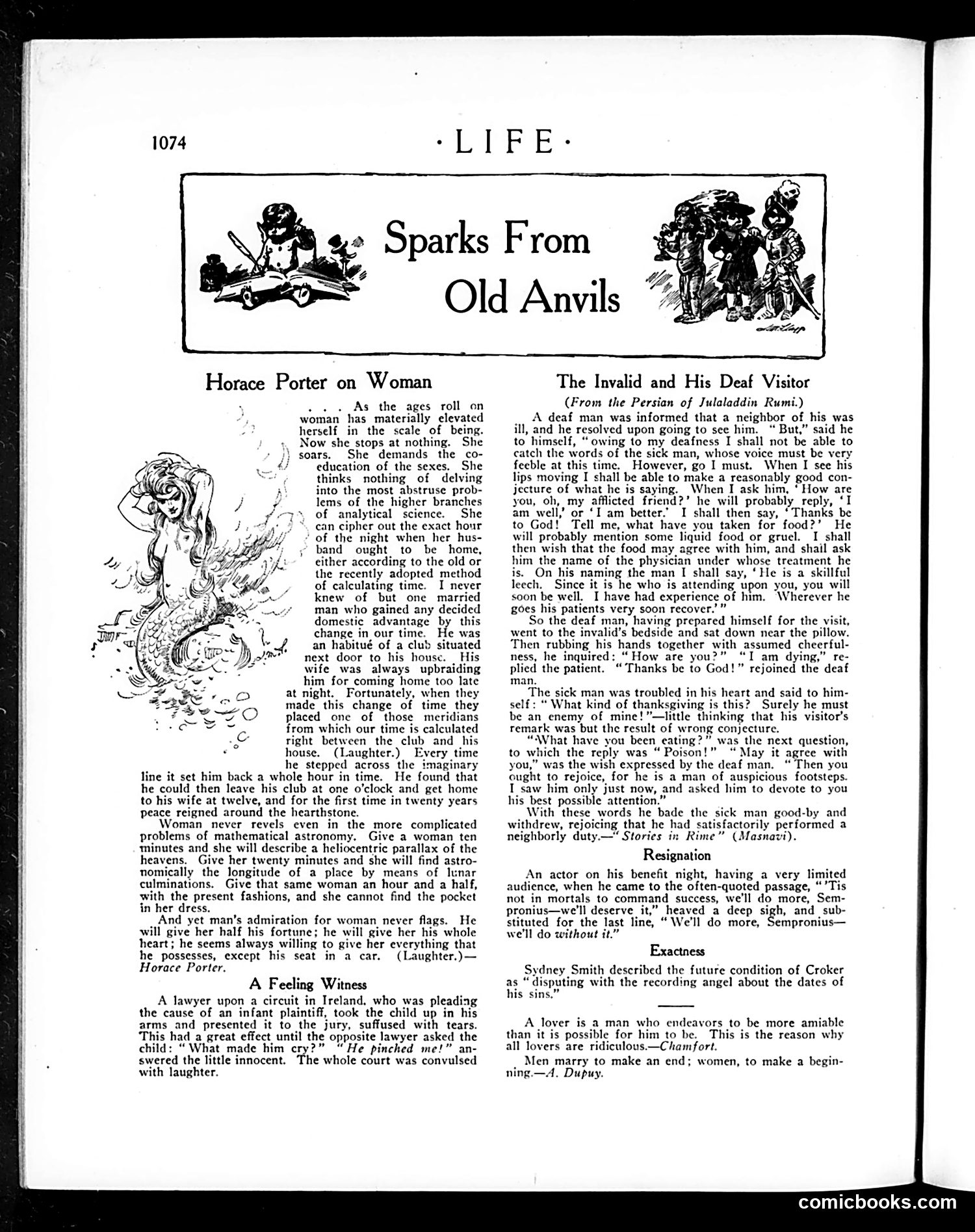
This page from *Life* magazine contains three humorous pieces satirizing social customs and human nature: **"Horace Porter on Woman"** mocks expanding female education and independence. Porter jokes that women master complex astronomy yet cannot find pockets in their dresses—a jab at the era's tension between women's intellectual ambitions and domestic realities. The punchline about men reluctant to give up train seats suggests male anxiety about women's social advancement. **"A Feeling Witness"** is a brief courtroom anecdote: a lawyer manipulates a jury by presenting an weeping child as evidence, but the child innocently reveals the lawyer pinched him to produce tears—exposing theatrical courtroom manipulation. **"The Invalid and His Deaf Visitor"** adapts Persian poetry about a deaf man visiting a sick neighbor. The deaf man rehearses sympathetic responses but fundamentally misreads the situation, saying "Thanks be to God!" when told the patient is dying. It satirizes how people project assumptions rather than truly listening. All three pieces mock human folly: vanity, performative emotion, and selective hearing.
📄 Transcribed text from this page (OCR, searchable)
Machine-transcribed from the original scan — historical spelling and the odd misread are preserved.
Horace Porter on Woman . . . As the ages roll on woman has materially elevated herself in the scale of being. Now she stops at nothing. She soars. She demands the co- education of the sexes. She thinks nothing of delving into the most abstruse prob- lems of the higher branches of analytical science. She can cipher out the exact hour of the night when her hus- band ought to be home, either according to the old or the recently adopted method of calculating time. I never knew of but one married man who gained any decided domestic advantage by this change in our time. He was an habitué of a club situated next door to his house. | His wife was always upbraiding him for coming home too late at night. Fortunately, when they made this change of time they placed one of those meridians from which our time is calculated right between the club and his house. (Laughter.) Every time he stepped across the imaginary line it set him back a whole hour in time. He found that he could then leave his club at one o'clock and get home to his wife at twelve, and for the first time in twenty years peace reigned around the hearthstone. Woman never revels even in the more complicated problems of mathematical astronomy. Give a woman ten minutes and she will describe a heliocentric parallax of the heavens. Give her twenty minutes and she will find astro- nomically the longitude of a place by means of lunar culminations. Give that same woman an hour and a half, with the present fashions, and she cannot find the pocket in her dress, And yet man’s admiration for woman never flags. He will give her half his fortune; he will give her his whole heart; he seems always willing to give her everything that he possesses, except his seat in a car. (Laughter.)— Horace Porter. A Feeling Witness A lawyer upon a circuit in Ireland. who was pleading the cause of an infant plaintiff, took the child up in his arms and presented it to the jury, suffused with tears. This had a great effect until the opposite lawyer asked the child: “ What made him cry?” “He pinched me!” an- swered the little innocent. The whole court was convulsed with laughter. The Invalid and His Deaf Visitor (From the Persian of Julaladdin Rumi.) A deaf man was informed that a neighbor of his was ill, and he resolved upon going to see him. “ But,” said he to himself, “ owing to my deafness I shall not be able to catch the words of the sick man, whose voice must be very feeble at this time. However, go I must. When I see his lips moving I shall be able to make a reasonably good con- jecture of what he is saying. When I ask him, ‘How are you, oh, my afflicted friend?’ he will probably reply, ‘I am well,’ or ‘I am better.’ I shall then say, ‘Thanks be to God! Tell me, what have you taken for food?’ He will probably mention some liquid food or grucl. I shall then wish that the food may agree with him, and shail ask him the name of the physician under whose treatment he is. On his naming the man I shall say, ‘He is a skillful leech, Since it is he who is attending upon you, you will soon be well. I have had experience of him. ‘Wherever he goes his patients very soon recover.” So the deaf man, having prepared himself for the visit, went to the invalid’s bedside and sat down near the pillow. Then rubbing his hands together with assumed cheerful- ness, he inquired: “How are you?” “I am dying,” re- plied the patient. “Thanks be to God!” rejoined the deaf man. The sick man was troubled in his heart and said to him- self: “ What kind of thanksgiving is this? Surely he must be an enemy of mine!”—little thinking that his visitor’s remark was but the result of wrong conjecture. “What have you been eating?” was the next question, to which the reply was “ Poison!” “ May it agree with you,” was the wish expressed by the deaf man. “Then you ought to rejoice, for he is a man of auspicious footsteps. I saw him only just now, and asked him to devote to you his best possible attention.” With these words he bade the sick man good-by and withdrew, rejoicing that he had satisfactorily performed a neighborly duty.—" Stories in Rime” (Masnavi). Resignation An actor on his benefit night, having a very limited audience, when he came to the often-quoted passage, “’Tis not in mortals to command success, we'll do more, Sem- pronius—we'll deserve it,” heaved a deep sigh, and sub- stituted for the last line, “ We'll do more, Sempronius— we'll do without it.” Exactness Sydney Smith described the future condition of Croker as “disputing with the recording angel about the dates of his sins.” A lover is a man who endeavors to be more amiable than it is possible for him to be. This is the reason why all lovers are ridiculous.—Chamfort. _ Men marry to make an end; women, to make a begin- ning.—A. Dupuy. comicbooks.com