
Life, 1910-12-08 · page 12 of 44
Life — December 8, 1910 — page 12: what you’re looking at
What you’re looking at
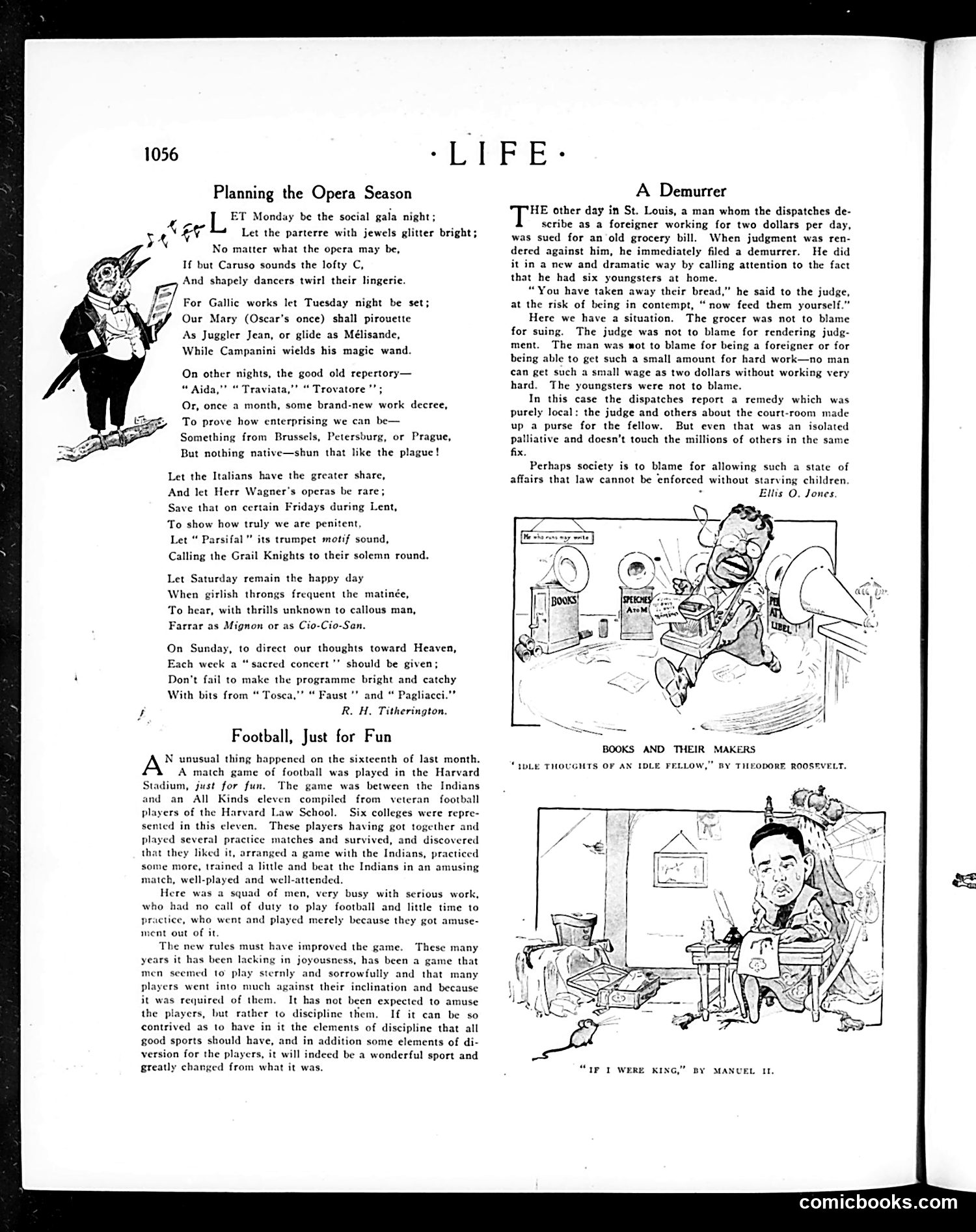
This page contains two main sections: **"Planning the Opera Season"** (top): A poem by R. H. Titherton humorously listing opera performances for the season, with an illustration of performers in period costume. The satire targets opera's perceived pretentiousness and foreign (particularly Italian) dominance of American cultural institutions. **"Football, Just for Fun"** (middle): An article describing an unusual Harvard Law School football game where newly-trained Indiana players defeated the law students. The piece argues this demonstrates football's potential as disciplined sport rather than mere amusement—suggesting contemporary concerns that American football had become chaotic and corrupting rather than character-building. **Two cartoon illustrations** appear below, including one captioned "If I Were King" by Manuel II, showing a figure surrounded by books and creative chaos—likely satirizing artistic pretension or bohemian lifestyle.
📄 Transcribed text from this page (OCR, searchable)
Machine-transcribed from the original scan — historical spelling and the odd misread are preserved.
-LIFE- Planning the Opera Season ET Monday be the social gala night; ae Let the parterre with jewels glitter bright; No matter what the opera may be, If but Caruso sounds the lofty C, And shapely dancers twirl their lingerie. dA For Gallic works let Tuesday night be set; Our Mary (Oscar’s once) shall pirouette As Juggler Jean, or glide as Mélisande, While Campanini wields his magic wand. On other nights, the good old repertory— “ Aida,’ “ Traviata,” “ Trovatore "’; Or, once a month, some brand-new work decree, To prove how enterprising we can be— Something from Brussels, Petersburg, or Prague, But nothing native—shun that like the plague! Let the Italians have the greater share, And let Herr Wagner's operas be rare; Save that on certain Fridays during Lent, To show how truly we are penitent, Let “ Parsifal” its trumpet motif sound, Calling the Grail Knights to their solemn round. Let Saturday remain the happy day When girlish throngs frequent the matinée, To hear, with thrills unknown to callous man, Farrar as Mignon or as Cio-Cio-San. On Sunday, to direct our thoughts toward Heaven, Each week a “sacred concert’’ should be given; Don’t fail to make the programme bright and catchy With bits from “ Tosea,"’ “ Faust ’’ and “ Pagliacci."” R. H, Titherington, Football, Just for Fun N unusual thing happened on the sixteenth of last month. A match game of football was played in the Harvard Stadium, just for fun. The game was between the Indians and an All Kinds eleven compiled from veteran football players of the Harvard Law School. Six colleges were repre- sented in this eleven. These players having got together and played several practice matches and survived, and discovered that they liked it, arranged a game with the Indians, practiced some more, trained a little and beat the Indians in an amusing match, well-played and well-attended. Here was a squad of men, very busy with serious work, who had no call of duty to play football and little time to practice, who went and played merely because they got amuse- nt out of it The new rules must have improved the game. These many years it has been lacking in joyousness, has been a game that men seemed to play sternly and sorrowfully and that many players went into much against their inclination and because it was required of them. It has not been expected to amuse the players, but rather to discipline them. If it can be so contrived as to have in it the clements of discipline that all good sports should have, and in addition some elements of di- version for the players, it will indeed be a wonderful sport and greatly changed from what it was. A Demurrer HE other day in St. Louis, a man whom the dispatches de- scribe as a foreigner working for two dollars per day, was sued for an old grocery bill. When judgment was ren- dered against him, he immediately filed a demurrer. He did it in a new and dramatic way by calling attention to the fact that he had six youngsters at home. “You have taken away their bread,” he said to the judge, at the risk of being in contempt, “now feed them yourself.” Here we have a situation. The grocer was not to blame for suing. The judge was not to blame for rendering judg- ment. The man was mot to blame for being a foreigner or for being able to get such a small amount for hard work—no man can get such a small wage as two dollars without working very hard. The youngsters were not to blame. In this case the dispatches report a remedy which was purely local: the judge and others about the court-room made up a purse for the fellow. But even that was an isolated palliative and doesn’t touch the millions of others in the same fix. Perhaps society is to blame for allowing such a state of affairs that law cannot be enforced without starving children. Ellis O. Jones. BOOKS AND THEIR MAKERS ‘IDLE THOUGHTS OF AN IDLE FELLOW,” BY THEODORE ROOS “PF 1 WERE KING,” BY MA’ comicbooks.com