
Life, 1910-12-08 · page 27 of 44
Life — December 8, 1910 — page 27: what you’re looking at
What you’re looking at
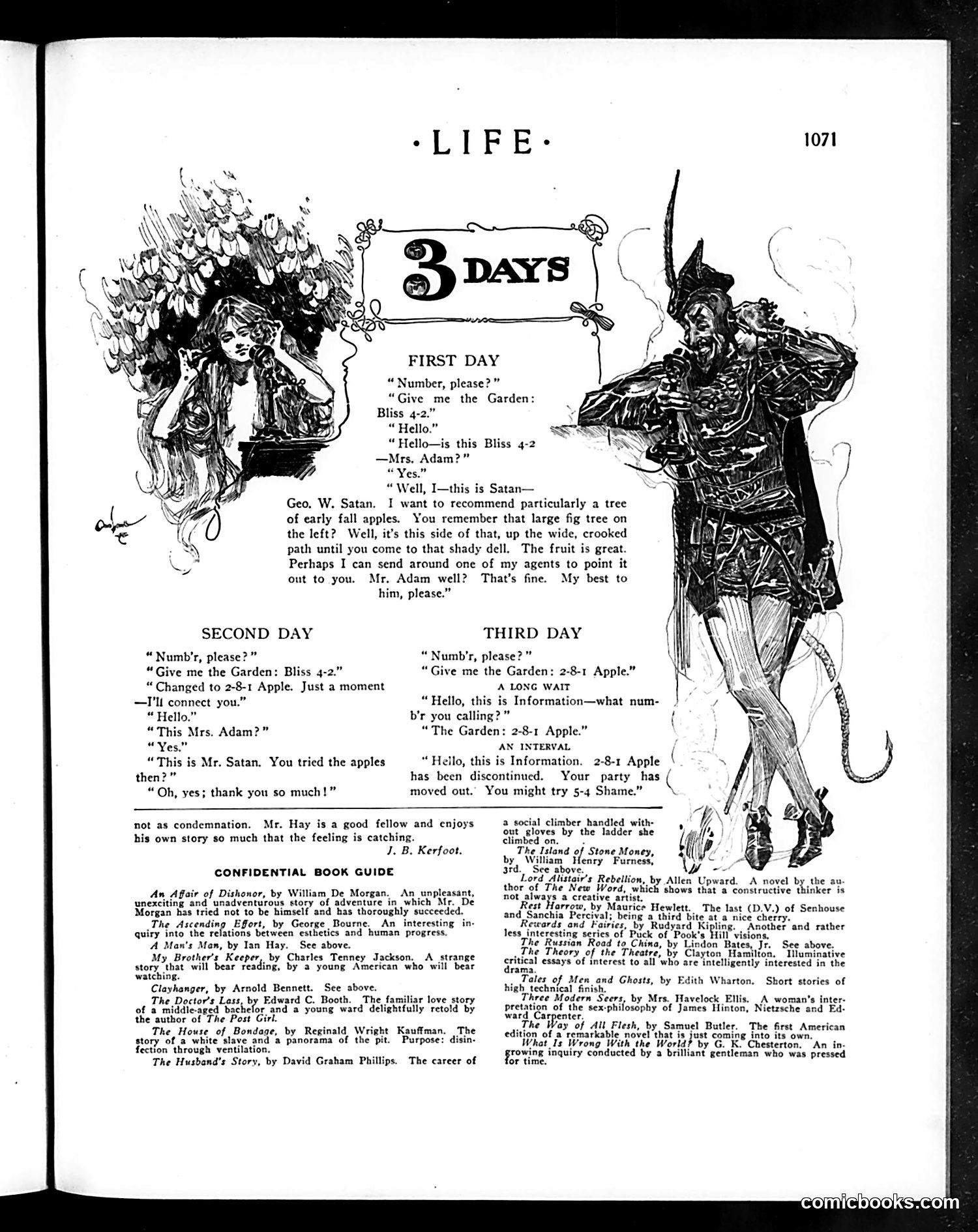
This cartoon depicts the biblical Fall of Man through a darkly comic telephone exchange. Satan (caricatured as a demonic figure on the right) calls Mrs. Adam in the Garden of Eden, recommending forbidden fruit—initially framed as innocent apples. Over three days, the narrative shows temptation's progression: Mrs. Adam initially resists, then succumbs, and finally loses everything when "the Garden: 2-8-1 Apple" is discontinued and she's told to "try 5-4 Shame"—implying expulsion and disgrace. The joke satirizes how temptation operates through incremental persuasion and how easily human weakness enables our downfall. The telephone technology (with operators and phone numbers) is anachronistic to Eden, adding absurdist humor. The reference to a "social climber" in the book guide suggests broader commentary on vanity and moral compromise in contemporary society.
📄 Transcribed text from this page (OCR, searchable)
Machine-transcribed from the original scan — historical spelling and the odd misread are preserved.
FIRST DAY “Number, please?” “Give me the Garden: Bliss 4-2.” “ Hello.” “Hello—is this Bliss 4-2 —Mrs, Adam?” “Yes.” “Well, I—this is Satan— Geo. W. Satan. I want to recommend particularly a tree of early fall apples. You remember that large fig tree on the left? Well, it’s this side of that, up the wide, crooked path until you come to that shady dell. The fruit is great. Perhaps I can send around one of my agents to point it out to you. Mr. Adam well? That's fine. My best to him, please.” SECOND DAY “Numb’r, please?” “Give me the Garden: Bliss 4-2.” “Changed to 2-8-1 Apple. Just a moment —I'll connect you.” “ Hello.” “This Mrs. Adam?” “Yes. “This is Mr. Satan. You tried the apples then?” “Oh, yes; thank you so much!” THIRD DAY “Numb’r, please?” “Give me the Garden: 2-8-1 Apple.” A LONG WAIT “Hello, this is Information—what num- b'r you calling?” “The Garden: 2-8-1 Apple.” AN INTERVAL “Hello, this is Information. 2-8-1 Apple has been discontinued. Your party has moved out.’ You might try 5-4 Shame.” a social climber handled with- out gloves by the ladder she climbed on. ° not as condemnation. Mr. Hay is a good fellow and enjoys his own story so much that the feeling is catching. The Island of Stone Money, J. B. Kerfoot. by, William ‘Henry Furness, Wy IDENTIAL BOOK GUIDE eee Le han ‘ " CONFIDEN’ Lord Alistair’s Rebellion, by Allen Upward. A novel by the au- thor of The New Word, which shows that a constructive thinker is An Affair of Dishonor, by William De Morgan. An unpleasant, not always a creative artist. unexciting and unadventurous story of adventure in which Mr. De Morgan has tried not to be himself and has thoroughly succeeded. The Ascending Efort, by George Bourne, An interesting in- quiry into the relations between esthetics and human progress. A Man's Man, by Ian Hay. Sce above. My Brother's Keeper, by Charles Tenney Jackson. A. strange story that will bear reading, by a young American who will bear watching. Clayhanger, by Arnold Bennett. See above. The Doctor’s Lass, by Edward C. Booth. The familiar love story of a middle-aged bachelor and a young ward delightfully retold by the author of The Post Girl. The House of Bondage, by Reginald Wright Kauffman. The story of a white slave and a panorama of the pit. Purpose: disin- fection through ventilation. The Husband’s Story, by David Graham Phillips. The career of Rest Harrow, by Maurice Hewlett. The last (D.V.) of Senhouse and Sanchia Percival; being a third bite at a nice cherry. Rewards and Fairies, by Rudyard Kipling. Another and rather less interesting series of Puck of Pook's fin visions, he Russian Road to China, by Lindon Bates, Jr. See above. «Zhe Theory of the Theatre, by Clayton Hamilton. Illuminative gritical essays of interest to all ‘who are intelligently interested in the rama. . Tales of Men and Ghosts, by Edith Wharton. Short stories of high technical finish. Three Modern Seers, by Mrs. Havelock Ellis. A woman's inter- pretation of the sex-philosophy of James Hinton, Nietzsche and Ed. ward Carpenter, The Way of All Flesh, by Samuel Butler. The first American edition of a remarkable novel that is just coming into its own. What Is Wrong With the World? by G. Chesterton. An in- frowing inquiry conducted by a brilliant gentleman who was pressed for time.