
Life, 1910-12-08 · page 25 of 44
Life — December 8, 1910 — page 25: what you’re looking at
What you’re looking at
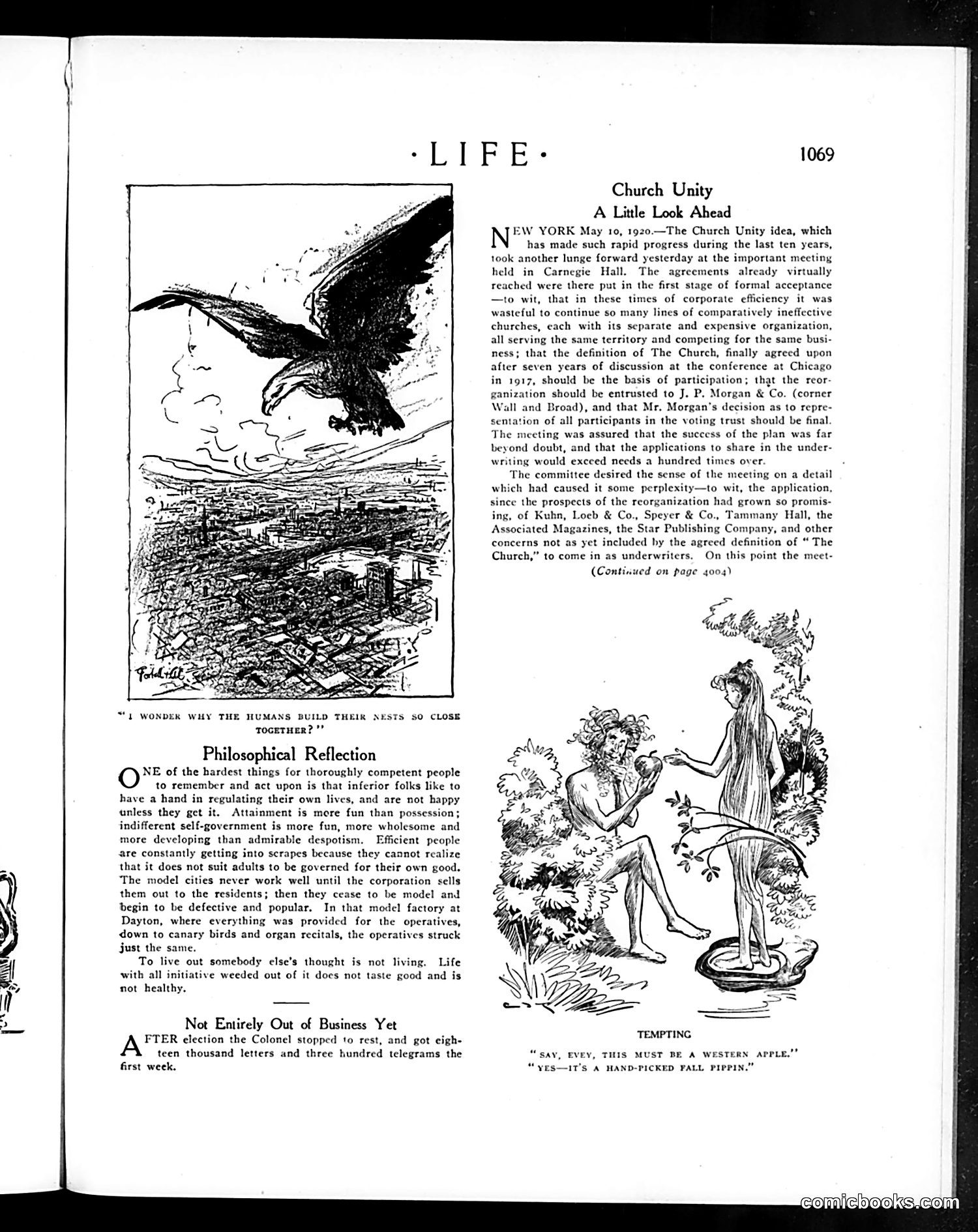
**Top Cartoon**: An eagle observes a densely packed cityscape, wondering why "humans build their nests so close together." This satirizes urban overcrowding and inefficient city planning. **"Philosophical Reflection"**: A lengthy editorial criticizing paternalistic management. It argues that even poorly self-governed people prefer autonomy to benevolent dictatorship—citing a model factory in Dayton where workers struck despite being provided comforts like "canary birds and organ recitals." The piece mocks efficient elites who cannot accept that ordinary people value agency. **"Church Unity" Article**: A satirical account of a May 10, 1920 Carnegie Hall meeting proposing church consolidation. The satire lies in its business-like tone: reorganization would be "entrusted to J.P. Morgan & Co.," with Morgan having final say on voting representation. This mocks the application of corporate efficiency to religious institutions, and the absurdity of financial firms seeking to "underwrite" churches. **Bottom Cartoon ("Tempting")**: A woman tempts another with an apple, claiming it's a "Western apple"—actually a "hand-picked Fall Pippin." This is mild wordplay on apple varieties and deception.
📄 Transcribed text from this page (OCR, searchable)
Machine-transcribed from the original scan — historical spelling and the odd misread are preserved.
“1 WONDER WHY THE HUMANS BUILD THEIR NESTS SO CLOSE TOGETHER? ’? Philosophical Reflection NE of the hardest things for thoroughly competent people to remember and act upon is that inferior folks like to have a hand in regulating their own lives, and are not happy unless they get it. Attainment is more fun than possession; indifferent self-government is more fun, more wholesome and more developing than admirable despotism. Efficient people are constantly getting into scrapes because they cannot realize that it does not suit adults to be governed for their own good. ‘The model cities never work well until the corporation sells them out to the residents; then they cease to be model and begin to be defective and popular. In that model factory at Dayton, where everything was provided for the operatives, down to canary birds and organ recitals, the operatives struck just the same. To live out somebody else’s thought is not living. Life with all initiative weeded out of it does not taste good and is not healthy. Not Entirely Out of Business Yet FTER election the Colonel stopped to rest, and got eigh- teen thousand letters and three hundred telegrams the first week. Church Unity A Little Look Ahead W YORK May 10, 1920.—The Church Unity idea, which has made such rapid progress during the last ten years, took another lunge forward yesterday at the important meeting held in Carnegie Hall. The agreements already virtually reached were there put in the first stage of formal acceptance —to wit, that in these times of corporate efficiency it was wasteful to continue so many lines of comparatively ineffective churches, cach with its separate and expensive organization, all serving the same territory and competing for the same busi- ness; that the definition of The Church, finally agreed upon after seven years of discussion at the conference at Chicago in 1917, should be the basis of participation; that the reor- ganization should be entrusted to J. P. Morgan & Co. (corner Wall and Broad), and that Mr. Morgan's decision as to repre- sentation of all participants in the voting trust should be final. The meeting was assured that the success of the plan was far beyond doubt, and that the applications to share in the under- writing would exceed needs a hundred times over. he committee desired the sense of the meeting on a detail which had caused it some perplexity—to wit, the application, since the prospects of the reorganization had grown so promis- ing, of Kuhn, Loeb & Co., Speyer & Co., Tammany Hall, the Associated Magazines, the Star Publishing Company, and other concerns not as yet included by the agreed definition of “ The Church,” to come in as underwriters. On this point the meet- (Continued on page 4004) “SAV, EVEY, THIS MUST BE A WESTERN ArpPLe.’’ “VES—IT'S A HAND-PICKED PALL PIPPIN.’