
Life, 1910-12-08 · page 26 of 44
Life — December 8, 1910 — page 26: what you’re looking at
What you’re looking at
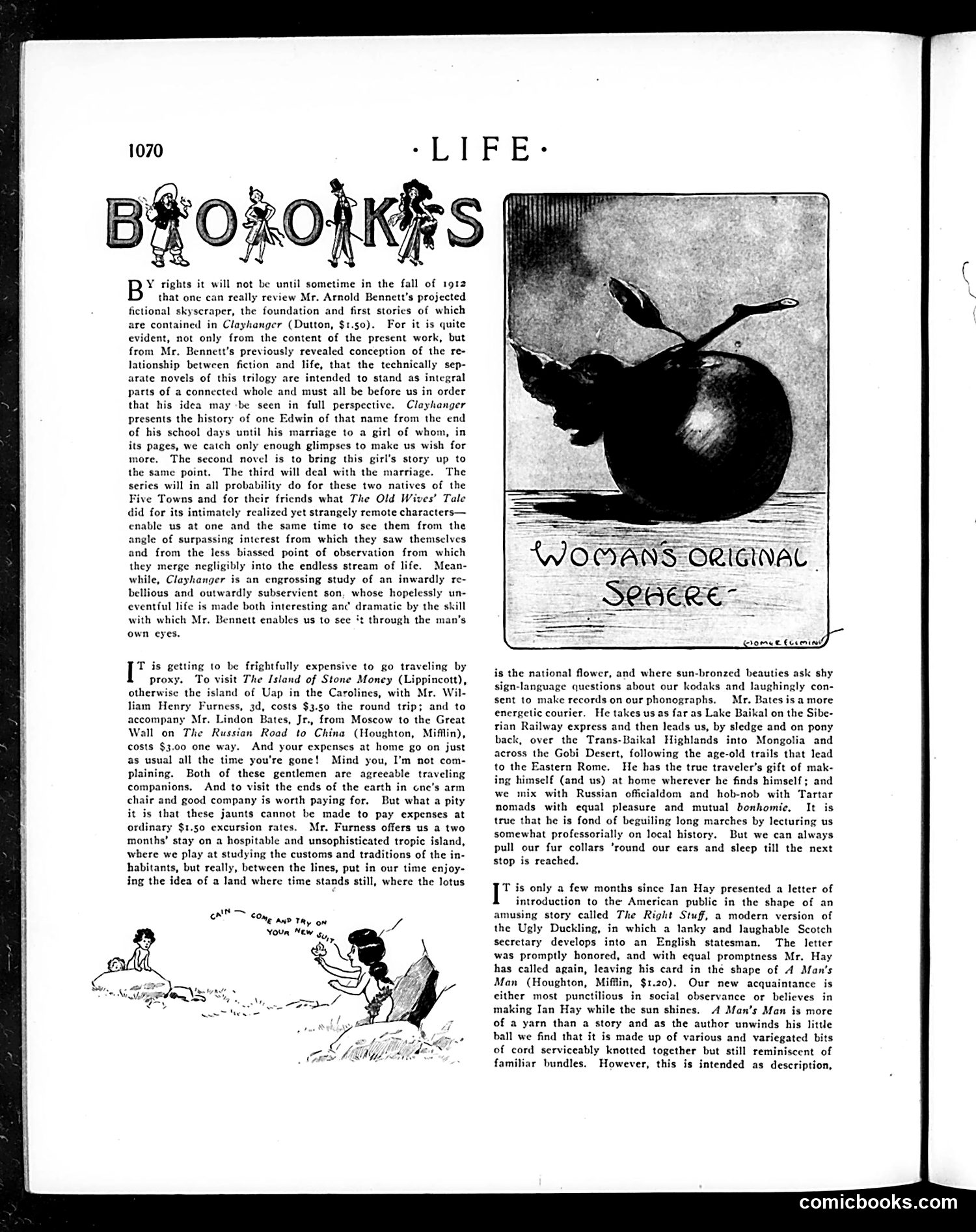
This page from *Life* magazine (circa 1912) contains two main elements: **Book Reviews Section ("Brookoks"):** The text discusses Arnold Bennett's novel *Clayhanger*, praising his technique of presenting characters from both their internal perspective and external observation. It's a serious literary critique. **Travel Books Satire:** The second section mocks the growing trend of armchair travel through expensive guidebooks. The author notes that visiting remote locations (Stone Money island in the Carolines, the Great Wall via Russia) costs $3.50-$3.00 through these books, while home expenses continue unchanged—an absurd financial reality. The satire targets how readers use such books to fantasize about exotic locales ("where the lotus is the national flower") rather than genuinely engage with foreign cultures, and how travel writers present themselves as sophisticated guides ("hob-nob with Tartar nomads"). The small cartoon at bottom-left appears to illustrate this armchair travel concept, showing someone comfortably at home while supposedly experiencing distant adventures.
📄 Transcribed text from this page (OCR, searchable)
Machine-transcribed from the original scan — historical spelling and the odd misread are preserved.
Y rights it will not be until sometime in the fall of 1912 that one can really review Mr. Arnold Bennett’s projected fictional skyscraper, the foundation and first stories of which are contained in Clayhanger (Dutton, $1.50). For it is quite evident, not only from the content of the present work, but from Mr. Bennett’s previously revealed conception of the re- lationship between fiction and life, that the technically sep- arate novels of this trilogy are intended to stand as integral parts of a connected whole and must all be before us in order that his idea may -be seen in full perspective. Clayhanger presents the history of one Edwin of that name from the end of his school days until his marriage to a girl of whom, in its pages, we catch only enough glimpses to make us wish for more, The second novel is to bring this girl's story up to the same point. The third will deal with the marriage. The series will in all probability do for these two natives of the ¢ Towns and for their friends what The Old Wives’ Tale did for its intimately realized yet strangely remote characters— enable us at one and the same time to sce them from the angle of surpassing interest from which they saw themselves and from the less biassed point of observation from which they merge negligibly into the endless stream of life. Mean- while, Clayhanger is an engrossing study of an inwardly re- bellious and outwardly subservient son, whose hopelessly un- eventful life is made both interesting anc dramatic by the skill with which Mr. Bennett enables us to see ‘t through the man’s own eyes. T is getting to be frightfully expensive to go traveling by proxy. To visit The Island of Stone Money (Lippincott), otherwise the island of Uap in the Carolines, with Mr. Wil- liam Henry Furness, 3d, costs $3.50 the round trip; and to accompany Mr. Lindon Bates, Jr., from Moscow to the Great Wall on The Russian Road to China (Houghton, Mifilin), costs $3.00 one way. And your expenses at home go on just as usual all the time you're gone! Mind you, I'm not com- plaining. Both of these gentlemen are agreeable traveling companions, And to visit the ends of the earth in one’s arm chair and good company is worth paying for. But what a pity it is that these jaunts cannot be made to pay expenses at ordinary $1.50 excursion rates. Mr. Furness offers us a two months’ stay on a hospitable and unsophisticated tropic island, where we play at studying the customs and traditions of the in- habitants, but really, between the lines, put in our time enjoy- ing the idea of a land where time stands still, where the lotus ns a £0, e Me AND Thy ow is the national flower, and where sun-bronzed beauties ask shy sign-language questions about our kodaks and laughingly con- sent to make records on our phonographs. Mr. Bates is a more energetic courier. He takes us as far as Lake Baikal on the Sibe- rian Railway express and then leads us, by sledge and on pony back, over the Trans-Baikal Highlands into Mongolia and across the Gobi Desert, following the age-old trails that lead to the Eastern Rome. He has the true traveler’s gift of mak- ing himself (and us) at home wherever he finds himself; and we mix with Russian officialdom and hob-nob with Tartar nomads with equal pleasure and mutual bonhomie, It is true that he is fond of beguiling long marches by lecturing us somewhat professorially on local history. But we can always pull our fur collars ‘round our ears and sleep till the next stop is reached. T is only a few months since Ian Hay presented a letter of introduction to the American public in the shape of an amusing story called The Right Stuf, a modern version of the Ugly Duckling, in which a lanky and laughable Scotch secretary develops into an English statesman, The letter was promptly honored, and with equal promptness Mr. Hay has called again, leaving his card in thé shape of A Man's Man (Houghton, Mifflin, $1.20). Our new acquaintance is cither most punctilious in social observance or believes in making Ian Hay while the sun shines, A Man’s Man is more of a yarn than a story and as the author unwinds his litte ball we find that it is made up of various and variegated bits of cord serviceably knotted together but still reminiscent of familiar bundles. However, this is intended as description, comicbooks.com