
Life, 1910-12-08 · page 20 of 44
Life — December 8, 1910 — page 20: what you’re looking at
What you’re looking at
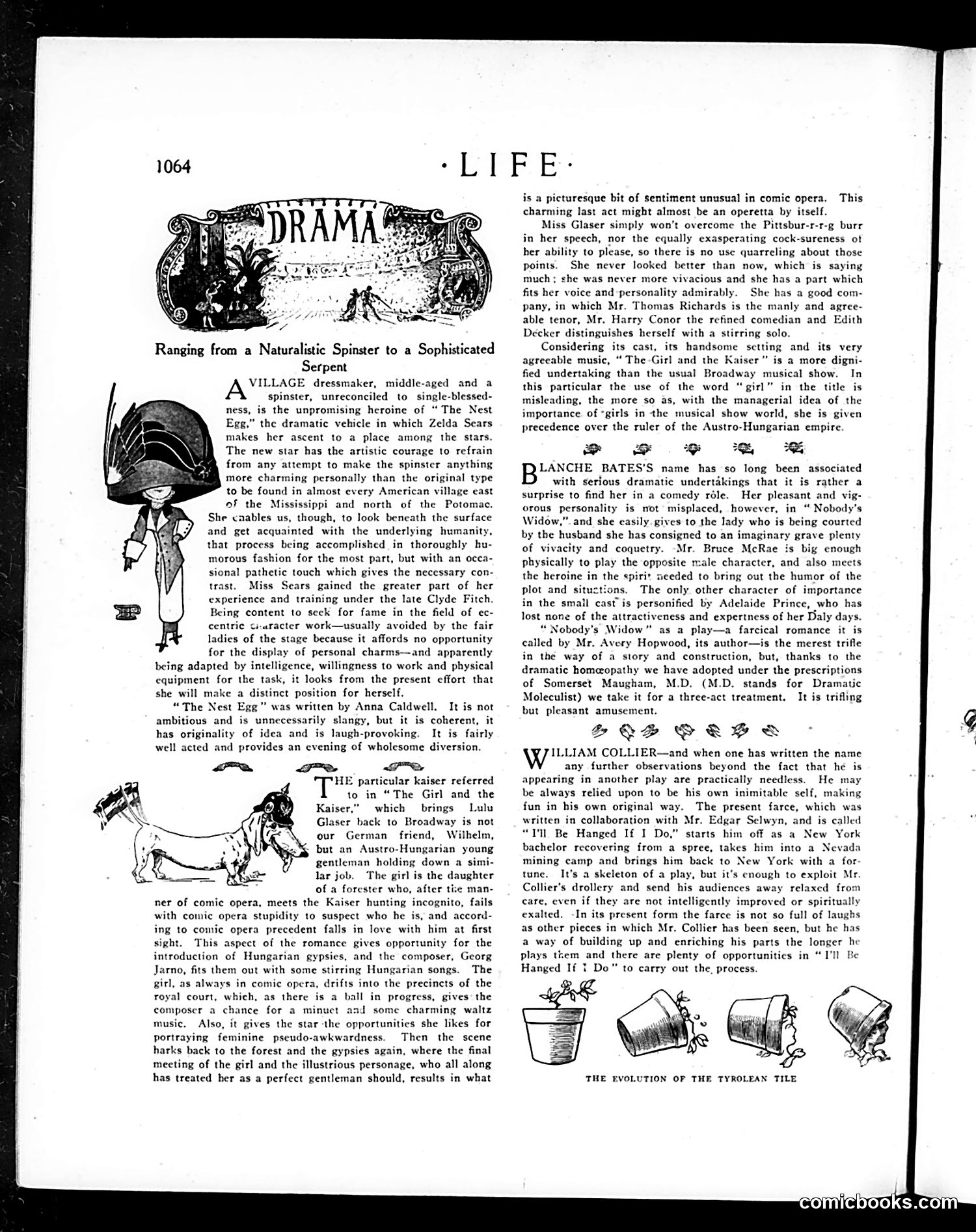
This page reviews two Broadway theatrical productions. The main content discusses "The Nest Egg," starring actress Zelda Sears as an unmarried village spinster—a rare choice since stage actresses typically avoided unglamorous character roles. The review praises her courage in accepting this unflattering but humanizing part, written by Anna Caldwell. The secondary review covers "The Girl and the Kaiser," a comic operetta featuring an Austro-Hungarian (not German) kaiser who falls in love with a forester's daughter. The plot follows typical operetta conventions: secret royal identity, Hungarian gypsies, elaborate court balls, and romantic sentiment. The review notes star Lulu Glaser's vivacity and appearance, though criticizes her Pittsburgh accent, while praising the male leads and the production's sophistication compared to typical Broadway musical fare. Both reviews exemplify early 20th-century theater criticism focused on character acting and production quality.
📄 Transcribed text from this page (OCR, searchable)
Machine-transcribed from the original scan — historical spelling and the odd misread are preserved.
Ranging from a Naturalistic Spinster to a Sophisticated Serpent JA VILLAGE “steseraier,.lidiecseed sod a spinster, unreconciled to single-blessed- ness, is the unpromising heroine of “The Nest Egg,” the dramatic vehicle in which Zelda Sears makes her ascent to a place among the stars. The new star has the artistic courage to refrain from any attempt to make the spinster anything more charming personally than the original type to be found in almost every American village east of the Mississippi and north of the Potomac. She caables us, though, to look beneath the surface and get acquainted with the underlying humanity, that process being accomplished in thoroughly hu- morous fashion for the most part, but with an occ: sional pathetic touch which gives the necessary con- trast. Miss Sears gained the greater part of her experience and training under the late Clyde Fitch. Being content to seck for fame in the field of ec- centric ci-aracter work—usually avoided by the fair ladies of the stage because it affords no opportunity for the display of personal charms—and apparently being adapted by intelligence, willingness to work and physical equipment for the task, it looks from the present effort that she will make a distinct position for herself. “The it Egg" was written by Anna Caldwell. It is not ambitious and is unnecessarily slangy, but it is coherent, it has originality of idea and is laugh-provoking. It is fairly well acted and provides an evening of wholesome diversion. Fre Pr HE particular kaiser referred to in “The Girl and the which brings Lulu back to Broadway is not our German friend, Wilhelm, 5 but an Austro-Hungarian young gentleman holding down a simi- lar job. The girl is the daughter of a forester who, after the man- ner of comic opera, meets the Kaiser hunting incognito, fails with comic opera stupidity to suspect who he is, and accord- ing to comic opera precedent falls in love with him at first sight. This aspect of the romance gives opportunity for the introduction of Hungarian gypsies, and the composer, Georg Jarno, fits them out with some stirring Hungarian songs. The drifts into the precincts of the gives the ming waltz girl, as always in comic oper: royal court, which, as there is a ball in progre composer a chance for a minuct and some ch. music. Also, it gives the star-the opportunities she likes for portraying feminine pseudo-awkwardness. Then the scene harks back to the forest and the gypsies again, where the final meeting of the girl and the illustrious personage, who all along has treated her as a perfect gentleman should, results in what ‘DPE E- is a picturesque bit of sentiment unusual in comic opera. This charming last act might almost be an operetta by itself. Miss Glaser simply won't overcome the Pittsbur-r-r-g burr in her speech, nor the equally exasperating cock-sureness ot her ability to please, so there is no use quarreling about those points. She never looked better than now, which is saying much ; she was never more vivacious and she has a part which fits her voice and personality admirably. She has a good com- pany, in which Mr. Thomas Richards is the manly and agree- able tenor, Mr. Harry Conor the refined comedian and Edith Decker distinguishes herself with a stirring solo. Considering its cast, its handsome sctting and its very agreeable music, “ The-Girl and the Kaiser” is a more digni- fied undertaking than the usual Broadway musical show. In this particular the use of the word “girl” in the title is misleading, the more so as, with the managerial idea of the importance of “girls in the musical show world, she is given precedence over the ruler of the Austro-Hungarian empire. LANCHE BATES’S name has so long been associated with serious dramatic undertakings that it is rather a surprise to find her in a comedy réle. Her pleasant and vig- orous personality is mot misplaced, however, in “ Nobody's Widow,”. and she casily. gives to the lady who is being courted by the husband she has consigned to an imaginary grave plenty of vivacity and coquetry. -Mr. Bruce McRae is big enough physically to play the opposite male character, and also meets the heroine in the spirit needed to bring out the humor of the plot and situctions, The only other character of importance in the small cast is personified by Adelaide Prince, who has lost none of the attractiveness and expertness of her Daly days. “Nobody's Widow” as a play farcical romance it is called by Mr. Avery Hopwood, its author—is the merest trifle in the way of a story and construction, but, thanks to the dramatic homaopathy we have adopted under the prescriptions of Somerset Maugham, M.D. (M.D. stands for Dramatic Moleculist) we take it for a three-act treatment. It is trifling but pleasant amusement. POP PRPS ILLIAM COLLIER—and when one has written the name any further observations beyond the fact that he is appearing in another play are practically needless. He may be always relied upon to be his own inimitable self, making fun in his own original way. The present farce, which was written in collaboration with Mr. Edgar Selwyn, and is called “I'll Be Hanged If I Do,” starts him off as a New York bachelor recovering from a spree, takes him into a Nevada mining camp and brings him back to New York with a for tune. It’s a skeleton of a play, but it's enough to exploit Mr. Collier's drollery and send his audiences away relaxed fro care, even if they are not intelligently improved or spiritually exalted. -In its present form the farce is not so full of laughs as other pieces in which Mr. Collier has been seen, but he has a way of building up and enriching his parts the longer he plays them and there are plenty of opportunities in “I'll Be Hanged If 1 Do” to carry out the, process. THE EVOLUTION OP THE TYROLEAN TILE