
Life, 1910-12-08 · page 31 of 44
Life — December 8, 1910 — page 31: what you’re looking at
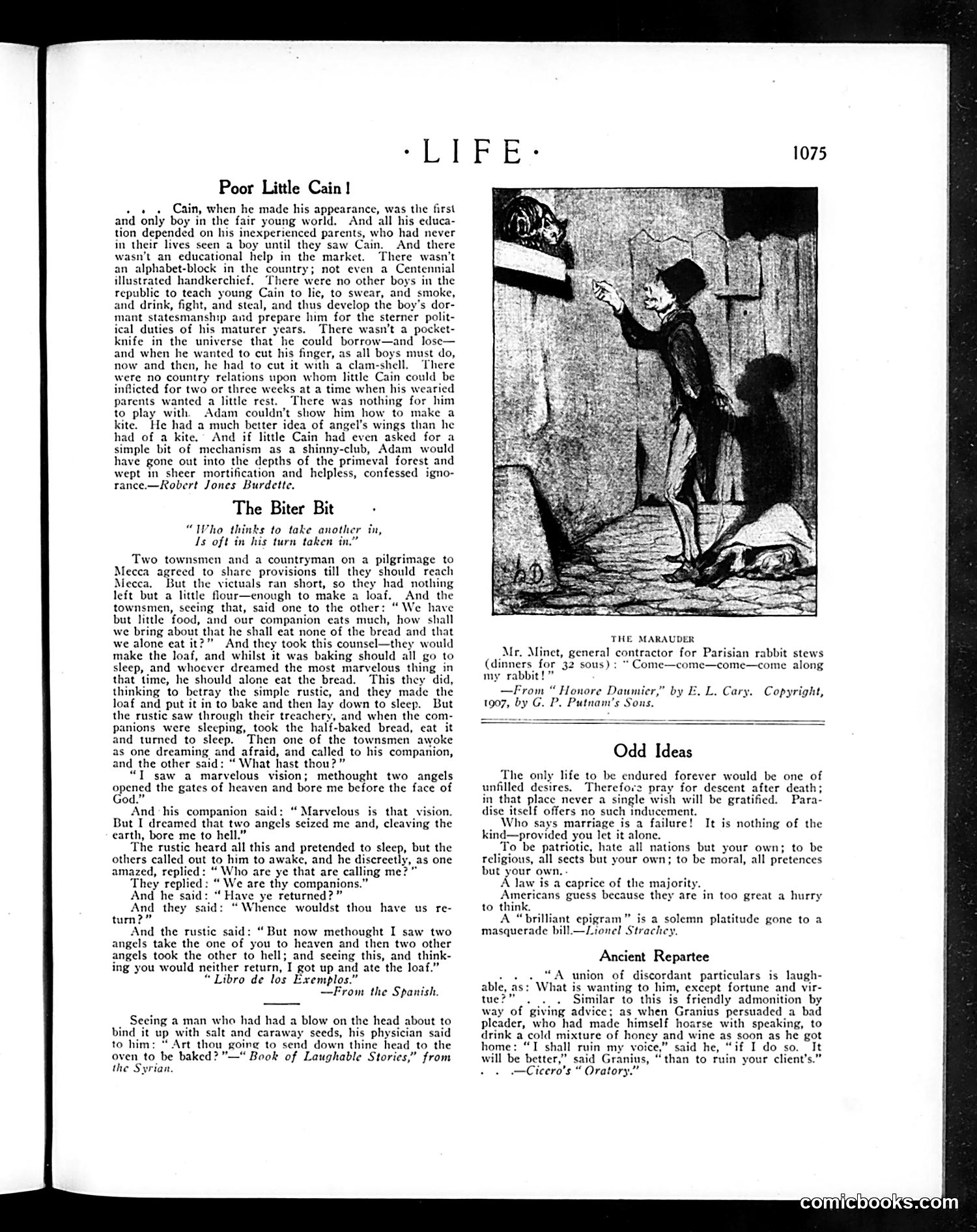
A restored page from Life, 1910-12-08. Page through the whole issue in the reader above.
📄 Transcribed text from this page (OCR, searchable)
Machine-transcribed from the original scan — historical spelling and the odd misread are preserved.
Poor Little Cain! « « Cain, when he made his appearance, was the first and only boy in the fair young world. And all his educa- tion depended on his inexperienced parents, who had never in their lives seen a boy until they saw Cain. And there wasn’t an educational help in the market. There wasn’t an alphabet-block in the country; not even a Centennial illustrated handkerchief. There were no other boys in the republic to teach young Cain to lie, to swear, and smoke, and drink, fight, and steal, and thus develop the boy’s dor- mant statesmanship and prepare him for the sterner polit- ical duties of his maturer years. There wasn’t a pocket- knife in the universe that he could borrow—and lose— and when he wanted to cut his finger, as all boys must do, now and then, he had to cut it with a clam-shell. There were no country relations upon whom little Cain could be inflicted for two or three weeks at a time when his wearied parents wanted a little rest. There was nothing for him to play with, Adam couldn’t show him how to make a kite. He had a much better idea of angel's wings than he had of a kite. And if little Cain had even asked for a simple bit of mechanism as a shinny-club, Adam would have gone out into the depths of the primeval forest and wept in sheer mortification and helpless, confessed igno- rance.—Robert Jones Burdette, The Biter Bit . “Who thinks to take another in, Is oft in his turn taken in.” Two townsmen and a countryman on a pilgrimage to Mecca agreed to share provisions till they should reach Mecca. But the victuals ran short, so they had nothing left but a little flour—enough to make a loaf. And the townsmen, secing that, said one to the other: “We have but little food, and our companion eats much, how shall we bring about that he shall eat none of the bread and that we alone eat it?” And they took this counsel—they would make the loaf, and whilst it was baking should all go to sleep, and whoever dreamed the most marvelous thing in that time, he should alone eat the bread. This they did, thinking to betray the simple rustic, and they made the loaf and put it in to bake and then lay down to sleep. But the rustic saw through their treache nd when the com- panions were sleeping, took the half-baked bread, cat it and turned to sleep. Then one of the townsmen awoke as one dreaming and afraid, and called to his companion, and the other said: “ What hast thou?” “T saw a marvelous vision; methought two angels eperied the gates of heaven and bore me before the face of 1d.” And his companion said: “ Marvelous is that vision. But I dreamed that two angels seized me and, cleaving the earth, bore me to hell.” The rustic heard all this and pretended to sleep, but the others called out to him to awake, and he discreetly, as one amazed, replied: “ Who are ye that are calling me?” They replied: “ We are thy companions.” And he said: “ Have ye returned?” And they said: “Whence wouldst thou have us re- tum?” And the rustic said: “But now methought I saw two angels take the one of you to heaven and then two other angels took the other to hell; and seeing this, and think- ing you would neither return, I got up and ate the loaf.” “Libro de los Exemplos.” —From the Spanish. Seeing a man who had had a blow on the head about to bind it up with salt and caraway seeds, his physician said to him: “Art thou going to send down thine head to the oven to be baked? "—“ Book of Laughable Stories,” from the Syrian. THE MARAUDER Mr, Minet, general contractor for Parisian rabbit stews (dinners for 32 sous): “ Come—come—come—come along my rabbit!” —From “ Honore Daumier,” by E. L. Cary. 1907, by G. P, Putnam's Sons. Copyright, Odd Ideas ‘The only life to be endured forever would be one of unfilled desires. Therefors pray for descent after deat in that place never a single v will be gratified. Pars dise itself offers no such inducement. Who says marriage is a failure! kind—provided you let it alone. fo be patriotic, hate all nations but your own; to be religious, all sects but your own; to be moral, all pretences but your own, A law is a caprice of the majority. Americans guess because they are in too great a hurry to think. A “brilliant epigram” is a solemn platitude gone to a masquerade bill.—Lronel Strach. It is nothing of the Ancient Repartee union of discordant particulars is laugh- : What is wanting to him, except fortune and vir- + Similar to this is friendly admonition by ing advice; as when Granius persuaded a bad pleader, who had made himself hoarse with speaking, to drink a cold mixture of honey and wine as soon as he got home: “T shall ruin my voice,” said he, “if I do so. It will be better,” aid Granius, “than to ruin your client's.” —Cicero’s “ Oratory.”