
A complete issue · 40 pages · 1910
Life — June 9, 1910
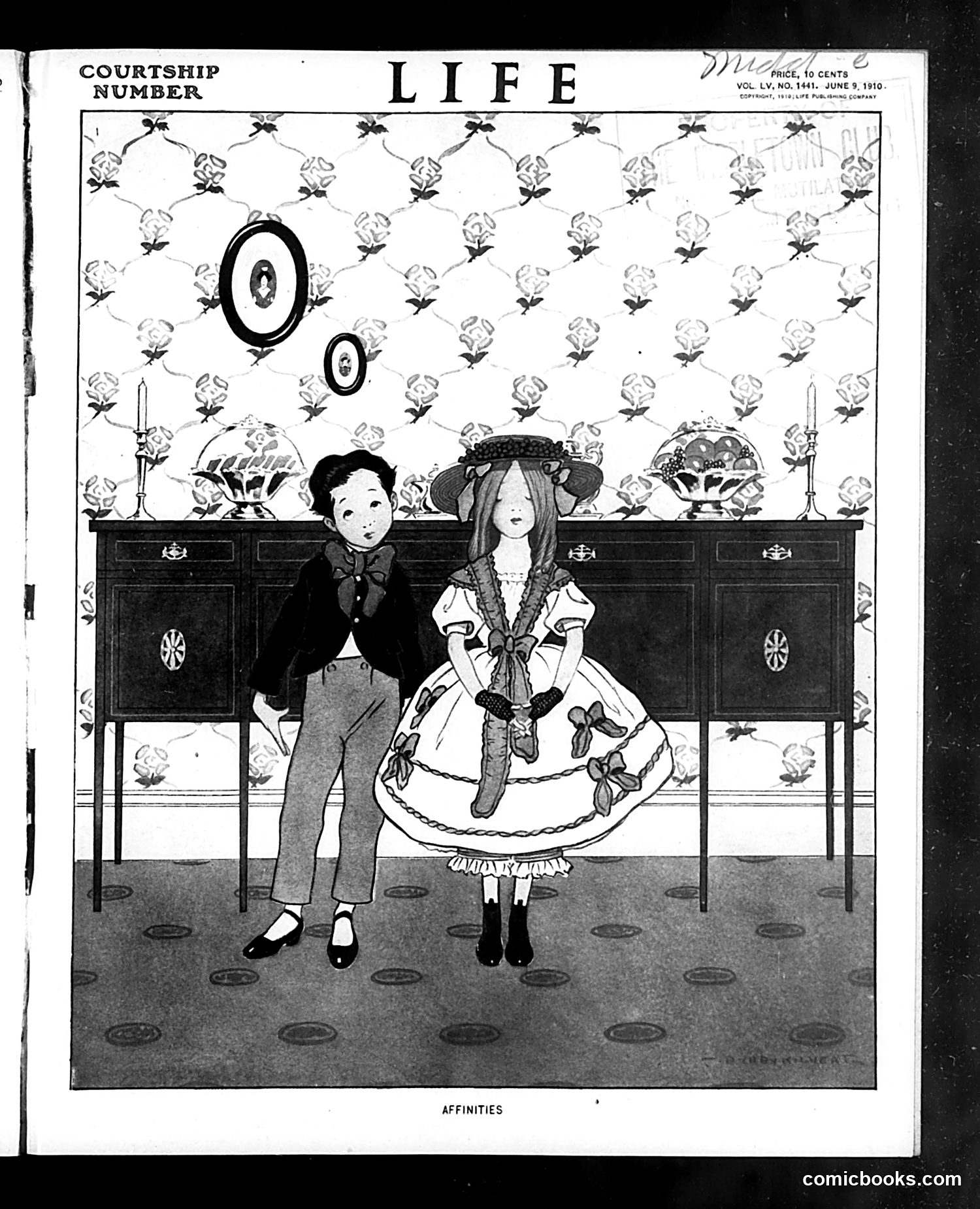
This page is titled "Courtship Number" and labeled "Affinities," depicting a young couple in an elegant interior. The boy wears formal attire (jacket and trousers); the girl wears a frilly white dress with ribbons. Both have stylized, somewhat vacant expressions and identical poses, suggesting they are matched pairs or "affinities." The satire likely mocks the era's "scientific" matchmaking trends and courtship customs. The repetitive floral wallpaper and identical facial features emphasize the mechanical, superficial nature of romantic pairing based on appearance or social status rather than genuine compatibility. The title suggests critique of deterministic ideas about romantic destiny popular in early-20th-century society.
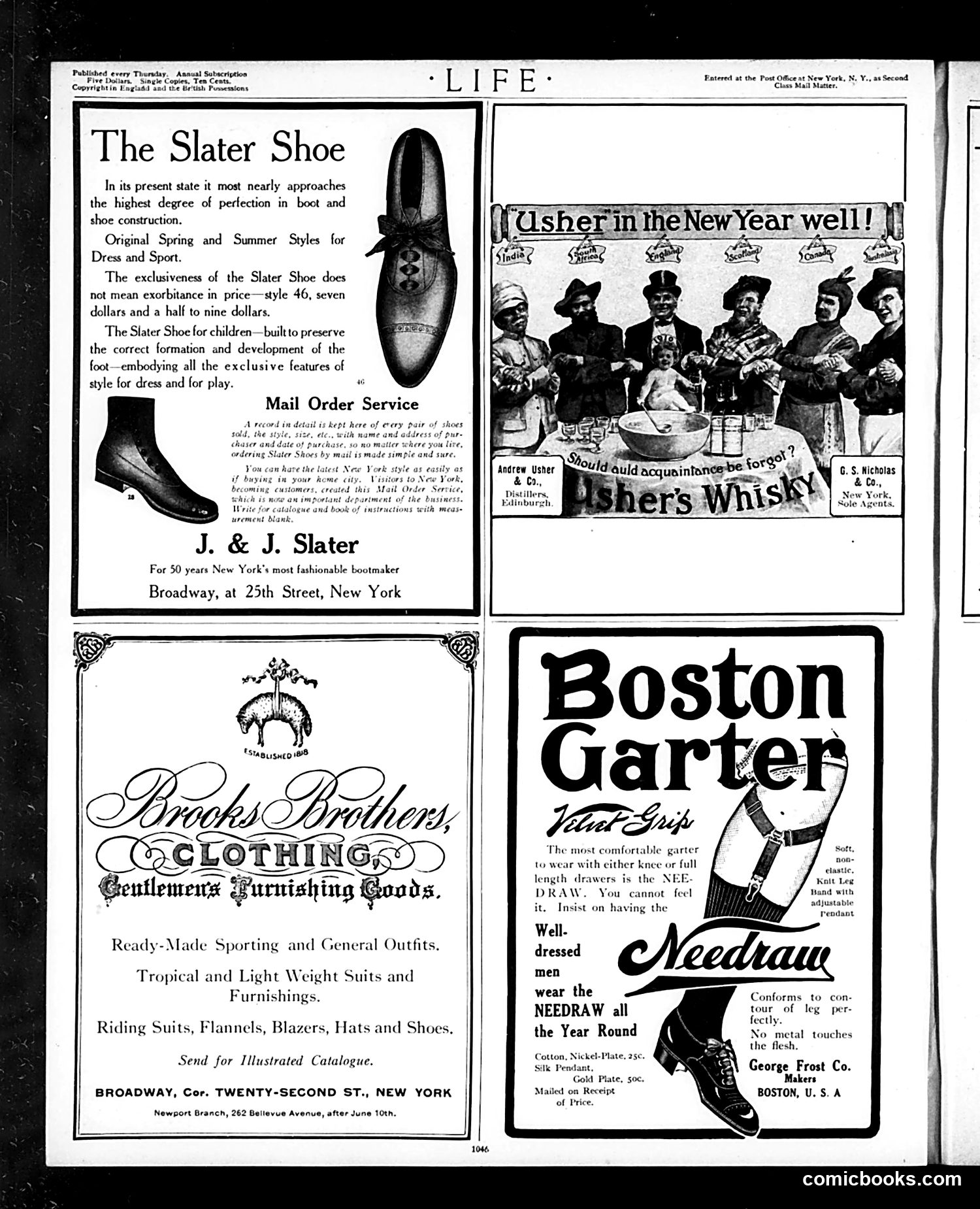
This page is primarily **advertising content** from a vintage Life magazine, not satirical editorial material. The advertisements promote: 1. **The Slater Shoe** — a women's boot emphasizing style and foot health, available by mail order from a Broadway bootmaker 2. **Usher's Whisky** — featuring men in period dress (appears to be New Year's themed, with the tagline "Usher in the New Year well!") 3. **Brooks Brothers** — men's clothing and furnishings from their Broadway location 4. **Boston Garter** — advertised as a comfortable leg garter for "well-dressed men" The only potentially humorous element is the Usher's Whisky ad, which plays on the brand name by depicting literal "ushers" (formally dressed attendants) for a New Year's celebration. Otherwise, this is straightforward product marketing typical of early 20th-century periodicals.
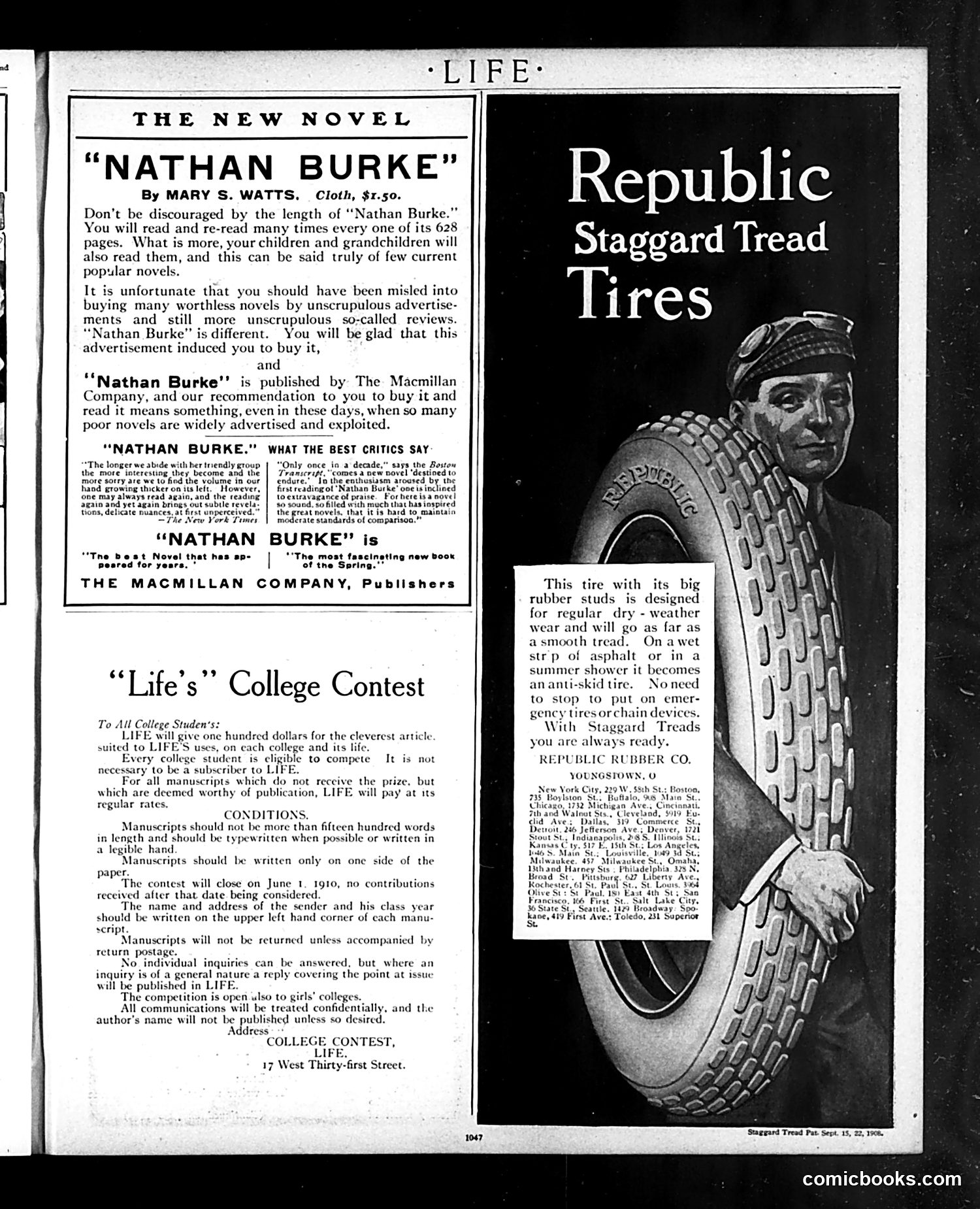
This page contains **no political cartoon or satire**. Instead, it features: **Left side:** A book advertisement for "Nathan Burke" by Mary S. Watts (published by Macmillan), promoting it as a superior novel worth reading repeatedly, plus a "Life's College Contest" announcement offering $100 for the best article submitted by college students by June 1, 1910. **Right side:** A commercial advertisement for Republic Staggered Tread Tires, showing a close-up photograph of a tire tread with an inset image of a man's face. The ad emphasizes the tire's durability in dry weather and anti-skid properties when wet. This is a standard magazine page mixing literature promotion, reader engagement (the contest), and paid advertising—typical of early 20th-century magazine business models.
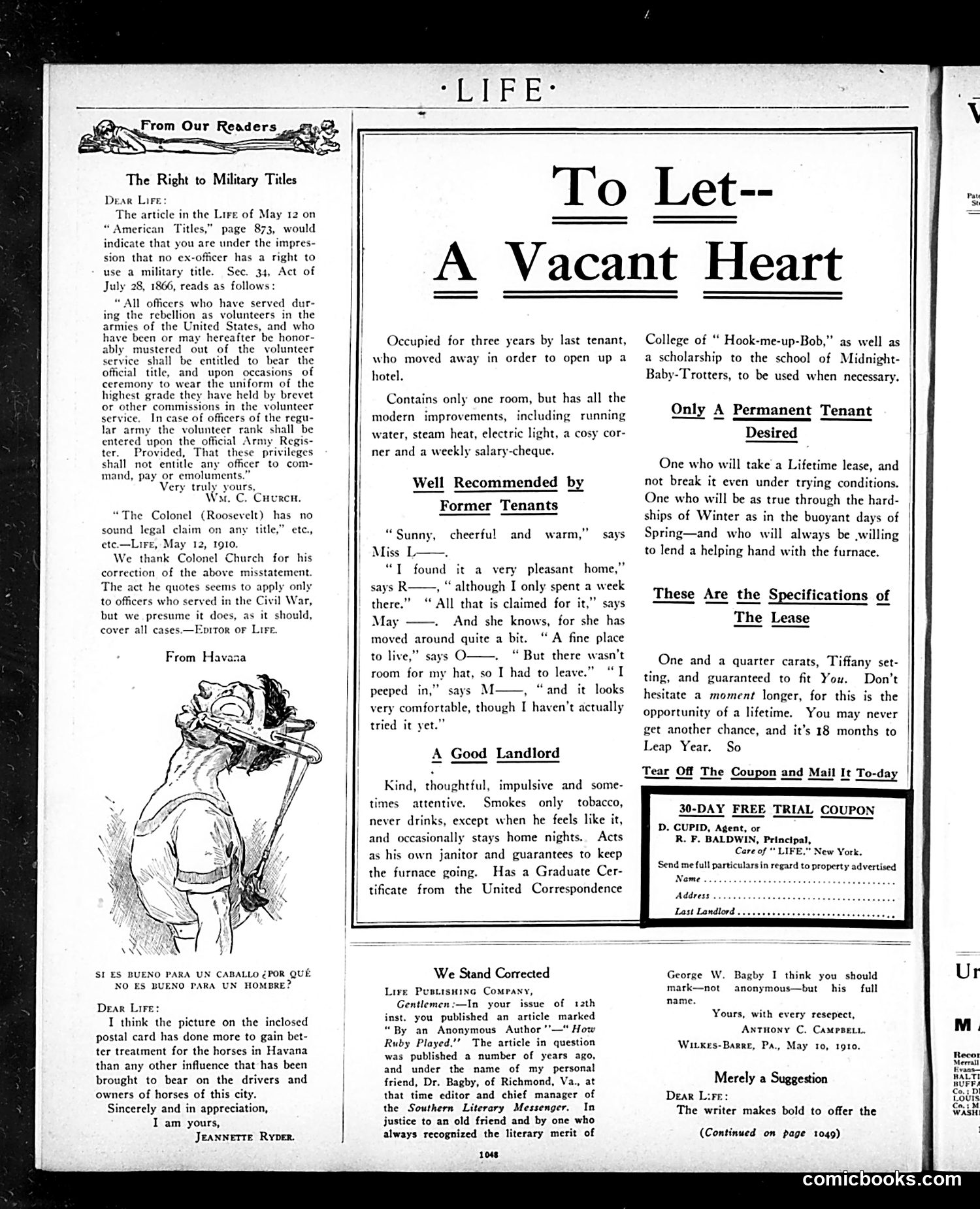
This page is primarily **classified advertising and reader correspondence**, not political satire. The main content features: 1. **"To Let—A Vacant Heart"**: A humorous rental advertisement for a one-room apartment, personifying the space as a romantic prospect. It's a playful real estate listing using romantic language. 2. **"From Our Readers"** section: Letters addressing military titles and a horse-treatment article, with editorial corrections. 3. **"From Havana"** cartoon: A sketch (caption in Spanish: "It is good for a horse, but why not for a man?") appears to satirize some practice or treatment, though the specific reference is unclear without fuller context. The page reflects early 20th-century Life magazine's mix of humor, reader engagement, and practical advertising rather than pointed political commentary.
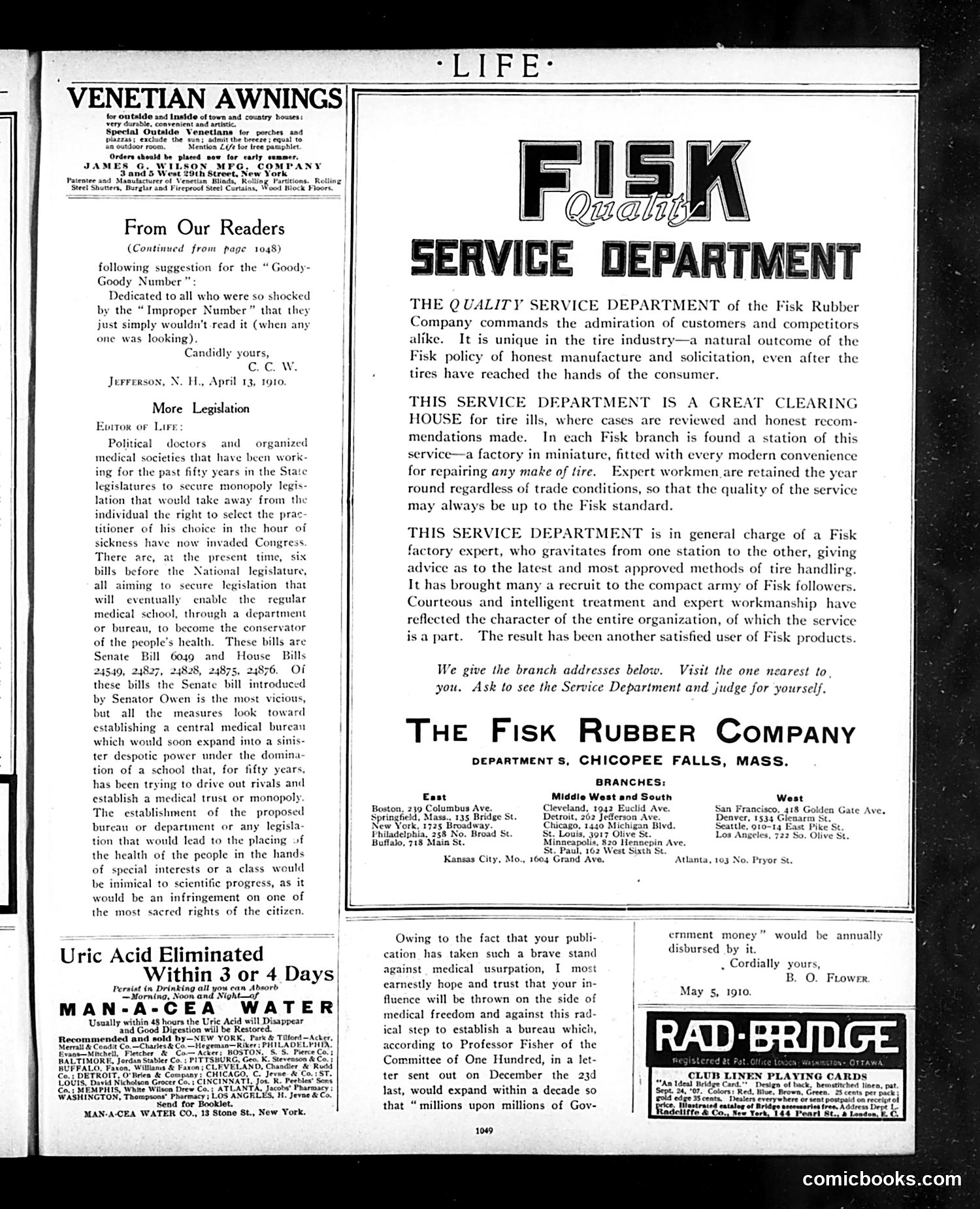
This page is **primarily advertising**, not satirical content. The main feature is a large advertisement for the Fisk Rubber Company's "Quality Service Department," which claims to offer tire repair and customer service at branches nationwide. The ad emphasizes Fisk's commitment to quality and customer satisfaction. The page also includes smaller ads for "Man-A-Cea Water" (a patent medicine claiming to eliminate uric acid) and "Rad-Bridge Club Linen Playing Cards." The only editorial content is a brief "From Our Readers" section with letters to the editor, including one about medical legislation and proper numbering systems. **No political cartoons appear on this page.** It represents early 20th-century magazine advertising practices.
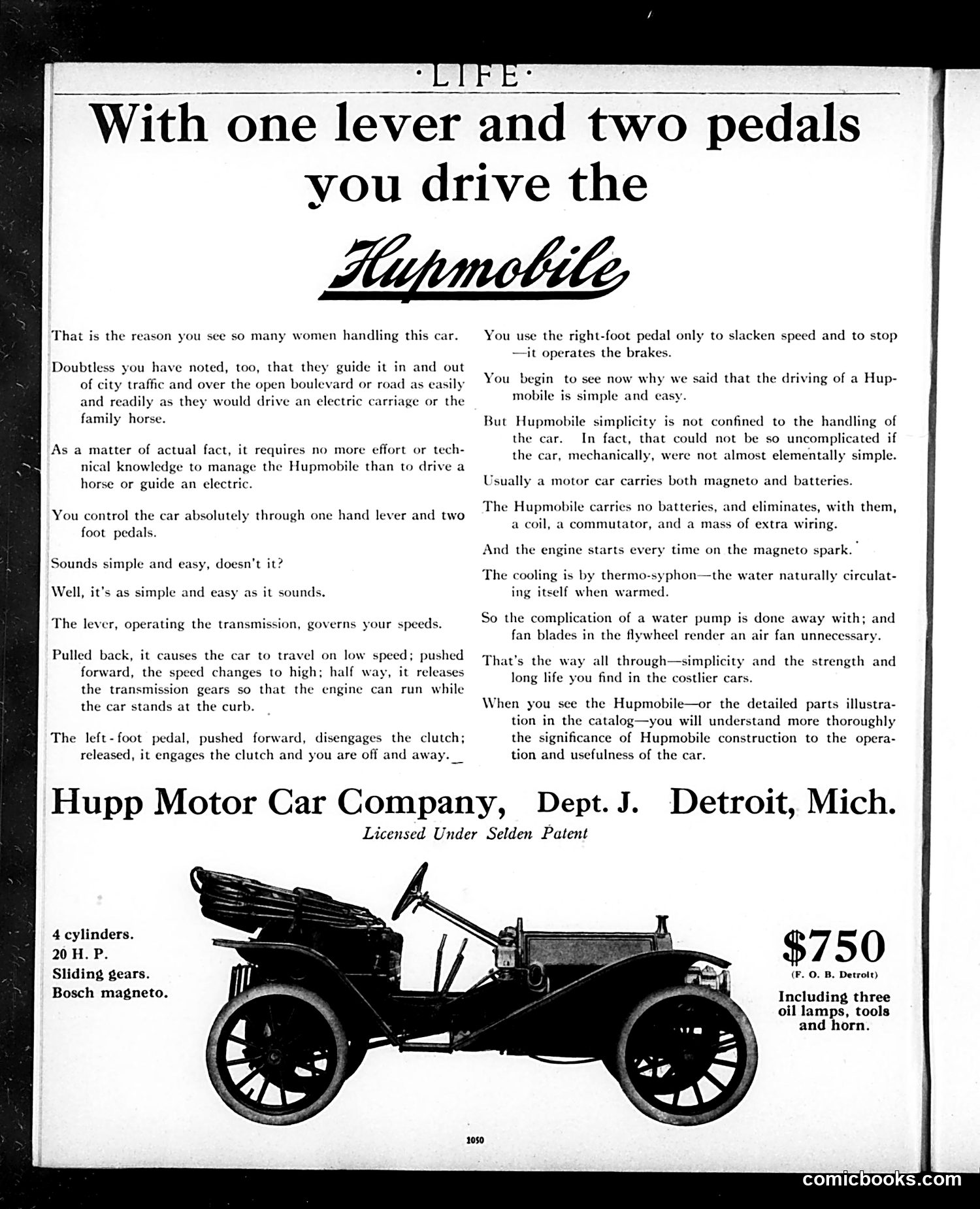
This page is **primarily an advertisement**, not satirical content. It promotes the Hupmobile, an early automobile manufactured by the Hupp Motor Car Company in Detroit. The ad emphasizes the car's simplicity of operation—controllable by "one lever and two pedals"—appealing to women drivers, who were still a novelty in the early automotive era. The text notes that women successfully navigate city traffic and open roads "as easily as they would drive an electric carriage or the family horse," suggesting the Hupmobile requires no special mechanical knowledge. The ad highlights technical innovations: no batteries needed, magneto ignition, thermosyphon cooling. The price of $750 (including lamps, tools, and horn) appears competitive for the period. This reflects early-1900s marketing targeting middle-class families and female drivers during motoring's infancy.
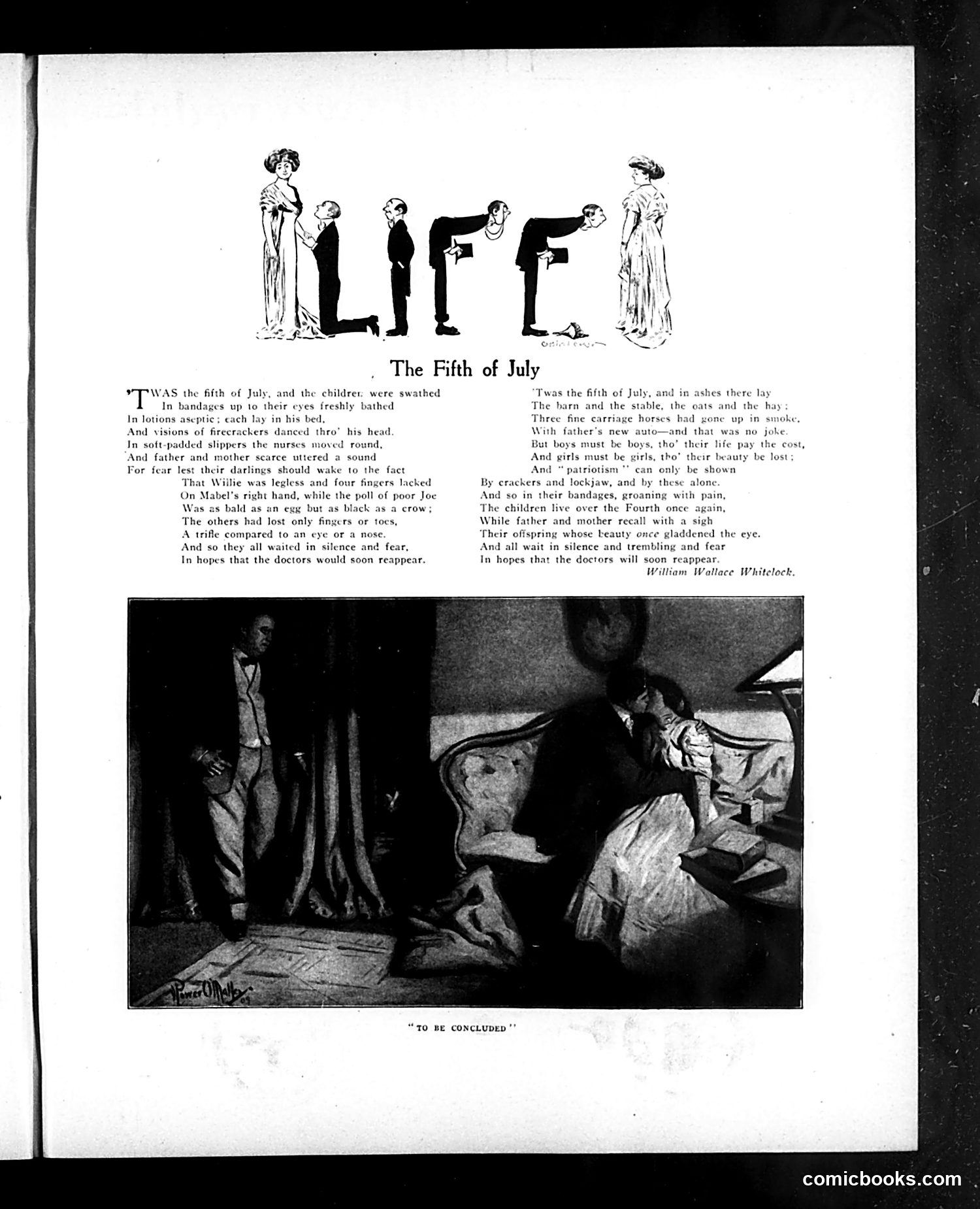
This page presents a poem by William Wallace Whitelock satirizing the aftermath of Fourth of July celebrations. The illustrated header shows figures in formal dress positioned to spell "LIFE," with two women flanking men in various contorted poses. The poem describes children injured and maimed from Independence Day festivities—firecrackers causing lost fingers, damaged eyes, and other injuries. It sarcastically notes that despite these casualties, "boys must be boys" and "girls must be girls," and that "patriotism" can only be shown through such dangerous practices. The lower photograph, captioned "TO BE CONCLUDED," appears to depict an injury scene, reinforcing the poem's grim commentary on how Fourth of July celebrations routinely resulted in serious childhood injuries during this era.
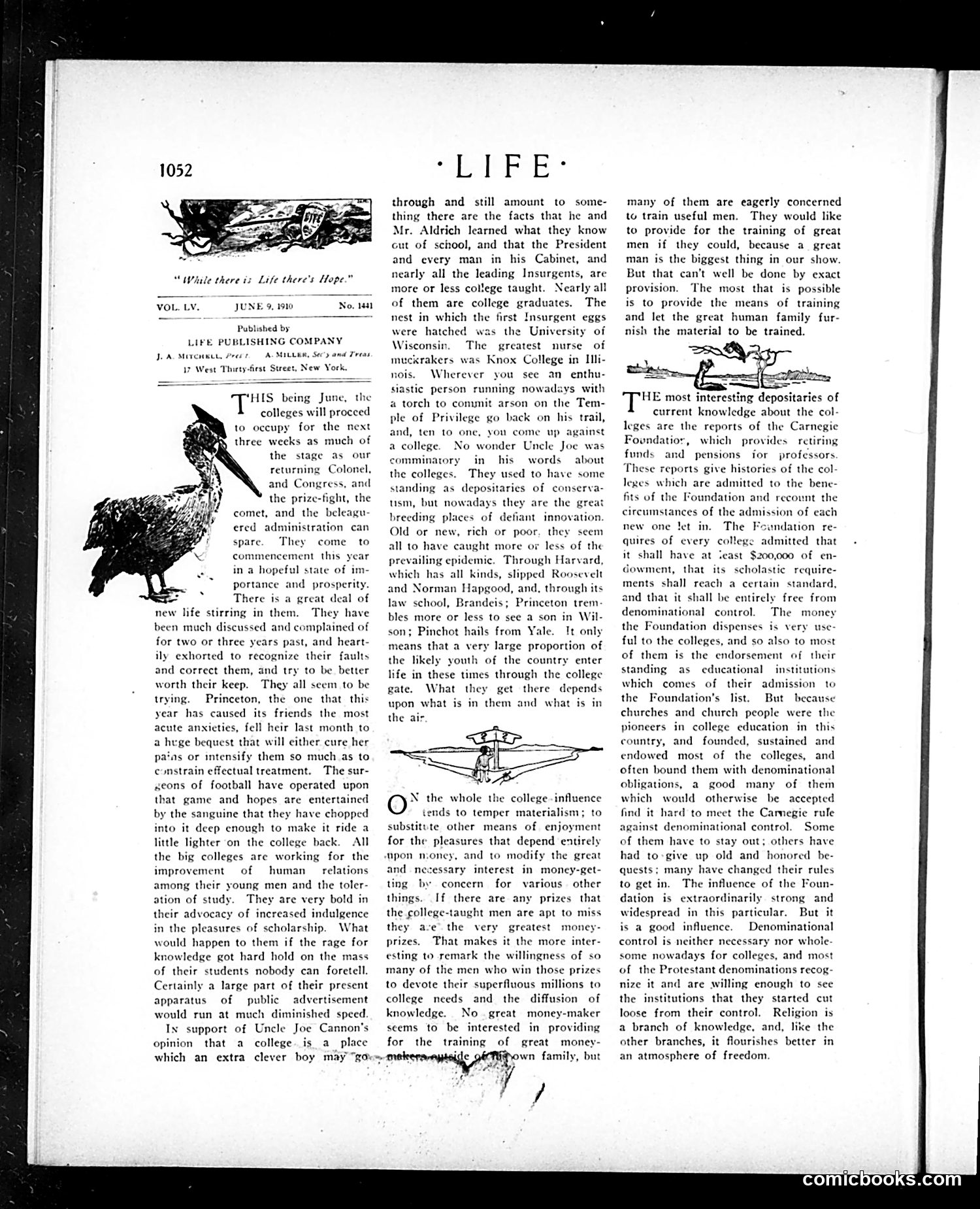
This page contains editorial content rather than political cartoons. The main illustration is a decorative drawing of a rooster, accompanying an article about American colleges and their role in developing leaders. The text discusses college education's importance, mentioning specific institutions (Harvard, Yale, Princeton, Knox College, University of Wisconsin, Brandeis) and their contributions to training influential men. It references the Carnegie Foundation's role in supporting educational institutions and critiques denominational control of colleges, arguing for academic freedom. The rooster image likely serves as a symbol of American vitality or vigilance, though its specific satirical meaning is unclear without additional context about Life's visual conventions of this era.
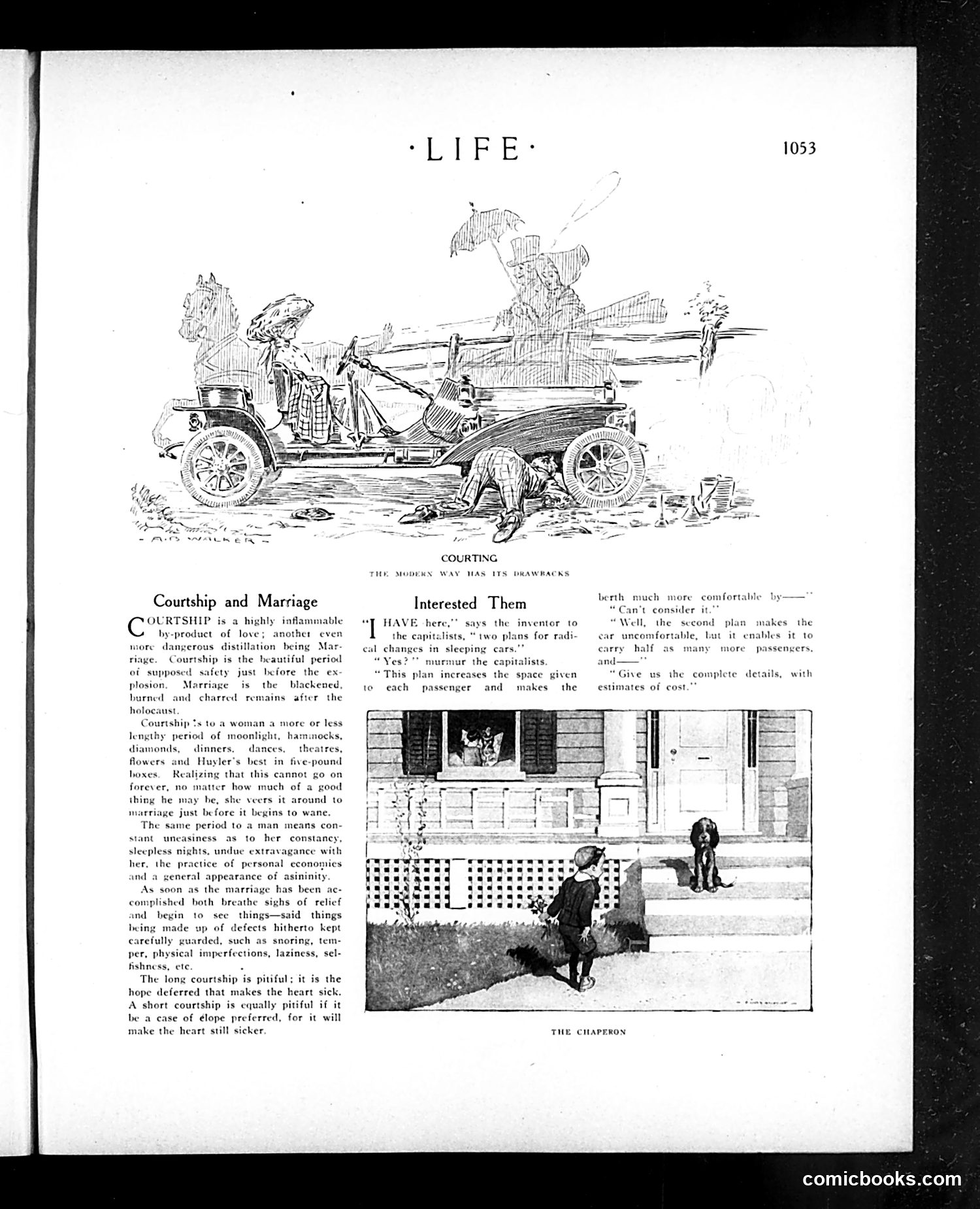
This page satirizes early 20th-century courtship customs and modern automobiles. The top cartoon shows a car breakdown during a date, with the caption "THE MODERN WAY HAS ITS DRAWBACKS"—the pun plays on both literal mechanical failure and the social awkwardness of romantic situations interrupted by technical problems. The text mocks courtship as an "inflammable" period full of exaggerated behaviors. The accompanying photograph "THE CHAPERON" shows a woman chaperoning a couple, reflecting the era's strict social conventions requiring supervised interactions between unmarried people. The joke targets tension between traditional courtship rituals and modern technology—automobiles were new and unreliable, making them both liberating (private space) and problematic (mechanical failures) for courting couples.
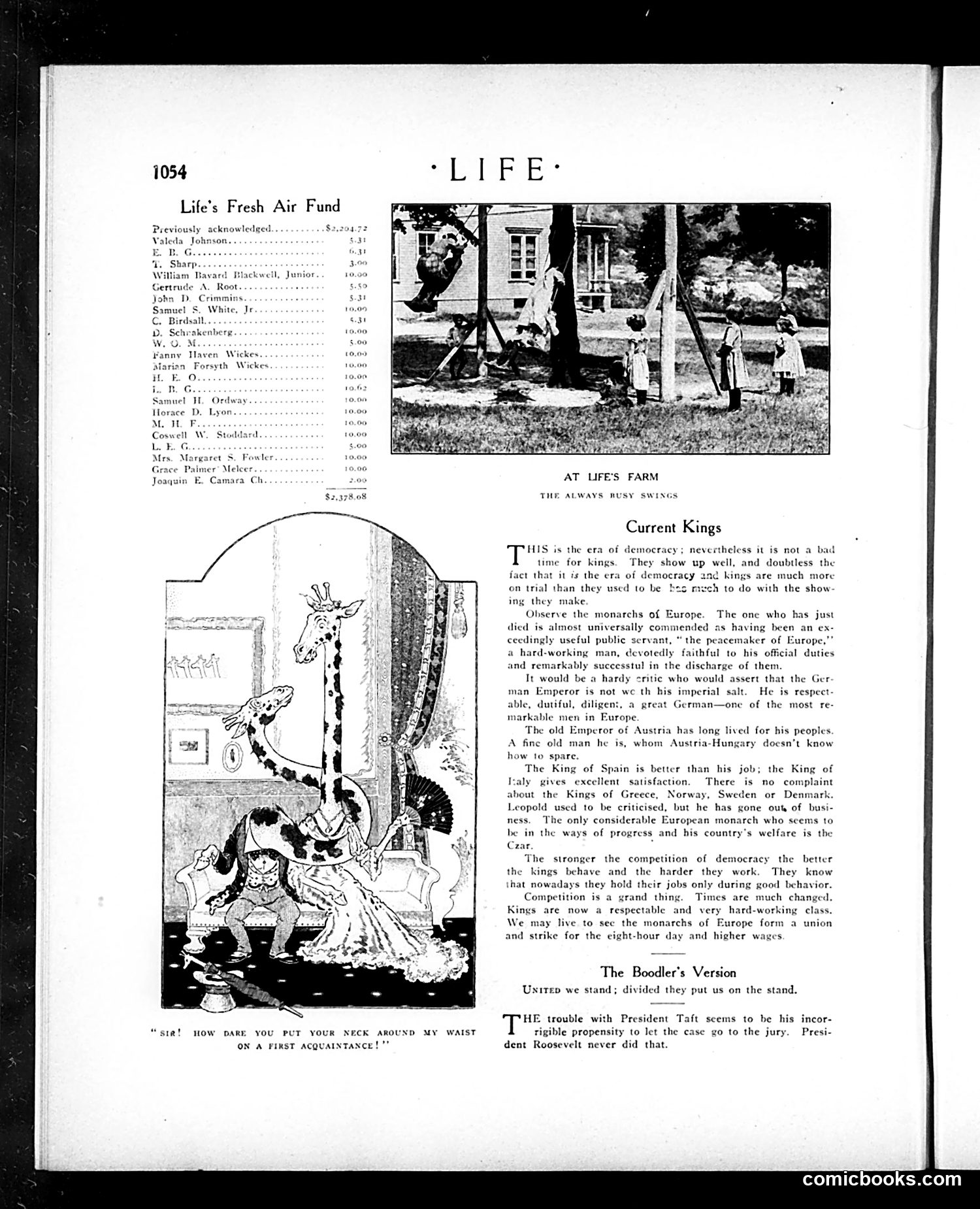
This page contains two distinct pieces: **Top Section - "At Life's Farm"**: A photograph captioned "The Always Busy Swings" showing children on a swing set, likely documenting recreational activities. **Main Cartoon**: A large illustration depicting what appears to be royalty or nobility (suggested by the crown) in an absurd, contorted position, with the caption: "SIS! HOW DARE YOU PUT YOUR NECK AROUND MY WAIST ON A FIRST ACQUAINTANCE!" The humor appears to satirize overly formal, stiff social protocols—suggesting aristocratic etiquette is so rigid that even innocent physical contact violates propriety. **Articles**: "Current Kings" and "The Bootler's Version" discuss European monarchs and mention President Taft, apparently critiquing contemporary political leadership and governance. The page satirizes both upper-class social pretension and early-20th-century political figures through humor and illustration.
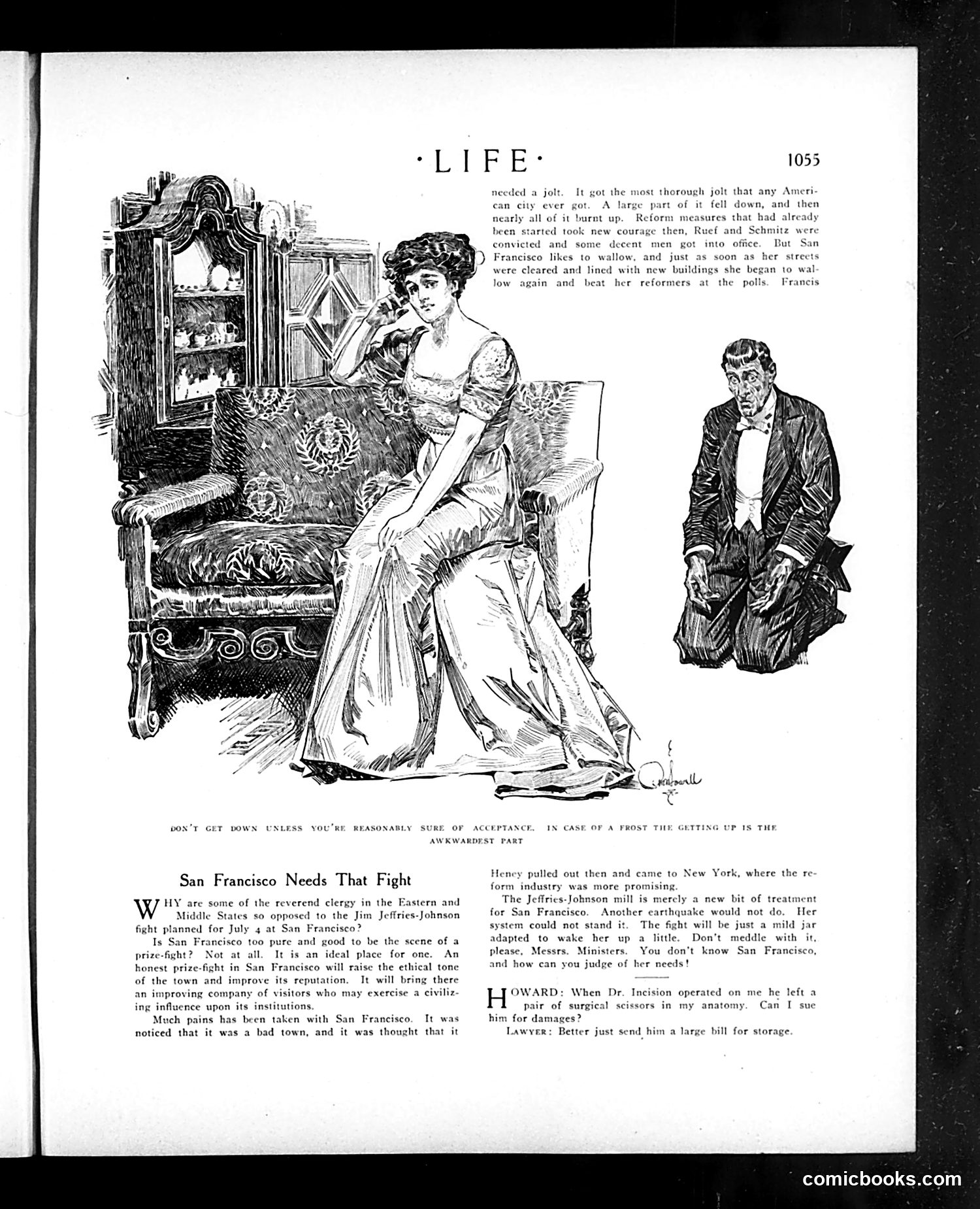
This page from *Life* magazine contains satirical commentary on San Francisco's reputation and urban reform. The article "San Francisco Needs That Fight" discusses a proposed prizefight scheduled for July 4th in the city, arguing it would boost San Francisco's moral standing and attract civilized visitors. The main illustration shows a well-dressed woman in her home, examining what appears to be a mirror or decorative object—likely satirizing San Francisco's desire to improve its image and reputation. A smaller sketch shows a man in formal attire, possibly representing a reformer or civic leader. The accompanying dialogue at bottom appears to be a humorous exchange about legal/medical matters, poking fun at San Francisco's rough reputation and the absurdity of using a prizefight as a civilizing influence on the city.
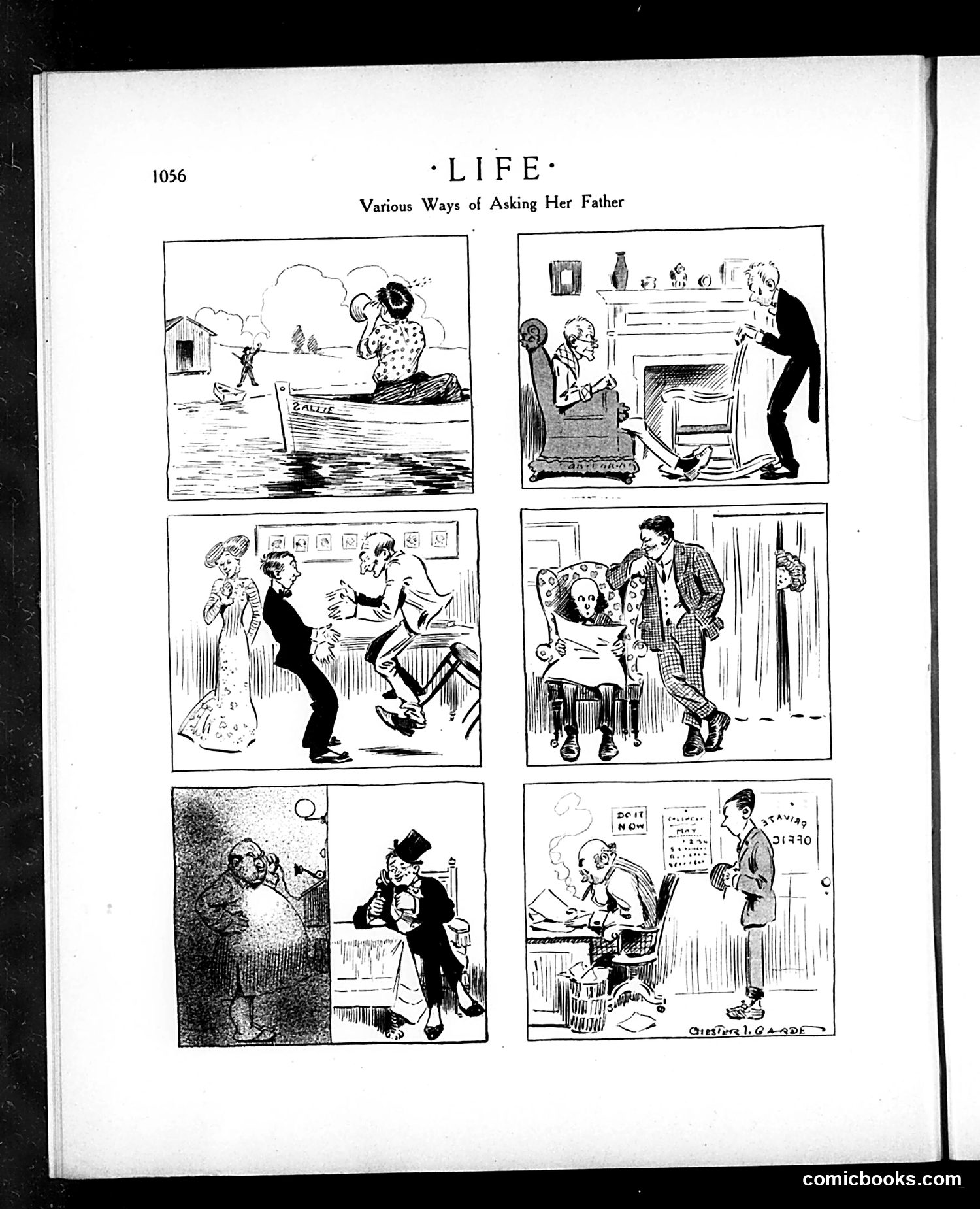
This comic strip satirizes the social convention of a young man formally requesting permission from a girl's father to marry her—a standard practice of the era when the page was published. The six panels show humorously contrasting approaches: fishing together (casual), visiting at home (formal), dancing (indirect), approaching with the girl present (confident), appearing in shadows (mysterious), and at a desk (businesslike). The humor derives from depicting the nervous awkwardness and varied strategies men employed to broach this delicate topic with her father. Each panel presents a different social setting and emotional tone—from relaxed to anxious—reflecting how uncomfortable or artificial this required ritual could feel, depending on the circumstances and personalities involved.
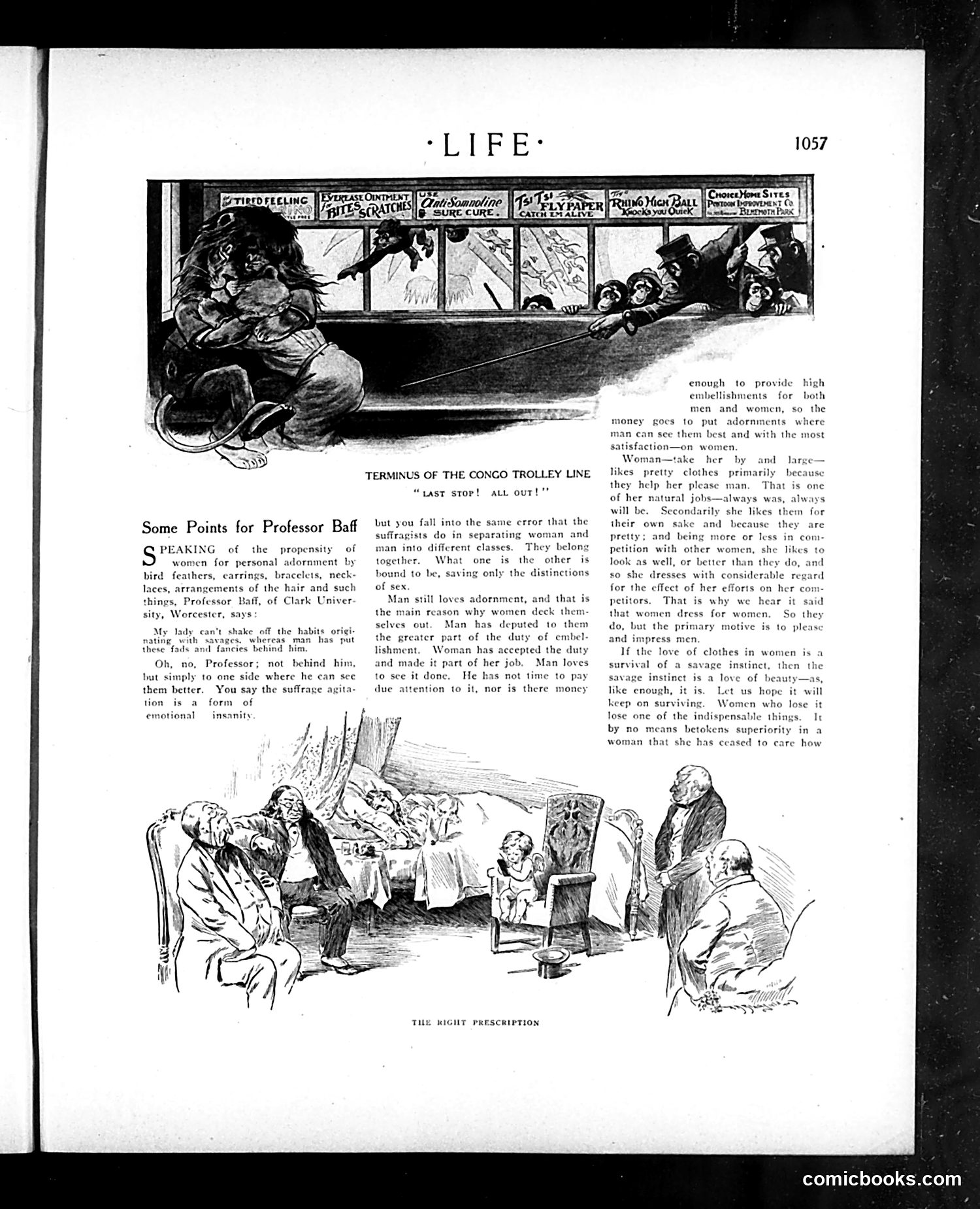
This page contains satirical commentary on women's fashion and adornment, framed as advice to "Professor Baff." The top cartoon shows a crowded trolley scene labeled "Terms of the Congo Trolley Line — 'Last Stop! All Out!'" — a reference to the "Congo" as slang for a crowded, chaotic space. The article argues that women wear fine clothes primarily to please men, not for themselves. It suggests this is natural and acceptable, claiming women should accept adornment as part of their role. The lower illustration titled "The Right Prescription" depicts a domestic scene, likely illustrating family life. The satire critiques contemporary debates about women's independence and fashion choices, positioning Baff as dispensing traditional advice about proper gender roles during an era of changing women's social status.
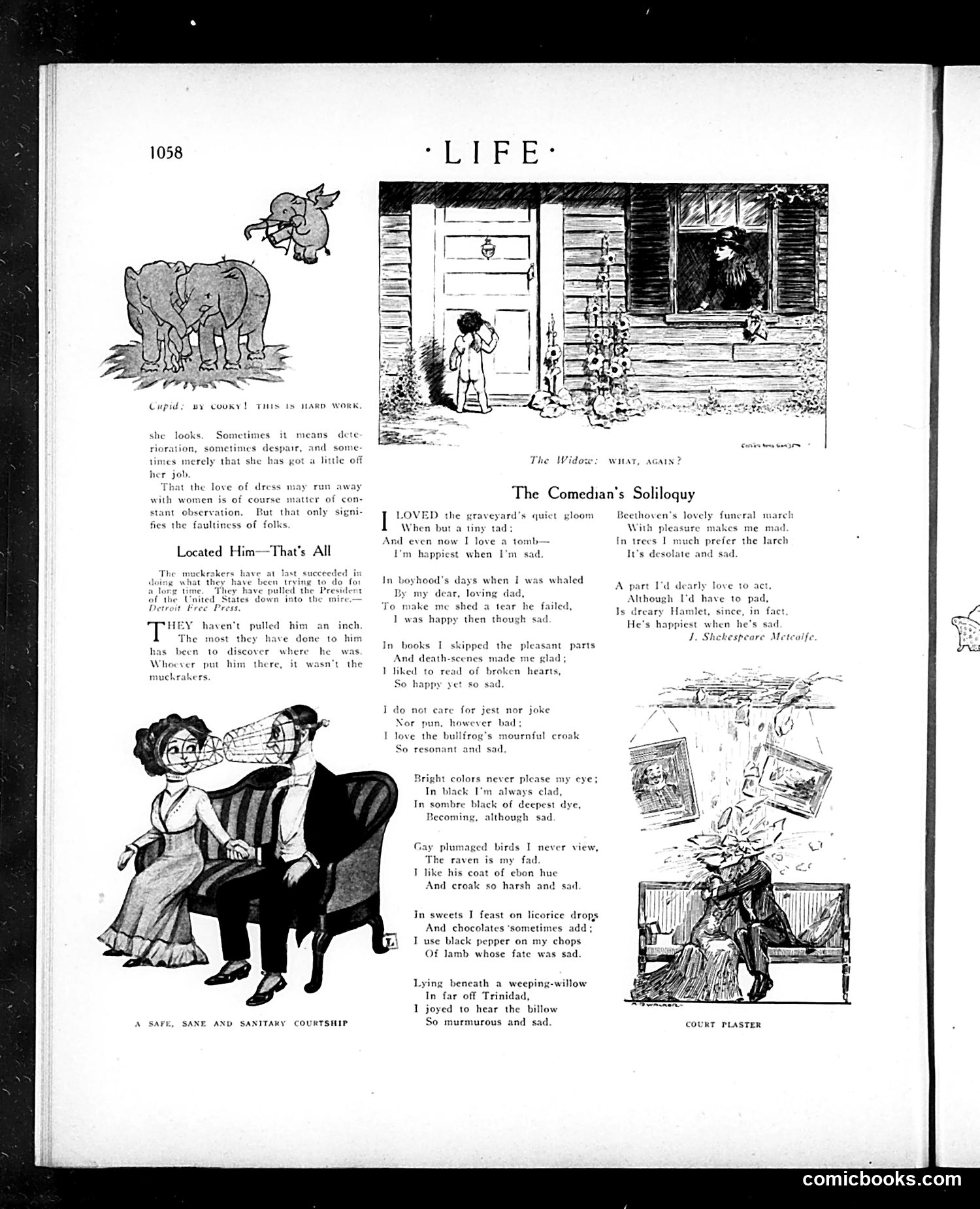
This Life magazine page contains three distinct satirical pieces: **"Located Him—That's All"** critiques efforts to locate a fugitive President (likely Theodore Roosevelt after leaving office). The joke: despite extensive searching, authorities haven't moved an inch toward finding him—suggesting the search is futile or the subject is deliberately elusive. **"A Safe, Sane and Sanitary Courtship"** satirizes overly cautious romantic behavior, showing a couple maintaining rigid propriety. The caption suggests modern courtship has become so regulated and artificial that genuine passion is impossible. **"The Comedian's Soliloquy"** mocks theatrical performers who romanticize melancholy and darkness—loving graveyards, ravens, weeping willows, and sad stories. It's satire of affected sadness in entertainment, where performers cultivate depression as artistic affectation rather than genuine emotion. The elephant cartoon labeled "Cupid: By Cooky! This is Hard Work" suggests romantic pursuits are exhausting labor.
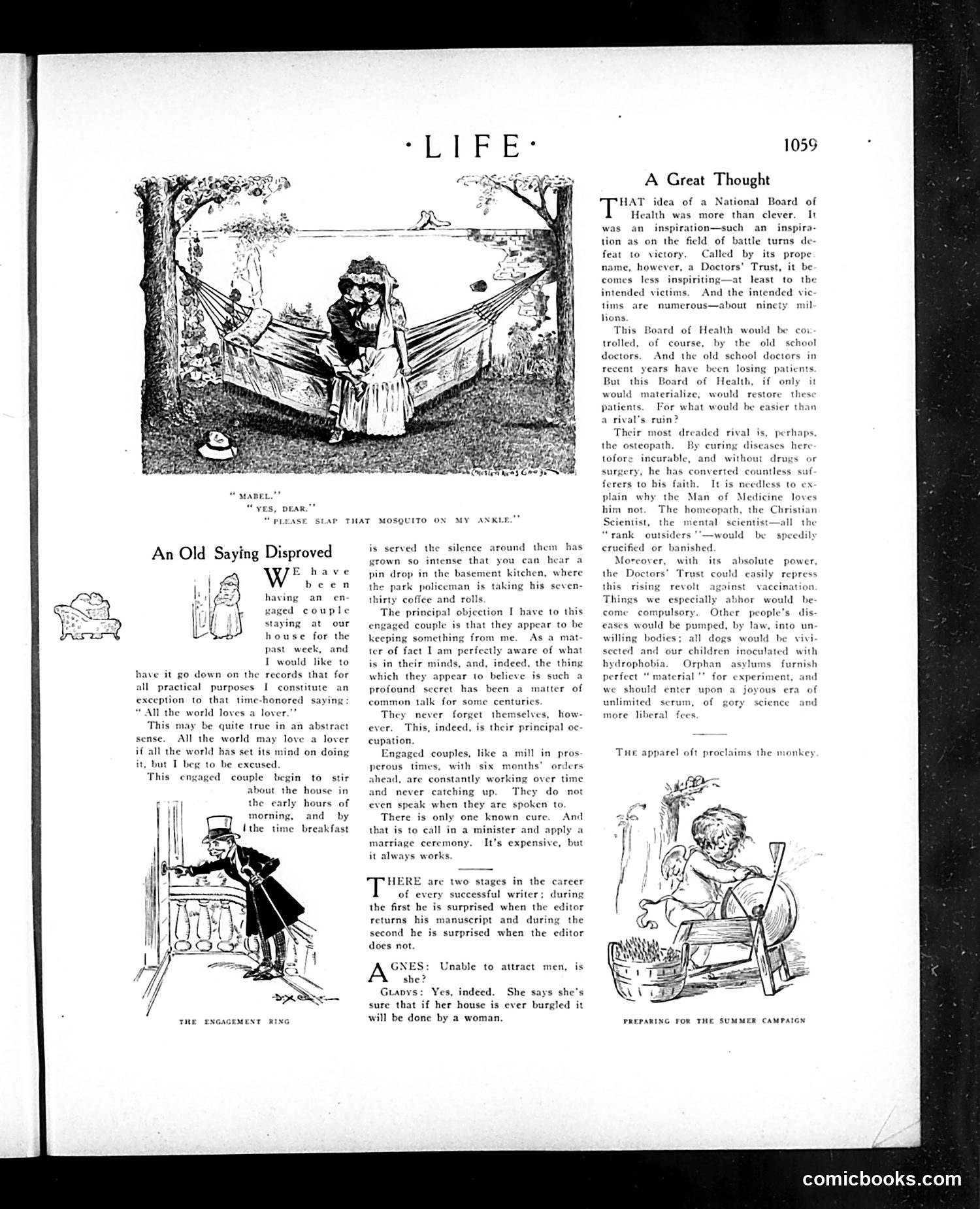
This satirical page contains three separate pieces mocking social conventions: **"An Old Saying Disproved"** ridicules the romantic couple staying at the narrator's house. The joke: engaged couples are so absorbed in each other—silently communing while the household tries to function—that they're actually unbearable to live with, contradicting the saying "all the world loves a lover." The cartoon showing "The Engagement Ring" depicts a man proposing while oblivious to mosquitoes. **"A Great Thought"** fiercely attacks a proposed National Board of Health (appearing to be a "Doctors' Trust"). The author warns it would give conventional physicians monopolistic power to suppress rival practitioners—osteopaths, Christian Scientists, homeopaths—whom they view as competitors. The satire warns of forced vaccinations and animal experimentation under state medical authority. **"Two Stages"** is a brief quip about writers' careers: initially shocked when editors reject manuscripts, later shocked when they *accept* them. **The brief exchange** between Agnes and Gladys jokes that a woman burglar would actually *improve* Agnes's house. The page reflects early 20th-century skepticism toward both medical authority and romantic sentimentality.
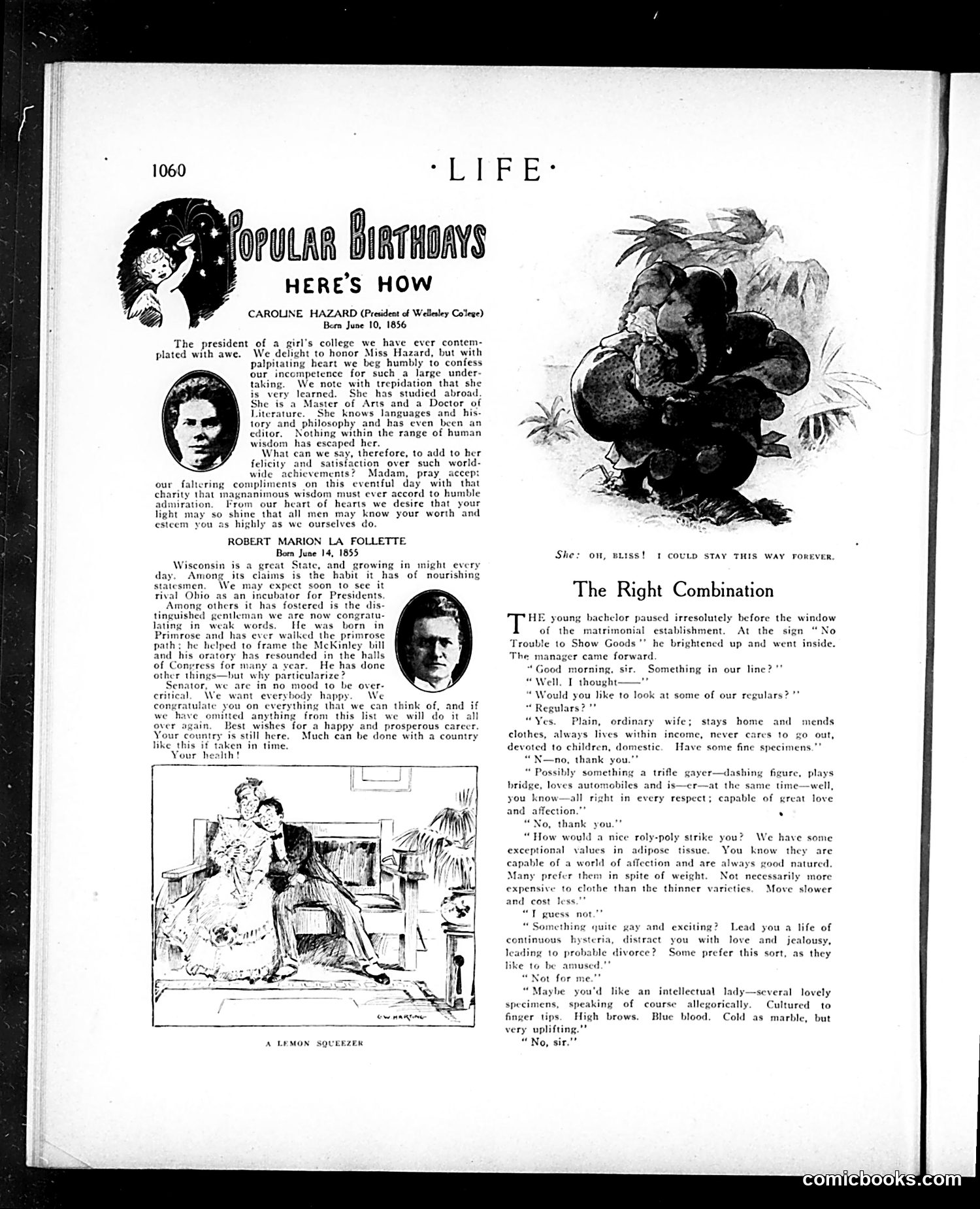
This Life magazine page celebrates notable figures' birthdays through satirical tributes. **Caroline Hazard** (Wellesley College president) is honored with mock-reverent language—the satire lies in Life's exaggerated claims of incompetence to praise her, listing her genuine accomplishments (multiple degrees, languages, editorial work) to humorously suggest she's intimidatingly overqualified. **Robert Marion La Follette** receives similar treatment, praised for Wisconsin's tradition of producing statesmen, with joking references to his role in the McKinley tariff bill and congressional oratory. **"The Right Combination"** is a satirical short story about a bachelor shopping at a "matrimonial establishment" (marriage broker). The humor mocks different wife "types"—plain domestic wives, overweight women, hysterical/jealous types, and cold intellectual women—all presented as consumer goods. The joke critiques both commercialization of marriage and period attitudes toward women, depicting them as interchangeable commodities with predetermined personality traits.
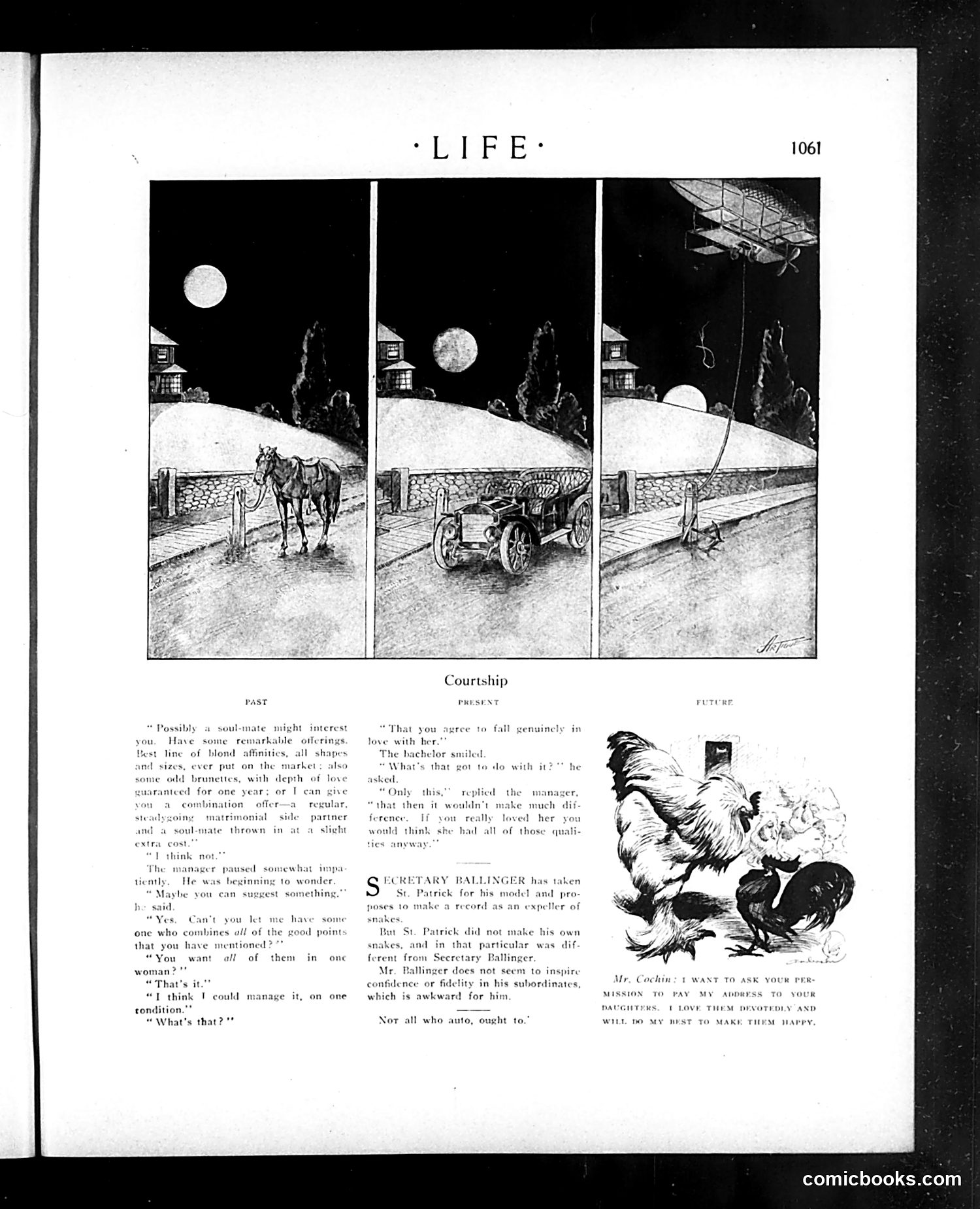
This page satirizes early-20th-century courtship and marriage attitudes through two pieces: **Top Panel (Three-panel comic):** Shows the evolution from horse-drawn carriage (Past), to automobile (Present), to airplane (Future)—depicting modernization's rapid pace. The "courtship" title suggests romantic progression changes with technology. **Bottom Section:** A humorous dialogue where a marriage broker offers various "soul-mate" options like consumer goods, with guarantees and "combination offers." The joke mocks the commercialization of romance and the absurdity of shopping for love. **Right side:** A brief jab at Secretary Ballinger (appears to be Richard Ballinger, Theodore Roosevelt's controversial Interior Secretary), suggesting his subordinates lack loyalty—a political dig at government competence. **Bottom illustration:** A rooster with a cat, with text about asking permission to court someone's daughters, using exaggerated formal language that mocks Victorian courtship conventions. Overall, the page satirizes both modernization's effect on romance and the era's rigid social formalities around courtship.
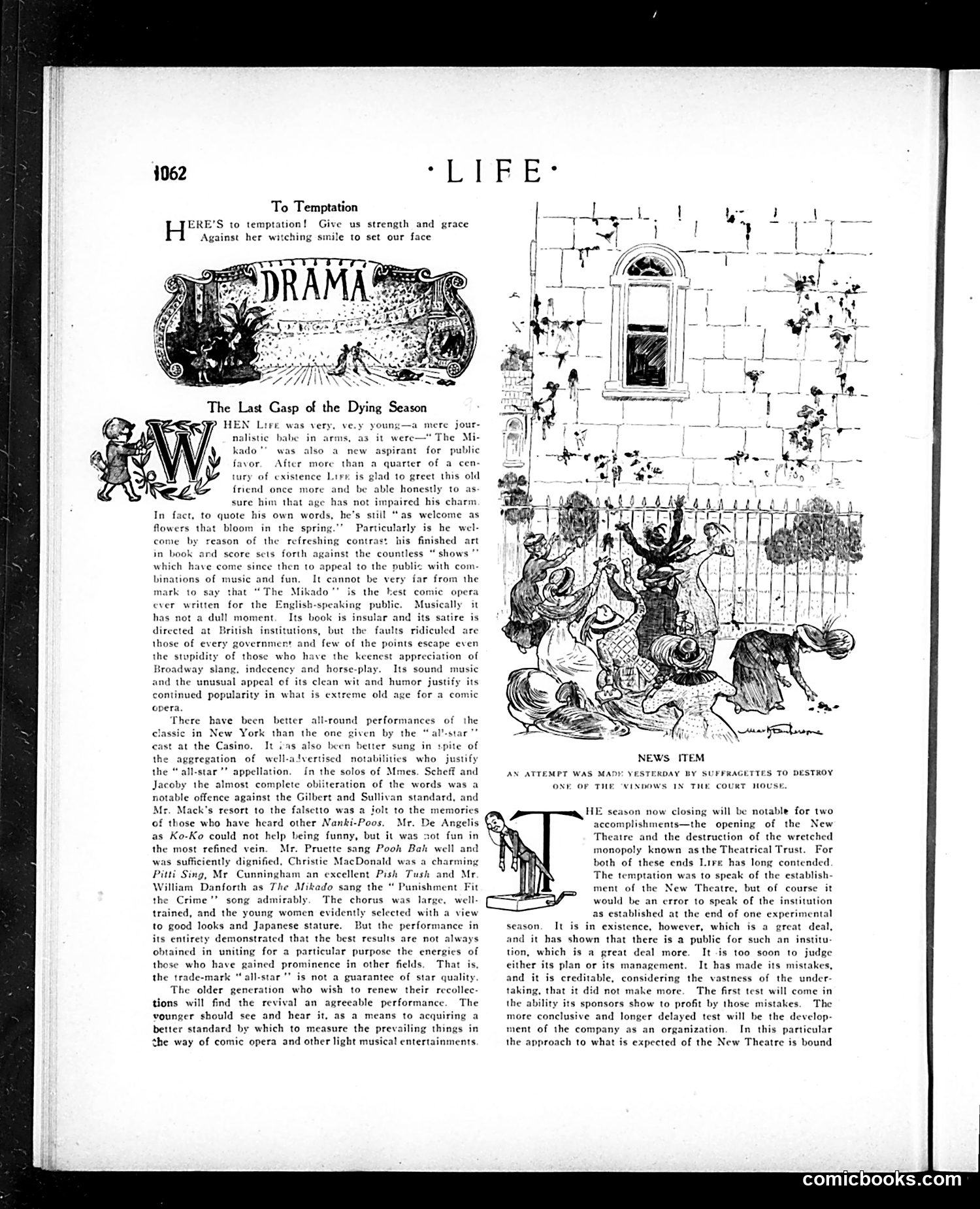
This page contains two distinct items: **"The Last Gasp of the Dying Season"** reviews a revival production of Gilbert and Sullivan's *The Mikado* at the Casino Theatre. The article praises the opera's enduring quality and satirical critique of British institutions, but critiques the contemporary "all-star" cast—despite marquee names like Mmes. Scheff and Jacoby, their performances underperformed compared to properly trained singers. The reviewer argues that assembling famous performers doesn't guarantee quality theatrical results. **"News Item"** reports that suffragettes attempted to destroy courthouse windows, then pivots to discuss two major theatrical developments: the opening of the New Theatre and the destruction of the "Theatrical Trust" (a monopoly controlling American theater production). Life magazine celebrates both accomplishments as breaking institutional monopolies. The page's opening verse "To Temptation" appears to be general editorial commentary about resisting vice.
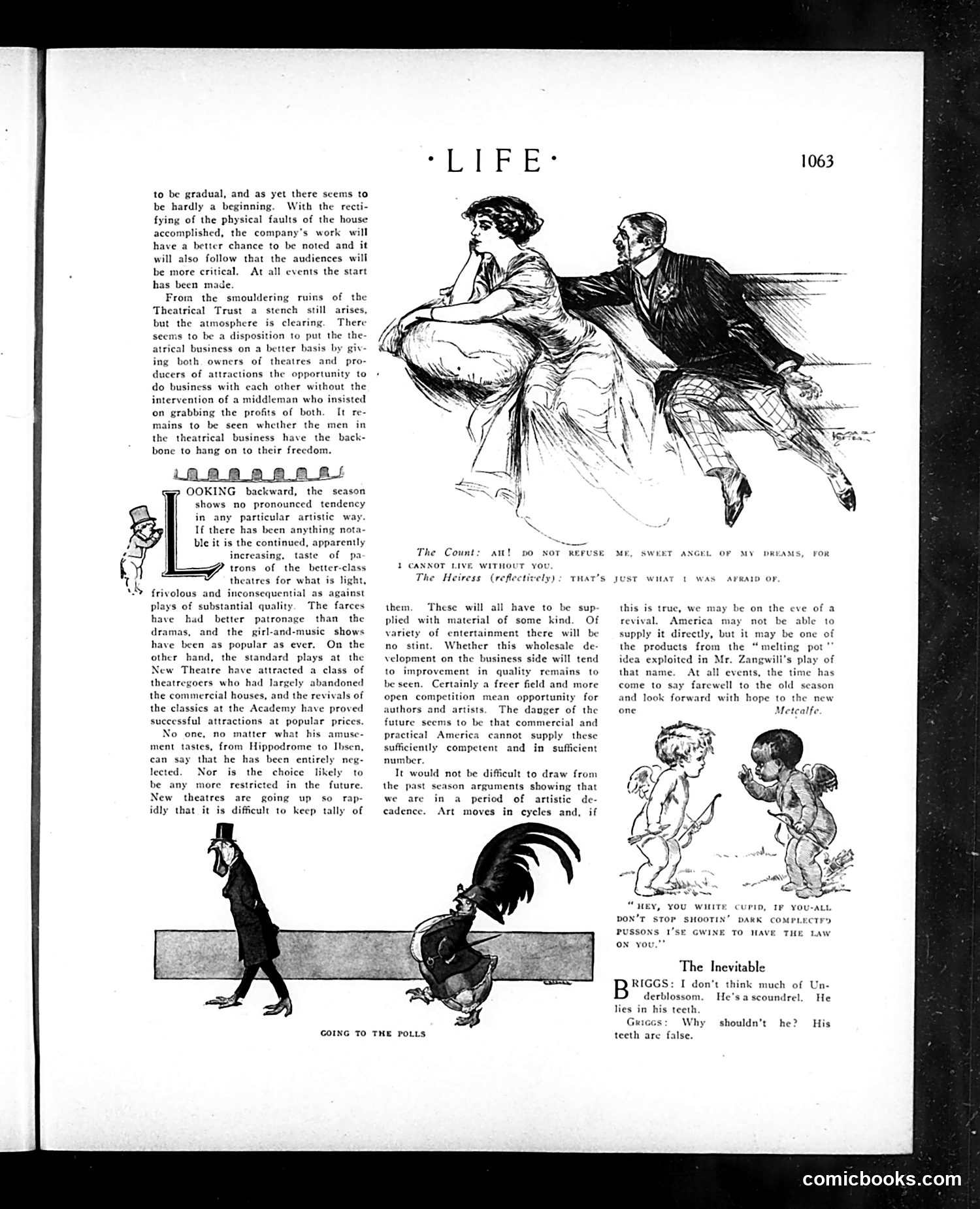
This page from Life magazine contains theatrical criticism and several satirical cartoons addressing early 20th-century American entertainment and politics. **Main Articles:** The text discusses the dissolution of the "Theatrical Trust"—a monopolistic middleman system controlling theater business—and debates whether American theater is experiencing artistic decline or merely cyclical change. The critic notes audiences favor light farces over serious drama. **Cartoons:** 1. **Top illustration** shows a romantic scene satirizing melodramatic theater dialogue about love and dreams. 2. **"Going to the Polls"** depicts a man in formal attire walking past a rooster, likely satirizing election behavior or political posturing (the meaning is unclear without fuller context). 3. **Bottom cartoon** jokes about false teeth: Griggs questions Underblossom's character for lying; Griggs responds that lying is expected from someone with false teeth—a period joke equating artificial teeth with dishonesty or fakeness. The page reflects turn-of-the-century concerns about theater monopolies, cultural quality, and contains typical satirical humor of the era.
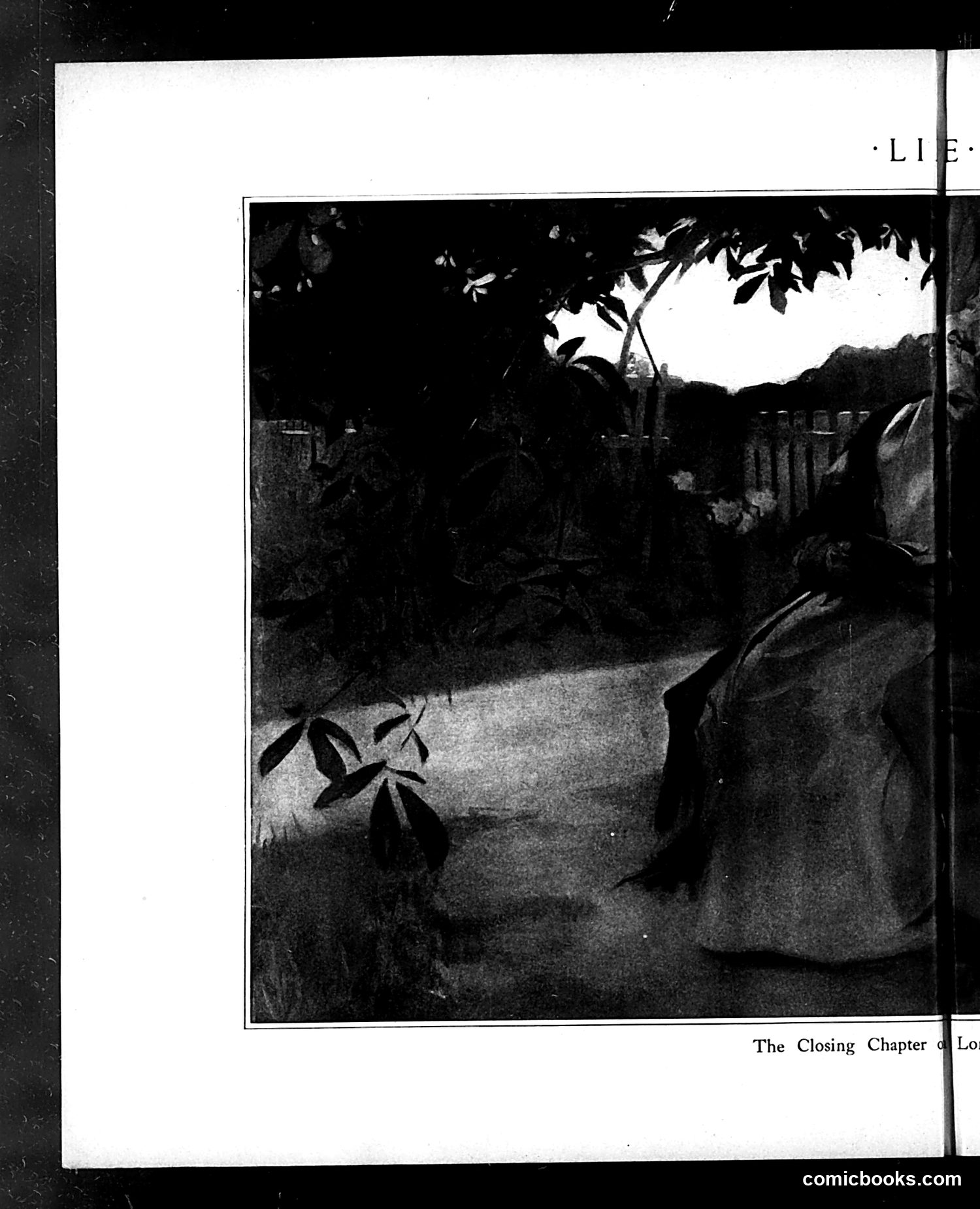
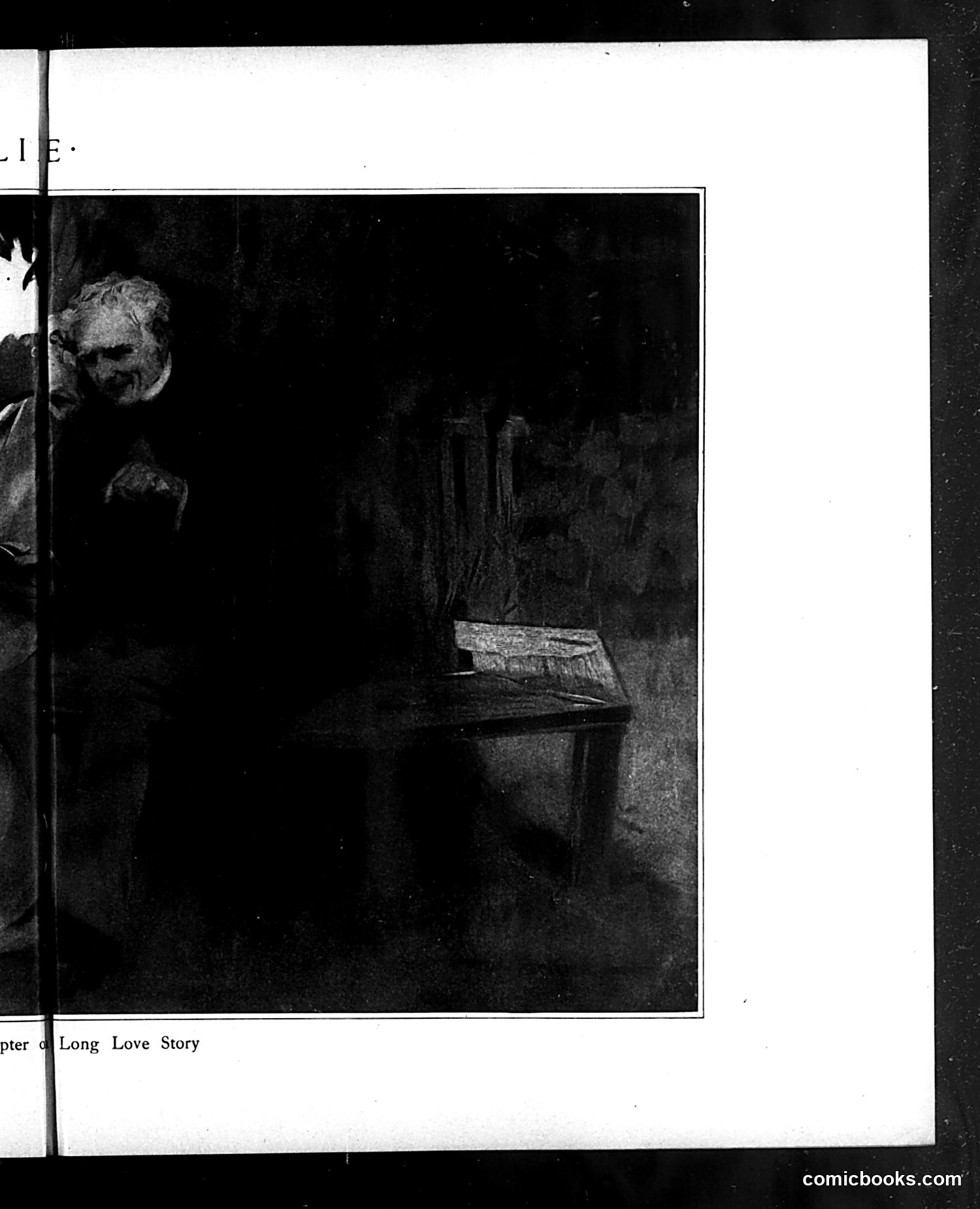
This page appears to be from a chapter or section titled "Long Love Story" in Life magazine. The image is a dark, atmospheric black-and-white photograph or illustration showing an elderly man on the left side of the frame, with what appears to be furniture or objects in shadow to the right. However, without additional context visible on this page—such as a clear caption, dialogue, or surrounding text explaining the narrative—I cannot definitively identify the specific figures, the historical or political references, or the satirical point being made. The dramatic lighting and composition suggest a serious or melancholic tone rather than outright satire, but the exact meaning and subject remain unclear from this image alone.
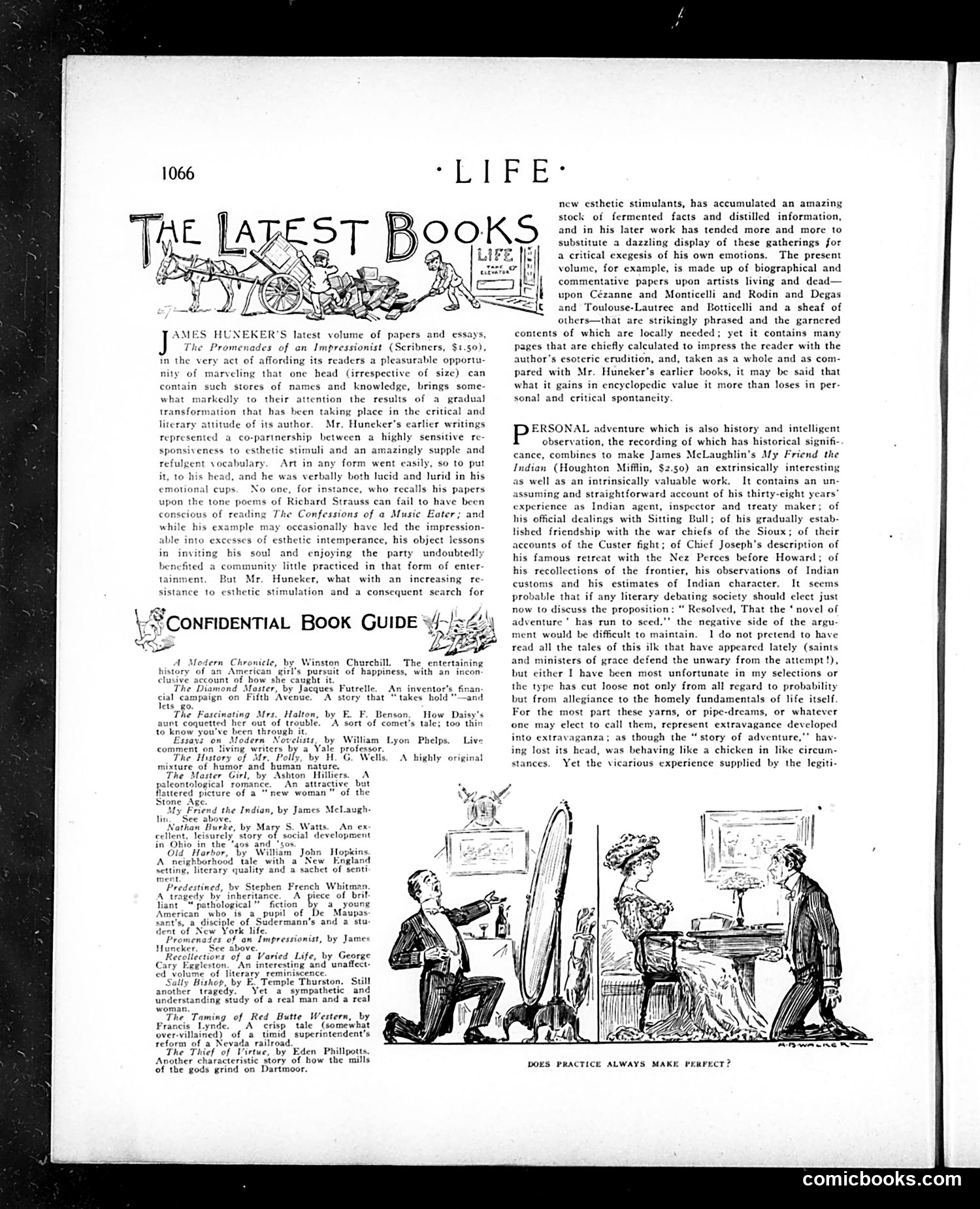
This page reviews James Huneker's essay collection *Promenades of an Impressionist*. The critic argues that Huneker, once known for passionate emotional response to art, has evolved into a mere collector of facts and biographical details. Rather than offering genuine critical insight, he now "substitute[s] a dazzling display" of information—impressive but intellectually hollow. The accompanying cartoon (bottom right) illustrates this critique: a figure practices painting at an easel while another observes. The caption "Does practice always make perfect?" suggests the review's central irony—that technical accumulation doesn't guarantee artistic or critical merit. Huneker's scholarly industriousness, like repetitive practice, doesn't necessarily produce meaningful analysis. The *Confidential Book Guide* section lists contemporary publications, positioning Huneker's work among current literary offerings.
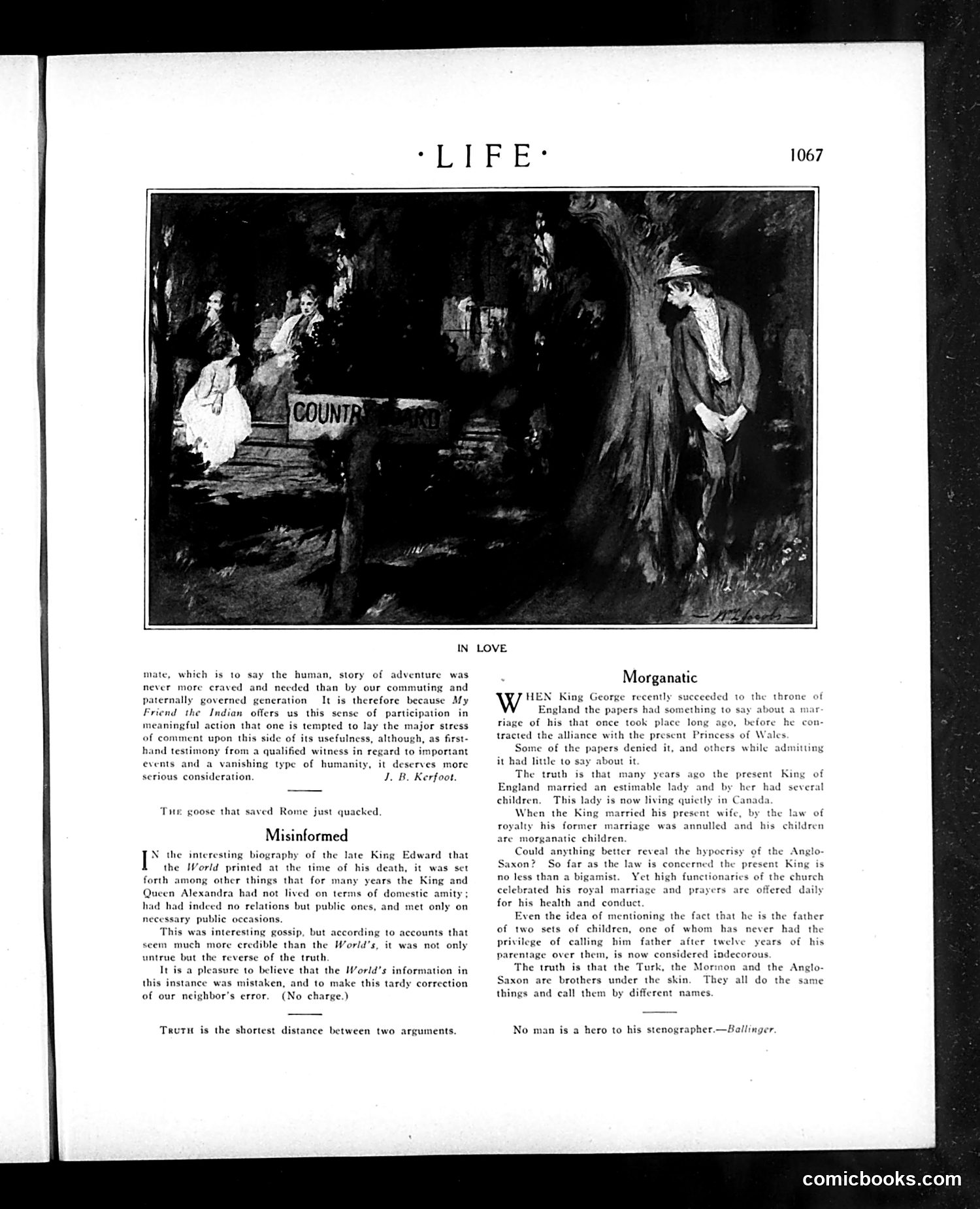
**Main Cartoon:** The illustration titled "In Love" depicts a nighttime scene at what appears to be a country inn or tavern, showing figures in silhouette—likely a romantic or comedic encounter. **"Morganatic" Article:** This is the page's substantive content. It discusses King George V's previous marriage to an "estimable lady" (now living in Canada) before his current marriage to the Princess of Wales. Under royal law, his children from the first marriage were deemed "morganatic"—illegitimate for succession purposes—and the marriage was legally annulled. **The Satire:** Life attacks the hypocrisy of Anglo-Saxon society (particularly the British establishment and church) for legally denying his first family while celebrating his current royal marriage through prayers and ceremony. The author equates this duplicitous behavior with the Turk and Mormon practices of redefining or concealing inconvenient truths through legal/religious language—all "brothers under the skin" committing identical acts while calling them by different names. **Point:** The magazine critiques institutional hypocrisy and the gap between law and morality in handling royal marriages.
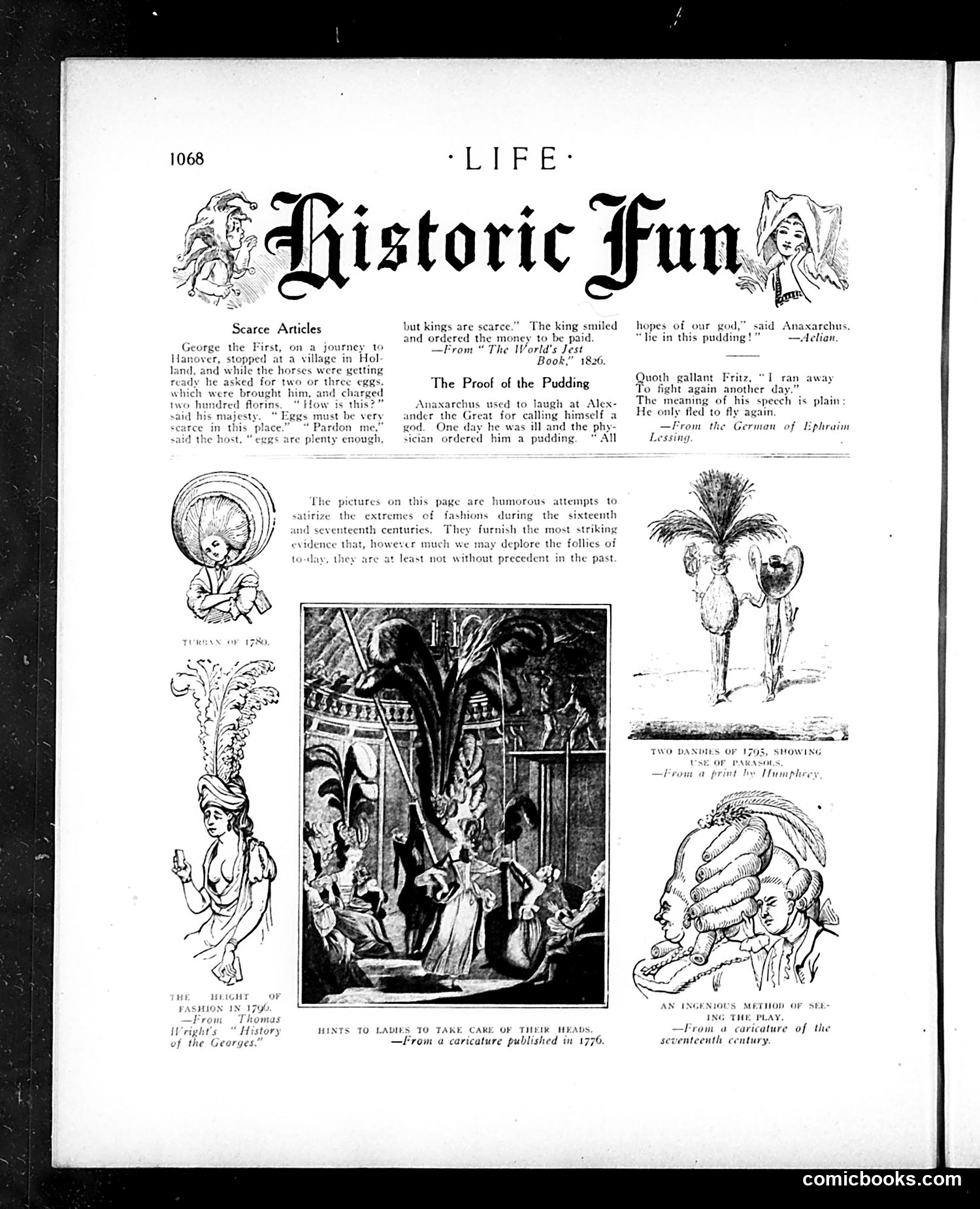
This "Historic Fun" page satirizes extreme fashions of the 16th-18th centuries through caricature and anecdote. The central image shows a 1776 caricature mocking exaggerated hairstyles and headpieces ("Hints to Ladies to Take Care of Their Heads"). Flanking illustrations depict absurd fashion details: impossibly tall coiffures with ornamental additions, and a 1793 dandy using an outsized parasol as a periscope to view theater performances—mocking both pretentious fashion accessories and the ridiculous lengths fashionable people would go to maintain their appearance. The scattered classical anecdotes (about Alexander the Great, George I) provide humorous counterpoint to these vanities. The magazine's point is clear: past fashions look ridiculous in retrospect, warning readers their own era's excesses may appear equally foolish to future generations. This was a common Victorian-era device: mocking historical absurdities while implicitly critiquing contemporary fashion excess.
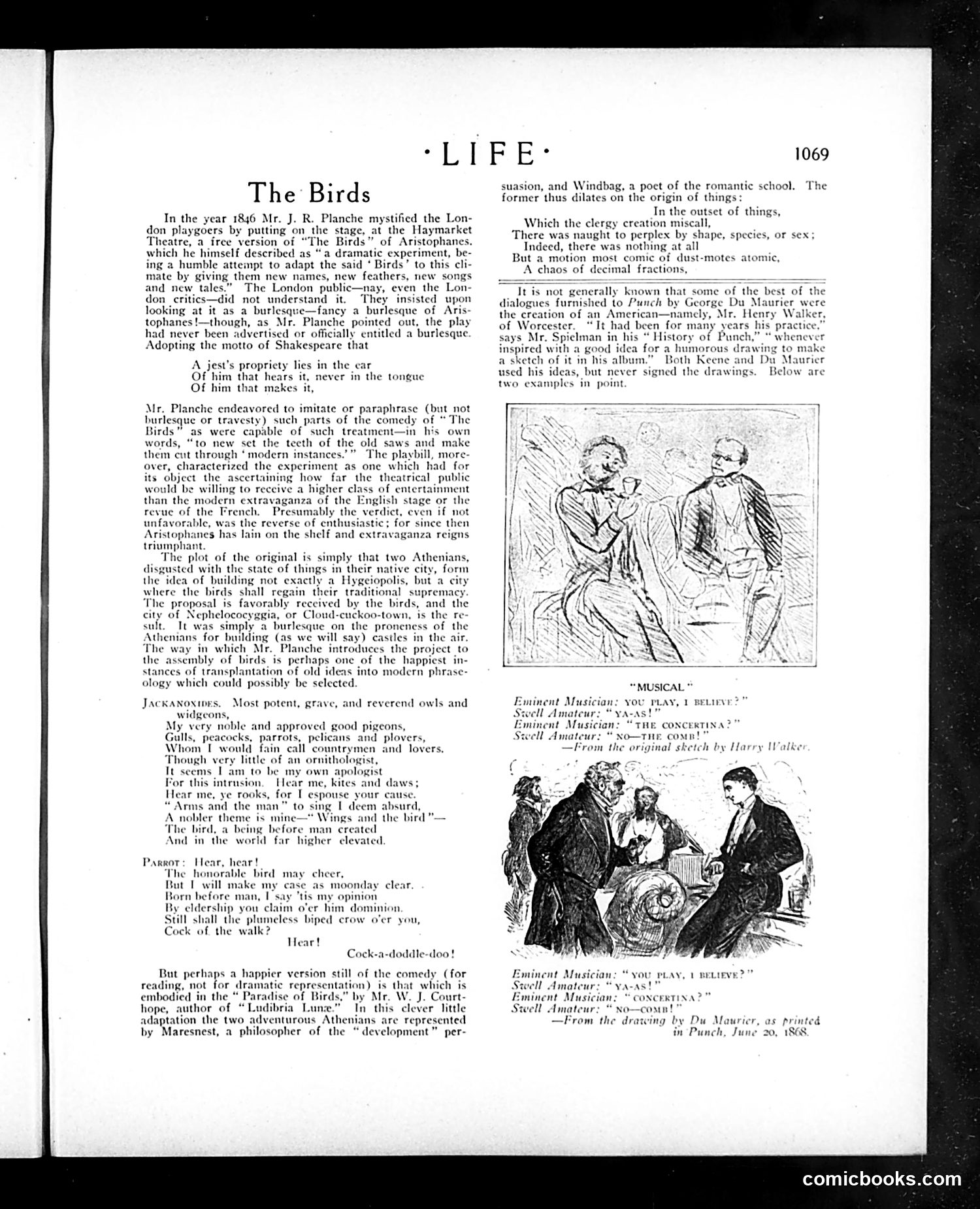
This article discusses 19th-century theatrical adaptations of Aristophanes' ancient Greek comedy *The Birds*. The page explains that in 1846, playwright J.R. Planché staged a modernized version at London's Haymarket Theatre, attempting serious dramatic adaptation rather than burlesque—but audiences dismissed it as mere farce. The two sketches shown are from an 1868 *Punch* drawing by Du Maurier, illustrating a scene labeled "Musical" where characters debate whether to attend a concert. The dialogue humorously captures Victorian social pretension around cultural entertainment. The article then previews another adaptation, W.J. Courthope's *Paradise of Birds*, which reimagines Aristophanes' protagonists as "Maresnest" (a development-theory philosopher) and "Windbag" (a romantic poet)—likely satirizing contemporary intellectual types and their fashionable philosophies. The satire mocks both theatrical mediocrity and Victorian intellectual pretension.
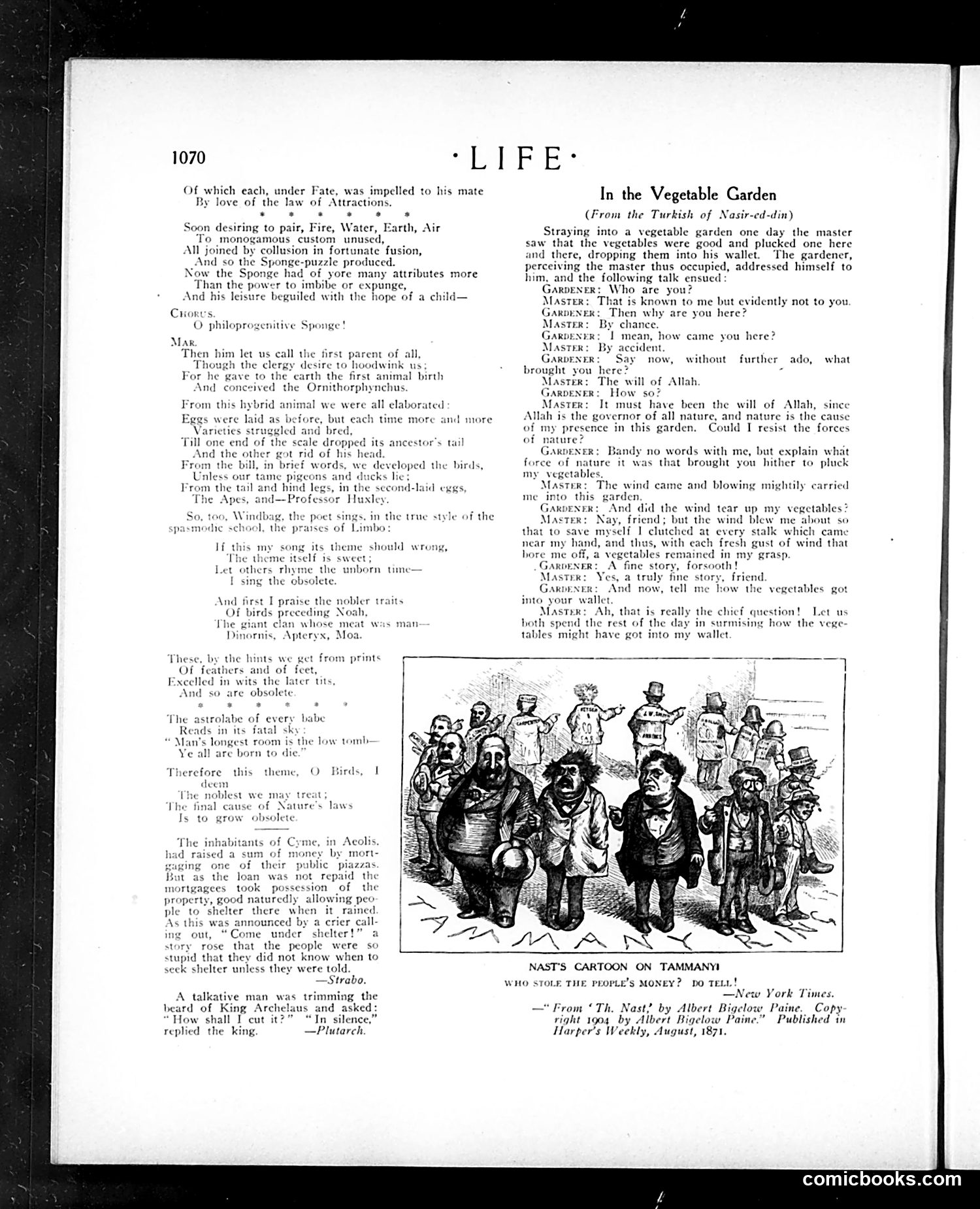
This page contains two distinct elements: **Left side:** Poetry on evolutionary theory, likely referencing Darwin's "Origin of Species" (published 1859). The verse traces life from primordial sponges through various creatures, ending with extinct animals (the Moa). It's satirical commentary on evolutionary debate—the phrase "nobler traits / Of birds preceding Noah" mocks religious opposition to evolution. **Right side:** "In the Vegetable Garden" is a humorous dialogue (adapted from Turkish literature) about a master caught stealing vegetables. When confronted, he blames wind and accident, while the gardener demands a scientific explanation. The satire mocks people who evade responsibility through elaborate excuses and fatalism. **Bottom:** A Nast cartoon captioned "WHO STOLE THE PEOPLE'S MONEY? Do TELL!" depicts Tammany Hall figures. This references the famous Boss Tweed/Tammany Hall corruption scandals of the 1870s, when massive public funds were embezzled. The cartoon uses familiar Nast caricatures to satirize ongoing political corruption.
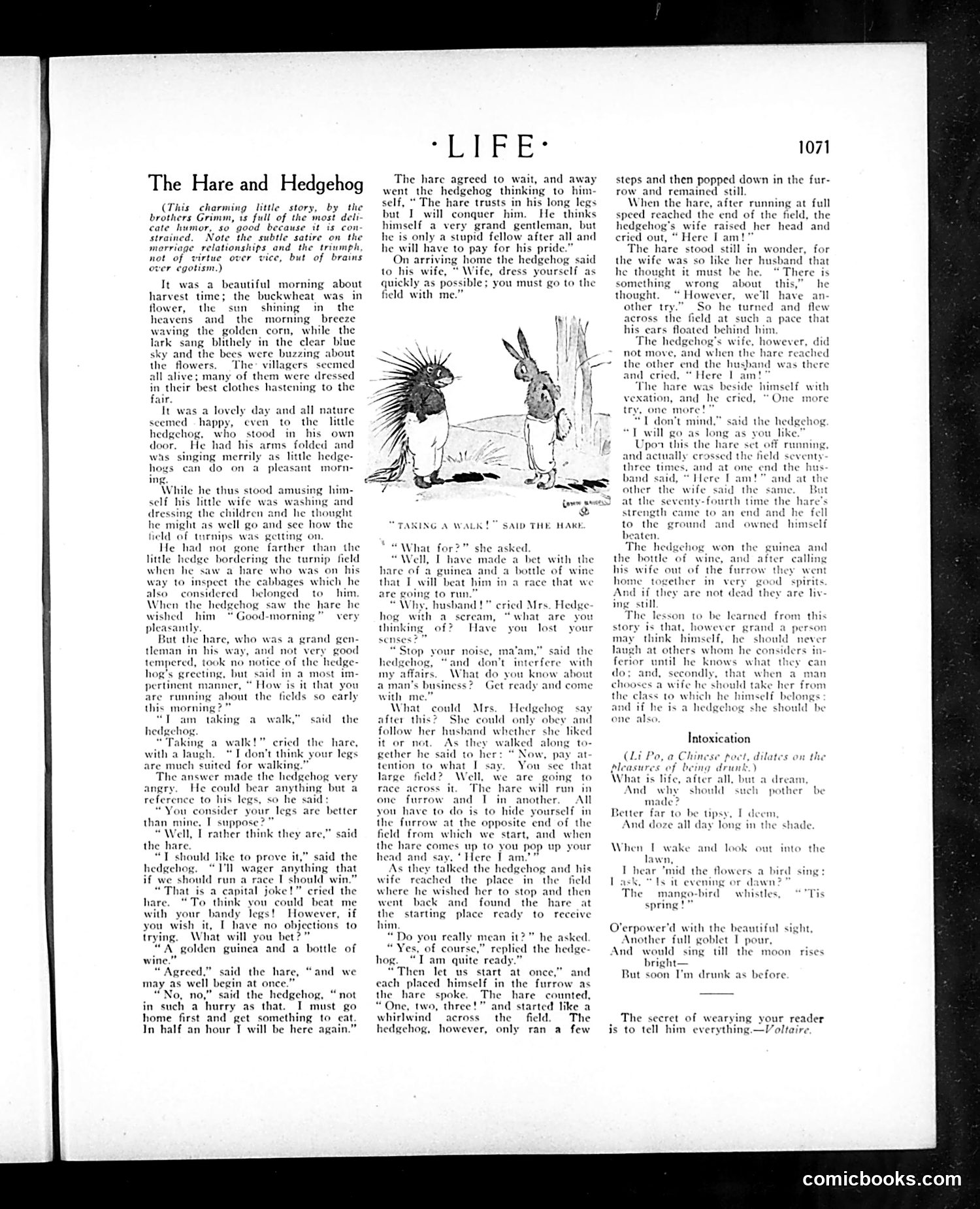
This page presents a serialized adaptation of the Brothers Grimm fairy tale, illustrated with a small cartoon showing the hare and hedgehog meeting in a field. The story itself is a straightforward moral fable about intelligence triumphing over arrogance. A proud, long-legged hare mocks the hedgehog's short legs and agrees to a race. The hedgehog, offended but clever, devises a scheme: he positions his wife (who looks identical to him) at the far end of the field. When the hare races across, the wife appears at the finish line first, making the hare believe the hedgehog has won repeatedly through superior speed—when really the hedgehog exploited the hare's vanity and limited perception. The editorial note frames this as satirizing "marriage relationships" and celebrating "brains over egotism." For Life's readers, this was likely a gentle critique of masculine pride and the value of wit over physical prowess—a sophisticated humor appealing to the magazine's educated, upper-middle-class audience.
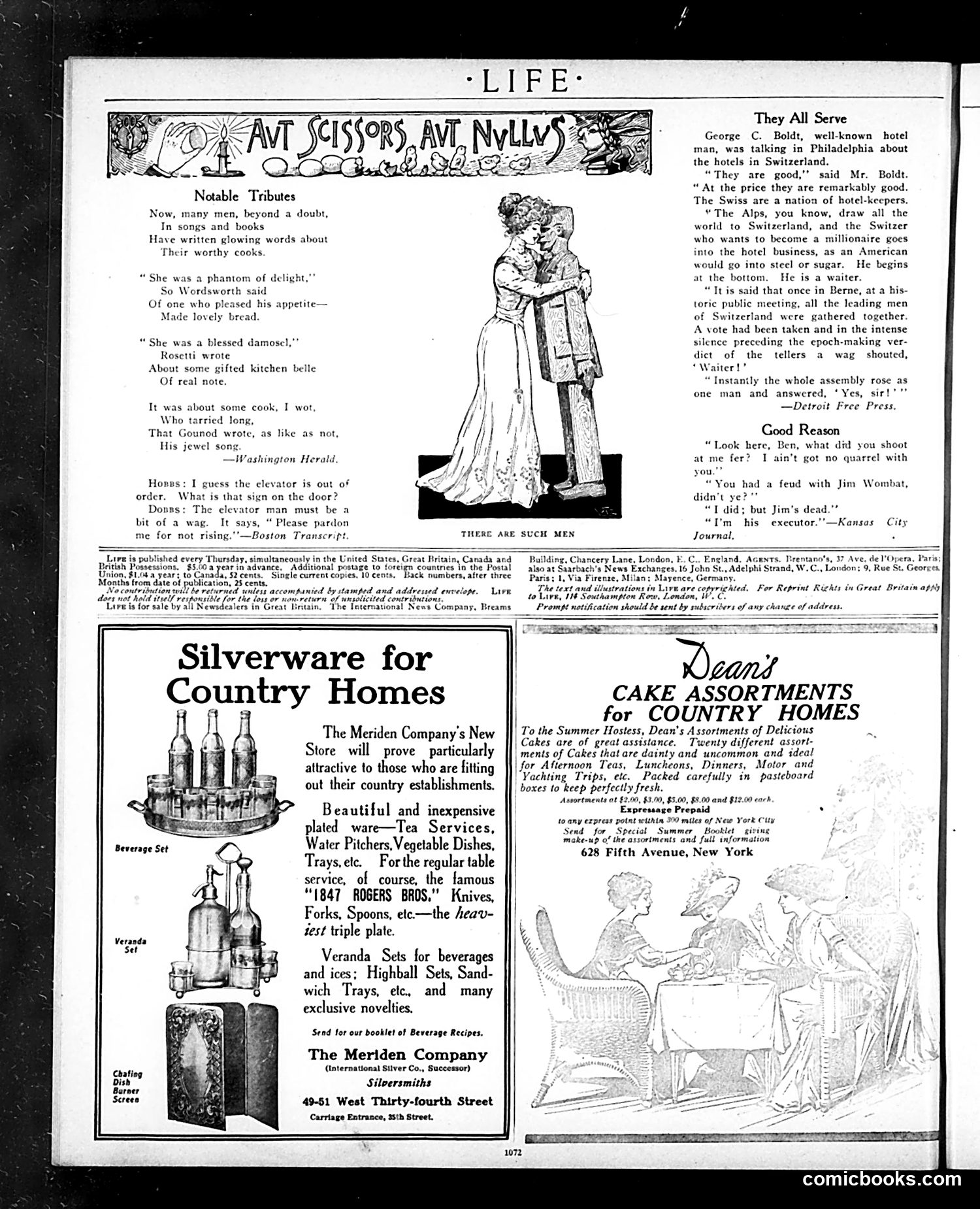
This page combines satirical content with advertisements for country home goods, typical of Life's early 20th-century format. **The Main Cartoon ("These Are Such Men"):** The illustration shows a well-dressed couple, likely depicting hotel proprietors or wealthy hosts. The accompanying anecdotes celebrate domestic servants—particularly cooks—by quoting famous poets (Wordsworth, Rossetti, Gounod) who praised their own cooks. The satire suggests that great men are defined not by their own achievements but by those who serve them. A Swiss hotel anecdote reinforces this: when a vote was called during an important meeting, all Switzerland's leading men stood up when someone shouted "Waiter!"—implying the entire nation serves the hospitality industry. **The Humor:** The joke mocks both the pretentiousness of elevated figures and the universal dependence on service workers. Even Switzerland's elite are, essentially, waiters. **Advertisements:** The Meriden Company and Dean's Cakes ads target wealthy country-home owners furnishing estates, reinforcing the page's theme of domestic luxury and service.
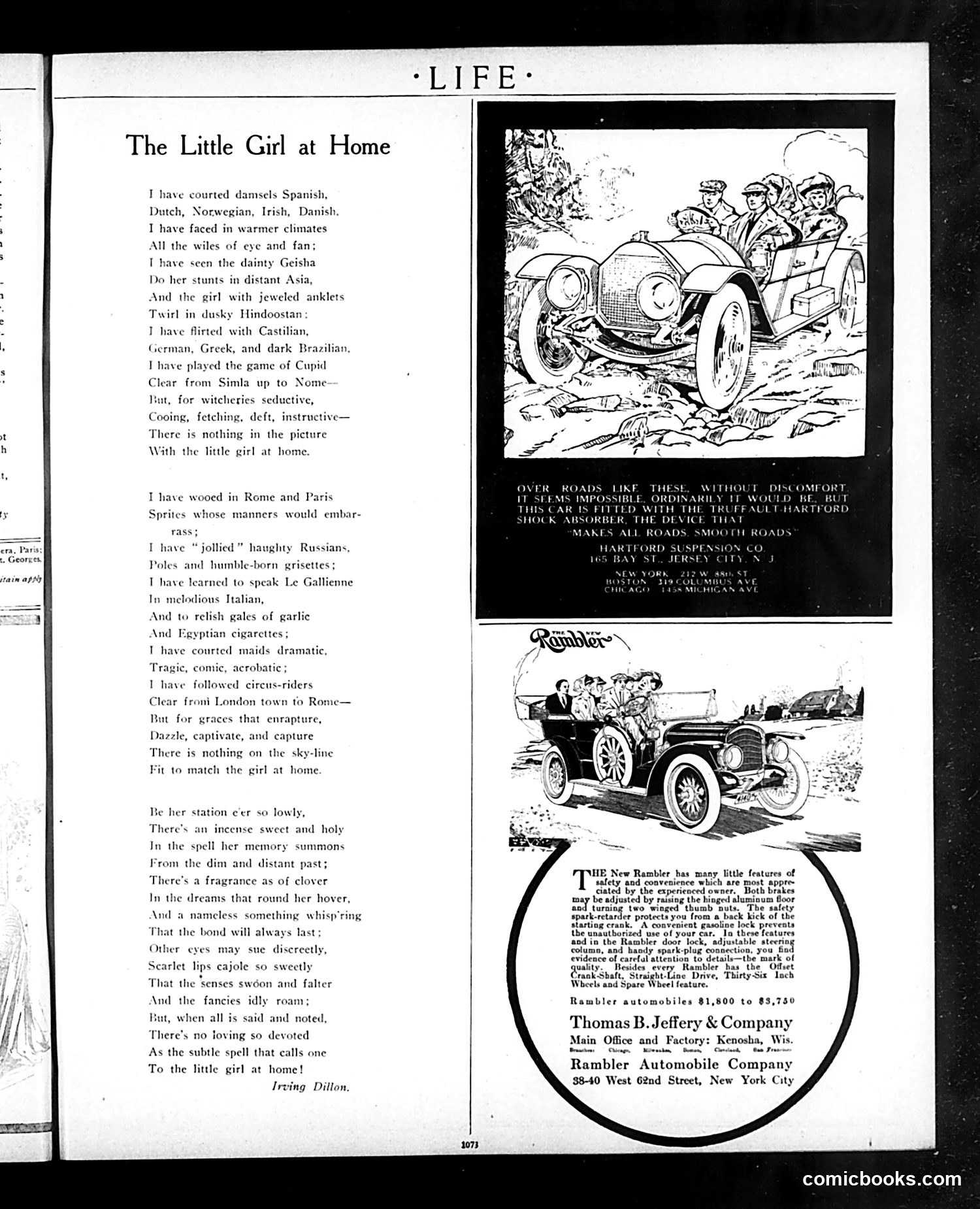
This page combines a sentimental poem with automobile advertisements, typical of early 20th-century Life magazine content. **The Poem:** Irving Dillon's verse celebrates domestic romance over exotic international conquests. The speaker boasts of flirting with women across Europe and Asia—Spanish, Russian, Italian women, geishas, circus performers—yet concludes that no foreign romance matches "the little girl at home." The poem romanticizes modest, local courtship and devotion, contrasting worldly sophistication with homespun sentiment. **The Advertisements:** Two car ads (Hartford Suspension and Rambler automobiles) occupy the right column. Both emphasize modern engineering features that improve comfort and safety—shock absorbers that "make all roads smooth roads" and safety devices like brake adjustments and spark-retarders. The ads highlight technological innovation appealing to middle-class buyers. **Overall Context:** The juxtaposition reflects early 1900s American values: nostalgia for traditional romance and domestic virtue paired with enthusiasm for modern technology and progress. The page targets readers valuing both sentimental tradition and contemporary advancement.
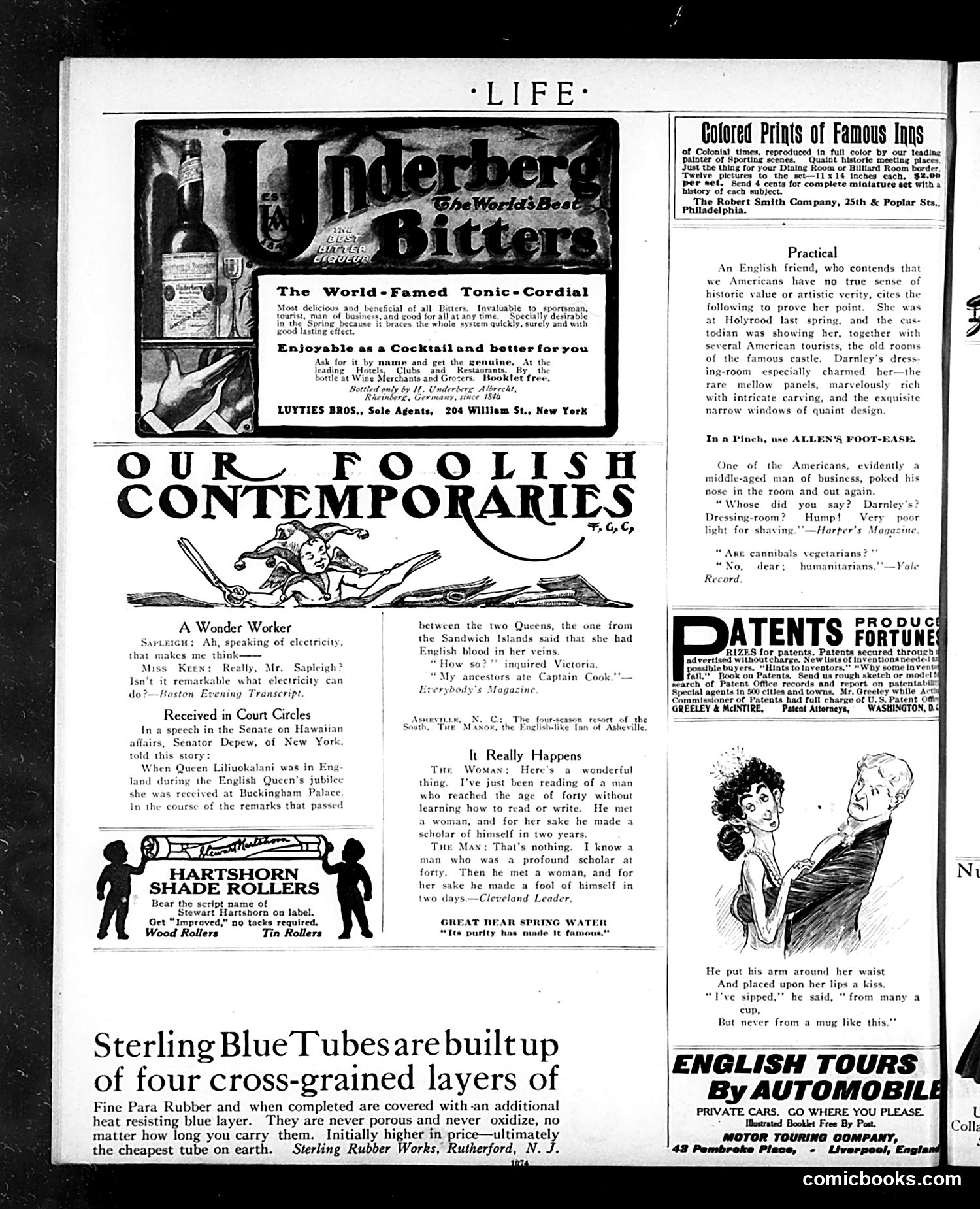
This page is primarily **advertisements and humor fillers** rather than political satire. Here's what appears: **Main content**: "Our Foolish Contemporaries" is a humor section featuring jokes and anecdotes from other publications. The cartoons show two brief comedic dialogues—one about electricity being "remarkable," another contrasting a man who learned to read/write for love versus one made foolish by it. These are mild social observations, not pointed satire. **Key items**: A Queen Liliuokalani anecdote references Hawaiian affairs (likely early 1890s U.S. imperial interest), while the "Darnley's dressing room" story mocks American tourists' practical indifference to historic significance—a common American vs. European cultural stereotype of the era. The page is dominated by **product advertisements**: Underberg Bitters, Sterling Rubber tubes, Hartshorn shade rollers, and patent services. This reflects Life magazine's business model of combining satirical content with substantial advertising revenue.
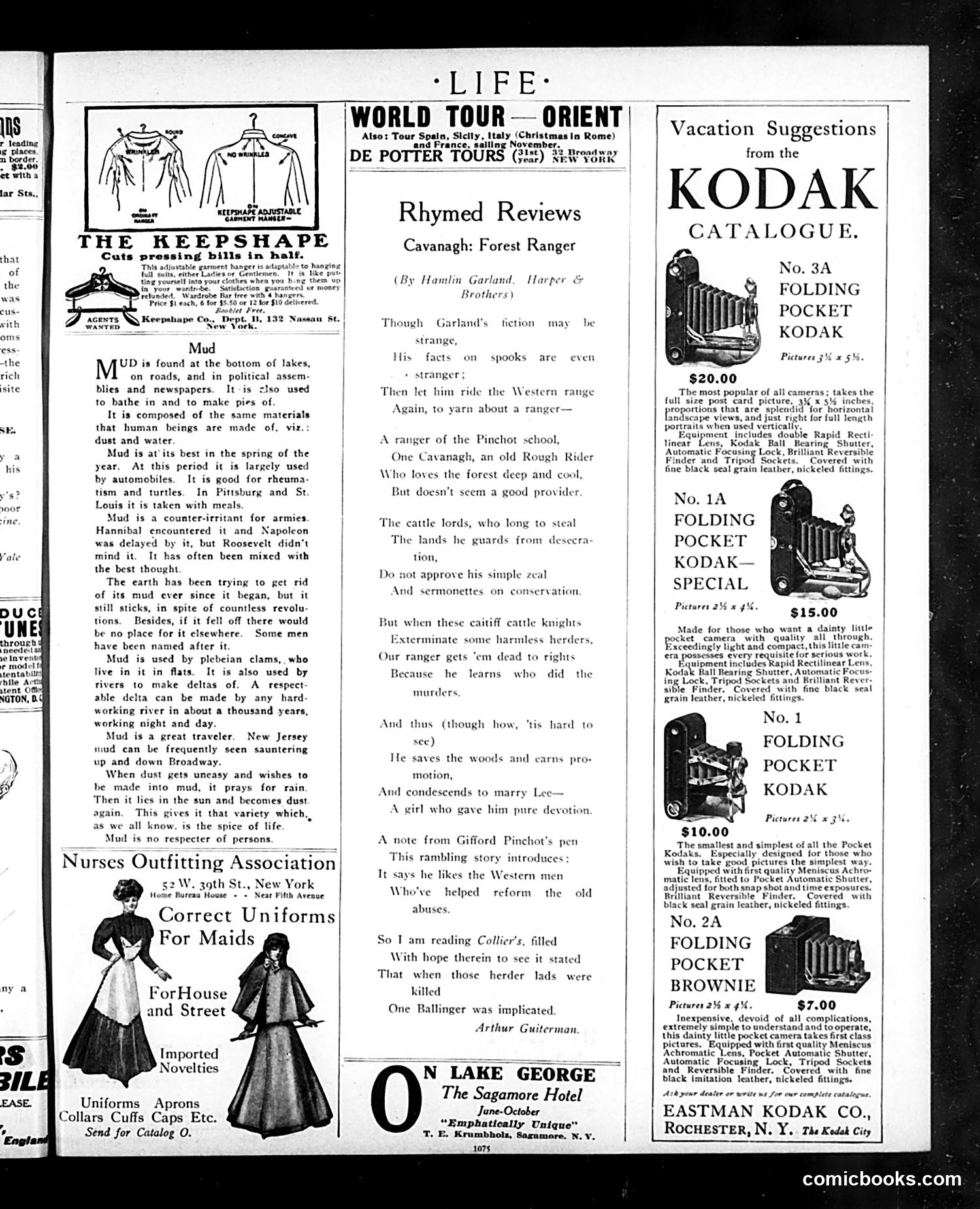
This page is primarily **advertising and literary content**, not political satire. The left side contains humorous essays: "The Keepshape" (a garment hanger ad), and a lengthy absurdist piece on "Mud" — treating the substance philosophically and historically, mentioning figures like Hannibal, Napoleon, and Roosevelt to mock its persistence. The center features a **rhymed book review** of "Cavanagh: Forest Ranger" by Hamlin Garland, written by Arthur Guiterman. It's a lighthearted poem summarizing the plot: a Rough Rider-turned-ranger fights cattle rustlers and wins a girl named Lee. The satire is gentle — poking fun at Western adventure tropes rather than making political points. The right side showcases **Kodak camera advertisements** in various sizes and prices. The bottom advertises a **Sagamore Hotel** and other period businesses. Overall, this is a typical early-20th-century *Life* magazine page mixing humor, literature, and advertising — not political commentary.
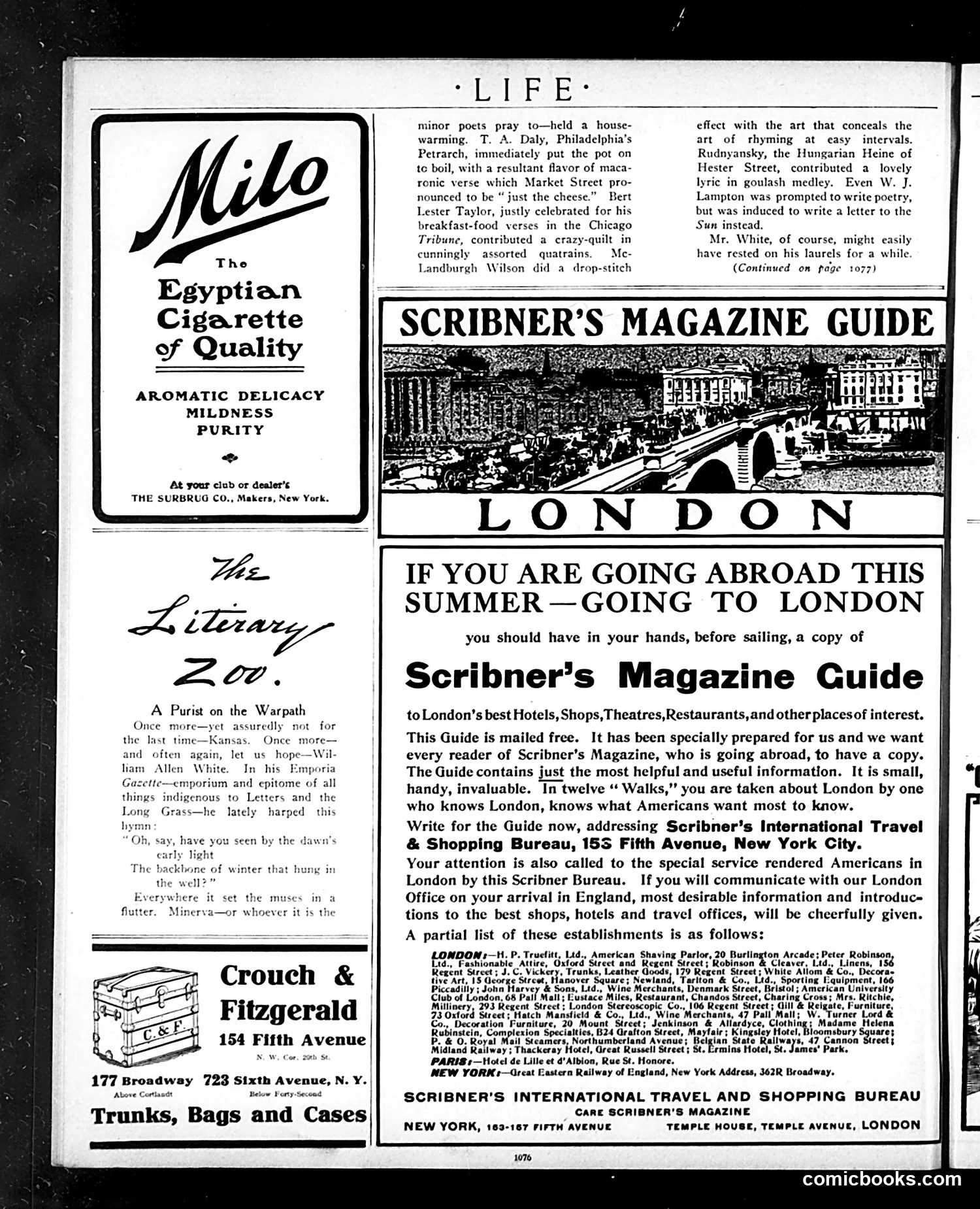
This is primarily an **advertising page** from Life magazine, not a cartoon or satirical content page. The top section contains a brief literary commentary about minor poets attending a housewarming—mentioning T.A. Daly, Bert Lester Taylor, and William Allen White (editor of the Emporia Gazette). The piece gently mocks their "breakfast-food verses" and poetic contributions in a lighthearted, gossipy manner typical of Life's social commentary. The bulk of the page is **commercial advertising**: Milo Egyptian Cigarettes, Crouch & Fitzgerald luggage, and prominently, Scribner's Magazine's travel guide to London. The Scribner's ad targets American travelers planning summer trips abroad, offering a free guidebook and promising introductions to London shops, hotels, and theaters through their "International Travel & Shopping Bureau." **No significant political satire or caricature appears here.** This is a lifestyle/advertising page aimed at affluent American readers of the era who traveled internationally.
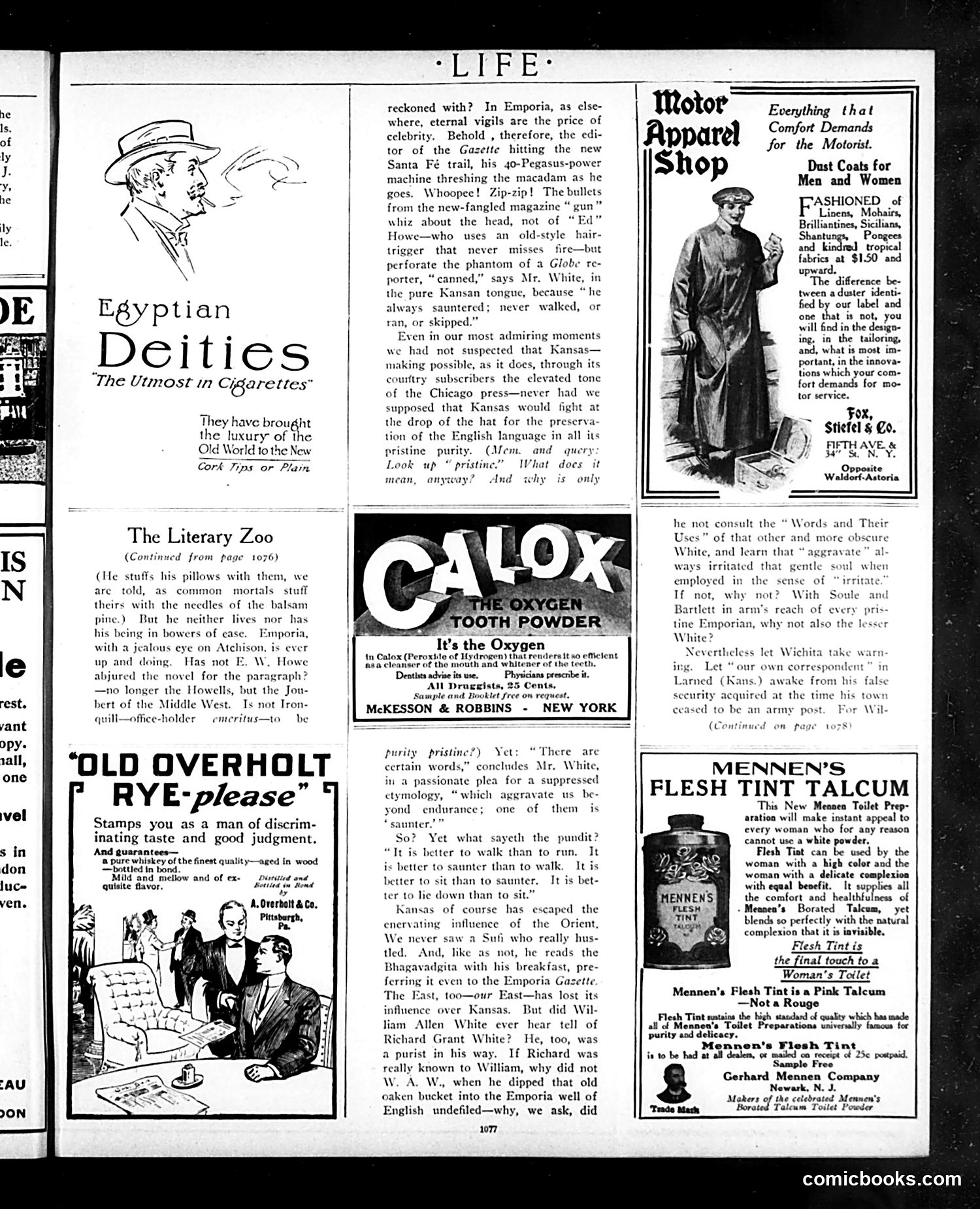
This page satirizes **E.W. Howe**, editor of the Emporia Gazette in Kansas, through "The Literary Zoo" column. The satire mocks Howe's self-righteous crusade for linguistic purity—particularly his objection to the word "inter" (meaning to saunter). The joke: Howe violently defends "pristine" English while racing around in a 40-horsepower automobile, shooting at imaginary Globe reporters he deems "canned" (fired) for their lazy walking habits. The irony is sharp—this man obsessed with proper English usage hasn't consulted actual authoritative dictionaries and seems to have adopted extreme, almost violent opinions about language from Oriental philosophy rather than scholarship. The column references **Richard Grant White**, a noted 19th-century American language expert, implying Howe should defer to established authorities rather than inventing personal linguistic crusades. **The surrounding advertisements** (cigarettes, whiskey, tooth powder, duster coats) are period-typical Life magazine content, not part of the satire.
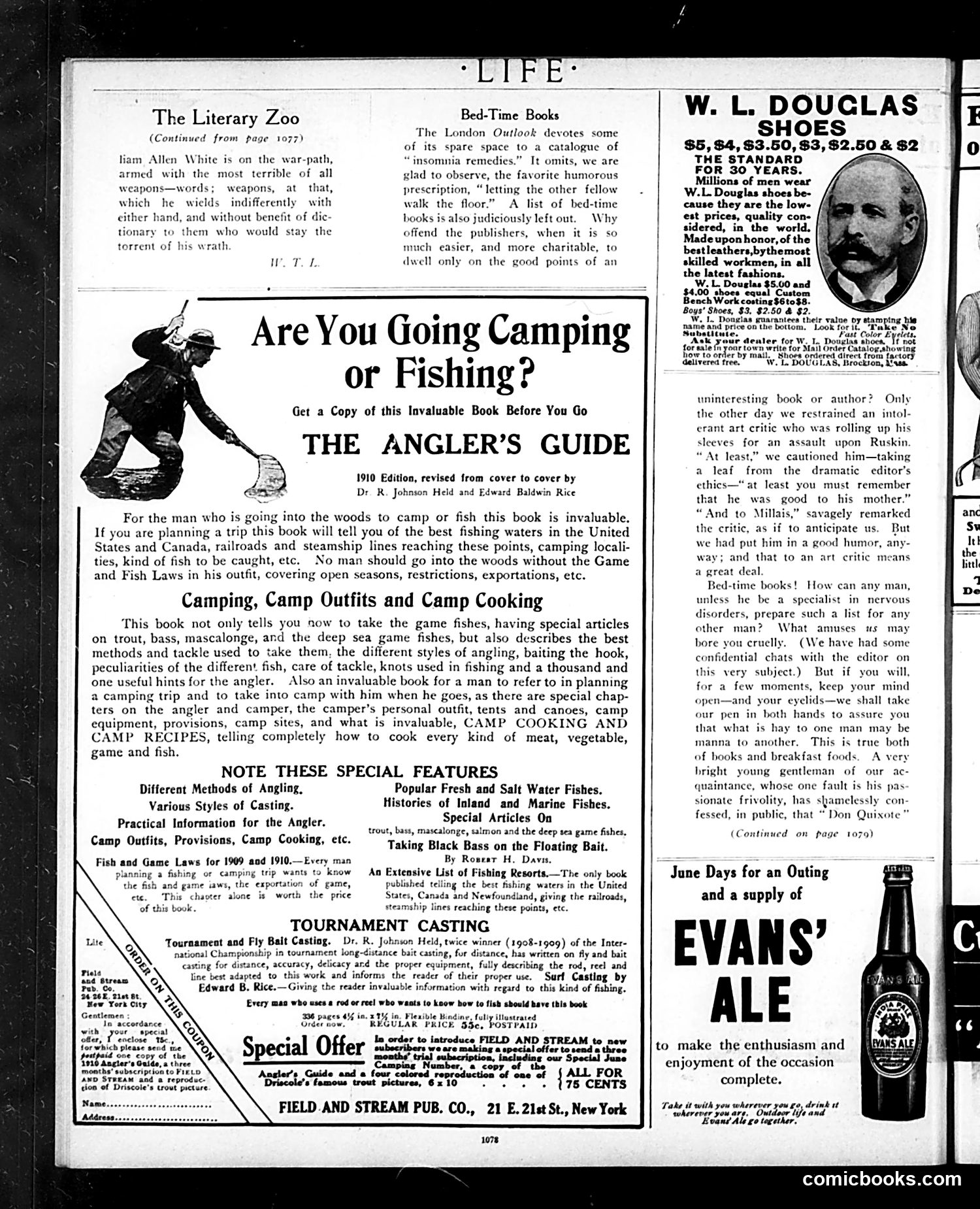
This page is primarily **advertising and product promotion**, not political satire. It contains: 1. **"The Literary Zoo"** column (top left): A brief literary critique mentioning William Allen White as a forceful writer wielding words as "weapons." This is straightforward commentary on a public figure known for his journalism. 2. **Main content**: A large advertisement for *The Angler's Guide* (1910 edition), a fishing and camping manual. The headline "Are You Going Camping or Fishing?" and detailed descriptions of the book's contents—fishing techniques, camp cooking, game laws—are standard early-1900s promotional material. 3. **Side advertisements**: W.L. Douglas Shoes (emphasizing affordable quality) and Evans' Ale (for outdoor enjoyment). There is **no political cartoon or satire** on this page. It's a commercial publication page typical of Life magazine's mixed content format, blending editorial commentary with advertisements aimed at outdoor enthusiasts and consumers of the era.
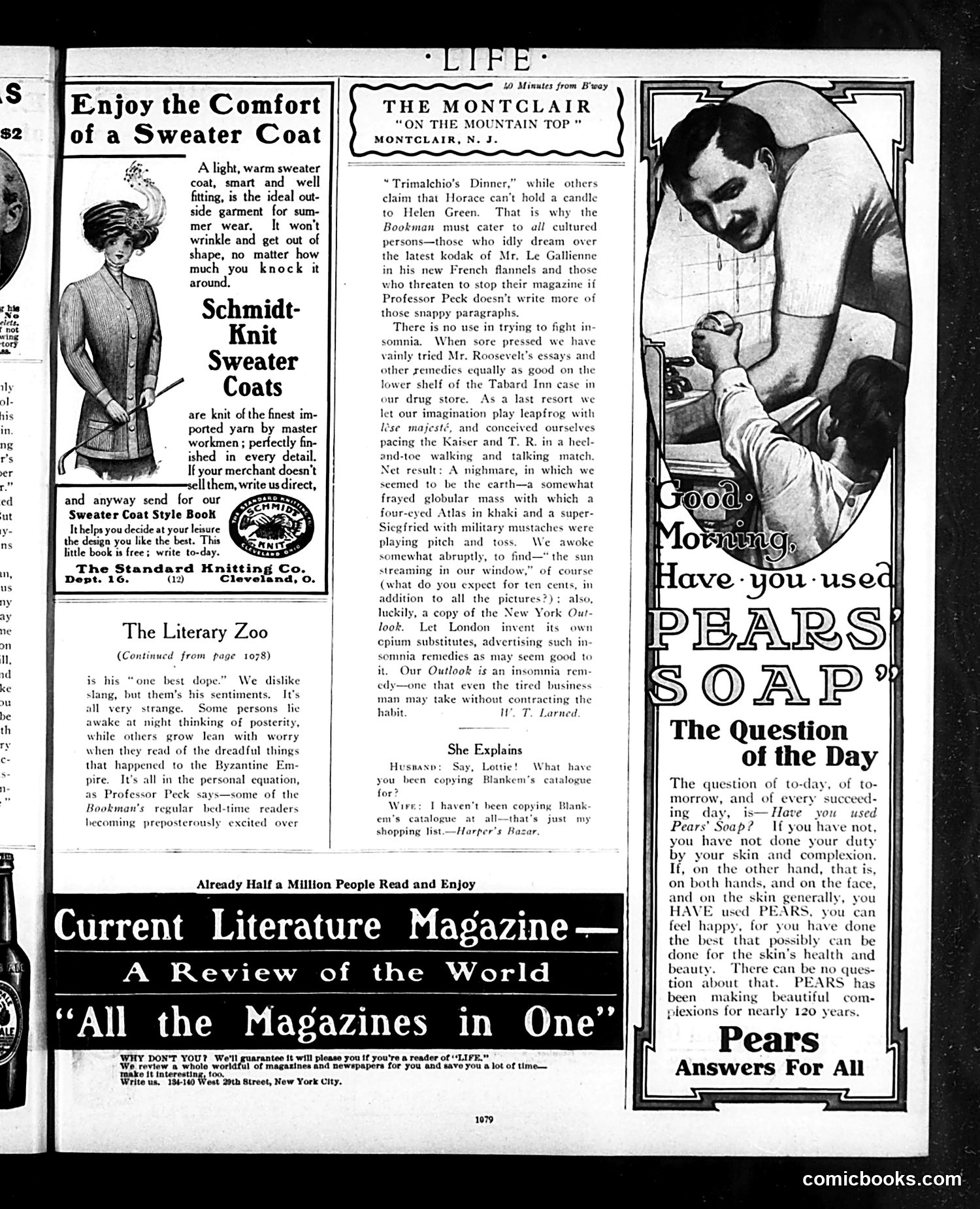
This page is primarily **advertising and light editorial content** from an early 20th-century *Life* magazine, not political satire. The main content includes: - **Advertisement for Schmidt-Knit Sweater Coats** - **"The Literary Zoo"** (continued article): A humorous essay mocking literary pretension. It references readers debating whether "Trimalchio's Dinner" or Horace is superior, and satirizes the *Bookman* magazine for catering to affected intellectuals. The author describes an absurdist nightmare where Theodore Roosevelt and the Kaiser play pitch-and-toss while treating the author (as Earth) like a ball—likely mocking anxieties about international tensions and powerful leaders' casual disregard for ordinary people. - **"She Explains"** (brief domestic humor): A wife explains her shopping list wasn't copied from a catalogue—mild marital comedy. - **Pears Soap advertisement**: A pseudo-philosophical pitch claiming the soap is humanity's duty to skin health, humorously overstating the product's importance. The page reflects early 1900s consumer culture and literary snobbery more than serious political commentary.
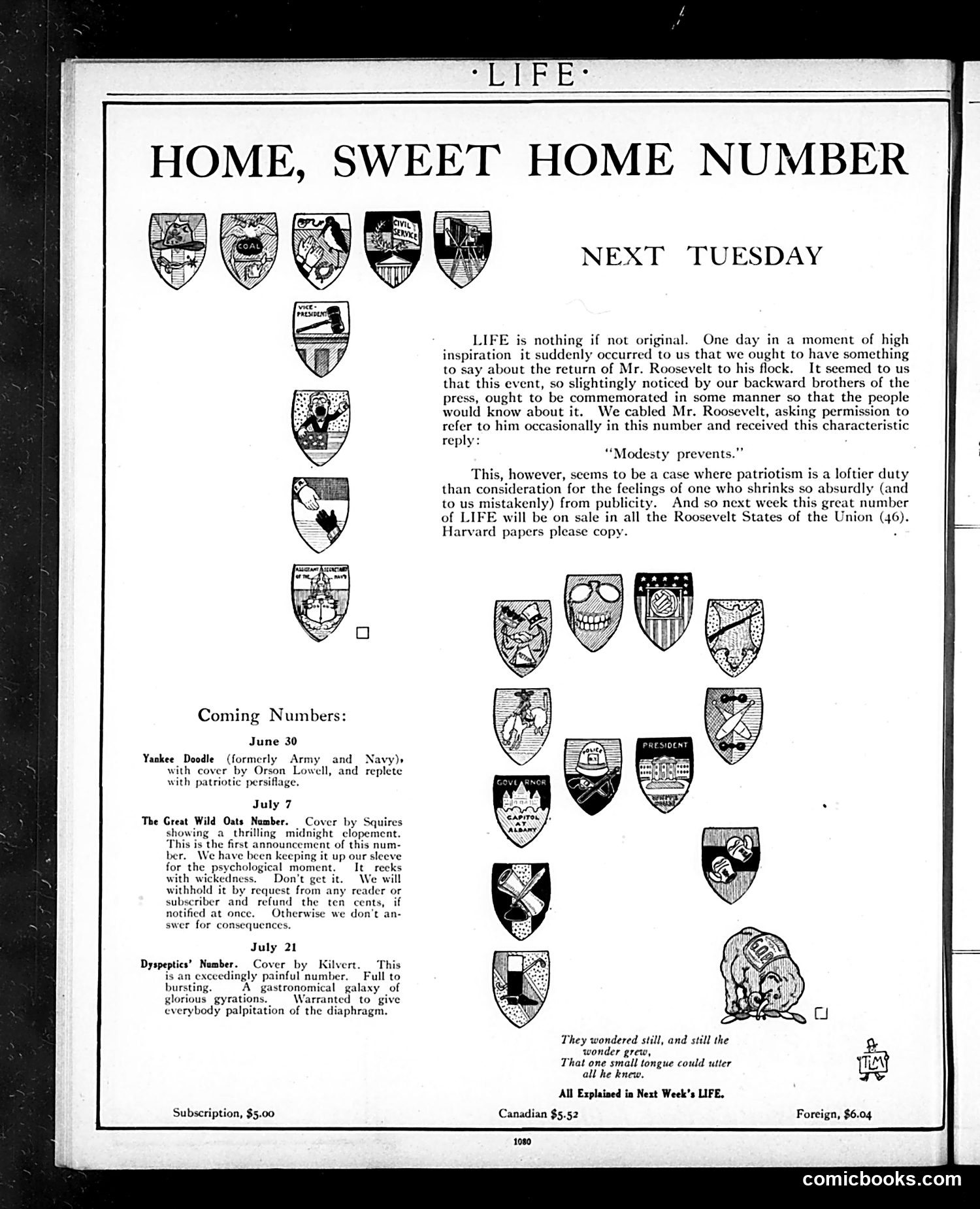
This is primarily a table of contents/announcement page rather than a cartoon. The main humor targets **Theodore Roosevelt's return to public prominence** (likely his 1912 comeback campaign). Life satirizes Roosevelt's claimed modesty—he allegedly refused to allow commemorative coverage, replying "Modesty prevents." Life responds that patriotism overrides his reluctance, announcing they'll run a special Roosevelt issue in all "Roosevelt States of the Union (46)," with obvious tongue-in-cheek exaggeration. The decorative shield emblems lining the page appear to be state or regional symbols, reinforcing the geographic emphasis. The page advertises upcoming issues with playful titles—"Yankee Doodle," "Great Wild Oats Number," and "Dyspeptics' Number"—showcasing Life's satirical house style. The closing verse ("That one small tongue could utter all he knew") is an oblique jab at Roosevelt's notorious talkativeness, a common target of contemporary satire.
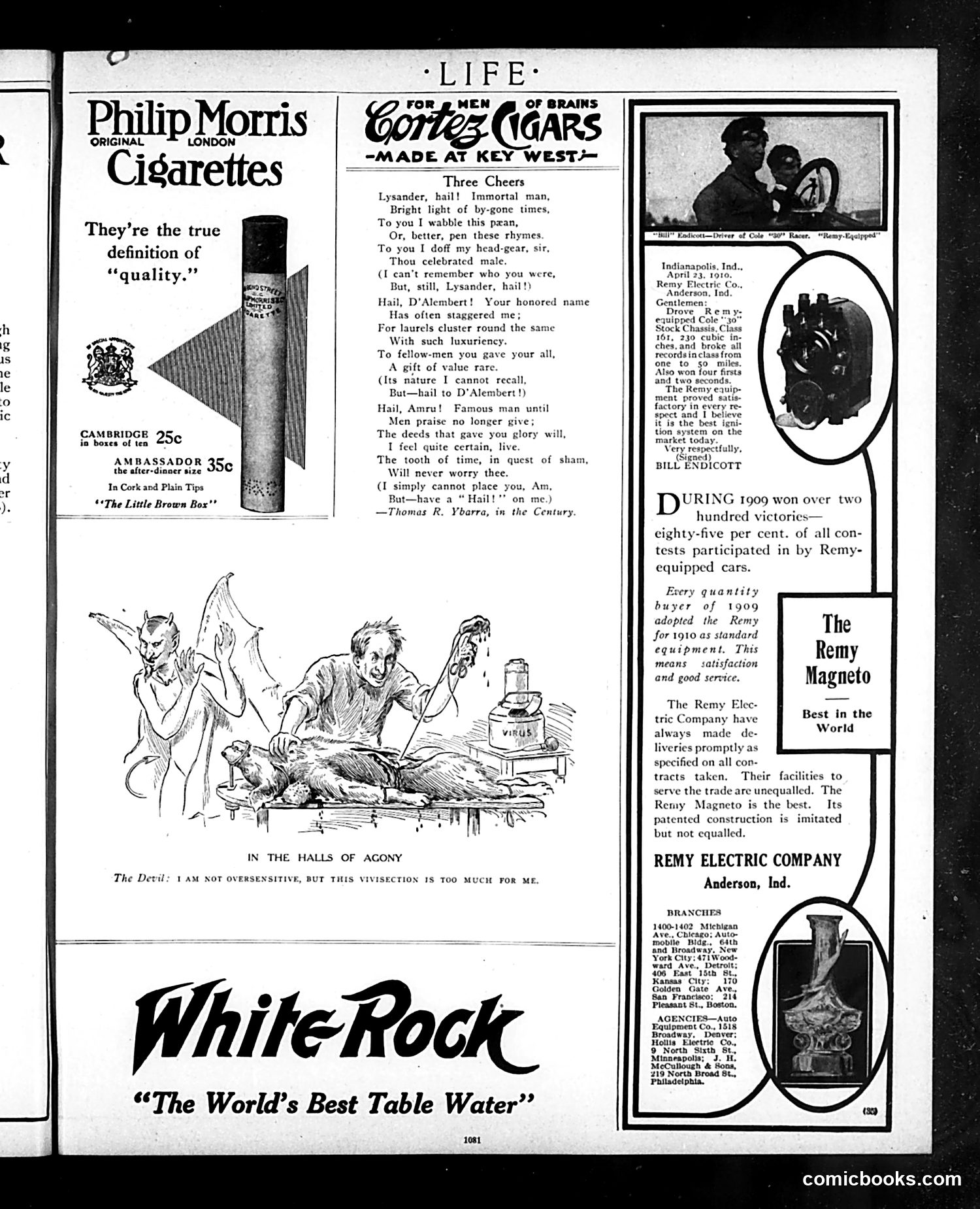
This page is primarily **advertising**, featuring cigarettes, table water, and automotive electrical equipment. The main satirical content is a brief poem titled "Three Cheers" by Thomas R. Ybarra. **The Poem's Satire:** Ybarra humorously celebrates three historical figures—Lysander, D'Alembert, and Amru—while openly admitting he cannot remember who they are or what they accomplished. Each stanza ends with "hail!" and a parenthetical confession of ignorance. The joke mocks people who invoke great names and achievements without genuine knowledge, treating classical learning as performative flattery rather than substantive understanding. **The Devil Cartoon:** A small illustration shows the Devil complaining that a "vivisection" (animal experimentation) is "too much" for him—dark satire suggesting even the Devil finds the practice excessively cruel. The page otherwise consists of period advertisements for Philip Morris cigarettes, White Rock table water, and Remy magnetos for automobiles, typical of early 1900s Life magazine content.
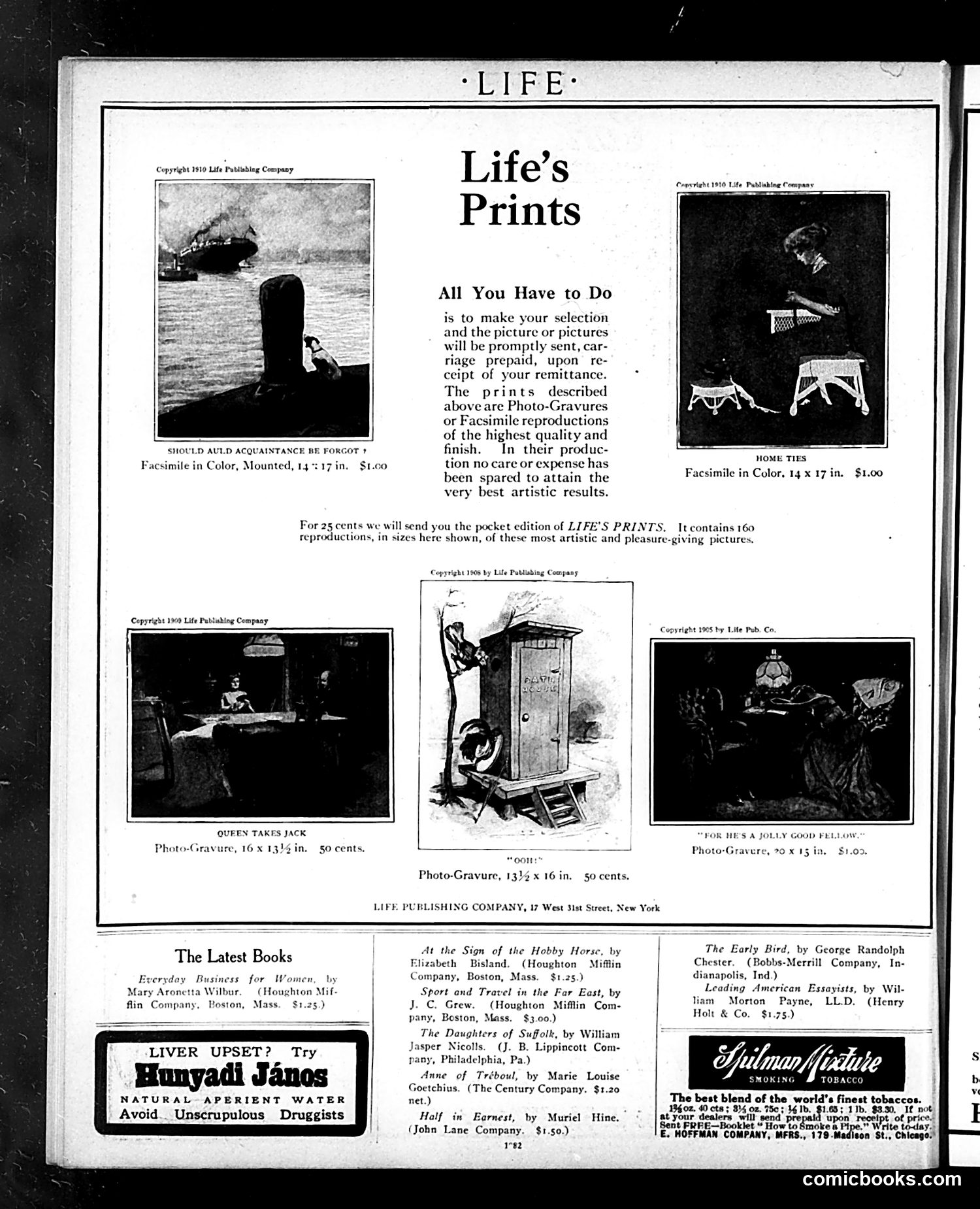
This page is primarily an **advertisement for "Life's Prints"**—a mail-order service selling reproductions of artwork and photographs. The four sample images shown are photo-gravures (high-quality facsimile prints) available for purchase. The visible prints include: - "Should Auld Acquaintance Be Forgot" (a sentimental scene, $1.00) - "Home Ties" (domestic interior, $1.00) - "Queen Takes Jack" (appears to be a card-game or parlor scene, 50 cents) - "Oooh" (unclear subject, 50 cents) - "For He's a Jolly Good Fellow" (social gathering, $1.02) The advertisement emphasizes quality and convenience—ordering by mail with prepaid shipping. The page also contains book advertisements and a patent medicine ad (Hunyadi Janos water for digestive complaints), typical of early 20th-century periodical advertising. There is **no political satire** on this page; it is fundamentally a commercial offering.
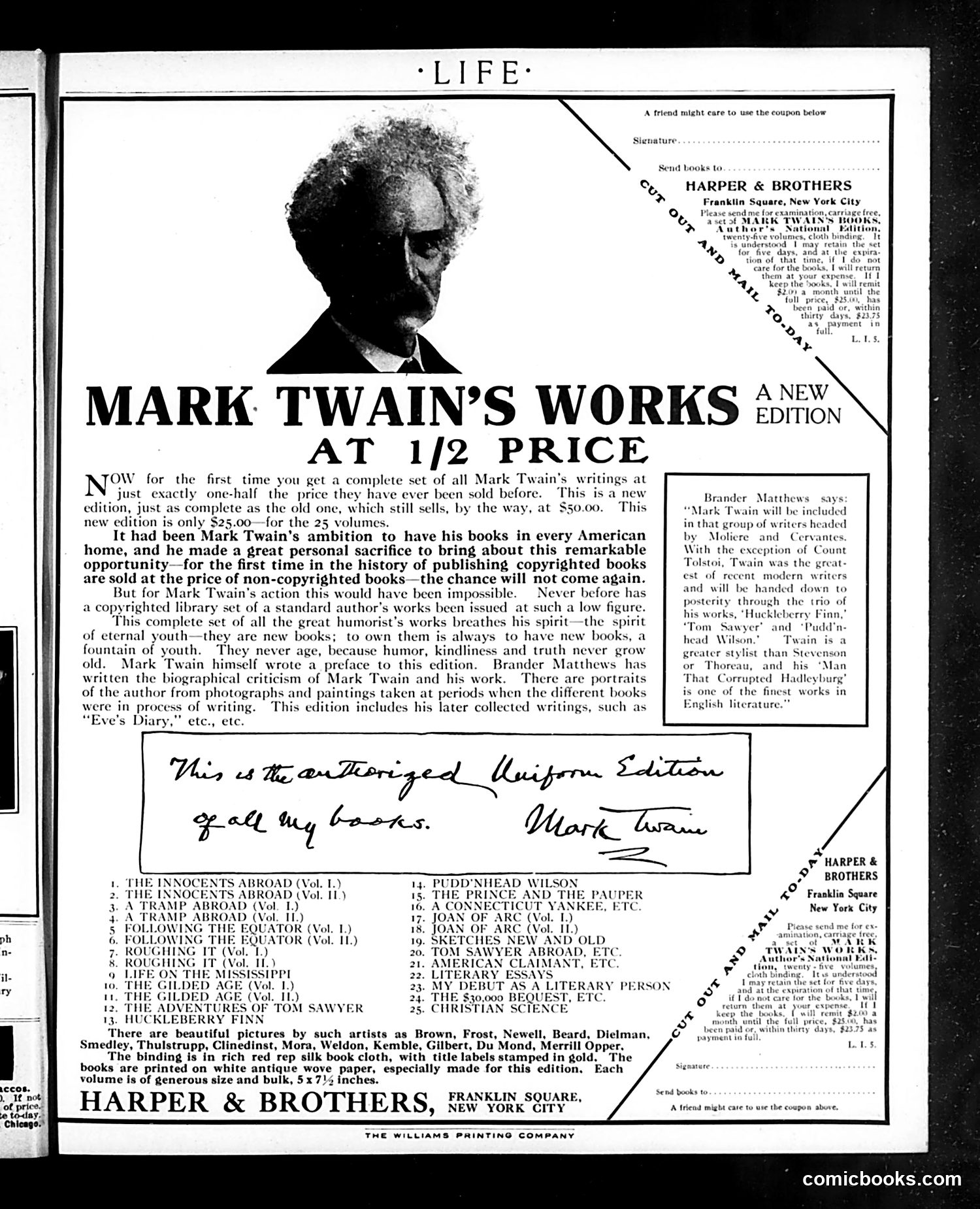
This is primarily a **book advertisement**, not political satire. Harper & Brothers publishers are promoting a new affordable complete edition of Mark Twain's works at half the previous price ($25 rather than $50 for 25 volumes). The page features a **portrait of Mark Twain** at top and includes an endorsement from literary critic **Brander Matthews**, praising Twain alongside Cervantes and claiming he'll be remembered through works like *Huckleberry Finn* and *Tom Sawyer*. The ad emphasizes this was Twain's personal ambition—to place his books in "every American home"—and frames the price reduction as historically unprecedented for copyrighted works. The edition includes illustrations by prominent contemporary artists and reproductions of photographs from periods when different books were written. **For modern readers**: This reflects early 20th-century publishing practices and Twain's stature as America's foremost humorist, positioning affordable literature as democratizing and culturally valuable.
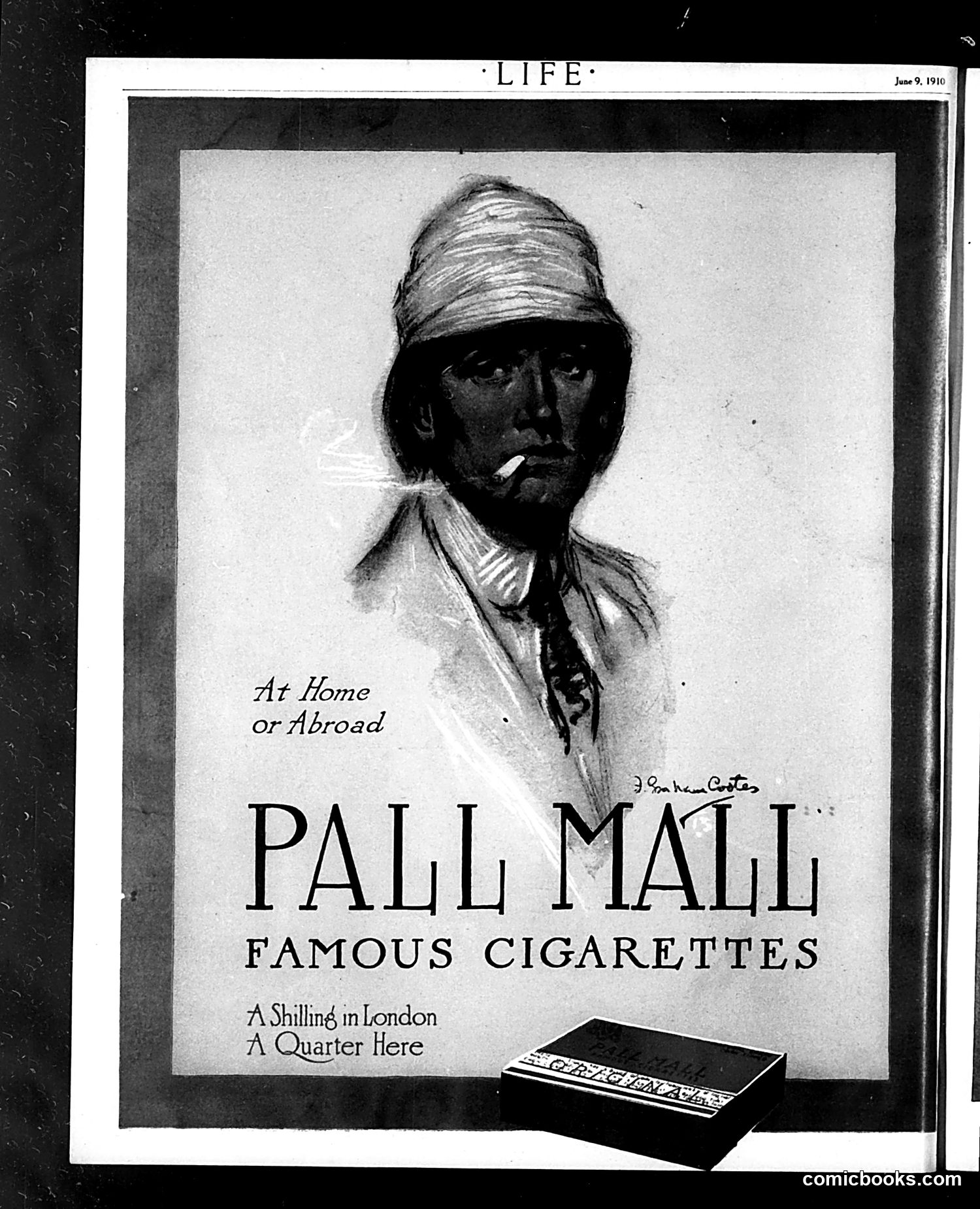
This is a Pall Mall cigarette advertisement from Life magazine (June 9, 1916). It features a portrait of a man wearing a head bandage and smoking a cigarette, drawn in a style suggesting he's wounded or injured. The tagline "At Home or Abroad" pairs with pricing information ("A Shilling in London / A Quarter Here"), emphasizing the product's international availability and affordability. Given the 1916 date, this likely references World War I. The wounded figure may implicitly suggest soldiers smoking Pall Malls in various theaters of war. The advertisement uses patriotic and wartime imagery to market cigarettes as a comfort product accessible to both American consumers and troops abroad—a common advertising strategy during the war years.