
Life, 1910-06-09 · page 25 of 40
Life — June 9, 1910 — page 25: what you’re looking at
What you’re looking at
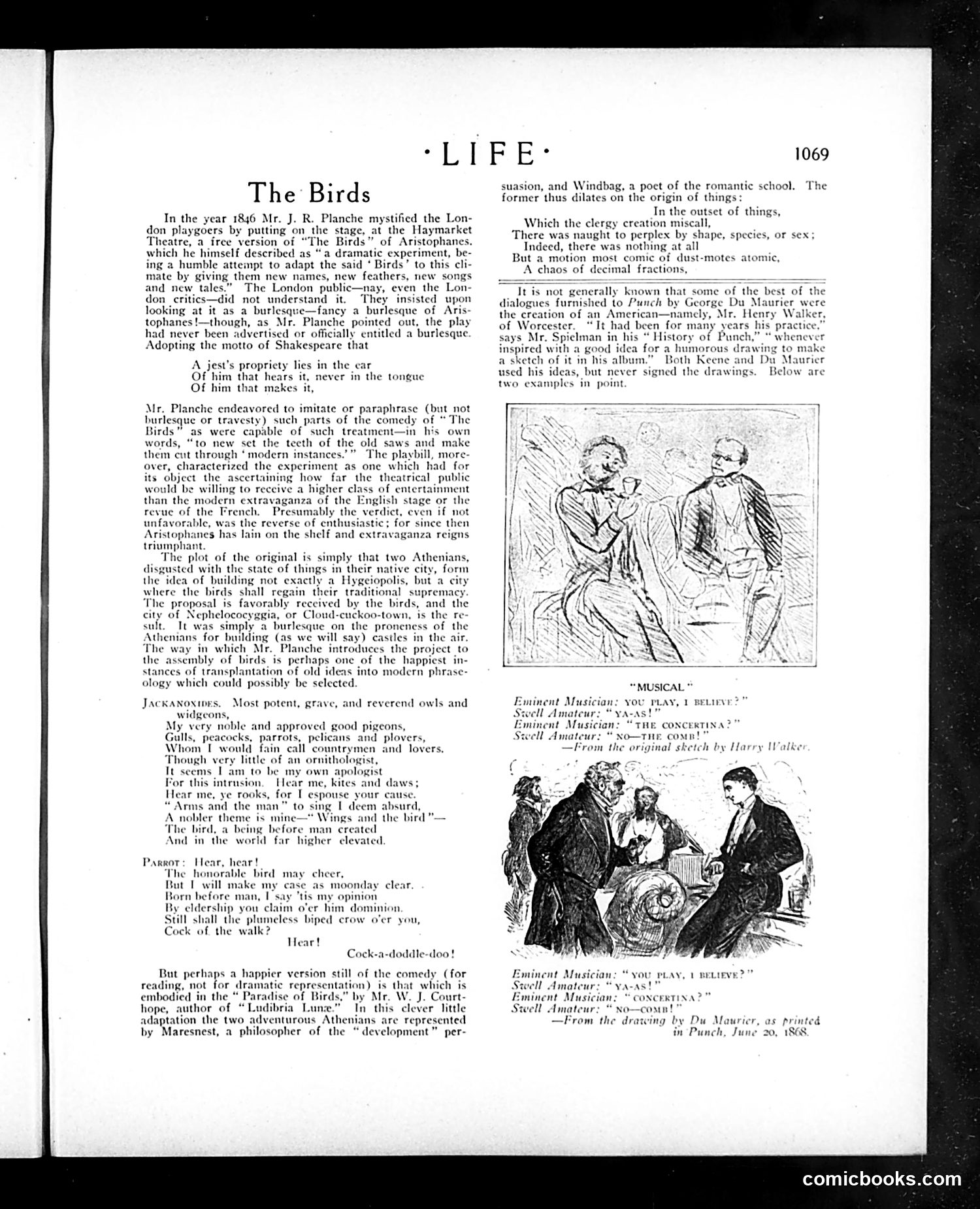
This article discusses 19th-century theatrical adaptations of Aristophanes' ancient Greek comedy *The Birds*. The page explains that in 1846, playwright J.R. Planché staged a modernized version at London's Haymarket Theatre, attempting serious dramatic adaptation rather than burlesque—but audiences dismissed it as mere farce. The two sketches shown are from an 1868 *Punch* drawing by Du Maurier, illustrating a scene labeled "Musical" where characters debate whether to attend a concert. The dialogue humorously captures Victorian social pretension around cultural entertainment. The article then previews another adaptation, W.J. Courthope's *Paradise of Birds*, which reimagines Aristophanes' protagonists as "Maresnest" (a development-theory philosopher) and "Windbag" (a romantic poet)—likely satirizing contemporary intellectual types and their fashionable philosophies. The satire mocks both theatrical mediocrity and Victorian intellectual pretension.
📄 Transcribed text from this page (OCR, searchable)
Machine-transcribed from the original scan — historical spelling and the odd misread are preserved.
-LIFE: The Birds year 1846 Mr. J. R. Planche mystified the Lon- don playgocrs by putting’ on the stage, at the Haymarket Theatre, a irce version of “The Birds” of Aristophanes. which he himself described as “a dramatic experiment, be- ing a humble attempt to adapt the said‘ Birds’ to this cli- mate by giving them new names, new feathers, new songs and new. tales.” The London public—nay, even the Lon- don critics—did not understand it. They insisted upon looking at it as a burlesque—fancy a burlesque of Aris tophanes!—though, as Mr. Planche pointed out, the play had never been advertised or officially entitled a burlesque Adopting the motto of Shakespeare that In the A jest's propriety lies in the ear Of him that hears it, never in the tongue Of him that makes it, Mr. Planche endeavored to imitate or paraphrase (but not irlesque or travesty) such parts of the comedy of “The Bird s were capable of such treatment—in his own words, “to new set the teeth of the old saws and make them cut through ‘modern instances.’ The playbill, more- over, characterized the experiment as one which had for its object the ascertaining how far the theatrical public would be willing to receive a higher class of entertainment than the modern extravaganza of the English stage or the revue of the French. Presumably the verdict, even if not unfavorable, was the reverse of enthusiastic; for since then Aristophanes has lain on the shelf and extravaganza reigns triumphant. The plot of the original is simply that two Athenians, disgusted with the state of things in their native city, form the idea of building not exactly a Hygeiopolis, but’a city where the birds shall regain their traditional supremacy. The proposal is favorably received by the birds, and the city of Nephelococyggia, or Cloud-cuckoo-town, is the re sult. It was simply a burlesque on the proneness of the Athenians for building (as we will say) castles in the air. The way in which Mr. Planche introduces the project to the assembly of birds is perhaps one of the happiest in- stances of transplantation of old ideas into modern phrase- ology which could possibly be selected. JACKANOYIDES. Most potent, grave, and reverend owls and widgeons, My very noble and approved good pigeons, Gulls, peacocks, parrots, pelicans and plovers, Whom I would fain call countrymen and lovers. Though very little of an ornithologist, It seems I am to be my own apologist For this intrusion. Hear me, kites and daws; Hear me, ye rooks, for I espouse your cause. “Arms and the man” to sing | deem absurd, A nobler theme is mine—* Wings and the bird The bird, a being before man created And in the world far higher elevated. Pargor: Hear, hear! The honorable bird may cheer, But | will make my case as moonday clear Born before man, [say ‘tis my opinion By eldership you claim o'er him dominion Still shall the plumeless biped crow o'er y« Cock of the walk? Hear! ‘ock-a-doddle-doo! But perhaps a happier version still of the comedy (for reading, not for dramatic representation) is that which is embodied in the “ Paradise of Birds,” by Mr. W. J. Court- hope, author of “Ludibria Lun.” In this clever little adaptation the two adventurous Athenians are represented by Maresnest, a philosopher of the “development” per- 1069 suasion, and Windbag, a poct of the romantic school. The former thus dilates on the origin of things: In the outset of things, Which the clergy creation miscall, There was naught to perplex by shape, species, or sex; Indeed, there was nothing at all But a motion most comic of dust-motes atomic, A chaos of decimal fractions, tis not generally known that some of the best of the dialogues furnished to Punch by George Du Maurier were the creation of an American—namely, Mr. Henry Walke of Worcester. “It had been for many years his practice. says Mr. Spielman in his “ History of Punch,” “ whenever inspired with a good idea for a humorous drawing to make a ske' of it in his album.” Both Keene and Du Maurier used his ideas, but never signed the drawings. Below are two examples in point “MUSICAL * Eminent Musician: you riay, 1 Betieve?” tor “xo—tHe coun!" ch by Harry U Swell Amateur —From the original ninent Musician: “you Play, 1 BELIEVE?” MW Amateur ya-as!™ ninent Musician: © CONCERTINA?” vell Amateur: “ No—comn!” —From the drawing by Du Maurie in Punch, Jun as printed 20, 1868, comicbooks.com