
Life, 1910-06-09 · page 6 of 40
Life — June 9, 1910 — page 6: what you’re looking at
What you’re looking at
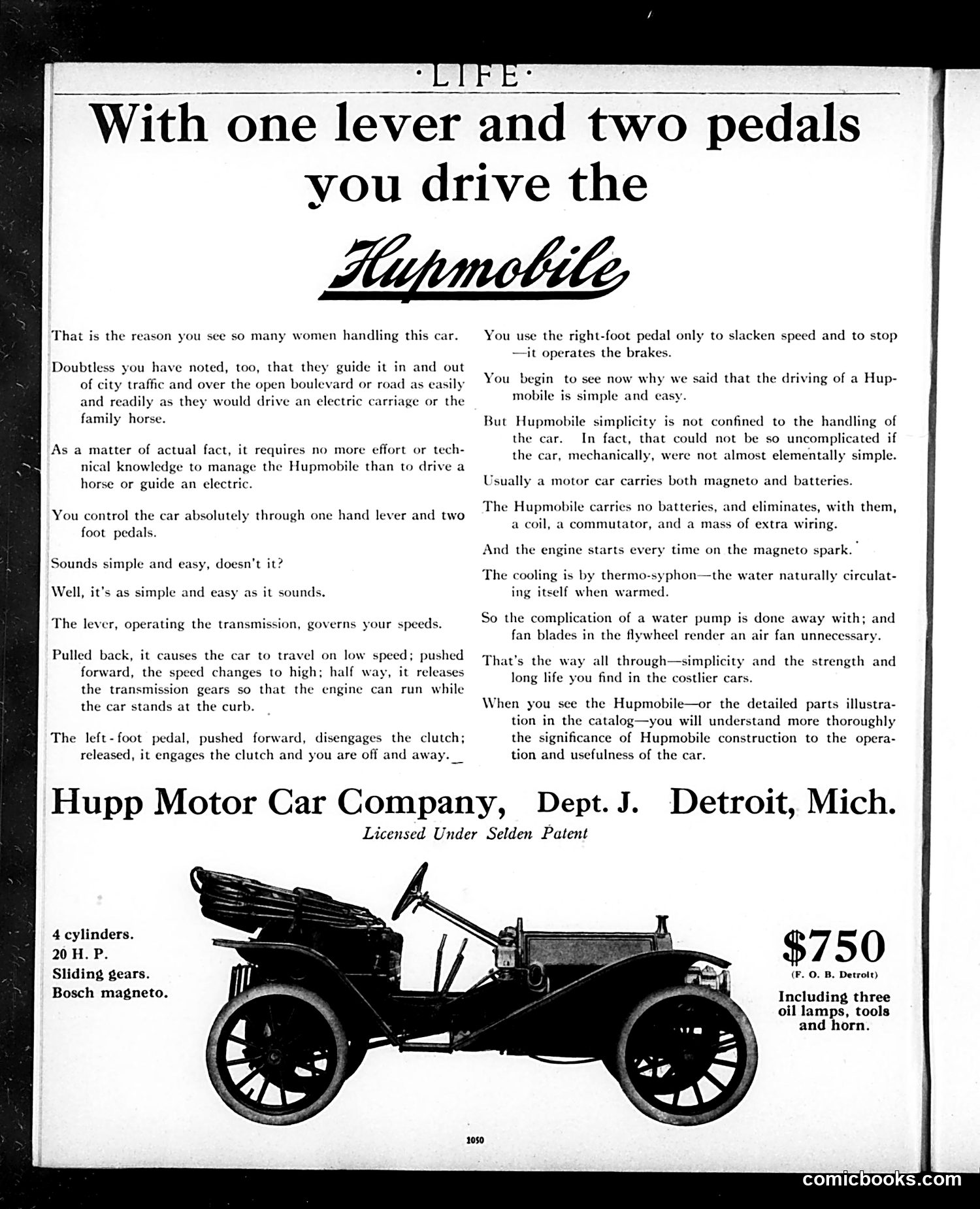
This page is **primarily an advertisement**, not satirical content. It promotes the Hupmobile, an early automobile manufactured by the Hupp Motor Car Company in Detroit. The ad emphasizes the car's simplicity of operation—controllable by "one lever and two pedals"—appealing to women drivers, who were still a novelty in the early automotive era. The text notes that women successfully navigate city traffic and open roads "as easily as they would drive an electric carriage or the family horse," suggesting the Hupmobile requires no special mechanical knowledge. The ad highlights technical innovations: no batteries needed, magneto ignition, thermosyphon cooling. The price of $750 (including lamps, tools, and horn) appears competitive for the period. This reflects early-1900s marketing targeting middle-class families and female drivers during motoring's infancy.
📄 Transcribed text from this page (OCR, searchable)
Machine-transcribed from the original scan — historical spelling and the odd misread are preserved.
With one lever and two pedals you drive the That is the reason you see so many women handling this car. Doubtless you have noted, too, that they guide it in and out of city traffic and over the open boulevard or road as easily and readily as they would drive an electric carriage or the family horse. As a matter of actual fact, it requires no more effort or tech- nical knowledge to manage the Hupmobile than to drive a horse or guide an electric. You control the car absolutely through one hand lever and two foot pedals. Sounds simple and easy, doesn't it? Well, it's as simple and easy as it sounds. The lever, operating the transmission, governs your speeds. Pulled back, it causes the car to travel on low speed; pushed forward, the speed changes to high; half way, it releases the transmission gears so that the engine can run while the car stands at the curb. The left-foot pedal, pushed forward, disengages the clutch; released, it engages the clutch and you are off and away. __ You use the right-foot pedal only to slacken speed and to stop —it operates the brakes. You begin to see now why we said that the driving of a Hup- mobile is simple and easy. But Hupmobile simplicity is not confined to the handling of the car. In fact, that could not be so uncomplicated if the car, mechanically, were not almost elementally simple. Usually a motor car carries both magneto and batteries. The Hupmobile carries no batteries, and eliminates, with them, a coil, a commutator, and a mass of extra wiring. And the engine starts every time on the magneto spark. The cooling is by thermo-syphon—the water naturally circulat- ing itself when warmed. So the complication of a water pump is done away with; and fan blades in the flywheel render an air fan unnecessary. That's the way all through—simplicity and the strength and long life you find in the costlier cars. When you see the Hupmobile—or the detailed parts illustra- tion in the catalog—you will understand more thoroughly the significance of Hupmobile construction to the opera- tion and usefulness of the car. Hupp Motor Car Company, Dept.J. Detroit, Mich. Licensed Under Selden Patent 4 cylinders. 20H. P. Sliding gears. Bosch magneto. $750 (F. O. B. Detroit) Including three oil lamps, tools and horn. comicbooks.com