
Life, 1910-06-09 · page 22 of 40
Life — June 9, 1910 — page 22: what you’re looking at
What you’re looking at
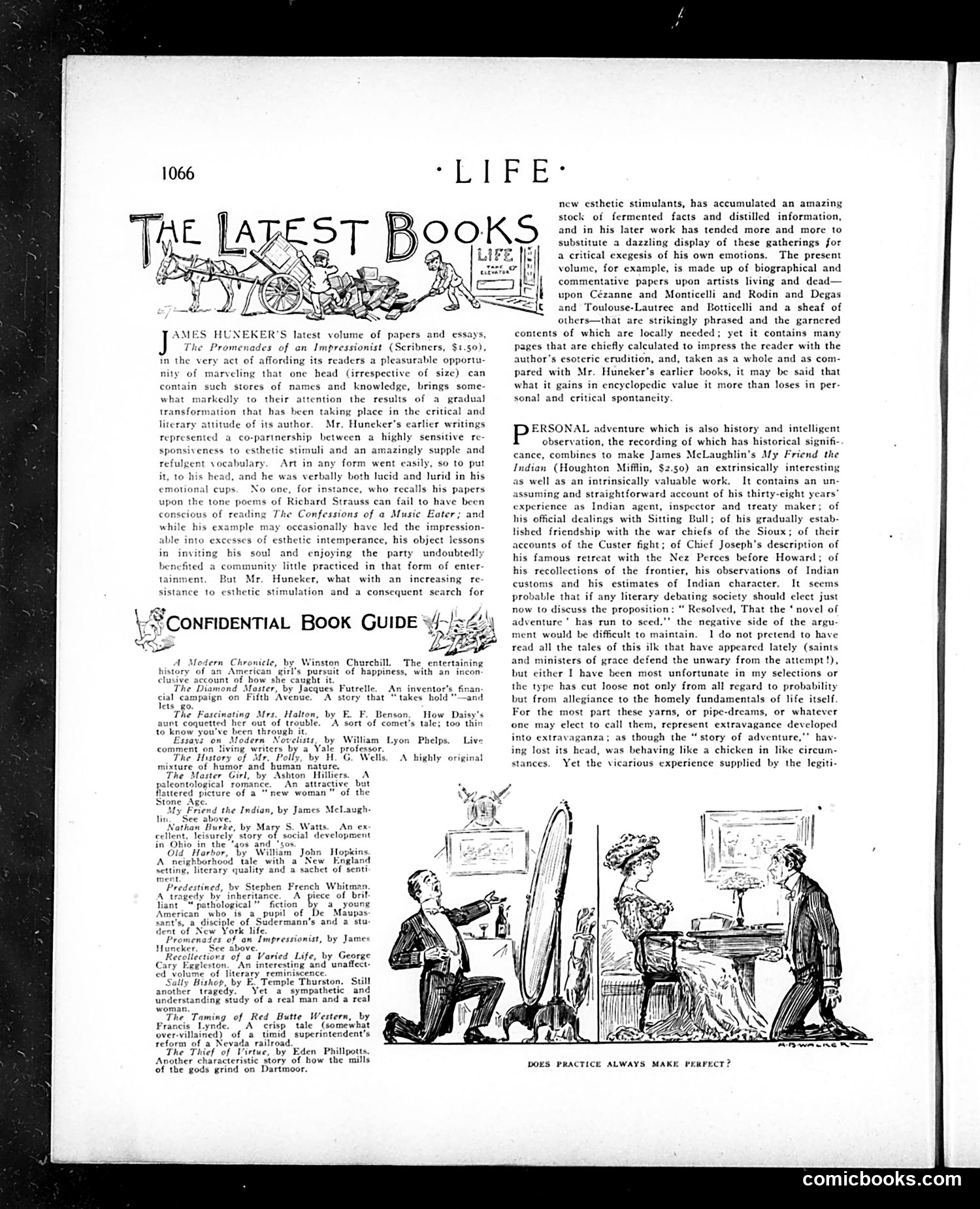
This page reviews James Huneker's essay collection *Promenades of an Impressionist*. The critic argues that Huneker, once known for passionate emotional response to art, has evolved into a mere collector of facts and biographical details. Rather than offering genuine critical insight, he now "substitute[s] a dazzling display" of information—impressive but intellectually hollow. The accompanying cartoon (bottom right) illustrates this critique: a figure practices painting at an easel while another observes. The caption "Does practice always make perfect?" suggests the review's central irony—that technical accumulation doesn't guarantee artistic or critical merit. Huneker's scholarly industriousness, like repetitive practice, doesn't necessarily produce meaningful analysis. The *Confidential Book Guide* section lists contemporary publications, positioning Huneker's work among current literary offerings.
📄 Transcribed text from this page (OCR, searchable)
Machine-transcribed from the original scan — historical spelling and the odd misread are preserved.
* DEE * Promenades of an Impressionist (Scribners, $1.50), the very act of affording its readers a pleasurable opportu nity of marveling that one head (irrespective of size) can contain such stores of names and knowledge, brings some- tention the results of a gradual J AMES HUNEKER’S latest volume of papers and essays, at_markedly to their transformation that has been taking place in the critical and literary attitude of its author. Mr. Huneker’s earlier writings represented a co-parinership between a highly sensitive re- imuli and an amazingly supple and any form went easily, so to put sponsiveness to esthetic cfulgent vocabulary. Art i to his head, and he was verbally both lucid and Jurid in his emotional cups. No one, for instance, who recalls his papers upon the tone poems of Richard Strauss can fail to have been ling The Confessions of a Music Eater; and occasionally have led the conscious of re while his example + mpression- able into excesses of esthetic intemperance, his object lessons in inviting bis soul and enjoying the party undoubtedly benefited a community little practiced in that form of enter- tainment. But Mr. Huneker, what with an increasing re sistance 10 esthetic stimulation and a consequent search for AS CONFIDENTIAL BOOK GUIDE \f4/=4 : LES ZE by, Winston Churchill. The enterta girl's pursuit of happiness, with an i of how she caught it. The Diamond Master, by Jacques Futrelle. 1 campaign fth Avenue. A story that 5. g9. The Fascinating Mrs. Halton, by E. F. Benson. aunt coquetted her out of trouble. A sort of comet's to know you've been through it Essayz on Modern Novelists, by William Lyon Phelps. Live comment on living we ale professor The History of Mr. Polly, by H. G. Wells. mixture of humor and buman nature. The Master Girl, by Ashton Hilliers. A paleontological romance. An attractive but flattered picture of a “new woman” of the Stone Age. An inventor's, finan: “takes hold "—any How Daisy's 3 too thin A highly original Indian, by James McLaugh S. Watts. An ex Nathan Burke, by ial ‘development ellent, leisurely n Obio in the Old Harbor, by William Hopkins neighborhood tale with a England ting, literary quality and a sachet of senti ment Predestined, a French Whitman. h A piece of brif _ Mfction | by a young American who is a_pupil of De Maupas sant’s, a disciple of Sudermann’s and a stu dent of New York life. Promenades of an Impressionist, by Jar Huneker. See above. Recollections of a Varied Life, by George Cary Eggleston. An interesting and unaffect- ed of literary reminiscence. = Sally Bishop, by E. Temple Thurston. Still another tragedy. Yet a sympathetic and understanding study of a real man and a real The Taming of Red Butte Western, by Francis Lynde. A crisp tale (somewhat over-villained) of a timid superintendent's reform of a Nevada railroad. The Thief of Virtue, by Eden Phillpotts. Another characteristic story of how the mills of the gods grind on Dartmoor. new esthetic stimulants, has accumulated an amazing stock of fermented facts and distilled information, and in his later work has tended more and more to substitute a dazzling display of these gatherings for a critical exegesis of his own emotions. The present volume, for example, is made up of biographical and commentative papers upon artists living and dead— upon Cézanne and Monticelli and Rodin and Degas and Toulouse-Lautrec and Botticelli and a sheaf of others—that are strikingly phrased and the garnered contents of which are locally needed; yet it contains many pages that are chiefly calculated to impress the reader with the author's esoteric erudition, and, whole and as com- pared with Mr. Huneker’s earlier books, it may be said that what it gains in encyclopedic value it more than loses in per- sonal and critical spontancity ERSONAL adventure which is also history and intelligent observation, the recording of which has historical signifi- cance, combines to make James McLaughlin's My Friend the Indian (Houghton Mifflin, $2.50) an extrinsically interesting as well as an intrinsically valuable work. It contains an un- assuming and straightforward account of his thirty-eight years’ experience as Indian agent, inspector and treaty maker; of his official dealings with Sitting Bull; of his gradually estab- lished friendship with the war chiefs of the Sioux; of their accounts of the Custer fight; of Chief Joseph's description of his famous retreat with the Nez Perces before Howard; of his recollections of the frontier, his observations of Indian customs and his estimates of Indian character. It seems probable that if any literary debating society should elect just now to discuss the proposition: “ Resolved, That the ‘ novel of adventure ' has run to seed."’ the negative side of the argu- ment would be difficult to maintain. I do not pretend to have read all the tales of this ilk that have appeared lately (saints and ministers of grace defend the unwary from the attempt!), but either I have been most unfortunate in my selections or the type has cut loose not only from all regard to probability but from allegiance to the homely fundamentals of life itself For the most part these yarns, or pipe-dreams, or whatever one may elect to call them, represent extravagance developed s though the “story of adventure,”’ hav- ing lost its head, was behaving like a chicken in like circu Yet the vicarious experience supplied by the legi into extravaganza; stances. DOES PRACTICE ALWAYS MAKE PERPECT? comicbooks.com