
Life, 1910-06-09 · page 8 of 40
Life — June 9, 1910 — page 8: what you’re looking at
What you’re looking at
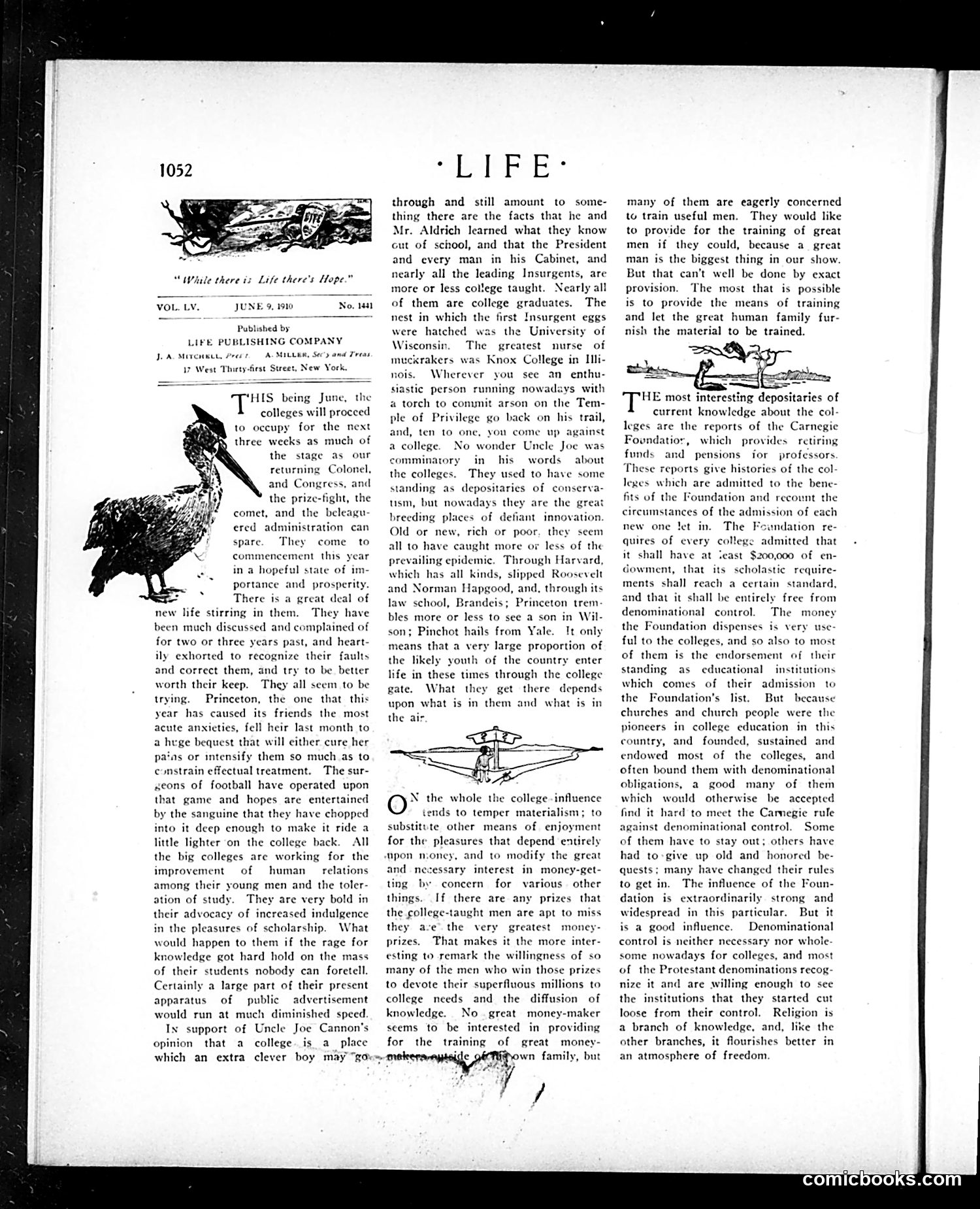
This page contains editorial content rather than political cartoons. The main illustration is a decorative drawing of a rooster, accompanying an article about American colleges and their role in developing leaders. The text discusses college education's importance, mentioning specific institutions (Harvard, Yale, Princeton, Knox College, University of Wisconsin, Brandeis) and their contributions to training influential men. It references the Carnegie Foundation's role in supporting educational institutions and critiques denominational control of colleges, arguing for academic freedom. The rooster image likely serves as a symbol of American vitality or vigilance, though its specific satirical meaning is unclear without additional context about Life's visual conventions of this era.
📄 Transcribed text from this page (OCR, searchable)
Machine-transcribed from the original scan — historical spelling and the odd misread are preserved.
“While there iz Life there's Hope.” VOL. LY. JUNE 9, 1910 Published by LIFE PUBLISHING COMPANY JA METCHRLL, Pret AO MILLER, Secs and Treas 7 West Thirty-first Street, New York. HIS being June, the colleges will proceed to occupy for the next three weeks as much of the stage as our returning Colonel, and Congress, and the prize-fight, the comet, and the beleagu- ered administration can spare. They come to commencement this yea in a hopeful state of im- portance and prosperity. There is a great deal of new life stirring in them. They have been much discussed and complained of for two or three years past, and heart- ily exhorted to recognize their faults and correct them, and try to be better worth their keep. They all seem to be trying. Princeton, the one that this year has caused its friends the most acute anxieties, fell heir last month to a hege bequest that will either cure her pa‘as or intensify them so much as to constrain effectual treatment. The sur- eons of football have operated upon that game and hopes are entertained by the sanguine that they have chopped into it deep enough to make it ride a little lighter on the college back. All the big colleges are working for the improvement of human relations among their young men and the toler- ation of study. They are very bold in their advocacy of increased indulgence in the pleasures of scholarship. What would happen to them if the rage for knowledge got hard hold on the mass of their students nobody can foretell. Certainly a large part of their present apparatus of public advertisement would run at much diminished speed. Ix support of Uncle Joe Cannon's that a college. is_a_ place opinion “TPE through and still amount to some- thing there are the facts that he and Mr. Aldrich learned what they know out of school, and that the President and every man in his Cabinet, and nearly all the leading Insurgents, are more of less college taught. Nearly all of them are college graduates. The nest in which the first Insurgent eggs were hatched was the University of Wisconsin. The greatest nurse of muckrakers was Knox College in Illi- ois. Wherever you see an enthu- siastic person running nowadays with torch to conynit arson on the Tem- ple of Privilege go back on his trail, and, ten to one, you come up against a college. No wonder Uncle Joe was comminatory in his words about the colleges. They used to have some standing as depositaries of conserva- tusm, but nowadays they are the great innovation. they seem breeding places of defiant Old or new, rich or poor. all to have caught more or less of the prevailing epidemic. Through Harvard, which has all kinds, slipped Roosevelt and Norman Hapgood, and, through its law school, Brandeis; Princeton trem bles more or less to see a son in Wil- son; Pinchot hails from Yale. It only means that a very large proportion of the likely youth of the country enter life in these times through the college gate. What they get there depends upon what is in them and what is in the air, the whole the college influence nds to temper materialism; to O* substitute other means of enjoyment for the pleasures that depend entirely npon noney, and to modify the great ssary interest in money-get- ting by concern for various other things. If there are any prizes that the college-taught men are apt to miss they ave the very greatest prizes. That makes it the more inter- esting to remark the willingness of so many of the men who win those prizes to devote their superfluous millions to college needs and the diffusion of knowledge. No great money-maker seems to be interested in providing for the training of great money- and n money- which an extra clever boy may “goo~ srakeroewaile AMMO" family, but Mess many of them are eagerly concerned to train useful men. They would like to provide for the training of great men if they could, because a great man is the biggest thing in our show. But that can’t well be done by exact provision. The most that is possible is to provide the means of training and let the great human family fur- nish the material to be trained. T' most interesting depositaries of current knowledge about the col leges are the reports of the Carnegie Fovndatior, which provides retiring funds and pensions jor professors These reports give histories of the col- leges which are admitted to the bene- fits of the Foundation and recount the circumstances of the admission of each new one let in. The Foundation re- quires of every college admitted that it shall have at ‘east $200,000 of en- dowment, that its scholastic require- ments shall reach a certain standard, and that it shall be entirely free from denominational control. The the Foundation dispenses is very use- ful to the colleges, and so also to most of them the endorsement of their standing as educational institutions which comes of their admission to the Foundation’s list. But because churches and church people were the pioneers in college education in this country, and founded, sustained and endowed most of the colleg and often bound them with denominational obligations, a good many of them which would otherwise be accepted find it hard to meet the Camegie rule against denominational control. Some of them have to stay out; others have had to-give up old and honored be- quests; many have changed their rules to get in. z money The influence of the Foun- dation is extraordinarily strong and widespread in this particular. But it is a good influence. Denominational control is neither necessary nor whole some nowadays for colleges, and most of the Protestant denominations recog- nize it and are willing enough to see the institutions that they started cut loose from their control. Religion is a branch of knowledge, and, like the other branches, it flourishes better in an atmosphere of freedom. comicbooks.com