
Life, 1910-06-09 · page 18 of 40
Life — June 9, 1910 — page 18: what you’re looking at
What you’re looking at
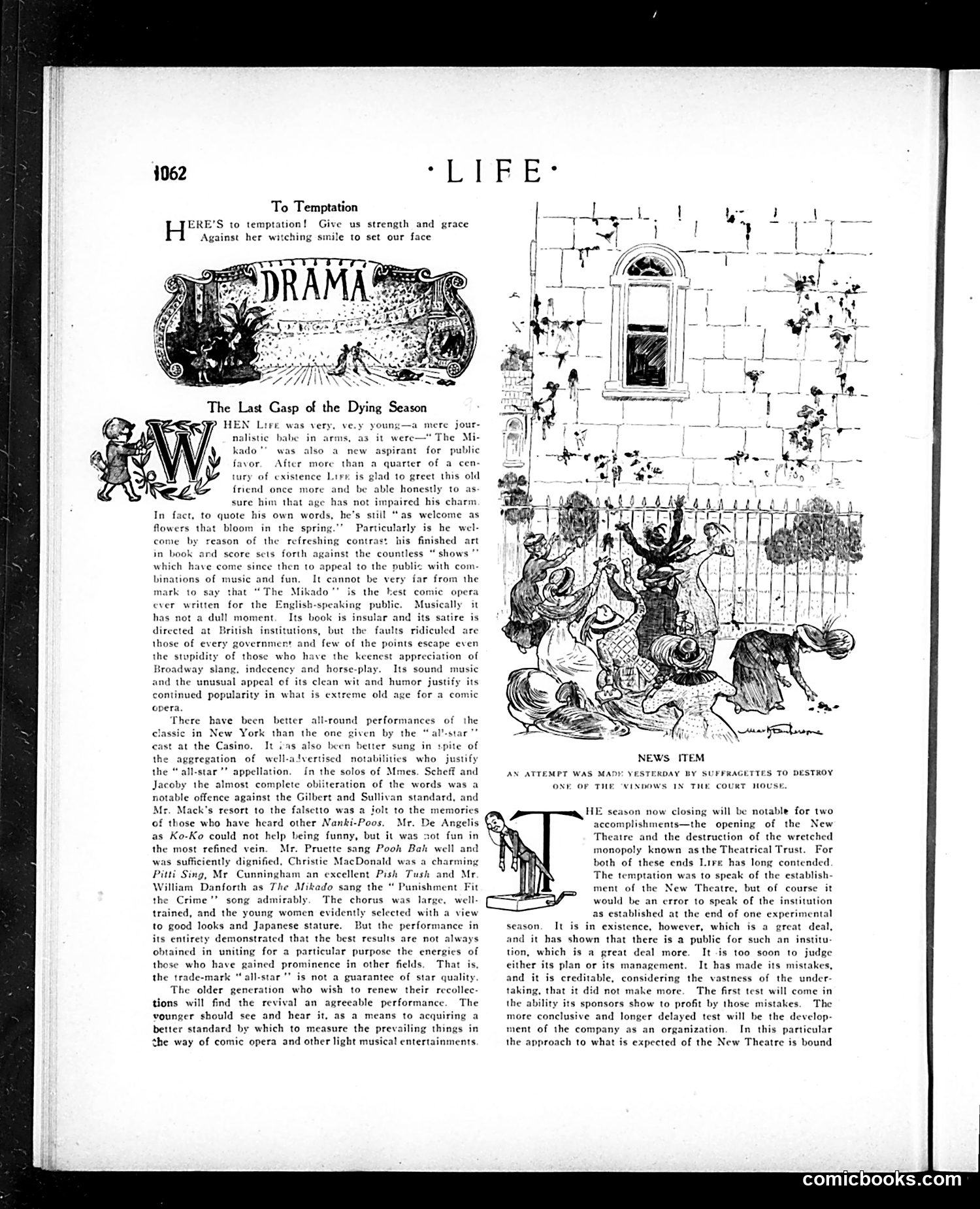
This page contains two distinct items: **"The Last Gasp of the Dying Season"** reviews a revival production of Gilbert and Sullivan's *The Mikado* at the Casino Theatre. The article praises the opera's enduring quality and satirical critique of British institutions, but critiques the contemporary "all-star" cast—despite marquee names like Mmes. Scheff and Jacoby, their performances underperformed compared to properly trained singers. The reviewer argues that assembling famous performers doesn't guarantee quality theatrical results. **"News Item"** reports that suffragettes attempted to destroy courthouse windows, then pivots to discuss two major theatrical developments: the opening of the New Theatre and the destruction of the "Theatrical Trust" (a monopoly controlling American theater production). Life magazine celebrates both accomplishments as breaking institutional monopolies. The page's opening verse "To Temptation" appears to be general editorial commentary about resisting vice.
📄 Transcribed text from this page (OCR, searchable)
Machine-transcribed from the original scan — historical spelling and the odd misread are preserved.
4062 To Temptation ERE’S to temptation! Give us strength and grace Against her witching smile to set our face The Last Gasp of the Dying Season HEN Lire was very, ve.y young—a mere jour- nalistic babe in arms, as it were— The Mi- ado'’ was also a new aspirant for public or. After more than a quarter of a cen f existence Lire is glad to greet this old friend once more and be able honestly to as sure him that age has not impaired his char t, to quote his own words, he's still “as welcome as flowers that bloom in the spring."’ Particularly is he wel- come by reason of the refreshing contrast his finished art * shows in book ard score sets forth against the countless ¢ since then to appeal to the public with com- It cannot be very iar from the which have binations of music and fun mark to hat“ Mikado" is the hest comic opera ever written for the English-speaking public. Musically it has not a dull moment. Its book is insular and its satire is directed at British institutions, but the faults ridiculed are those of every government and few of the points escape even the stupidity of those who have the keenest appreciation of Broadway slang, indecency and horse-play. Its sound music and the unusual appeal of its clean wit and humor justify its continued popularity in what is extreme old age for a comic opera. here have been better a classic in New York than the one given by the cast at the Casino. It :as also been better sung in spite of the aggregation of well-alvertised notabilities who justify the “all-star ’” appellation. in the solos of Mmes. Scheff and Jacoby the almost complete obiiteration of the words was a notable offence against the Gilbert and Sullivan standard, and Mr. Mack’s resort to the falsetto was a jolt to the memories of those who have heard other Nanki-Poos. Mr. De Angelis as Ko-Ko could not help being funny, but it was not fun in the most refined vein. Mr. Pruette sang Pooh Bah well and was sufficiently dignified, Christie MacDonald was a charming Pitti Sing, Mr Cunningham an excellent Pish Tush and Mr William Danforth as The Mikado sang the “ Punishment Fit the Crime’? song admirably. The chorus was large, well- trained, and the young women evidently selected with a view to good looks and Japanese stature. But the performance in its entirety demonstrated that the best results are not always obtained in uniting for a particular purpose the energies of those who have gained prominence in other fields, That i the trade-mark “all-star ' is not a guarantee of star quality The older generation who wish to renew their recollec- tions will find the revival an agreeable performance. The vounger should see and hear it, as a means to acquiring a better standard by which to measure the prevailing things in the way of comic opera and other light musical entertainments ound performances of the “allstar * “TE * NEWS ITEM AN ATTEMPT WAS MAD#: YESTERDAY BY SUFFRAGETTES TO DESTROY ONY OF THE (VINDOWS IN THLE COURT HoUSE. HE season now closing will be notable for two accomplishments—the opening of the New Theatre and the destruction of the wretched monopoly known as the Theatrical Trust. For both of these ends Lire has long contended The temptation was to speak of the establish- ment of the New Theatre, but of course it would be an error to speak of the institution as established at the end of one experimental season. It is in existence, however, which is a great deal, and it has shown that there is a public for such an institu tion, which is a great deal more. It -is too soon to judge cither its plan or its management. It has made its mistakes, and it is creditable, considering the vastness of the under- taking, that it did not make more. The first test will come in the ability its sponsors show to profit by those mistakes. The more conclusive and longer delayed test will be the develop- ment of the company as an organization. In this particular the approach to what is expected of the New Theatre is bound comicbooks.com