
A complete issue · 44 pages · 1910
Life — May 26, 1910
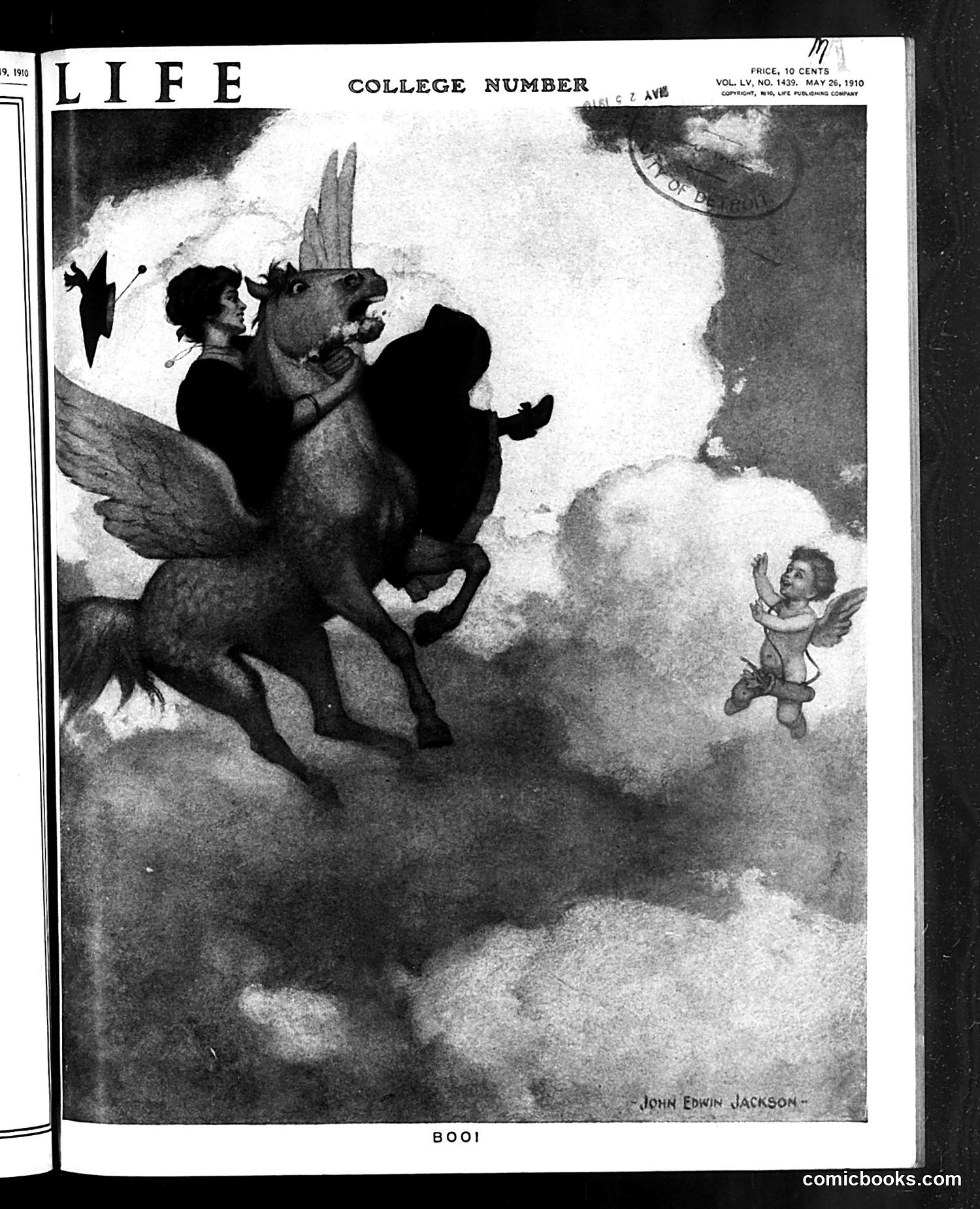
This illustration by John Edwin Jackson depicts a fantastical scene: a woman rides a winged, horned creature (appearing demonic or dragon-like) through clouds, while a small cupid or cherub flees in alarm on the right. The title "Boo!" suggests this is a humorous Halloween or supernatural-themed piece. The woman's confident, almost aggressive posture contrasts with the cherub's frightened retreat—inverting traditional gender dynamics of the era, where women were typically portrayed as delicate or fearful. The artwork likely satirizes changing attitudes toward women around 1910, perhaps mocking contemporary anxieties about women's increasing independence and assertiveness during the Progressive Era. The grotesque mount emphasizes the "scandalous" or "unnatural" quality such behavior represented to conservative viewers.
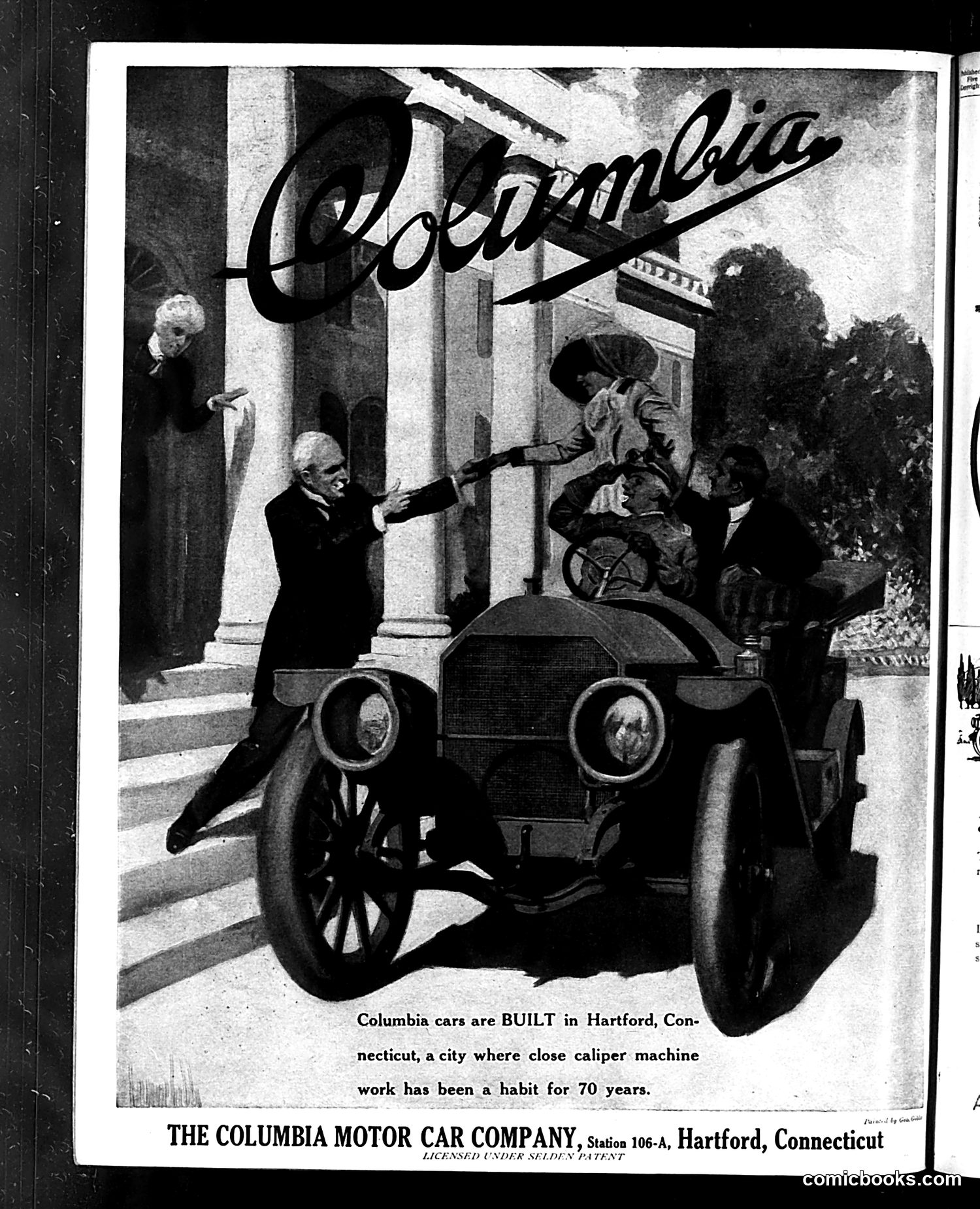
This is primarily a **product advertisement**, not satire or political commentary. It promotes Columbia motor cars manufactured in Hartford, Connecticut. The image depicts an early automobile (appears to be from the 1900s era based on the design) positioned in front of classical architecture with well-dressed figures. The advertisement emphasizes Hartford's manufacturing heritage, claiming "close caliper machine work has been a habit for 70 years." The handwritten signature "Columbia" at the top appears to be an authentic autograph, likely from a celebrity endorser of the era, adding prestige to the product. This was common advertising practice in early 20th-century publications. The page contains **no political satire or social commentary**—it's straightforward commercial promotion leveraging Hartford's reputation for precision manufacturing.
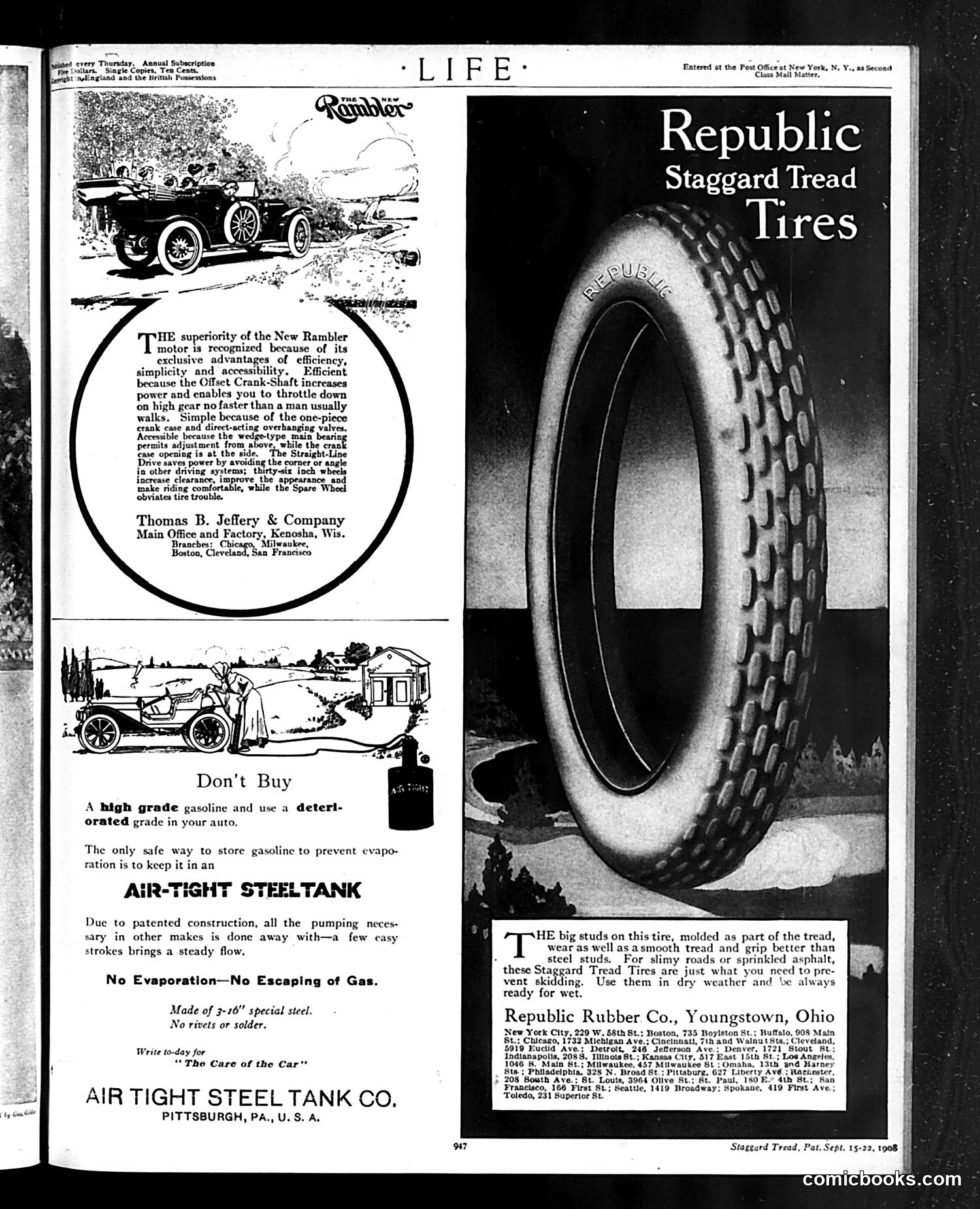
This page is primarily **advertising**, not satire or political commentary. The left side features ads for the **Rambler automobile** (Thomas B. Jeffery & Company, Kenosha, Wisconsin) highlighting its mechanical advantages, and an **Air-Tight Steel Tank** for safe gasoline storage. The right side is a full-page advertisement for **Republic Staggard Tread Tires** from Republic Rubber Co., Youngstown, Ohio, featuring a large photograph of a tire with prominent treads. The text emphasizes the tire's studded design for traction on slippery roads and wet conditions. This represents early automotive-era advertising (patent date shown as 1908), targeting early motorists concerned with vehicle reliability and maintenance—practical concerns for owners of these relatively new machines.
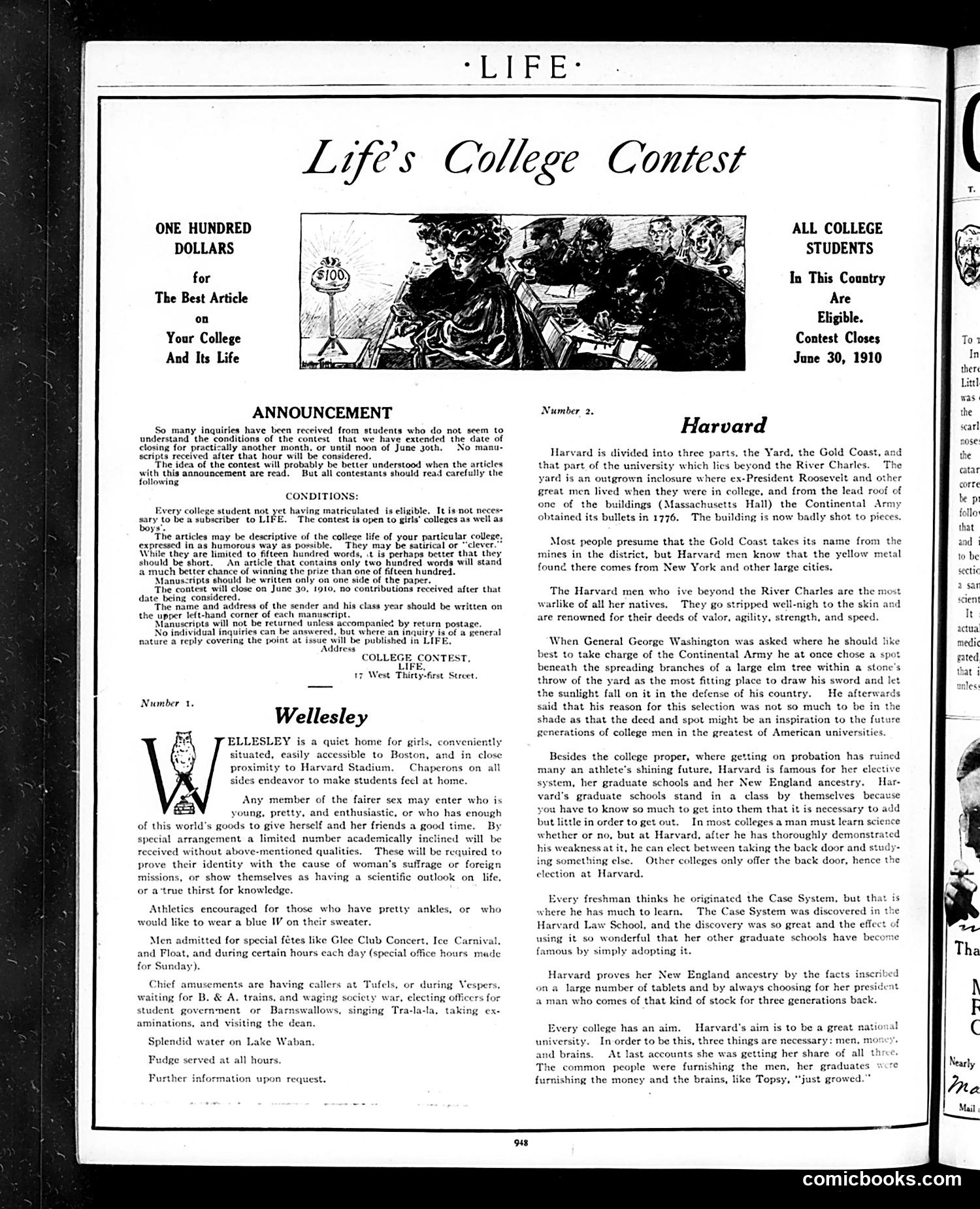
This page announces Life magazine's writing contest offering $100 for the best article about college life. The cartoon at top appears to show college students in a social scene, likely depicting typical campus activities the magazine wants contestants to describe. The detailed text profiles two universities: **Wellesley** (a women's college) and **Harvard**. The Wellesley section humorously describes it as "a quiet home for girls" while detailing social activities, athletics, and traditions. The Harvard section discusses the university's three sections and emphasizes its prestige and historical significance in American higher education. The satirical tone gently pokes fun at college life and institutional pretensions while inviting student submissions about their college experiences.
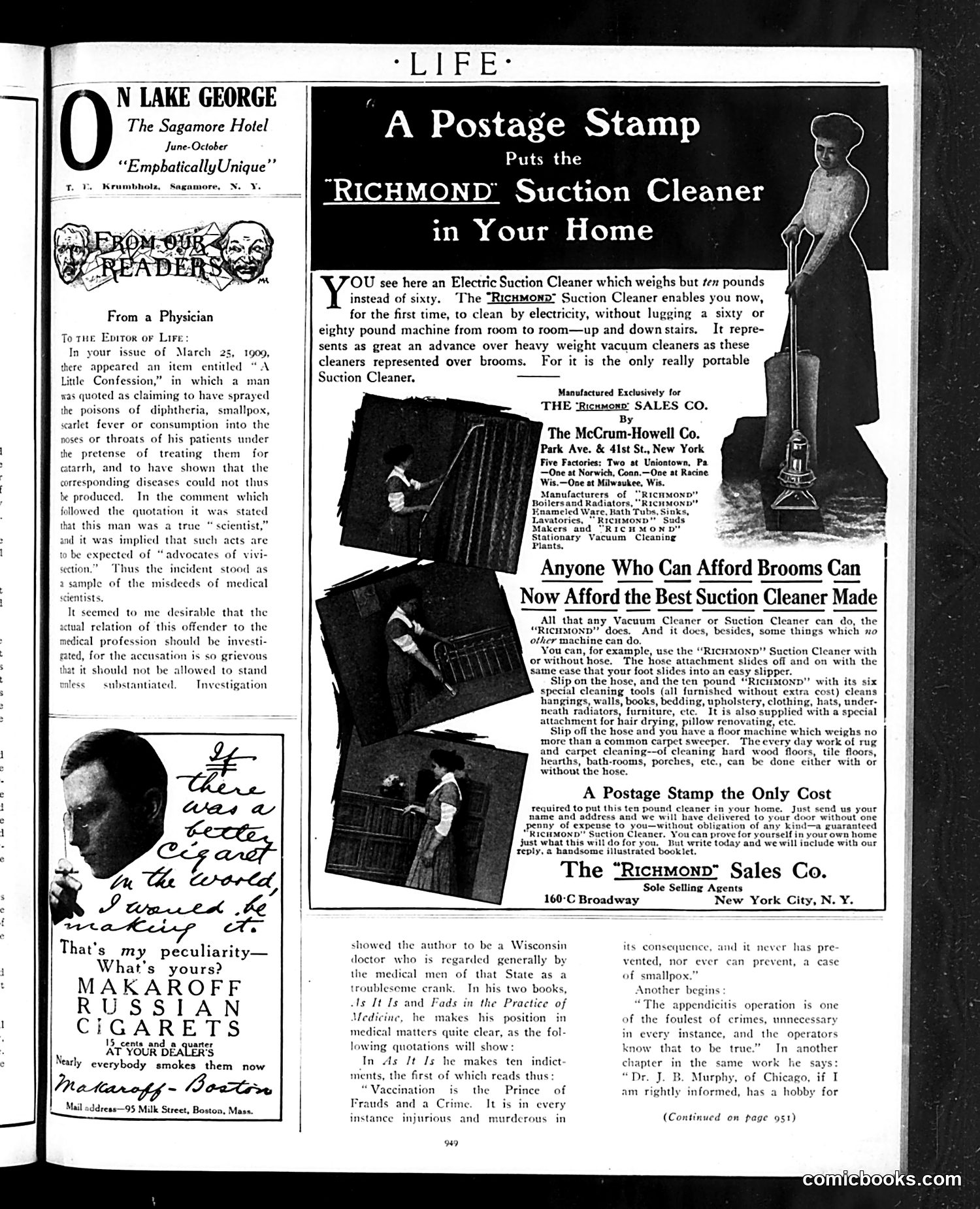
This page is primarily **advertising**, not satire or political commentary. The dominant content is a full-page advertisement for the "Richmond" Suction Cleaner—an early electric vacuum cleaner weighing only 10 pounds, marketed as revolutionary compared to heavy machines of the era. The left column contains an unrelated letter from a physician critiquing medical quackery, and a cigarette advertisement for Makaroff Russian Cigarettes featuring a stylized figure. There is **no political cartoon** on this page. The vacuum cleaner images show people using the device in domestic settings—typical product demonstration photography from the early 20th century. The humor is purely commercial, emphasizing that even someone who could afford brooms could now afford this "best suction cleaner made."
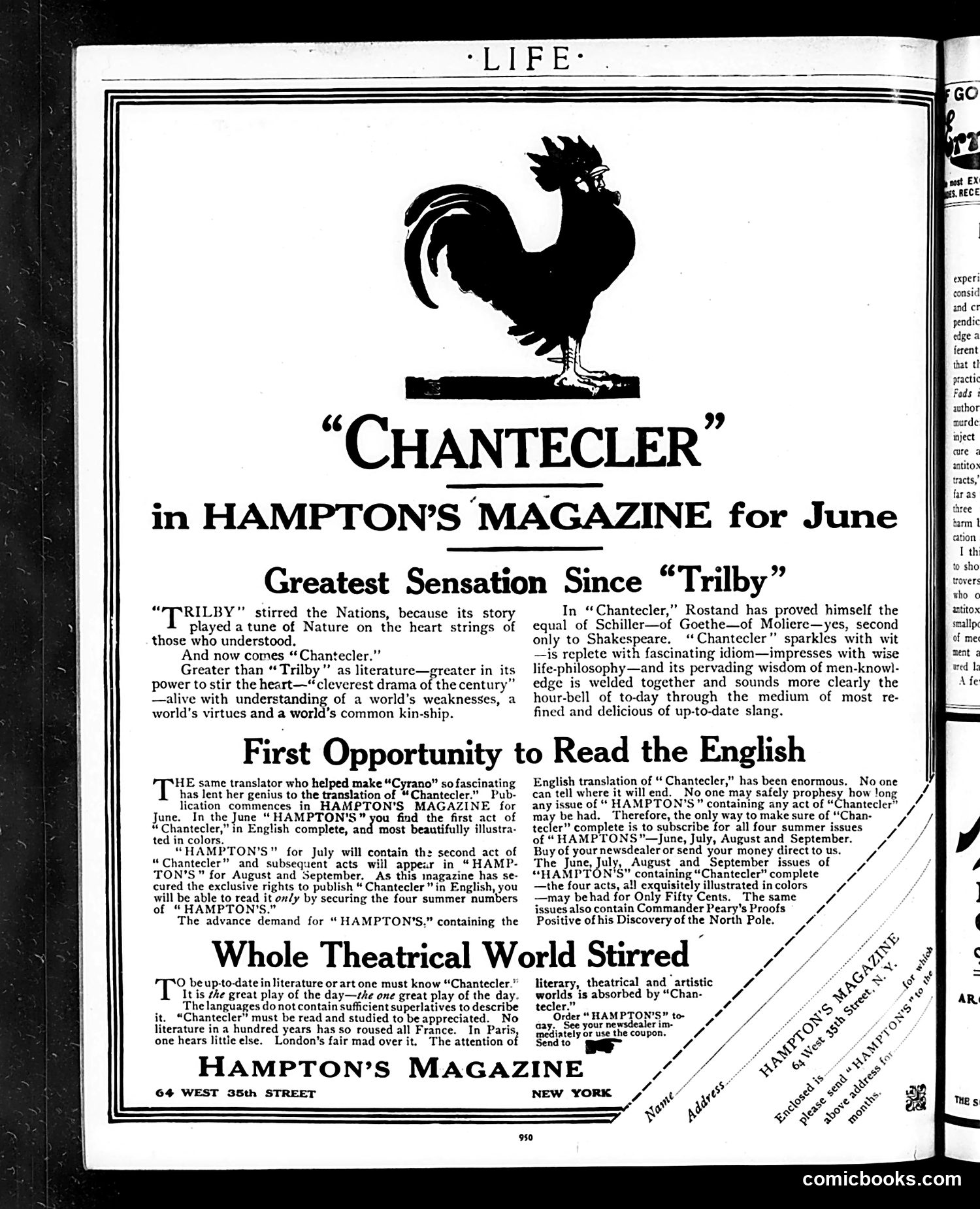
This is a **paid advertisement**, not editorial content or satire. Hampton's Magazine is promoting the June 1911 issue, which will serialize Edmond Rostand's play *Chantecler* in English for the first time. The rooster image is the play's central symbol—Rostand's work uses a talking rooster as its protagonist. The ad claims this French literary work rivals Shakespeare and represents "the greatest sensation since 'Trilby'" (a popular earlier serialization). The text emphasizes exclusivity: Hampton's will publish all four acts serially across summer months, and subscription is the only way to guarantee access. This advertising strategy exploited early 20th-century magazine competition and readers' desire for prestigious European literature. The rooster mascot became iconic marketing for the publication.
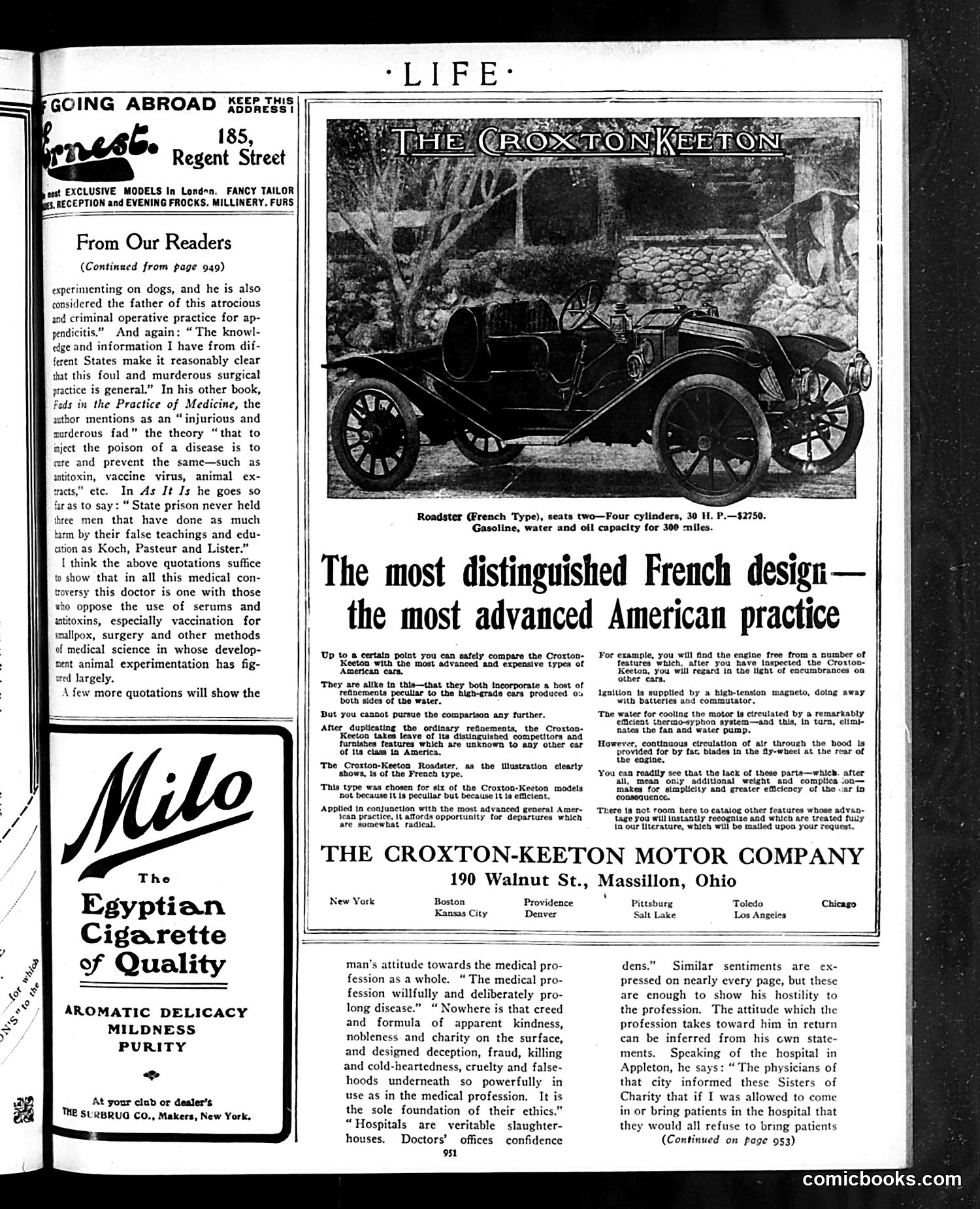
This page is primarily **advertising and editorial content**, not satire or political cartooning. The main advertisement features the **Croxton-Keeton Motor Company's French-designed roadster**, highlighting how it incorporates both French automotive design and American manufacturing practices. The car advertisement emphasizes technical specifications and engineering quality. The left side contains a **"From Our Readers" column** discussing medical ethics and criticizing doctors' practices—particularly regarding vivisection (animal experimentation) and vaccination. The letter writer criticizes the medical profession's attitudes and ethics, referencing figures like Pasteur and Koch. Below is an advertisement for **Milo Egyptian Cigarettes**. The page contains no political cartoons or satirical commentary—it's a typical magazine layout mixing reader correspondence with commercial advertisements.
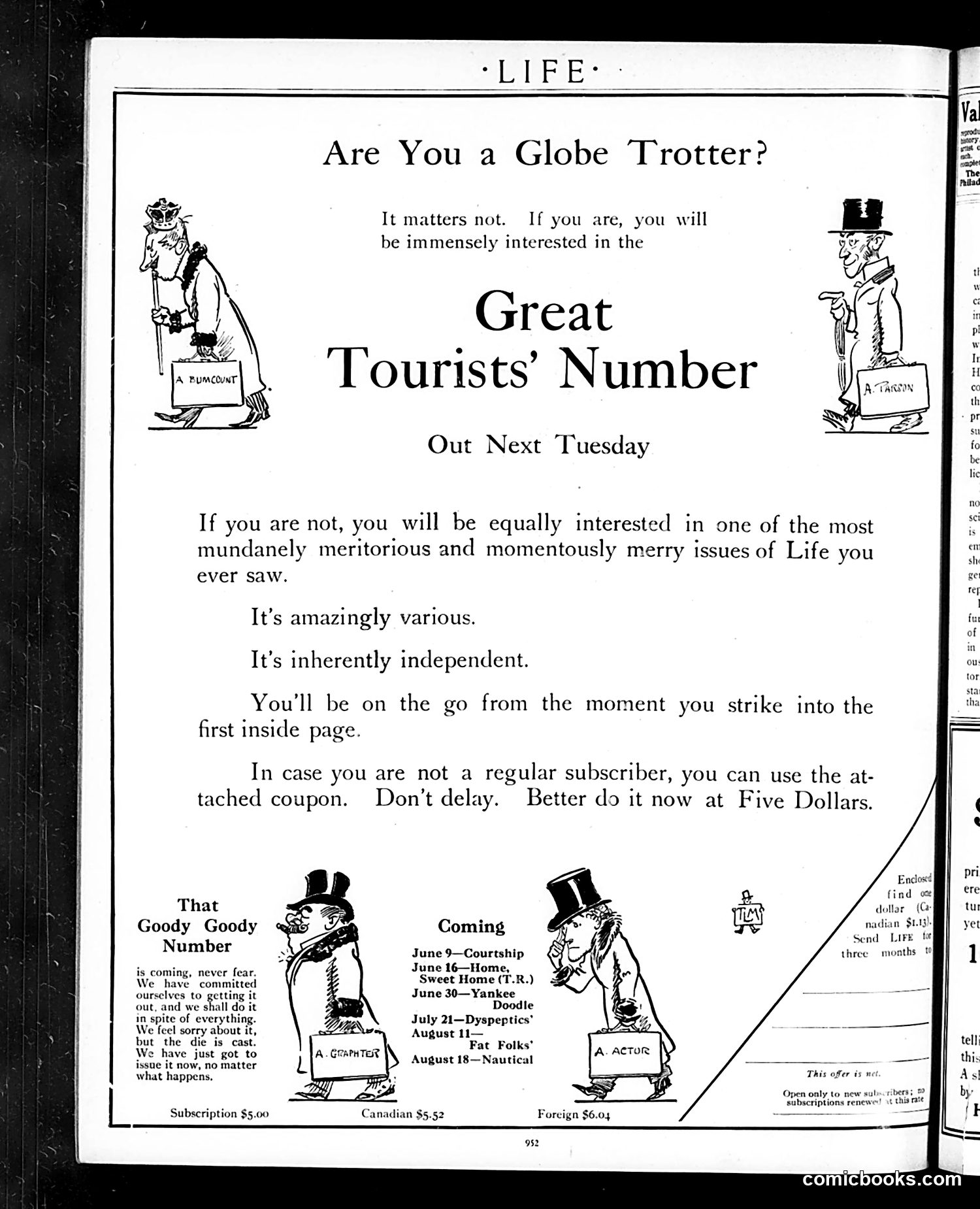
This is primarily a **subscription advertisement** for Life magazine's "Great Tourists' Number," promoting the upcoming Tuesday issue. The cartoon figures appear to be **stereotypical tourists** (labeled "A Rumskoat" and "A Tariff"), depicted as wealthy travelers in formal attire with top hats—visual shorthand for affluent globetrotters of the early 20th century. The satire targets **globe-trotting leisure travelers**, suggesting the issue will appeal to both actual tourists and stay-at-home readers. The ad emphasizes the magazine's content as "mundanely meritorious and momentously merry"—poking fun at Life's own satirical pretensions while promoting its variety and independence. The subscription cost of $5.00 (domestic) places this at a time when such leisure travel was an activity of the wealthy classes. The ad is essentially marketing aspirational lifestyle content.
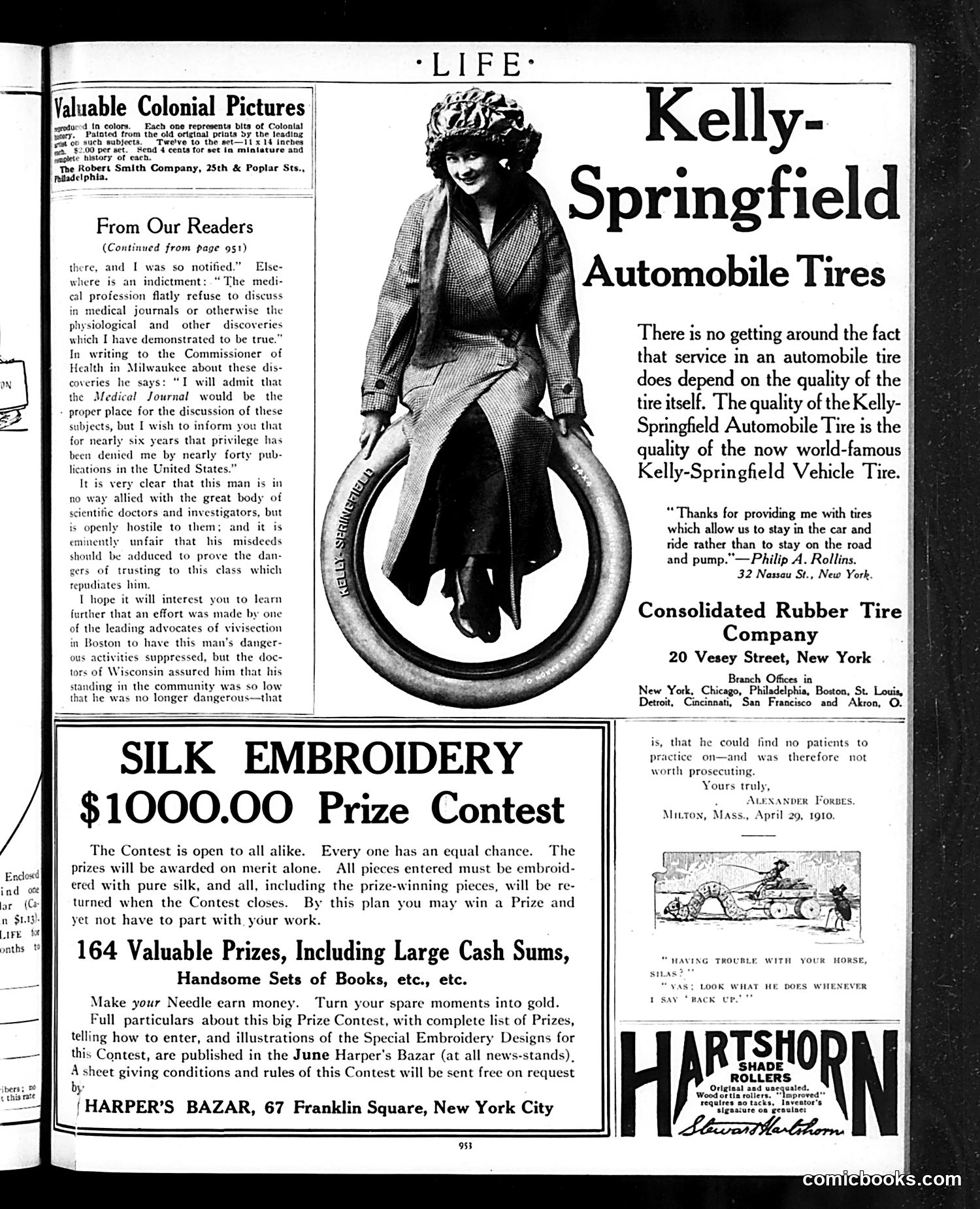
This page is primarily **advertising content** from an early 20th-century *Life* magazine, not political satire or comics requiring historical interpretation. The main advertisements are: 1. **Kelly-Springfield Automobile Tires** - featuring a woman posing with a tire, using a testimonial quote to promote product quality 2. **Silk Embroidery Prize Contest** - Harper's Bazaar offering $1,000 and 164 prizes for embroidery submissions 3. **Hartshorn Shade Rollers** - a window shade product advertisement There is a "From Our Readers" section containing a letter defending a medical professional against accusations of unethical behavior, but this is reader correspondence rather than editorial content. The small cartoon at bottom appears to show someone with a horse, accompanying humorous text about horse trouble. Overall, this is a standard magazine page mixing reader letters with commercial advertisements.
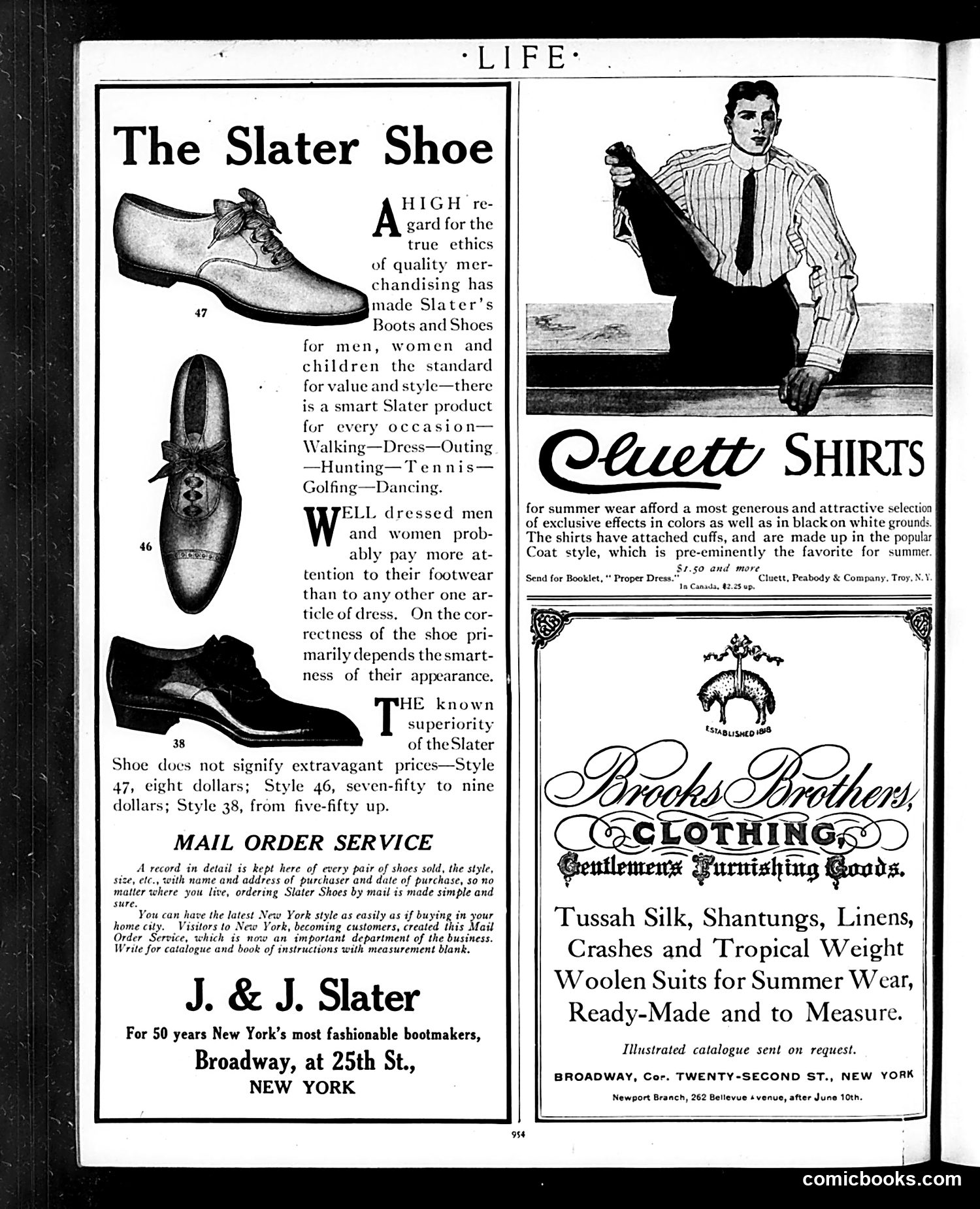
This page is primarily **advertising** rather than editorial content or satire. It contains three commercial advertisements: 1. **The Slater Shoe** (left): Promotes footwear for men, women, and children, emphasizing quality and style. Prices range from $5.50 to nine dollars. J. & J. Slater operated as "New York's most fashionable bootmakers" on Broadway at 25th Street. 2. **Cluett Shirts** (top right): Advertises summer shirts with exclusive color effects and attached cuffs in a "Coat style." 3. **Brooks Brothers Clothing** (bottom right): Announces gentlemen's furnishings including tropical-weight woolens and silk fabrics for summer wear, available ready-made or custom. The page contains no political cartoons or satirical commentary—it's a fashion and lifestyle advertising section typical of early-20th-century *Life* magazine.
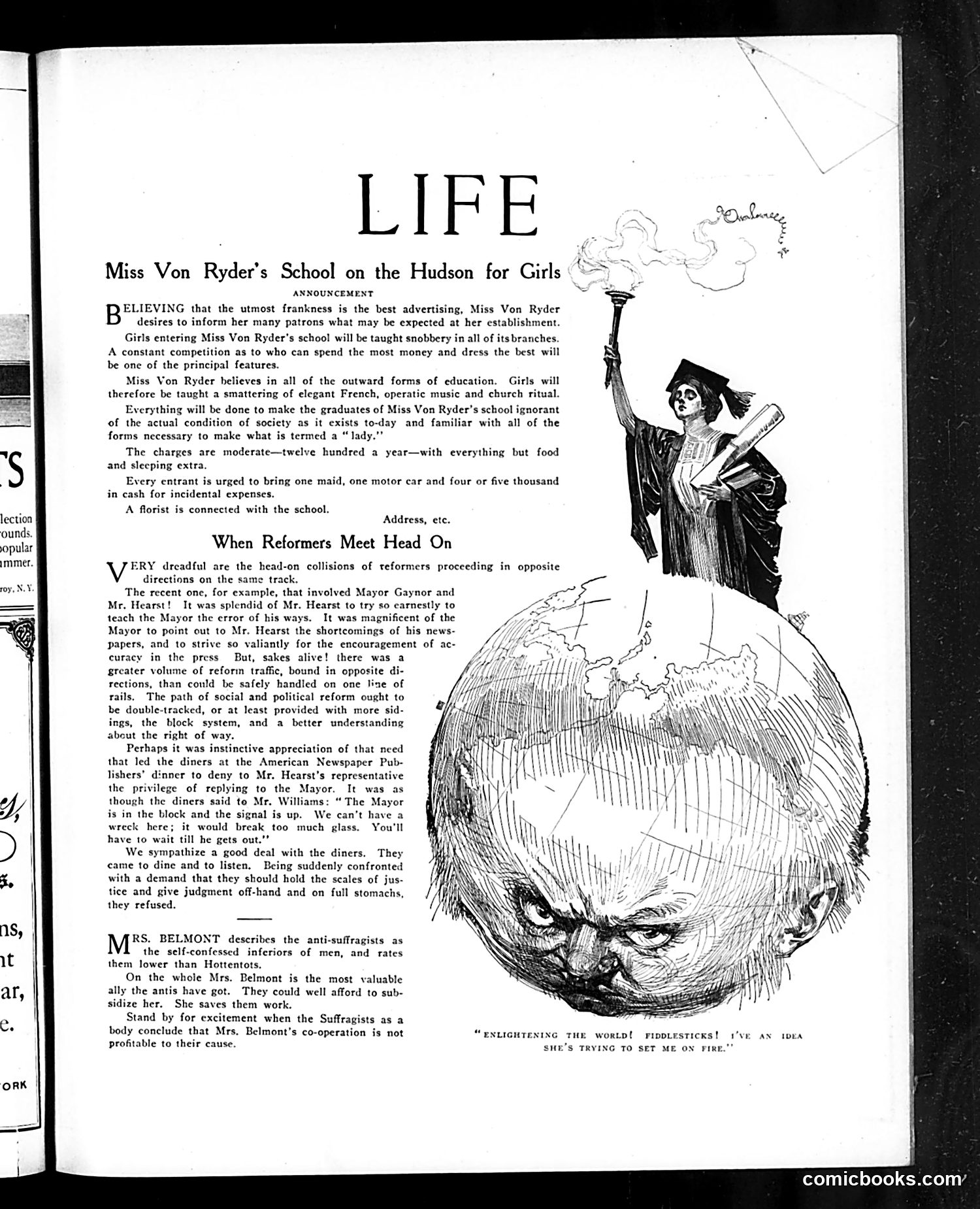
This page contains two distinct pieces: **Top**: An advertisement for Miss Von Ryder's School on the Hudson for Girls, announcing an educational institution emphasizing "elegant French, operatic music and church ritual" alongside awareness of current social conditions. The satirical tone suggests mockery of pretentious finishing schools. **Bottom**: A political cartoon titled "When Reformers Meet Head On," depicting a confrontation between Mayor Gaynor and Mr. Hearst (the newspaper publisher) regarding municipal reform efforts. The text describes their clash over newspaper coverage and competing visions for urban improvement. The large caricatured face with "fiddlesticks" caption represents frustration with reform theater—suggesting the reformers' public disputes undermine their actual effectiveness. The overall page satirizes both elite education and municipal politics through contrast.
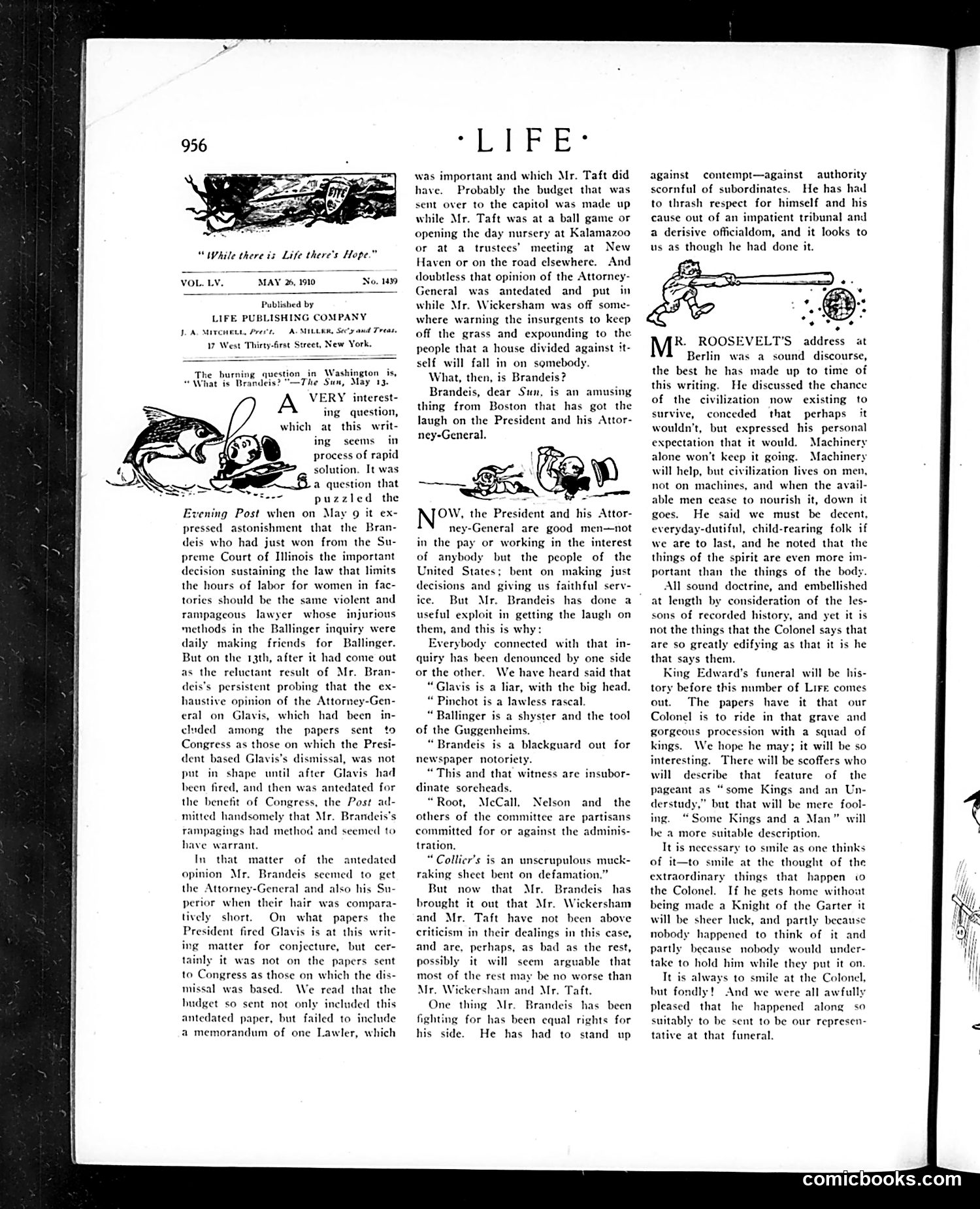
This *Life* magazine page discusses tensions within President William Howard Taft's administration. The text criticizes Attorney General Wickersham and Mr. Taft for their handling of an inquiry, with harsh language: "Glavis is a liar, with the big head," "Pinchot is a lawless rascal," and "Ballinger is a shyster." These appear to reference the Ballinger-Pinchot controversy—a major conservation scandal. The article defends Brandeis (likely Louis Brandeis, the lawyer) and suggests the administration's internal disputes damage its credibility. The satirical cartoons visible mock administrative figures through exaggerated caricatures, typical of *Life* magazine's political satire. The overall piece criticizes the Taft administration's handling of conservation issues and personnel conflicts.
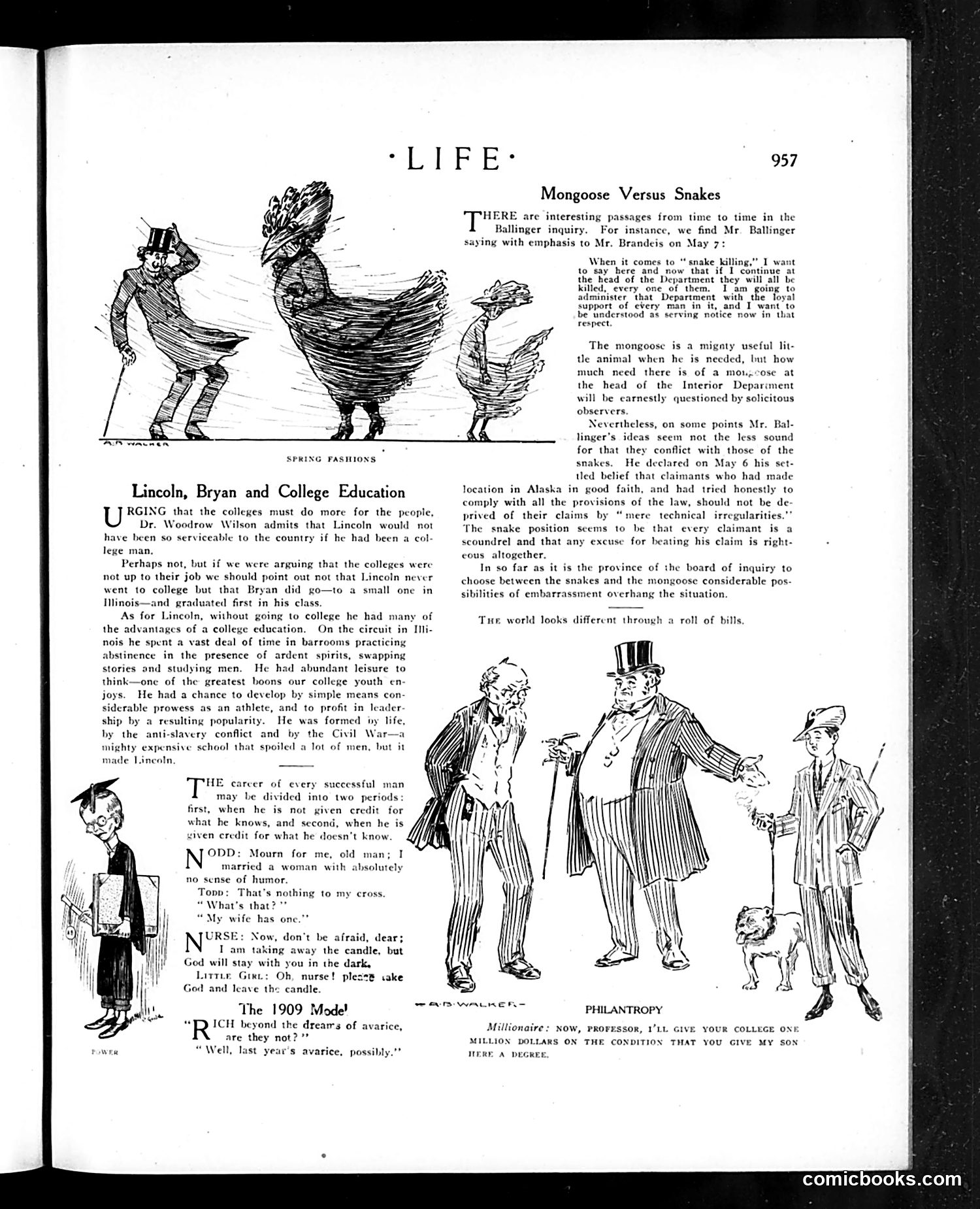
**Top Section - "Mongoose Versus Snakes":** This section satirizes a Ballinger inquiry (likely the 1909-1910 Ballinger-Pinchot conservation controversy). The text mocks debates about whether a mongoose should be hired by the Interior Department to kill snakes, using this absurd animal metaphor to critique bureaucratic infighting and excuse-making among government officials. **"Lincoln, Bryan and College Education":** Argues colleges failed to prepare Lincoln adequately, contrasting him with William Jennings Bryan. The text suggests Lincoln's real education came from practical experience rather than formal schooling. **"The 1909 Model" and "Philanthropy" cartoons:** Social satire about wealth and class—depicting wealthy individuals and discussions of charitable giving as social posturing rather than genuine benevolence.
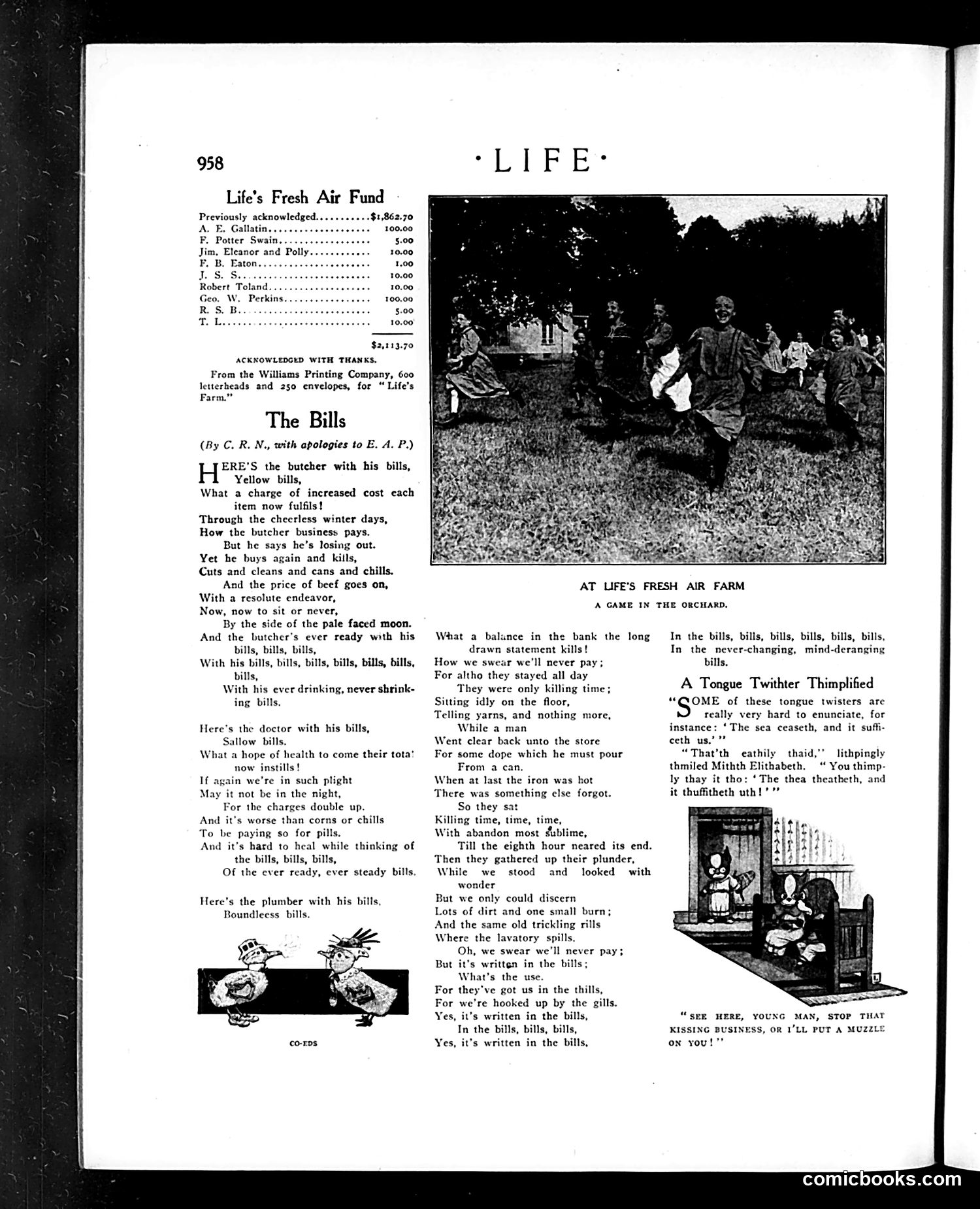
This poem satirizes skyrocketing prices following World War I, when inflation severely strained American household budgets. The recurring refrain "bills, bills, bills" emphasizes relentless financial burden. The piece targets three professions notorious for rising costs: butchers (meat prices climbed during wartime rationing), doctors, and plumbers. Each verse depicts these tradesmen as either profiteering or incompetent—the plumber "kills time" on the job while customers pay inflated rates for minimal work. The satire's point: working families felt trapped in a cycle of perpetual debt, unable to escape mounting bills despite their protests that "we'll never pay." The phrase "they've got us in the thills / hooked up by the gills" uses fishing metaphors to suggest entrapment. This reflects genuine postwar anxiety about inflation and wage stagnation that characterized the early 1920s American economy.
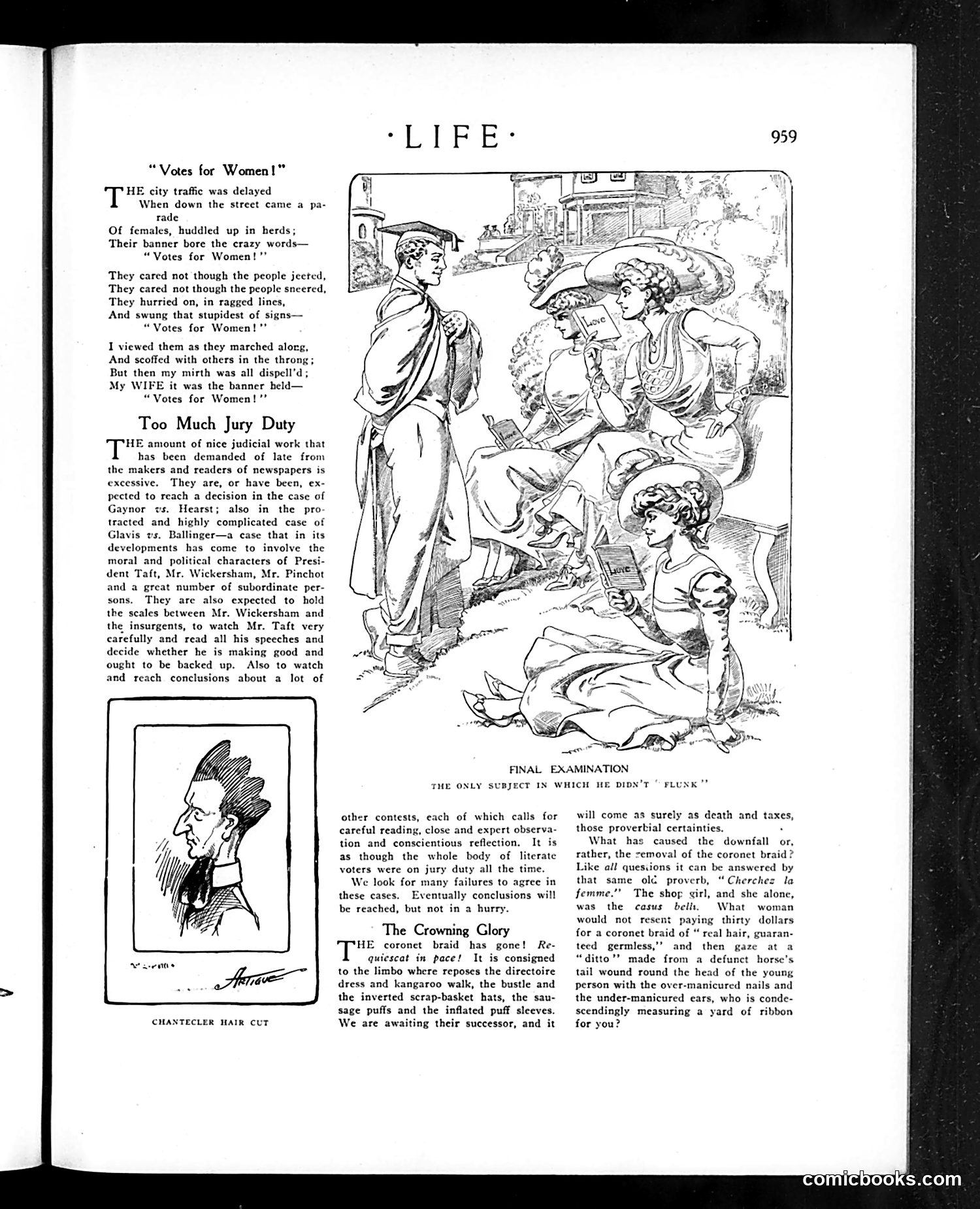
This page contains three satirical pieces reflecting early 20th-century American social debates: **"Votes for Women!"** mocks the women's suffrage movement through a husband's perspective. Initially scoffing at female marchers demanding voting rights, he's mortified to discover his own wife carries their banner—suggesting domestic embarrassment undermines his public ridicule. **"Too Much Jury Duty"** critiques how newspapers burden readers with complex judicial and political cases (likely referencing the Gaynor vs. Hearst case and Glavis vs. Ballinger controversy involving President Taft and conservationist Pinchot). The satire suggests citizens are exhausted by demands to form informed opinions on intricate matters. **"The Crowning Glory"** discusses obsolete women's fashion—the coronet braid hairstyle—blaming working-class "shop girls" for its demise by wearing cheaper imitation versions made from horse hair instead of authentic expensive braids. All three pieces use humor to address contemporary gender, political, and class anxieties.
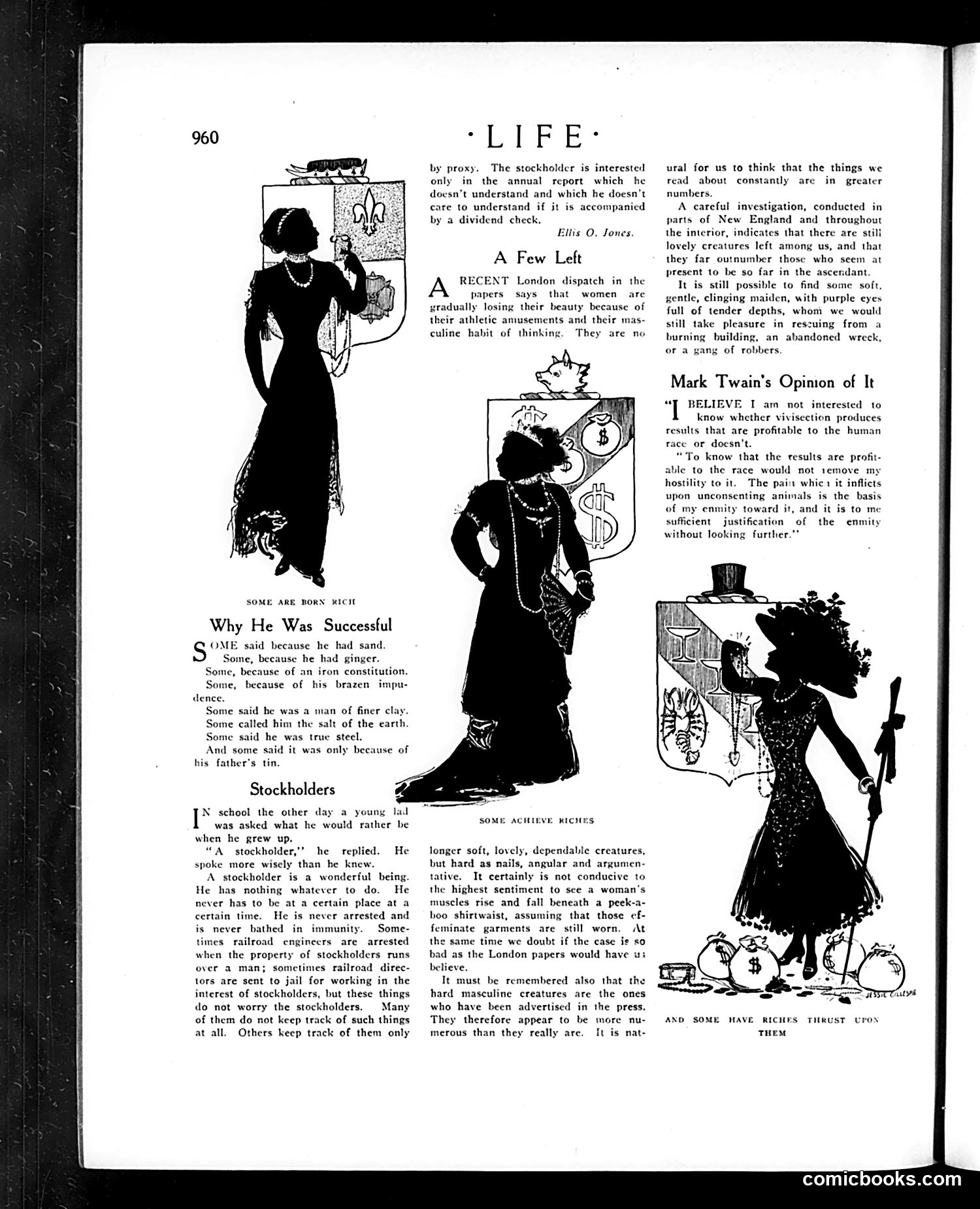
This page from Life magazine contains three satirical pieces criticizing wealth, idleness, and social hypocrisy in early 20th-century America. **"Why He Was Successful"** mocks the myth of self-made men, listing contradictory reasons for success before revealing the real answer: inherited wealth ("father's tin"). **"Stockholders"** ridicules wealthy investors as parasitic do-nothings who profit without labor or accountability. The satire notes they avoid consequences that befall workers and managers, caring only about dividend checks they don't understand. **"A Few Left"** responds to a London newspaper claiming women are losing beauty through athleticism and thinking. Life's author sarcastically agrees women are "harder" now, but argues this is exaggerated—soft, gentle women still exist and actually outnumber the publicized "modern" types. The piece ironically celebrates traditional femininity while acknowledging social change. The Mark Twain quote on animal testing provides moral commentary unrelated to the above sections, opposing vivisection on ethical grounds regardless of scientific benefit.
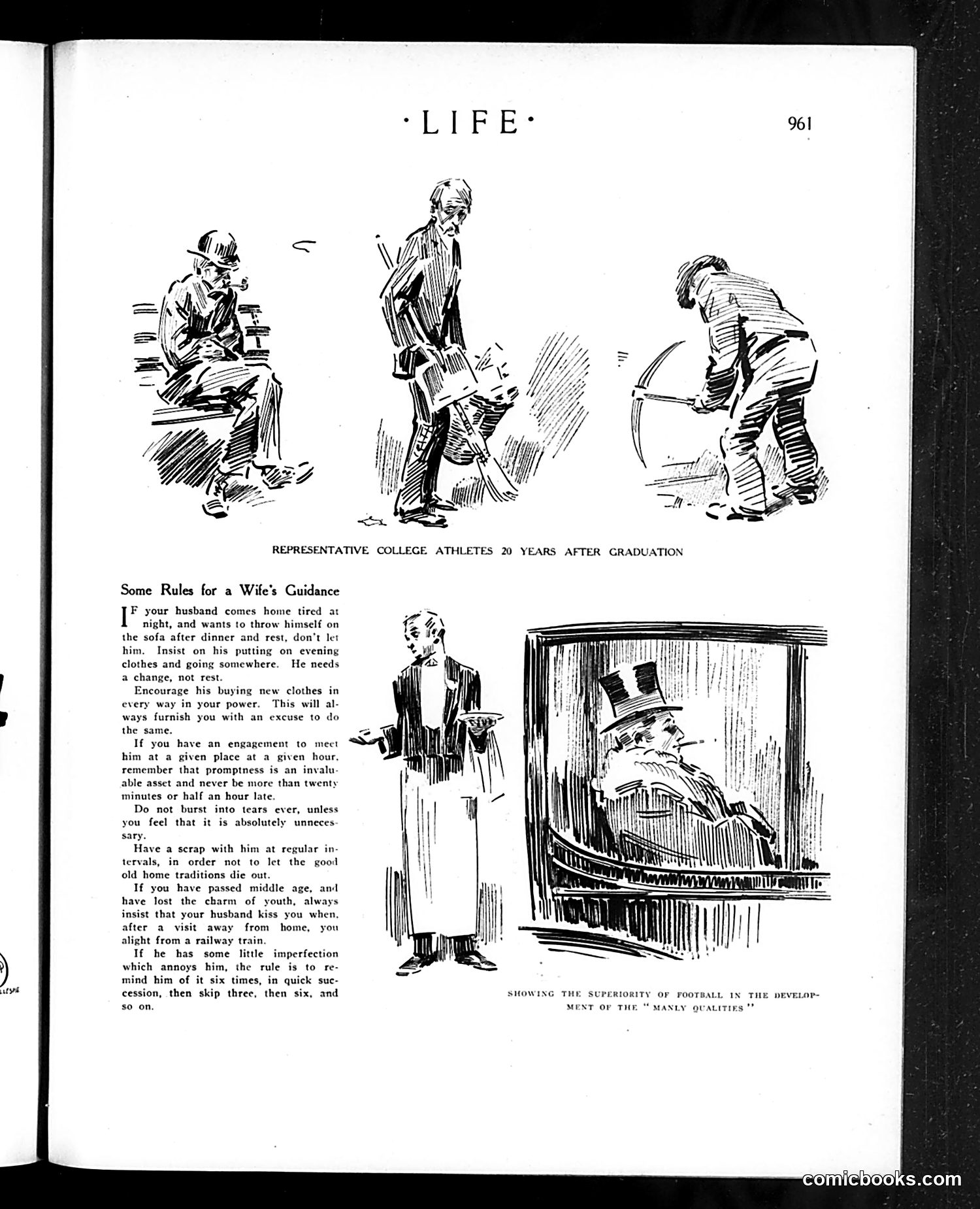
This page contains two distinct satirical pieces: **Top Section:** Three sketches titled "Representative College Athletes 20 Years After Graduation" mock the decline of former athletes. The illustrations show men who were once athletic now depicted as sedentary or physically deteriorated—one slouching on a bench, one bent over digging, one hunched with a tool. The joke satirizes the false promise that college athletics builds lasting vigor; these "representative" graduates appear physically diminished by middle age. **Bottom Section:** "Some Rules for a Wife's Guidance" is tongue-in-cheek marital advice that actually mocks wives' behavior through exaggeration. The rules—encouraging excessive spending, chronic lateness, needless quarreling, and repeatedly nagging about minor faults—present a satirical portrait of an annoying spouse. The accompanying cartoon showing a woman admiring a man in a mirror labeled "Football" sarcastically suggests football supposedly develops "manly qualities," ironically undermining the premise by showing vanity. Together, these pieces satirize both the false claims of athletics and gender relations of the era.
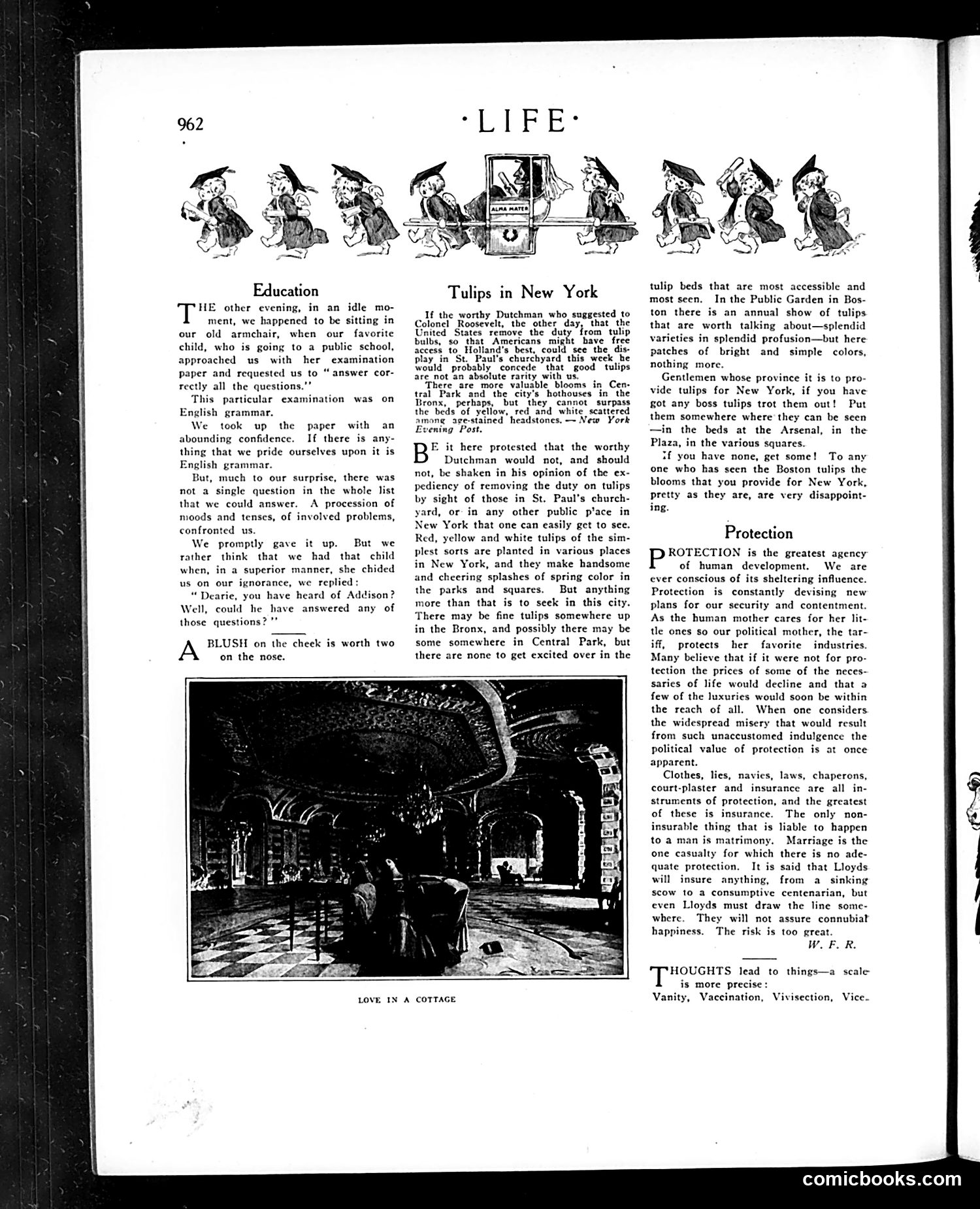
This page contains three distinct satirical pieces: **"Education"**: The author humorously describes being unable to answer his child's modern English grammar examination questions. The joke mocks both educational standards and parental inadequacy—the author deflects by invoking Addison (an 18th-century literary figure), implying classical education is superior to contemporary schooling. It's generational satire about how new teaching methods confuse adults trained the old way. **"Tulips in New York"**: This piece criticizes New York's public flower displays as inferior to Boston's, despite the city's wealth and resources. It's civic boosterism and social commentary—a mild complaint that even wealthy cities neglect beautiful public amenities. **"Protection"**: A sardonic defense of protectionist tariffs (likely from Theodore Roosevelt's era). The satire is subtle but clear: by equating tariffs with mothers, lies, navies, and insurance as "protective," the author mocks protectionists' paternalistic logic while implying tariffs artificially inflate prices and prevent ordinary people from accessing goods. The "Love in a Cottage" illustration caption appears disconnected from the text above it.
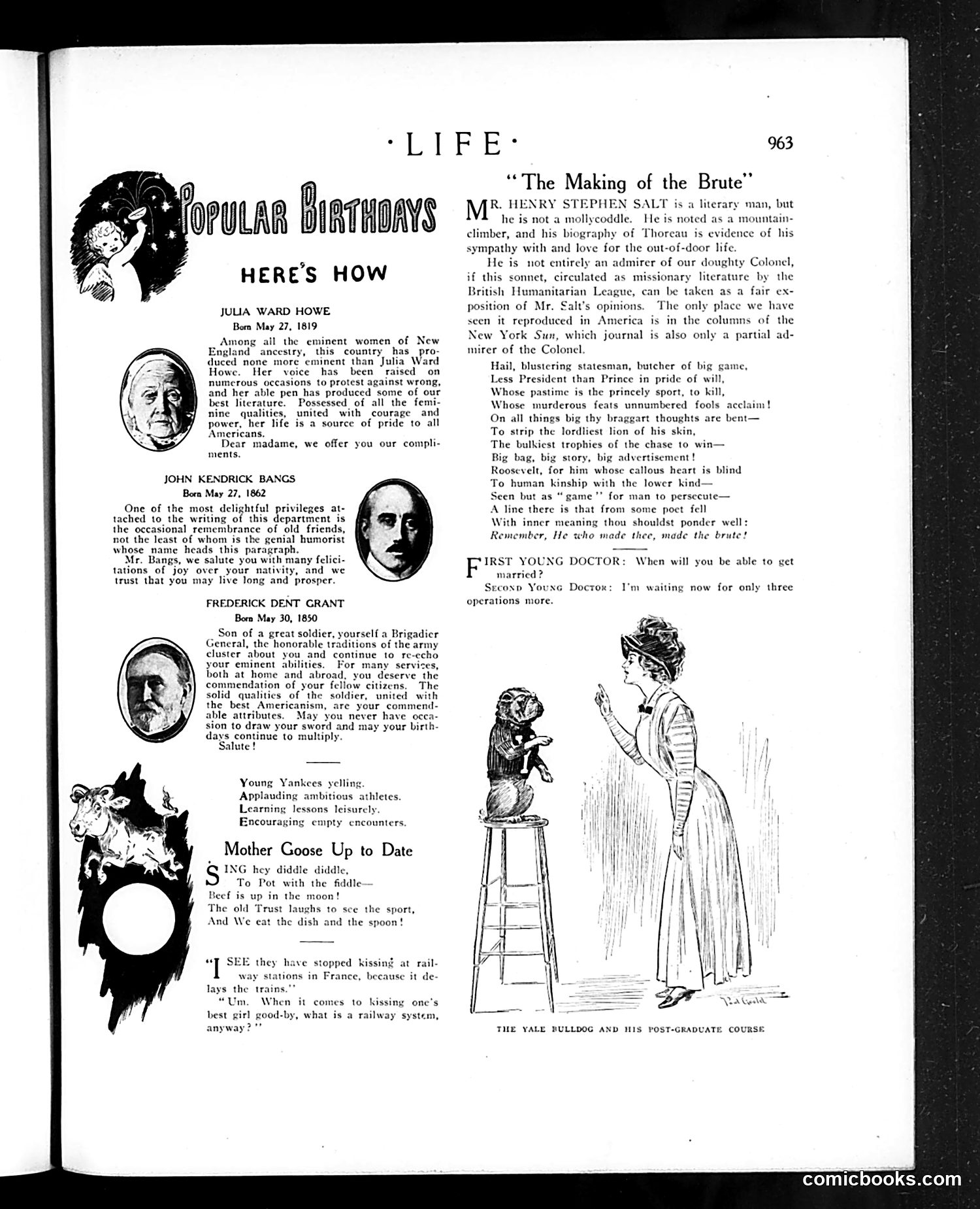
This page celebrates notable American birthdays while featuring a critical poem about Theodore Roosevelt. The main satire attacks Roosevelt's hunting and aggressive foreign policy. **Key Content:** The poem by Henry Stephen Salt (a British humanitarian) uses Roosevelt as its subject, mocking his reputation for big-game hunting and military bravado. It criticizes him as a "blustering statesman" who kills for sport and trophy-gathering rather than necessity, equating his treatment of animals with moral blindness to "human kinship with the lower kind." **Context:** This reflects early 1900s criticism of Roosevelt's famous hunting expeditions and his "big stick" diplomacy. The poem's final line—"Remember, He who made thee, made the brute!"—argues that animals deserve moral consideration, not merely exploitation. **Additional Content:** The page includes birthday tributes to Julia Ward Howe and others, plus humorous verse sections ("Mother Goose Up to Date") and a joke about young doctors waiting for surgical experience. The satire assumes readers know Roosevelt's public hunting persona and understand the humanitarian critique of both animal exploitation and imperial aggression.
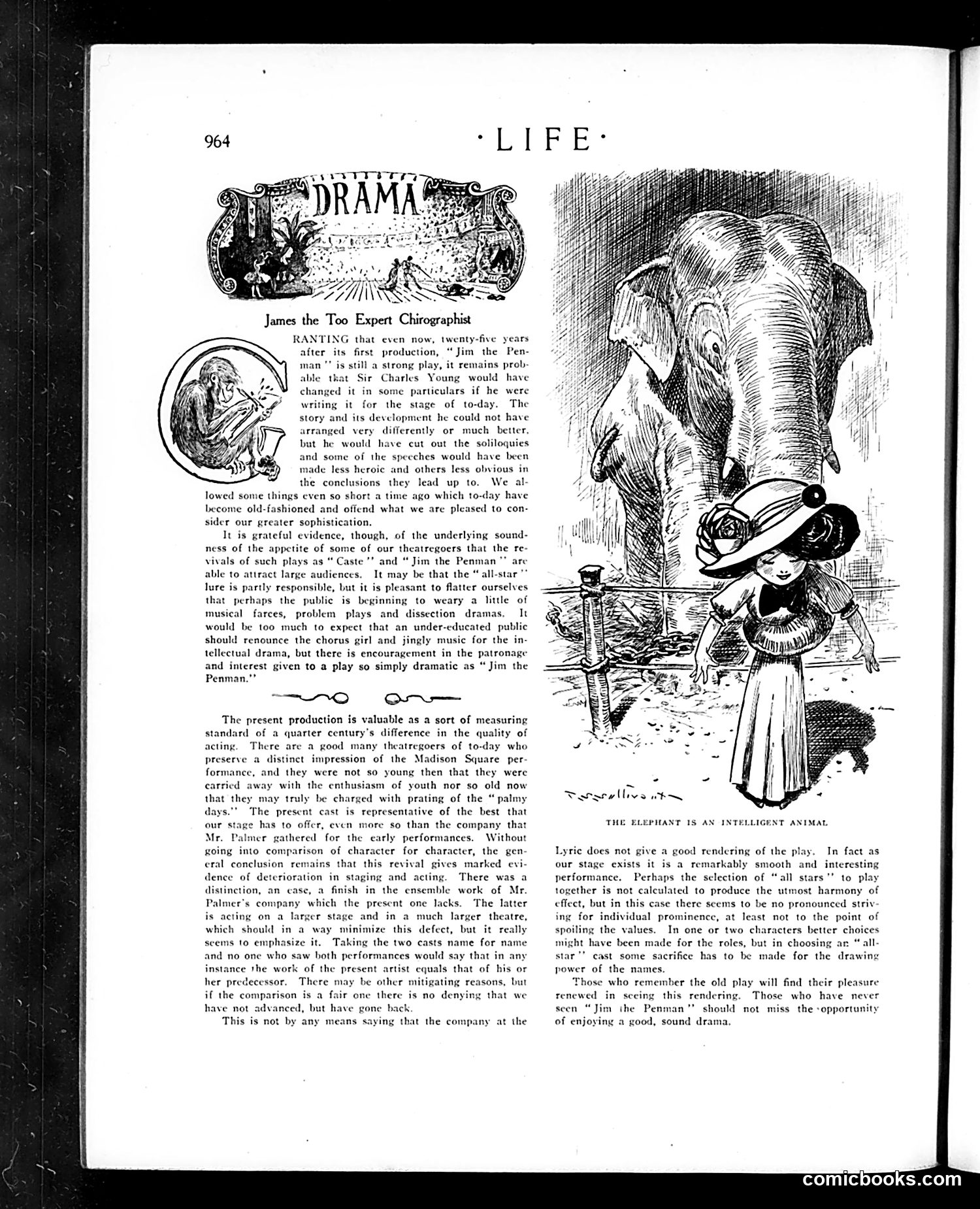
This page reviews a revival of the play *"Jim the Penman,"* originally produced 25 years earlier. The review discusses how the play, though still effective, shows its age—soliloquies and speeches that once seemed powerful now appear overwrought by modern standards. The small illustration (left) shows a man writing or drawing, labeled a "chirographist" (handwriting expert)—likely referencing the play's plot. The larger illustration depicts an elephant with a human figure, captioned "The Elephant Is an Intelligent Animal," which appears unrelated to the drama review and likely belongs to a separate article or humorous commentary. The review's main point: while the current "all-star" cast performs well, it demonstrates a *decline* in theatrical quality compared to the original production. Modern acting lacks the "distinction, ease, and finish" of earlier ensembles, despite access to better resources and larger theaters.
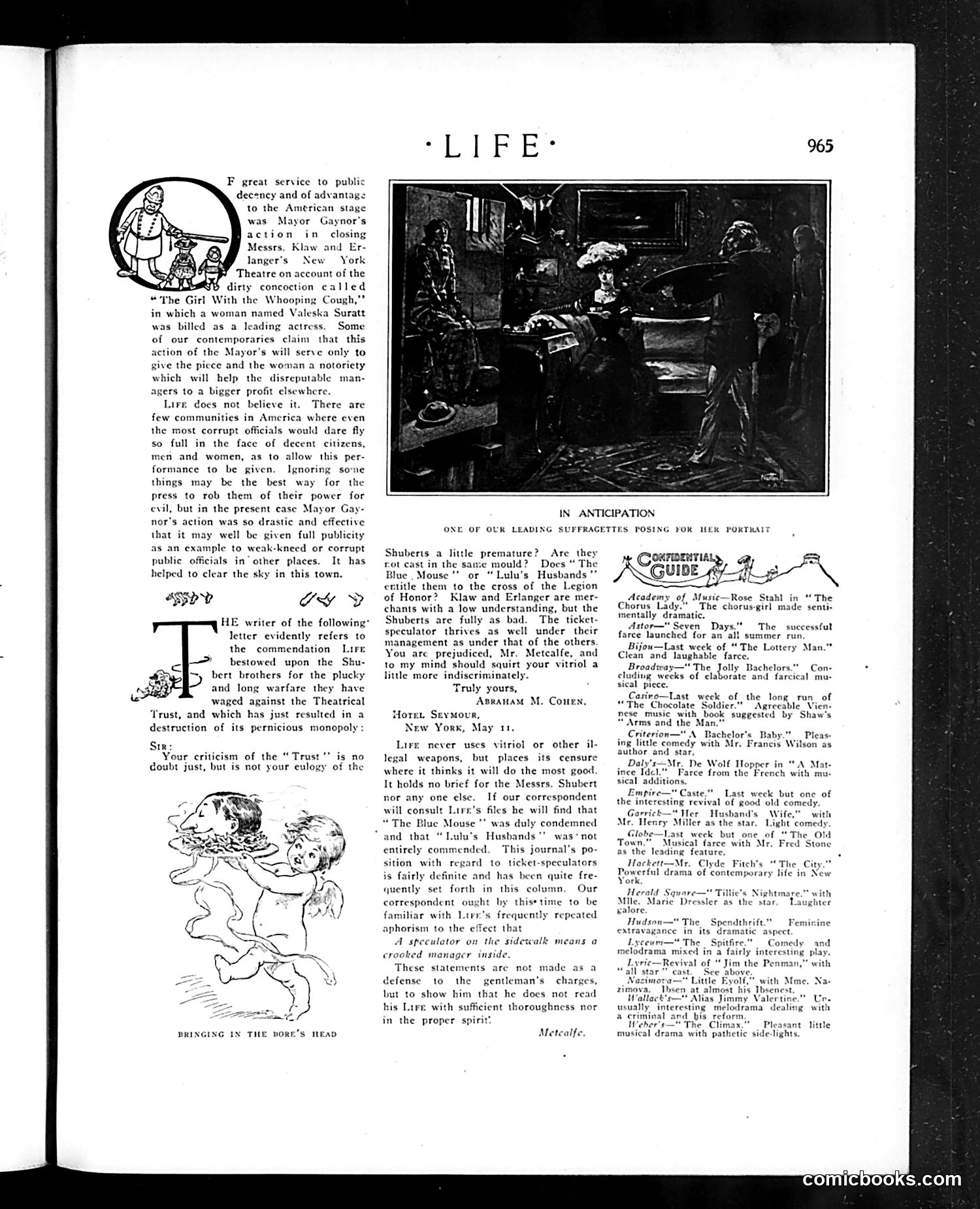
This page contains two distinct pieces addressing New York theater controversies circa 1911: **Main Editorial ("In Anticipation"):** Mayor Gaynor closed the New York Theatre's production of "The Girl With the Whooping Cough," starring Valeska Suratt, deeming it indecent. *Life* magazine supports this censorship action as protective of public morality, arguing strong official action against "dirty" theatrical productions serves the public good—despite critics claiming it only gives the show notoriety. **Reader's Letter & Response:** A correspondent criticizes *Life*'s recent praise of the Shubert brothers as theater reformers, arguing they're equally corrupt as their rivals Klaw and Erlanger. The Shuberts allegedly profit from ticket speculation just as much. *Life* defends its position, claiming it consistently opposes ticket speculation under any manager. **Bottom cartoon ("Bringing in the Bore's Head"):** An illustration accompanies discussion of theatrical monopolies and corruption—likely satirizing bloated theater management. The suffragette reference is unclear from visible content.
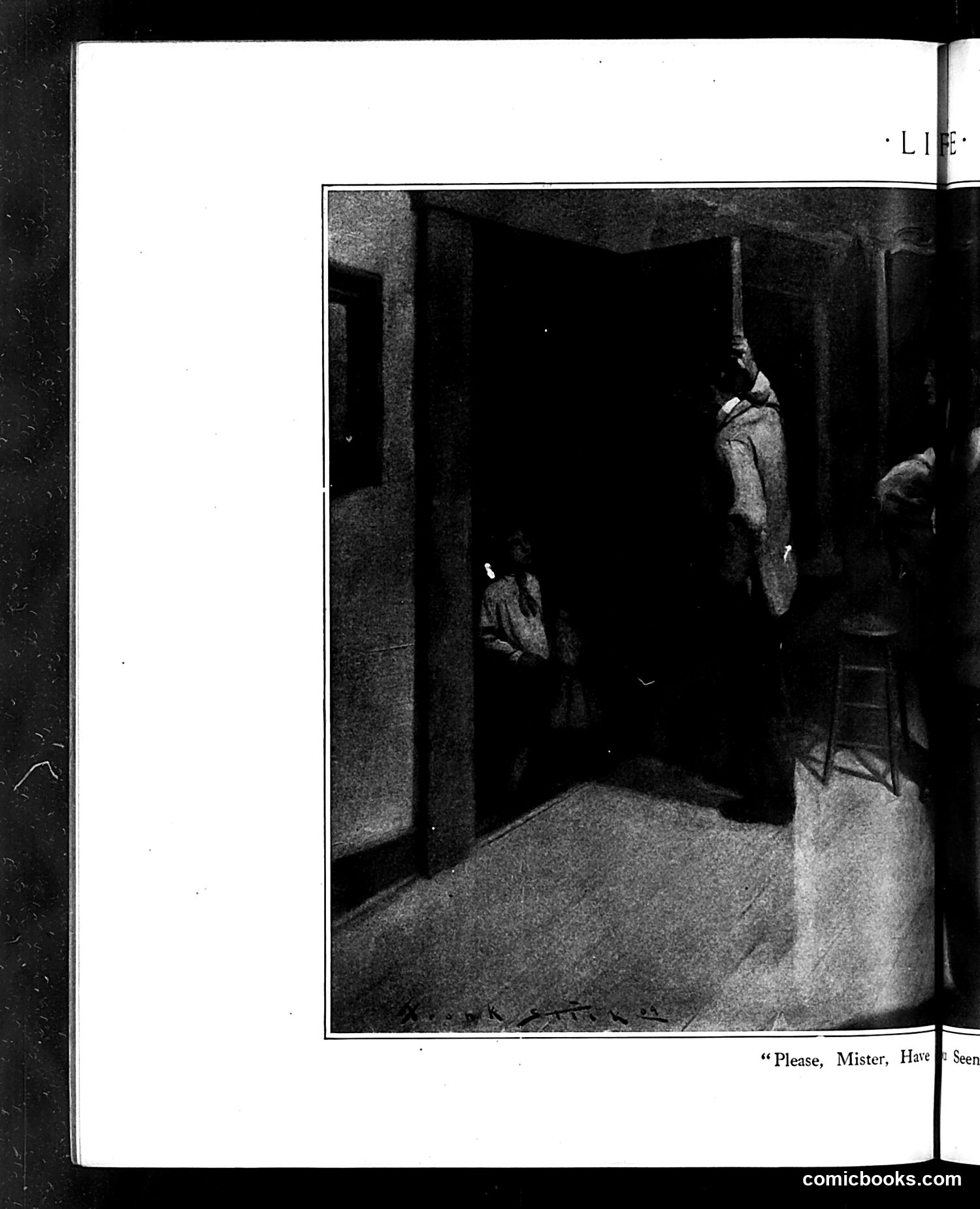
This page appears to be from a dramatized story or comic narrative rather than a political cartoon. The black-and-white photograph shows an interior scene with figures in what appears to be a darkened room or hallway, with one person visible on the left and another figure hanging or suspended in the center-right area. The incomplete caption at the bottom—"Please, Mister, Have Seen"—suggests this is part of a serialized story, likely depicting a dramatic or suspenseful moment. Without additional context pages or complete text, the specific narrative, historical reference, or satirical intent remains unclear. The image's composition and lighting suggest this is meant to convey tension or urgency, but the exact subject and commentary cannot be definitively determined from this page alone.
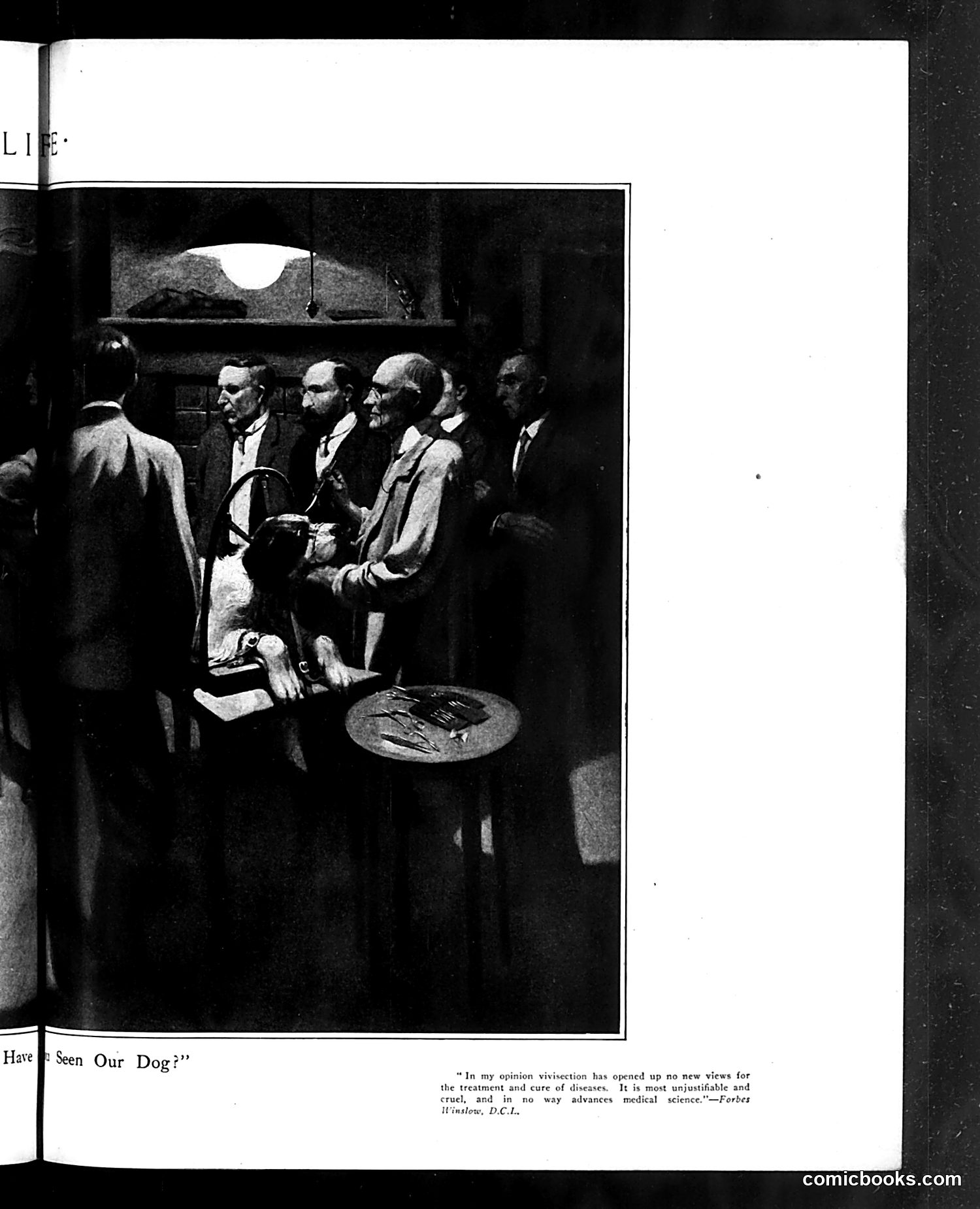
This page satirizes **vivisection** (animal experimentation), a heated ethical debate in early 20th-century America. The image shows well-dressed men examining what appears to be a dog, with the caption "Have [You] Seen Our Dog?" The accompanying quote, attributed to Forbes Winslow, D.C.L., sarcastically critiques vivisection as "unjustifiable and cruel" while claiming it doesn't advance medical science. The cartoon's dark humor juxtaposes the men's formal attire and professional demeanor against the implied fate of the missing dog—suggesting that animals were being seized for laboratory use without owners' knowledge or consent. This reflects actual animal-welfare activism of the era, when vivisection opponents feared their pets could be stolen for medical research.
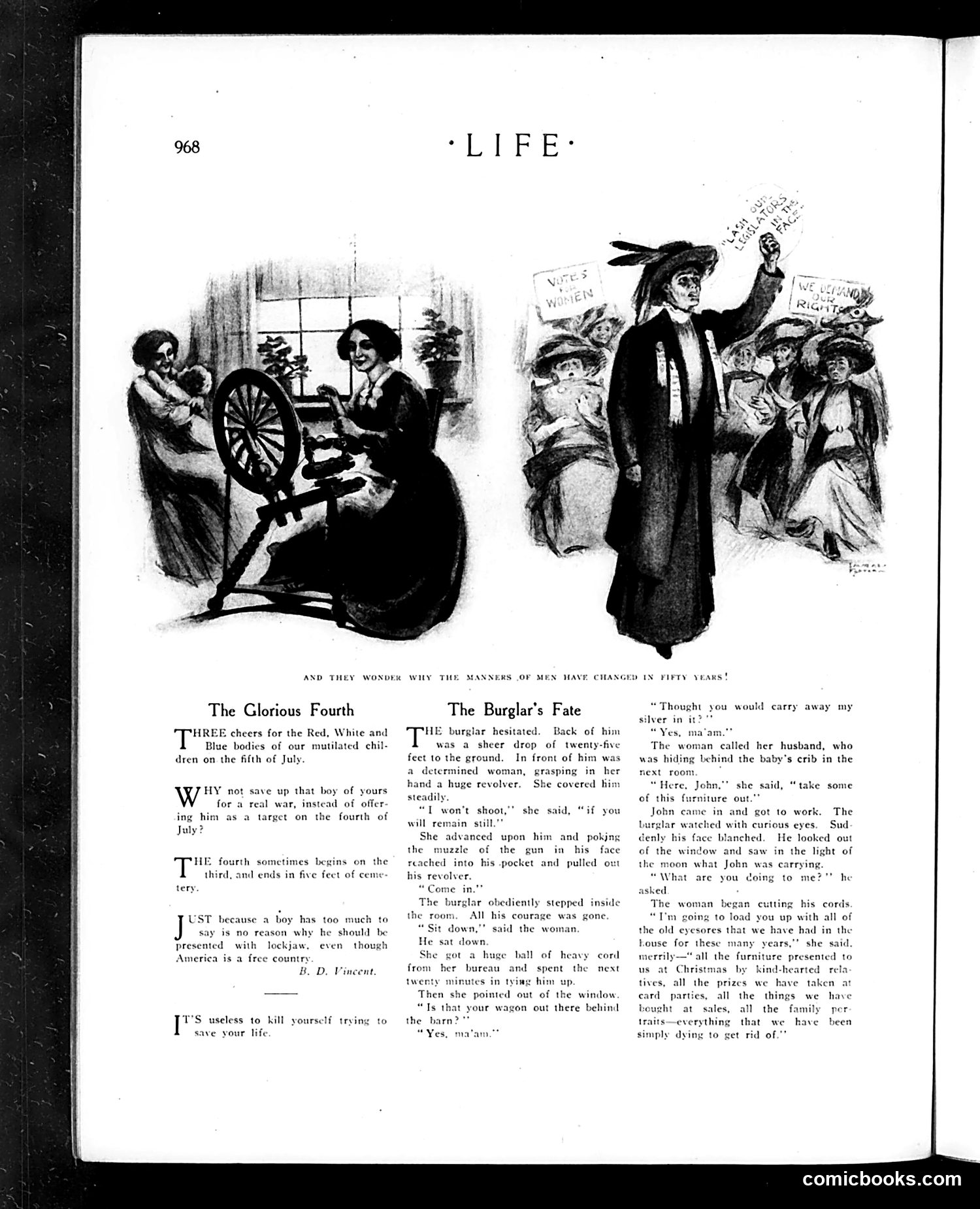
**"The Glorious Fourth"** (left): A brief satirical piece mocking July 4th celebrations. It criticizes parents for casually risking their children's lives with fireworks ("offering him as a target on the fourth of July") rather than saving them for actual warfare. The dark joke suggests American Independence Day traditions are needlessly dangerous. **"The Burglar's Fate"** (right): A humorous story subverting burglar-narrative expectations. A woman catches an intruder but, rather than shooting him, forces him to help her dispose of unwanted household items—furniture and gifts from relatives she's wanted to discard for years. The satire targets domestic life's accumulated clutter and obligatory gift-giving: the burglar becomes an unwilling tool for solving the couple's storage problem, making robbery seem less threatening than marital accumulation. Both pieces use dark humor typical of early 20th-century *Life* magazine's satirical approach to American social conventions.
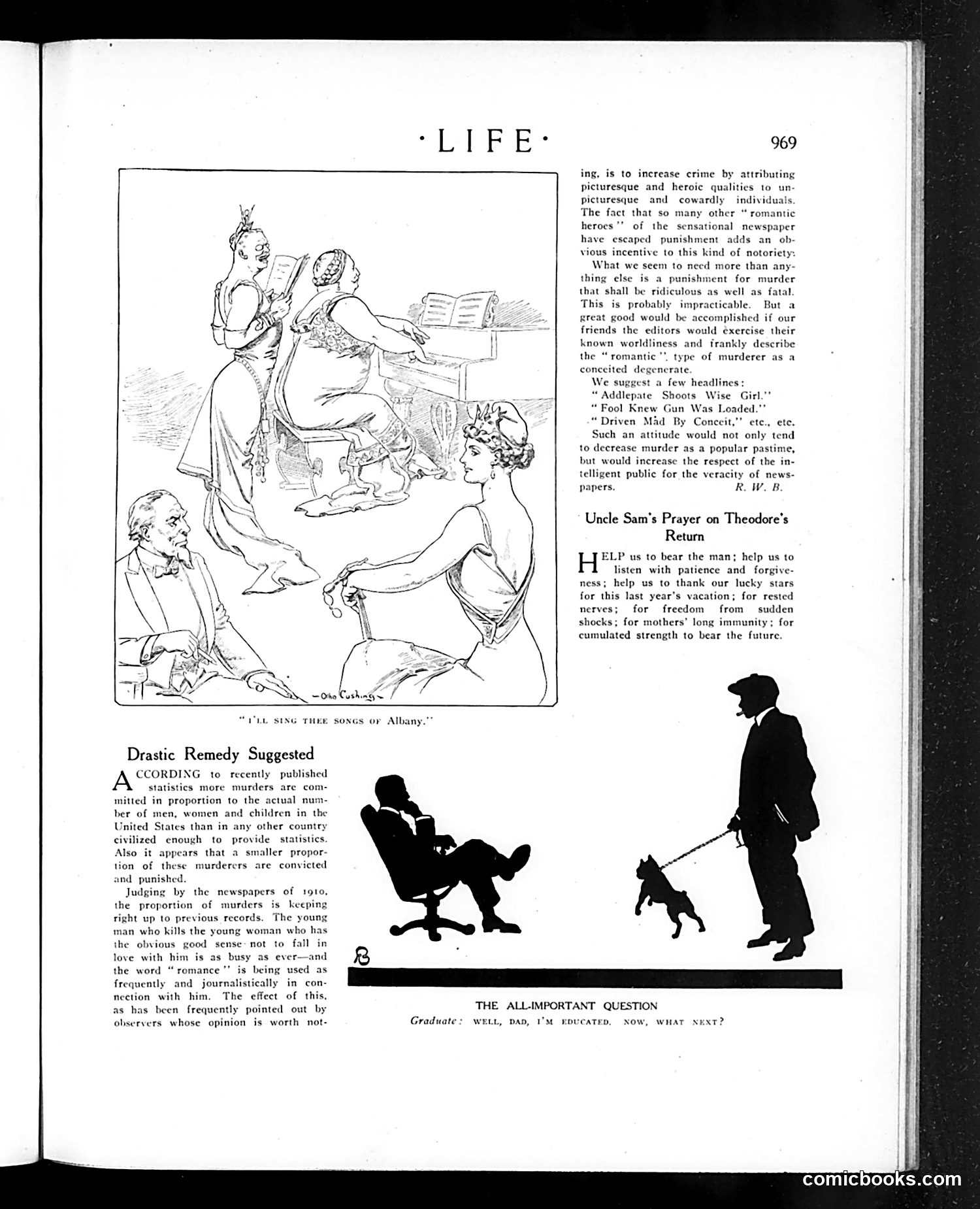
**Upper Section - "Drastic Remedy Suggested":** This article criticizes American newspapers for romanticizing murderers. The author argues that sensational coverage creates heroic narratives around criminals—particularly young men who kill women—encouraging similar crimes. The piece proposes editors should instead describe such murderers as "conceited degenerates" with unglamorous headlines to discourage copycat killings and restore public trust in newspapers. **Bottom Cartoon - "The All-Important Question":** A silhouetted scene shows a young graduate asking his father "Well, dad, I'm educated now, what next?" while the father walks with a small dog. The satire mocks the disconnect between education and practical employment prospects—suggesting that academic credentials alone provide no clear path to a career or meaningful life purpose. It reflects early 20th-century anxiety about education's actual utility. **Context:** The reference to "Theodore's Return" in another article likely refers to Theodore Roosevelt.
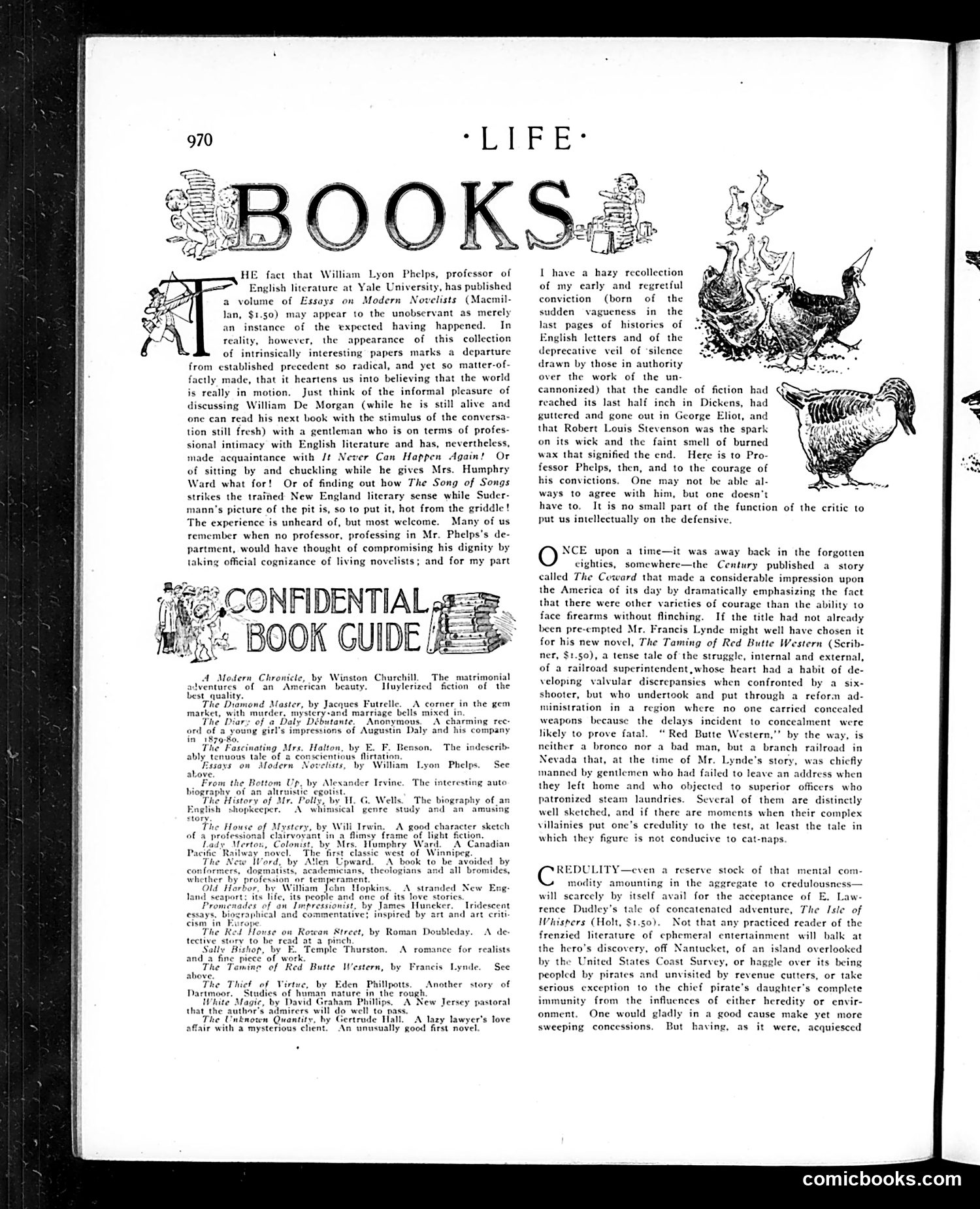
This is page 970 of Life's book review section, featuring Professor William Lyon Phelps of Yale University and his new essay collection on modern novelists. **The Main Point:** The article celebrates Phelps as a radical figure—not for his scholarship itself, but for breaking academic protocol by publicly discussing *living* authors. Traditionally, academic dignity required professors to ignore contemporary literature. Phelps's willingness to critique and engage with working writers like Mrs. Humphry Ward and discuss modern fiction represents surprising progress. **The Satire:** The author playfully mocks old-guard academia's pretension and silence about modern work. He recalls the depressing conviction that serious fiction had essentially died with Dickens, barely sputtering on with Stevenson. Phelps's openness offers intellectual hope. **The "Confidential Book Guide":** Lists contemporary novels reviewed for educated readers, bridging academic literary criticism with popular taste. The cartoonish margin illustrations feature period characters reinforcing the literary atmosphere.
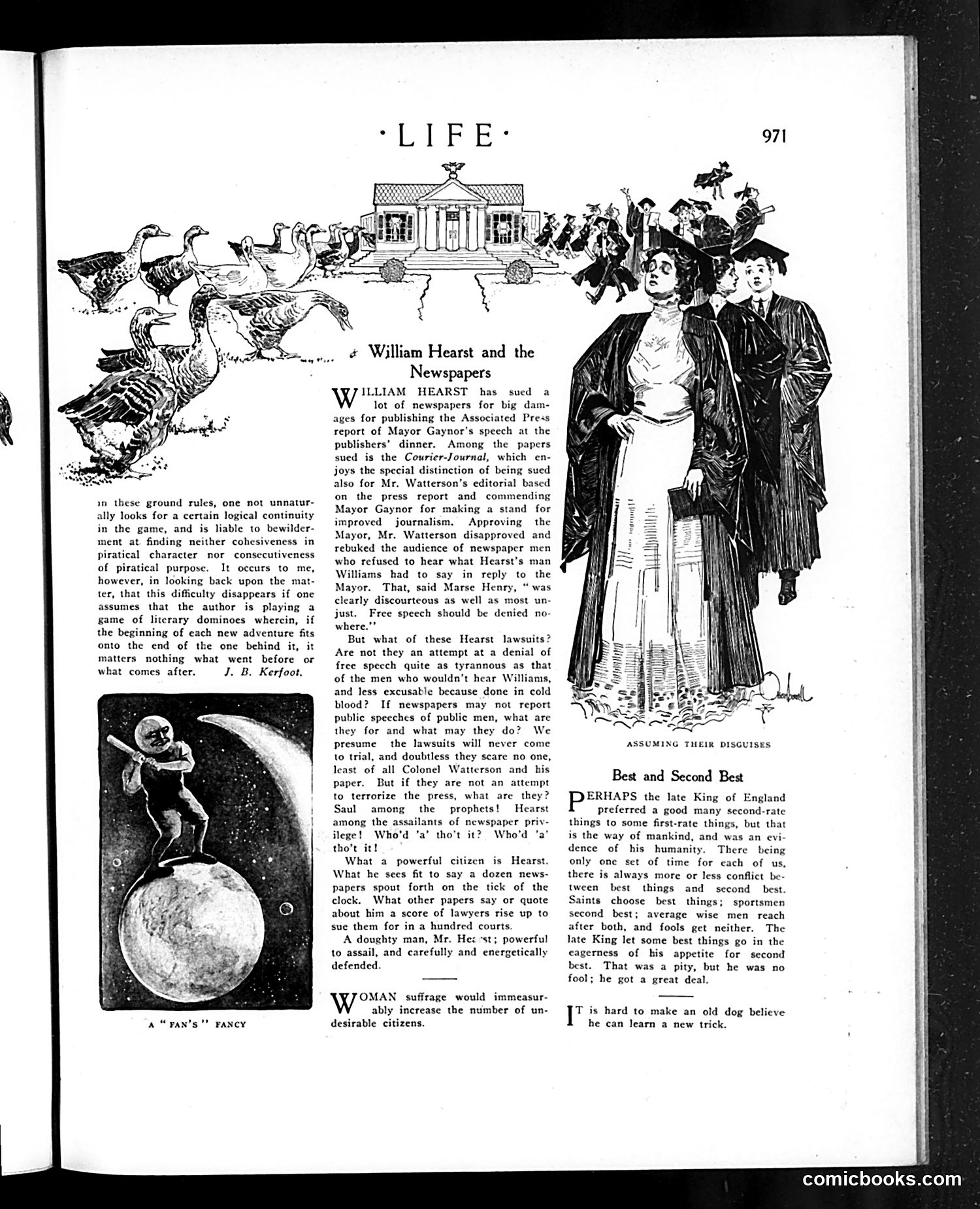
This page contains editorial commentary on **William Hearst's newspaper lawsuits** against publications reporting Mayor Gaynor's speech at a publishers' dinner. The satire's point: Hearst is suing newspapers (including the *Courier-Journal*) for publishing the Associated Press account and editorial commentary—an attempt to suppress free speech that the writer finds hypocritical. The piece mocks Hearst's power to control media narrative while simultaneously attacking press freedom, calling him "Saul among the prophets" (an unexpected figure doing something contrary to his nature). The cartoon illustration shows three figures "assuming their disguises"—likely representing newspaper editors or publishers adopting false personas, though the specific identities are unclear from the image alone. A secondary article discusses King Edward's preference for "second best" pleasures over "best" things, suggesting moral compromise.
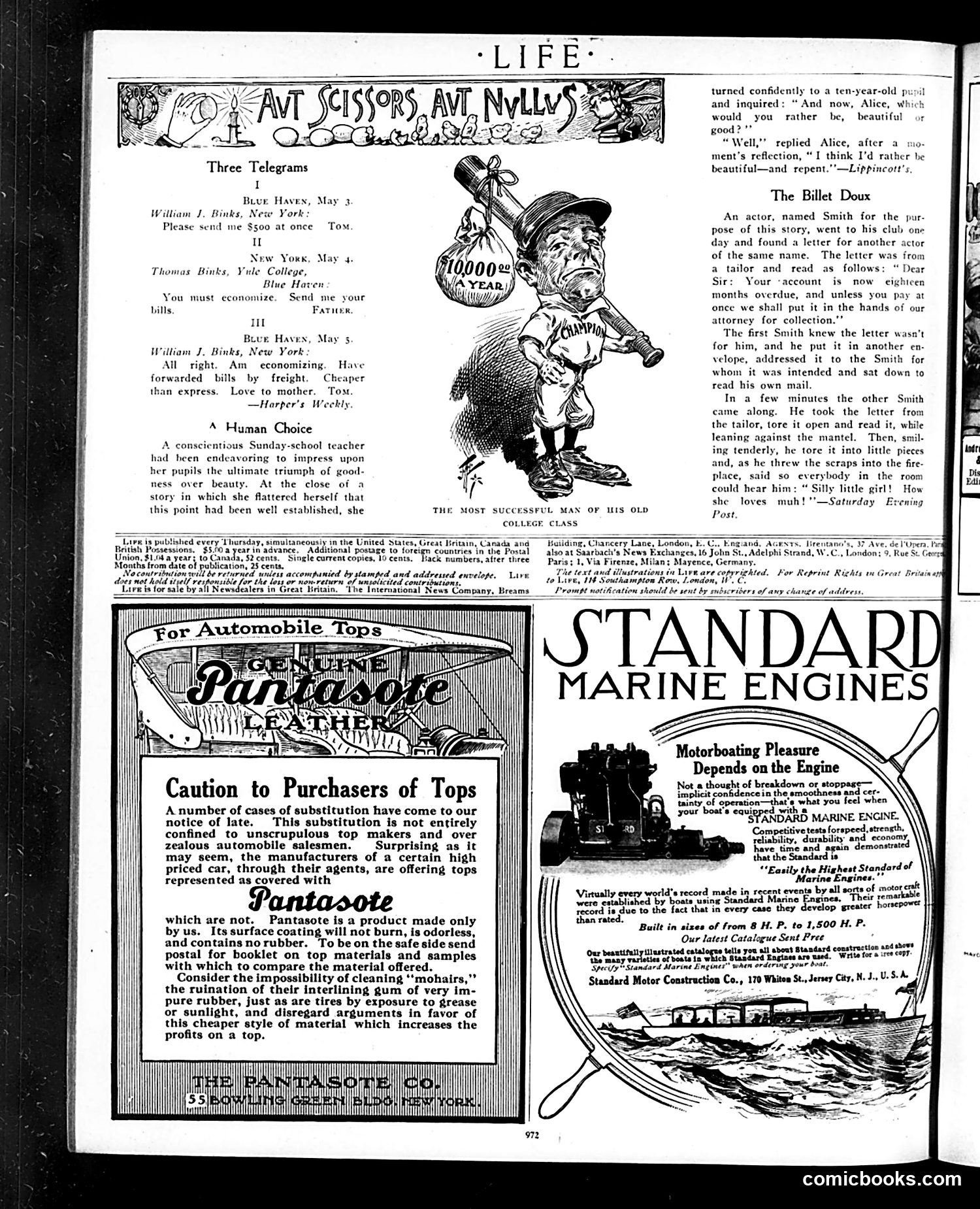
This page contains three humor pieces and period advertisements. **"Three Telegrams"** satirizes parental hypocrisy: A father demands his son economize, then the son responds by shipping bills via freight instead of express—technically economizing while mocking the father's instruction's absurdity. **"A Human Choice"** is a joke about child innocence undermining moral instruction. A Sunday school teacher asks a pupil whether she'd rather be beautiful or good. The child replies she'd rather be beautiful "and repent"—innocently exposing that goodness and beauty aren't mutually exclusive, and suggesting the teacher's moralizing is naive. **"The Billet Doux"** involves mistaken identity humor: Two actors named Smith confuse each other's mail. One receives a tailor's overdue bill, reads it as a love letter from "his little girl," and melodramatically cries over it—creating situational comedy from the misreading. The advertisements for Pantasote automobile tops and Standard Marine Engines are period marketing from the early 1900s.
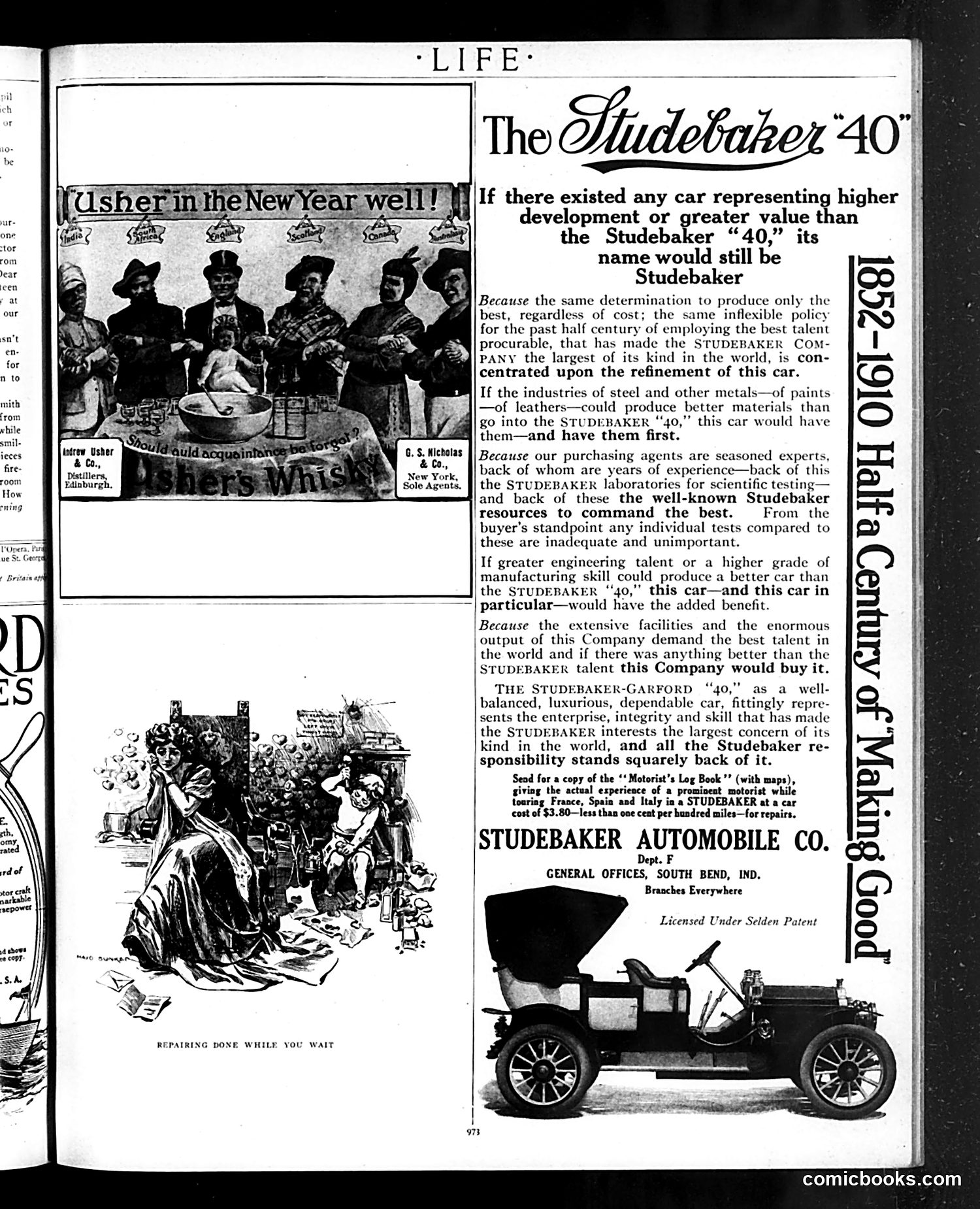
This page is primarily a **Studebaker automobile advertisement** from Life magazine, not political satire. The left side contains two humorous illustrations: the top shows people "ushering in the New Year well" (a New Year's celebration scene), while the bottom depicts "Repairing Done While You Wait"—a comedic scene of extensive car repairs, suggesting the ironic contrast between promise and reality. The dominant right side is a full advertisement for the Studebaker "40" automobile. The ad uses repetitive rhetoric to claim superiority: if any car were better, it would still be called "Studebaker" because of the company's commitment to quality, materials, talent, and resources. It emphasizes the company's half-century track record. At the bottom is an actual photograph of the 1912 Studebaker-Garford "40" model. **For modern readers:** This represents early automobile advertising that emphasizes brand prestige and manufacturing excellence rather than specific features or price. The cartoons provide light humor around transportation themes.
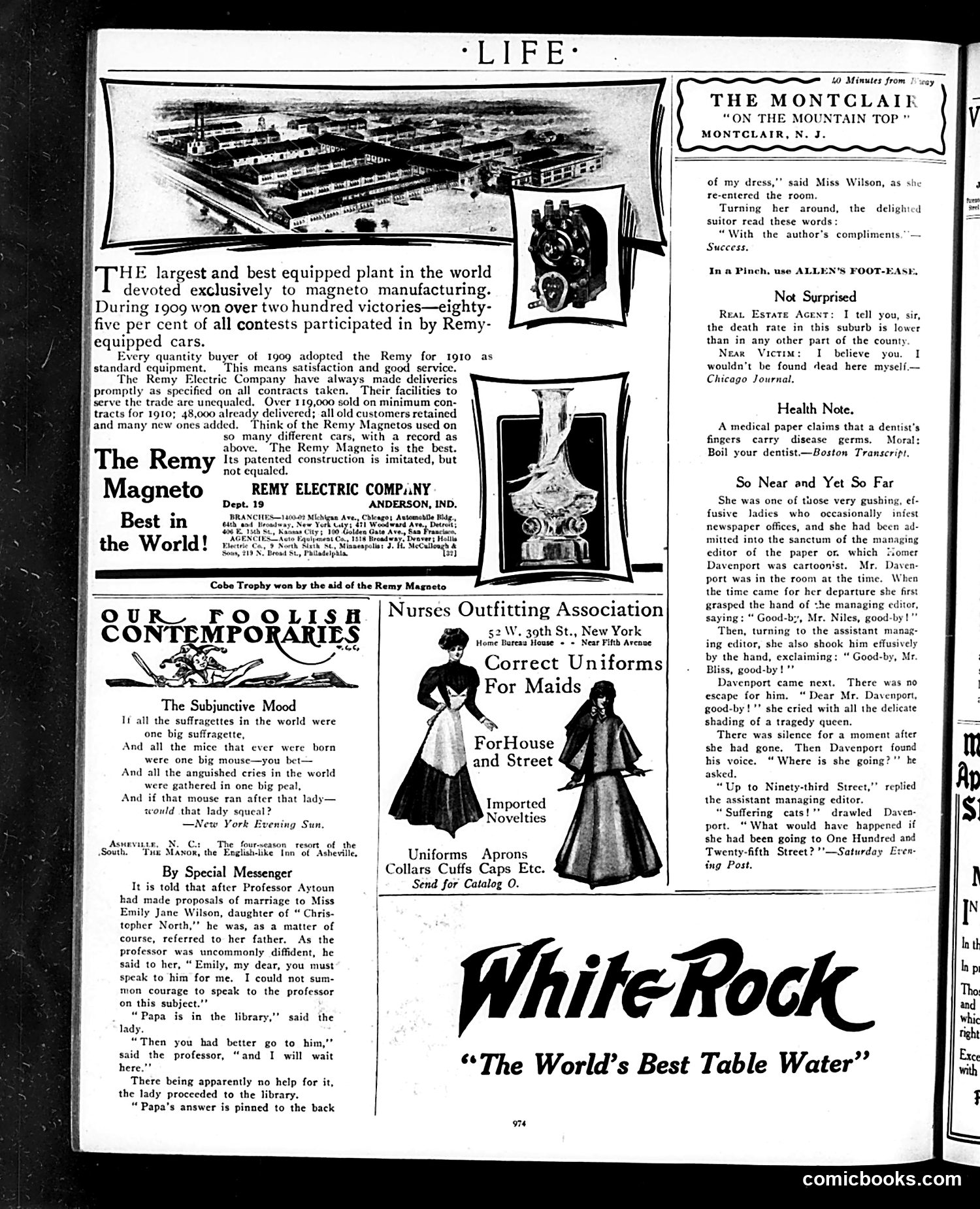
This is primarily an **advertising page** from Life magazine, containing multiple commercial advertisements interspersed with short humorous pieces. The main content includes: **Advertisements**: The Remy Magneto (automobile ignition system), Nurses Outfitting Association uniforms, White Rock table water, and a resort in Asheville. **Satirical Sketches**: Several short comic pieces, including: - A suffragette joke comparing a mousy woman to squealing mice (mocking early 1900s feminist activism) - A real estate agent's ironic boast about low death rates in a suburb - A dentist joke about disease transmission - An anecdote about Homer Davenport (a famous cartoonist of the era) being greeted effusively by a gossipy woman visitor **Political Context**: The suffragette reference reflects the heated debates over women's voting rights occurring in this pre-1920 period. The humor assumes readers will find feminist activism ridiculous. The page reflects typical Life magazine content: commercial sponsorship combined with social satire targeting contemporary issues and public figures.
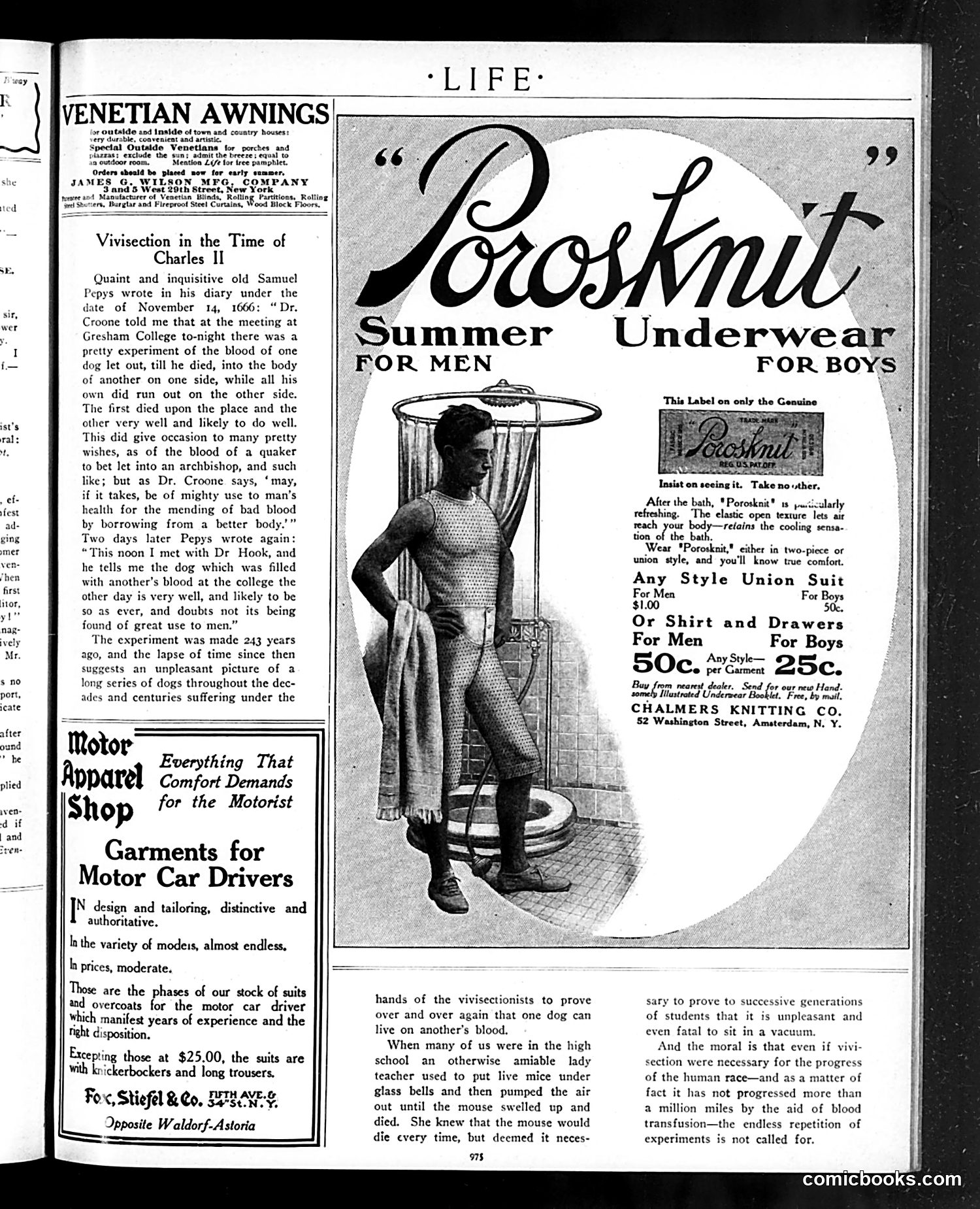
This page is primarily **advertising** with one substantive article. The main content is "Vivisection in the Time of Charles II," a historical essay discussing 17th-century blood transfusion experiments on dogs conducted at Gresham College (documented by diarist Samuel Pepys in 1666). The article uses this historical precedent to **critique contemporary animal testing practices**—specifically vivisection and classroom demonstrations where live mice were suffocated under glass bells. The author argues such repetitive experiments are unnecessary cruelty, noting they don't substantially advance human knowledge or health. The satire is implicit rather than visual: the juxtaposition of this ethical critique against surrounding advertisements (Porosknit underwear, motor apparel, Venetian blinds) exemplifies Life's mixed approach of serious commentary alongside commercial content. The piece reflects early 20th-century concerns about animal welfare and scientific ethics.
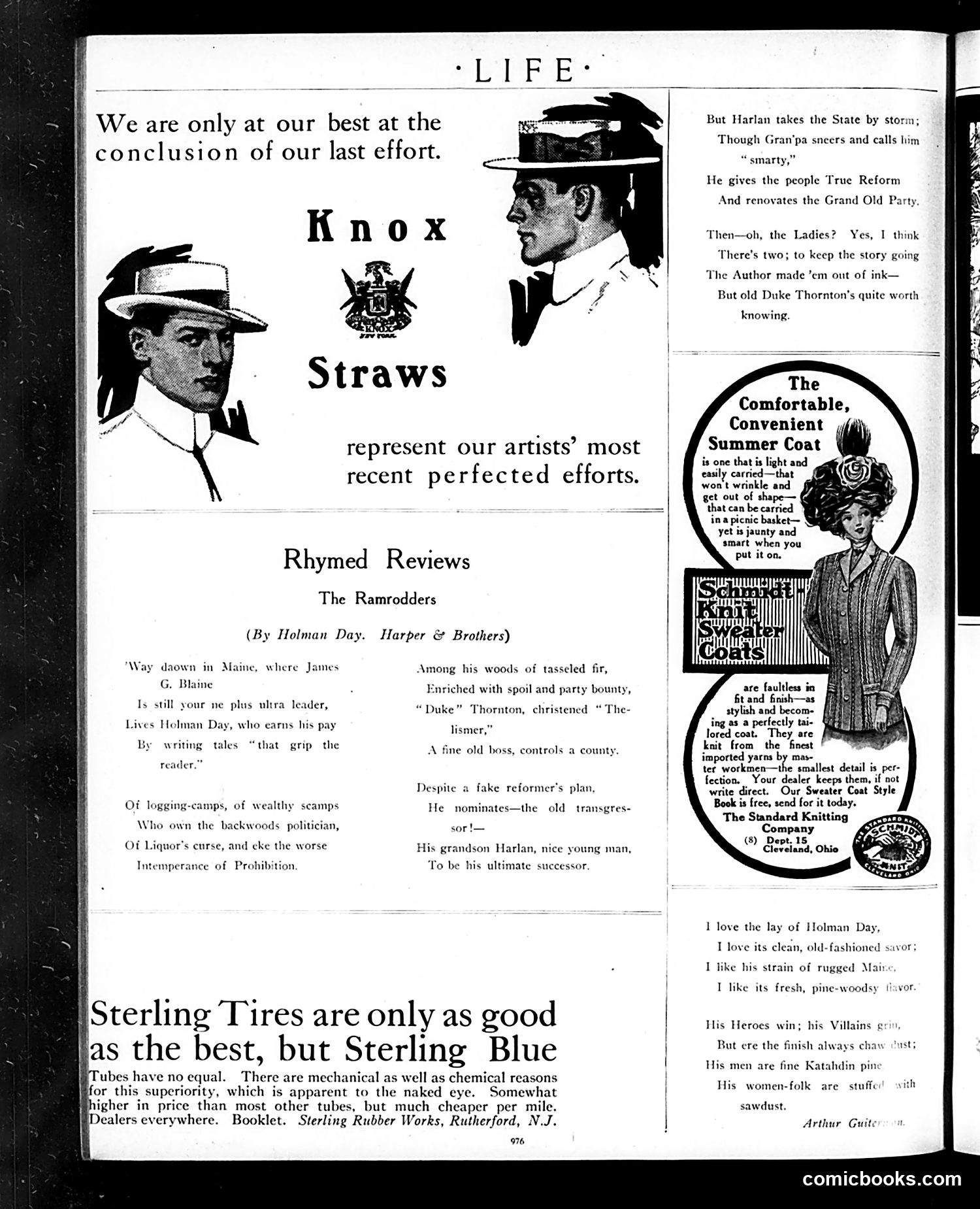
This page primarily features a **book review in verse** of Holman Day's novel *The Ramrodders* (published by Harper & Brothers). The satirical poem mocks the predictable plot: set in Maine, it concerns an old political boss named "Duke" Thornton who represents corrupt machine politics and Prohibition-era corruption. His reform-minded grandson Harlan challenges him, wins over the people with "True Reform," and presumably will succeed him—a hackneyed political narrative. The reviewer (likely Arthur Guiterman, credited at bottom) gently ridicules Day's formulaic storytelling: heroes always triumph, villains always lose, and the female characters are literally "stuffed with sawdust"—a dismissive comment on their cardboard characterization. The satire targets both Day's predictable Maine-based political fiction and, indirectly, the real corruption it depicts. The page also contains period **advertisements** for Knox Straws, Sterling Tires, and Summer Coats—typical magazine filler of the era.
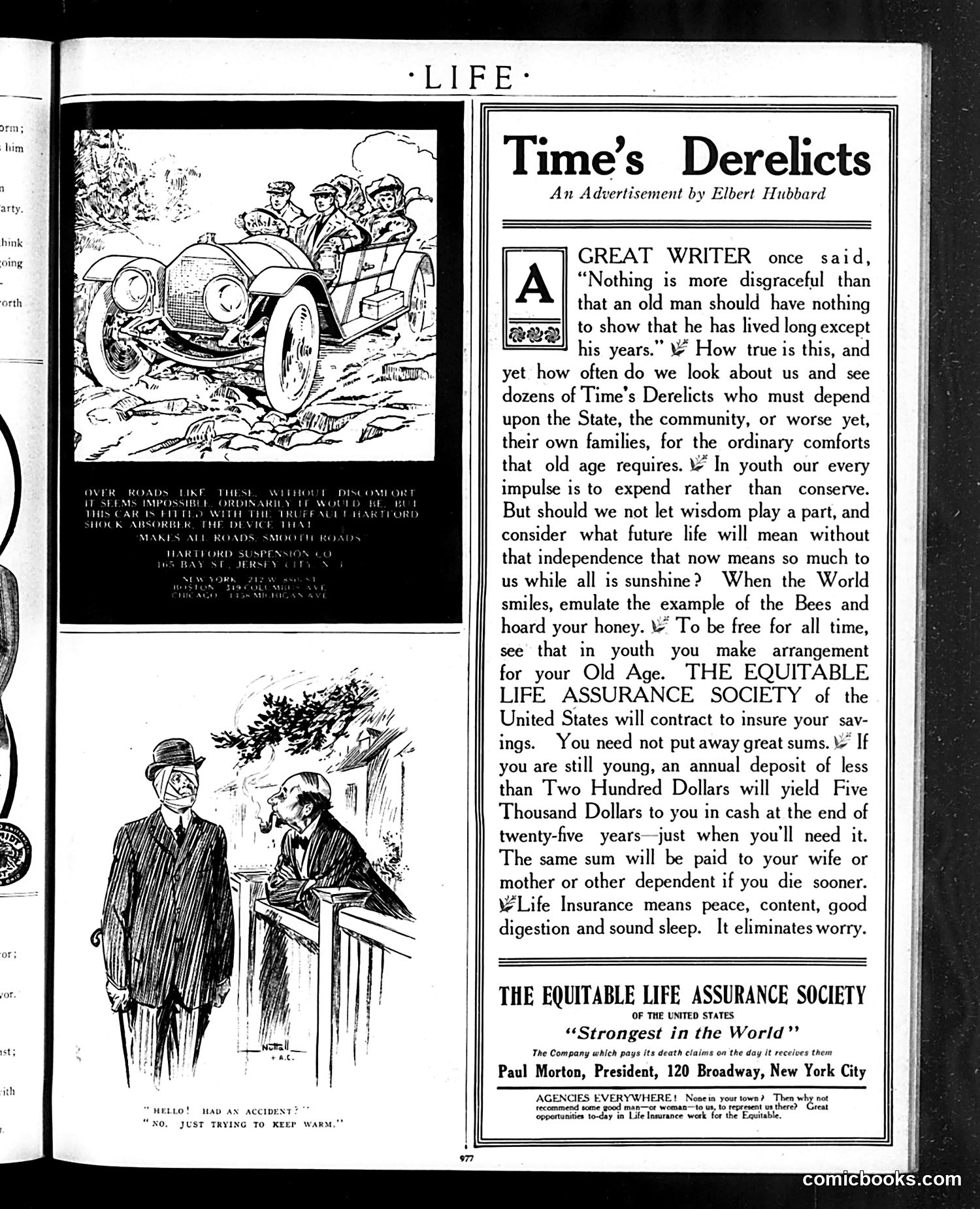
This page is primarily a life insurance advertisement by Elbert Hubbard for the Equitable Life Assurance Society. The term "Time's Derelicts" refers to elderly poor people—those dependent on the state, community, or family for survival. The two cartoons illustrate the advertisement's moral message: the top shows reckless youth spending money frivolously on cars and thrills; the bottom depicts an impoverished elderly man. Together, they warn readers that youthful extravagance leads to destitute old age. The ad's pitch uses shame and fear as motivation: young readers should buy life insurance now (modest annual payments under $200) to avoid becoming "derelicts" in old age. It frames insurance as ensuring independence, dignity, and freedom—positioning financial security as a moral imperative tied to respectability and self-reliance, values central to early 20th-century American culture.
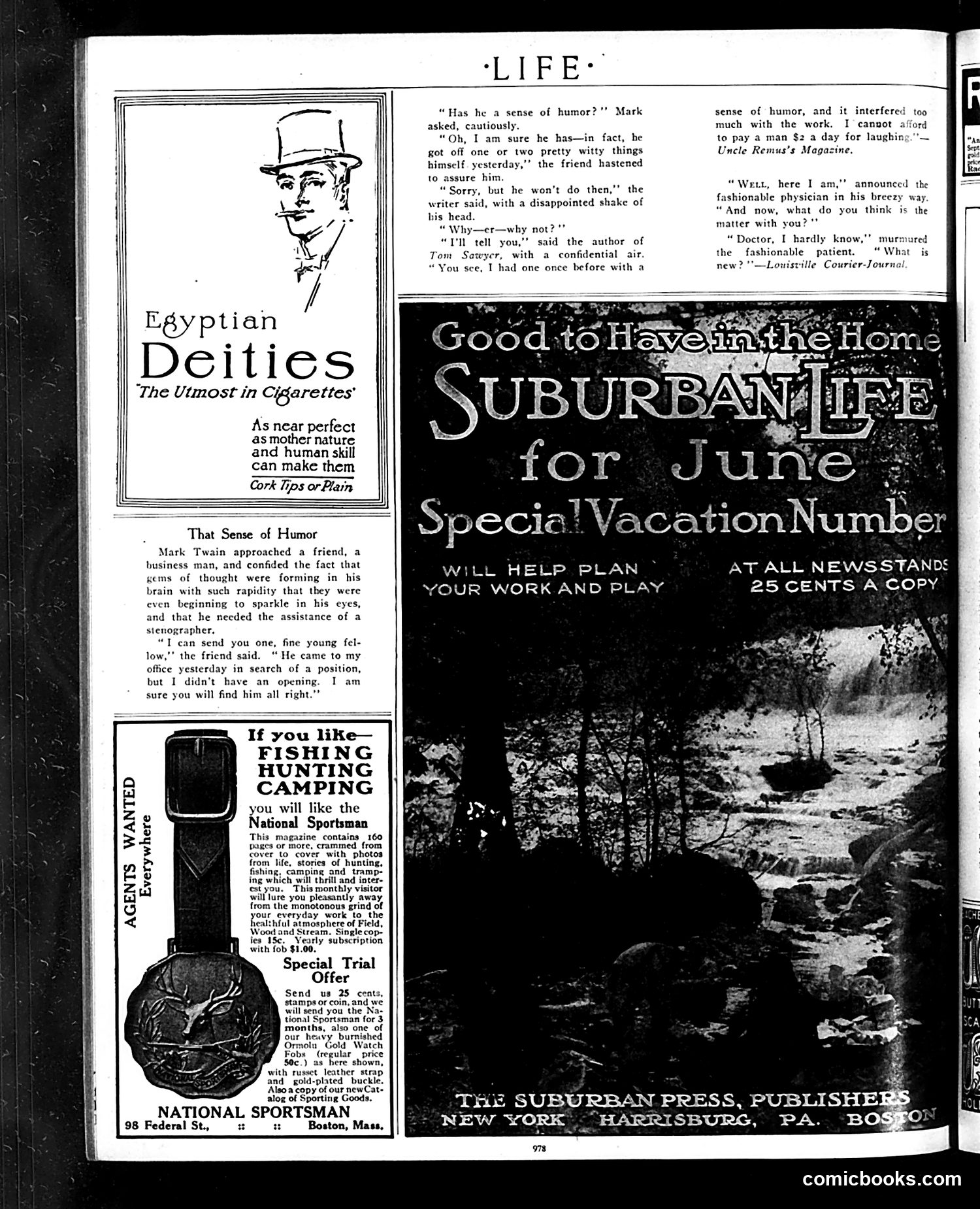
This page contains **two humorous anecdotes** and period advertisements: **"That Sense of Humor"** (top): Mark Twain asks a business associate if a job candidate has a sense of humor. The friend assures him the man is witty, but then admits this very quality makes him unsuitable—he laughs too much to be productive at $2/day wages. The joke satirizes the tension between valuing humor as a personal trait and viewing it as an impediment to labor productivity. **"The Fashionable Physician"** (right): A breezy doctor visits a wealthy patient who admits ignorance about their condition. The patient wryly quotes a medical journal's complaint that fashionable doctors provide no actual diagnosis. The satire mocks physicians who rely on manner and reputation rather than genuine medical expertise. **Advertisements**: Egyptian Deities cigarettes, Suburban Life vacation magazine, National Sportsman (hunting/fishing periodical), and recruitment for agents—typical early 20th-century magazine filler promoting leisure and consumer goods.
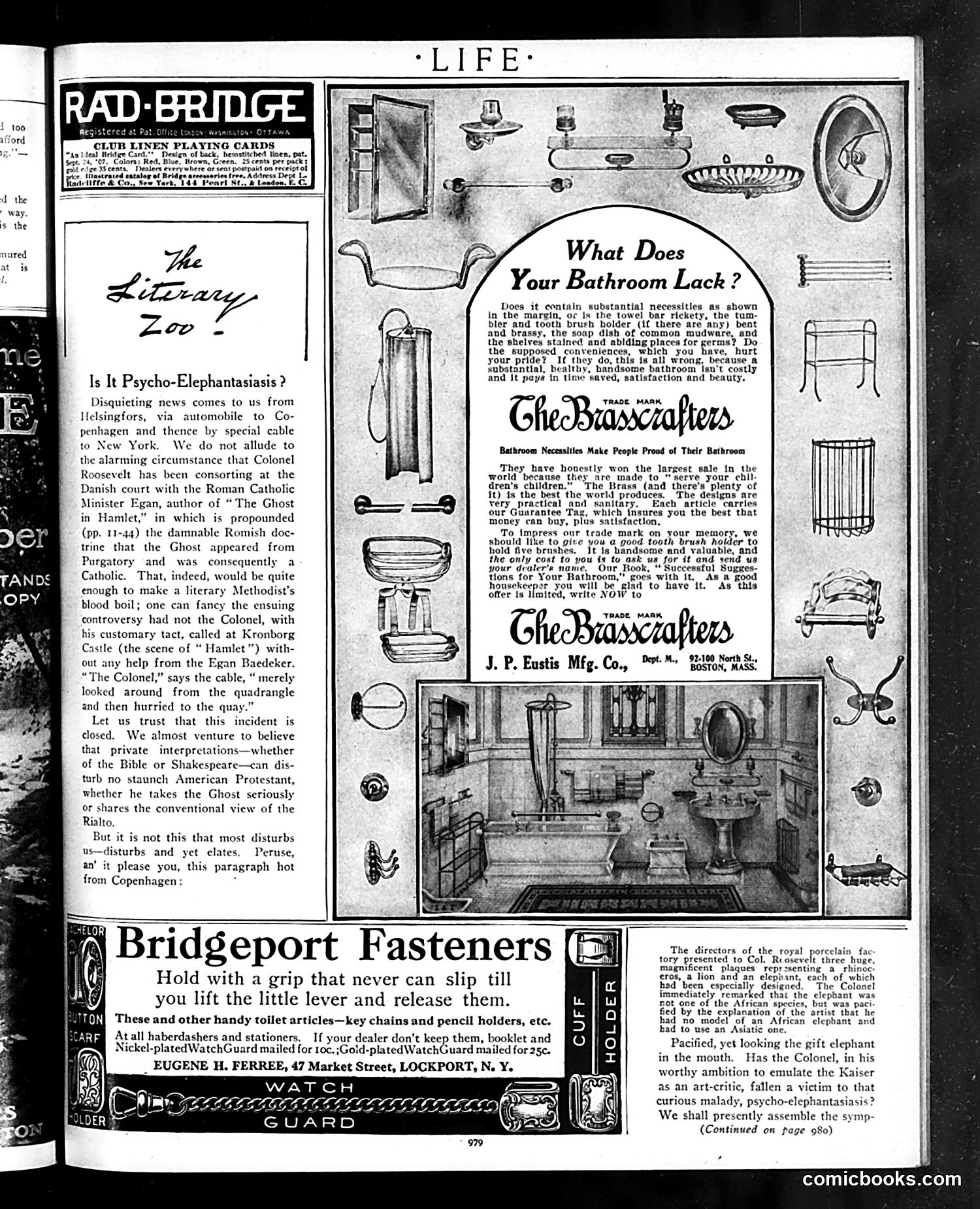
This page contains two unrelated items: a satirical column and advertisements. **"The Literary Zoo" column** mocks Theodore Roosevelt's diplomatic visit to Copenhagen. The satire criticizes Roosevelt for visiting Kronborg Castle (Hamlet's setting) while consorting with a Catholic minister—a sensitive issue for Protestant America. The column's humor peaks in reporting that Danish porcelain makers gifted Roosevelt an elephant sculpture, which Roosevelt complained wasn't authentically African. The title "Is It Psycho-Elephantasiasis?" suggests Roosevelt is obsessed with elephants, playing on his famous big-game hunting. The satire implies Roosevelt is culturally obtuse, nitpicking a diplomatic gift rather than graciously accepting it—typical of Life magazine's irreverent treatment of public figures. **The advertisements** promote bathroom fixtures (Che Brasscrafter brand) and Bridgeport Fasteners, typical early 20th-century consumer goods advertising. These hold no satirical content.
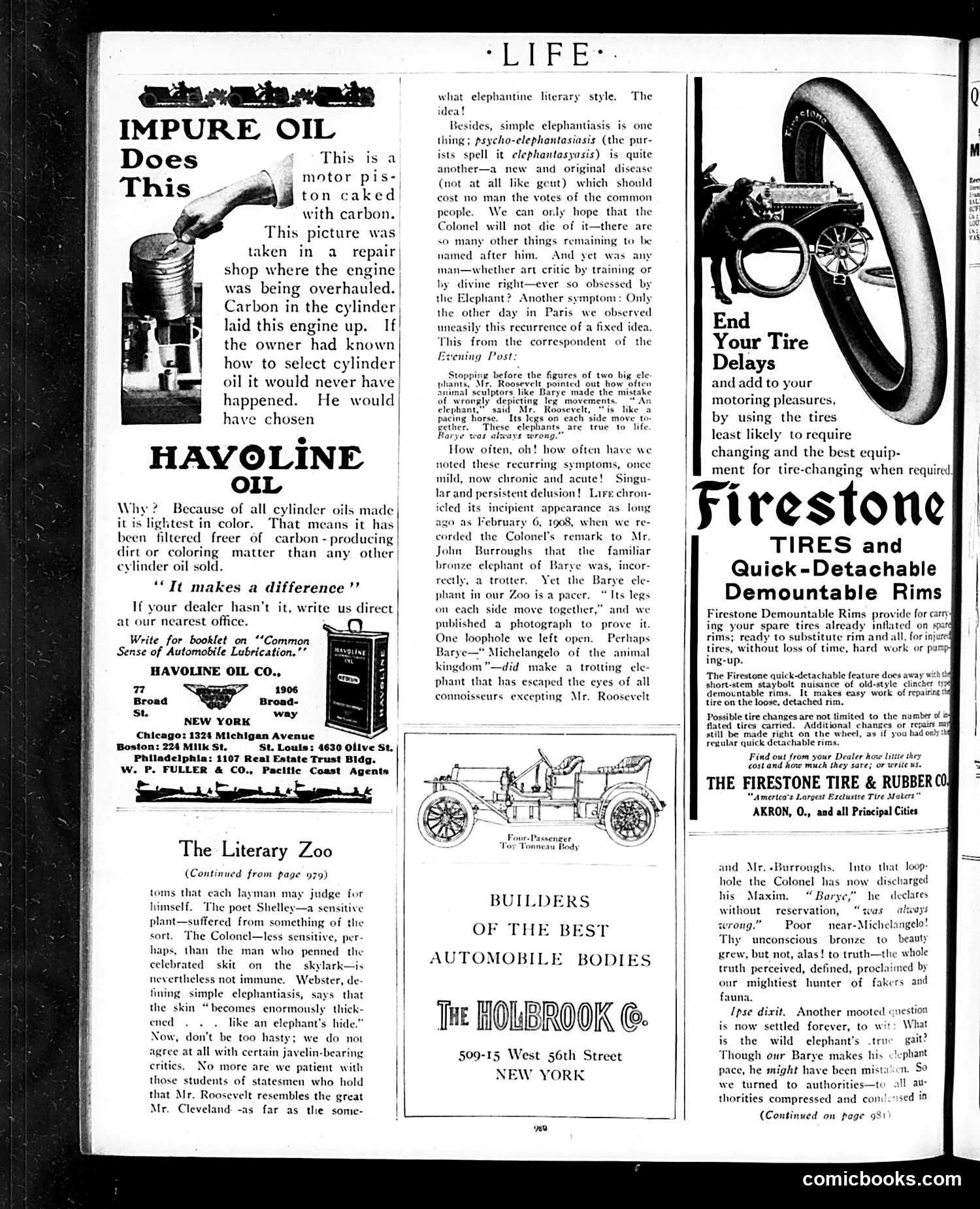
This page is primarily **advertising**, not political satire. It contains three distinct advertisements: 1. **Havoline Oil**: An engine oil company advertisement showing a carbon-caked piston, arguing their filtered oil prevents engine damage. 2. **Firestone Tires**: A tire company promoting quick-detachable rims to reduce tire-changing delays. 3. **Holbrook Co.**: An automobile body builder advertisement. The only editorial content is "The Literary Zoo" (continued from page 979), a satirical piece mocking Theodore Roosevelt's obsessive fixation on elephant anatomy. The text suggests Roosevelt repeatedly corrected sculptors (particularly Barye) about how elephant legs move—claiming they "trot" rather than "pace." The writer uses medical metaphors, calling this psychological condition "psycho-elephantiasis," sarcastically hoping the "Colonel will not die of it." The satire ridicules Roosevelt's pedantic nature and his assumption of expertise beyond his station.
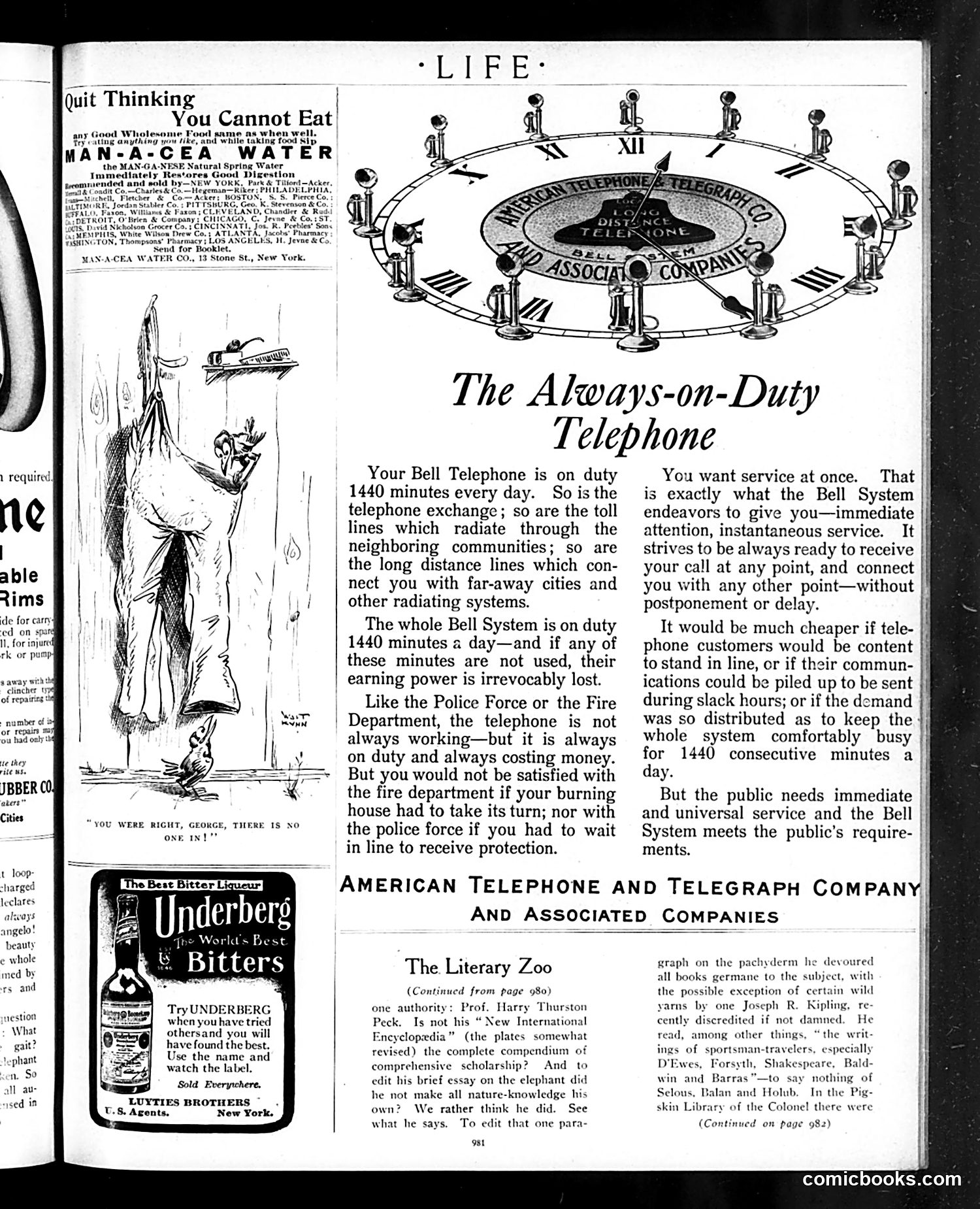
This page contains **advertising and corporate messaging rather than political satire**. The main content is a Bell Telephone advertisement disguised as editorial copy. The piece defends the telephone company's 24/7 operational costs by comparing the telephone system to police and fire departments—essential services that must always be "on duty" even when not actively used. The argument is that customers demand immediate service availability, justifying continuous infrastructure maintenance and expense. The accompanying cartoon (lower left) shows a couple discussing whether to eat, with the caption "You were right, George, there is no one in [line]"—a light domestic joke about avoiding crowds. The page also features period advertisements for **Underberg Bitters** (a digestif liqueur) and **Man-a-cea Water** (a patent digestive aid), typical of early 20th-century magazine marketing. **The Literary Zoo** article continues below, discussing encyclopedia scholarship. This is primarily a **commercial publication** rather than satirical commentary.
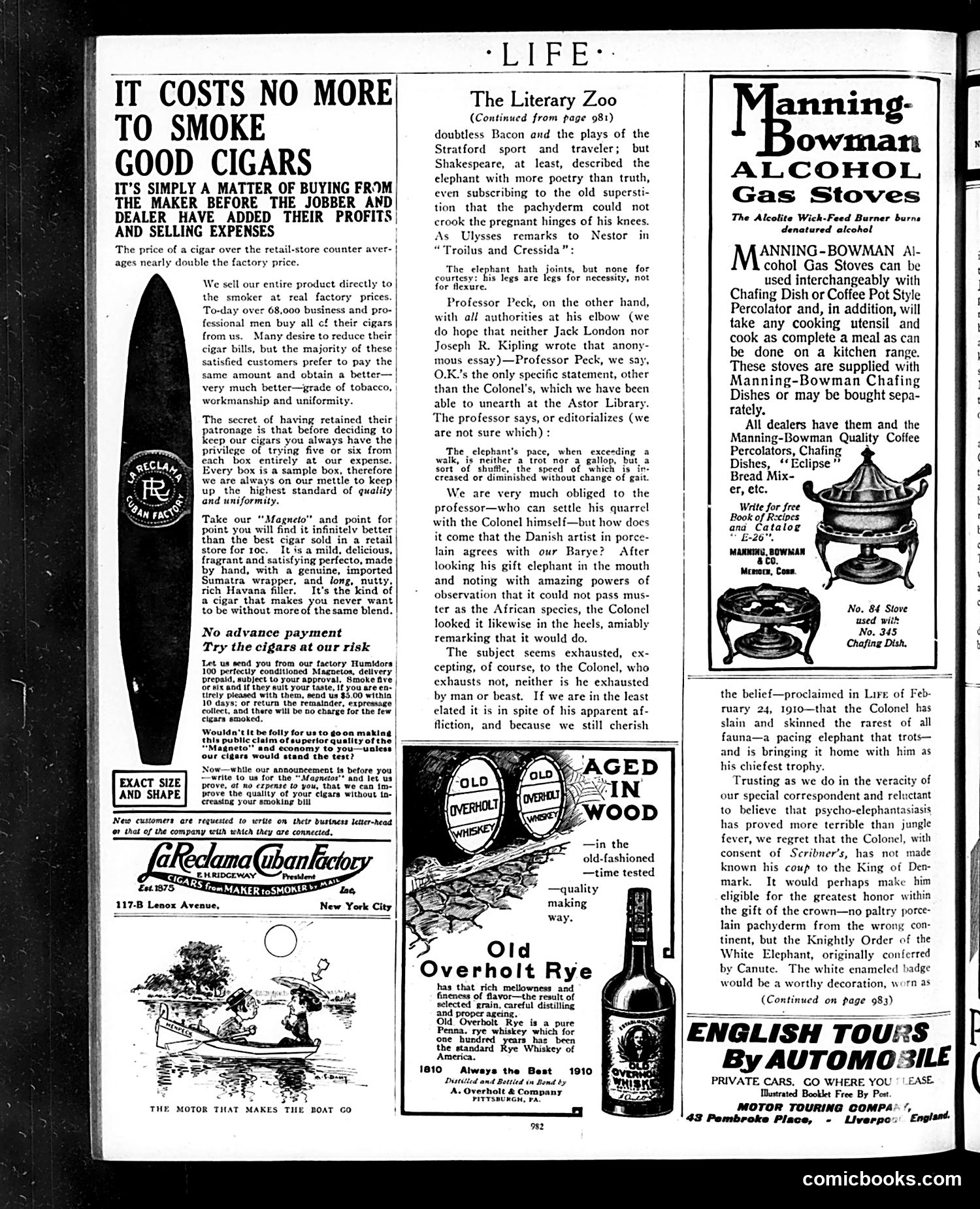
This page is primarily **advertising**, not political satire. It contains three major ads: 1. **Reclaim Cigar Factory ad** (left): Argues consumers save money buying directly from the manufacturer rather than through retailers who add markup. It offers a risk-free trial of "Magneto" cigars. 2. **Manning-Bowman Alcohol Gas Stoves** (right): Markets kitchen stoves that use alcohol fuel and can be purchased separately or bundled with chafing dishes. 3. **Old Overhold Rye Whiskey** (bottom center): Advertises whiskey aged in wood, positioned as a quality product with historical pedigree. The only editorial content is **"The Literary Zoo"** (top center), a literary criticism piece discussing how various authors (Shakespeare, Kipling, Barye) have portrayed elephants, comparing factual accuracy versus poetic license. This appears continued from a previous page. The cartoons are minimal—primarily **decorative boat illustration** (bottom left) advertising motor engines.
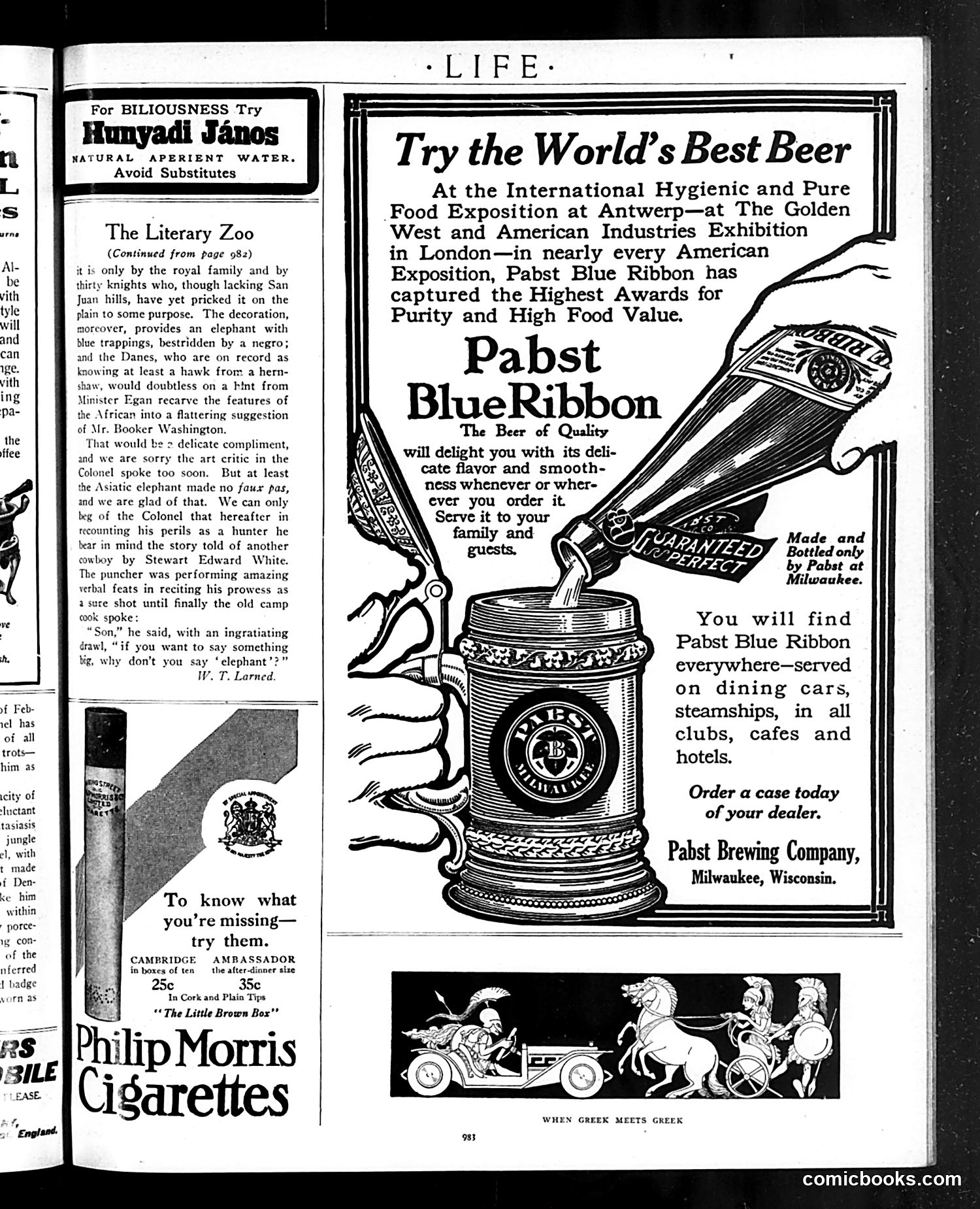
This page is primarily **advertising**, not satire or political content. The main advertisements are: 1. **Hunyadi Janos** (top left): A digestive water product marketed for treating biliousness (a period term for indigestion/upset stomach). 2. **Philip Morris Cigarettes** (bottom left): Promoting their "Cambridge" and "Ambassador" brands in boxes of ten. 3. **Pabst Blue Ribbon Beer** (center/right, dominant): Claims the beer won awards at international food expositions for "Purity and High Food Value." It emphasizes the beer is served on dining cars, steamships, clubs, and hotels—positioning it as a quality, widely-available product. The only non-advertising content is "The Literary Zoo" (continued article about animal symbolism in literature), which references Theodore Roosevelt and African-American educator Booker T. Washington in a literary context unrelated to satire. The page reflects early 20th-century consumer culture and product promotion rather than political commentary.
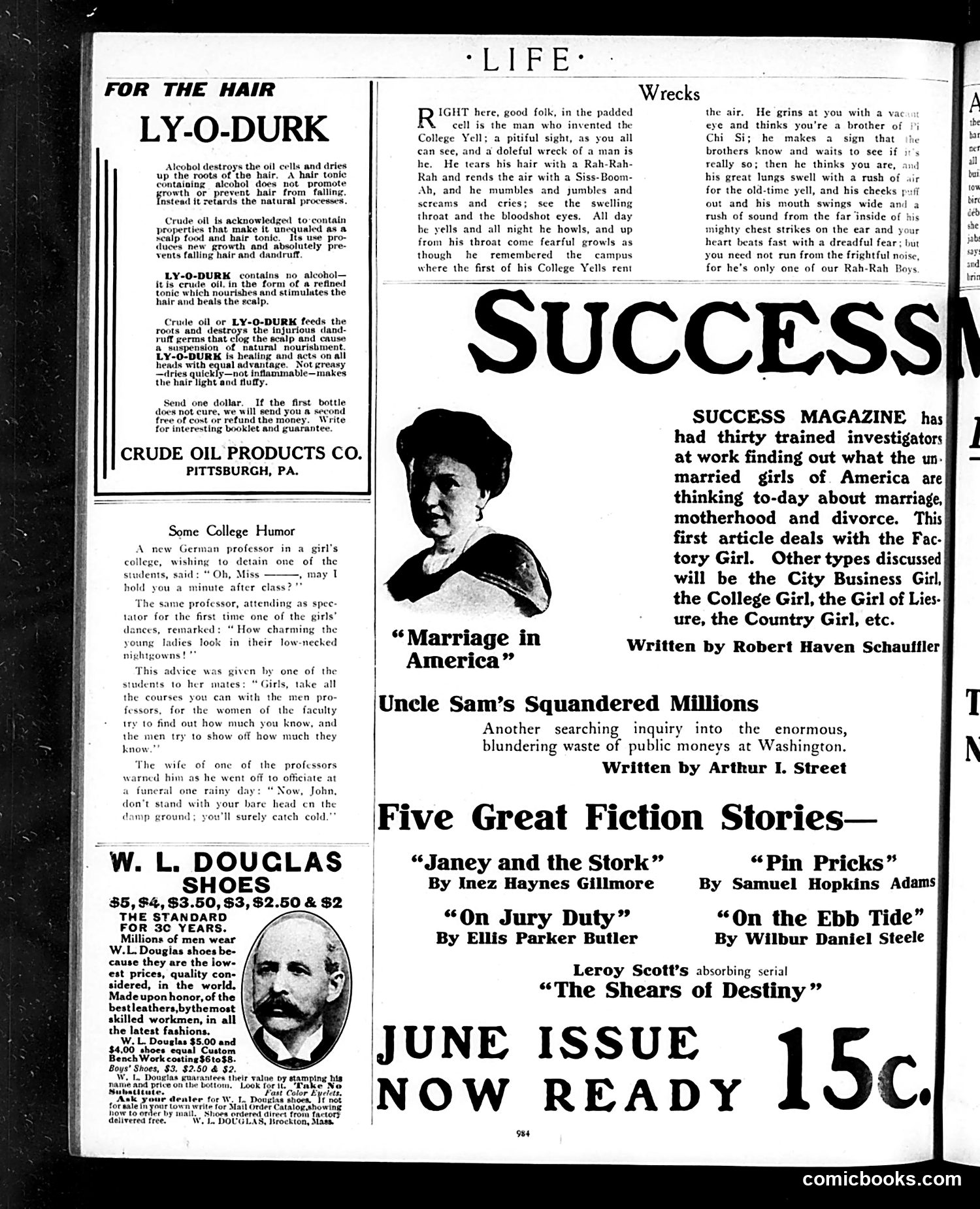
This page is primarily **advertisements and promotional content** rather than political cartoons or social satire. The main content includes: 1. **Hair tonic ads** (Ly-O-Durk and W.L. Douglas Shoes) promoting products with exaggerated health claims typical of early 20th-century marketing. 2. **"Wrecks" cartoon/illustration**: A satirical piece mocking college culture, specifically the "Rah-Rah Boy"—a student stereotype obsessed with college yells and school spirit. The text describes this character as mentally unhinged from excessive enthusiasm, depicted as confined in a "padded cell." This reflects contemporaneous anxiety about youth culture and collegiate excess. 3. **Magazine content previews**: Success Magazine announces investigations into "unmarried girls of America" and their views on marriage and divorce—reflecting Progressive Era concerns about changing women's roles. 4. The humor is gentle social commentary on college life rather than sharp political satire. The "Rah-Rah Boy" represents mockery of excessive school spirit and conformist peer pressure.
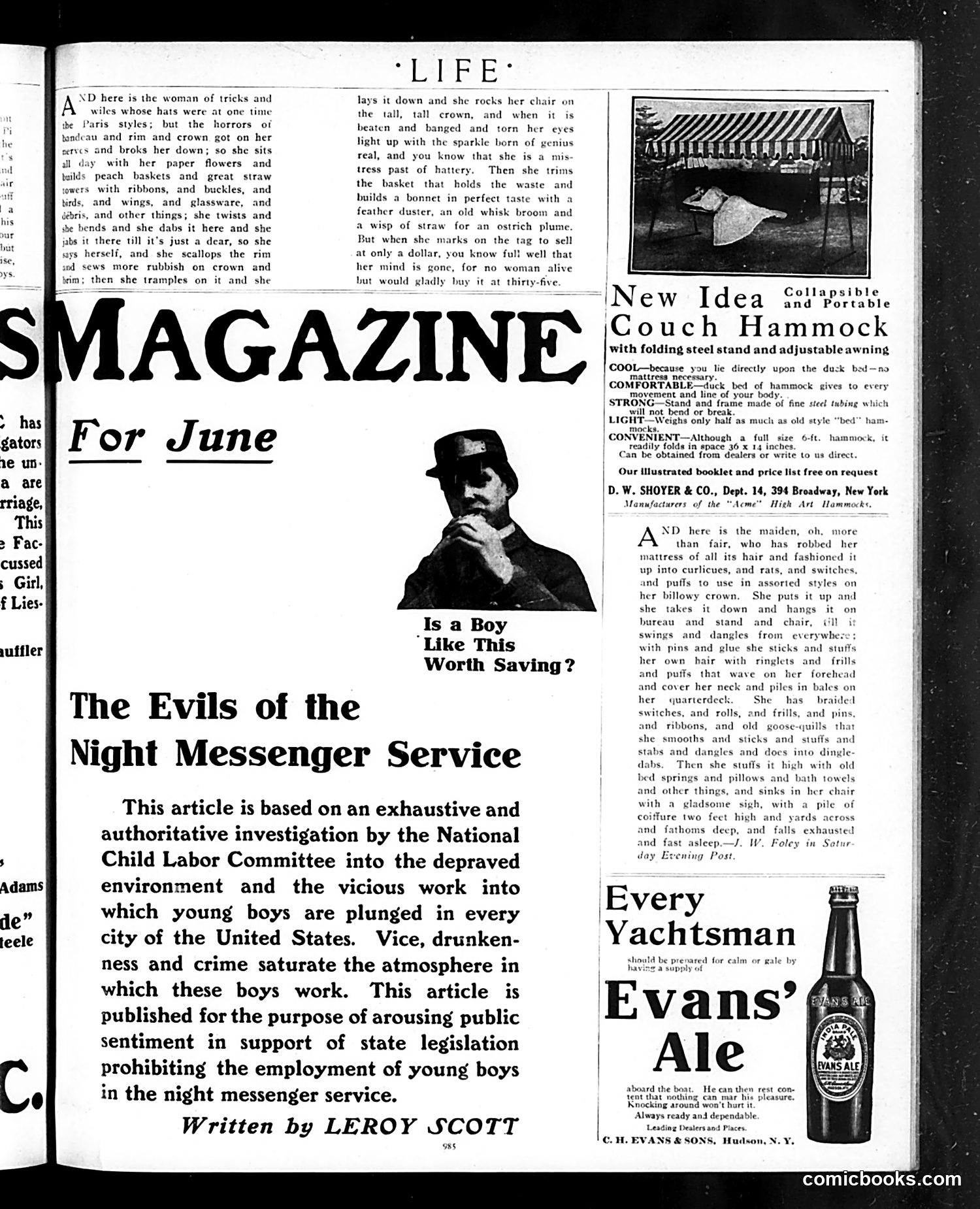
This page mixes social commentary with advertisements. The central article, "The Evils of the Night Messenger Service" by Leroy Scott, addresses child labor—specifically boys employed as nighttime messengers in American cities. The text emphasizes that this work exposes children to "vice, drunkenness and crime," and the article aims to build public support for state legislation banning such employment. The surrounding content includes humorous sketches about women's hat-making and hairstyling fashions (satirizing the elaborate, wasteful styles of the era), plus advertisements for a collapsible hammock and Evans' Ale. The boy's portrait asking "Is a Boy Like This Worth Saving?" appears designed to appeal to readers' protective instincts toward children, supporting the article's reform agenda—a characteristic Progressive Era concern about child welfare and labor exploitation.
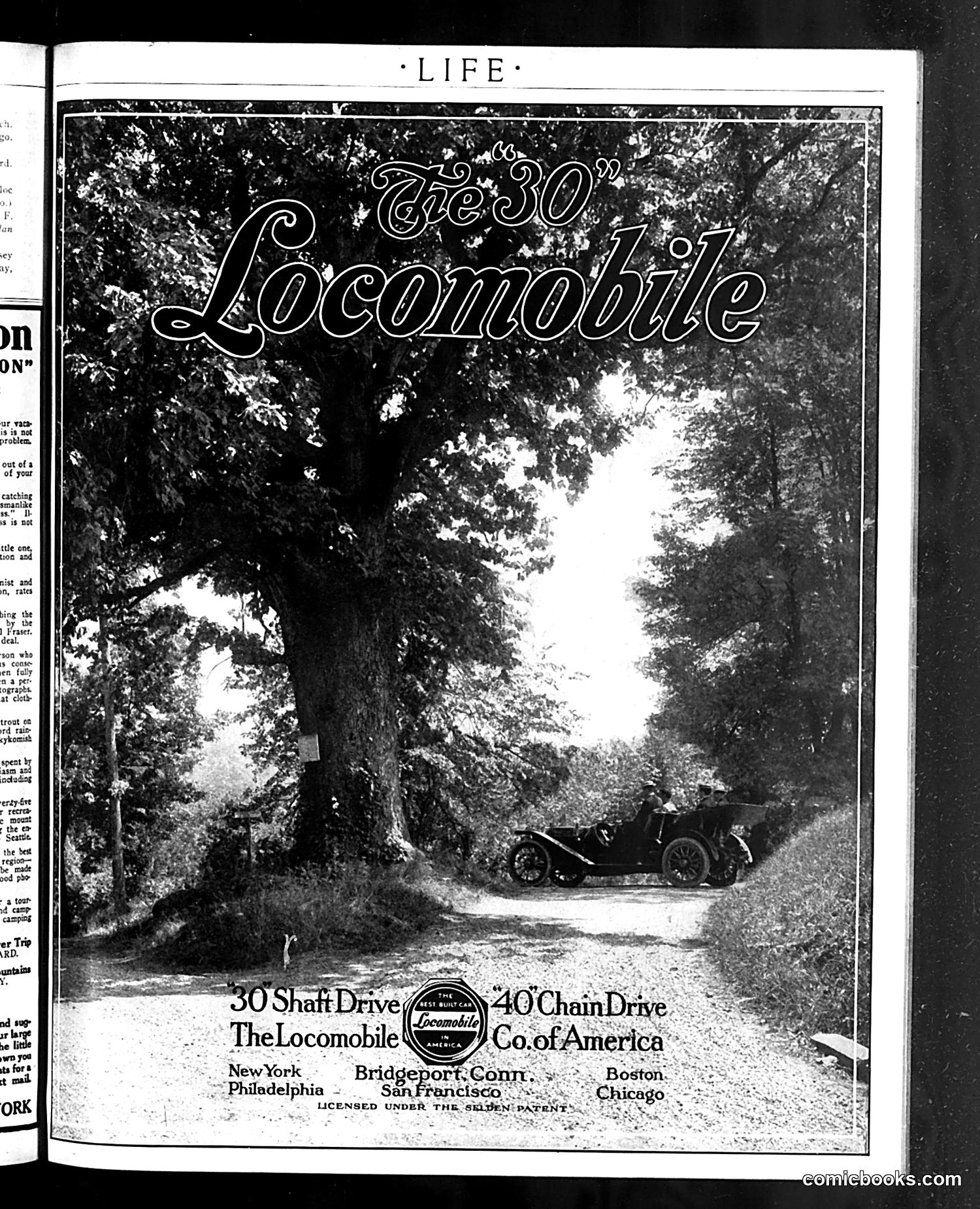
This is primarily a **full-page advertisement**, not a cartoon or satirical content. It promotes the **1930 Locomobile automobile**, featuring a luxury car parked beneath a massive tree on a rural road. The ad emphasizes the vehicle's elegance and reliability by showcasing it in a picturesque, natural setting. The Locomobile Co. of America lists multiple headquarters locations (New York, Philadelphia, Bridgeport Connecticut, San Francisco, Boston, Chicago), indicating it was a significant national manufacturer at the time. The "30 Shaft Drive" and "40 Chain Drive" specifications reference technical features meant to appeal to informed buyers. This represents typical early 1930s automotive advertising targeting affluent consumers—placing the car within aspirational, peaceful scenery rather than urban environments.
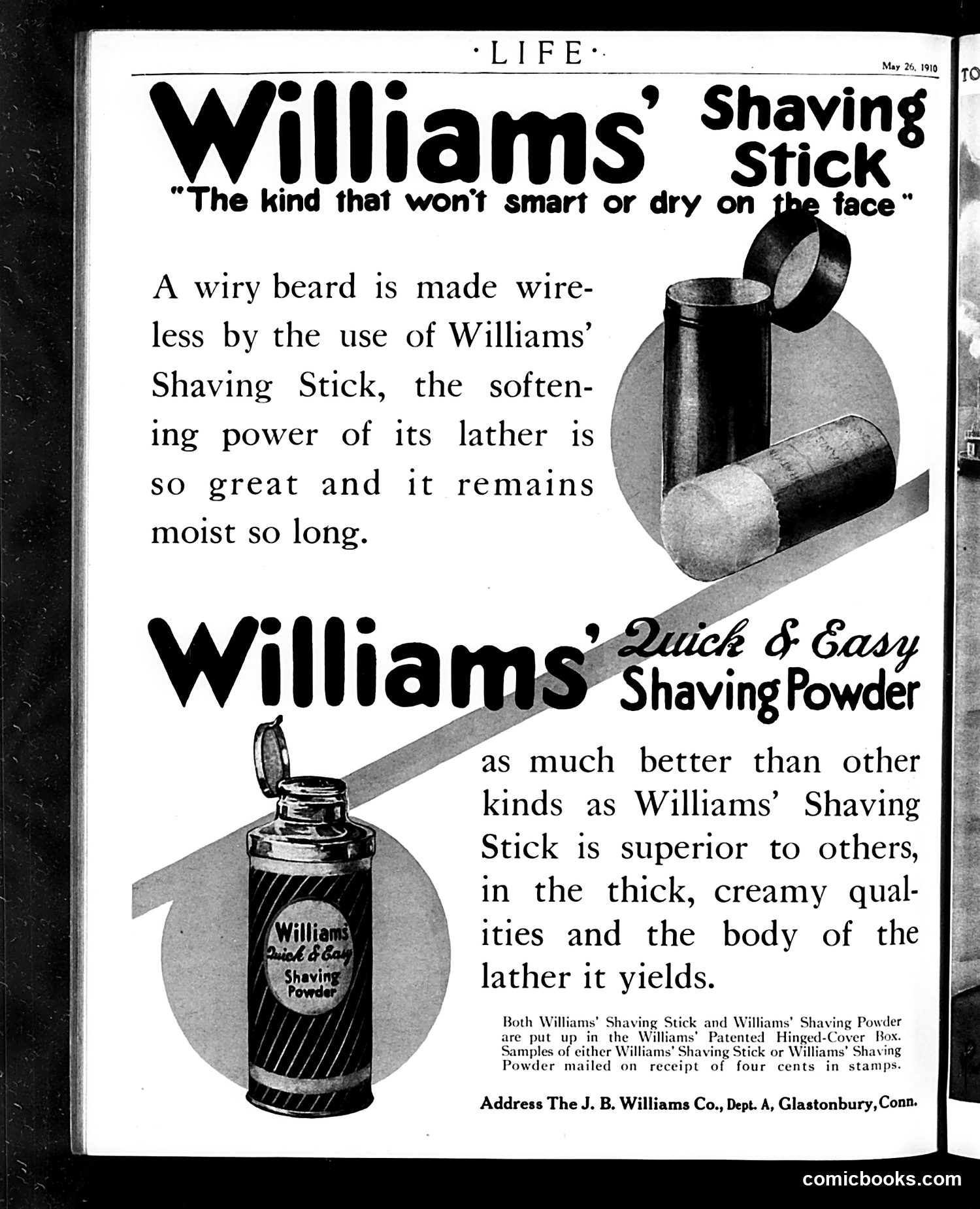
This page is **not a cartoon or satire—it's a straightforward advertisement** from *Life* magazine (May 26, 1919). It promotes two Williams brand shaving products: a Shaving Stick and Shaving Powder. The ad uses the typical marketing language of the era, claiming superior lathering ability that "won't smart or dry on the face" and remains moist longer than competitors. The visual elements show the product packaging: a cylindrical stick and a powder container in their distinctive boxes. The text emphasizes product quality through comparative claims ("as much better...as...is superior to others"). This represents early 20th-century advertising strategy—appealing to male grooming concerns and offering product samples for four cents in stamps to encourage trial. There is no political commentary, satire, or caricature present; *Life* magazine frequently published commercial advertisements alongside its satirical editorial content.