
Life, 1910-05-26 · page 18 of 44
Life — May 26, 1910 — page 18: what you’re looking at
What you’re looking at
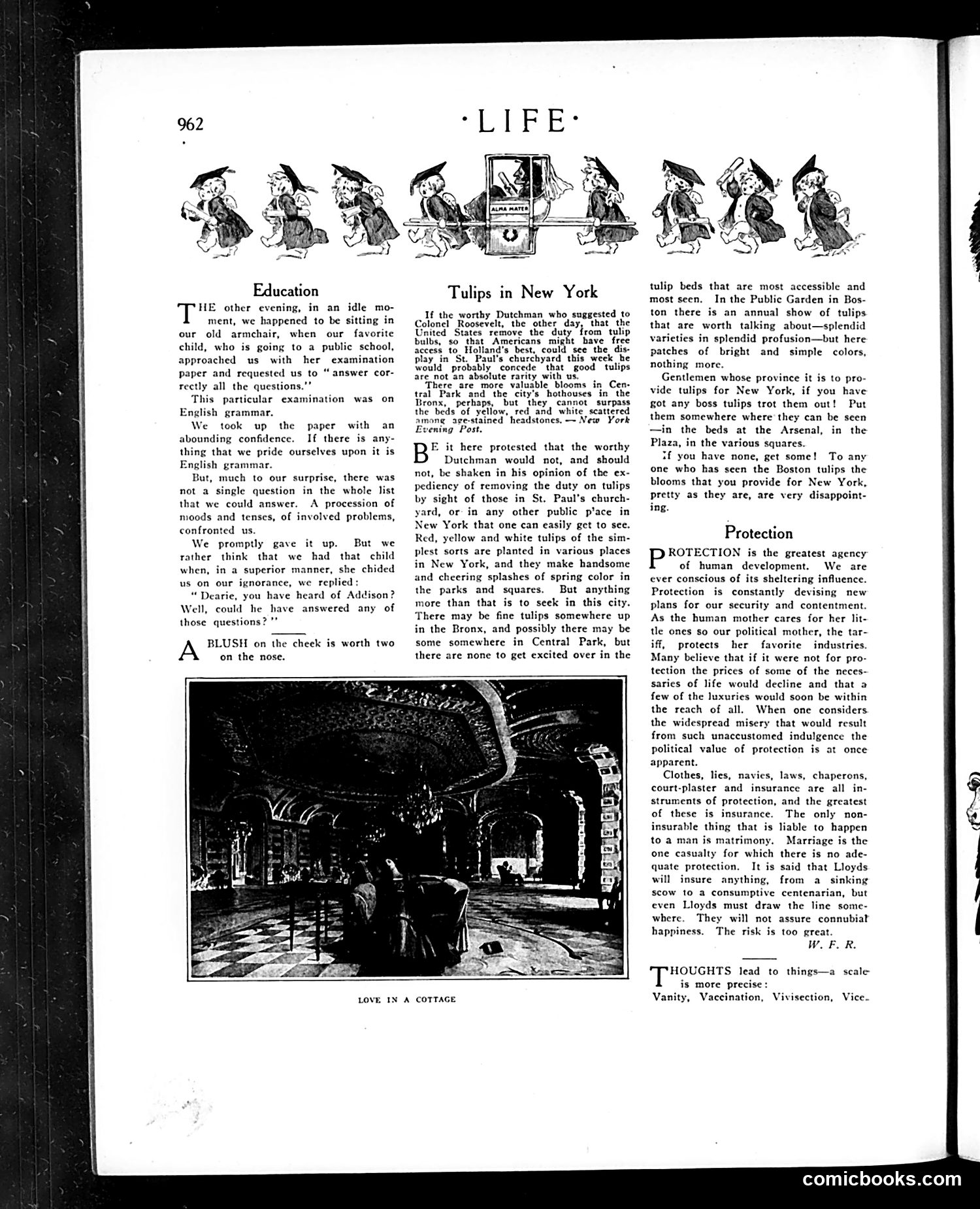
This page contains three distinct satirical pieces: **"Education"**: The author humorously describes being unable to answer his child's modern English grammar examination questions. The joke mocks both educational standards and parental inadequacy—the author deflects by invoking Addison (an 18th-century literary figure), implying classical education is superior to contemporary schooling. It's generational satire about how new teaching methods confuse adults trained the old way. **"Tulips in New York"**: This piece criticizes New York's public flower displays as inferior to Boston's, despite the city's wealth and resources. It's civic boosterism and social commentary—a mild complaint that even wealthy cities neglect beautiful public amenities. **"Protection"**: A sardonic defense of protectionist tariffs (likely from Theodore Roosevelt's era). The satire is subtle but clear: by equating tariffs with mothers, lies, navies, and insurance as "protective," the author mocks protectionists' paternalistic logic while implying tariffs artificially inflate prices and prevent ordinary people from accessing goods. The "Love in a Cottage" illustration caption appears disconnected from the text above it.
📄 Transcribed text from this page (OCR, searchable)
Machine-transcribed from the original scan — historical spelling and the odd misread are preserved.
HE other evening, in an idle mo- ment, we happened to be sitting in our old armchair, when our favorite child, who is going to a public school, approached us with her examination paper and requested us to “answer cor- rectly all the questions."” This particular examination was on English grammar. We took up the paper wi abounding confidence. If there is any- thing that we pride ourselves upon it is English grammar. But, much to our surprise, there was not a single question in the whole list that we could answer. A procession of moods and tenses, of involved problems, confronted us. We promptly gave it up. But we rather think that we had that child when, in a superior manner, she chided us on our ignorance, we replied “Dearie, you have heard of Addison? Well, could he have answered any of those questions?" BLUSH on the cheek is worth two on the nose. Tulips in New York If the worthy Dutchman who suggested to Colonel Roosevelt, the other day, that the United States remove the duty from tulip bulbs, so that Americans might bave free access to Holland’s best, could see the, dis- play in St, Paul's churchyard this week he would probably concede that good tulips are not an absolute rarity with us. | There are more valuable blooms in Cen tral Park and the city's hothouses in the Bronx, perhaps, but they cannot surpass the beds of yellow, red and white scattered mong age-stained headstones. — New York ning Post. B® it here protested that the worthy Dutchman would not, and should not, be shaken in his opinion of the ex- pediency of removing the duty on tulips by sight of those in St. Paul's church- yard, or in any other public p'ace in ‘ew York that one can easily get to see. Red, yellow and white tulips of the sim- plest sorts are planted in various places in New York, and they make handsome and cheering splashes of spring color in the parks and squares. But anything more than that is to seek in this city. There may be fine tulips somewhere up in the Bronx, and possibly there may be some somewhere in Central Park, but there are none to get excited over in the LOVE IN A COTTAGE tulip beds that are most accessible and most seen. In the Public Garden in Bos- ton there is an annual show of tulips that are worth talking about—splendid varieties in splendid profusion—but here patches of bright and simple colors, nothing more. Gentlemen whose province it is to pro- vide tulips for New York, if you have got any boss tulips trot them out! Put them somewhere where they can be seen —in the beds at the Arsenal, in the Plaza, in the various squares. if you have none, get some! To any one who has seen the Boston tulips the blooms that you provide for New York, pretty as they are, are very disappoint- ing. Protection ROTECTION is the greatest agency of human development. We are ever conscious of its sheltering influence. Protection is constantly devising new plans for our security and contentment. As the human mother cares for her lit- tle ones so our political mother, the tar- iff, protects her favorite industries. Many believe that if it were not for pro- tection the prices of some of the neces- saries of life would decline and that a few of the luxuries would soon be within the reach of all. When one considers the widespread misery that would result from such unaccustomed indulgence the political value of protection is at once apparent. Clothes, lies, navies, laws, chaperons, court-plaster and insurance are all in- struments of protection, and the greatest of these is insurance. The only non- insurable thing that is liable to happen to a man is matrimony. Marriage is the one casualty for which there is no ade- quate protection. It is said that Lloyds will insure anything, from a sinking scow to a consumptive centenarian, but even Lloyds must draw the line some- where. They will not assure connubia? happiness. The risk is too great. W. FR. HOUGHTS lead to things—a scale is more precise: Vanity, Vaccination, Vivisection, Vice. comicbooks.com