
Life, 1910-05-26 · page 15 of 44
Life — May 26, 1910 — page 15: what you’re looking at
What you’re looking at
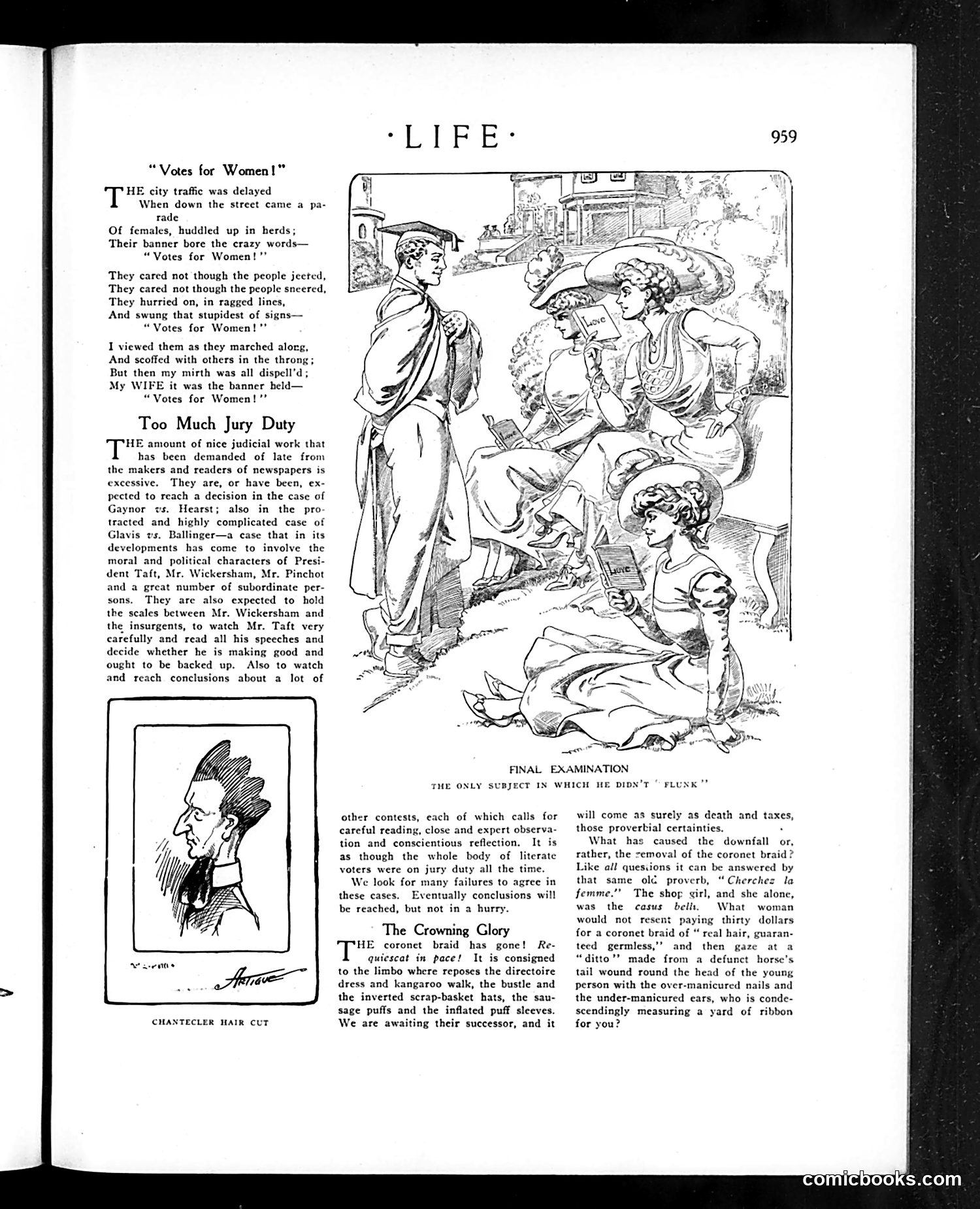
This page contains three satirical pieces reflecting early 20th-century American social debates: **"Votes for Women!"** mocks the women's suffrage movement through a husband's perspective. Initially scoffing at female marchers demanding voting rights, he's mortified to discover his own wife carries their banner—suggesting domestic embarrassment undermines his public ridicule. **"Too Much Jury Duty"** critiques how newspapers burden readers with complex judicial and political cases (likely referencing the Gaynor vs. Hearst case and Glavis vs. Ballinger controversy involving President Taft and conservationist Pinchot). The satire suggests citizens are exhausted by demands to form informed opinions on intricate matters. **"The Crowning Glory"** discusses obsolete women's fashion—the coronet braid hairstyle—blaming working-class "shop girls" for its demise by wearing cheaper imitation versions made from horse hair instead of authentic expensive braids. All three pieces use humor to address contemporary gender, political, and class anxieties.
📄 Transcribed text from this page (OCR, searchable)
Machine-transcribed from the original scan — historical spelling and the odd misread are preserved.
“Votes for Women!” HE city traffic was delayed When down the street came a pa- rade Of females, huddled up in herds; Their banner bore the crazy words— “Votes for Women!" They cared not though the people jeeted, They cared not though the people sneered, They hurried on, in ragged lines, And swung that stupidest of signs— “Votes for Women!" 1 viewed them as they marched alorg, And scoffed with others in the throng; But then my mirth was all dispell’d; My WIFE it was the banner held— “Votes for Women! ’’ Too Much Jury Duty HE amount of nice judicial work that has been demanded of late from the makers and readers of newspapers is excessive. They are, or have been, ex- pected to reach a decision in the case of Gaynor vs. Hearst; also in the pro tracted and highly complicated case of Glavis vs. Ballinger—a case that in its developments has come to involve the moral and political characters of Presi- dent Taft, Mr. Wickersham, Mr. Pinchot and a great number of subordinate per- sons, They are also expected to hold the scales between Mr. Wickersham and the insurgents, to watch Mr. Taft very carefully and read all his speeches and decide whether he is making good and ought to be backed up. Also to watch and reach conclusions about a lot of wens CHANTECLER HAIR CUT FINAL EXAMINATION TME ONLY SUBJECT IN WHICH HE DIDN'T other contests, each of which calls for careful reading, close and expert observa- tion and conscientious reflection. It is as though the whole body of literate voters were on jury duty all the time. We look for many failures to agree in these cases. Eventually conclusions will be reached, but not in a hurry. The Crowning Glory HE coronet braid has gone! Re- quicscat in pace! It is consigned to the limbo where reposes the directoire dress and kangaroo walk, the bustle and the inverted scrap-basket hats, the sau- sage puffs and the inflated puff sleeves. We are awaiting their successor, and it FLUNK"? will come as surely as death and taxes, those proverbial certainties. What has caused the downfall or, rather, the semoval of the coronet braid? Like all quesiions it can be answered by that same old proverb, “Cherches la femme.” The shor girl, and she alone, was the casus bell. What woman would not resent paying thirty dollars for a coronet braid of “ real hair, guaran- teed germless,"” and then gaze at a “ditto”? made from a defunct horse's tail wound round the head of the young person with the over-manicured nails and the under-manicured ears, who is conde- scendingly measuring a yard of ribbon for you?