
Life, 1910-05-26 · page 12 of 44
Life — May 26, 1910 — page 12: what you’re looking at
What you’re looking at
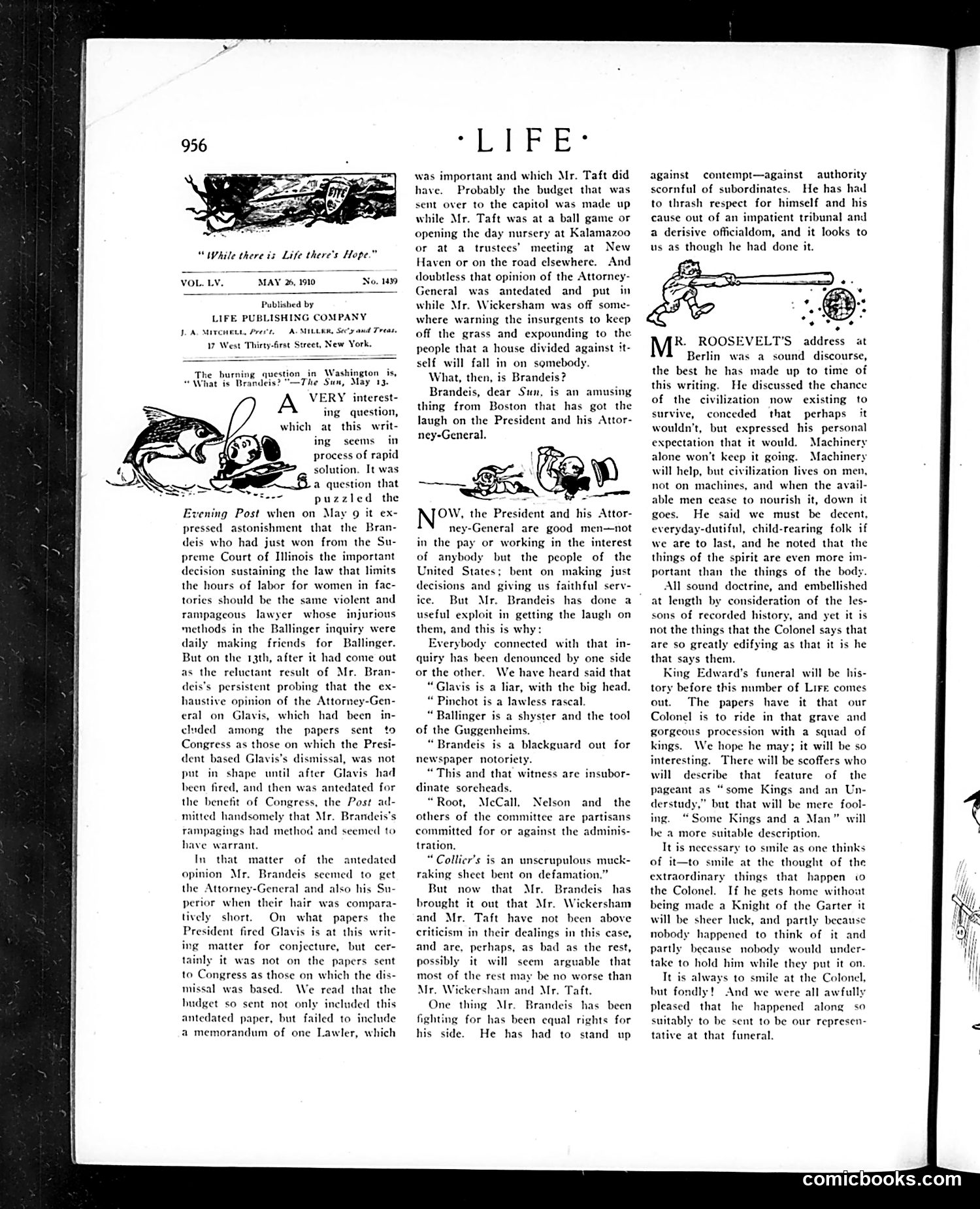
This *Life* magazine page discusses tensions within President William Howard Taft's administration. The text criticizes Attorney General Wickersham and Mr. Taft for their handling of an inquiry, with harsh language: "Glavis is a liar, with the big head," "Pinchot is a lawless rascal," and "Ballinger is a shyster." These appear to reference the Ballinger-Pinchot controversy—a major conservation scandal. The article defends Brandeis (likely Louis Brandeis, the lawyer) and suggests the administration's internal disputes damage its credibility. The satirical cartoons visible mock administrative figures through exaggerated caricatures, typical of *Life* magazine's political satire. The overall piece criticizes the Taft administration's handling of conservation issues and personnel conflicts.
📄 Transcribed text from this page (OCR, searchable)
Machine-transcribed from the original scan — historical spelling and the odd misread are preserved.
“While there iz Life there's Hope.” No. 1439 VOL. LY. MAY 2, 1910 Published by LIFE PUBLISHING COMPANY JA MITCHELL, Prete As MILURR, Sey and Treas, 17 West Thirty-first Street, New York. in Washington is, The Sun, May 13. VERY interest- ing question, which at this writ- ing seems in process of rapid solution. It was a question that puzzled the ning Post when on May 9 it ex- pressed astonishment that the Bran- deis who had just won from the Su- preme Court of Illinois the important decision sustaining the law that limits the hours of labor for women in fac- tories should be the same violent and rampageous lawyer whose injurious methods in the Ballinger inquiry were daily making friends for Ballinger. But on the 13th, after it had come out as the reluctant result of Mr. Bran- deis’s persistent probing that the ex- haustive opinion of the Attorney-Gen- eral on Glavis, which had been in- eluded among the papers sent to Congress as those on which the Presi- dent based Glavis’s dismissal, was not put in shape until after Glavis had been fired, and then was antedated for the benefit of Congress, the Post ad- mitted handsomely that Mr. Brandeis’s rampagings had method and seemed to have warrant. In that matter of the antedated opinion Mr. Brandeis seemed to get the Attorney-General and also his Su- perior when their hair was compara- tively short. On what papers the President fired Glavis is at this writ- ing matter for conjecture, but cer- tainly it was not on the papers sent to Congress as those on which the dis- missal was based. We read that the Indget so sent not only included this antedated paper, but failed to include a memorandum of one Lawler, which question *L SP E* was important and which Mr. Taft did have. Probably the budget that was sent over to the capitol was made up while Mr. Taft was at a ball game or opening the day nursery at Kalamazoo or at a trustees’ meeting at New Haven or on the road elsewhere. And doubtless that opinion of the Attorne: General was antedated and put in while Mr. Wickersham was off some- where warning the insurgents to keep off the grass and expounding to the people that a house divided against self will fall in on somebody. What, then, is Brandeis? Brandeis, dear Sun, is an amusing thing from Boston that has got the laugh on the President and his Attor- ney-General. ca — OW, the President and his Attor- ney-General are good men—not in the pay or working in the interest of anybody but the people of the United States; bent on making just decisions and giving us faithful serv- ice. But Mr. Brandeis has done a useful exploit in getting the laugh on them, and this is why: Everybody connected with that in- quiry has been denounced by one side or the other. We have heard said that “Glavis is a liar, with the big head. “ Pinchot is a lawless rascal. “Ballinger is a shyster and the tool of the Guggenheims. Brandeis is a blackguard out for newspaper notorie “This and that witness are insubor- dinate sorcheads. “Root, McCall, Nelson and the others of the committee are partisans committed for or against the admini: tration. “Collicr’s is an unscrupulous muck- raking sheet bent on defamation.” But now that Mr. Brandeis has brought it out that Mr. Wickersham and Mr. Taft have not been above criticism in their dealings in this case, and are, perhaps, as bad as the rest, possibly it will seem arguable that most of the rest may be no worse than Mr. Wickersham and Mr. Taft. One thing Mr. Brandeis has been fighting for has been equal rights for his side. He has had to stand up against contempt—against authority scornful of subordinates. He has had to thrash respect for himself and his cause out of an impatient tribunal and a derisive officialdom, and it looks to us as though he had done it. R. ROOSEVELT’S address at Berlin was a sound discourse, the best he has made up to time of this writing. He discussed the chance of the civilization now existing to survive, conceded that perhaps it wouldn't, but expressed his personal expectation that it would. Machinery alone won't keep it going. Machinery will help, but civilization lives on men, not on machines, and when the avail- able men cease to nourish it, down it goes. He said we must be decent, everyday-dutiful, child-rearing folk if we are to last, and he noted that the things of the spirit are even more im- portant than the things of the body. All sound doctrine, and embellished at length by consideration of the les- sons of recorded history, and yet it is not the things that the Colonel says that are so greatly edifying as that it is he that says them. King Edward’s funeral will be his- tory before this number of Lire comes out. The papers have it that our Colonel is to ride in that grave and gorgeous procession with a squad of kings. We hope he may; it will be so interesting. There will be scoffers who will describe that feature of the pageant as “some Kings and an Un- derstudy,” but that will be mere fool- ing. “Some Kings and a Man” will be a more suitable description. It is necessary to smile as one thinks of it—to smile at the thought of the extraordinary things that happen 10 the Colonel. If he gets home without being made a Knight of the Garter it will be sheer luck, and partly because nobody happened to think of it and partly because nobody would under- take to hold him while they put it on. It is always to smile at the Colonel, but fondly! And we were all awfully pleased that he happened along so suitably to be sent to be our represen- tative at that funeral. comicbooks.com