
Life, 1910-05-26 · page 26 of 44
Life — May 26, 1910 — page 26: what you’re looking at
What you’re looking at
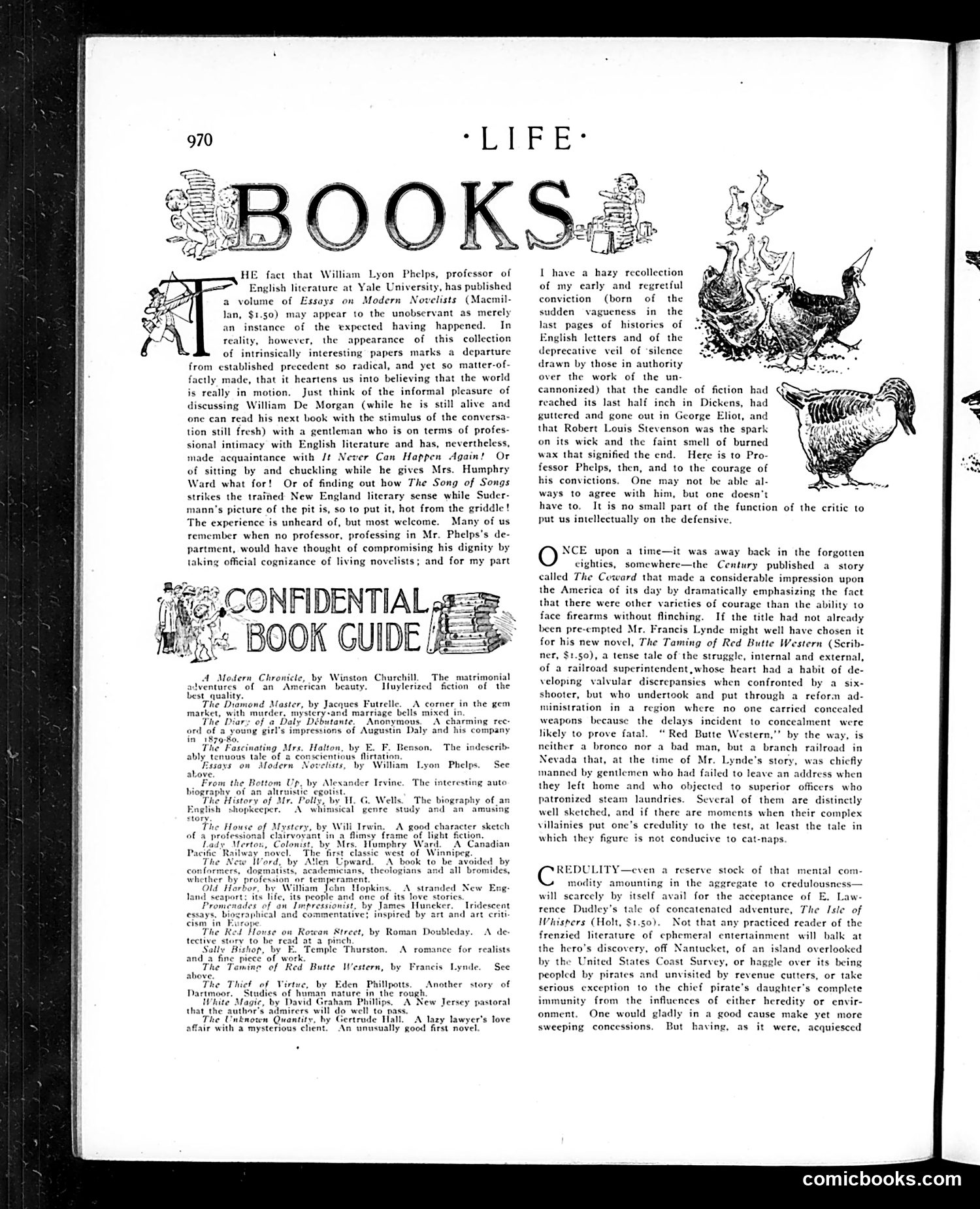
This is page 970 of Life's book review section, featuring Professor William Lyon Phelps of Yale University and his new essay collection on modern novelists. **The Main Point:** The article celebrates Phelps as a radical figure—not for his scholarship itself, but for breaking academic protocol by publicly discussing *living* authors. Traditionally, academic dignity required professors to ignore contemporary literature. Phelps's willingness to critique and engage with working writers like Mrs. Humphry Ward and discuss modern fiction represents surprising progress. **The Satire:** The author playfully mocks old-guard academia's pretension and silence about modern work. He recalls the depressing conviction that serious fiction had essentially died with Dickens, barely sputtering on with Stevenson. Phelps's openness offers intellectual hope. **The "Confidential Book Guide":** Lists contemporary novels reviewed for educated readers, bridging academic literary criticism with popular taste. The cartoonish margin illustrations feature period characters reinforcing the literary atmosphere.
📄 Transcribed text from this page (OCR, searchable)
Machine-transcribed from the original scan — historical spelling and the odd misread are preserved.
fact that William Lyon Phelps, professor of lish literature at Yale University, has published a volume of Essays on Modern Novelists (Macmil- lan, $1.50) may appear to the unobservant as merely an instance of the expected having happened. In however, the appearance of this collection of intrinsically interesting papers marks a departure from established precedent so radical, and yet so matter-of- factly made, that it heartens us into believing that the world is really in motion, Just think of the informal pleasure of discussing William De Morgan (while he is still alive and one can read his next book with the stimulus of the conversa- tion still fresh) with a gentleman who is on terms of profes- sional intimacy with English literature and has, nevertheless, made acquaintance with [¢ Never Can Happen Again! Or of sitting by and chuckling while he gives Mrs. Humphry Ward what for! Or of finding out how The Song of Songs strikes the trained New England literary sense while Suder- mann’s picture of the pit is, so to put it, hot from the griddle! The experience is unheard of, but most welcome. Many of us remember when no professor, professing in Mr. Phelps’s de- partment, would have thought of compromising his dignity by taking official cognizance of living novelists; and for my part (ies GC CONFIDENTIAL, ie BOOK GUIDE { A Modern Chronicte, by Winston Churchill. The matrimonial alventures of an American beauty. Huylerized fiction of the best_quality. The Diamond Master, by Jacques Futrelle. A corner in the gem market, with murder, mystery-and marriage bells mixed in The Diars of a Daly Débutante, Anonymous, A charming rec ord of a young girl's impressions of Augustin Daly and his company in 1879-80. The Fascinating Mrs. Hatton, . F. Benson, The indeserit- tale of a consi tation. . Modern Nove y William Lyon Phelps, See Jp. by Mexander Irvine. The interesting auto biography of an altruistic egotist. The History of Mr. Polly, by I. G. Wells. ‘The biography of an English shopkeeper. A whimsical genre study and an amusing story The House of Mystery, by Wil Irwin, A good character sketch na flimsy frame of light fiction. Humphry W: A Canadian The first classic west of Winnipeg Word. n Upward. A book to be avoided by . dogmatists, academicians, theologians and all bromides, hether by’ profession or temperament Old Hoi William fobn tlopking. A. stranded New Eng land seapor its people and one of its love stories. f an Impressi by James Huneker. Iridescent mentative; inspired by art and art criti A de Thurston. A romance for realists and.a fine piece’ of work. The ine of Red Butte Western, by Francis Lynde. See above. The Thict of Virtue, by Eden Phillpotts. Another story of Dartmoor. Studies of human nature in the rough White Magic, by David am Phillips. A New Jersey pastoral that the author's admirers will do well to. pass. The Untnoten Quantity, by Gertrude Hall. A lazy lawyer's love affair with a mysterious chent. An unusually good first novel. I have a hazy recollection of my carly and regretful conviction (born of the sudden vagueness in the last. pages of histories of glish letters and of the deprecative veil of ‘silence drawn by those in authority over the work of the un- cannonized) that the candle of fiction had reached its last half inch in Dickens, had guttered and gone out in George Eliot, and that Robert Louis Stevenson was the spark on its wick and the faint smell of burned wax that signified the end. Here is to Pro- fessor Phelps, then, and to the courage of his convictions. One may not be able al- ways to agree with him, but one doesn’t have to. It is no small part of the function of the critic to put us intellectually on the defensive. O* upon a time—it was away back in the forgotten ties, somewhere—the Century published a story called The Coward that made a considerable impression upon the America of its day by dramatically emphasizing the fact that there were other varicties of courage than the ability to face firearms without flinching. If the title had not already been pre-empted Mr. Francis Lynde might well have chosen it for his new novel, The Taming of Red Butte Western (Scrib- ner, $1.50), a tense tale of the struggle, internal and external, of a railroad superintendent ,whose heart had a habit of de- veloping valvular discrepansies when confronted by a six- shooter, but who undertook and put through a reform ad- ministration in a region where no one carried concealed pons because the delays incident to concealment were likely to prove fatal. “Red Butte Western,’” by the way, is neither a bronco nor a bad man, but a branch railroad in Nevada that, at the time of Mr. Lynde’s story, was chiefiy manned by gentlemen who had failed to leave an address when they left home and who objected to superior officers who patronized steam laundries. Several of them are distinctly well sketched, and if there are moments when their complex Villainies put one’s credulity to the test, at least the tale in which they figure is not conducive to cat-naps. REDULITY—even a reserve stock of that mental co modity amounting in the aggregate to credulousness— will scarcely by itself avail for the acceptance of E. Law- rence Dudley's tale of concatenated adventure, The Isle of IWhispers (Holt, $1.50). Not that any practiced reader of the frenzied literature of ephemeral entertainment will balk at the hero's discovery, off Nantucket, of an island overlooked by the United States Coast Survey, or haggle over its being peopled by pirates and unvisited by revenue cutters, or take serious exception to the chief pirate’s daughter's complete immunity from the influences of either heredity or envir- onment. One would gladly in a good cause make yet more sweeping concessions. But having, as it were, acquiesced Eos comicbooks.com