
Life, 1910-05-26 · page 27 of 44
Life — May 26, 1910 — page 27: what you’re looking at
What you’re looking at
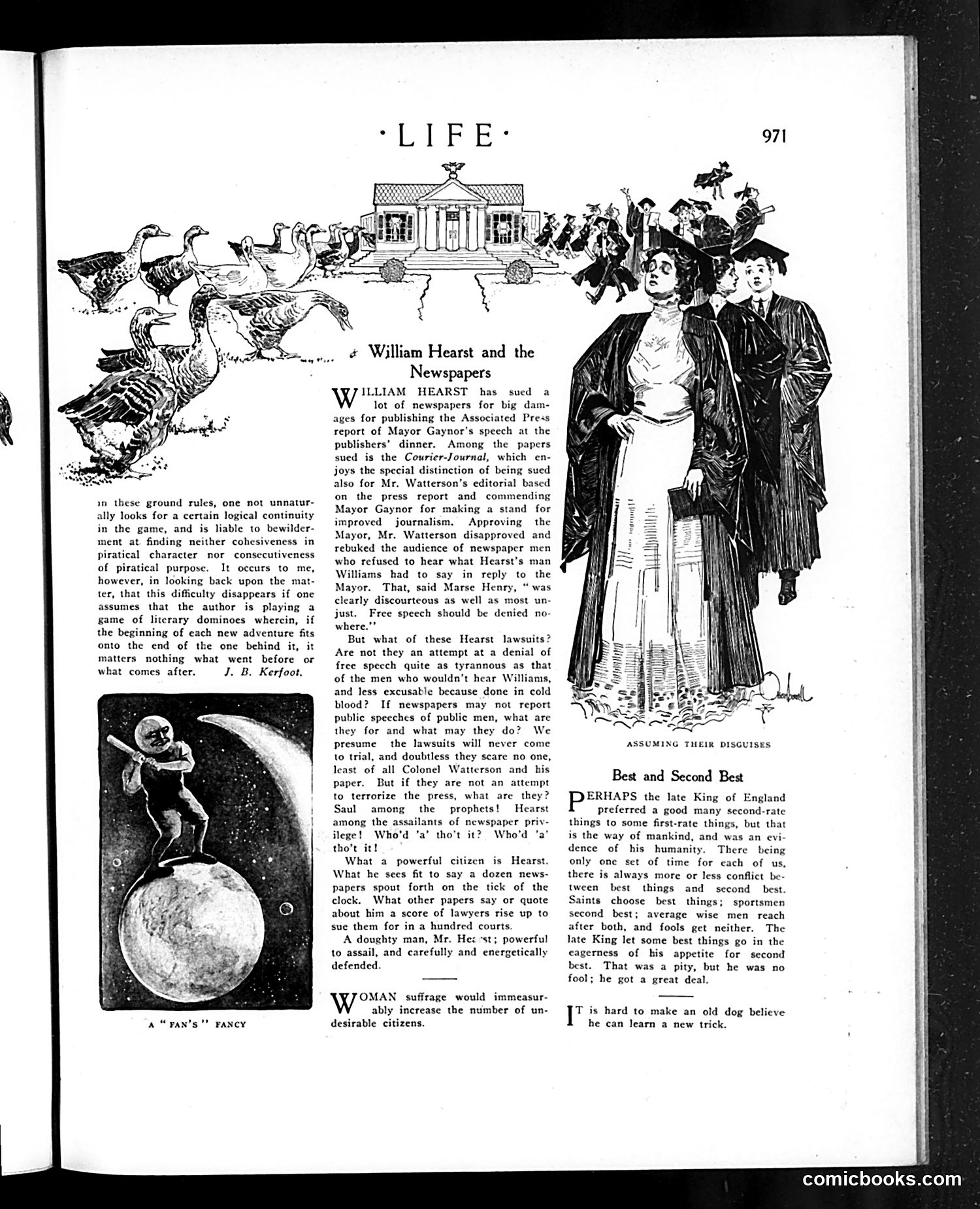
This page contains editorial commentary on **William Hearst's newspaper lawsuits** against publications reporting Mayor Gaynor's speech at a publishers' dinner. The satire's point: Hearst is suing newspapers (including the *Courier-Journal*) for publishing the Associated Press account and editorial commentary—an attempt to suppress free speech that the writer finds hypocritical. The piece mocks Hearst's power to control media narrative while simultaneously attacking press freedom, calling him "Saul among the prophets" (an unexpected figure doing something contrary to his nature). The cartoon illustration shows three figures "assuming their disguises"—likely representing newspaper editors or publishers adopting false personas, though the specific identities are unclear from the image alone. A secondary article discusses King Edward's preference for "second best" pleasures over "best" things, suggesting moral compromise.
📄 Transcribed text from this page (OCR, searchable)
Machine-transcribed from the original scan — historical spelling and the odd misread are preserved.
in these ground rules, one not unnatur- ally looks for a certain logical continuity in the game, and is liable to bewilder- ment at finding neither cohesiveness in piratical character nor consccutiveness of piratical purpose. It occurs to me, however, in looking back upon the mat- ter, that this difficulty disappears if one assumes that the author is playing a game of literary dominoes whercin, if the beginning of each new adventure fits onto the end of the one behind it, it matters nothing what went before or what comes after. J. B. Kerfoot. ¢ William Hearst and the Newspapers ILLIAM HEARST has sued a lot of newspapers for big dam- ages for publishing the Associated Press report of Mayor Gaynor's speech at the publishers’ dinner. Among the papers sued is the Courier-Journal, which en- joys the special distinction of being sued also for Mr. Watterson’s editorial based on the press report and commending Mayor Gaynor for making a stand for improved journalism. Approving the Mayor, Mr. Watterson disapproved and rebuked the audience of newspaper men who refused to hear what Hearst’s man Williams had to say in reply to the Mayor. That, said Marse Henry, “was clearly discourteous as well as most un- just. Free speech should be denied no- where.’ But what of these Hearst lawsuits? Are not they an attempt at a denial of free specch quite as tyrannous as that of the men who wouldn’t hear Williams, and less excusable because done in cold blood? If newspapers may not report public speeches of public men, what are they for and what may they do? We presume the lawsuits will never come to trial, and doubtless they scare no one, least of all Colonel Watterson and his paper. But if they are not an attempt to terrorize the press, what are they? Saul among the prophets! Hearst among the assailants of newspaper priv- ilege! Who'd 'a’ tho’t it? Who'd ‘a’ tho’t it! What a powerful citizen is Hearst. What he sces fit to say a dozen news- papers spout forth on the tick of the clock. What other papers say or quote about him a score of lawyers rise up to sue them for in a hundred courts A doughty man, Mr. Hez “st; powerful to assail, and carefully and energetically defended. OMAN suffrage would immeasur- ably increase the number of un- desirable citizens. ASSUMING THEIR DISGUISES Best and Second Best PERHAPS the late King of England preferred a good many second-rate things to some first-rate things, but that is the way of mankind, and was an evi- dence of his humanity. There being only one set of time for each of us, there is always more or less conflict be- tween best things and second best. Saints choose best things; sportsmen second best; average wise men reach after both, and fools get neither. The late King let some best things go in the eagerness of his appetite for second best. That was a pity, but he was no fool; he got a great deal. T is hard to make an old dog believe he can learn a new trick. comicbooks.com