
A complete issue · 40 pages · 1910
Life — May 19, 1910
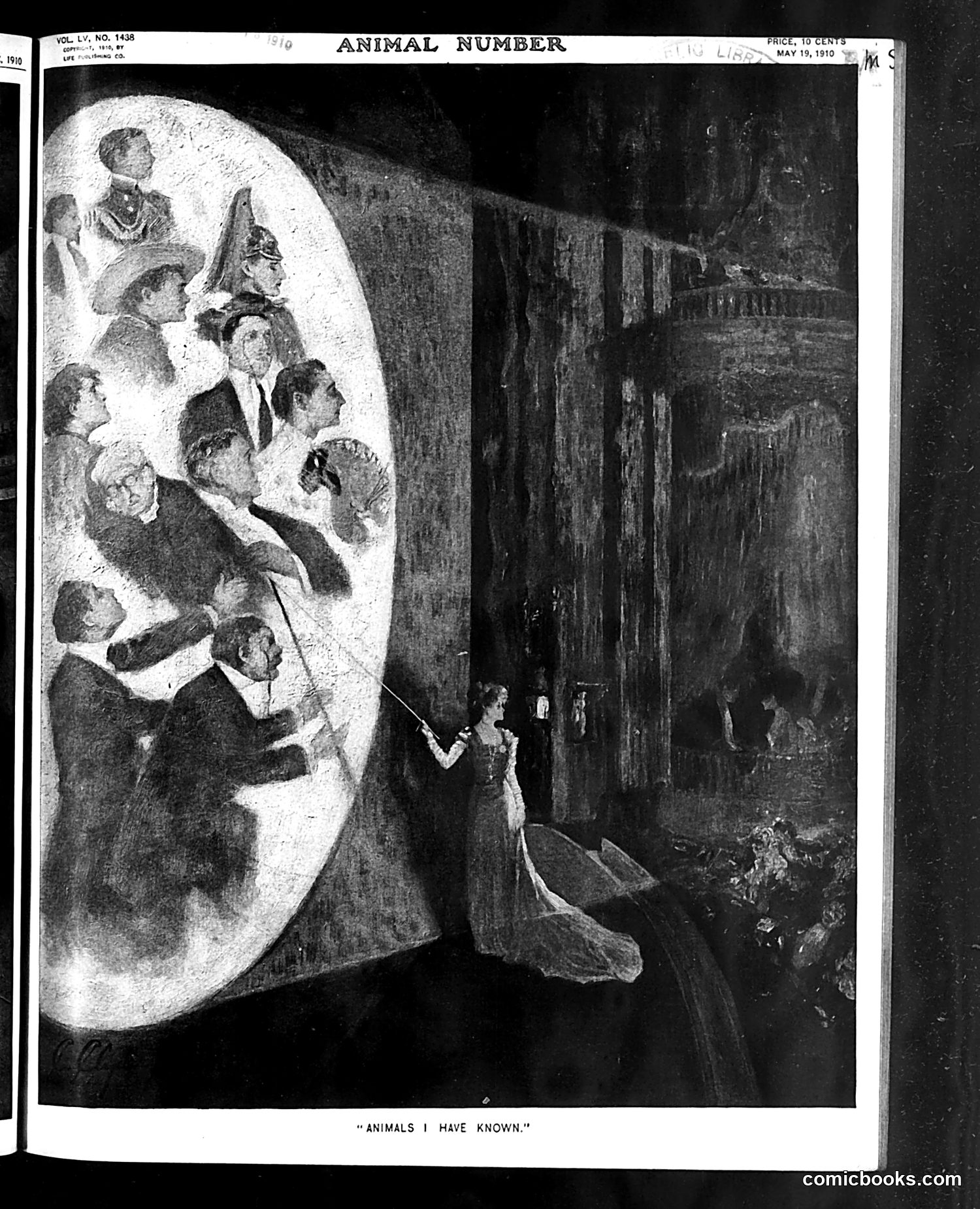
This Life magazine page (May 19, 1910) presents a satirical comparison. On the left, a large profile silhouette contains multiple human faces—appearing to represent various political or public figures of the era crowded together like animals in a head. On the right, a woman in Edwardian dress gestures toward what appears to be an actual zoo or animal enclosure at night. The title "Animals I Have Known" is the joke: the cartoon suggests that certain human figures—likely politicians or celebrities—are no better than actual animals, worth viewing in a zoo. This was common Progressive Era satire, using animal metaphors to mock public figures' intelligence or behavior. The specific identities of the figures in the profile are unclear from the image alone.
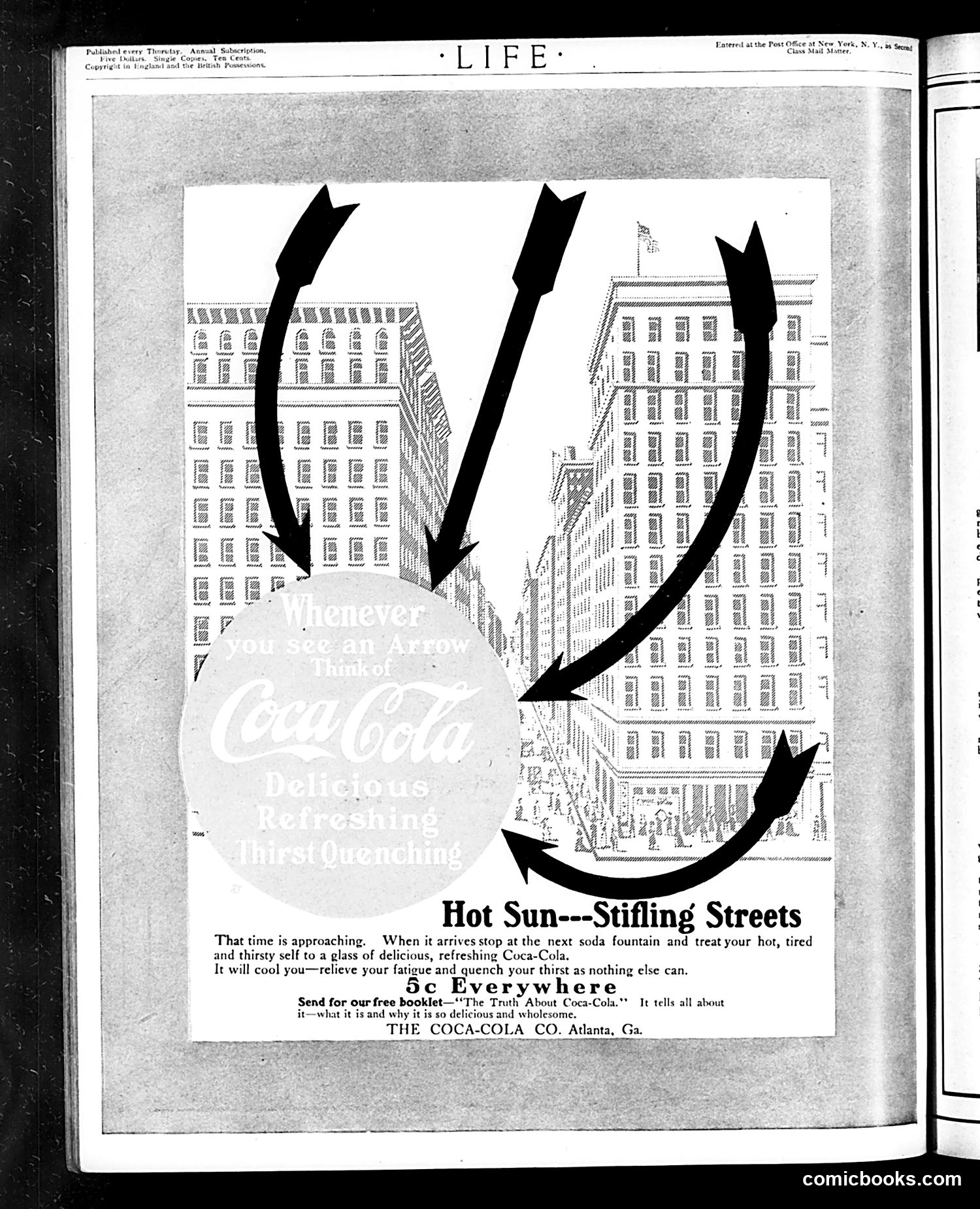
This page is **primarily a Coca-Cola advertisement**, not political satire. The large graphic shows a smiling face formed by arrows pointing downward (like a frown) that curves upward (transforming into a smile), set against a cityscape backdrop. The visual metaphor represents hot, difficult summer conditions ("Hot Sun—Stifling Streets") that depress mood, then Coca-Cola's refreshment "quenching" that discomfort and reversing the emotional downturn. The text emphasizes the drink's cooling, thirst-relieving properties. This is commercial messaging using visual wordplay—the face transformation illustrates mood improvement through consumption—rather than political commentary or satire typical of Life magazine's editorial content.
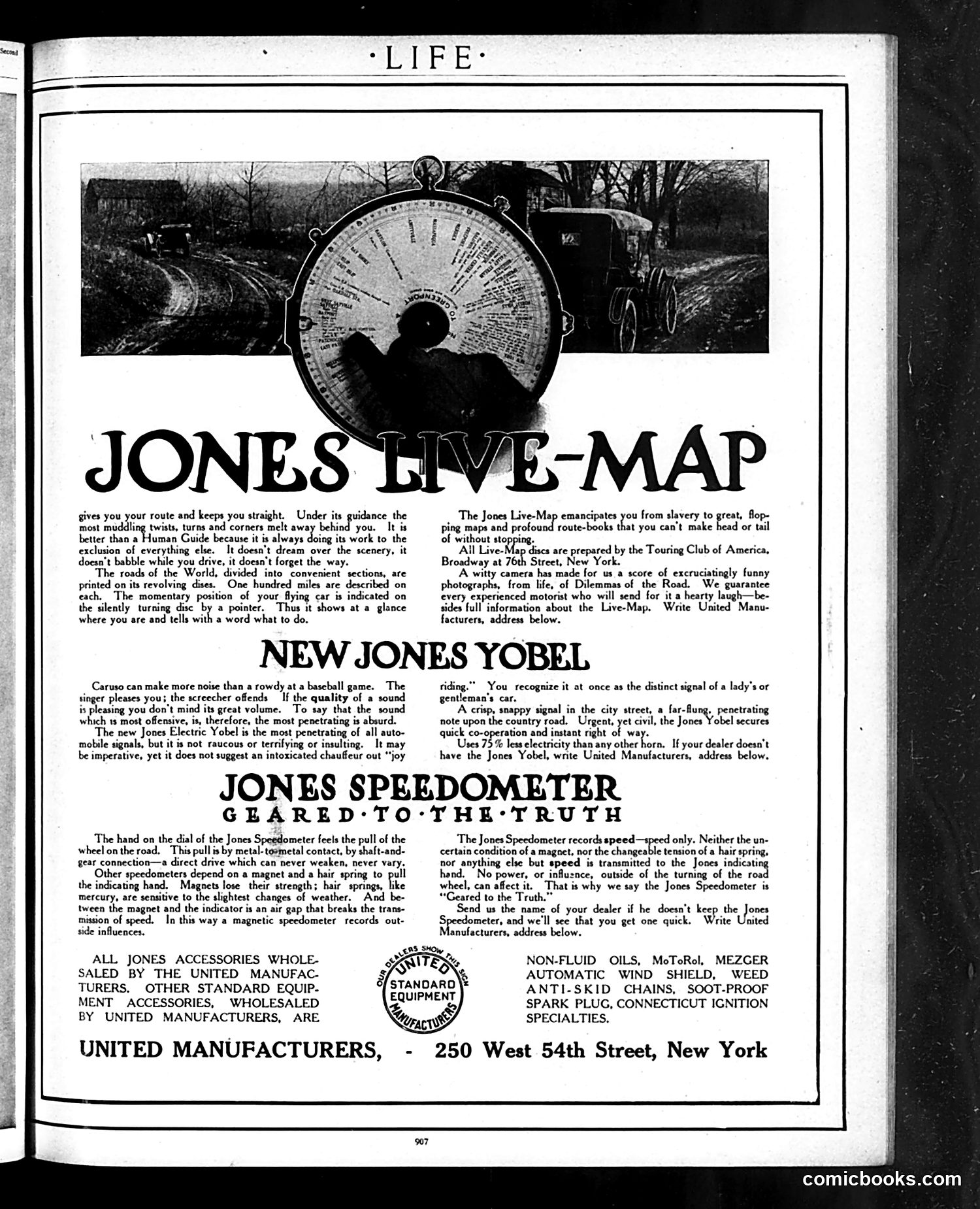
This page is primarily **advertising**, not satire or political commentary. It promotes three Jones brand automotive accessories manufactured by United Manufacturers (250 West 54th Street, New York): 1. **Jones Live-Map** - a navigation aid that guides drivers by indicating their route on a rotating disc, keeping them oriented on roads 2. **Jones Yobel** - an electric horn designed to produce distinctive signals for safety and communication on roads 3. **Jones Speedometer** - described as "geared to the truth," a speedometer measuring actual road speed The page uses humorous language and small illustrations of early automobiles to market these products to motorists. The "humor" is largely in the marketing copy's tone rather than any satire—these are straightforward product advertisements dressed up with witty descriptions of their practical benefits.
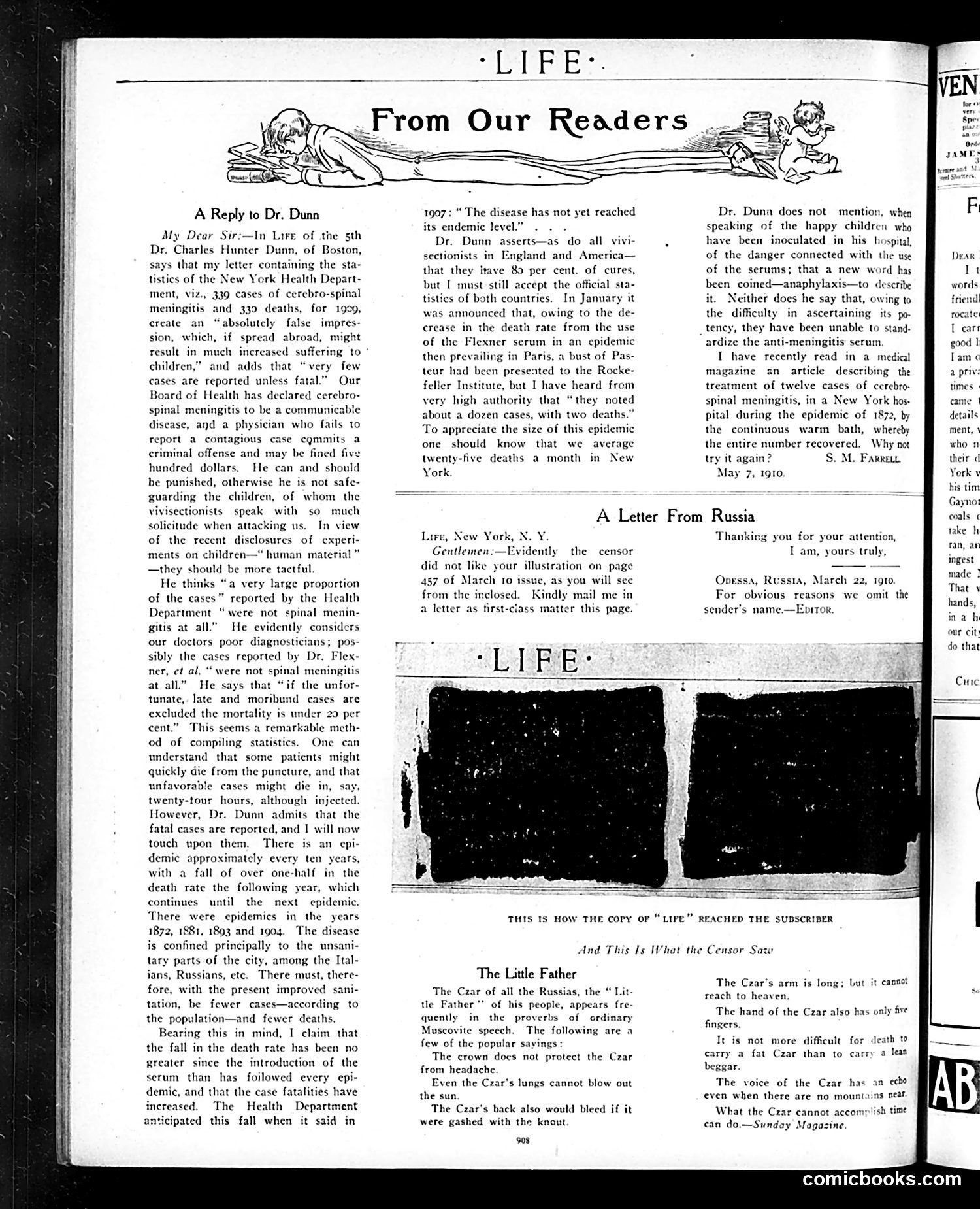
This page consists primarily of reader letters and editorial content rather than political cartoons. The main sections include: **"A Reply to Dr. Dunn"** — a lengthy response to Dr. Charles Hunter Dunn of Boston regarding reported cebrospinal meningitis statistics in New York for 1909. The writer disputes Dunn's characterization of cases, noting that fatality rates and case classifications may be incomplete. **"A Letter From Russia"** — a brief note from Odessa regarding a censored illustration on page 437. **"The Little Father"** — a humorous piece presenting Russian proverbs about the Czar, likely satirizing Russian autocracy and the Czar's power. The image shows what appears to be a heavily redacted or blacked-out section, illustrating the mentioned censorship issue.
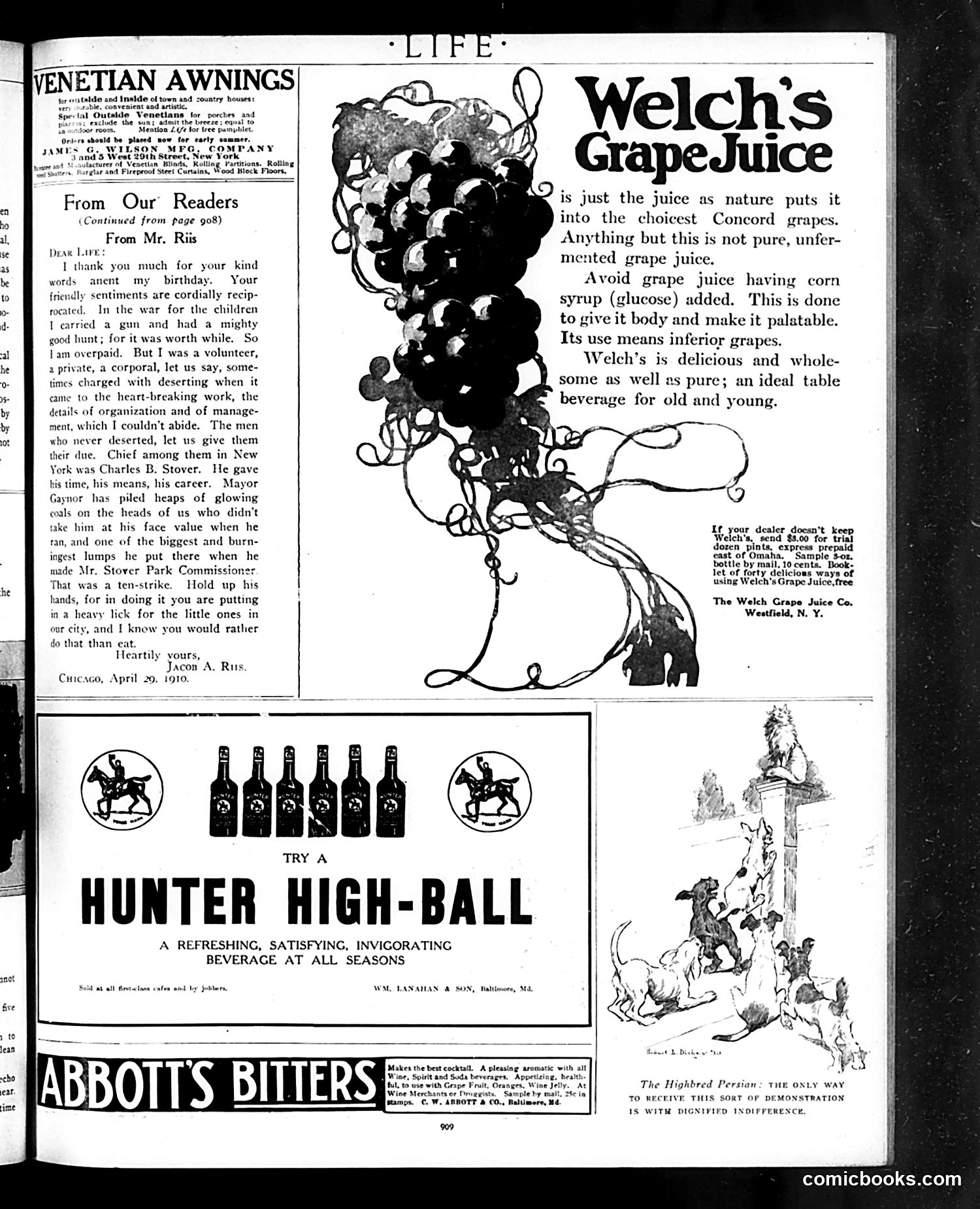
This page is primarily **advertising rather than political satire**. The main content includes: 1. **Venetian Awnings ad** (top left): Product advertisement 2. **"From Our Readers" letter** (left column): A 1910 Chicago reader thanks Life for birthday wishes and discusses his WWI service, mentioning NYC officials like Mayor Gaynor and Charles Stover (Park Commissioner) 3. **Welch's Grape Juice ad** (top right): Large advertisement emphasizing purity and natural ingredients 4. **Hunter High-Ball ad** (center): Beverage advertisement 5. **Abbott's Bitters ad** (bottom left): Medicinal drink advertisement 6. **"The Highbred Persian" cartoon** (bottom right): Small illustration about demonstrating a cat, labeled as "the only way to receive this sort of demonstration is with dignified indifference" The page reflects early 1900s consumer culture with minimal political commentary.
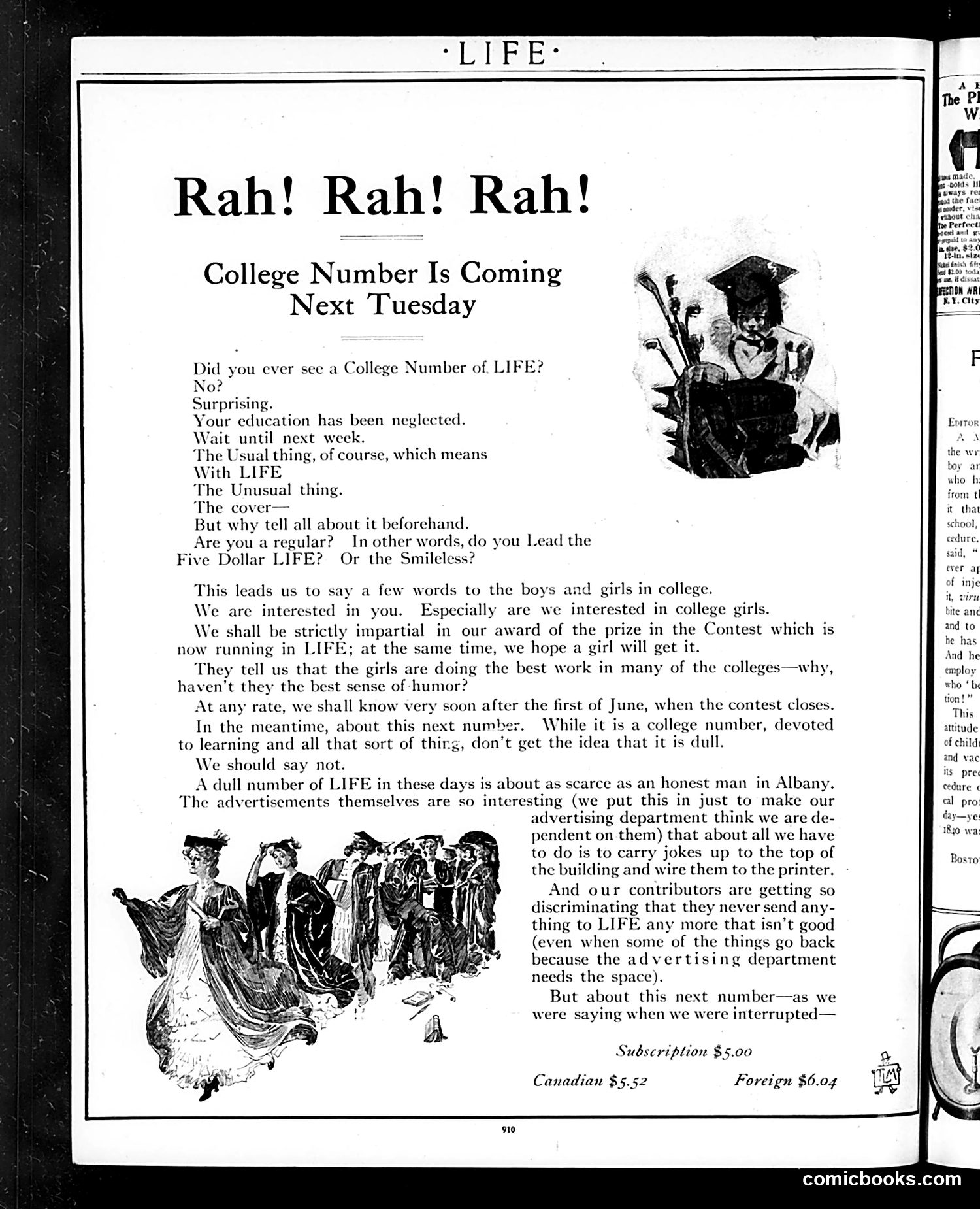
This page announces an upcoming "College Number" issue of Life magazine, targeting college students and promoting a contest (apparently featuring college girls, which the editors note hopefully). The two illustrations depict college life stereotypes: the upper cartoon shows a graduate in academic regalia surrounded by flora and pursuits of learning; the lower illustration portrays female college students in flowing dresses engaged in social activities. The satire mocks Life's own advertising practices—the editors humorously admit their advertisements are so numerous they must "carry jokes up to the top of the building and wire them to the printer" for space. They joke that an issue without good content "is about as scarce as an honest man in Albany," poking fun at both their publication quality and contemporary politics/morality.
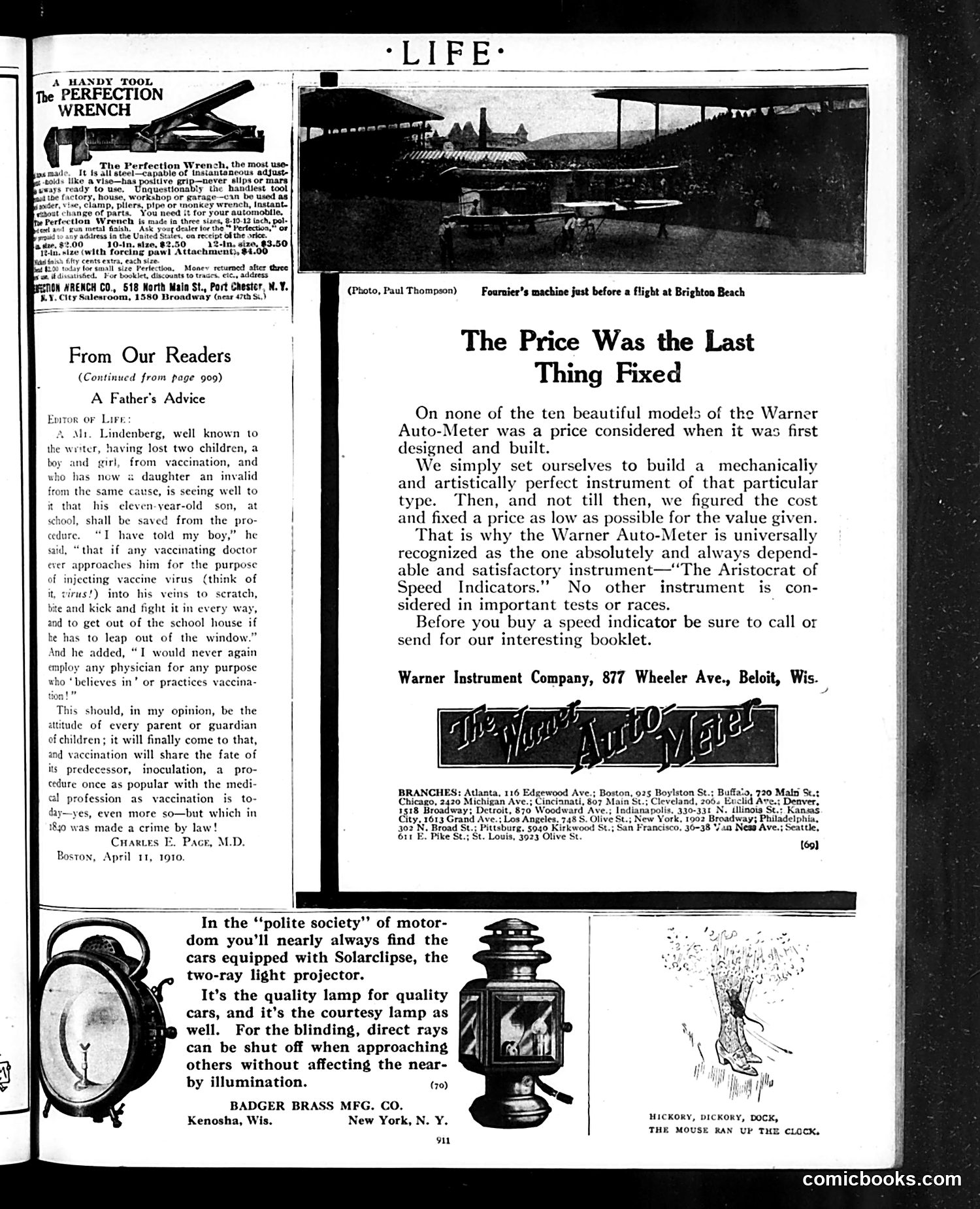
This page is primarily **advertising and miscellaneous content** rather than political satire or comics. The main elements include: 1. **"The Perfection Wrench"** advertisement (top left) — a tool product pitch 2. **"From Our Readers" column** — a letter from Dr. Charles E. Page criticizing parents who avoid vaccinating children, arguing vaccination should become legally mandatory like it has in some places 3. **Warner Auto-Meter advertisement** — promoting speed indicators for automobiles 4. **Solarclipse lamp advertisement** — a motorcar headlight product 5. **Small illustration** — "Hickory, Dickory, Dock, The Mouse Ran Up the Clock," a nursery rhyme illustration (bottom right) The only editorial content is the anti-vaccination skepticism letter, which represents early-1900s medical debate. The rest is purely commercial messaging typical of Life magazine's revenue model.
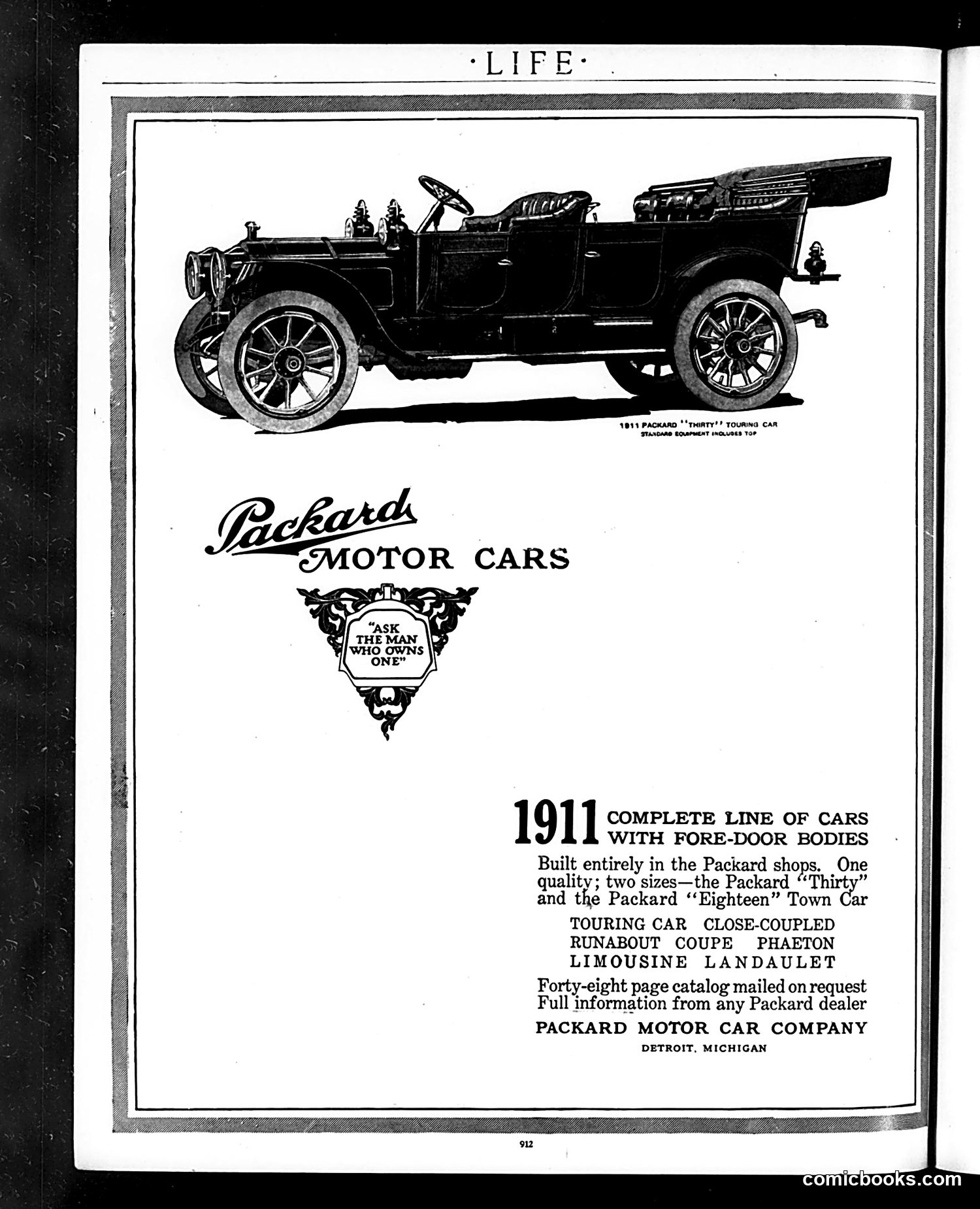
This is a **full-page advertisement**, not a cartoon or satirical content. It promotes Packard Motor Cars' 1911 automobile lineup featuring the "Thirty" touring car shown in the detailed illustration at top. The ad emphasizes that Packard manufactured complete vehicles in their own shops, offering "one quality; two sizes" in models including the "Thirty" and "Eighteen" town cars, plus touring, runabout, coupe, phaeton, limousine, and landaulet variants. The tagline "Ask the man who owns one" became Packard's famous marketing slogan, implying satisfied customer testimonials validated the brand's quality and prestige. This represents early automotive advertising aimed at wealthy buyers during the pioneer motorcar era.
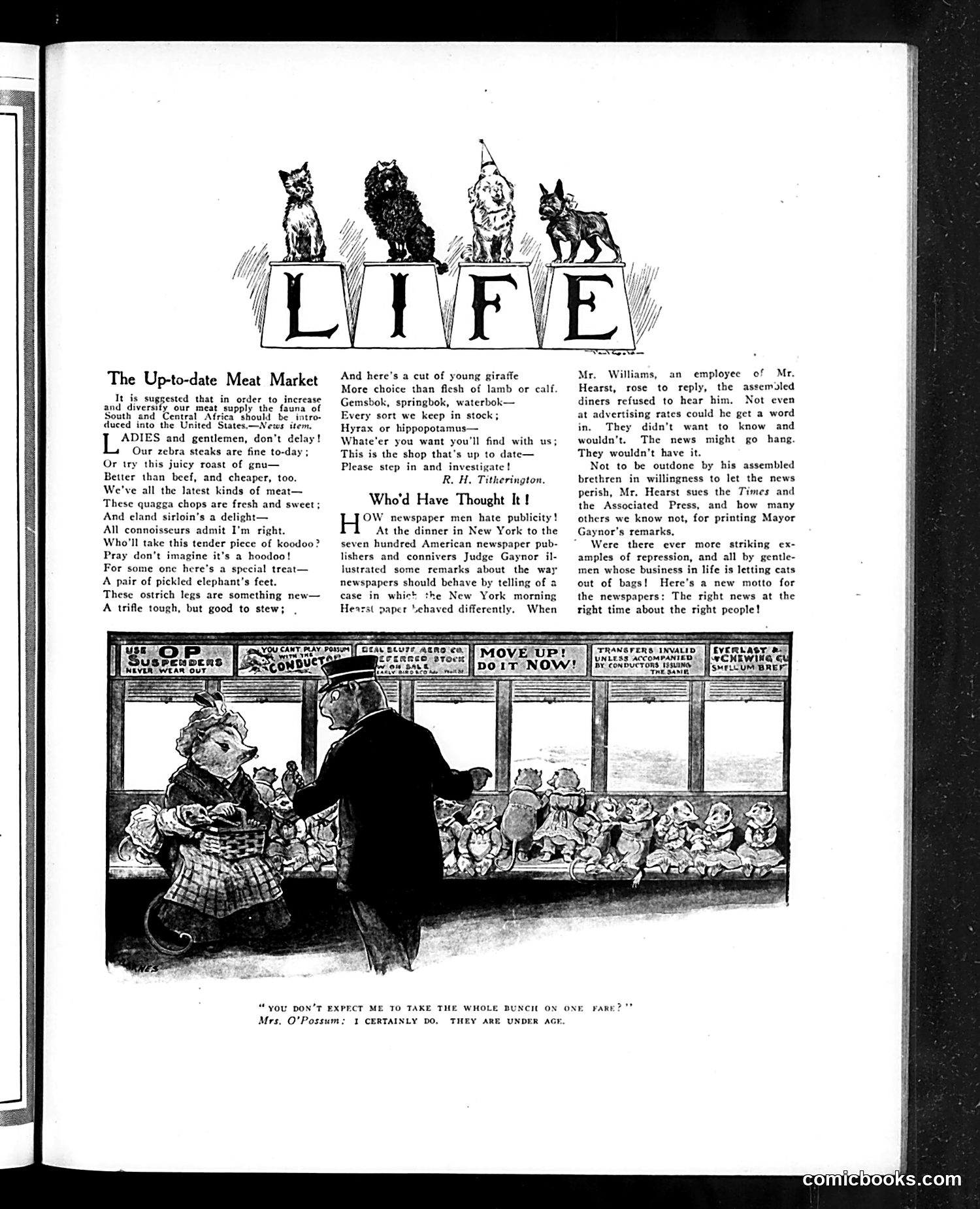
This page contains three distinct pieces of early 20th-century American satire: **"The Up-to-date Meat Market"** (top) mocks modern commercial practices by sarcastically listing absurd animal products (giraffe, camel, hippopotamus) supposedly in stock, suggesting butchers were making outlandish claims about their inventory. **"Who'd Have Thought It!"** (middle text) critiques American newspaper behavior during wartime, specifically how the *New York Herald* covered news differently than competitors. The satire suggests newspapers sensationalized or manipulated war reporting for competitive advantage. **The cartoon below** depicts Mrs. O'Possum at a shop window with many children, asking a man to take them all on "one fare"—likely satirizing working-class families struggling with transportation costs or vendor pricing during an economically difficult period.
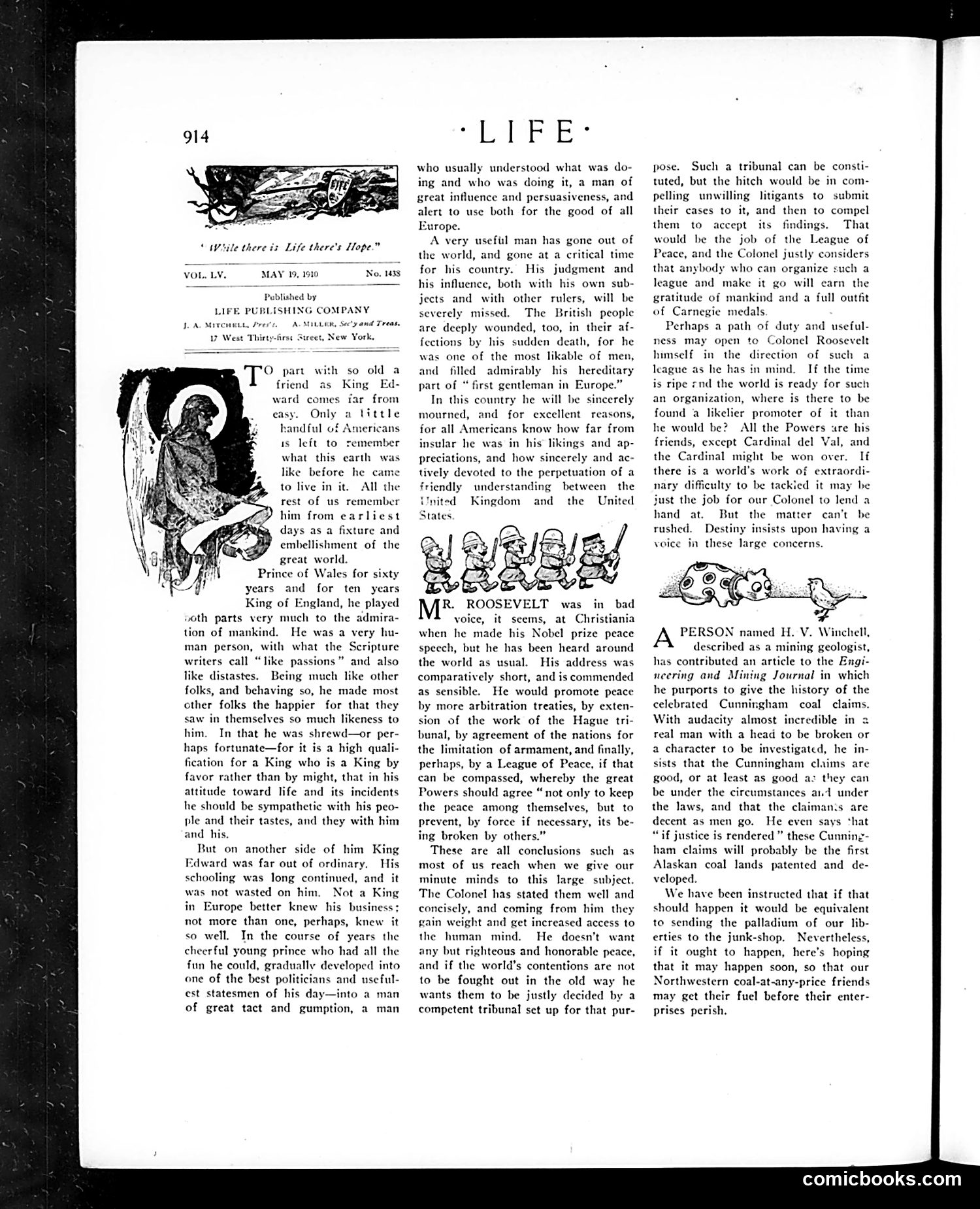
This page contains two editorial pieces, not political cartoons. The main article mourns the recent death of an unnamed British statesman described as influential and beloved in both Britain and America—likely referring to a prominent figure who died during WWI's aftermath. The second piece, titled "A PERSON named H. V. Winchell," satirizes claims made in the *Engineering and Mining Journal* about Cunningham coal deposits in Alaska. The author mocks these assertions as dubious, suggesting the journal may have published unreliable geological claims. The satire targets credulous promotion of commercial interests through pseudo-scientific journalism. The page reflects post-WWI concerns about international relations and domestic commercial fraud.
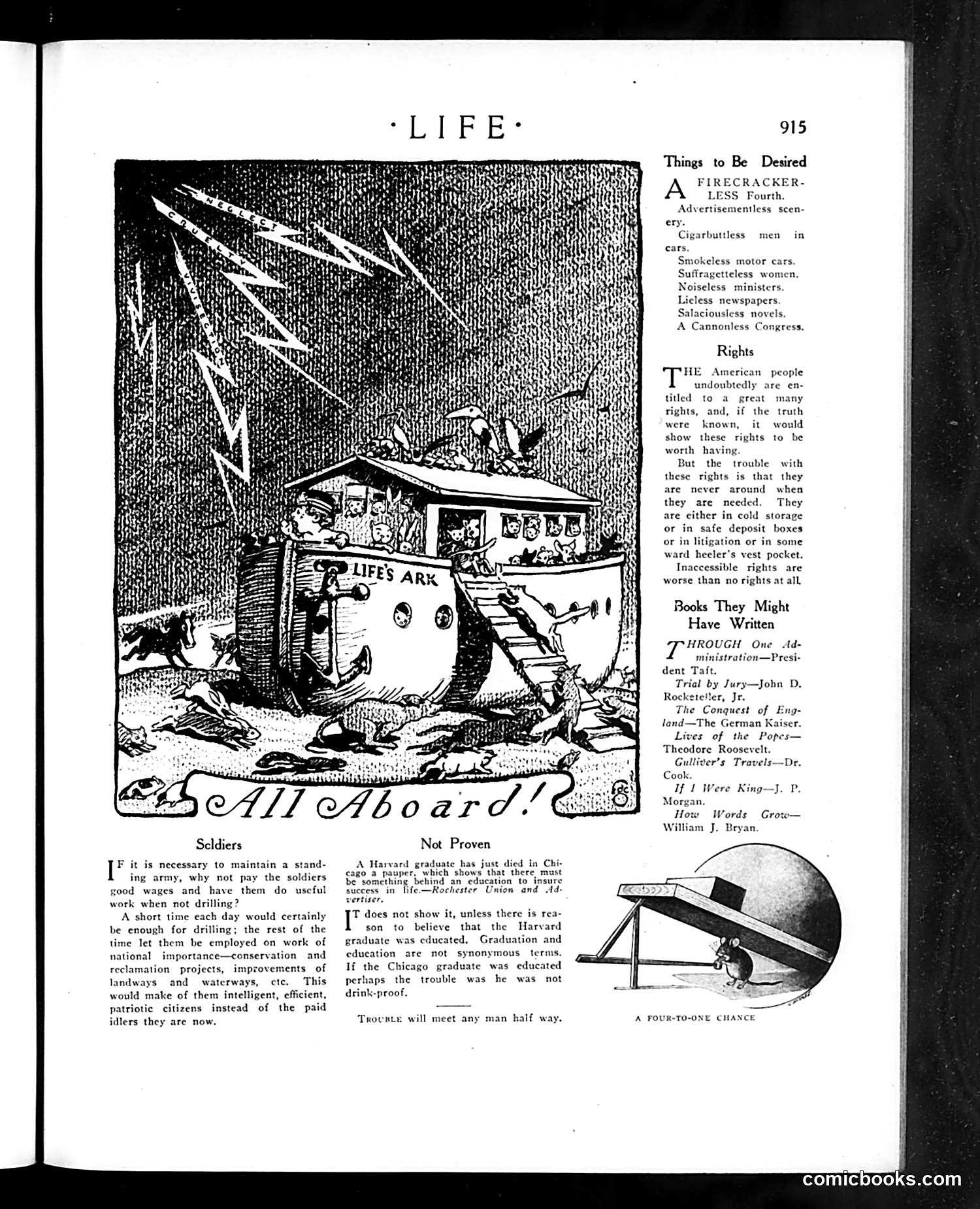
The main cartoon depicts "Life's Ark"—a vessel packed with animals and people, referencing Noah's Ark. Lightning strikes above, suggesting divine judgment or crisis. The satire appears to critique American society by showing various social types boarding a metaphorical ark, implying the nation needs salvation or escape from current conditions. The accompanying articles address social concerns: "Soldiers" argues soldiers deserve better compensation than drilling wages; "Not Proven" questions whether a Harvard graduate's education actually matters if he lacks common sense (referencing drink-proofing). "A Firecracker-Less Fourth" and the "Things to Be Desired" list mock what Life considers absurd modern wishes—smokeless cars, silent ministers—suggesting satirical commentary on contemporary American preferences and social anxieties.
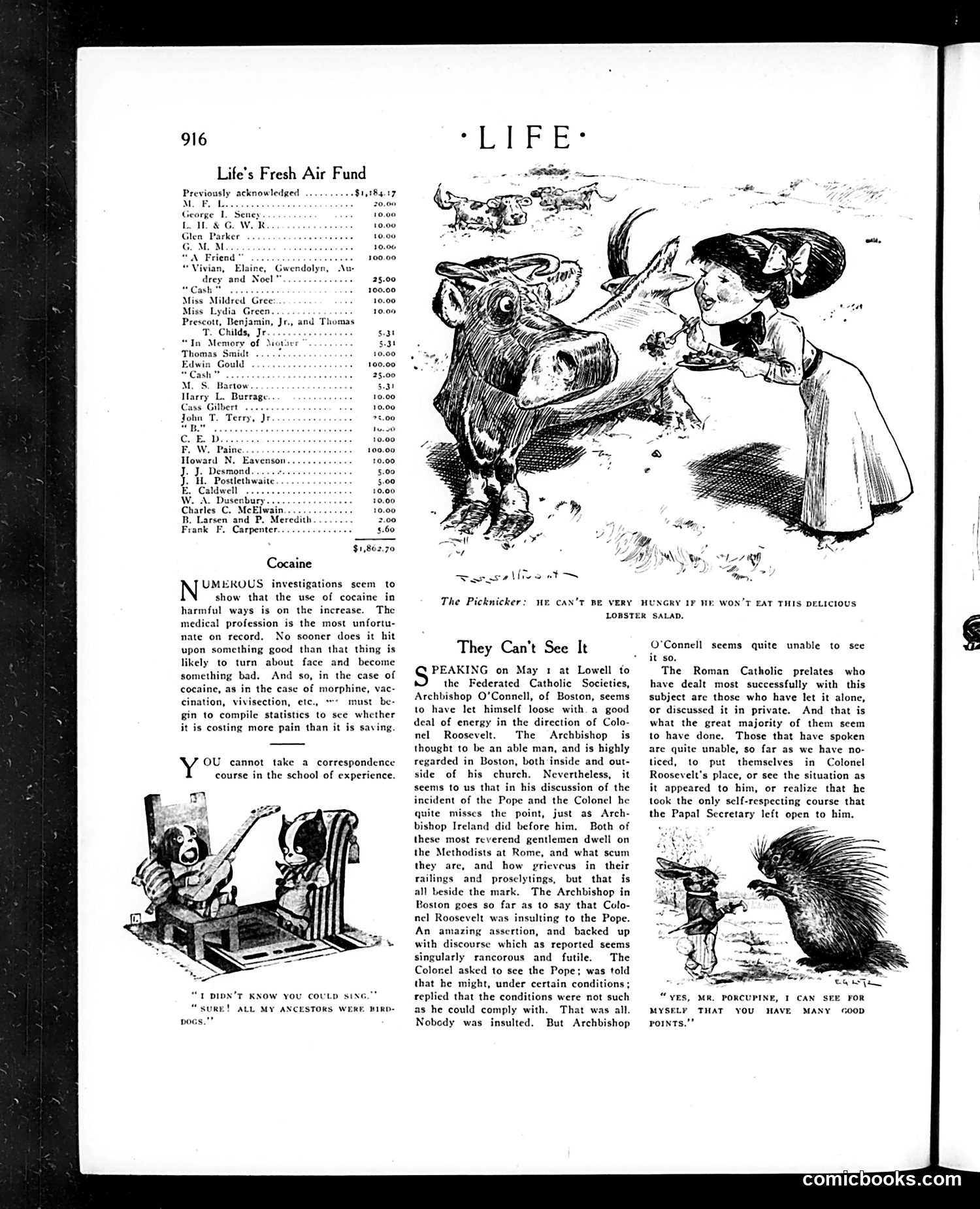
This page contains three distinct elements: 1. **"Life's Fresh Air Fund"** - A donation list acknowledging contributors to a charitable fund. 2. **"The Picknicker" illustration** - A humorous sketch showing a woman offering a lobster salad to a cow, with the caption suggesting the cow won't eat unless offered this "delicious" food. This is gentle satirical humor about human presumptions about animal preferences. 3. **"They Can't See It"** - An article criticizing Archbishop O'Connell of Boston for his public dispute with Colonel Roosevelt regarding papal authority. The satire targets the Archbishop's inability to recognize his own logical inconsistency: he claims to oppose Roosevelt's "insult to the Pope," yet uses inflammatory language himself. Modern readers should note this reflects early 1900s Catholic-political tensions and ecclesiastical debates over papal prerogatives. The page demonstrates Life magazine's mix of light humor and pointed social commentary.
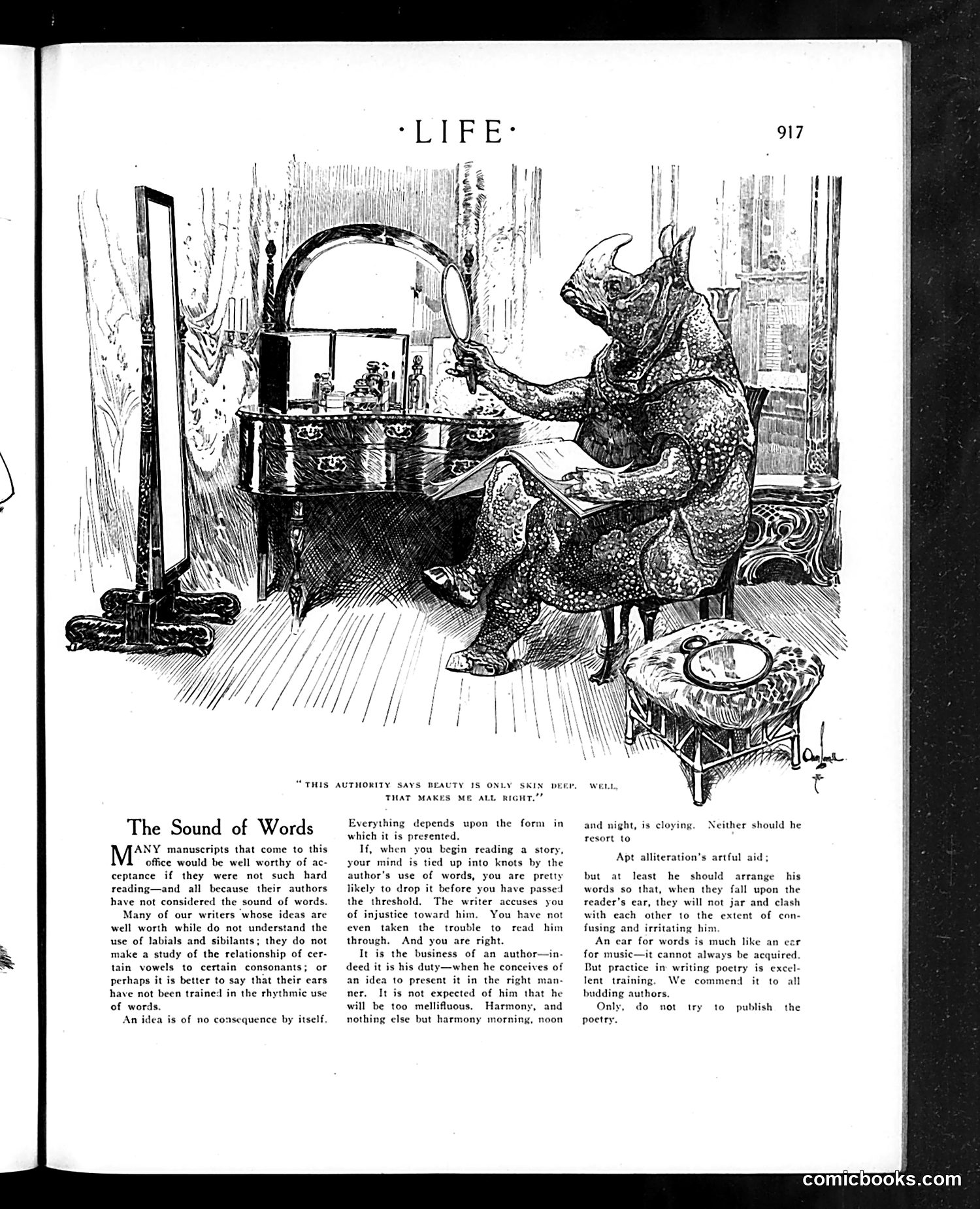
The cartoon depicts a grotesque, toad-like creature sitting at a vanity mirror in what appears to be a bedroom. The caption reads: "This authority says beauty is only skin deep. Well, that makes me all right." The accompanying article discusses how writers should carefully consider the *sound* of words—their rhythm, alliteration, and harmony—when composing prose and poetry. The author argues manuscripts often fail because authors neglect how words sound when read aloud. The visual joke pairs this literary advice with the creature's self-satisfied comment about being "all right" despite lacking conventional beauty. The satire suggests that poor writers, like the ugly creature, may have only "surface" appeal (or lack thereof) if they ignore the sonic qualities of language. The cartoon humorously illustrates the article's point about form mattering.
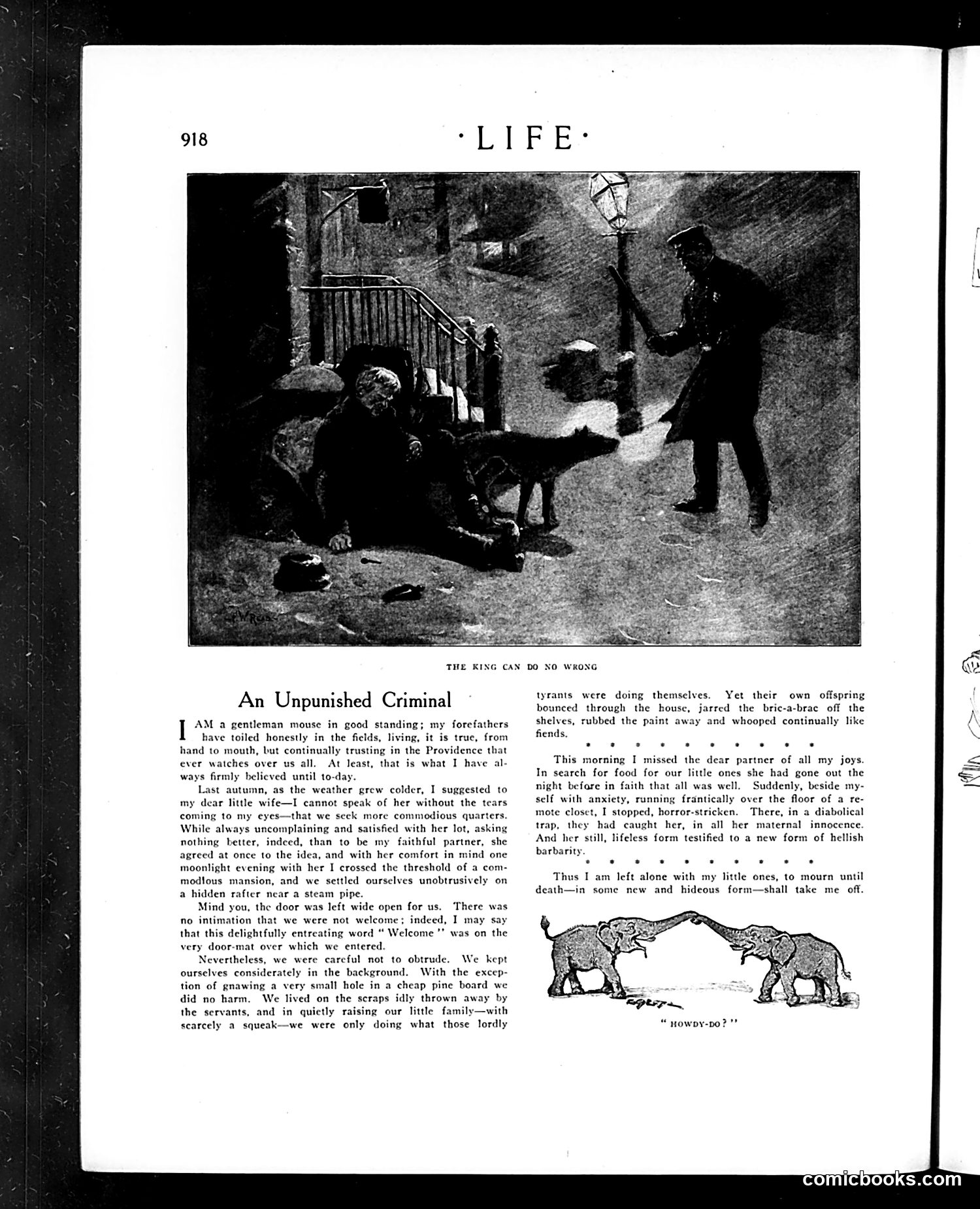
This satirical story uses a *gentleman mouse* narrator to critique class hypocrisy and injustice. The mouse family—poor but honest and unobtrusive—enters a mansion seeking shelter, causing minimal harm (one small hole). Meanwhile, the human residents' *own children* destructively "bounce through the house" and "whoop continually." When the mouse's wife is killed in a trap, the narrator bitterly highlights the double standard: the wealthy family suffers no consequences for their children's destructive behavior, yet uses lethal force against the mice for merely existing in their home. The title "The King Can Do No Wrong" underscores this—the wealthy operate without accountability while the poor are punished harshly for minor transgressions. This appears to be social commentary on class inequality and the disproportionate justice system of the era, using animal fable conventions to make its point safe for satire.
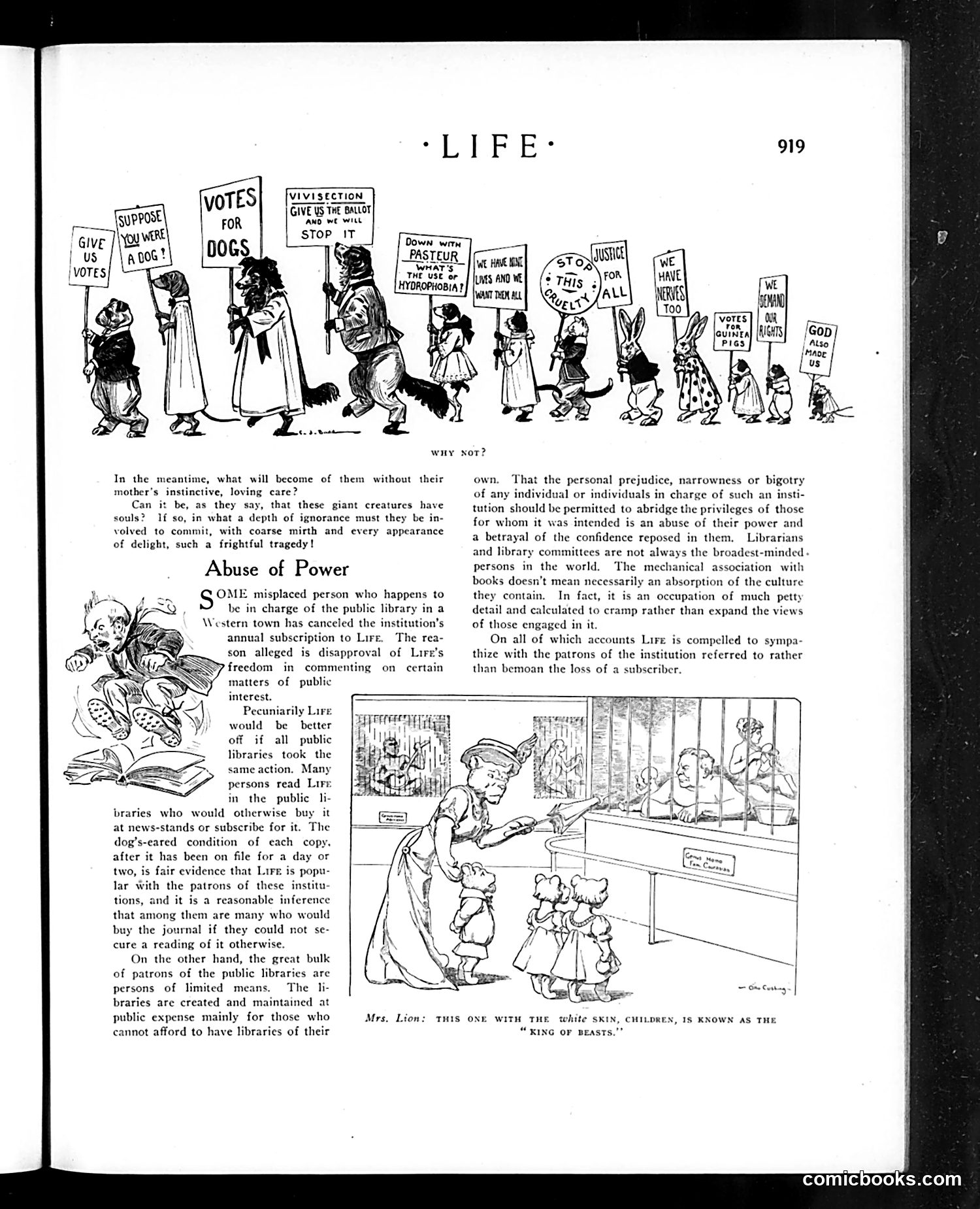
This 1919 *Life* magazine page contains two satirical pieces: **Top cartoon**: Shows various animals (dogs, rabbits, etc.) holding protest signs demanding voting rights and other reforms ("Votes for Dogs," "Down with Pasteur," "Stop Vivisection"). The satire mocks suffragists and progressive reformers by equating their demands to absurd animal activism—suggesting their causes are as ridiculous as animals voting. **"Abuse of Power" article**: Critiques a Western town librarian who canceled the library's *Life* subscription due to disagreeing with the magazine's editorial positions. The piece defends *Life*'s editorial freedom and argues that individual prejudice shouldn't dictate public institutions. Ironically, it notes *Life* actually benefits financially from library cancellations, since poorer patrons read free copies rather than buying subscriptions. **Historical context**: This reflects early 20th-century tensions over institutional censorship, free speech, and the role of public libraries—issues that remain relevant today.
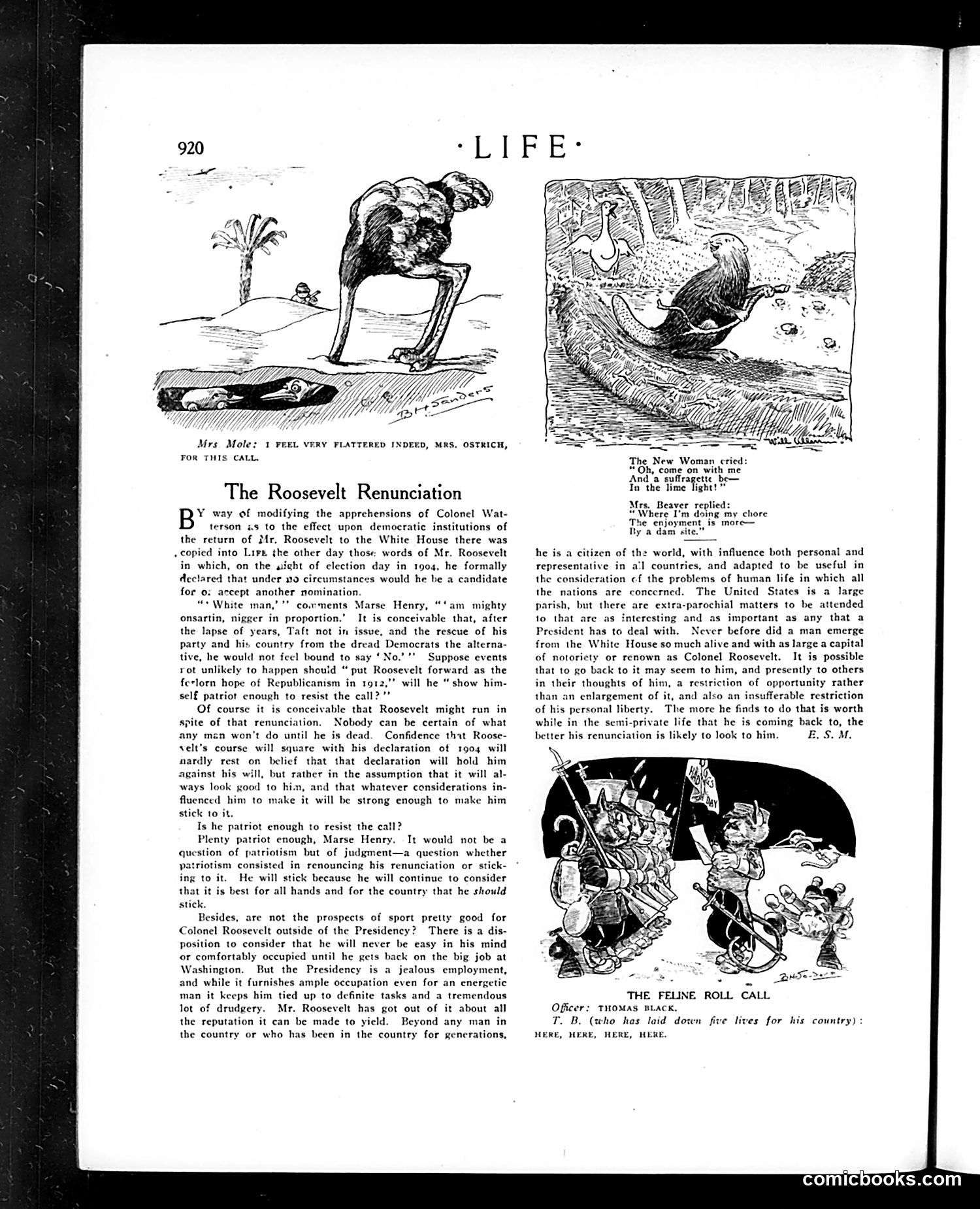
This page contains commentary on Theodore Roosevelt's political future after leaving the presidency in 1909. The article "The Roosevelt Renunciation" references Roosevelt's 1904 pledge not to seek another term—questioning whether he would honor this promise if pressured to run again in 1912. The key cartoons satirize: 1. **"Mrs. Mole and Mrs. Ostrich"**: A visual pun about those claiming not to see Roosevelt's likely comeback attempt (moles and ostriches can't/won't see). 2. **"The New Woman" comic**: Contrasts the suffragette movement's appeal to modern women with traditional domestic life, suggesting domesticity offers more genuine enjoyment. 3. **"The Feline Roll Call"**: References Officer Thomas Black (unclear context without full caption). The text argues Roosevelt, despite his 1904 renunciation, might justify running again if circumstances changed, while also suggesting his post-presidency opportunities outside Washington might make a return seem like a "restriction" rather than an opportunity.
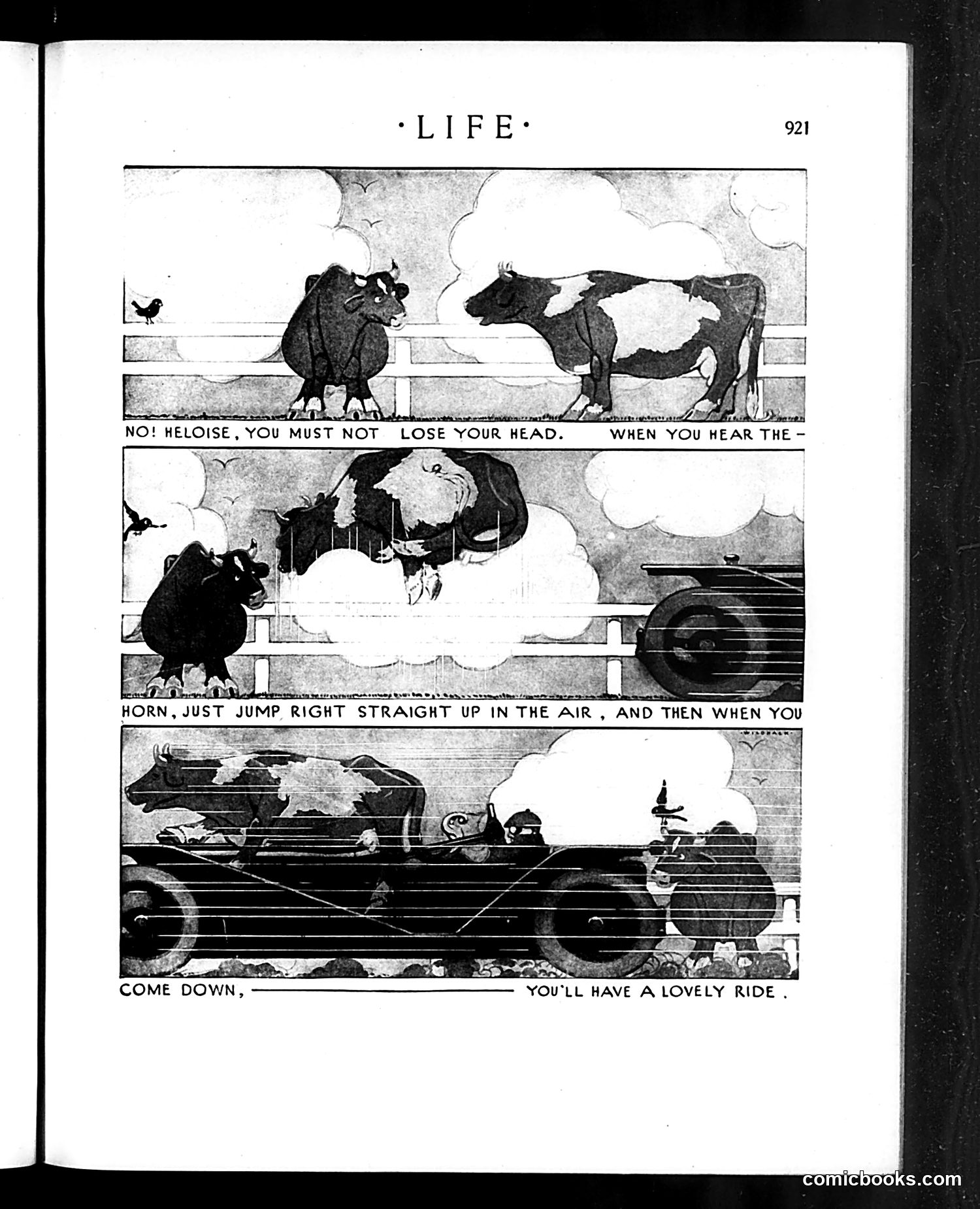
This is a humorous comic strip warning a cow named Heloise about a motorcar. The dialogue instructs her not to "lose your head" when hearing a car horn, but instead to "jump right straight up in the air" so she'll "come down" for "a lovely ride." The joke plays on the common rural hazard of the early automobile era: cows wandering onto roads and being struck by cars. Rather than offering genuine safety advice, the cartoon absurdly suggests the cow should jump into the air—implying she'll land in the vehicle for a chaotic "ride." This satirizes the novelty and danger of automobiles in early 20th-century America, when motorized vehicles were still relatively new and posed genuine risks to livestock and pedestrians unfamiliar with them.
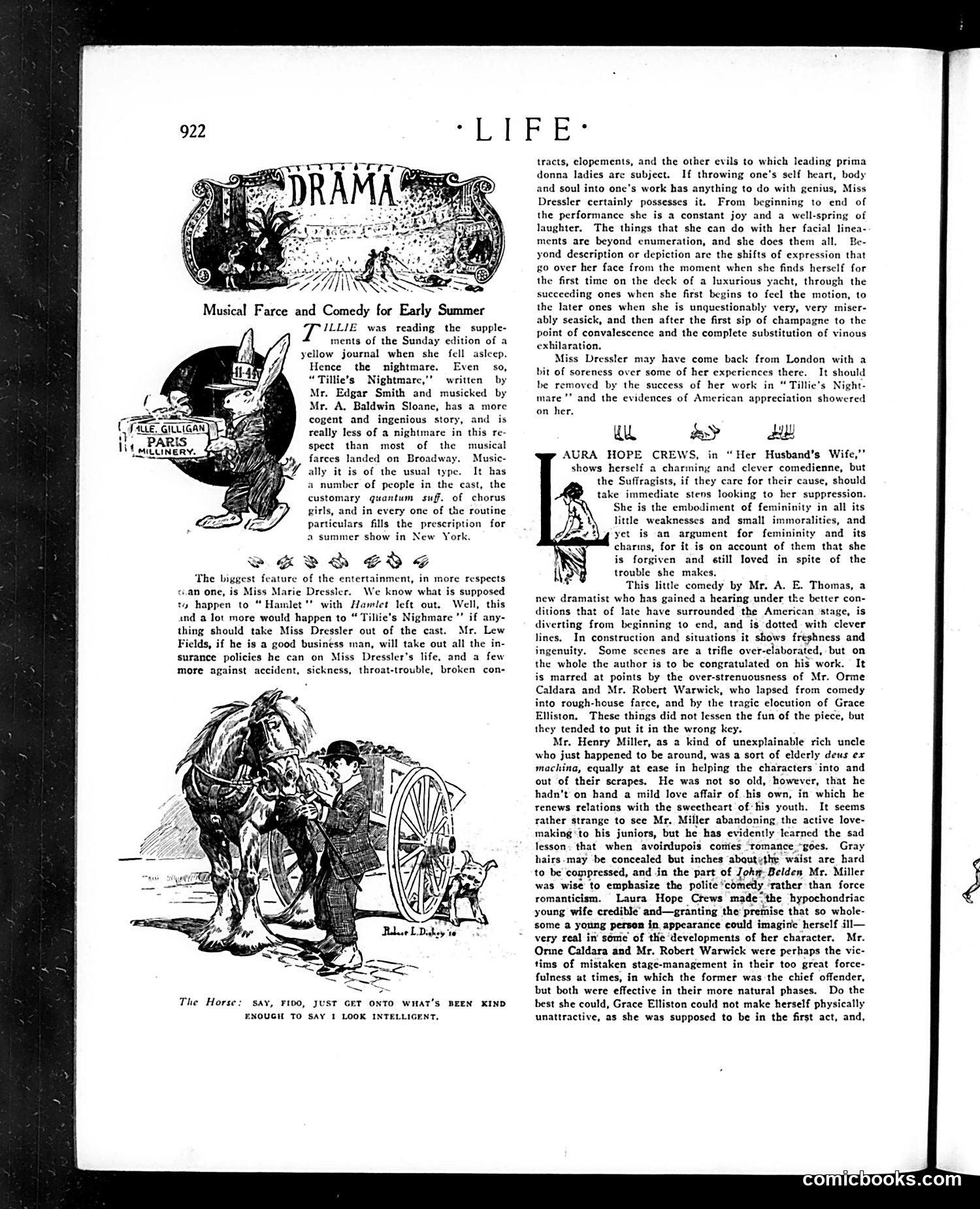
This page reviews Broadway musical comedies, centering on **"Tillie's Nightmare,"** a musical farce by Edgar Smith and A. Baldwin Sloane. The critic argues the show depends entirely on star **Marie Dressler**—so completely that Fields (the producer) should insure her life heavily, as the play would collapse without her. The cartoon shows a horse addressing a carriage driver, with the caption about "looking intelligent"—likely satirizing the absurdity of the show's plot or contemporary theater's low standards. The page also reviews **"Her Husband's Wife"** by A.E. Thomas, praising leading lady **Laura Hope Crews** as embodying "femininity" and its "weaknesses." The critic warns suffragists she undermines their cause by playing a character too charming and forgiven despite causing trouble—a backhanded critique reflecting early 1900s debates about women's roles.
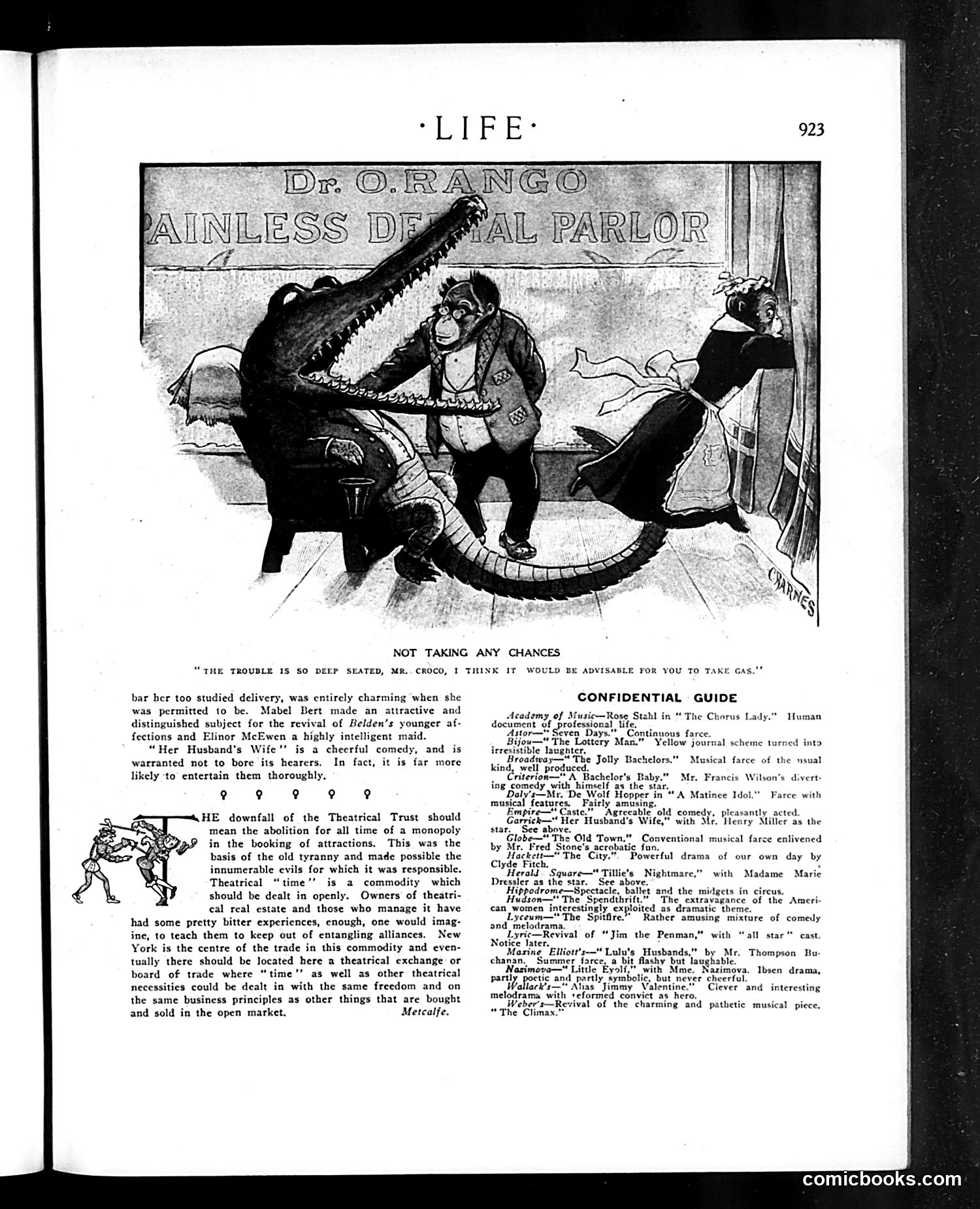
This cartoon satirizes the **Theatrical Trust**, a monopoly controlling theater bookings that had recently collapsed. The image depicts a crocodile (labeled "Croco," likely representing the Trust's predatory nature) in a dental chair, while a dentist (possibly representing reformers or competitors) prepares to extract its teeth—a metaphor for dismantling the monopoly's power. The caption quotes the dentist advising the crocodile to "take gas" (anesthesia) because "the trouble is so deep seated"—a pun suggesting the Trust's entrenched control over theatrical "time" (booking slots). The accompanying text argues for establishing an open "theatrical exchange" where theater time could be traded freely, like commodities in legitimate markets, rather than through monopolistic control. The cartoonist ridicules the Trust's grip on the industry while advocating for transparent, competitive business practices in theater management.
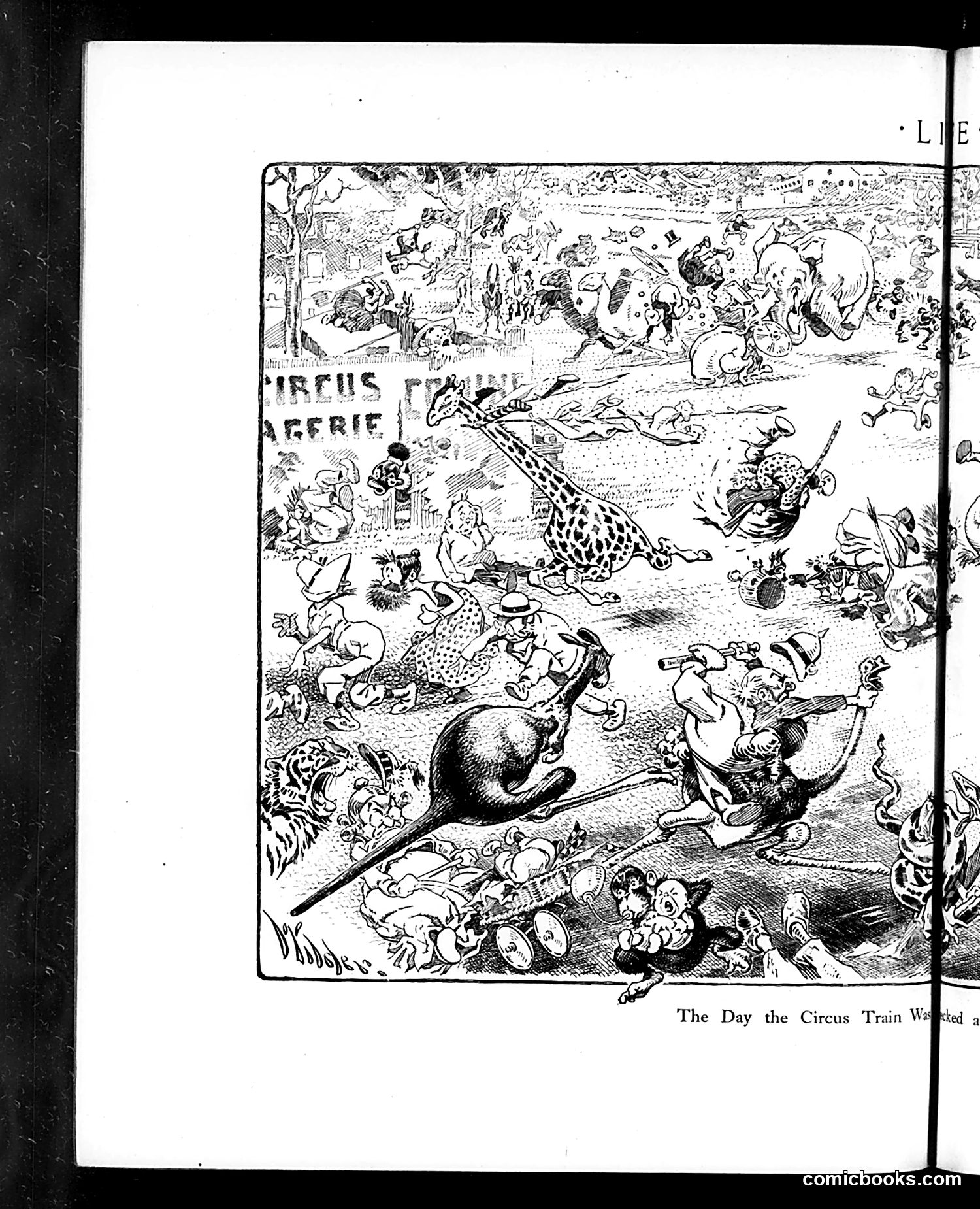
This is a humorous illustration depicting chaos following a circus train derailment. The scene shows escaped circus animals and performers running amok through a landscape labeled "CIRCUS" and "AGGERIE" (likely "menagerie"). Visible are a giraffe, what appears to be big cats, clowns, acrobats, and various circus performers in disarray. The satire lies in the pandemonium created by exotic animals loose in an everyday setting—a common early 20th-century humor trope. The detailed, crowded composition emphasizes the mayhem and confusion of the accident's aftermath. The specific political or social commentary, if any exists beyond general slapstick humor, is unclear from the image alone.
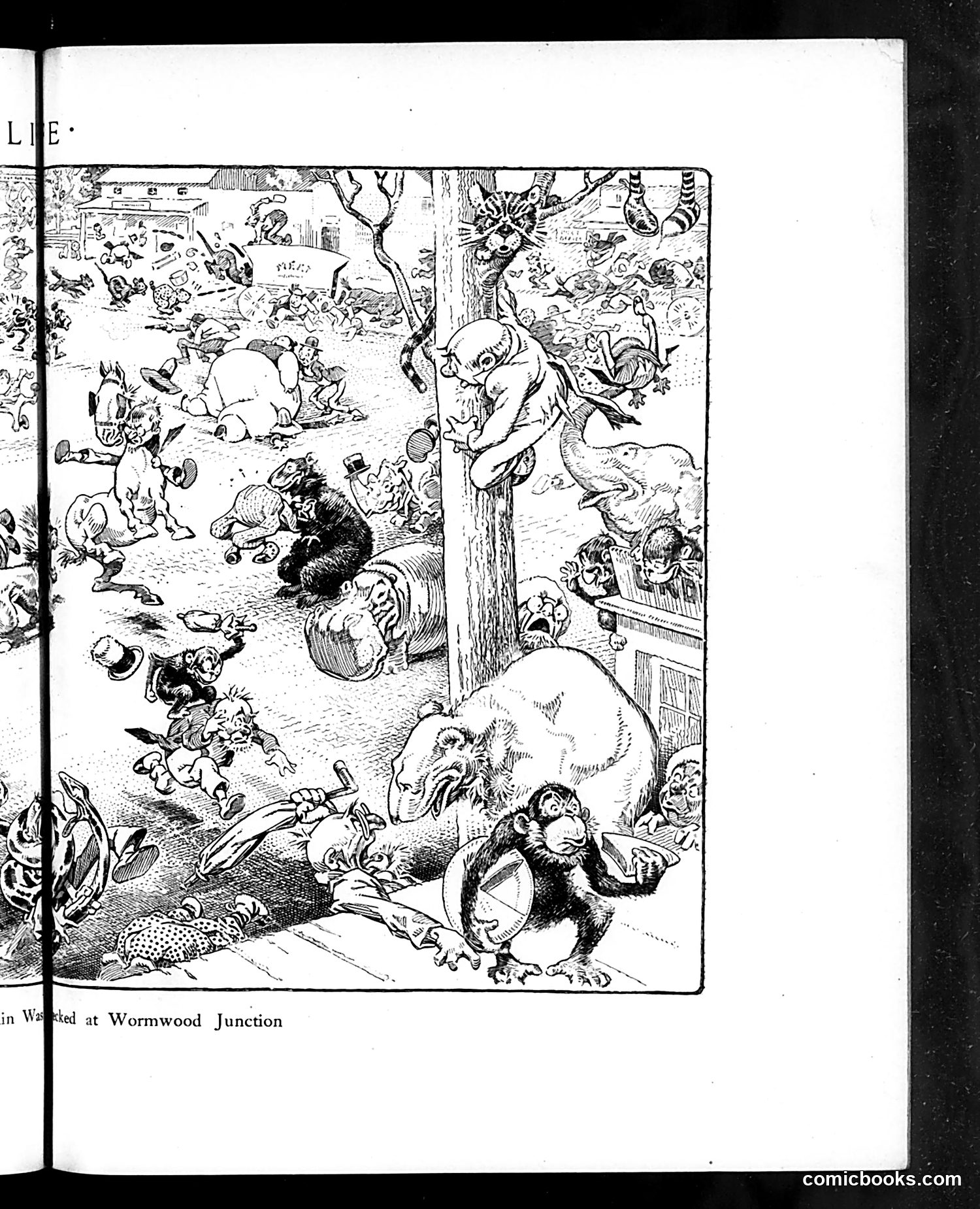
This is a chaotic satirical scene titled "in Wa[i]ted at Wormwood Junction" (text partially obscured). The cartoon depicts numerous anthropomorphic animals and grotesque figures in apparent disorder or conflict—bears, monkeys, and other creatures engaged in various activities around what appears to be a railway junction or station setting. The style suggests early 20th-century American satirical humor, likely commenting on social chaos, labor unrest, or political disorder of the era. The "Wormwood Junction" reference possibly alludes to a specific location or metaphorical "bitter place" of social turmoil. Without clearer context or visible byline, the precise political target remains unclear, though the densely-packed, anarchic composition emphasizes societal confusion or conflict as the satire's primary subject.
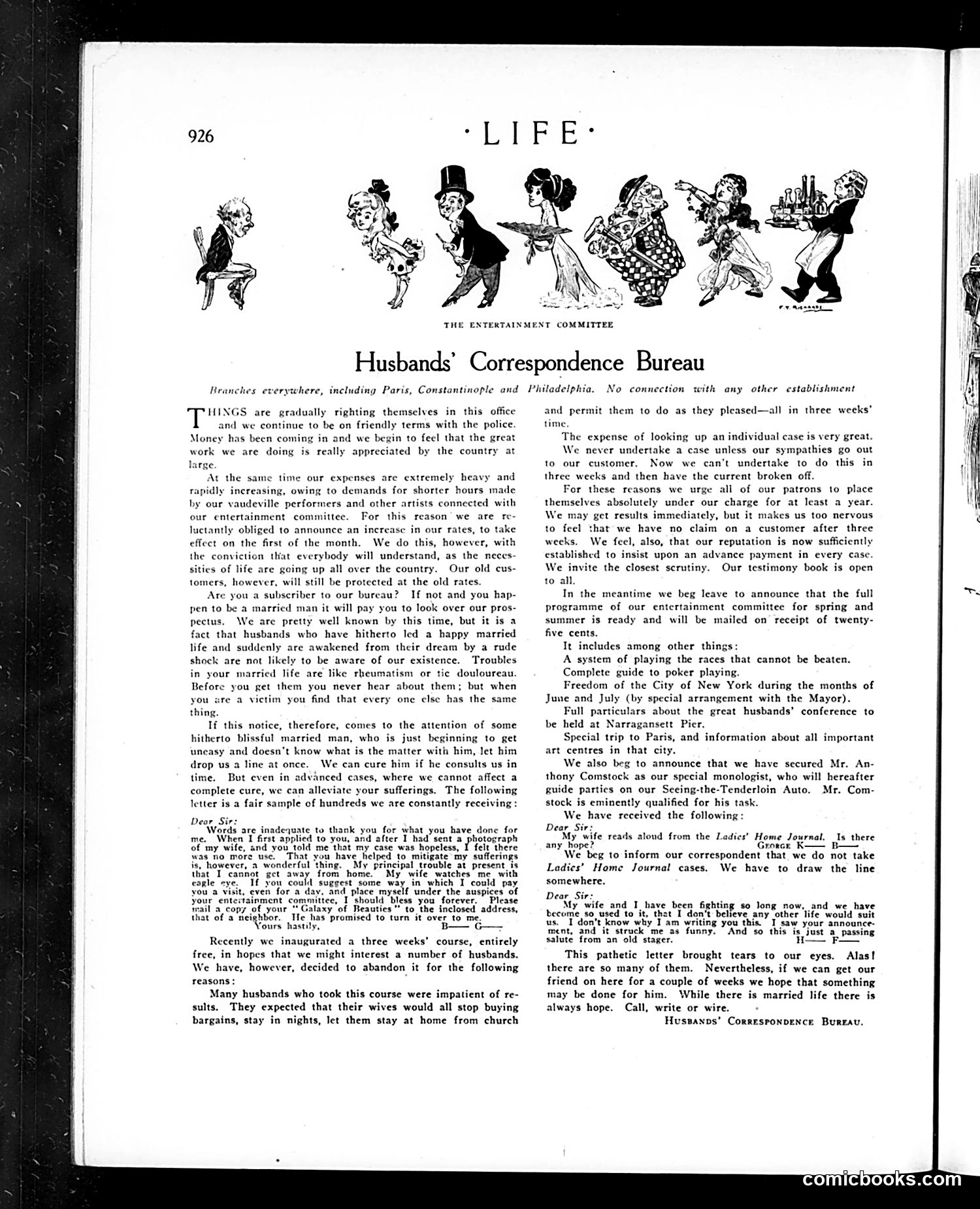
This page satirizes marital discord and the emerging "advice industry" of early 20th-century America. The cartoon depicts a fictional "Entertainment Committee" offering a correspondence bureau—ostensibly to help troubled husbands—with branches in major cities including Paris and Constantinople. The satire targets husbands seeking escape from their marriages. The text mocks their complaints: wives who shop excessively, won't stay home, or prevent husbands from attending church. The "bureau" offers dubious remedies, including entertainment guides and trips, while charging fees and requiring year-long commitments. The included sample letter from a desperate husband—who admits his case is "hopeless" yet still seeks ways to leave home—exemplifies the magazine's mockery of male infidelity and marital unhappiness. Life's satirical point: these men are foolishly seeking external solutions to their own domestic failures, while the "bureau" cynically profits from their predicament. The decorative figures at top represent typical "entertainment" diversions being offered.
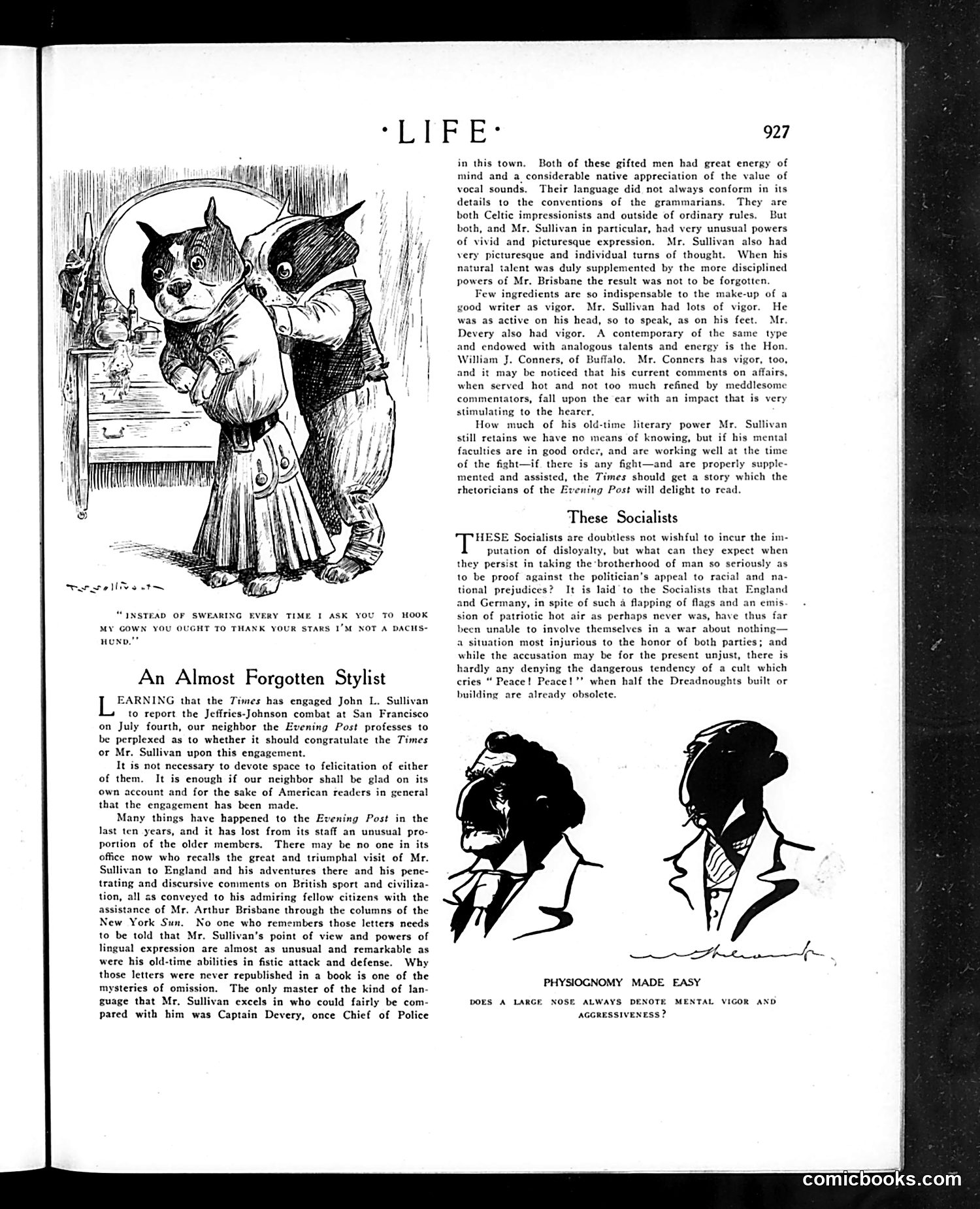
## Top Cartoon The illustration shows a woman addressing a dachshund (German dog breed), with the caption about hooking her gown. This is a **World War I-era joke** mocking German-Americans during anti-German sentiment. The humor relies on equating a dachshund with German identity—suggesting the woman is sarcastically saying she should be grateful the dog isn't human, implying Germans were undesirable or troublesome during wartime xenophobia. ## Article: "An Almost Forgotten Stylist" The text praises boxer **John L. Sullivan**, recently hired by the Times to cover the Jeffries-Johnson heavyweight fight (July 4, 1910). Sullivan is celebrated as a colorful writer with vigorous, unconventional language and Irish-inflected expression—compared favorably to former NYC Police Chief **Captain Devery**. The piece argues vigor and personality matter more than grammatical correctness in good writing. ## Bottom Section: "These Socialists" This brief commentary criticizes Socialists for taking international "brotherhood of man" ideology seriously, making them immune to nationalist appeals. It suggests their internationalism is disloyal during wartime patriotic fervor—reflecting anti-socialist propaganda of the WWI period.
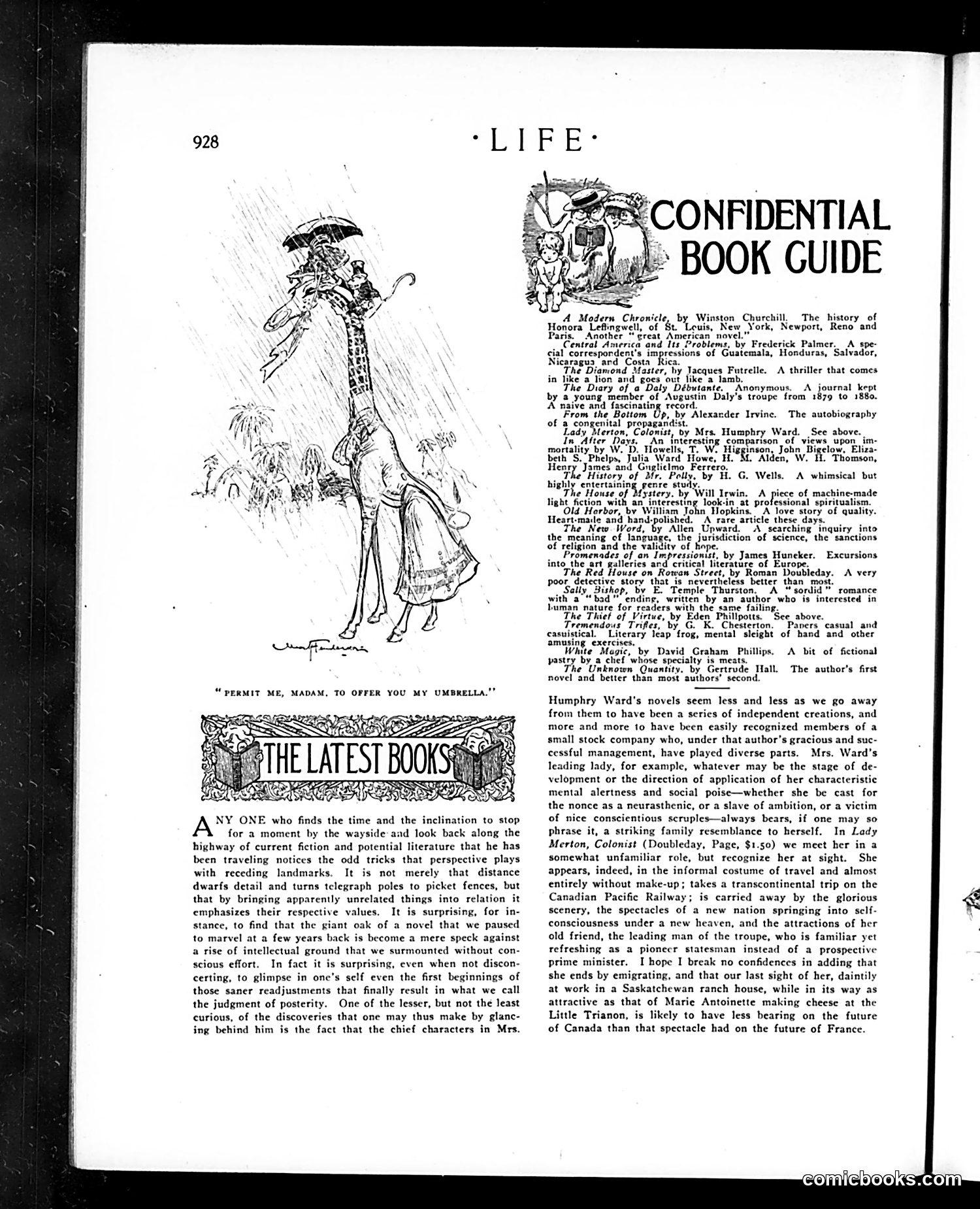
This is a "Confidential Book Guide"—a literary review column disguised as insider commentary. The page features: **The Cartoon**: Shows a fashionably dressed woman with an umbrella in rain, captioned "Permit me, Madam, to offer you my umbrella." The illustration likely satirizes gallantry or social pretense, possibly accompanying the review section's tone of sophisticated critique. **The Content**: The guide reviews contemporary fiction (circa 1909-1910), including works by H.G. Wells, Mrs. Humphry Ward, and others. The accompanying essay critiques how literary perspective changes over time—what seemed like important "giant oak" novels fade into insignificance while lesser works gain appreciation. **The Satire**: The "confidential" framing and the essay's patronizing tone mock both literary pretension and critics' tendency to reassess authors retroactively. The guide positions itself as offering insider knowledge about which books will endure versus which are forgettable period pieces—a humorous commentary on literature's unpredictable legacy and critical fickleness.
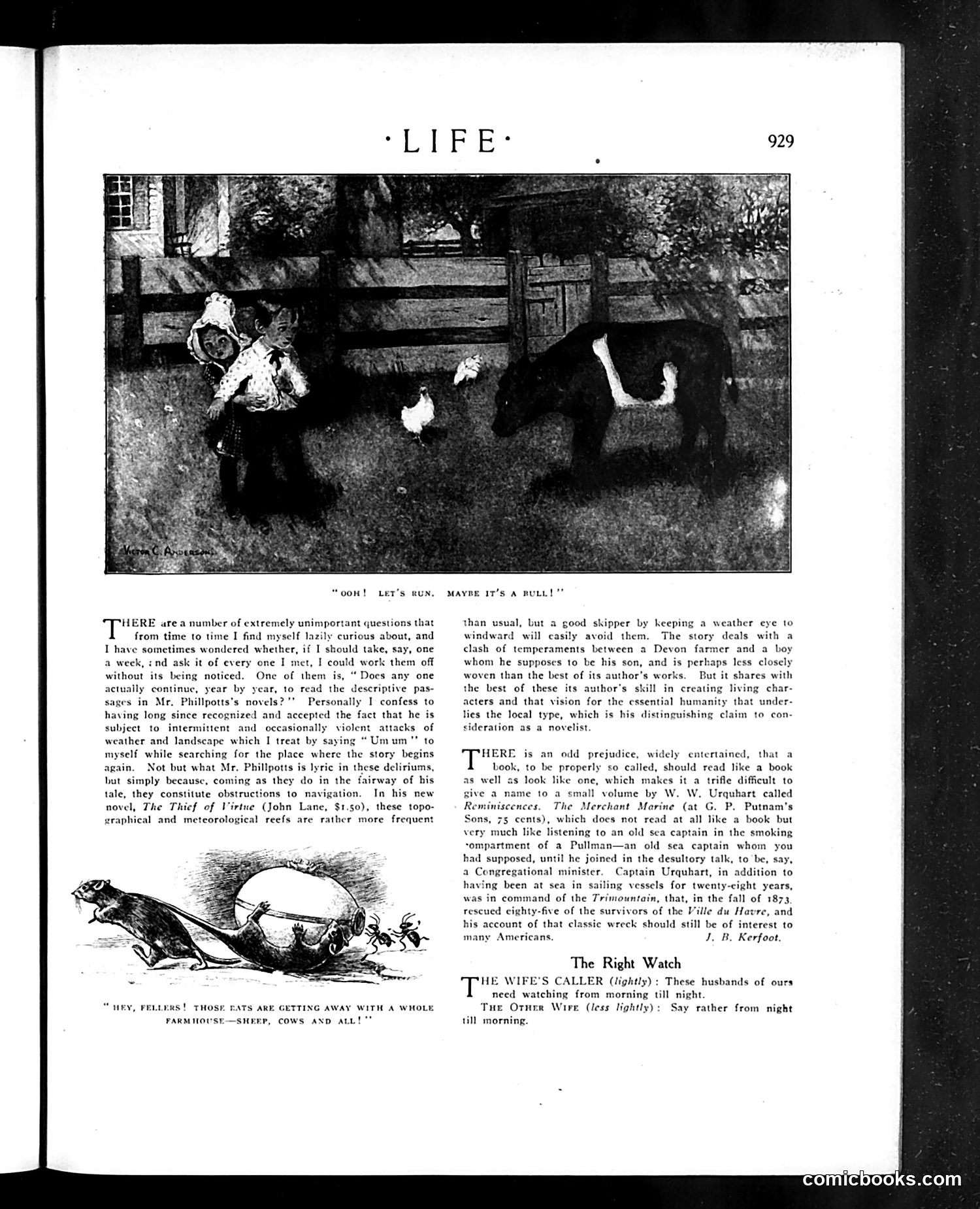
This page contains two distinct elements: **Top Image & Caption:** A cartoon showing people and animals in apparent chaos near a farmhouse. The caption "Oon! Let's run. Maybe it's a bull!" suggests someone has mistaken an animal for a dangerous bull, prompting panicked flight. The humor lies in the misidentification causing unnecessary alarm. **Text Section:** A book review column discussing novels by Eden Phillpotts and a memoir by Captain W.W. Urquhart about his merchant marine experiences. The reviewer criticizes Phillpotts for lengthy landscape descriptions that interrupt his narratives, but praises his character development. Urquhart's book is praised for its authentic conversational style recounting life at sea, including his role in rescuing survivors from the 1873 wreck of the *Ville du Havre*. **Bottom Cartoon:** "The Right Watch" - A brief humorous dialogue between two women about husbands. The "Other Wife" quips that husbands need watching "from night till morning," implying infidelity or misbehavior during evening hours—a marital joke about spousal mistrust.
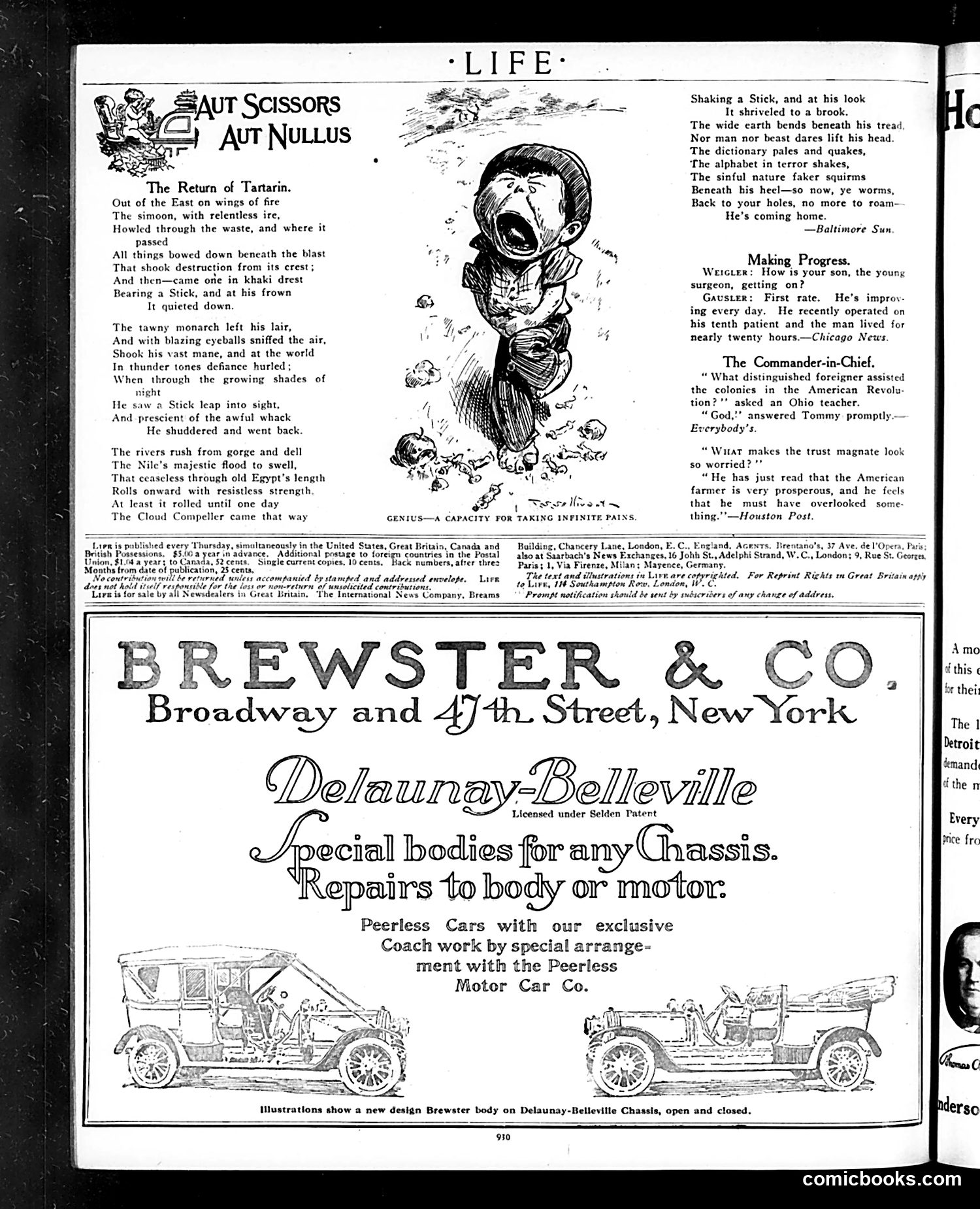
This Life magazine page contains satirical poetry and brief comic items from the early 1900s. **"The Return of Tartarin"** (main cartoon) appears to mock colonial attitudes. Tartarin is a fictional French character known for tall tales and exaggeration. The poem depicts a European colonial figure ("in khaki drest / Bearing a Stick") who commands absolute authority over nature and wild animals simply through intimidation—the Nile itself "shrivels to a brook" at his presence. The satire targets the grandiose self-image of European colonizers who believed their mere presence subdued entire regions. **The brief jokes below** mock everyday subjects: a young surgeon whose patient survives only "nearly twenty hours," and a trust magnate worried that American farmers' prosperity might escape his exploitation. These are typical period humor—cynical about business and professional incompetence. The page is primarily advertising for Brewster & Co. automobiles, positioned as quality coach-builders.
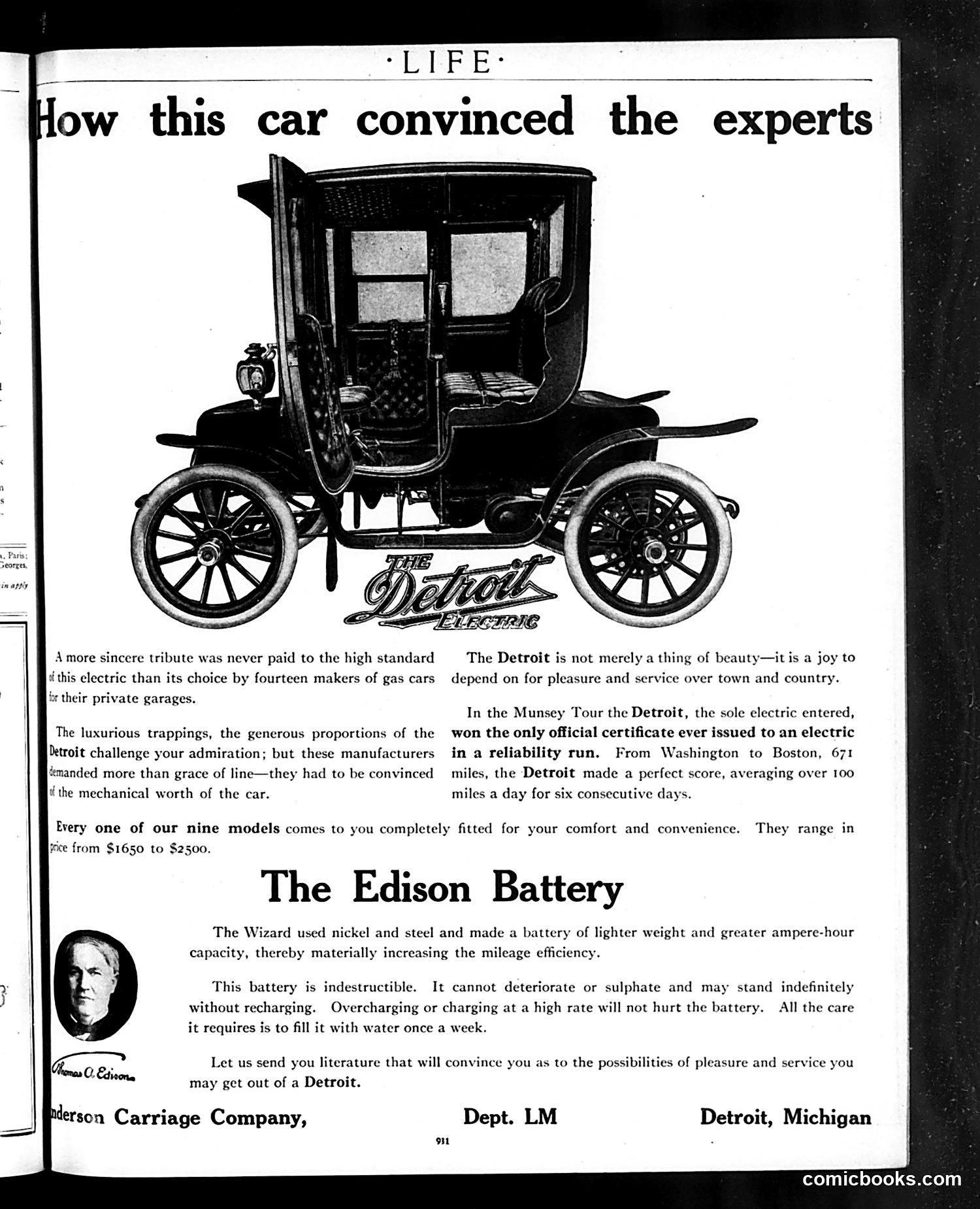
This is **advertising, not satire**—a Detroit Electric automobile ad from Life magazine (likely early 1900s). The page promotes electric cars to a skeptical market by claiming expert validation. Key points: - **"Fourteen makers of gas cars"** chose the Detroit Electric for their private garages, positioning it as the luxury choice among skeptics - **The Munsey Tour** reliability run (Washington to Boston, 671 miles) supposedly proved electric cars' dependability—a major selling point when automobiles were still experimental - **Edison Battery** reference invokes Thomas Edison's credibility; the ad emphasizes the battery is "indestructible" and requires only weekly water fills The humor for modern readers: electric cars are presented as cutting-edge luxury items requiring expert reassurance. Today, the irony is that electric vehicles were abandoned for decades, then recently reinvented as futuristic. The ad's breathless enthusiasm about 100-mile daily range and weekly maintenance now seems quaint. This reflects genuine early-1900s competition between electric, gasoline, and steam automobiles—a forgotten chapter of automotive history.
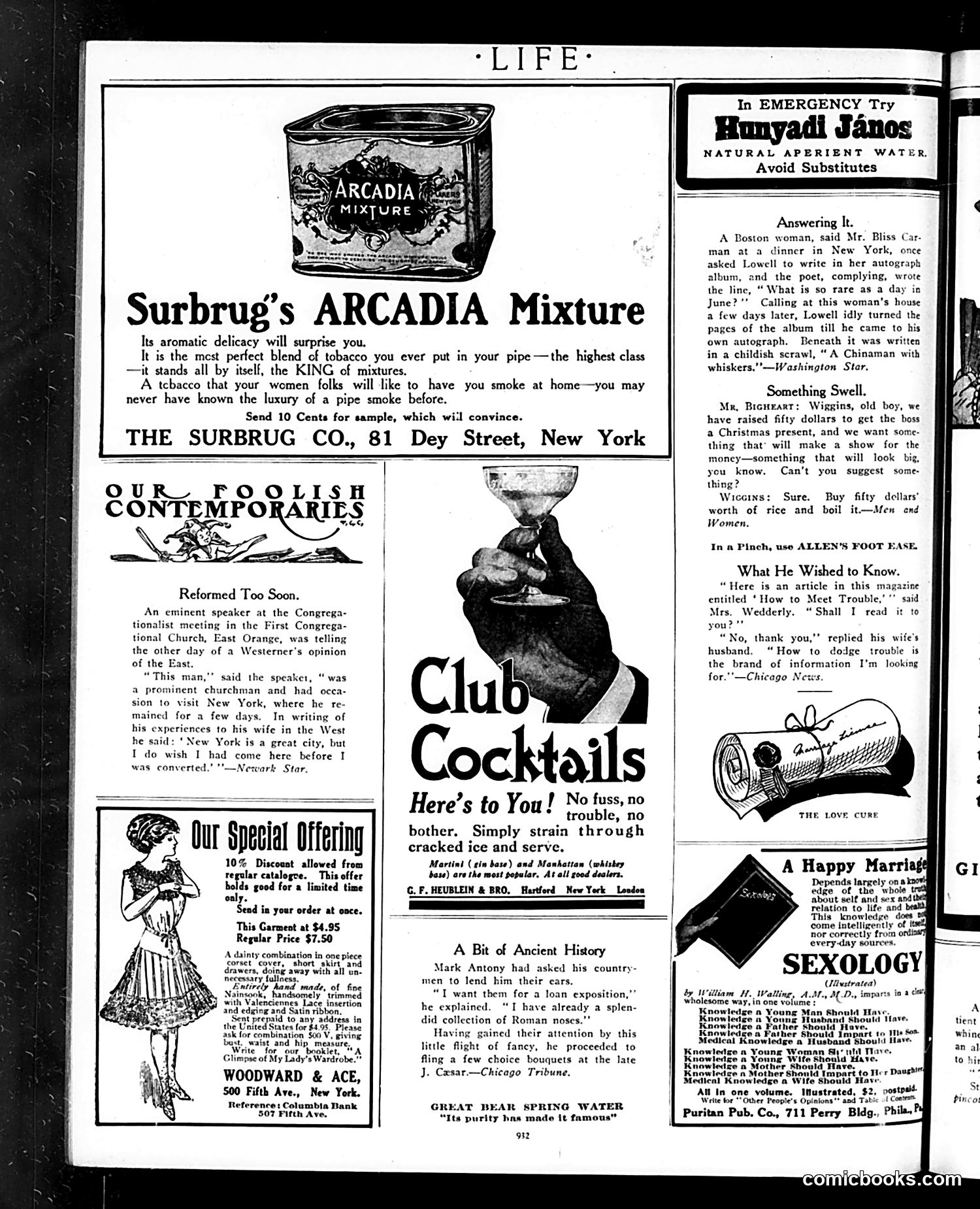
This page is primarily **advertisements and humor pieces** typical of early 20th-century Life magazine. The main satirical content includes: **"Reformed Too Soon"** — A joke about a Western churchman visiting New York who wishes he'd seen the city before becoming religious, implying New York's secular pleasures would have been more enjoyable to his unconverted self. This satirizes both Western religiosity and Eastern worldliness. **"A Bit of Ancient History"** — A pun-based joke where Mark Antony asks for "ears" for a "loan exposition," then reveals he already has "Roman noses," leading to him complimenting Julius Caesar. This is wordplay humor rather than political satire. The rest consists of advertisements for pipe tobacco, cocktail mixers, women's clothing, spring water, and books on "Sexology" — representative of consumer products marketed to affluent readers of the era. The ads reflect period attitudes toward luxury goods and self-improvement literature. The page demonstrates Life's mix of commercial content and gentle, pun-based humor rather than sharp political commentary.
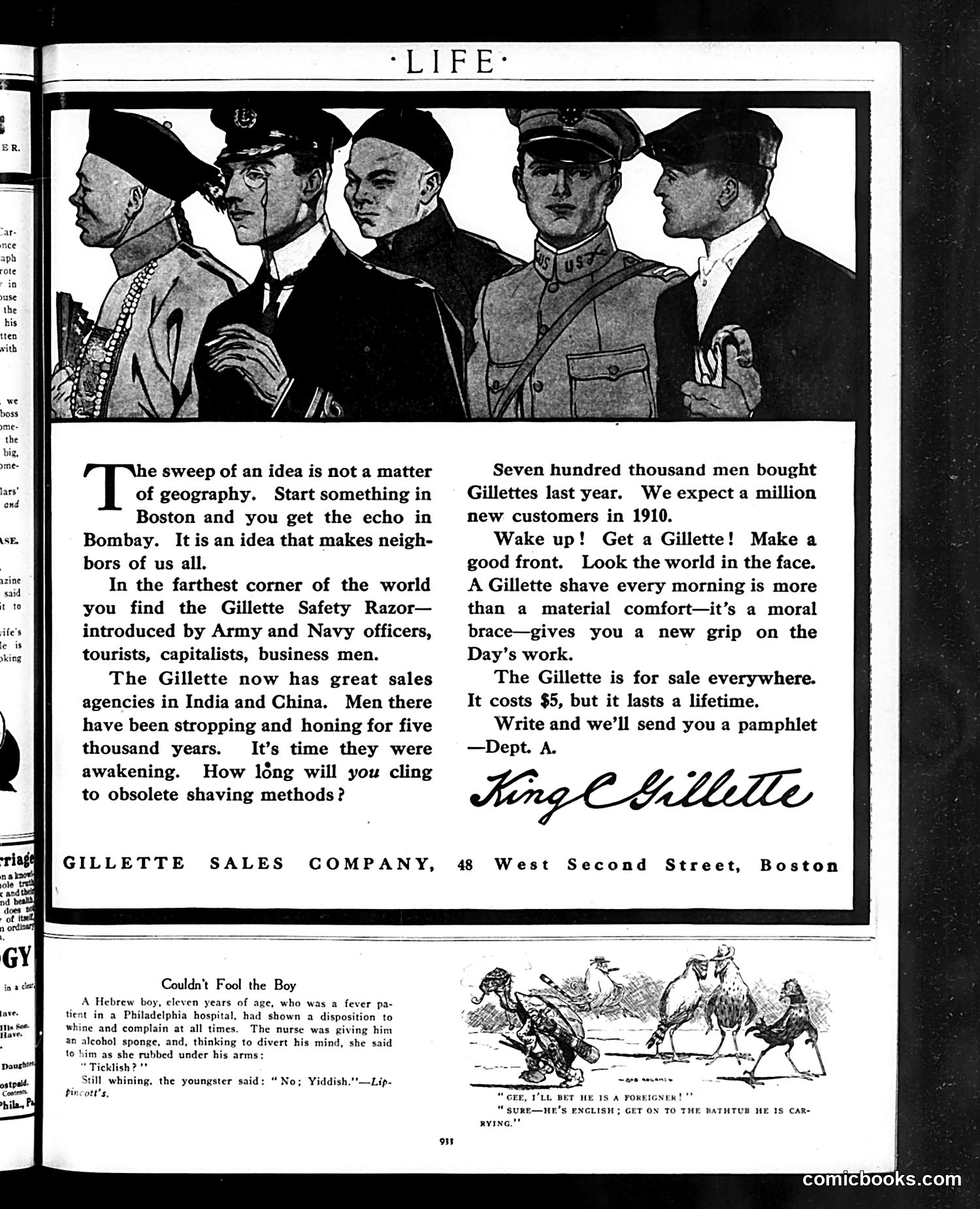
This page is primarily a **Gillette Safety Razor advertisement** (circa 1909-1910) that reveals the racist attitudes embedded in early 20th-century American corporate expansion. The ad's top illustration shows five men representing different nationalities/military affiliations, depicting how Gillette marketed razors globally. The text explicitly targets non-Western populations—particularly in India and China—using language that patronizes them as "awakening" from "obsolete" traditions. Phrases like "Men there have been stropping and honing for five thousand years" frame non-Western grooming practices as primitive, positioning the razor as civilizing technology spread by "Army and Navy officers, tourists, capitalists." The bottom section, "Couldn't Fool the Boy," is a brief ethnic joke about a Jewish boy in a Philadelphia hospital who responds to "Ticklish?" with "No; Yiddish"—a pun playing on Jewish identity and dialect stereotypes. Together, these pieces exemplify how turn-of-the-century consumer capitalism wrapped imperialism and cultural supremacy in humor and commercial messaging.
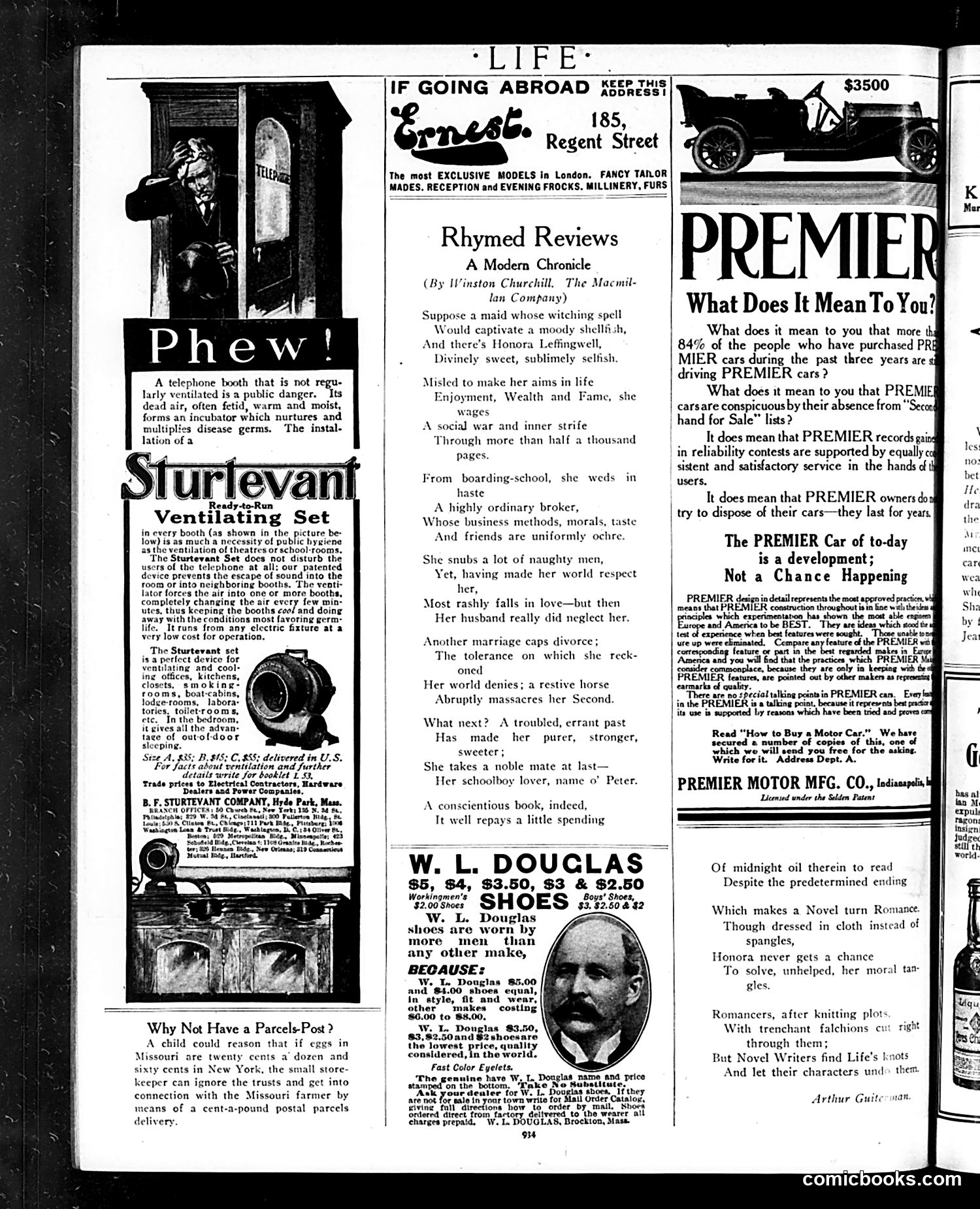
This page is primarily **advertising**, not political satire. The main cartoon labeled "Phew!" illustrates a public health concern: unventilated telephone booths as disease vectors. A man emerges from a booth looking distressed, highlighting the "dead air, often fetid, warm and moist" that the ad claims "forms an incubator which nurtures and multiplies disease germs." This reflects **early 20th-century anxieties about germ theory and public hygiene**—telephone booths were novel, shared public spaces generating legitimate health concerns. The Sturtevant Company capitalizes on this fear by advertising ventilation systems for booths. The page also includes a poem reviewing Winston Churchill's novel, ads for W.L. Douglas shoes and Premier automobiles, and a proposal for expanded parcel-post delivery. All content emphasizes consumer products and services rather than political commentary.
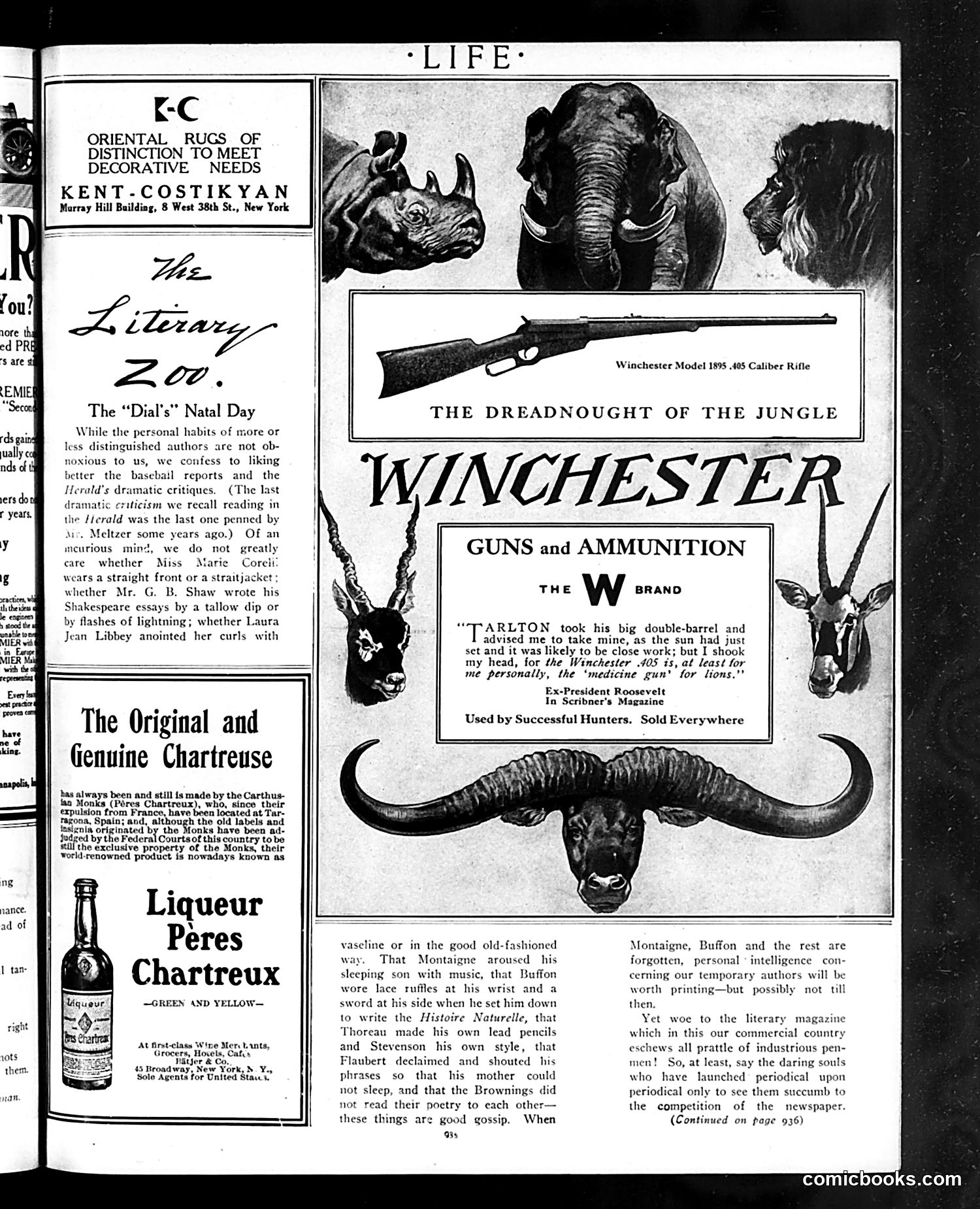
This page from *Life* magazine is primarily **advertising** interspersed with editorial commentary on literary culture. The main satire appears in "The 'Dial's' Natal Day" section, which mocks the *Dial* literary magazine's focus on authors' personal habits and gossip rather than substantive criticism. The piece sarcastically notes that while readers prefer baseball reports to celebrity trivia about writers like Marie Corelli or G.B. Shaw, literary magazines nonetheless rely on such "prattle" to compete commercially against newspapers. The dominant imagery—exotic animals (rhinoceros, elephant, antelope, buffalo)—paired with the Winchester rifle advertisement titled "The Dreadnought of the Jungle" suggests a metaphorical comparison: the literary world is treated as a savage landscape requiring the right "weapon" (or magazine strategy) to survive. The page satirizes the commercialization of literary culture and magazines' compromises between artistic integrity and market demands for sensationalism. Roosevelt's endorsement of Winchester rifles adds prestige through celebrity authority—itself exemplifying the gossip-driven marketing the editorial critiques.
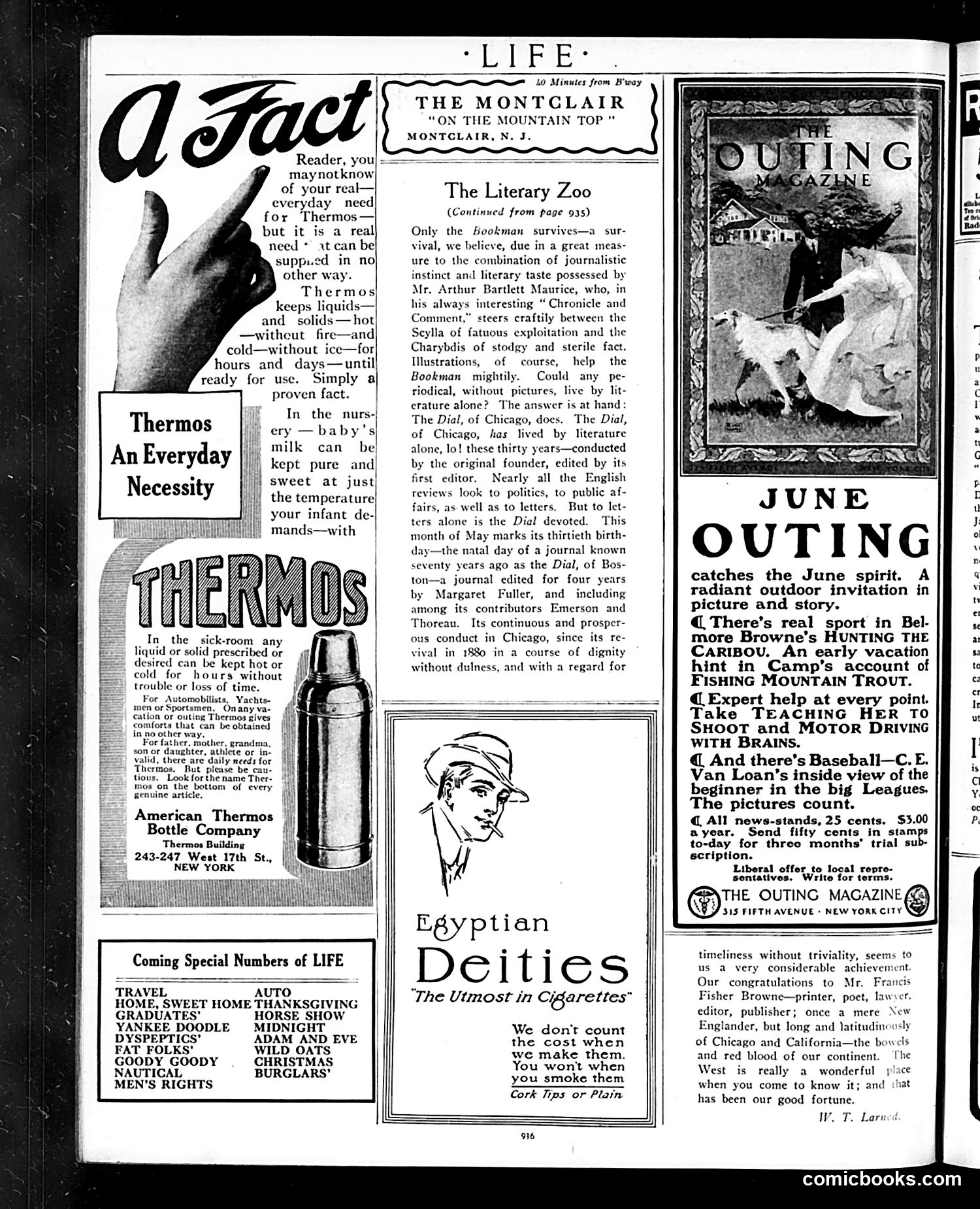
This is primarily an **advertising and editorial content page** from Life magazine, not a political cartoon page. The main content includes: 1. **Thermos bottle advertisement** (left side): A practical ad emphasizing the Thermos's everyday utility—keeping liquids hot or cold for hours without fire or ice. It targets multiple demographics (mothers, athletes, travelers). 2. **"The Literary Zoo" editorial** (center): A column discussing literary journals, particularly praising *The Bookman* for balancing journalism with literary taste. It celebrates *The Dial* of Chicago for surviving thirty years on literature alone, tracing its lineage to Margaret Fuller's 1840s Boston journal featuring Emerson and Thoreau. 3. **The Outing Magazine advertisement** (right): Promotes outdoor recreation—hunting, fishing, baseball, and motor driving—appealing to June leisure activities. 4. **Egyptian Deities cigarette ad** (bottom): A minimal advertisement for cigarettes. The page reflects early 20th-century Life magazine's mixed format of advertising, literary criticism, and lifestyle content rather than satirical political commentary.
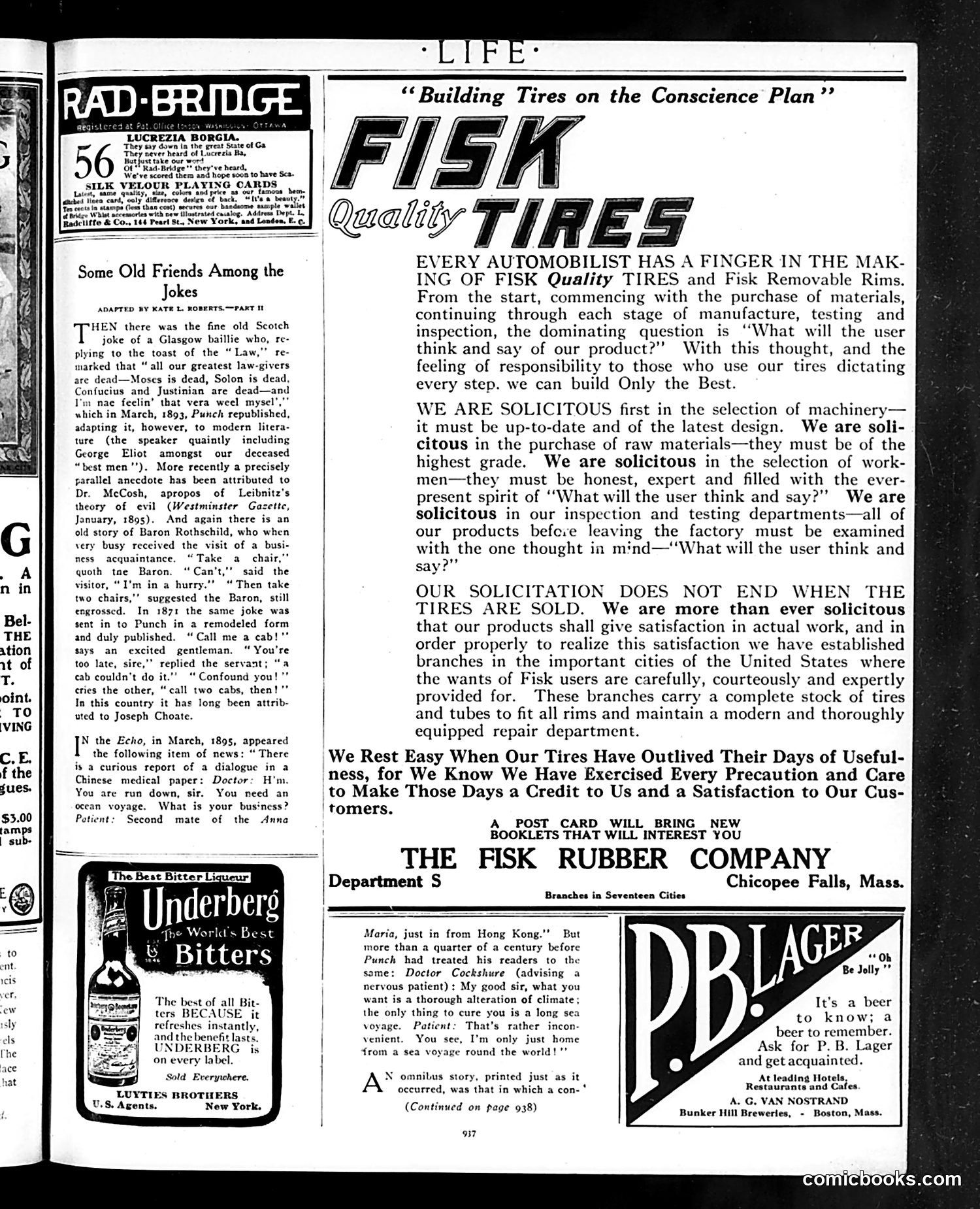
This page is primarily **advertising**, not political satire. The dominant content is a Fisk Quality Tires advertisement occupying the right half of the page. The Fisk ad uses moralistic language ("Building Tires on the Conscience Plan") to market automobile tires by claiming the company prioritizes consumer satisfaction at every manufacturing stage. This reflects early-20th-century advertising that appealed to middle-class values of integrity and responsibility. The left side contains filler content: a brief humor column ("Some Old Friends Among the Jokes") recycling old anecdotes about historical figures like Baron Rothschild, and smaller ads for Underberg Bitters and D.B. Lager beer. **There are no political cartoons or satire on this page.** The "conscience plan" language is sincere corporate messaging, not irony. This represents typical Life magazine layout from this era—mixing light humor with commercial advertisements targeting automobile owners and affluent readers.
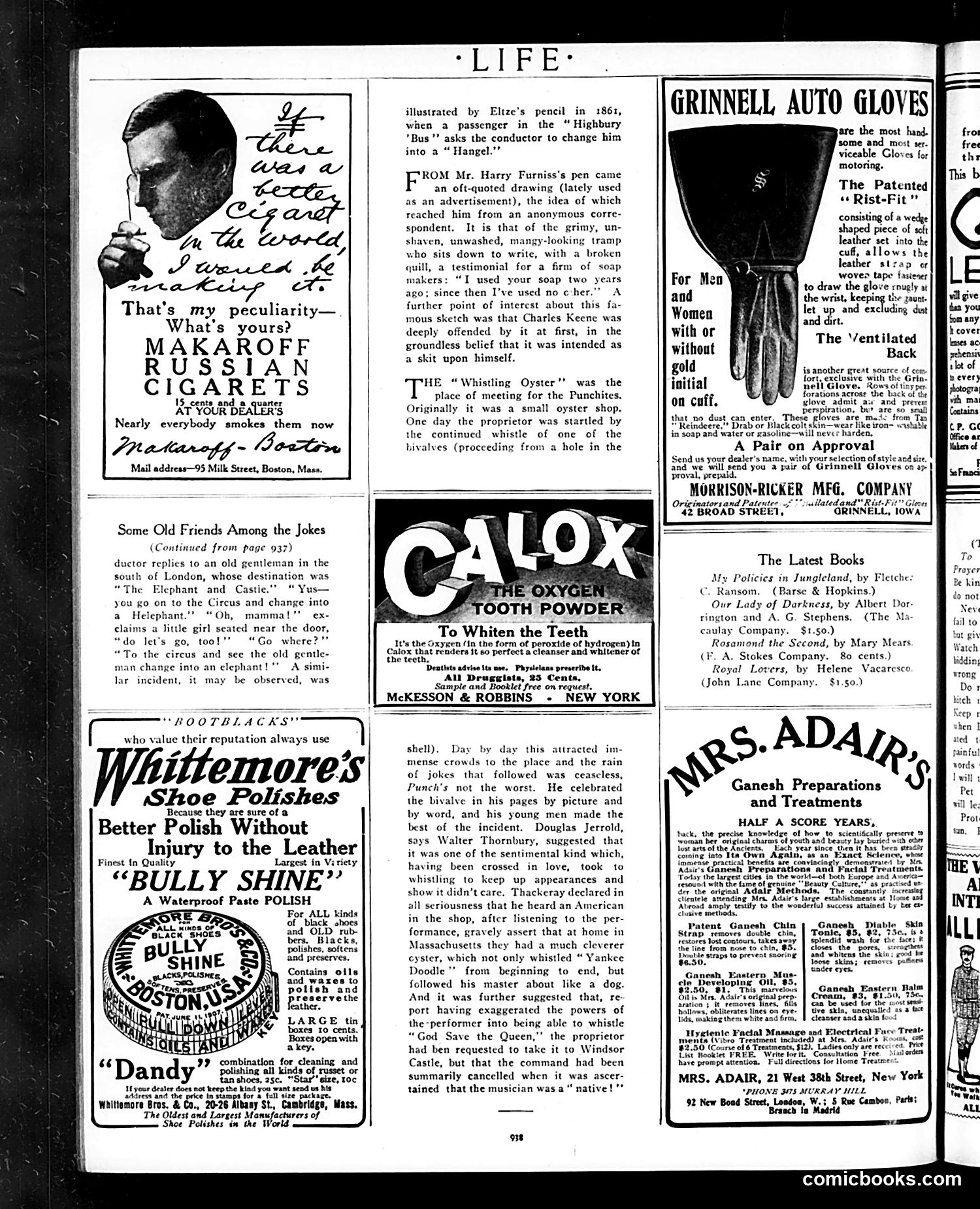
This page primarily consists of **advertisements and nostalgic humor** rather than political cartoons. The main content includes a humorous anecdote about a London bus conductor who tells a passenger heading to "The Elephant and Castle" (a real London location) that he must "change into a Helephant"—a pun playing on the place name. A child overhears and asks to go along to see the gentleman transform into an elephant. The joke relies on wordplay and the child's literal misinterpretation. The page also references the "Whistling Oyster," apparently a famous London oyster shop that attracted crowds due to an oyster that whistled from its shell. Writers like Douglas Jerrold and Thackeray supposedly created humorous explanations for the phenomenon—that it was lovesick, or that Americans claimed Massachusetts had a better-whistling oyster. The remainder consists of period **product advertisements** (Makaroff Russian Cigarettes, Whittemore's Shoe Polish, Calox tooth powder, Grinnell Auto Gloves, and Mrs. Adair's Ganesh Preparations). This appears to be a **lighter, humor-focused section** rather than satirical political commentary.
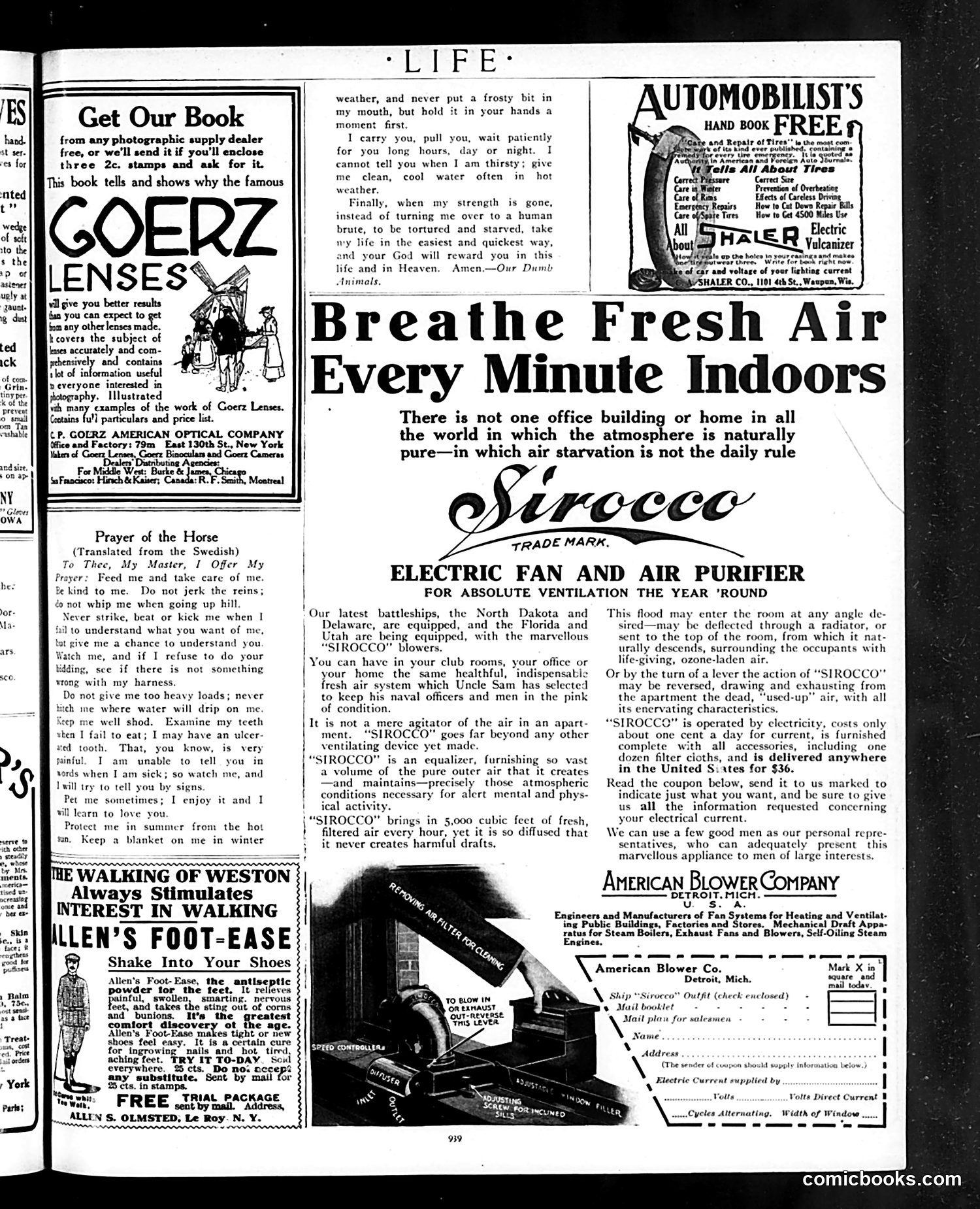
This is primarily an **advertising page** from an early 20th-century American magazine, with minimal editorial content. The main advertisements promote: 1. **Goerz Lenses** – photographic equipment 2. **Sirocco Electric Fan and Air Purifier** – emphasized as providing fresh air indoors, notably already installed on U.S. Navy battleships (Delaware, Florida, Utah) 3. **Allen's Foot-Ease** – a foot powder, humorously referencing "The Walking of Weston" (likely the famous pedestrian Edward Payson Weston) 4. **Automobilist's Hand Book** – tire care guide 5. **American Blower Company** – industrial ventilation equipment The page includes two poems: a "Prayer of the Horse" advocating humane treatment of animals, and promotional verse for foot powder. **Context for modern readers:** These ads reflect early 1900s consumer products and emerging technology. The Sirocco advertisement is notable for emphasizing military/governmental adoption as a selling point—a common marketing tactic of the era. The humorous tone and earnest product claims are typical of period advertising.
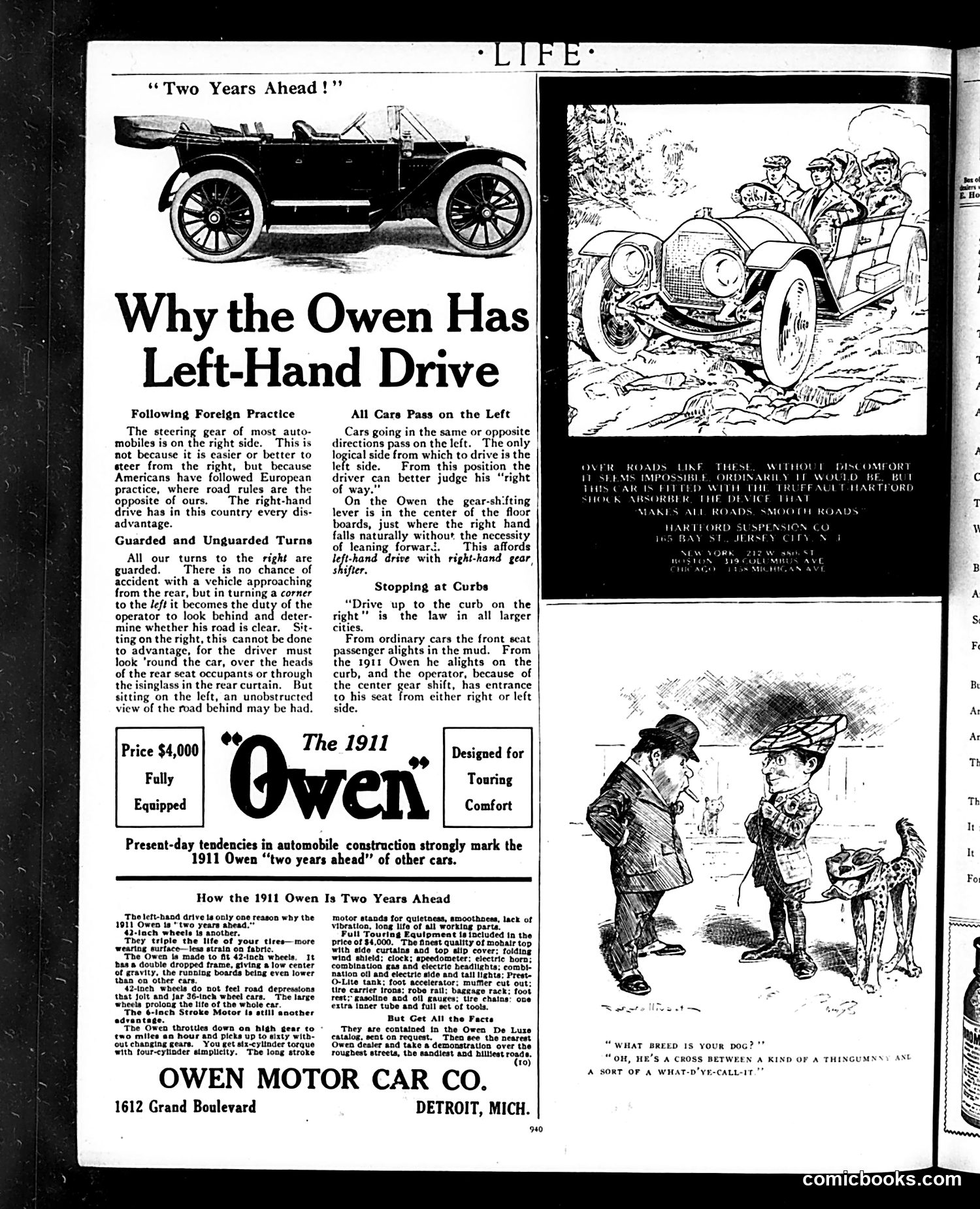
This is primarily an **advertisement for the 1911 Owen automobile**, not political satire. The page argues that the Owen's left-hand drive design is superior to the industry standard right-hand drive. The text explains practical advantages: left-hand positioning allows better visibility for left turns (America's "guarded turns"), easier curb access, and natural center-floor gear shifting. It positions the Owen as "two years ahead" of competitors through this design choice and other features (larger wheels, six-cylinder engine, full touring equipment). The small cartoon at page bottom is unrelated humor: two men discussing a dog's mixed breed—a joke about unclear ancestry that has no connection to the automobile advertisement. The page reflects early 1900s automotive development, when design standards hadn't yet solidified. The $4,000 price and "fully equipped" messaging targets wealthy buyers willing to pay premium prices for advanced features.
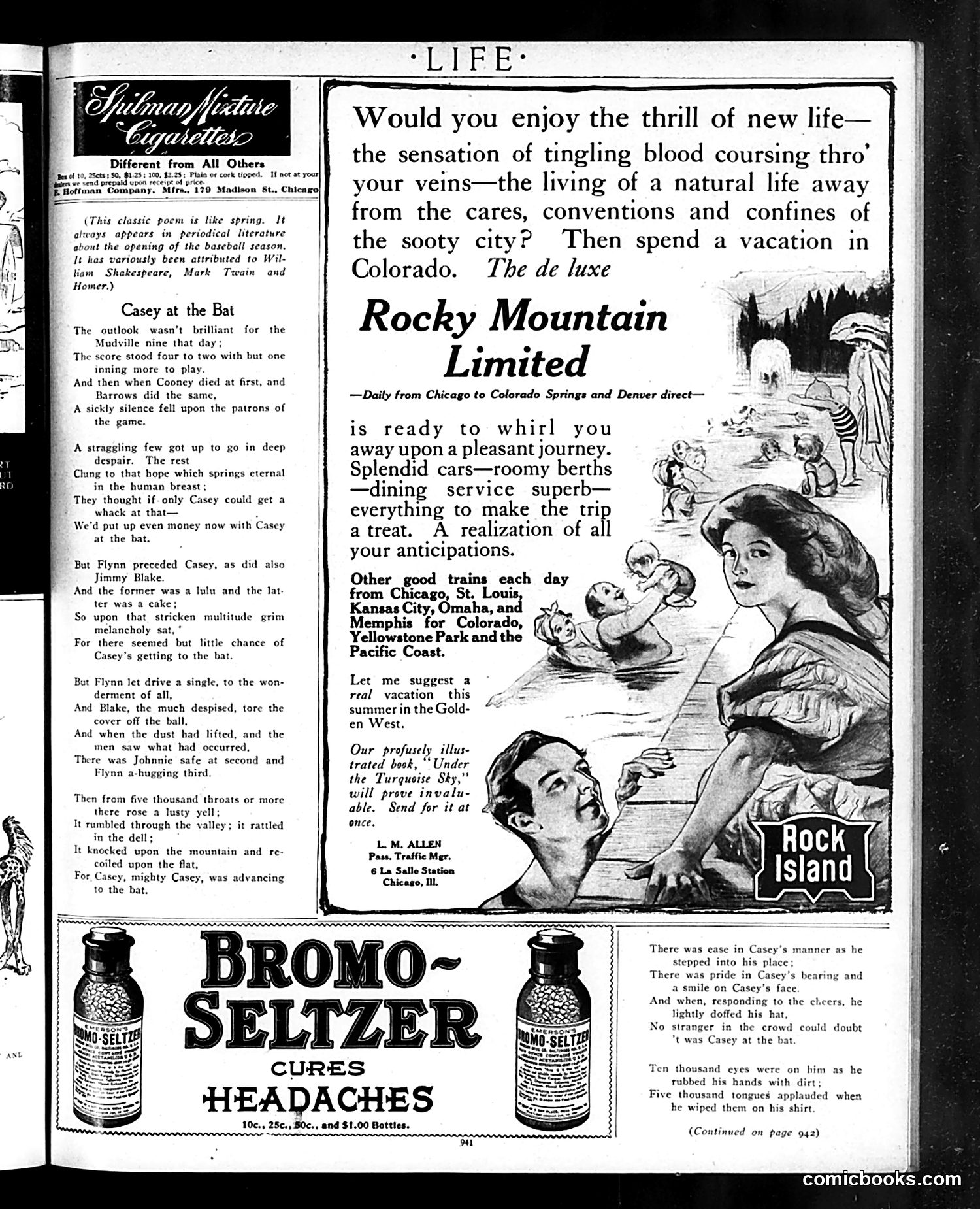
This page primarily contains **advertisements and literary content** rather than political cartoons. The main feature is **"Casey at the Bat,"** Ernest Lawrence Thayer's famous 1888 baseball poem. The text notes it's a "classic poem" humorously attributed to Shakespeare, Twain, and Homer, though it's actually about a baseball game in Mudville. The poem celebrates American baseball culture and the drama of a crucial moment in a game. The page includes two advertisements: 1. **Rocky Mountain Limited train** — promoting leisure travel from Chicago to Colorado, emphasizing escape from urban "cares, conventions and confines" to natural beauty. This reflects early 20th-century tourism marketing. 2. **Bromo-Seltzer** — a headache remedy, a common patent medicine advertisement of the era. There's also a **Spulman Picture Cigarettes** ad at the top. No political satire or caricature is evident on this page. It's primarily a leisure and consumer-focused magazine spread typical of early Life magazine's mix of literature, humor, and advertising.
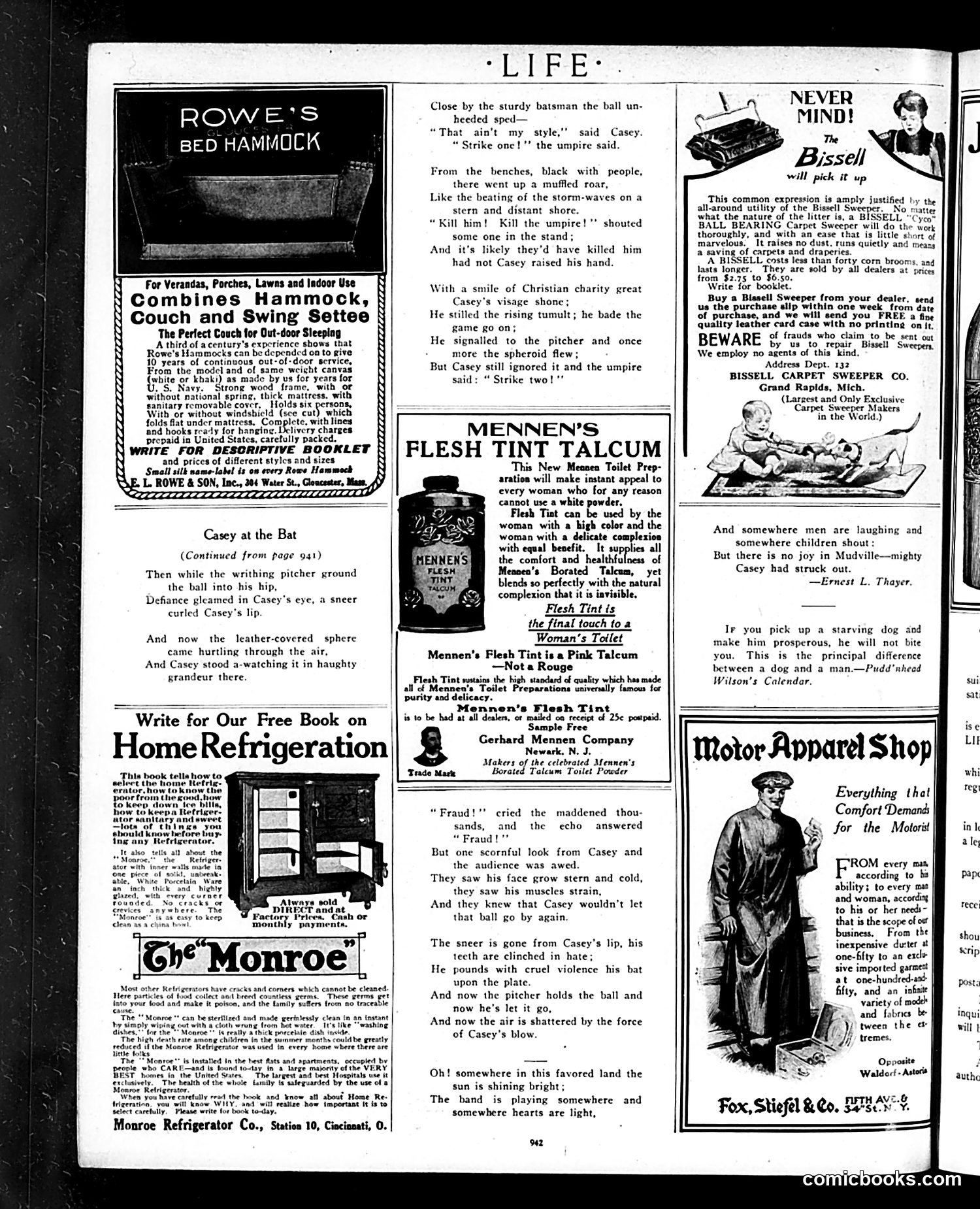
This page is primarily **advertising with a serialized story excerpt**, not a political cartoon. The main content is a continuation of "Casey at the Bat," the famous baseball poem. The excerpt shows Casey at bat ignoring two strikes with characteristic arrogance and "Christian charity"—he even calms an angry crowd calling for the umpire's death. The narrative setup promises dramatic tension: will Casey strike out? The page is dominated by **period advertisements** (circa 1910s-1920s): - Rowe's bed hammocks - Monroe refrigerators - Mennen's talcum powder (notably in "Flesh Tint" for women of darker complexions) - Motor apparel shop These ads reveal early 20th-century consumer concerns: outdoor leisure furniture, home refrigeration (a novelty), and cosmetics marketing. The "Flesh Tint" powder advertisement is notable for explicitly addressing women seeking non-white powder options, reflecting era-specific beauty standards and market segmentation. There are **no political cartoons** visible on this page.
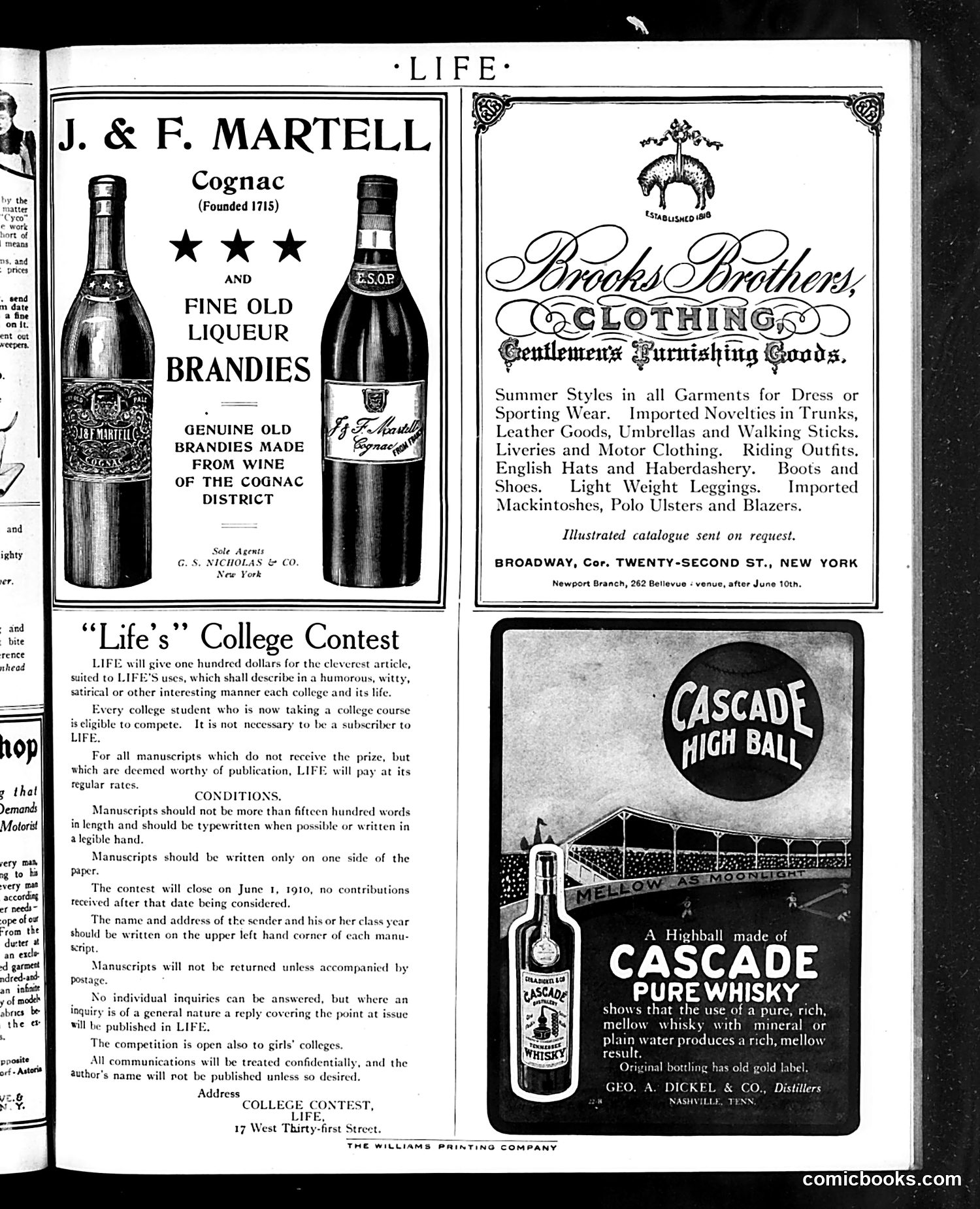
This page is primarily **advertising and editorial content**, not a political cartoon. It contains: **Advertisements:** - J. & F. Martell Cognac (established 1715) - Brooks Brothers clothing for gentlemen - Cascade Pure Whisky **Editorial Content:** A "Life's College Contest" announcement offering $100 for the cleverest humorous article describing a college and student life. The contest, closing June 1, 1910, accepts submissions from college students (male or female). Accepted but non-winning manuscripts will be paid at regular rates. **For Modern Readers:** This reflects early 20th-century Life magazine's dual function as satirical publication and advertising platform. The college contest reveals Life's role in shaping youth culture commentary. The liquor and upscale clothing ads suggest the magazine's affluent readership. The contest's openness to women students was relatively progressive for 1910, though still limited to college-attending populations.
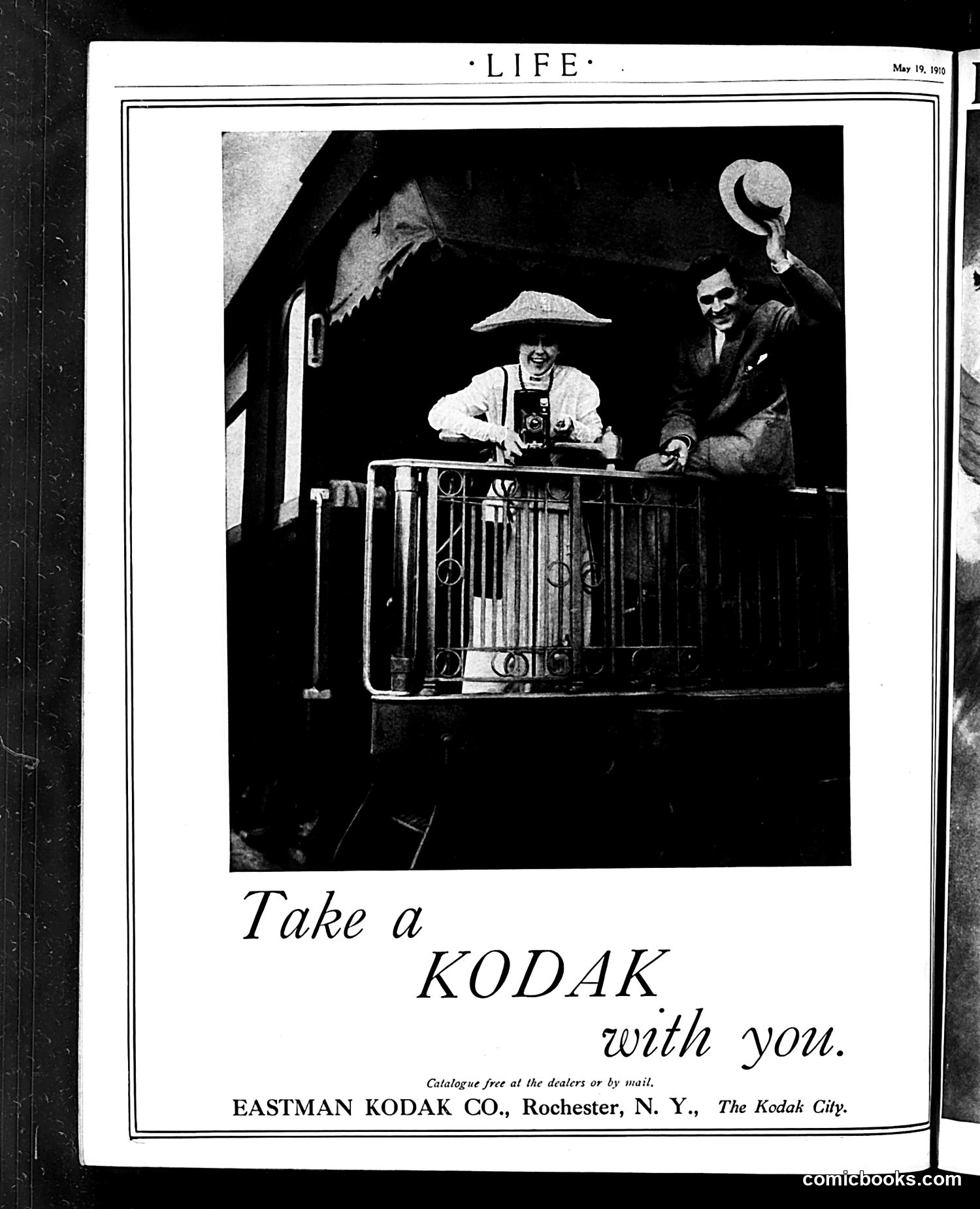
This is a **Kodak camera advertisement**, not political satire. The image shows three figures on a balcony in what appears to be a comedic scene—a man in a wide-brimmed hat examining a camera, with two other figures gesturing animatedly above him, one holding a straw hat. The ad's message is straightforward: "Take a KODAK with you"—promoting portable cameras for capturing everyday moments and travel. The humorous scene suggests candid photography opportunities in social situations, which was Kodak's marketing approach: making photography accessible and casual for the general public. The company's slogan, "The Kodak City" (referencing Rochester, NY headquarters), emphasizes Kodak's dominance in the camera industry at this period. This represents early consumer photography marketing.