
Life, 1910-05-19 · page 16 of 40
Life — May 19, 1910 — page 16: what you’re looking at
What you’re looking at
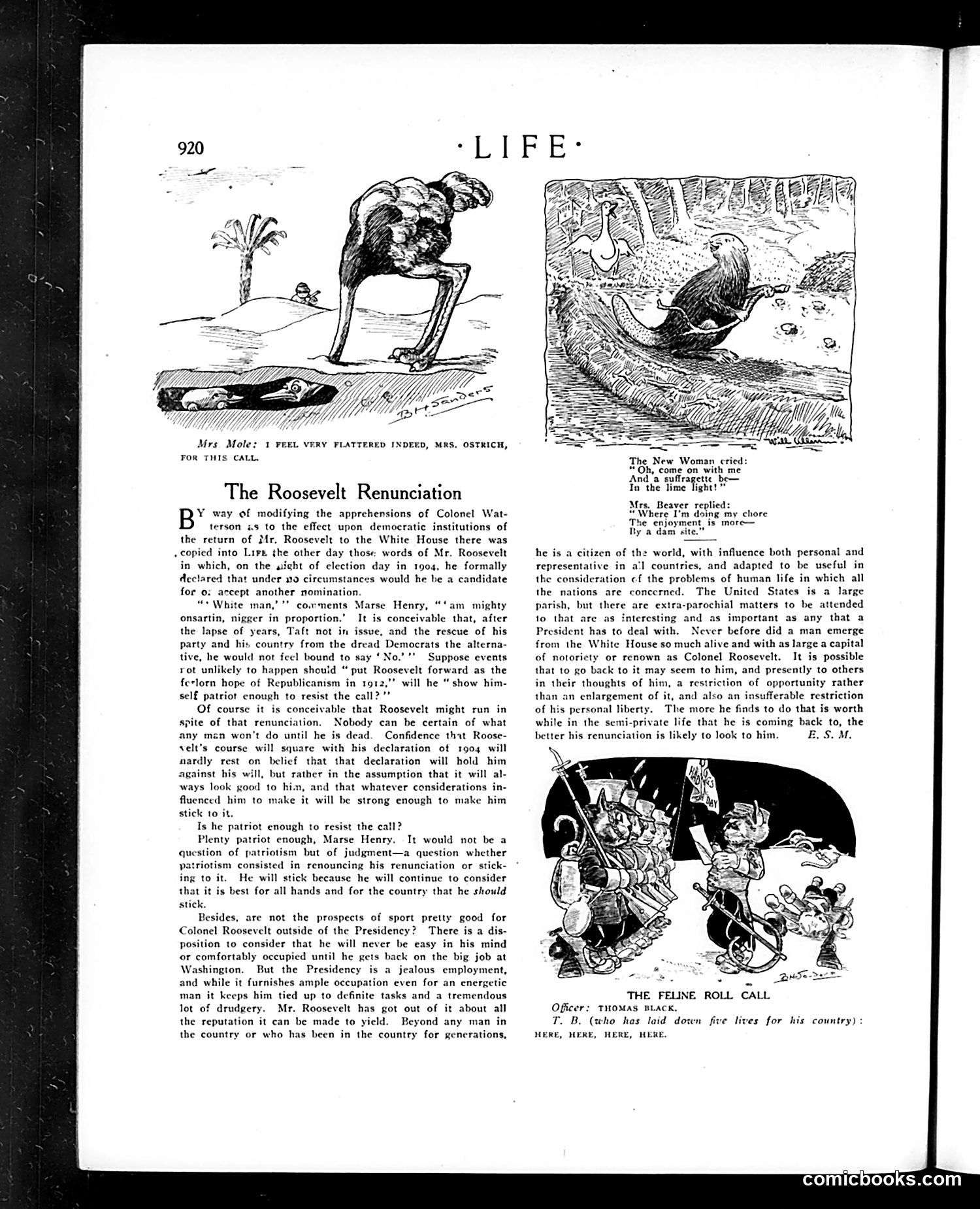
This page contains commentary on Theodore Roosevelt's political future after leaving the presidency in 1909. The article "The Roosevelt Renunciation" references Roosevelt's 1904 pledge not to seek another term—questioning whether he would honor this promise if pressured to run again in 1912. The key cartoons satirize: 1. **"Mrs. Mole and Mrs. Ostrich"**: A visual pun about those claiming not to see Roosevelt's likely comeback attempt (moles and ostriches can't/won't see). 2. **"The New Woman" comic**: Contrasts the suffragette movement's appeal to modern women with traditional domestic life, suggesting domesticity offers more genuine enjoyment. 3. **"The Feline Roll Call"**: References Officer Thomas Black (unclear context without full caption). The text argues Roosevelt, despite his 1904 renunciation, might justify running again if circumstances changed, while also suggesting his post-presidency opportunities outside Washington might make a return seem like a "restriction" rather than an opportunity.
📄 Transcribed text from this page (OCR, searchable)
Machine-transcribed from the original scan — historical spelling and the odd misread are preserved.
Mrs Mole: 1 VEEL VERY FLATTERED INDEED, MRS, OSTRICH, FOR THIS CALL, The Roosevelt Renunciation Y way of modifying the apprehensions of Colonel Wat- terson is to the effect upon democratic institutions of the return of Mr. Roosevelt to the White House there was . copied into Live the other day those words of Mr. Roosevelt in which, on the aight of election day in 1904, he formally dcclared that under x9 circumstances would he be a candidate for 0: accept another nomination. “* White man,’ ’? comments M. onsartin, nigger in proportion.’ It is conceivable that, after the lapse of years, Taft not in issue, and the rescue of his party and his country from the dread Democrats the alterna- , he would not feel bound to say ‘No.’ ’* Suppose events rot unlikely to happen should “ put Roosevelt forward as the ferlorn hope of Republicanism in 1912," will he “show him- self patriot cnough to resist the call? Of course it is conceivable that Roosevelt might run in spite of that renunciation. Nobody can be certain of what any men won't do until he is dead. Confidence that Roose- velt's course will square with his declaration of 1904 will nardly rest on belief that that declaration will hold him inst his will, but rather in the assumption that it will al- ways look good to him, and that whatever considerations in- fluenced him to make it will be strong enough to make him stick 10 it. Is he patriot enough to resist the call? Plenty patriot enough, Marse Henry. It would not be a question of patriotism but of judgment—a question whether patriotism consisted in renouncing his renunciation or stick- ing to it. He will stick because he will continue to consider that it is best for all hands and for the country that he should stick, Besides, are not the prospects of sport pretty good for Colonel Roosevelt outside of the Presidency? There is a dis- position to consider that he will never be easy in his mind or comfortably occupied until he gets back on the big job at Washington. But the Presidency is a jealous employment, and while it furnishes ample occupation even for an energetic man it keeps him tied up to definite tasks and a tremendous lot of drudgery. Mr. Roosevelt has got out of it about all the reputation it can be made to yield. Beyond any man in the country or who has been in the country for generations, ¢ Henry, “‘am mighty MifZgy Ton Wakes VU SESH The New Woman cried: “Oh, come on with me And ‘a suffragette be— In the lime light Mrs. Beaver replied: “ Where I'm doing my chore ‘The enjoyment. is more— Ty a dam site.” he is a citizen of the world, with influence both personal and representative in a‘l countries, and adapted to be useful in the consideration ¢f the problems of human life in which all the nations are concerned. The United States is a large parish, but there are extra-parochial matters to be attended 1o that are as interesting and as important as any that a President has to deal with. Never before did a man emerge from the White House so much alive and with as large a capital of notoriety or renown as Colonel Roosevelt. It is possible that to go back to it may seem to him, and presently to others in their thoughts of him, a restriction of opportunity rather than an enlargement of it, and also an insufferable restriction of personal liberty. The more he finds to do that is worth while in the semi-private life that he is coming back to, the better his renunciation is likely to look to him. . M. THE FELINE ROLL CALL Officer: THOMAS BLACK, T. B. (who has laid down five lives for his country): MERE, MERE, HERE, MERE. comicbooks.com