
Life, 1910-05-19 · page 10 of 40
Life — May 19, 1910 — page 10: what you’re looking at
What you’re looking at
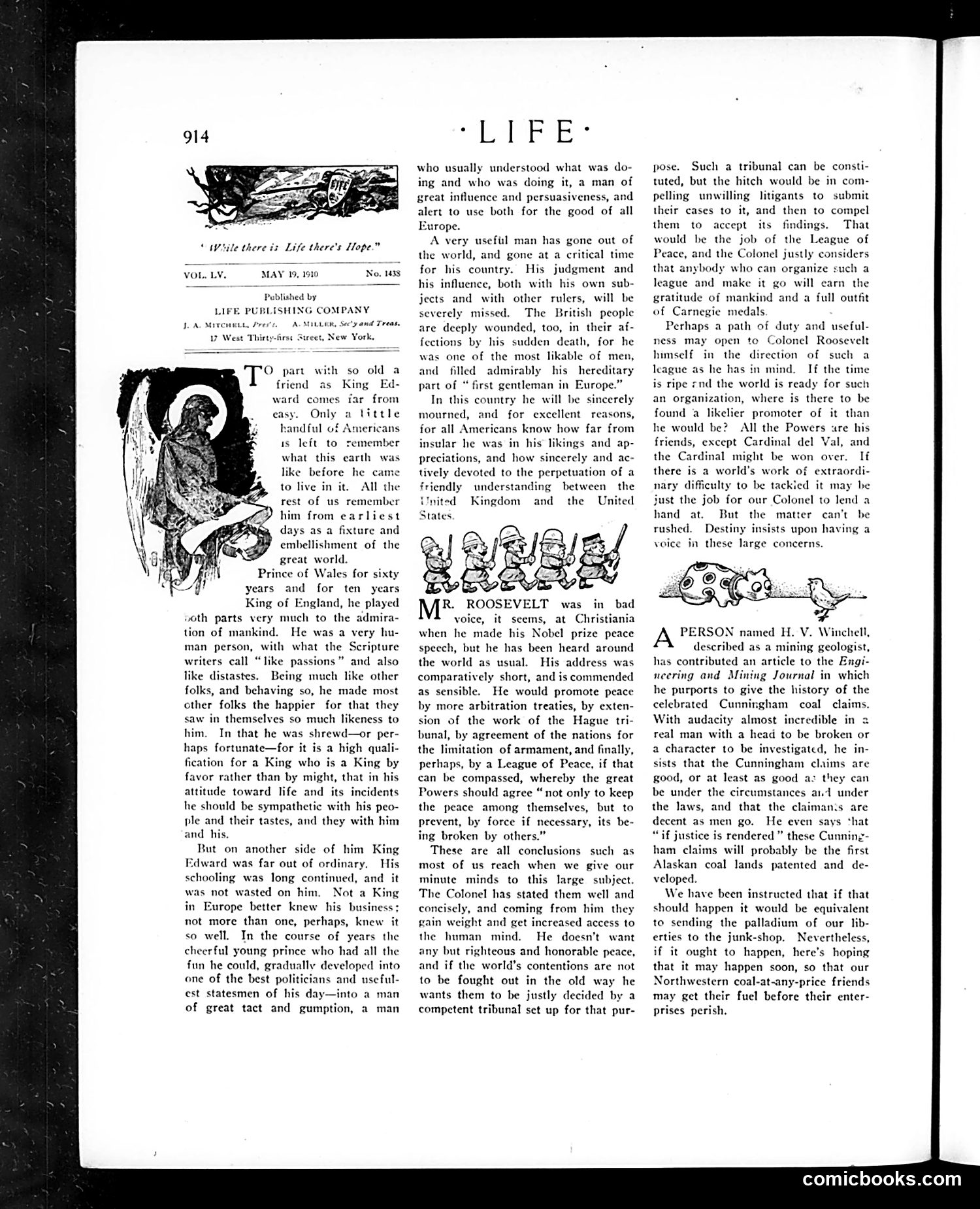
This page contains two editorial pieces, not political cartoons. The main article mourns the recent death of an unnamed British statesman described as influential and beloved in both Britain and America—likely referring to a prominent figure who died during WWI's aftermath. The second piece, titled "A PERSON named H. V. Winchell," satirizes claims made in the *Engineering and Mining Journal* about Cunningham coal deposits in Alaska. The author mocks these assertions as dubious, suggesting the journal may have published unreliable geological claims. The satire targets credulous promotion of commercial interests through pseudo-scientific journalism. The page reflects post-WWI concerns about international relations and domestic commercial fraud.
📄 Transcribed text from this page (OCR, searchable)
Machine-transcribed from the original scan — historical spelling and the odd misread are preserved.
“ Wile there iz Life there's Hope.” VOL. LY. MAY 19, 1910 Published by LIFE PUBLISHING COMPANY Ac MILLER, See'y and Treas. JA. Mrrcnent, Pree v We T° part with so old friend as King Ed- ward comes far from casy. Only a little handful of Americans is left to remember what this earth like before he came to live in it. All the Thirty-firse Street, New York, was rest of us remember him from earliest days as a fixture and embellishment of the great world. Prince of Wales for sixty years and for ten years King of England, he played woth parts very much to the admira- tion of mankind. He was a very hu- man person, with what the Scripture writers call “like passions” and also like distastes. Being much like other folks, and behaving so, he made most other folks the happier for that they saw in themselves so much likeness to him. In that he was shrewd—or per- haps fortunate—for it is a high quali- fication for a King who is a King by favor rather than by might, that in his attitude toward life and its incidents he should be sympathetic with his peo- ple and their tastes, and they with him and his. But on another side of him King Edward was far out of ordinary. His schooling was long continued, and it was not wasted on him. Not a King in Europe better knew his business; not more than one, perhaps, knew it so well. In the course of years the cheerful young prince who had all the fun he could, gradually developed into one of the best politicians and useful- est statesmen of his day—into a man of great tact and gumption, a man who usually understood what was do- ing and who was doing it, a man of great influence and persuasiveness, and alert to use both for the good of all Europe. A very usefil man has gone out of the world, and gone at a critical time for his country. His judgment and his influence, both with his own sub- jects and with other rulers, will be severely missed. The British people are deeply wounded, too, in their af- fections by his sudden death, for he was one of the most likable of men, and filled admirably his hereditary part of “ first gentleman in Europe.” In this country he will be sincerely mourned, and for excellent for all Americans know how far from insular he was in his likings and ap- preciations, and how sincerely and ac- tively devoted to the perpetuation of a friendly understanding between the nited Kingdom and the United reasons, R. ROOSEVELT was in bad voice, it seems, at Christiania when he made his Nobel prize peace speech, but he has been heard around the world as usual. His address was comparatively short, and is commended as sensible. He would promote peace by more arbitration treaties, by exten- sion of the work of the Hague tri- bunal, by agreement of the nations for the limitation of armament, and finally, perhaps, by a League of Peace, if that can be compassed, whereby the great Powers should agree “ not only to keep the peace among themselves, but to prevent, by force if necessary, its be- ing broken by others.” These are all conclusions such as most of us reach when we give our minute minds to this large subject. The Colonel has stated them well and concisely, and coming from him they gain weight and get increased access to the human mind. He doesn’t want any but righteous and honorable peace, and if the world’s contentions are not to be fought out in the old way he wants them to be justly decided by a competent tribunal set up for that pur- pose. Such a tribunal can be consti- tuted, but the hitch would be in com- pelling unwilling litigants to submit their cases to it, and then to compel them to accept its findings. That would be the job of the League of Peace, and the Colonel justly considers that anybody who can organize such a league and make it go will carn the gratitude of mankind and a full outfit of Carnegie medals. Perhaps a path of duty and useful- ness may open to Colonel Roosevelt himself in the direction of such a league as he has in mind. If the time is ripe znd the world is ready for such an organization, where is there to be found a likelier promoter of it than he would be? All the Powers are his friends, except Cardinal del Val, and the Cardinal might be won over. If there is a world’s work of extraordi- nary difficulty to be tackied it may he just the job for our Colonel to lend a hand at. But the matter can't be rushed. Destiny insists upon having a voice in these large concerns. PERSON named H. V. Winchell, described as a mining geologist, has contributed an article to the Engi- neering and Mining Journal in which he purports to give the history of the celebrated Cunningham coal claims. With audacity almost incredible in 2 real man with a head to be broken or a character to be investigated, he in- sists that the Cunningham claims are good, or at least as good a: they can be under the circumstances and under the laws, and that the claimanis are decent as men go. He even says ‘hat “if justice is rendered” these Cunning- ham claims will probably be the first Alaskan coal lands patented and de- veloped. We have been instructed that if that should happen it would be equivalent to sending the palladium of our lib- erties to the junk-shop. Nevertheless, if it ought to happen, here’s hoping that it may happen soon, so that our Northwestern coal-at-any-price friends may get their fuel before their enter- prises perish, comicbooks.com