
Life, 1910-05-19 · page 18 of 40
Life — May 19, 1910 — page 18: what you’re looking at
What you’re looking at
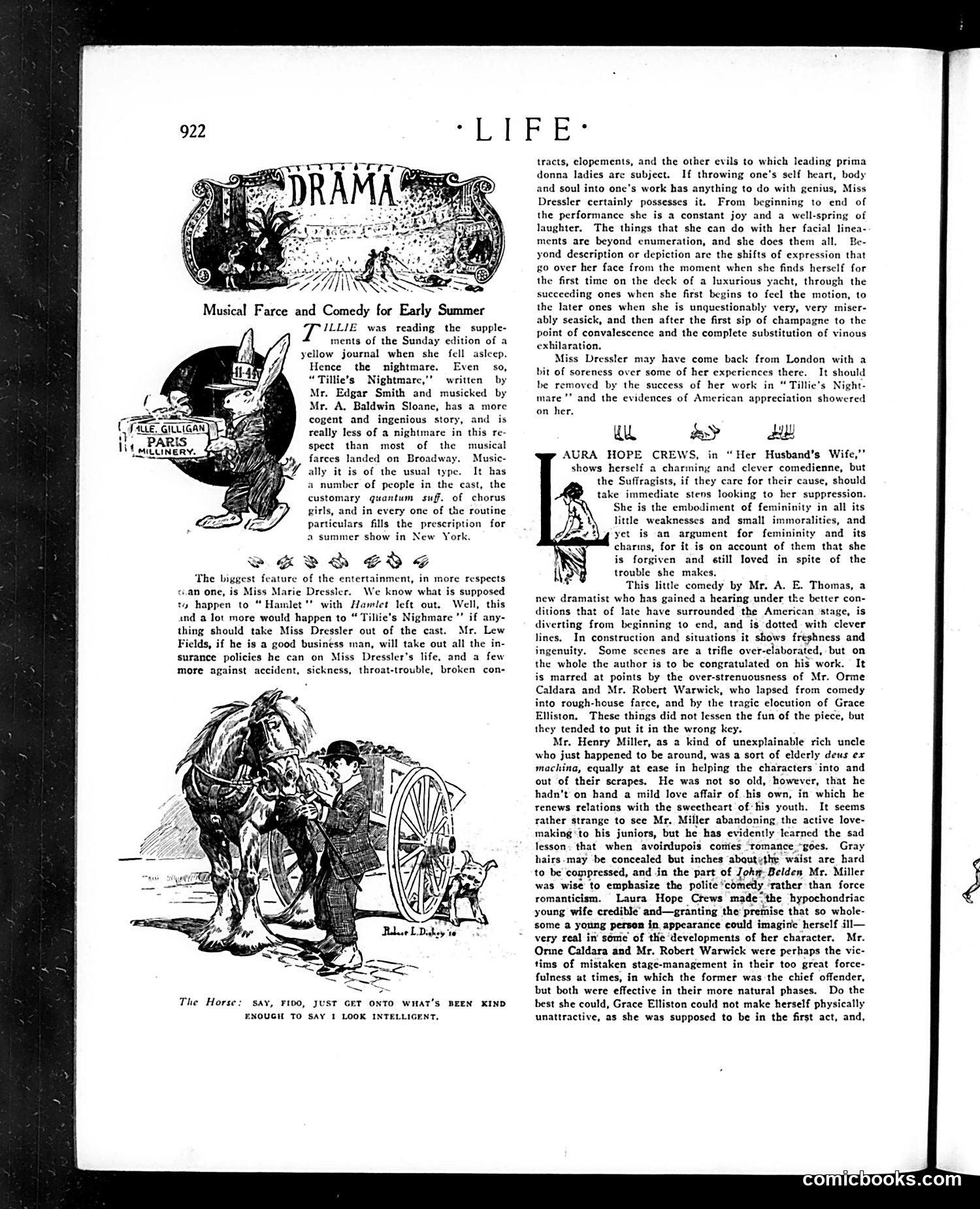
This page reviews Broadway musical comedies, centering on **"Tillie's Nightmare,"** a musical farce by Edgar Smith and A. Baldwin Sloane. The critic argues the show depends entirely on star **Marie Dressler**—so completely that Fields (the producer) should insure her life heavily, as the play would collapse without her. The cartoon shows a horse addressing a carriage driver, with the caption about "looking intelligent"—likely satirizing the absurdity of the show's plot or contemporary theater's low standards. The page also reviews **"Her Husband's Wife"** by A.E. Thomas, praising leading lady **Laura Hope Crews** as embodying "femininity" and its "weaknesses." The critic warns suffragists she undermines their cause by playing a character too charming and forgiven despite causing trouble—a backhanded critique reflecting early 1900s debates about women's roles.
📄 Transcribed text from this page (OCR, searchable)
Machine-transcribed from the original scan — historical spelling and the odd misread are preserved.
* LIP ES ILLIE was reading the supple- ments of the Sunday edition of a yellow journal when she fell asleep. Hence the nightmai Even $0, “Tillie’s Nightmare,’ written by Mr. Edgar Smith and musicked by Mr. A. Baldwin Sloane, has a more cogent and ingenious story, and is really less of a nightmare in this re- spect than most of the musical farces landed on Broadwa: Music- ally it is of the usual typ It has a number of people in the cast, the customary quantum suf. of chorus girl nd in every one of the routine particulars fills the prescription for a summer show in New York. SZ2R& EdG feature of the entertainment, in more respects Marie Dressler. We know what is supposed The bigge «an one, is M: ty happen to “Hamlet '’ with Hamlet left out. Well, this and a lot more would happen to “ Tillie’s Nighmare ”’ if any- thing should take Miss Dressler out of the cast. Mr. Lew Fields, if he is a good business man, will take out all the in- surance policies he can on Miss Dressler’s life, and a few more against accident, sickness, throat-trouble, broken con- The Horse: sav, F100, JUST GET ONTO WHAT'S BEEN KIND ENOUGH TO SAY 1 LOOK INTELLIGENT. tracts, clopements, and the other evils to which leading prima donna ladies are subject. If throwing one’s self heart, body and soul into one’s work has anything to do with genius, Miss Dressler certainly possesses it. From beginning to end of the performance she is a constant joy and a well-spring of laughter. The things that she can do with her facial linea- ments are beyond enumeration, and she docs them all, Be- yond description or depiction are the shifts of expression that g0 over her face from the moment when she finds herself for the first time on the deck of a luxurious yacht, through the succeeding ones when she first begins to feel the motion, to the later ones when she is unquestionably very, very miser- ably seasick, and then after the first sip of champagne to the point of convalescence and the complete substitution of vinous exhilaration, Miss Dressler may have come back from London with a bit of soreness over some of her experiences there. It should be removed by the success of her work in “Tillic’s Night- mare" and the evidences of American appreciation showered on her. au ay a AURA HOPE CREWS, in “Her Husband’s Wife,”” shows herself a charming and clever comedienne, but the Suffragists, if they care for their cause, should take immediate stens looking to her suppression. She is the embodiment of femininity in all its little weaknesses and small immoralities, and yet is an argument for femininity and its charins, for it is on account of them that she is forgiven and till loved in spite of the trouble she makes. This little comedy by Mr. A. E. Thomas, a new dramatist who has gained a hearing under the better con- ditions that of late have surrounded the American stage, is diverting from beginning to end, and is dotted with clever lines. In construction and situations it shows freshness and ingenuity. Some scenes are a trifle over-claborated, but on the whole the author is to be congratulated on his work. It is marred at points by the over-strenuousness of Mr. Orme Caldara and Mr. Robert Warwick, who lapsed from comedy into rough-house farce, and by the tragic elocution of Grace Elliston, These things did not lessen the fun of the piece, but they tended to put it in the wrong key. Mr. Henry Miller, as 2 kind of unexplainable rich uncle who just happened to be around, was a sort of elderly deus ex machina, equally at ease in helping the characters into and out of their scrapes. He was not so old, however, that he hadn't on hand a mild love affair of his own, in which he renews relations with the sweetheart of his youth. It seems rather strange to see Mr. Miller abandoning the active love- making to his juniors, but he has evidently learned the sad lesson. that when avoirdupois cories ‘tomance “goes. Gray hairs.may be concealed but inches aboutythe waist are hard to be compressed, and in the part of Johe Belden Mr. Miller was wise to emphasize the polite ‘comedy ‘rather than force romanticism. Laura Hope Ctews made the hypochondriac young wife credible’ and—granting the premise that so whole- some a young person in appearance could imagine herself ill— very real in’ some of the developments of her character. Mr. Orme Caldara and Mr. Robert Warwick were perhaps the vic- tims of mistaken stage-management in their too great force- fulness at times, in which the former was the chief offender, but both were effective in their more natural phases. Do the best she could, Grace Elliston could not make herself physically unattractive, as she was supposed to be in the first act, and,