
Life, 1910-05-19 · page 4 of 40
Life — May 19, 1910 — page 4: what you’re looking at
What you’re looking at
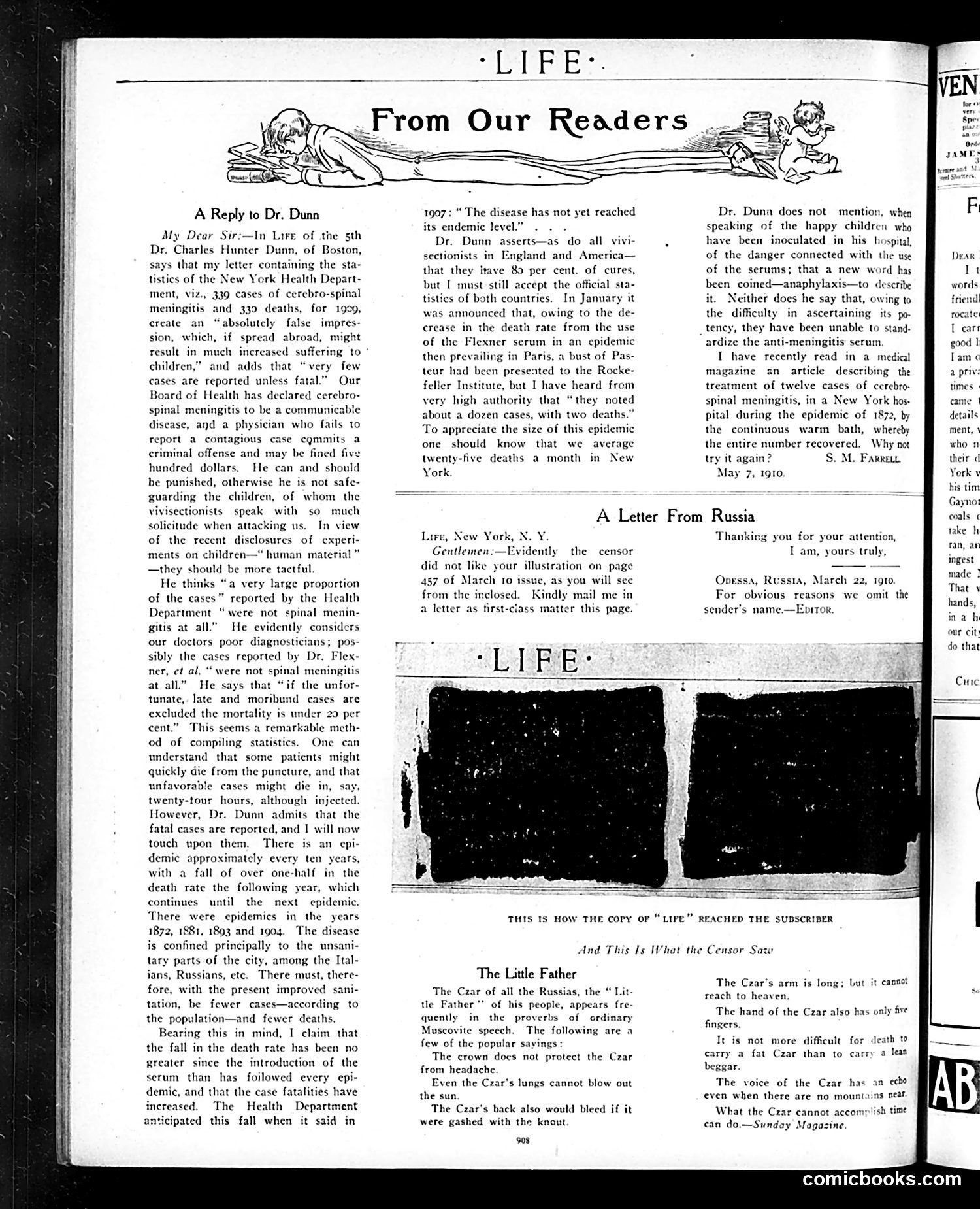
This page consists primarily of reader letters and editorial content rather than political cartoons. The main sections include: **"A Reply to Dr. Dunn"** — a lengthy response to Dr. Charles Hunter Dunn of Boston regarding reported cebrospinal meningitis statistics in New York for 1909. The writer disputes Dunn's characterization of cases, noting that fatality rates and case classifications may be incomplete. **"A Letter From Russia"** — a brief note from Odessa regarding a censored illustration on page 437. **"The Little Father"** — a humorous piece presenting Russian proverbs about the Czar, likely satirizing Russian autocracy and the Czar's power. The image shows what appears to be a heavily redacted or blacked-out section, illustrating the mentioned censorship issue.
📄 Transcribed text from this page (OCR, searchable)
Machine-transcribed from the original scan — historical spelling and the odd misread are preserved.
A Reply to Dr. Dunn My Dear Sir:—In Lire of the 5th Dr. Charles Hunter Dunn, of Boston, says that my letter containing the sta- tistics of the New York Health Depart- ment, viz., 339 cases of cerebro-spinal meningitis and 339 deaths, for 1909, create an “absolutely false impres- sion, which, if spread abroad, might result in much increased suffering to children,” and adds that “very few cases are reported unless fatal.” Our Board of Health has declared cerebro- spinal meningitis to be a communicable disease, and a physician who fails to report a contagious case cgmmits a criminal offense and may be fined five hundred dollars. He can and should be punished, otherwise he is not safe- guarding the children, of whom the vivisectionists speak with so much solicitude when attacking us. In view of the recent disclosures of experi- ments on children—* human material” —they should be more tactful. He thinks “a very large proportion of the cases” reported by the Health Department “were not spinal menin- gitis at all.” He evidently considers our doctors poor diagnosticians; pos- sibly the cases reported by Dr. Flex- ner, et al, “were not spinal meningitis at all.” He says that “if the unfor- tunate,. late and moribund cases are excluded the mortality is under 29 per cent.” This seems a remarkable meth- od of compiling statistics. One can understand that some patients might quickly die from the puncture, and that unfavorable cases might die in, sa twenty-tour hours, although injected. However, Dr. Dunn admits that the fatal cases are reported, and I will now touch upon them. There is an epi- demic approximately every ten years, with a fall of over one-half in the death rate the following year, which continues until the next epidemic. There were epidemics in the years 1872, 1881, 1893 and 1903. The disease is confined principally to the unsani- tary parts of the city, among the Ital- ians, Russians, etc. There must, there- fore, with the present improved sani- tation, be fewer cases—according to the population—and fewer deaths. Bearing this in mind, I claim that the fall in the death rate has been no greater since the introduction of the serum than has foilowed every epi- demic, and that the case fatalities have increased. The Health Department anticipated this fall when it said in 1907 : its endemic level. Dr. Dunn asserts—as do all vivi- sectionists in England and America— that they itave 8 per cent. of cures, but I must still accept the official sta- tistics of both countries. In January it was announced that, owing to the de- crease in the death rate from the use of the Flexner serum in an epidemic then prevailing in Paris, a bust of Pas- teur had been preseated to the Roch feller Institute, but I have heard from very high authority that “they noted about a dozen cases, with two deaths.” To appreciate the size of this epidemic one should know that we average twenty-five deaths a month in New York. Dr. Duna does not mention, when speaking of the happy children who have been inoculated in his hospital, of the danger connected with the use of the serums; that a new word has been coined—anaphylaxis—to describe it. Neither does he say that, owing to the difficulty in ascertaining its po- tency, they have been unable to stand- atdize the anti-meningitis serum. I have recently read in a medical magazine an article describing the treatment of twelve cases of cerebro- spinal meningitis, in a New York hos- pital during the epidemic of 1872, by the continuous warm bath, whereby the entire number recovered. Why net try it again? S. M. Farrete May 7, 1910. A Letter From Russia Lire, New York, N. Y. Gentlemen:—Evidently the censor did not like your illustration on page 457 of March 10 issue, as you will see from the inclosed. Kindly mail me in a letter as first-class matter this page. ‘LIFE: | Thanking you for your attention, Iam, yours truly, Opessa, Russia, March 22, 1910. For obvious reasons we omit sender's name.—Ebrror. THIS IS HOW THE COPY OF “LIFE” REACHED THE SUBSCRIBER And This 1s What the Censor Saw The Little Father The Czar of all the Russias, the “ Lit- tle Father "’ of his people, appears fre- quently in the proverbs of ordinary Muscovite speech. The following are a few of the popular sayings : The crown docs not protect the Czar from headache Even the Czar’s lungs cannot blow out the sun The Czar’s back also would bleed if it were gashed with the knout 908 The Czar's arm is long; but it cannot reach to heaven. The hand of the Czar also has fingers. It is not more difficult for death carry a fat Czar than to carry a leat beggar, The voice of the Czar has an echo even when there are no mountains neat What the Czar cannot accomptish time can do.—Sunday Magazine Mrs SAME: ee 2 words friend rocate I cart good | Tam ¢ a priv: times | came | details ment, | who n their d York v his tim Gayno: coals ¢ take h ran, ar ingest made 1 That v hands, ina hi out cit comicbooks.com