
Life, 1910-05-19 · page 24 of 40
Life — May 19, 1910 — page 24: what you’re looking at
What you’re looking at
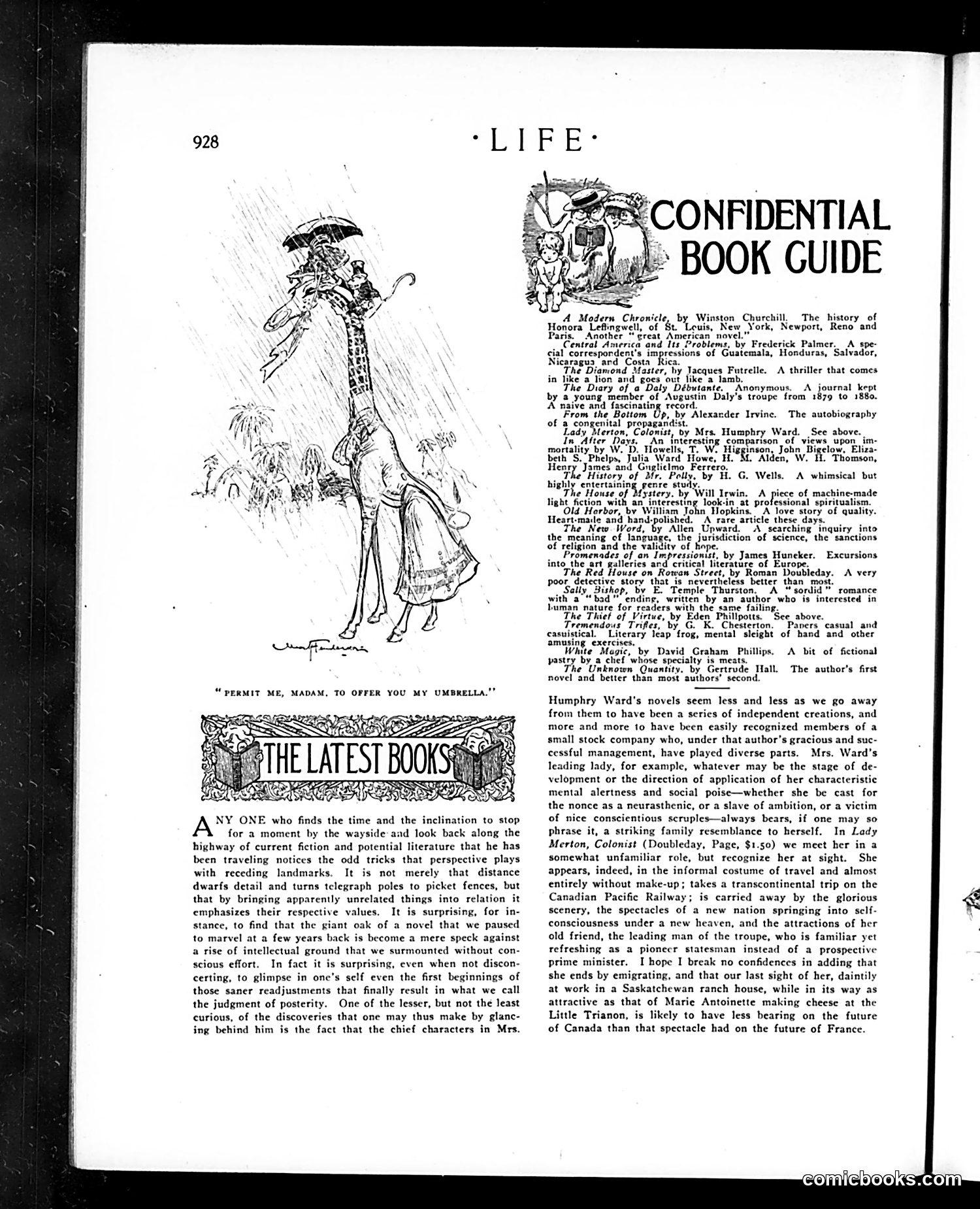
This is a "Confidential Book Guide"—a literary review column disguised as insider commentary. The page features: **The Cartoon**: Shows a fashionably dressed woman with an umbrella in rain, captioned "Permit me, Madam, to offer you my umbrella." The illustration likely satirizes gallantry or social pretense, possibly accompanying the review section's tone of sophisticated critique. **The Content**: The guide reviews contemporary fiction (circa 1909-1910), including works by H.G. Wells, Mrs. Humphry Ward, and others. The accompanying essay critiques how literary perspective changes over time—what seemed like important "giant oak" novels fade into insignificance while lesser works gain appreciation. **The Satire**: The "confidential" framing and the essay's patronizing tone mock both literary pretension and critics' tendency to reassess authors retroactively. The guide positions itself as offering insider knowledge about which books will endure versus which are forgettable period pieces—a humorous commentary on literature's unpredictable legacy and critical fickleness.
📄 Transcribed text from this page (OCR, searchable)
Machine-transcribed from the original scan — historical spelling and the odd misread are preserved.
NY ONE who finds the time and the inclination to stop for a moment by the wayside:and look back along the highway of current fiction and potential literature that he has been traveling notices the odd tricks that perspective plays with receding landmarks. It is not merely that distance dwarfs detail and turns tclegraph poles to picket fences, but that by bringing apparently unrelated things into relation it emphasizes their respective values. It is surprising, for in- stance, to find that the giant oak of a novel that we paused to marvel at a few years back is become a mere speck against a rise of intellectual ground that we surmounted without con- scious effort. In fact it is surprising, even when not discon- certing, to glimpse in one's self even the first beginnings of those saner readjustments that finally result in what we call the judgment of posterity. One of the lesser, but not the least curious, of the discoveries that one may thus make by glanc- ing behind him is the fact that the chief characters in Mrs. “CONFIDENTIAL » BOOK GUIDE A Modern Chronicle, by Winston Churchill. The history of Honora Lefiingwell, of St. Louis, New York, Newport, Reno and Paris. Another “great American novel.” 4 Central America and Its Problems, by Frederick Palmer. A spe- 1 correspordent’s impressions of Guatemala, Honduras, Salvador, icaragua, ard Costa, Rica. i _. The Diamond Master, by Jacques Futreile. A thriller that comes in like a lion and goes out like a lamb. The Diary of a Daly Débutante, Anonymous. A journal kept by a young member of “Augustin Daly’s troupe from 1879 to 1880. A naive and fascinating record. | From the Bottom Up, Alexander Irvine. The autobiography of a congenital propagandist. Lady Merton, Colonist, by Mrs. Humphry Ward. See above. In After Days. An interesting comparison of views upon it mortality by W. D. Howells, T. W. Higginson, John Bige ‘low, Eliza- beth S. Phelps, Julia Ward Howe, H. L. Alden, W. H. Henry Jzmes and Guglielmo Ferrero. _ The History of Mr. Polly, by H. highly entertaining genre study. The House of SSstery. by Will Irwin. A Thomson, G. Wells. A whimsical but ¢ of machine-made light fiction with an interesting look-in at professional spiritualism. Old Herbor, by William John Hopkins. A love story of quality. Heart-maie and hand-polished. A rare article these days. The New. Word, by Allen Upward. pward. A searching inquiry into the meaning of language, the jurisdiction of science, the sanctions of religion and the validity of hope. . __ Promenades of an Impressionist, by James Huncker. Excursions into the art galleries and critical literature of Europe. The Red House on Rowan Street, by Roman Doubleday. A very poor detective story that is nevertheless better t . Sally, Bishop, by E. Temple Thurston. A romance with a “bad” ending, written by an author who is interested in Juman nature for readers with the same failing. The Thief of Virtue, by Eden Phillpotts. See above. Tremendous Trifles, by G. K. Chesterton. Paners casual and casuistical. Literary leap frog, mental sleight of band and other amusing exercises. White Magic, by David Graham Phillips. A bit of fictional pastry by a chef whose specialty is meats. The Unknown Quantity. by Gertrude Hall. The author's first novel and better than most authors’ second. Humphry Ward's novels seem less and less as we go away from them to have been a series of independent creations, and more and more to have been easily recognized members of a small stock company who, under that author’s gracious and suc- cessful management, have played diverse parts. Mrs. Ward’s leading lady, for example, whatever may be the stage of de- velopment or the direction of application of her characteristic mental alertness and social poise—whether she be cast for the nonce as a neurasthenic, or a slave of ambition, or a victim of nice conscientious scruples—always bears, if one may so phrase it, a striking family resemblance to herself. In Lady Merton, Colonist (Doubleday, Page, $1.50) we meet her in a somewhat unfamiliar role, but recognize her at sight. She appears, indeed, in the informal costume of travel and almost entirely without make-up; takes a transcontinental trip on the Canadian Pacific Railway; is carried away by the glorious scenery, the spectacles of a new nation springing into sclf- consciousness under a new heaven, and the attractions of her old friend, the leading man of the troupe, who is familiar yet refreshing as a pionecr statesman instead of a prospective prime minister. I hope I break no confidences in adding that she ends by emigrating, and that our last sight of her, daintily at work in a Saskatchewan ranch house, while in its way as attractive as that of Marie Antoinette making cheese at the Little Trianon, is likely to have less bearing on the future of Canada than that spectacle had on the future of France.